- Product Description Description
- Table of Contents TOC
- List of Table & Figure LOT
- Get Free Sample PDF Sample PDF
Market Size, 2025
$1.60 BnMarket Estimate, 2026
$1.83 BnMarket Forecast, 2034
$5.42 BnCAGR, 2026–2034
14.51%Europe Educational Robots Market Summary
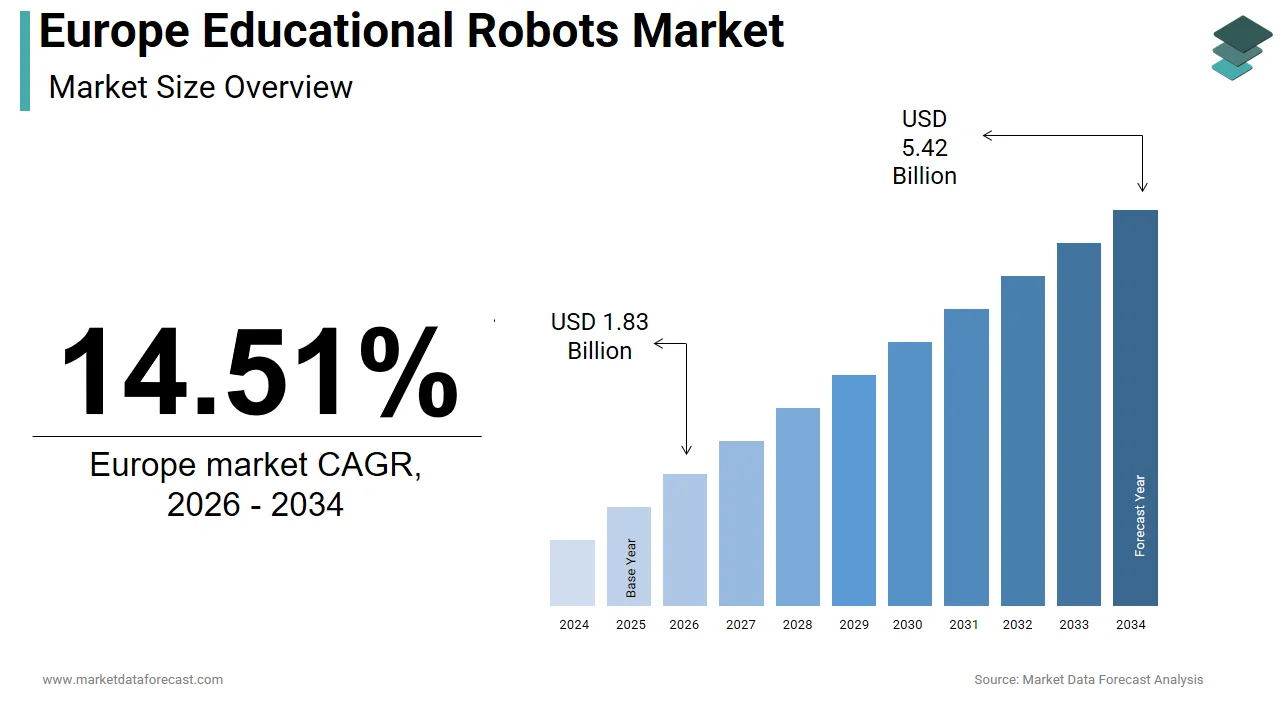
The Europe educational robots market is an expanding technology-driven education segment, valued at USD 1.60 billion in 2025, estimated to reach USD 1.83 billion in 2026, and projected to surpass USD 5.42 billion by 2034. The market is expected to grow at a CAGR of 14.51% from 2026 to 2034, driven by digital education reforms, rising STEM adoption, and the increasing integration of robotics in primary, secondary, and higher education systems across Europe.
Key Insights
- Policy & Regulatory Drivers: The market is strongly influenced by the European Union’s Digital Education Action Plan 2021–2027, which encourages hands-on digital skill development, computational thinking, and robotics-led learning. Several member states have embedded coding and robotics into national curricula from early primary levels, while inclusive education policies support the deployment of socially assistive and humanoid robots for neurodiverse learners.
- Market Segmentation: In 2025, the primary education segment accounted for the largest market share, driven by early-stage STEM integration and the affordability of modular learning robots. By product type, non-humanoid robots dominated the market due to lower costs, durability, and strong classroom suitability, while humanoid robots are gaining traction in special education, research programs, and social-emotional learning applications.
- Key Growth Drivers: Growth is supported by the expansion of robotics and coding in early and secondary education, the rising emphasis on AI and digital skills strategies, increased funding for STEM innovation, and growing institutional adoption of robotics for inclusive and project-based learning environments across European schools and universities.
Challenges:
- Market expansion is constrained by high upfront procurement costs in public education systems, fragmented curriculum standards across countries, insufficient teacher training and integration frameworks, and limited long-term evidence demonstrating measurable academic performance gains or return on investment.
Major Market Players
- Key companies operating in the Europe educational robots market include: ABB Group, FANUC Corporation, Yaskawa Electric Corporation, SoftBank Group Corporation (SoftBank Robotics), Teradyne, Inc. (Universal Robots), LEGO Education, Techman Robot, Inc. (Quanta Storage, Inc.), Makeblock (mBlock), Seiko Epson Corporation, Hanson Robotics Limited, SZ DJI Technology Co., Ltd. (iFlight Technology Company Limited), Kuka AG, and Others.
Europe Educational Robots Market Size
The Europe educational robots market was valued at USD 1.60 billion in 2025, is estimated to reach USD 1.83 billion in 2026, and is projected to reach USD 5.42 billion by 2034, growing at a CAGR of 14.51% from 2026 to 2034.
Educational robots refer to programmable, interactive robotic platforms designed to teach computational thinking, robotics, artificial intelligence, and STEM principles across primary, secondary, and tertiary education levels. These systems range from screen-free coding toys for young children to advanced humanoid or modular robots used in university engineering labs. The integration of such tools aligns with the European Union’s Digital Education Action Plan, which emphasizes hands-on digital competence development from an early age. According to multiple sources, A notable gap exists between the availability of digital education opportunities and the actual attainment of foundational digital and coding proficiencies among students, even as most European educational systems strive to integrate these skills and technologies into their curricula. In response, member states are embedding robotics into national curricula. Finland mandates robotics instruction from grade one, while France allocates dedicated hours for algorithmic thinking in collèges. The European Institute for Innovation and Technology (EIT) actively funds numerous projects within higher education institutions to boost innovation and entrepreneurial skills in STEM, focusing on strengthening collaboration between academia and industry. As per research, educational robotics is increasingly recognized and explored as a valuable tool in inclusive education settings, helping to provide structured and predictable interactions that support the social and emotional development of neurodiverse learners. These converging pedagogical policies and inclusion imperatives position educational robots not as novelties but as strategic instruments in Europe’s effort to cultivate a digitally literate and innovation-ready future workforce.
MARKET DRIVERS
EU Digital Education Policy Mandates STEM and Coding Integration
The European Union’s structured push to embed digital competencies in national curricula is a major factor fuelling the growth of the Europe educational robot market. The Digital Education Action Plan 2021–2027 explicitly calls for “active, hands-on, and inquiry-based learning” using physical computing tools to develop algorithmic thinking and problem-solving skills. Numerous European nations have updated their national curricula to incorporate mandatory modules for coding or robotics within primary or lower secondary education. Certain countries have integrated robotics instruction beginning at the earliest grade levels, while others now mandate specific annual hours of programming for adolescent students. Educational initiatives have facilitated the deployment of robotics technology across various pilot schools to enhance classroom learning. Regional educational objectives are focused on increasing the percentage of students who possess basic digital skills. These policy levers transform educational robots from optional supplements into essential classroom infrastructure supporting Europe’s strategic goal of digital sovereignty through early skill formation.
Rising Demand for Inclusive and Special Needs Education Tools
These robots are increasingly recognized as powerful aids in inclusive education, particularly for students with autism spectrum disorder, attention deficits, or communication challenges, which in turn propels the expansion of the Europe educational robots market. Socially assistive robots offer predictable, repetitive, and non-judgmental interactions that reduce cognitive overload and build engagement. Several students across educational systems receive various forms of support, but standard approaches often struggle to keep them consistently engaged. In response, countries like Sweden and the Netherlands have integrated robots such as NAO and Leka into therapy and classroom routines. Within a study focusing on autistic children, those who interacted with humanoid robots demonstrated improved task completion rates and better verbal initiation when compared to sessions guided by humans. Educational development programs have dedicated funds to research and create robots equipped with emotional intelligence capabilities designed for use in inclusive learning environments. Educational robots are essential for advancing inclusive education across Europe, which provides therapeutic and pedagogical support that aligns with national systems prioritizing equity and personalized learning.
MARKET RESTRAINTS
High Initial Costs and Limited Public Education Budgets Restrict Scalability
Budget limitations in publicly funded schools, despite strong pedagogical rationale, continue to restrain the growth of the Europe educational robots market. Public funding for educational technology integration tends to be limited across various regions. The cost of modern educational tools, such as programmable robots, can pose a significant challenge for some schools. Consequently, many institutions rely on alternative funding sources, such as grants or contributions, to support newer technology programs. Even in wealthier nations like Germany, regional disparities persist. Schools in Bavaria may receive state robotics subsidies while those in Saxony do not. The promise of universal hands-on digital education in Europe will remain unfulfilled and continue to reinforce socioeconomic divides unless there is sustained public investment or the development of scalable leasing models.
Lack of Teacher Training and Pedagogical Integration Frameworks
The effective use of these robots is greatly affected by insufficient teacher preparedness and the absence of standardized integration guidelines across European education systems, which impedes the expansion of the Europe educational robots market. Many educators in primary and secondary education express a lack of confidence in their ability to teach subjects like coding or robotics, even when these topics are required by the curriculum. Most initial teacher education programs do not include robotics pedagogy. A limited number of teacher training institutions provide specialized coursework focused on educational robotics. Consequently, robots often remain underutilized in storage closets or are used for occasional demonstrations rather than structured learning sequences. Schools that acquire robotic equipment through various initiatives frequently struggle to integrate these tools into the classroom because of insufficient technical or pedagogical support. Teacher engagement in available online robotics professional development is limited due to time constraints and the absence of formal recognition or career advancement opportunities. Educational robots in Europe won't reach their full potential until teacher training becomes integrated with curriculum goals, allowing for systemic adoption and effective pedagogical use, as current challenges include a lack of alignment, teacher skills gaps, and technical barriers.
MARKET OPPORTUNITIES
Integration with National AI and Digital Skills Strategies Creates Systemic Demand
The region’s strategic focus on artificial intelligence literacy is transforming these robots into foundational tools for demystifying AI concepts at an early age, which provides new opportunities for the growth of the Europe educational robots market. Understanding artificial intelligence systems has been identified as a fundamental competency for students. Educational approaches are incorporating advanced robotics that involve machine learning and the interpretation of sensor data. Physical artificial intelligence systems are being used in some school programs to teach core concepts. One country's educational center has provided robots to secondary schools to facilitate learning about neural networks using facial recognition exercises. In another country, a program has introduced specific robots in some schools to show how real-time decisions are made using camera and proximity sensor information. A roadmap for artificial intelligence education suggests that students of a certain age group should interact with an artificial intelligence-powered physical system during their schooling. As AI transitions from abstract theory to tangible experience, educational robots are becoming the essential bridge, which positions them at the heart of Europe’s next-generation digital curriculum.
Expansion of Coding and Robotics in Early Childhood Education Opens New Segments
The growing emphasis on computational thinking from early childhood, ages three to eight, where screen-free and tactile learning is prioritized, generates fresh possibilities for the expansion of the Europe educational robots market. The European Commission’s Digital Education Action Plan encourages unplugged and playful digital introduction in preschools, recognizing that foundational logic skills develop before reading proficiency. Countries like Estonia and Denmark have integrated screen-free robots such as Cubetto and Bee Bot into kindergarten curricula to teach sequencing and problem-solving without digital screens. A growing number of preschools within the European Union have incorporated robotics into their play-based learning activities. These tools can be helpful for multilingual children, as they often engage learners through visual and kinesthetic interactions. Some manufacturers have developed durable, easy-to-use robots specifically designed for young children, adhering to established toy safety guidelines. Neuroscience research has confirmed that the foundations of algorithmic thinking begin to develop in children as young as four years old. Consequently, the field of early childhood robotics is rapidly becoming a significant and socially impactful area within the European educational technology sector.
MARKET CHALLENGES
Fragmented Curriculum Standards Hinder Cross-Border Scalability
The absence of harmonized educational robotics standards across European national curricula creates significant barriers to scalable product development and teacher resource sharing, which obstructs the growth of the educational robots market. The EU promotes digital skills through common frameworks like DigCompEdu. However, implementation is decentralized as each member state defines its own learning outcomes, tools, and assessment methods. Robotics-based lessons focusing on specific programming concepts often fail to align with the varying educational standards established across different European nations. This fragmentation forces manufacturers to adapt software interfaces, lesson plans, and language support for each market, increasing costs and delaying rollout. The majority of educational robotics platforms lack a comprehensive curriculum mapping that covers multiple national frameworks. More information is available from the source of these observations. Consequently, teachers waste valuable time translating or redesigning activities rather than focusing on pedagogy. The EU's failure to establish a common framework for robotics education is perpetuating isolated national markets, which in turn stifles the diffusion of new ideas and equitable opportunities for students across member states.
Limited Longitudinal Evidence of Learning Impact Reduces Institutional Buy-In
Skepticism from school administrators and policymakers due to a lack of robust longitudinal studies proving sustained academic or cognitive benefits, despite anecdotal success, remains an obstacle to the Europe educational robots market. According to sources, existing evaluations often face challenges regarding their scope and the potential for bias due to funding sources. A review of numerous studies focusing on robotics interventions noted a scarcity of studies that utilized control groups and conducted follow-up assessments over extended periods. Decision-makers are reluctant to allocate scarce resources to robot use because there is no clear evidence that it improves performance in national exams, problem-solving transfer, or career choices. In countries like Portugal and Croatia, ministries explicitly require randomized controlled trials before approving large-scale procurements. Future large-scale research initiatives are currently underway, with their results anticipated in the coming years. Widespread adoption of educational robots in Europe's evidence-driven school systems will be slow unless solid, long-term data proves a clear return on investment (ROI).
REPORT COVERAGE
| REPORT METRIC | DETAILS |
| Market Size Available | 2025 to 2034 |
| Base Year | 2025 |
| Forecast Period | 2026 to 2034 |
| Segments Covered | By Application, Product Type, and County. |
| Various Analyses Covered | Global, Regional, and Country-Level Analysis, Segment-Level Analysis, Drivers, Restraints, Opportunities, Challenges; PESTLE Analysis; Porter’s Five Forces Analysis, Competitive Landscape, Analyst Overview of Investment Opportunities |
| Countries Covered | UK, France, Spain, Germany, Italy, Russia, Sweden, Denmark, Switzerland, Netherlands, Turkey, Czech Republic, and the Rest of Europe. |
| Market Leaders Profiled | ABB Group, FANUC Corporation, Yaskawa Electric Corporation, SoftBank Group Corporation (SoftBank Robotics), Teradyne, Inc. (Universal Robots), LEGO Education, Techman Robot, Inc. (Quanta Storage, Inc.), Makeblock (mBlock), Seiko Epson Corporation, Hanson Robotics Limited, SZ DJI Technology Co., Ltd. (iFlight Technology Company Limited), Kuka AG, and Others. |
SEGMENTAL ANALYSIS
By Application Insights
The primary education segment captured a leading share of 42.5% in the Europe educational robots market in 2024. Factors such as the EU’s strategic emphasis on introducing computational thinking at the earliest stages of cognitive development have contributed to the leading position of the primary education segment. The Digital Education Action Plan suggests that activities such as "playful, screen-free robotics" can help younger children develop foundational logic skills without the potential for digital overload. Several countries in Northern Europe have incorporated various educational robots into their national educational programs, sometimes recommending specific devices for regular classroom use. Across the European Union, many primary schools now utilize educational robots for a range of activities, including mathematics, sequencing, storytelling, and language skill building. These types of tools are also recognized as being particularly supportive for diverse learning needs, as their predictable interactions may help reduce anxiety in students. Additionally, primary robots are often lower-cost, modular, and compliant with the EU toy safety standard EN 71, making them accessible to public school budgets. This combination of policy alignment, developmental appropriateness, and affordability ensures primary education remains the cornerstone of Europe’s educational robotics adoption.
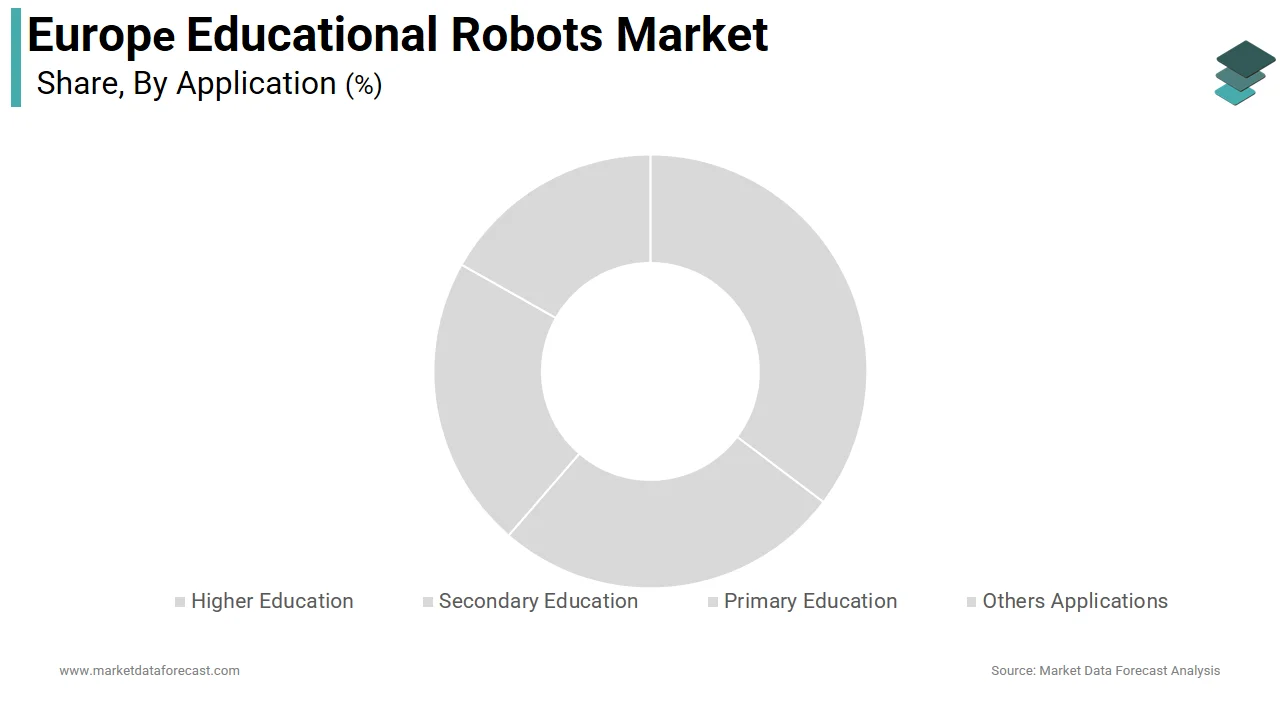
The secondary education segment is on the rise and is expected to be the fastest-growing segment in the market by witnessing a CAGR of 24.7% from 2025 to 2033 due to mandatory coding and robotics modules introduced across national curricula to prepare students for future digital careers. Several nations across Europe have incorporated the teaching of algorithmic thinking into their educational systems for students in the 11 to 15 age bracket. One country has dedicated a specific number of yearly hours to this subject, while another has chosen to blend the study of robotics into its existing science and technology curricula. Schools are adopting advanced platforms like LEGO Education SPIKE Prime and VEX V5 that support Python and block-based programming, enabling project-based learning in AI, data logging, and sensor integration. Policymakers and industry analysts anticipate a significant shortfall in the number of skilled information and communication technology professionals within the next several years, positioning specialized technology education as a key strategic response to meet future workforce needs. A national education initiative in one country introduced thousands of small, programmable robots into secondary schools. The goal of this program is to help students grasp the foundational principles of machine learning by engaging them in activities that involve artificial intelligence features like basic facial recognition. The inclusion of digital competence within national exam frameworks means this segment is transitioning from enrichment material to fundamental pedagogy, positioning it as the highest-growth frontier for educational robotics across Europe.
By Product Type Insights
The non-humanoid robots segment dominated the Europe educational robots market and held a substantial share in 2025. Its cost-effectiveness, modularity, and pedagogical flexibility across age groups and subjects drive the dominance of the non-humanoid robots segment. Platforms prioritize functional components, motors, sensors, wheels, and programmable hubs over anthropomorphic design, enabling students to focus on engineering principles rather than social simulation. In European public schools, there is a noted preference for non-humanoid systems when acquiring technology, a trend observed across primary and secondary levels. This preference is often linked to the system's durability and suitability for STEM (science, technology, engineering, and mathematics) educational goals. Their open architecture supports curriculum integration in physics, mathematics, and environmental science. Additionally, non-humanoid robots cost less than humanoid alternatives, making them accessible to tight school budgets. Furthermore, factors such as lower maintenance needs and longer operational lifespans appear to contribute to the choice of these non-humanoid models in educational settings. The selection process also seems to be influenced by the need for compliance with established safety standards for electrical educational equipment. These practical advantages ensure their continued dominance in Europe’s institutional education landscape.
The humanoid robots segment is expected to exhibit a noteworthy CAGR of 28.3% over the forecast period, owing to its unique capacity to support social-emotional learning and inclusive education, particularly for students with autism spectrum disorder or communication challenges. Humanoid platforms like SoftBank’s NAO and Leka’s Milo offer expressive gestures, eye contact, and speech recognition that create engaging and predictable social interactions. Humanoid robots are being used in some specialized schools to help improve attention, verbal initiation, and joint attention skills. In controlled studies, certain robotic interventions have been shown to increase the task engagement of autistic children when compared to interventions involving tablets. Additionally, universities in Germany and Italy deploy humanoids in psychology and human-robot interaction courses to study empathy and ethical AI. Europe's focus on mental health and inclusive education is propelling this emotionally intelligent segment from a therapeutic niche into a primary pedagogical resource, making it the market's most rapidly expanding category.
COUNTRY-LEVEL ANALYSIS
Finland Educational Robots Market Analysis
Finland was the top performer in the Europe educational robots market and accounted for a 16.8% share in 2024, with its world-leading integration of robotics into national curricula from the earliest school years. In Finnish primary education, computational thinking is a required subject from the first grade, frequently utilizing screen-free robotic tools in most schools. At the lower secondary level, all educational institutions provide integrated robotics modules that align with science and math curricula, commonly incorporating popular educational building kits. A government initiative supports enhancing technology education by providing funding for specialized labs and instructor development in every comprehensive school. Furthermore, there is a strong emphasis on inclusive educational technology, with specific robotic aids being used in many special education environments to assist neurodiverse students. The country’s emphasis on phenomenon-based learning, where robots model real-world systems, ensures deep pedagogical integration rather than isolated tech use. This systemic policy infrastructure makes Finland Europe’s benchmark for scalable and equitable educational robotics deployment.
France Educational Robots Market Analysis
France was the second-largest country in the Europe educational robots market and captured a 14.2% share in 2024 because of its centralized national strategy and robust teacher upskilling programs. A structured national education plan requires a specific amount of time each year for students in a particular age group to engage in algorithmic thinking, utilizing educational robotics as a primary method of instruction. Many secondary schools across the country now use specific types of educational robot platforms, which have been incorporated into the official learning materials available to educators. The government has provided training for tens of thousands of educators in the area of robotics pedagogy through its national digital education centers. Furthermore, an initiative focused on integrating artificial intelligence into schools introduced advanced robotics in numerous secondary institutions, aiming to teach machine learning principles through practical, real-time decision-making exercises. Finally, national scientific research bodies are actively working with schools on collaborative projects to ensure that the educational content maintains a high standard of scientific accuracy and relevance to the curriculum. This top-down coordination between policy, teacher capacity, and content development creates a cohesive and rapidly scalable ecosystem that positions France as Europe’s strategy-driven leader in educational robotics.
United Kingdom Educational Robots Market Analysis
The United Kingdom maintains a significant position in the Europe educational robots market due to strong university research and expanding secondary school adoption. Robots are being used in secondary schools to support the computing curriculum. This initiative involves distributing AI-enabled robots to educational institutions to help teach mandatory programming concepts. Secondary schools are incorporating robotics programming into their curriculum. The programming often uses both text-based and visual block-based languages. Universities are involved in advanced robotics research. Specific institutions develop educational materials and curricula for advanced humanoid robots. These advanced robots are used in university degree programs. Their application supports studies in fields such as psychology and engineering. Additionally, the UK participates in EU-funded projects despite Brexit, maintaining alignment on pedagogical standards. The government’s Turing Scheme also funds robotics teacher exchanges with European partners. This fusion of academic innovation, curriculum mandates, and international collaboration ensures the UK remains a high-value contributor to Europe’s educational robotics evolution.
Germany Educational Robots Market Analysis
Germany witnessed a notable growth in the Europe educational robots market owing to its strong engineering education tradition and state-level funding initiatives. The Kultusministerkonferenz encourages the use of robotics in “Technik” and physics classes within most Bundesländer, utilizing various platforms to help teach mechanics and control systems. Many schools across Germany participate in initiatives that provide robotics kits and teacher workshops, though the level of coverage and participation varies significantly across different regions. German universities are actively developing advanced curricula, incorporating various robotic platforms for human-robot interaction studies and other research areas. Additionally, Germany’s dual vocational system incorporates educational robots in mechatronics apprenticeships, preparing students for Industry 4 0 careers. Despite budget fragmentation, the country’s technical rigor and industry alignment create a resilient and application-oriented robotics ecosystem in European education.
Sweden Educational Robots Market Analysis
Sweden is likely to expand in the Europe educational robots market from 2025 to 2033 due to its pioneering use of educational robots in inclusive and special needs education. Social robots are classified as assistive technology under a national inclusion policy, which allows schools serving neurodiverse students to access funding. Across various specialized educational environments, humanoid robots are used to support autistic children with communication and emotional regulation. A recent pilot program in one region suggested an improvement in social engagement among students using robots regularly. Additionally, Sweden’s curriculum emphasizes sustainability and digital citizenship, with robots used to model energy systems and ethical AI dilemmas. Sweden’s human-centered approach, prioritizing equity, emotional learning, and ethics, positions it as Europe’s moral and inclusive leader in educational robotics innovation.
COMPETITIVE LANDSCAPE
Competition in the Europe educational robots market is defined by pedagogical credibility, regulatory compliance, and systemic integration rather than hardware novelty alone. The landscape features a mix of global STEM brands, European humanoid specialists, and agile EdTech startups, each competing through curriculum alignment, teacher support, and inclusive design. Success hinges on meeting stringent EU standards for safety data privacy and educational efficacy while navigating decentralized national procurement systems. Unlike consumer robotics, here the end user is often a public institution requiring long sales cycles, evidence-based validation, and multi-year support commitments. Differentiation arises from seamless integration into official syllabi, robust teacher training, and accessibility for diverse learners, including those with special needs or limited digital exposure. The market rewards companies that view robots not as gadgets but as pedagogical tools embedded in national strategies for digital sovereignty. With budgets constrained and scrutiny high, only vendors combining educational integrity, regulatory rigor, and scalable support can sustain leadership in Europe’s mission-driven educational robotics ecosystem.
KEY MARKET PLAYERS
The leading companies operating in the Europe educational robots market include:
- ABB Group
- FANUC Corporation
- Yaskawa Electric Corporation
- SoftBank Group Corporation (SoftBank Robotics)
- Teradyne, Inc. (Universal Robots)
- LEGO Education
- Techman Robot, Inc. (Quanta Storage, Inc.)
- Makeblock (mBlock)
- Seiko Epson Corporation
- Hanson Robotics Limited
- SZ DJI Technology Co., Ltd. (iFlight Technology Company Limited)
- Kuka AG
TOP PLAYERS IN THE MARKET
- LEGO Education is a global leader in hands-on STEM learning with deep integration across European classrooms through its SPIKE Prime and WeDo platforms. The company aligns its robotics kits with national curricula in over 20 EU countries, offering structured lesson plans in multiple languages that meet DigCompEdu standards. LEGO Education contributes globally by promoting constructionist learning where students build physical models and program behaviors using block-based and Python coding. It also partners with ministries in Finland, France, and Germany to deliver certified teacher training programs. These initiatives reinforce LEGO Education’s role as a trusted pedagogical partner that bridges play, creativity, and computational thinking in Europe’s digital education transformation.
- SoftBank Robotics Europe is a pioneer in humanoid educational robots with its NAO platform widely adopted in universities and special needs schools across the continent. The company enables advanced research in human-robot interaction, artificial intelligence, and inclusive education through an open software architecture compatible with Python, ROS, and machine learning libraries. SoftBank contributes globally by setting benchmarks for social robotics in therapeutic and academic settings. It also launched the NAOv6 Education Pack with GDPR compliant data handling and offline operation to meet EU privacy standards. These actions position SoftBank Robotics as a leader in emotionally intelligent and ethically designed educational robotics for Europe’s inclusive future.
- Makeblock is an innovative European educational robotics provider known for its mBot and Codey Rocky platforms that combine affordability with powerful coding capabilities through its mBlock software. The company supports schools across Southern and Eastern Europe with scalable classroom kits that integrate block-based and Python programming aligned with national digital competence frameworks. Makeblock contributes globally by bridging beginner and advanced coding through a seamless transition from Scratch to AI and IoT projects. It also partnered with the Czech Ministry of Education to deploy 2 000 mBot units in pilot schools focused on rural STEM access. These efforts establish Makeblock as a key enabler of equitable and future-ready digital skills development across Europe.
TOP STRATEGIES USED BY THE KEY MARKET PARTICIPANTS
Key players in the Europe educational robots market align their hardware and software with national curricula and the EU’s DigCompEdu framework to ensure pedagogical relevance. They invest in certified teacher training programs and localized lesson plans in multiple European languages to overcome implementation barriers. Companies prioritize compliance with EN 71 toy safety, EN 60950 electrical standards, and GDPR data privacy rules to meet regulatory expectations. They also develop inclusive features such as screen-free coding, emotional recognition, and modular design to support neurodiverse learners. Additionally, firms partner with ministries, universities, and research institutes to validate learning outcomes and integrate robotics into systemic education strategies rather than isolated pilot projects.
MARKET SEGMENTATION
This research report on the Europe educational robots market has been segmented and sub-segmented into the following categories.
By Application
- Higher Education
- Secondary Education
- Primary Education
- Others Applications
By Product Type
- Non-Humanoid
- Humanoid
By Country
- United Kingdom
- France
- Spain
- Germany
- Italy
- Russia
- Sweden
- Denmark
- Switzerland
- Netherlands
- Rest of Europe