Europe Anchor Market Size, Share, Trends, and Growth Analysis Report, Segmented by Product Type, Application, and Country – Industry Forecast From 2026 to 2034
Market Size, 2025
$1.10 BnMarket Estimate, 2026
$1.13 BnMarket Forecast, 2034
$1.35 BnCAGR, 2026–2034
2.31%Europe Anchor Market Report Summary
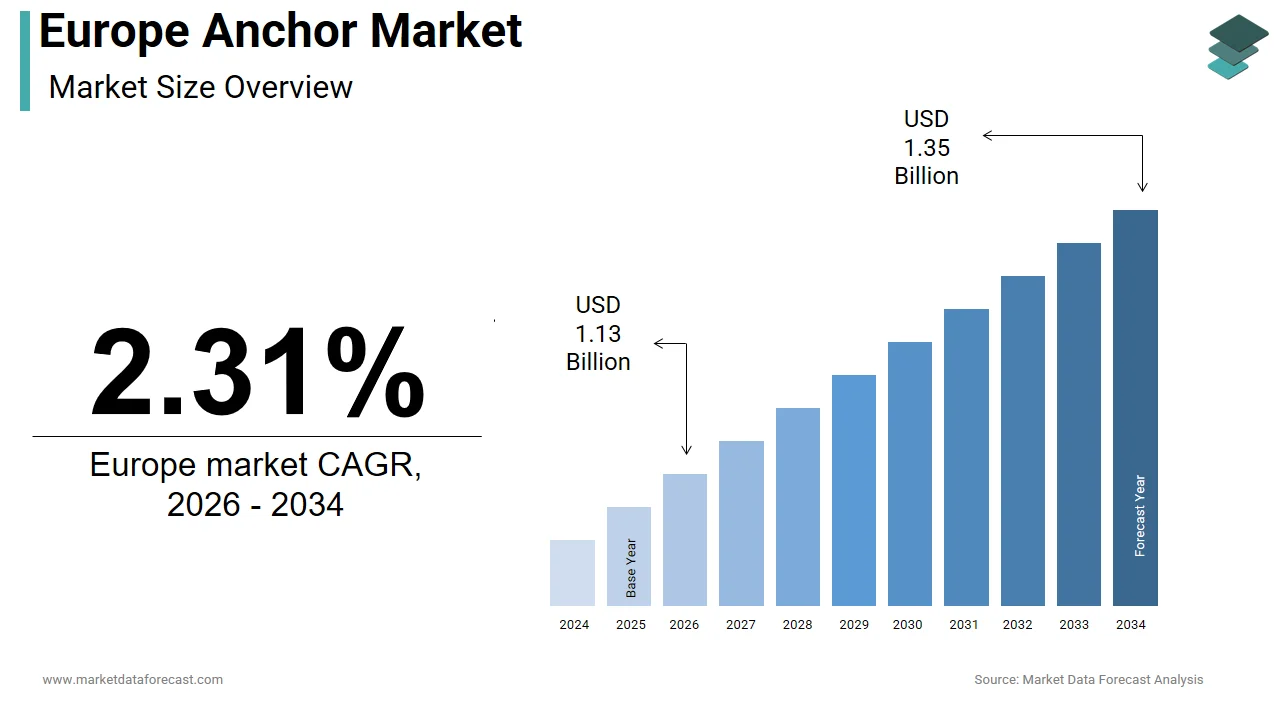
The Europe anchor market was valued at USD 1.10 billion in 2025, is estimated to reach USD 1.13 billion in 2026, and is projected to reach USD 1.35 billion by 2034, growing at a CAGR of 2.31% from 2026 to 2034. Market growth is driven by increasing infrastructure development, expansion of renewable energy projects, and rising demand for secure foundation systems in construction and civil engineering applications. Anchoring systems play a critical role in stabilizing structures, supporting foundations, and ensuring safety in geotechnical engineering projects. The growing adoption of advanced anchoring technologies and increasing investments in transportation, energy, and industrial infrastructure are further supporting market expansion across Europe.
Key Market Trends
- Increasing demand for high-performance anchoring systems in infrastructure and construction projects.
- Rising adoption of screw pile and ground anchoring technologies for foundation stabilization.
- Growth in renewable energy installations, including wind and solar infrastructure requiring anchoring systems.
- Expanding investments in transportation and public infrastructure modernization.
- Strengthening regulatory standards for structural safety and geotechnical engineering practices.
Segmental Insights
- Based on product type, the screw pile anchors segment held the largest share of the Europe anchor market in 2025, driven by its ease of installation, high load-bearing capacity, and suitability for a wide range of soil conditions.
- Based on application, the commercial segment dominated the market in 2025 by accounting for the major share, supported by growing construction of commercial buildings, industrial facilities, and infrastructure projects across Europe.
Regional Insights
The Europe anchor market is witnessing steady demand across major economies, supported by expanding infrastructure investments and strong engineering capabilities.
- Germany dominated the regional market in 2025 with 23.9% share, driven by large-scale infrastructure development and strong construction activity.
- The United Kingdom held a promising share in 2025, supported by ongoing transportation upgrades and commercial construction projects.
- France is expected to register a notable CAGR over the forecast period, supported by ambitious nuclear and renewable energy programs, extensive public infrastructure investments, and strict seismic regulations in certain regions.
Competitive Landscape
The Europe anchor market is characterized by the presence of established engineering component manufacturers and specialized anchoring system providers with strong technological capabilities. Market players are focusing on product innovation, high-strength materials, and customized solutions for complex geotechnical applications. Strategic partnerships, expansion of manufacturing capabilities, and investments in infrastructure projects are shaping competitive dynamics across the region.
Prominent companies operating in the Europe anchor market include MacLean Civil Products, Foresight Products LLC, Fischer Group, Hubbell Power Systems, Inc., Hilti Corporation, Platipus Anchors Ltd, Earth Contact Products (ECP), Piletech International, Gripple Ltd, Simpson Strong-Tie, American Earth Anchors, and DYWIDAG Systems International.
Europe Anchor Market Size
The Europe anchor market was valued at USD 1.10 billion in 2025, is estimated to reach USD 1.13 billion in 2026, and is projected to reach USD 1.35 billion by 2034, growing at a CAGR of 2.31% from 2026 to 2034.
Anchor encompasses a specialized sector dedicated to the design, manufacturing, and deployment of mechanical and chemical fixing systems essential for securing structures to concrete, masonry, and steel substrates across the continent. This industry serves as the silent backbone of European infrastructure, ranging from high-rise residential complexes and industrial facilities to renewable energy installations and transportation networks. The region distinguishes itself through an uncompromising adherence to safety standards, specifically the European Technical Assessment guidelines, which mandate rigorous testing for load-bearing capacity and fire resistance. According to Eurostat, the construction sector contributes to the European Union's gross domestic product, which is creating a foundational demand for reliable anchoring solutions that ensure structural integrity in both new builds and renovation projects. Furthermore, the European Commission emphasizes the critical role of durable fixings in the seismic retrofitting of existing buildings, particularly in Southern Europe, where earthquake risks are prevalent. Unlike markets driven solely by volume, the European landscape prioritizes certified performance and longevity, driven by strict liability laws and building codes. The market definition now extends to include smart anchors equipped with sensors for structural health monitoring and eco-friendly chemical formulations with low volatile organic compound emissions, reflecting a shift towards sustainable and intelligent construction practices that align with the Green Deal objectives for resilient urban environments.
MARKET DRIVERS
Aggressive Urban Regeneration and Seismic Retrofitting Initiatives
The widespread implementation of urban regeneration programs and mandatory seismic retrofitting measures aimed at enhancing the safety and longevity of the continent's aging building stock is one of the major factors propelling the Europe anchor market expansion. A significant portion of European infrastructure was constructed decades ago and often lacks modern reinforcement, necessitating the installation of high-strength anchors to secure facades, bridge external insulation systems, and reinforce structural elements against seismic activity. According to the European Commission, many buildings in Europe were built before the introduction of modern seismic codes, prompting governments in Italy, Greece, and Romania to launch subsidy schemes for retrofitting projects that rely heavily on advanced chemical and mechanical anchors. The Renovation Wave strategy further accelerates this demand by targeting higher renovation rates to improve energy efficiency, a process that invariably requires the secure attachment of heavy insulation panels and cladding systems using certified fixing technologies. As per the European Construction Industry Federation, renovation work now surpasses new construction in many member states, creating a sustained and growing market for anchors capable of performing in cracked concrete and varying substrate conditions. The legal imperative to prevent facade detachment and ensure public safety transforms anchors from simple commodities into critical safety components, driving consistent procurement cycles and fostering demand for premium, tested products.
Expansion of Renewable Energy Infrastructure and Industrial Modularization
The massive rollout of renewable energy projects and the increasing trend toward prefabricated modular construction in the industrial sector are further boosting the expansion of the Europe anchor market. The transition to clean energy requires the secure fixation of solar panel mounting systems on rooftops and wind turbine foundations, both of which demand anchors with exceptional fatigue resistance and durability under dynamic loads. According to WindEurope, the continent has long-term plans to expand wind capacity, each turbine requiring high-grade anchor bolts to withstand extreme weather conditions and operational vibrations. Similarly, the solar industry relies on specialized roof hooks and concrete screws to attach photovoltaic arrays securely without compromising waterproofing or structural integrity. As per the European Solar Photovoltaic Industry Association, the growth of distributed solar generation on commercial and industrial buildings has created a vast addressable market for lightweight yet robust anchoring solutions. Furthermore, the shift toward off-site manufacturing and modular construction involves assembling large precast concrete elements on-site, a process that depends entirely on the precision and strength of embedded and post-installed anchors to join modules safely. This convergence of green energy mandates and industrial modernization creates a robust demand stream for high-performance anchoring systems tailored to specific engineering challenges.
MARKET RESTRAINTS
Volatility in Raw Material Prices and Supply Chain Disruptions
The Europe anchor market faces a significant restraint due to the extreme volatility in global prices of critical raw materials such as steel, zinc, nickel, and specialized resins, which are the fundamental inputs for manufacturing mechanical and chemical anchors. The production of high-strength steel anchors and corrosion-resistant coatings relies heavily on these commodities, whose prices are subject to geopolitical tensions, energy costs, and logistical bottlenecks. According to the European Steel Association, energy-intensive steel production has faced severe cost pressures due to fluctuating natural gas prices, forcing manufacturers to either absorb margins or pass increased costs onto customers, thereby dampening demand in price-sensitive segments. The reliance on imported raw materials for certain chemical components and rare alloying elements leaves the industry exposed to supply chain disruptions that can delay production schedules and inflate lead times. As per the European Chemical Industry Council, the cost of epoxy and vinyl ester resins used in chemical anchors has increased, impacting the profitability of fixings manufacturers. The inability to predict long-term material costs complicates bidding processes for large infrastructure projects, where fixed-price contracts are common, leading to hesitation among contractors to commit to large-scale purchases. These economic uncertainties act as a persistent brake on market expansion, forcing companies to prioritize inventory management over growth initiatives.
Complex Regulatory Compliance and Certification Barriers
The implementation of rigorous and often fragmented regulatory frameworks across European member states acts as a complex restraint on the anchor market by increasing the time and cost associated with bringing new products to market. Manufacturers must navigate a labyrinth of standards, including the European Technical Assessment, national building codes, and fire safety regulations, which often vary significantly between countries despite efforts at harmonization. According to the European Organisation for Technical Assessment, obtaining approval for a new anchor system involves extensive testing protocols for load capacity, fire resistance, and seismic performance, which can take years and require substantial financial investment. This administrative burden disproportionately affects small and medium-sized enterprises that lack the resources to manage multi-national certification processes, limiting competition and innovation. As per industry associations, the lack of mutual recognition for certain national approvals creates barriers to cross-border trade, forcing companies to duplicate testing efforts for different markets. Furthermore, the evolving nature of safety standards means that previously certified products may require re-evaluation, adding ongoing compliance costs. These regulatory hurdles slow down the adoption of innovative anchoring technologies and increase the overall cost of construction projects, acting as a structural constraint on market dynamism.
MARKET OPPORTUNITIES
Integration of Smart Anchors for Structural Health Monitoring
The convergence of Internet of Things technology with construction materials presents a potential opportunity for the Europe anchor market through the development of smart anchors equipped with sensors for real-time structural health monitoring. These advanced fixing systems can measure parameters such as preload tension, vibration, temperature, and corrosion levels, transmitting data to centralized platforms to predict maintenance needs and prevent catastrophic failures. According to the Fraunhofer Institute, the integration of sensor technology into critical infrastructure components is gaining traction as asset managers seek to extend the lifespan of bridges, tunnels, and high-rise buildings through predictive maintenance strategies. This technological evolution appeals to government agencies and private operators who aim to reduce inspection costs and enhance public safety by detecting loosening or degradation before it becomes visible. As per the European Innovation Council, funding for smart infrastructure projects has increased, driving pilot deployment of connected anchoring systems in major transport hubs and energy facilities. The opportunity extends to creating subscription-based services where manufacturers provide not just the hardware but also the analytics software, generating recurring revenue streams. By bridging the gap between passive fixings and active monitoring, companies can create high-value products that command premium pricing and differentiate themselves in a crowded market, positioning anchors as key nodes in the digital twin ecosystem of modern cities.
Adoption of Sustainable and Bio-Based Chemical Anchoring Solutions
The growing emphasis on sustainability and the circular economy offers a lucrative avenue for the Europe anchor market through the development of eco-friendly chemical anchors formulated with bio-based resins and low volatile organic compound emissions. As the construction industry faces pressure to reduce its carbon footprint, there is a surging demand for fixing solutions that align with green building certifications such as BREEAM and LEED. According to the European Commission's Green Public Procurement criteria, public tenders increasingly favor products with verified environmental product declarations and reduced toxicity, creating a competitive advantage for manufacturers who innovate in green chemistry. The shift away from petroleum-based epoxies toward resins derived from renewable sources like plant oils not only lowers embodied carbon but also improves indoor air quality during installation. As per the European Chemical Agency, the regulatory push to restrict hazardous substances in construction materials is accelerating the reformulation of traditional chemical anchors. The opportunity lies in developing high-performance bio-based anchors that match or exceed the mechanical properties of conventional products while offering superior environmental credentials. By leading the transition to sustainable fixings, manufacturers can tap into a growing segment of environmentally conscious developers and comply with future regulations proactively, securing long-term market relevance.
MARKET CHALLENGES
Intense Price Competition from Non-Compliant Imports
The influx of low-cost and non-compliant anchoring products from outside the European Economic Area that undercut legitimate manufacturers on price while failing to meet stringent safety standards is primarily challenging the growth of the Europe anchor market. These inferior imports often lack proper certification or utilize substandard materials, posing significant safety risks yet attracting price-sensitive buyers in a competitive construction landscape. According to the European Association of Anchor Manufacturers, the presence of counterfeit or non-certified anchors in the supply chain undermines trust in the market and creates unfair competition for companies investing heavily in research, testing, and quality assurance. The difficulty in distinguishing between compliant and non-compliant products at the point of sale exacerbates the issue, allowing dubious goods to enter projects unnoticed until failure occurs. As per market surveillance authorities, enforcement of construction product regulations remains inconsistent across member states, enabling rogue traders to exploit loopholes. This price pressure forces reputable manufacturers to either lower their margins to compete or risk losing market share in the lower-end segment, potentially compromising their ability to invest in innovation. The reputational damage caused by anchor failures linked to cheap imports also threatens the overall perception of the industry, making it challenging to advocate for the value of certified, high-quality solutions.
Shortage of Skilled Installers and Technical Expertise
The Europe anchor market grapples with a critical bottleneck due to the severe shortage of skilled professionals capable of correctly installing and inspecting advanced anchoring systems according to manufacturer specifications and safety codes. Proper installation of chemical and mechanical anchors requires precise drilling techniques, cleaning procedures, and torque application, errors in which can lead to catastrophic structural failures. According to the European Centre for the Development of Vocational Training, the construction sector faces a widening skills gap, with fewer young people entering trades and an aging workforce retiring without adequate replacement. This talent deficit leads to improper installation practices, such as insufficient hole cleaning or over-tightening, which compromise the performance of even the highest quality anchors. As per industry training bodies, the lack of standardized certification for anchor installers across different countries further complicates the issue, resulting in variable workmanship quality. The complexity of modern anchoring systems, especially those designed for seismic zones or cracked concrete, demands a higher level of technical proficiency that is often lacking on general construction sites. Until comprehensive training programs and mandatory certification schemes are widely adopted, the market risks will be constrained by human error, leading to liability issues and hesitancy among engineers to specify advanced anchoring solutions.
SEGMENTAL ANALYSIS
By Product Type Insights
The screw pile anchors segment held the largest share of the Europe anchor market in 2025. The leading position of screw pile anchors in the European market is driven by their versatility, rapid installation capabilities, and suitability for a wide range of soil conditions across the continent. The extensive deployment of renewable energy infrastructure, particularly solar farms and onshore wind turbines that require foundations that can be installed quickly with minimal environmental disruption, is further boosting the expansion of the screw pile anchors segment in the Europe anchor market. According to WindEurope, the continent is accelerating renewable project development, and screw piles offer a distinct advantage by eliminating the need for concrete curing times and heavy excavation machinery. This efficiency translates to significant cost savings and reduced project timelines, making them the preferred choice for large-scale utility installations. As per the European Solar Photovoltaic Industry Association, the growth of ground-mounted solar arrays has further bolstered demand, as screw piles allow for easy removal and site restoration at the end of the project lifecycle, aligning with circular economy principles. Furthermore, their adaptability to varying load requirements and ability to be installed in restricted access sites where traditional piling rigs cannot operate ensures their widespread adoption in both urban and rural settings. The combination of speed, cost-effectiveness, and environmental compatibility secures the screw pile segment in its leading position in the regional market.
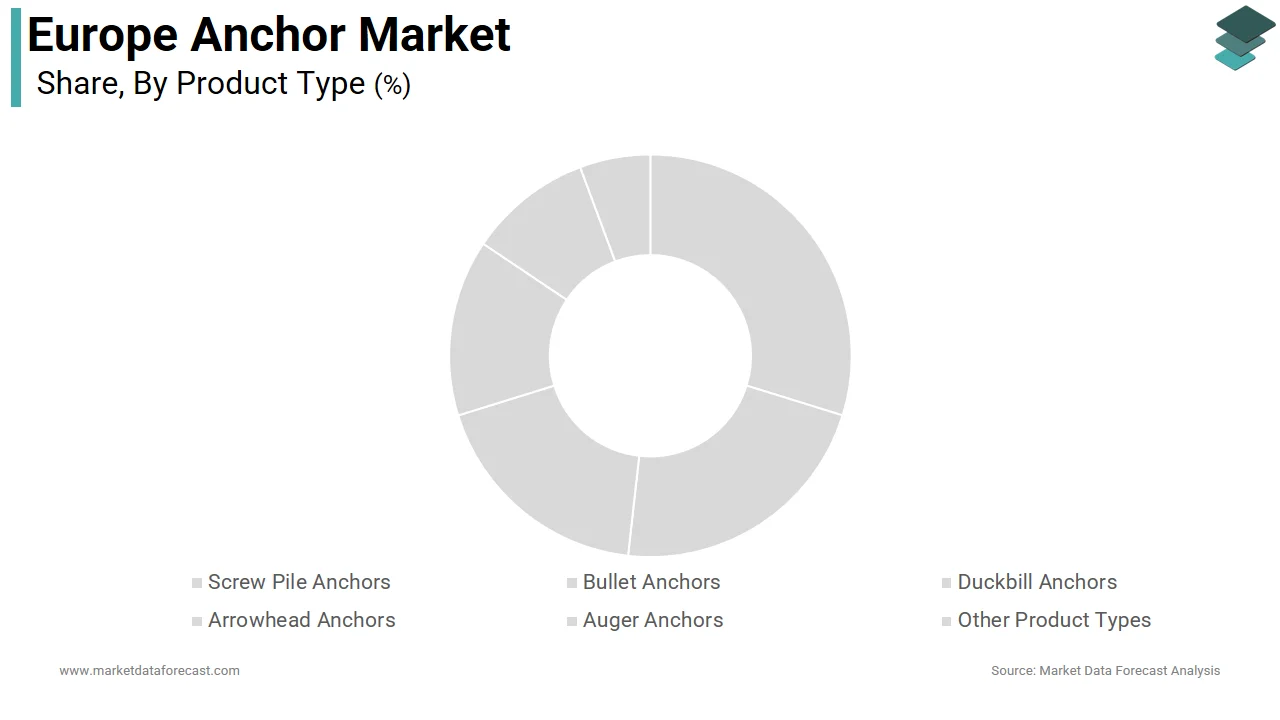
The auger anchors segment is emerging as the fastest growing category in the Europe anchor market and is estimated to witness the fastest CAGR of 9.2% over the forecast period owing to the increasing need for high-capacity holding solutions in soft soil conditions for temporary structures, event staging, and marine applications and the booming outdoor events and festival industry in Europe, which relies heavily on auger anchors to secure large tents, stages, and signage against wind loads without damaging underground utilities or causing excessive ground disturbance. According to the European Event Services Association, the resurgence of large-scale public gatherings has created sustained demand for reliable, reusable, and easily deployable anchoring systems that augers provide. Additionally, the marine and offshore sector is increasingly utilizing auger anchors for mooring floating platforms and buoys, where their helical design offers superior holding power in sandy or muddy seabeds compared to traditional gravity anchors. As per maritime safety authorities, the shift towards floating wind farms and aquaculture installations is driving innovation in large-diameter auger designs capable of withstanding dynamic ocean forces. The ability to install these anchors using standard drilling equipment and retrieve them for reuse enhances their economic appeal. This convergence of event industry growth, marine expansion, and reusability propels the auger anchor segment to outpace others in growth rate.
By Application Insights
The commercial segment held the dominant position in the Europe anchor market by accounting for the major share of the European anchor market in 2025. The leading position of the commercial segment in the European market is attributed to the scale and complexity of infrastructure projects, industrial facilities, and public works that require high-performance fixing solutions and the massive investment in transportation networks, energy grids, and commercial real estate across the continent, all of which rely on certified anchors for structural integrity and safety. According to the European Construction Industry Federation, non-residential construction activity has shown strong growth, driven by public funding for schools, hospitals, and transport hubs that mandate the use of rigorously tested mechanical and chemical anchors to comply with strict building codes. The industrial sector, including warehouses and manufacturing plants, also contributes significantly, utilizing heavy-duty anchors to secure machinery, racking systems, and facade panels that must withstand dynamic loads and seismic forces. As per national safety agencies, the liability associated with commercial building failures necessitates the use of premium, certified anchoring products, creating a high-value market segment less sensitive to price fluctuations than residential applications. Furthermore, the trend toward retrofitting existing commercial buildings for energy efficiency involves attaching heavy external insulation and cladding systems, driving continuous demand for specialized anchors. The sheer volume of materials and the critical nature of safety in commercial environments ensure this segment remains the market leader.
The residential segment is poised to be the fastest-growing area in the Europe anchor market and is expected to exhibit the fastest CAGR of 8.08% over the forecast period, owing to the aggressive renovation wave targeting the continent's aging housing stock and the rise of DIY home improvement activities. This surge is propelled by the European Union's Renovation Wave strategy, which aims to increase the annual energy renovation rate of residential buildings, necessitating the secure attachment of insulation materials, solar panels, and ventilation systems to existing facades and roofs. According to Eurostat, a large share of European households live in buildings constructed before 1990, many of which require extensive retrofitting to meet modern energy and safety standards, creating a massive addressable market for residential anchoring solutions. The growing popularity of home renewable energy installations, such as rooftop solar and heat pumps, further drives demand for specific roof hooks and wall anchors designed for quick and safe installation by contractors and skilled DIY enthusiasts. As per European hardware retailers, sales of consumer-grade chemical and mechanical anchors have increased, reflecting the trend of homeowners undertaking self-installation projects to reduce costs. The introduction of user-friendly, pre-packaged anchoring kits with clear instructions has lowered the barrier to entry, expanding the consumer base. This combination of policy-driven renovations, energy transition at the household level, and DIY culture fuels the rapid expansion of the residential segment.
COUNTRY-LEVEL ANALYSIS
Germany Anchor Market Analysis
Germany dominated the anchor market in Europe with 23.9% of the regional market share in 2025. The leading position of Germany in the European market is driven by its robust construction industry, stringent safety regulations, and status as a manufacturing hub for high-quality fixing systems. The country's market status is defined by a deep-rooted engineering culture that prioritizes certified performance and reliability, making it the primary testing ground for new anchoring technologies before they are rolled out across the continent. The primary driver for this dominance is the extensive "Energiewende" energy transition program, which has spurred massive investments in renewable energy infrastructure and building retrofits, both of which require vast quantities of advanced anchors. According to the Federal Statistical Office of Germany, the construction sector contributes significantly to the national economy, with spending on industrial facilities and residential renovations that adhere to some of the world's strictest building codes. Furthermore, Germany hosts several leading global anchor manufacturers who benefit from a highly skilled workforce and advanced production facilities. As per the German Construction Confederation, demand for seismic retrofitting and facade safety inspections has increased, driving the adoption of premium mechanical and chemical anchors. The synergy of regulatory rigor, industrial strength, and sustainability goals secures Germany's position as the most influential market in the region.
United Kingdom Anchor Market Analysis
The United Kingdom had a promising share of the European anchor market in 2025. The vibrant construction sector, a strong focus on infrastructure renewal, a thriving DIY culture, the government's levelling up agenda, and net zero targets that drive substantial investment in transport links, social housing, and energy efficiency upgrades for private homes are propelling the UK market growth. The aging building stock, much of which requires structural reinforcement and thermal retrofitting, is creating a steady stream of projects for both commercial and residential anchors, which is further contributing to the UK market expansion. According to the Office for National Statistics, repair and maintenance activity often surpasses new build projects, ensuring consistent demand for fixing solutions. The UK's leadership in offshore wind energy also creates specialized demand for marine-grade anchors used in foundation and mooring systems. As per the Federation of Master Builders, the shortage of skilled labor has accelerated the adoption of faster-installing anchor systems that reduce on-site time, favoring innovative product designs. The combination of infrastructure spending, housing renovation, and renewable energy leadership ensures the UK remains a critical and dynamic market for anchor technologies.
France is anticipated to showcase a prominent CAGR in the European anchor market over the forecast period due to its ambitious nuclear and renewable energy programs, extensive public infrastructure projects, and strict seismic regulations in certain regions. The state-led "Grand Plan de Investissement" that allocates significant funding to modernize transport networks, schools, and hospitals, and the mandatory seismic retrofitting of buildings in zones classified as moderate to high risk, particularly in the south and east of the country, are also contributing to the French market growth. According to the French Ministry of Ecological Transition, the push for energy renovation of residential buildings is accelerating, creating strong demand for facade fixings and roof anchors for solar installations. The presence of major industrial players and a strong tradition of engineering excellence further supports the market. As per the French Construction Industry Federation, the emphasis on fire safety in high-rise residential and commercial buildings necessitates the use of fire-rated anchors, adding a layer of technical requirement that favors qualified suppliers. This blend of public investment, safety mandates, and energy transition reinforces France's standing as a key market player.
Italy Anchor Market Analysis
Italy is predicted to account for a prominent share of the European anchor market during the forecast period due to its high seismic activity, rich architectural heritage requiring sensitive retrofitting, and a strong manufacturing base for construction chemicals. The government's "Superbonus" and other fiscal incentives that have triggered a wave of building renovations and seismic upgrades across the nation, and the critical need to secure historical masonry structures and modern concrete buildings against earthquakes, are further propelling the Italian market expansion. According to the Italian National Institute of Statistics, the construction sector has seen significant growth driven by these tax breaks, with a particular focus on energy efficiency and safety improvements. The country's leadership in the production of high-quality chemical resins also supports a robust domestic supply chain for chemical anchors. As per the Italian Association of Construction Machinery, reconstruction efforts in seismic zones and the preservation of cultural heritage sites create a unique niche for custom and high-tech anchoring solutions. The convergence of seismic risk, fiscal stimulus, and industrial capability sustains Italy's prominent position in the regional market.
Spain Anchor Market Analysis
Spain is estimated to register a steady CAGR in the European anchor market during the forecast period due to its booming tourism infrastructure, extensive renewable energy projects, and ongoing urban regeneration initiatives. The strong focus on coastal development and the retrofitting of buildings to improve energy efficiency in a warm climate, and the massive expansion of solar photovoltaic capacity, with Spain leading Europe in new installations, are further contributing to the Spanish market expansion. According to the Spanish Photovoltaic Union, the country has set ambitious solar expansion goals, necessitating millions of anchoring points for panels across diverse terrains. Additionally, the tourism sector drives the construction and renovation of hotels and resorts, which require durable fixings for facades and outdoor structures exposed to harsh marine environments. As per the Spanish Construction Confederation, the rehabilitation of existing housing stock to meet new energy codes is gaining momentum, further boosting residential anchor sales. The combination of renewable energy leadership, tourism-driven construction, and urban renewal ensures Spain punches above its weight in the European anchor landscape.
COMPETITIVE LANDSCAPE
The competition in the Europe anchor market is characterized by intense rivalry among established global giants and specialized regional manufacturers who constantly innovate to capture market share through technological superiority and certified performance. Major players differentiate themselves by securing approvals for the most stringent seismic and fire safety standards while offering integrated digital tools that simplify design and installation for engineers. The market sees frequent launches of eco-friendly chemical anchors and corrosion-resistant mechanical systems designed to meet the strict sustainability criteria of the European Green Deal. Price competition is moderate since buyers prioritize reliability and legal compliance over cost savings, given the catastrophic consequences of anchor failure in structural applications. Regional specialists often compete by providing highly customized solutions for specific local substrates or heritage restoration projects that require unique fixing techniques. The barrier to entry remains extremely high due to significant costs associated with extensive testing protocols and obtaining European Technical Assessments. Collaboration between manufacturers and academic institutions is accelerating the development of advanced materials like carbon fiber reinforced polymers. Overall, the landscape is dynamic with companies vying to establish leadership in safety, sustainability, and digital integration across the diverse construction sectors of the continent.
KEY MARKET PLAYERS
The leading companies operating in the Europe anchor market include:
- MacLean Civil Products
- Foresight Products LLC
- Fischer Group
- Hubbell Power Systems, Inc.
- Hilti Corporation
- Platipus Anchors Ltd
- Earth Contact Products (ECP)
- Piletech International
- Gripple Ltd
- Simpson Strong-Tie
- American Earth Anchors
- DYWIDAG Systems International
TOP PLAYERS IN THE MARKET
- Hilti Corporation stands as a global pioneer in the Europe anchor market, delivering advanced fastening solutions that define safety and reliability for critical infrastructure projects worldwide. The company significantly contributes to the international landscape by setting benchmarks for seismic performance and fire resistance in mechanical and chemical anchoring systems. Hilti recently strengthened its European position by launching next-generation carbon-based anchors designed for extreme load conditions and corrosive environments. The firm actively collaborates with engineering bodies to develop digital design software that simplifies specification and ensures compliance with complex local regulations. By expanding its direct sales force and on-site service teams across major European nations, Hilti ensures rapid technical support and rigorous quality assurance for large-scale developments. Their commitment to sustainability drives the development of low-carbon manufacturing processes and eco-friendly chemical formulations. This strategic focus on innovation and customer partnership solidifies their reputation as a leader in the global construction technology industry.
- Fischer Group leverages its German engineering heritage to maintain a dominant presence in the Europe anchor market through a comprehensive portfolio of high-performance fixing systems for diverse substrates. The company contributes globally by providing specialized solutions for lightweight construction, heavy-duty industrial applications, and renewable energy installations. Fischer recently enhanced its European footprint by introducing innovative green chemical anchors made from bio-based resins that reduce environmental impact without compromising strength. The firm focuses on developing smart installation tools that monitor torque and setting depth to guarantee perfect execution every time. Through strategic partnerships with leading universities and research institutes, Fischer continuously pioneers new testing methodologies for cracked concrete and seismic zones. Their dedication to education drives the establishment of training centers that certify installers across the continent. This customer-centric approach, combined with continuous material science evolution, ensures the company remains a trusted partner for professionals seeking maximum safety and efficiency in their projects.
- Simpson Strong-Tie is a leading innovator in the Europe anchor market, distinguished by its extensive range of structural connection products and engineered wood solutions tailored for modern construction challenges. The company plays a pivotal role globally by supplying critical anchoring hardware that ensures structural integrity in residential, commercial, and civil engineering projects. Simpson Strong-Tie recently strengthened its market position in Europe by expanding its manufacturing capacity for cold-formed steel connectors and high-strength adhesive anchors to meet surging demand. The firm actively invests in building information modeling libraries that allow architects and engineers to integrate their products seamlessly into digital designs. By collaborating with regulatory agencies, the company helps shape future safety standards for timber and concrete connections. Their focus on sustainable forestry and recycled steel content aligns with European green building goals. This holistic approach to combining hardware excellence with digital integration enables Simpson Strong-Tie to meet the evolving needs of the construction industry. Their strong brand recognition and focus on structural safety continue to drive growth and influence in the European and global markets.
TOP STRATEGIES USED BY KEY MARKET PARTICIPANTS
Key players in the Europe anchor market primarily focus on product innovation and sustainability to differentiate their offerings and meet stringent regulatory demands. Companies heavily invest in research and development to create bio-based chemical anchors and high-strength mechanical systems capable of withstanding seismic events. Strategic partnerships with construction firms and engineering consultancies enable manufacturers to co-develop customized solutions for complex infrastructure projects. Expanding digital capabilities through building information modeling libraries and design software helps streamline the specification process and ensures code compliance. Firms increasingly adopt circular economy practices by utilizing recycled materials in production and offering take-back programs for packaging. Providing comprehensive technical training and certification programs for installers builds trust and reduces liability risks associated with improper application. Acquisitions of niche technology startups allow major players to integrate smart sensors and monitoring capabilities into their product lines. Diversifying supply chains ensures resilience against raw material volatility and geopolitical disruptions affecting global logistics.
MARKET SEGMENTATION
This research report on the Europe anchor market has been segmented and sub-segmented into the following categories.
By Product Type
- Screw Pile Anchors
- Bullet Anchors
- Duckbill Anchors
- Arrowhead Anchors
- Auger Anchors
- Other Product Types
By Application
- Commercial
- Residential
By Country
- United Kingdom
- France
- Spain
- Germany
- Italy
- Russia
- Sweden
- Denmark
- Switzerland
- Netherlands
- Rest of Europe
Frequently Asked Questions
What is the Europe anchor market?
The Europe anchor market supplies mechanical and chemical fasteners securing loads in concrete structures. Germany leads production serving construction and renovation projects effectively.
How does the Europe anchor market function?
The Europe anchor market functions through manufacturers supplying post-installed systems for retrofits. Distributors serve contractors ensuring compliance with Eurocode standards.
What drives growth in the Europe anchor market?
Growth in the Europe anchor market stems from infrastructure rehabilitation and seismic upgrades. Aging buildings require high-performance anchors for safety reinforcement.
Which countries lead the Europe anchor market?
Germany, Italy, and UK lead the Europe anchor market with advanced manufacturing bases. France follows through extensive bridge and tunnel rehabilitation initiatives.
What types dominate the Europe anchor market?
Mechanical anchors dominate the Europe anchor market for immediate loading capacity. Chemical resin systems excel in cracked concrete and overhead installations.
How does regulation shape the Europe anchor market?
Eurocode 2 and ETA approvals govern the Europe anchor market ensuring load capacities. CE marking validates performance for structural safety applications.
What role does construction play in the Europe anchor market?
Construction drives the Europe anchor market securing facades, railings, and heavy equipment. Prefabrication demands high-precision anchors for factory assembly.
What trends influence the Europe anchor market?
Trends in the Europe anchor market feature carbon steel alternatives and fire-rated designs. Hybrid mechanical-chemical systems expand application versatility.
What challenges face the Europe anchor market?
Challenges in the Europe anchor market include concrete cracking risks and installation training. Digital design software improves anchor layout optimization significantly.
How has infrastructure renewal impacted the Europe anchor market?
Infrastructure renewal boosts the Europe anchor market replacing corroded fasteners. Seismic zones prioritize ductile anchors meeting enhanced performance criteria.
Related Reports
Access the study in MULTIPLE FORMATS
Purchase options starting from
$ 2000
Didn’t find what you’re looking for?
TALK TO OUR ANALYST TEAM
Need something within your budget?
NO WORRIES! WE GOT YOU COVERED!
Call us on: +1 888 702 9696 (U.S Toll Free)
Write to us: sales@marketdataforecast.com