- Product Description Description
- Table of Contents TOC
- List of Table & Figure LOT
- Get Free Sample PDF Sample PDF
Market Size, 2025
$1,411.86 MnMarket Estimate, 2026
$1,550.93 MnMarket Forecast, 2034
$3,288 MnCAGR, 2026–2034
9.85%Europe Application Lifecycle Management Market Report Summary
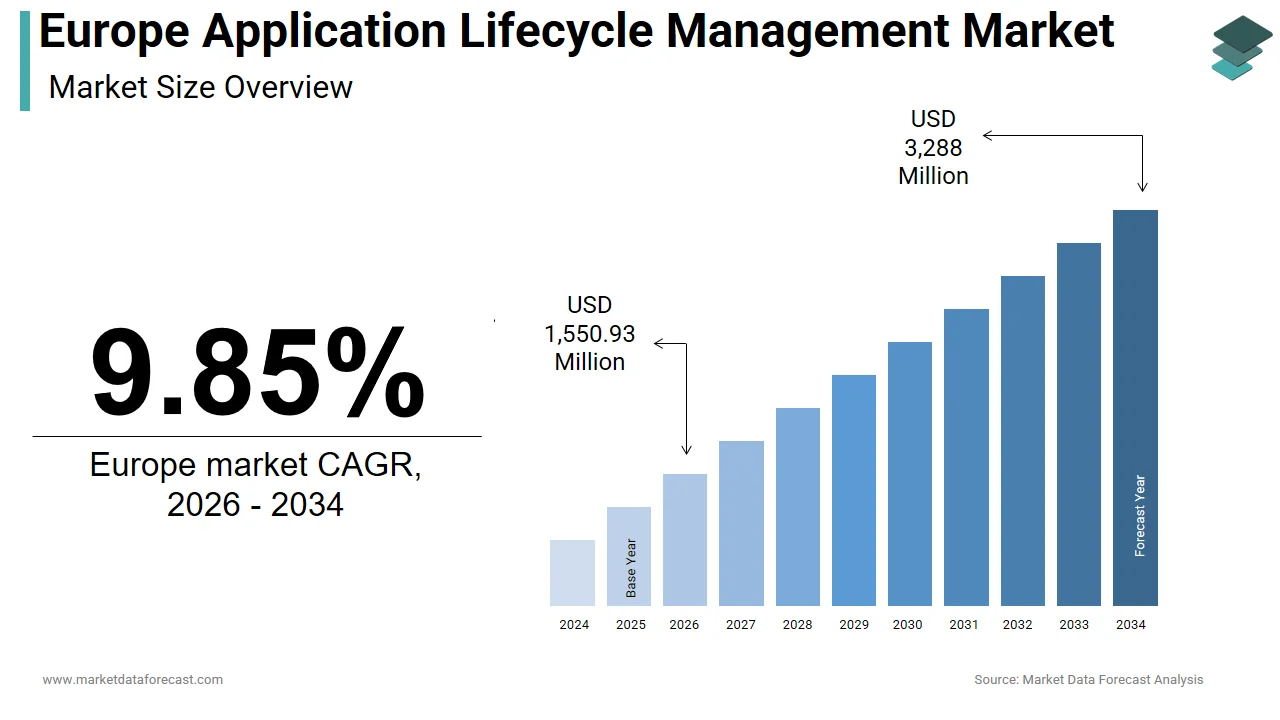
The Europe application lifecycle management (ALM) market was valued at USD 1,411.86 million in 2025, is estimated to reach USD 1,550.93 million in 2026, and is projected to reach USD 3,288 million by 2034, growing at a steady CAGR of 9.85% from 2026 to 2034. The market growth is driven by Europe’s accelerated digital transformation, rising adoption of DevOps and agile development frameworks, and increasing need for end-to-end visibility across complex software development cycles. Expanding cloud integration, regulatory compliance requirements, and the push for faster release cycles across critical industries are further strengthening ALM adoption across the region.
Key Market Trends
- Growing adoption of DevOps-driven ALM platforms for continuous integration and continuous delivery (CI/CD).
- Increasing demand for centralized lifecycle visibility across hybrid, multi-cloud, and distributed development environments.
- Expansion of regulatory and compliance-driven ALM solutions in BFSI, healthcare, and public sectors.
- Rising use of AI- and analytics-enhanced ALM tools for improving testing efficiency and predictive quality assurance.
- Growing adoption of microservices and API-driven architectures that requires more sophisticated application lifecycle control.
Segmental Insights
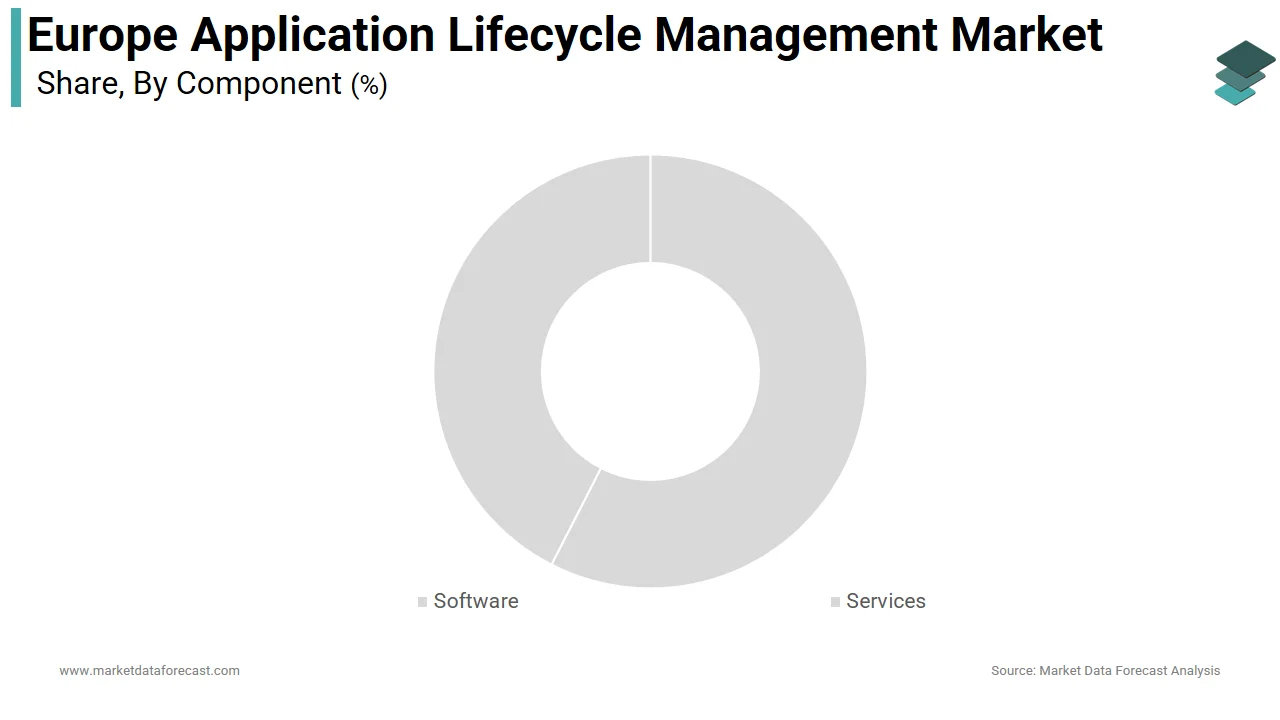
- Based on component, the software segment dominated the European application lifecycle management market in 2024, holding 61.8% of the market share. Strong enterprise demand for integrated ALM toolchains, streamlined workflows, and advanced collaboration capabilities continues to drive software adoption across industries.
- Based on deployment, the on-premises segment remained the leading model in 2024. Its dominance is influenced by strict data governance requirements, complex enterprise architectures, and the need for secure in-house development environments across heavily regulated sectors.
- Based on end use, the BFSI segment accounted for 23.5% of the European ALM market share in 2024. The segment’s leadership is supported by the sector’s stringent compliance mandates, high reliance on mission-critical software systems, and continuous need for lifecycle governance across large-scale digital transformation programs.
Regional Insights
The Europe ALM market is experiencing strong growth across major economies, supported by the modernization of legacy systems, rising cloud adoption, and increasing prioritization of regulatory-compliant software delivery.
- Germany captured the largest share, accounting for 24.4% of the market in 2024, driven by its advanced industrial base, strong IT workforce, and early adoption of agile and DevOps practices.
- France occupied a strategic position in 2024, supported by growing enterprise digitization, expanding government digital initiatives, and strong adoption of ALM tools in public administration and finance.
- The United Kingdom remained a pivotal market despite post-Brexit regulatory divergence, supported by its globally integrated financial services, life sciences, and high-growth tech sectors.
- Italy holds a significant position in the European ALM market, with growth driven by its strong manufacturing heritage and the digital modernization efforts under the National Recovery and Resilience Plan.
Competitive Landscape
The Europe application lifecycle management market is characterized by leading global software providers and specialized ALM solution developers offering robust, integrated platforms tailored for complex enterprise environments. Companies are focusing on enhancing automation, improving cross-team collaboration, and integrating AI-driven analytics to support high-velocity software delivery. Strategic acquisitions, cloud-native product enhancements, and ecosystem partnerships are shaping the competitive environment across Europe’s evolving software development landscape.
Prominent companies in the Europe ALM market include Atlassian Corporation Plc, CollabNet, Inc., HP Development Company, L.P., Siemens AG, Inflectra Corporation, IBM, Micro Focus International plc, Microsoft, NimbleWork, Inc., Parasoft Corporation, Polarion Software GmbH, PTC Inc., SAP SE, and others.
Europe Application Lifecycle Management Market Size
The Europe application lifecycle management market was valued at USD 1,411.86 million in 2025, is estimated to reach USD 1,550.93 million in 2026, and is projected to reach USD 3,288 million by 2034, growing at a CAGR of 9.85% from 2026 to 2034.
Application lifecycle management (ALM) is the integrated governance of software applications from initial concept through retirement, encompassing requirements management, development, testing, deployment, maintenance, and decommissioning. This approach ensures alignment between business objectives and IT execution while enhancing traceability, compliance, and collaboration across distributed teams. In the European context, ALM adoption is increasingly shaped by regulatory imperatives such as the General Data Protection Regulation and the EU Cyber Resilience Act, which mandate stringent documentation and security protocols throughout the software development pipeline. According to Eurostat, large EU enterprises widely utilize structured software development methodologies, which indicates the institutionalization of formalized lifecycle practices. Additionally, many critical infrastructure operators across the EU have adopted integrated toolchains for software governance, which reflects heightened scrutiny on digital resilience. The European software industry employs millions of people and is indicating a robust ecosystem capable of sustaining advanced ALM implementations. Unlike generic interpretations of software management, Europe’s ALM landscape is distinctly influenced by cross-border data flow regulations, multi-jurisdictional compliance, and a strong emphasis on sustainable digital transformation rooted in accountability and auditability.
MARKET DRIVERS
Accelerated Digital Transformation Mandates Across European Industries
European enterprises are undergoing a profound digital metamorphosis, which is compelling them to implement robust Application Lifecycle Management frameworks to manage increasingly complex software portfolios, and is one of the major factors driving the growth of the European application lifecycle management market. According to the European Investment Bank, many non-financial corporations in the EU accelerated their digital investment plans between 2021 and 2023 in direct response to supply chain disruptions and hybrid work adoption. This digital urgency has intensified the need for end-to-end visibility across development pipelines to ensure rapid yet compliant delivery. For instance, the manufacturing sector in Germany reported a notable increase in custom software development projects in 2024, as per Germany’s Federal Ministry for Economic Affairs and Climate Action. Simultaneously, financial institutions across the Eurozone are modernizing core banking systems, with most Tier 1 banks engaging in multi-year application reengineering initiatives according to the European Banking Authority. These transformations require ALM solutions that support traceability, version control, and auditability across geographically dispersed teams. Moreover, the European Union’s Digital Europe Programme has allocated 7.5 billion euros to strengthen digital capacities, with a significant share directed toward enterprise software modernization. This coordinated push not only expands the scale of software projects but also deepens regulatory expectations around documentation and change management. Consequently, ALM is no longer a support function but a strategic enabler ensuring that digital investments translate into resilient, maintainable, and compliant applications aligned with Europe’s unique governance environment.
Stringent EU Regulatory and Compliance Requirements Driving ALM Adoption
The European regulatory landscape imposes rigorous documentation, security, and audit mandates that directly amplify demand for structured Application Lifecycle Management systems, which is further boosting the regional market growth. As per the European Data Protection Board, thousands of data breach notifications were filed by EU member states in 2023, which is intensifying pressure on organizations to embed compliance into every software development phase. The EU Cyber Resilience Act, adopted in 2024, now legally obligates software vendors to maintain comprehensive records of design decisions, testing results, and vulnerability patches throughout an application’s lifespan. Similarly, the Medical Device Regulation requires manufacturers to demonstrate full traceability of software components in health-related applications, which is a requirement that has driven many Class II and III medical device firms in the EU to implement certified ALM platforms. In the financial domain, the European Securities and Markets Authority mandates that algorithmic trading systems undergo rigorous change control and audit logging, which is compelling firms to adopt ALM tools that enforce regulatory workflows. Furthermore, the European Commission’s Digital Operational Resilience Act compels a broad range of financial entities to establish resilient ICT risk management frameworks, which inherently rely on ALM for software asset governance. These overlapping mandates create a non-negotiable business case for ALM adoption, transforming it from an efficiency tool into a legal necessity. Unlike regions with lighter oversight, Europe’s dense regulatory fabric ensures that ALM is embedded at the core of software strategy, not as an afterthought.
MARKET RESTRAINTS
Legacy System Integration Complexities Impeding ALM Implementation
The deep entrenchment of legacy infrastructure across critical sectors that impedes seamless integration with modern ALM platforms is one of the major restraints of the European market. Many financial institutions in the Eurozone continue to rely on mainframe-based core banking systems developed before 2000, many of which lack standardized APIs or version control mechanisms. Similarly, in the energy sector, grid management software in use across Western Europe often operates on proprietary architectures that predate contemporary DevOps principles. These systems often store critical business logic in undocumented formats and making traceability and automated testing nearly impossible without costly reengineering. Moreover, public sector entities face compounded challenges as many EU member state IT departments manage applications with lifespans exceeding 15 years and many lacking source code repositories or change logs. The absence of modular design in these environments creates friction when introducing ALM tools that assume standardized workflows, versioned artifacts, and cloud native deployment patterns. Consequently, organizations face extended implementation cycles, inflated total cost of ownership, and increased risk of project failure. This legacy burden not only delays ALM adoption but also forces compromises in governance depth, thereby undermining the very compliance and quality objectives that drive ALM demand in the European context.
Fragmented Data Sovereignty and Cross-Border Development Constraints
The stringent data localization norms and jurisdictional fragmentation of Europe present a formidable operational barrier to cohesive Application Lifecycle Management deployment in Europe. Many EU member states have introduced supplementary data residency requirements beyond the General Data Protection Regulation, which often restricts the transfer of application metadata, code repositories, or testing logs across national borders. This fragmentation disrupts the unified data flows that modern ALM platforms depend on for real-time collaboration, audit trails, and continuous integration. For example, a multinational automotive manufacturer headquartered in France but with development teams in Poland, Spain, and Sweden must navigate divergent interpretations of data processing consent and infrastructure hosting rules, which leads to duplicated ALM instances or watered-down functionality. Cross-border data governance is widely recognized as a major obstacle to scaling agile development practices across the EU. Additionally, the EU’s proposed Data Act imposes new obligations on B2B data sharing, which requires ALM systems to embed granular access controls and usage logging that many vendors are not yet equipped to handle. These regulatory variances increase administrative overhead, reduce tool interoperability, and inhibit the centralized visibility that ALM promises. Rather than enabling seamless lifecycle orchestration, European firms often resort to hybrid or siloed ALM configurations that sacrifice efficiency for compliance, which ultimately dilutes the strategic value of full lifecycle governance.
MARKET OPPORTUNITIES
Expansion of Sovereign Cloud Initiatives Creating ALM Integration Opportunities
The strategic pivot of Europe toward digital sovereignty is unlocking new avenues for tailored Application Lifecycle Management solutions that align with region-specific infrastructure and governance models, which is one of the promising opportunities for the regional market. The European Union’s GAIA X initiative, which is supported by over 300 public and private partners, including Siemens, Bosch, and Atos, aims to establish a federated, secure, and transparent data infrastructure that inherently demands ALM systems capable of operating within sovereign cloud boundaries. Public sector cloud procurements in the EU increasingly include mandatory ALM compatibility clauses to ensure auditability and supply chain transparency. Concurrently, national sovereign cloud projects such as France’s Cloud de Confiance and Germany’s Catena-X automotive network are embedding ALM requirements into their compliance frameworks, which is compelling vendors to develop localized toolchains. Several EU member states are now mandating certified ALM workflows for defense-related software, which is creating a niche but high-integrity market segment. These initiatives foster demand for ALM platforms that natively support European identity standards, encrypted metadata handling, and jurisdiction-aware deployment policies. Unlike global public cloud environments, sovereign clouds prioritize data residency, vendor neutrality, and interoperability within a federated ecosystem as these conditions necessitate purpose-built ALM integrations. This shift is not merely about hosting location but about reengineering lifecycle governance to reflect European values of autonomy, resilience, and democratic oversight. Consequently, ALM vendors who embed sovereign cloud compatibility into their architecture stand to benefit from a structural realignment of Europe’s digital infrastructure strategy.
Rise of Green Software Engineering as a Catalyst for ALM Innovation
The commitment of the European Union to digital sustainability is fostering a novel opportunity for Application Lifecycle Management systems to integrate environmental impact metrics directly into development workflows. Under the European Green Deal and the 2023 Code of Conduct for Energy Efficient Cloud Infrastructure, software must now account for its carbon footprint across design, execution, and maintenance phases. According to the European Environment Agency, data centers in the EU consumed around 84 terawatt hours of electricity in 2023, with software inefficiencies contributing to avoidable energy waste. In response, organizations are seeking ALM platforms that incorporate carbon-aware coding practices, energy-optimized testing protocols, and lifecycle-based emissions tracking. The Green Software Foundation, backed by European tech leaders including SAP and Capgemini, has developed standardized methodologies for measuring software carbon intensity, which require ALM tools to log energy consumption per build, test cycle, and deployment. Furthermore, the EU’s upcoming Ecodesign for Sustainable Products Regulation will extend environmental labeling requirements to digital products by 2027, which requires auditable ALM records of sustainability performance. This regulatory trajectory transforms ALM from a purely technical governance layer into an environmental compliance engine. Early adopters have already integrated carbon dashboards into their ALM pipelines, which is reducing energy use per application according to internal benchmarks. Thus, ALM’s evolution toward sustainability represents a distinct European opportunity where regulatory foresight converges with technological innovation to redefine value beyond functionality and security.
MARKET CHALLENGES
Persistent Shortage of Skilled ALM Practitioners Across European Markets
A critical challenge constraining the maturity of the Europe Application Lifecycle Management market is the acute scarcity of professionals with integrated expertise in ALM toolchains, regulatory compliance, and domain-specific software engineering. According to the European Centre for the Development of Vocational Training, the EU faces a shortfall of over 400,000 cybersecurity specialists as of 2024, with ALM-related competencies among the least available. This gap is particularly severe in sectors like healthcare and energy, where ALM must intersect with highly specialized regulatory knowledge. For example, the European Health Data Space initiative requires healthcare software to maintain an auditable lineage of data processing logic, yet many health IT teams in the EU lack certified ALM training. Similarly, in the automotive sector, the transition to software-defined vehicles demands ALM engineers who understand both ASPICE compliance and real-time system constraints. The lack of standardized ALM curricula in European universities exacerbates the issue, with only a limited number of EU member states offering dedicated postgraduate programs in software lifecycle governance. Consequently, organizations either deploy ALM tools sub-optimally or rely on costly external consultants, delaying ROI and increasing operational risk. This human capital deficit not only slows adoption but also weakens the fidelity of compliance and traceability, which are core promises of ALM in the European context.
Inconsistent ALM Tool Interoperability Within Heterogeneous Enterprise Stacks
The heterogeneous nature of enterprise software environments across Europe creates a persistent challenge in achieving seamless interoperability among Application Lifecycle Management tools, thereby fragmenting governance and reducing operational efficiency. According to a 2024 study, a majority of large European enterprises operate multiple distinct development toolchains across departments, each with proprietary data models and workflow engines. This fragmentation is especially pronounced in industries like banking, where legacy mainframes coexist with cloud-native microservices, requiring ALM platforms to bridge incompatible metadata formats and approval protocols. For instance, less than one-third of surveyed banks achieved full traceability from requirement to deployment due to toolchain silos. Moreover, open standards such as OSLC and OpenAPI remain inconsistently implemented, with fewer than half of commercial ALM vendors in Europe fully supporting cross-vendor data exchange protocols. This lack of interoperability forces organizations into manual reconciliation or expensive middleware solutions, which undermines automation and audit reliability. In public sector projects, the problem is magnified by procurement policies that favor best-of-breed tools over integrated suites, which leads to disjointed lifecycle records. As a result, the promise of end-to-end visibility is often compromised, which is reducing both agility and compliance assurance in Europe’s complex multi-vendor software landscape.
REPORT COVERAGE
| REPORT METRIC | DETAILS |
| Market Size Available | 2025 to 2034 |
| Base Year | 2025 |
| Forecast Period | 2026 to 2034 |
| Segments Covered | By Component, Deployment, Enterprise Size, End-use, and County. |
| Various Analyses Covered | Global, Regional, and Country-Level Analysis, Segment-Level Analysis, Drivers, Restraints, Opportunities, Challenges; PESTLE Analysis; Porter’s Five Forces Analysis, Competitive Landscape, Analyst Overview of Investment Opportunities |
| Countries Covered | UK, France, Spain, Germany, Italy, Russia, Sweden, Denmark, Switzerland, Netherlands, Turkey, Czech Republic, and the Rest of Europe. |
| Market Leaders Profiled | Atlassian Corporation Plc, CollabNet, Inc., HP Development Company, L.P., Siemens AG, Inflectra Corporation, International Business Machines Corporation (IBM), Micro Focus International plc, Microsoft, NimbleWork, Inc., Parasoft Corporation, Polarion Software GmbH, PTC Inc., SAP SE, and Others. |
SEGMENTAL ANALYSIS
By Component Insights
The software segment dominated the European application lifecycle management market in 2024 and held 61.8% of the regional market share. The dominance of the software segment in the European market is attributed to the growing preference of enterprises for integrated platforms that unify requirements management, version control, testing, and deployment orchestration. Many large enterprises in the EU have standardized on commercial ALM software suites to ensure compliance with regulatory frameworks like the Cyber Resilience Act and Medical Device Regulation. This consolidation reduces reliance on fragmented open-source tools that lack audit trails and traceability features mandated under EU law. Additionally, the Digital Europe Programme has a budget of 8.1 billion euros for 2021–2027 to support areas such as cybersecurity and advanced digital skills, which has incentivized public sector procurement of certified ALM software. German and French industrial firms, in particular, favor end-to-end ALM software to support ASPICE and ISO 26262 compliance in automotive software development, as noted by the European Association of Automotive Suppliers. These regulatory and operational imperatives make modular, auditable, and scalable ALM software indispensable, reinforcing its market dominance over discrete services.
The services segment is estimated to record the fastest CAGR in the European market during the forecast period, owing to the escalating demand for customization, integration, and compliance enablement in complex IT environments. Many Eurozone financial institutions require external ALM consulting to align legacy core banking systems with the Digital Operational Resilience Act, which is a process that demands specialized expertise in both regulatory interpretation and toolchain configuration. Similarly, multiple member states have initiated sovereign software modernization programs, each requiring ALM implementation services to embed supply chain transparency and secure coding workflows. The shortage of in-house ALM talent further amplifies reliance on third-party providers; organizations face a significant deficit of ALM-skilled professionals across the EU, which is compelling them to outsource deployment, training, and maintenance. Additionally, cloud migration initiatives under GAIA-X and national sovereign cloud strategies have created demand for ALM integration services that ensure jurisdictional compliance and data residency. Unlike software, which offers standardized functionality, services provide contextual adaptation, which is making them critical for translating regulatory and architectural complexity into operational reality across Europe’s fragmented digital landscape.
By Deployment Insights
The on-premises segment remained the leading model in the Europe Application Lifecycle Management market in 2025. The dominance of the on-premises segment in the European market is primarily due to stringent data sovereignty requirements and sector-specific regulatory constraints. Many critical infrastructure operators in energy, defense, and healthcare continue to host ALM systems on-premises to maintain direct control over source code repositories, audit logs, and vulnerability records. In Germany, policies governing industrial control software emphasize storing lifecycle metadata within national borders, a stance that has discouraged cloud adoption in the sector. Similarly, France’s ANSSI cybersecurity agency treats ALM-related data for aerospace and defense contractors as sensitive, often requiring on-premises deployment under trusted cloud frameworks. Public sector procurement rules across the EU further reinforce this trend, with many ALM contracts awarded by national governments specifying on-premises or private cloud deployment. These institutional and legal imperatives ensure that on-premises ALM remains dominant despite global cloud momentum, which is reflecting Europe’s distinct risk calculus around data control and national digital autonomy.
The cloud-based segment is the fastest-growing segment in Europe and is anticipated to register a CAGR of 13.3% over the forecast period, owing to the convergence of sovereign cloud initiatives, agile development mandates, and cross-border collaboration needs. The GAIA-X ecosystem, now operational across 17 EU countries, provides a trusted cloud infrastructure where ALM platforms can operate within EU jurisdiction while enabling secure data sharing among partners, as reported by the European Cloud Partnership. This model is particularly attractive to mid-sized manufacturers in Sweden and the Netherlands, where participation in digital industrial networks like Catena-X requires cloud-resident ALM for real-time compliance verification. Many EU enterprises with remote or hybrid development teams adopted cloud ALM in 2024 to ensure continuous integration across geographies, which is a shift accelerated by labor mobility and talent shortages. Regulatory acceptance is also evolving as the European Medicines Agency’s 2023 guideline on computerised systems in clinical trials permits cloud ALM for clinical trial software, provided data residency and encryption standards are met. These developments signal a structural shift where cloud ALM is no longer seen as a risk but as a compliance-enabling architecture, especially when aligned with Europe’s vision of secure, interoperable, and sovereign digital infrastructure.
By End-use Insights
The BFSI segment had 23.5% of the European application lifecycle management market share in 2024. The growth of the BFSI segment in the European market is attributed to the stringent regulatory mandates and the criticality of software integrity in financial operations. Under the Digital Operational Resilience Act, which took effect in January 2025, EU financial entities are required to implement auditable software development practices, which is mandating end-to-end traceability for ICT systems and encouraging the adoption of enterprise-grade ALM platforms. According to the European Central Bank’s 2024 Financial Stability Review, many Tier 1 banks in the Eurozone have integrated ALM into core modernization programs to manage algorithmic trading systems and payment infrastructures. Insurers are also using ALM to document model risk governance for AI-driven underwriting tools, which aligns with the AI Act’s high-risk classification. The sector’s high exposure to cyber threats further justifies investment in ALM for change control and vulnerability tracking. Given the zero tolerance for software failure in finance, BFSI’s ALM dominance reflects a structural necessity rather than a discretionary choice.
The healthcare segment is experiencing the highest CAGR of 13.3% in Europe’s ALM market over the forecast period, owing to the convergence of digital health expansion, medical device regulation, and cross-border data governance. According to the European Commission, the EU’s digital health market continued to grow in 2024, with many new software-based medical devices submitted for CE marking with each requiring full ALM documentation under the Medical Device Regulation. As per the European Medical Devices Industry Group, most Class II and III device manufacturers now use certified ALM platforms to demonstrate software lifecycle traceability during audits. The rollout of the European Health Data Space further accelerates ALM adoption as national health agencies in Germany, France, and the Netherlands are increasingly mandating ALM integration for health IT systems that process patient data, to ensure auditability and version control. Additionally, the European Medicines Agency’s 2023 guidance on clinical trial software explicitly requires ALM for validation and change management, affecting thousands of ongoing trials across the EU. The rise of AI in diagnostics adds another layer of compliance, which requires ALM systems to log training data lineage and model updates. These overlapping regulatory, technological, and public health imperatives position healthcare as Europe’s most dynamic ALM growth frontier.
COUNTRY-LEVEL ANALYSIS
Germany Application Lifecycle Management Market Analysis
Germany captured the major share of 24.4% of the Europe application lifecycle management market in 2024. The dominance of Germany in the European market is driven by its advanced industrial base and rigorous regulatory culture. The leadership of Germany in automotive and industrial automation necessitates sophisticated ALM to comply with standards such as ASPICE and IEC 62304, which mandate full software lifecycle traceability. Many automotive suppliers in Baden-Württemberg and Bavaria have implemented certified ALM platforms to support software-defined vehicle development. Policies from Germany’s Federal Office for Information Security emphasize robust governance for critical infrastructure operators in energy and manufacturing, including secure audit trails and controlled data storage. Additionally, Germany’s participation in GAIA-X and the Catena-X automotive data space has created demand for ALM that supports federated identity and cross-company collaboration while preserving data sovereignty. With a large software engineering workforce in 2024, the talent ecosystem supports deep ALM integration. Germany’s market reflects a fusion of industrial pragmatism, regulatory rigor, and digital sovereignty, which is making it the anchor of Europe’s ALM landscape.
France Application Lifecycle Management Market Analysis
France occupied a strategic position in the European ALM market in 2025. The strong state-led digital sovereignty policies and a concentrated aerospace and defense sector are propelling the French ALM market growth. The French National Cybersecurity Agency mandates that all defense and critical infrastructure software undergo ALM-based certification under the Cloud de Confiance framework, which has driven adoption across companies like Thales, Dassault, and Naval Group. Many large enterprises in France’s aerospace sector use integrated ALM to comply with DO-178C and EU safety directives. France’s public cloud strategy further differentiates its ALM trajectory as the state-backed Cloud Souverain platform, and operated by OVHcloud and Orange, now hosts ALM instances for numerous government agencies. The country also leads in health tech regulation, with the French National Agency for Medicines requiring ALM documentation for AI-based diagnostic software under national implementation of the EU MDR. With digital transformation contributing meaningfully to France’s GDP in 2024, according to INSEE, ALM has become a non-negotiable layer of software governance across strategic sectors, reinforcing its second-place standing in Europe.
United Kingdom Application Lifecycle Management Market Analysis
The United Kingdom remained a pivotal ALM market in Europe in 2025 despite its post-Brexit regulatory divergence, owing to its globally integrated financial and life sciences sectors. The UK’s Financial Conduct Authority enforces software governance standards similar to the EU’s DORA, requiring banks and fintech firms to maintain auditable development pipelines. According to industry sources, many major banks have upgraded their ALM systems since 2022 to meet operational resilience expectations. Simultaneously, the Medicines and Healthcare products Regulatory Agency expects ALM practices for software used in clinical trials and medical devices, a policy that has accelerated adoption among biotech clusters in Cambridge and Oxford. The UK also leads in agile adoption; surveys indicate widespread use of cloud-native ALM to support DevOps at scale, particularly in IT and telecommunications. Although no longer bound by EU data rules, the UK maintains GDPR-equivalent standards under the Data Protection Act, which ensures continued emphasis on data lineage and auditability. This blend of financial innovation, scientific rigor, and agile culture sustains the UK’s strong ALM footprint within the European context.
Italy Application Lifecycle Management Market Analysis
Italy holds a significant position in the Europe ALM market. The manufacturing legacy of Italy and recent digital modernization push under the National Recovery and Resilience Plan are fuelling the ALM market growth in Italy. The Italian government has allocated funding for industrial digitalization, with ALM adoption prioritized for subsidy access. This has driven small and medium manufacturers in regions like Emilia-Romagna and Lombardy to adopt lightweight ALM platforms to meet compliance and quality benchmarks for export markets. The energy sector is another key driver; major utilities are implementing ALM to manage grid modernization software in line with EU cybersecurity requirements. Additionally, Italy’s healthcare system is digitizing rapidly as national strategies emphasize ALM for regional e-health platforms, impacting hospitals nationwide. Despite historically lower cloud adoption, Italy’s participation in GAIA-X and growing awareness of software risk are shifting the market toward structured lifecycle governance. Italy’s evolution reflects a transition from informal software practices to regulated, traceable development, which is a trend amplified by EU funding and industrial competitiveness pressures.
Netherlands Application Lifecycle Management Market Analysis
The Netherlands secured its position as a top-five ALM market in 2025 through a combination of digital infrastructure leadership, multinational corporate presence, and progressive regulatory alignment. Home to Europe’s largest data hub and major tech campuses, the country hosts numerous global enterprises that use advanced ALM to coordinate distributed development teams while adhering to EU data rules. Many large Dutch companies operate cross-border software projects, which require cloud-based ALM with built-in GDPR compliance. The Netherlands also leads in sustainable software initiatives; many Dutch IT firms have integrated carbon tracking into their ALM workflows as part of national green IT efforts. In the logistics and energy sectors, companies like Shell and Port of Rotterdam use ALM to manage mission-critical applications under NIS2 Directive requirements. Furthermore, the Dutch government’s “Digital by Default” policy promotes ALM for public sector software, creating consistent demand across ministries and municipalities. The Netherlands exemplifies how a small but highly connected and forward-looking economy can exert disproportionate influence in Europe’s ALM ecosystem.
COMPETITIVE LANDSCAPE
Competition in the Europe application lifecycle management market is characterized by a blend of global technology giants and specialized European vendors, each vying for dominance through regulatory alignment and domain-specific innovation. The market features intense rivalry as vendors differentiate via compliance depth, integration with industrial ecosystems, and data sovereignty assurances. Unlike other regions where scalability and cost drive adoption, Europe prioritizes auditability, traceability, and jurisdictional control, making regulatory fluency a core competitive lever. Established players leverage legacy relationships in automotive, aerospace, and finance, while newer entrants focus on cloud native architectures tailored for SMEs. Strategic partnerships with sovereign cloud initiatives like GAIA-X and national digital programs further shape competitive dynamics. The absence of standardized ALM interoperability fuels vendor lock-in but also creates opportunities for agile niche providers. Overall, competition centers less on features and more on trust governance and alignment with Europe’s unique digital policy framework.
KEY MARKET PLAYERS
The leading companies operating in the Europe application lifecycle management market include:
- Atlassian Corporation Plc
- CollabNet, Inc.
- HP Development Company, L.P.
- Siemens AG
- Inflectra Corporation
- International Business Machines Corporation (IBM)
- Micro Focus International plc
- Microsoft
- NimbleWork, Inc.
- Parasoft Corporation
- Polarion Software GmbH
- PTC Inc
- SAP SE
TOP PLAYERS IN THE MARKET
- Siemens AG plays a pivotal role in the Europe application lifecycle management market through its Polarion ALM platform, which is deeply embedded in automotive and industrial sectors across Germany and beyond. The company aligns its ALM solutions with a stringent European regulatory framework, including ASPICE and ISO 26262, ensuring compliance for safety-critical software. In 2024, Siemens enhanced its offering by integrating Polarion with Teamcenter X to support end-to-end digital thread capabilities across product and software lifecycles. This move strengthens traceability between mechanical design and embedded software development. Siemens also collaborates with GAIA-X to ensure its ALM infrastructure adheres to European data sovereignty principles, thereby reinforcing trust among public and private enterprises seeking secure and compliant software governance.
- PTC Inc. exerts significant influence in the Europe application lifecycle management market through its Windchill ALM module, which caters especially to aerospace defense and industrial equipment manufacturers. The company has strategically localized its cloud infrastructure within the European Union to comply with data residency mandates under GDPR and the Cyber Resilience Act. In early 2024, PTC deepened integration between its ALM and ThingWorx IoT platform, enabling real-time feedback from deployed products into the development lifecycle. This closed-loop approach enhances software reliability and supports predictive maintenance use cases. PTC also partners with European engineering schools to embed ALM best practices in curricula, thereby cultivating a skilled talent pipeline aligned with its technology stack and reinforcing long-term market relevance across the region.
- IBM Corporation maintains a strong footprint in the Europe application lifecycle management market through its Engineering Lifecycle Management suite, which serves banking, energy, and public sector clients. The company emphasizes hybrid deployment models, allowing European organizations to run ALM workloads on premises or in IBM Cloud data centers located in Frankfurt and Amsterdam. In 2024, IBM introduced AI-powered requirement validation features that automatically detect ambiguities and regulatory gaps in software specifications. This capability directly addresses EU mandates for auditable and transparent development processes. IBM also participates in the European Cyber Resilience Act stakeholder forum, contributing technical expertise to shape future ALM compliance standards. These initiatives position IBM as a trusted partner for mission-critical and highly regulated software development environments across Europe.
TOP STRATEGIES USED BY THE KEY MARKET PARTICIPANTS
Key players in the Europe application lifecycle management market prioritize regulatory alignment by embedding EU-specific compliance requirements, such as the Cyber Resilience Act and Medical Device Regulation, directly into their platforms. They invest heavily in sovereign cloud partnerships to ensure data residency and jurisdictional control, which is critical for public sector and defense clients. Strategic integrations with industrial IoT and product lifecycle management systems enable unified digital threads across hardware and software domains. Companies also focus on talent development through academic collaborations to address the ALM skills gap across the region. Additionally, they deploy artificial intelligence to automate traceability testing and audit readiness, thereby reducing manual overhead and enhancing governance reliability in complex development environments.
MARKET SEGMENTATION
This research report on the Europe application lifecycle management market has been segmented and sub-segmented into the following categories.
By Component
- Software
- Services
By Deployment
- Cloud
- On-premises
By Enterprise Size
- Small & Medium Enterprises
- Large Enterprises
By End-use
- Automotive & Transportation
- Manufacturing
- Aerospace & Defense
- BFSI
- Energy & Utilities
- Retail & E-commerce
- Healthcare
- IT & Telecommunication
- Others
By Country
- United Kingdom
- France
- Spain
- Germany
- Italy
- Russia
- Sweden
- Denmark
- Switzerland
- Netherlands
- Rest of Europe