Europe Automotive Blockchain Market Size, Share, Trends and Growth Forecasts Research Report, Segmented By Application, Provider, Mobility Type and Country – Industry Analysis (2026 to 2034)
Market Size, 2025
$272.74 MnMarket Estimate, 2026
$365.09 MnMarket Forecast, 2034
$3,764 MnCAGR, 2026–2034
33.86%Europe Automotive Blockchain Market Report Summary
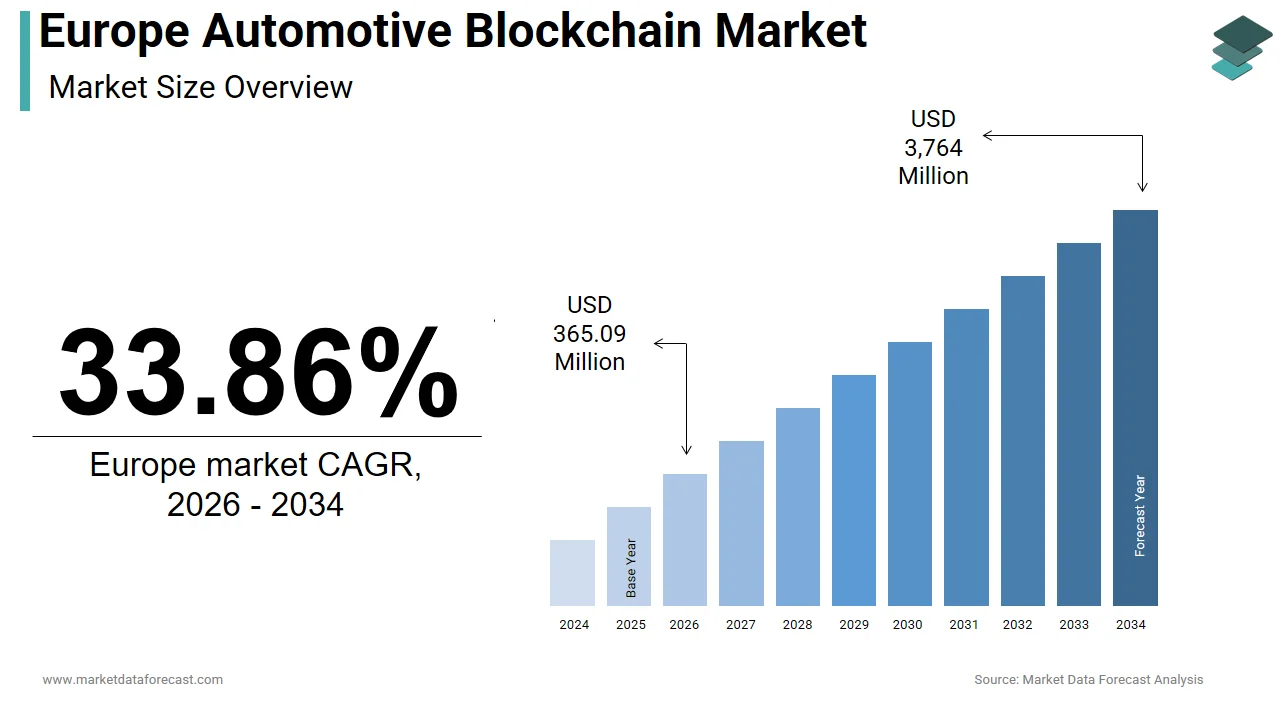
The Europe automotive blockchain market was valued at USD 272.74 million in 2025, is estimated to reach USD 365.09 million in 2026, and is projected to reach USD 3,764 million by 2034, growing at an exceptionally strong CAGR of 33.86% from 2026 to 2034. Market growth is driven by the increasing digitalization of mobility services, rising demand for secure data exchange across automotive ecosystems, and expanding use of blockchain for supply chain transparency, vehicle lifecycle tracking, and smart mobility applications. Regulatory support for digital innovation, the growth of connected and autonomous vehicles, and strong enterprise investment in distributed ledger technologies are further accelerating blockchain adoption across Europe’s automotive sector.
Key Market Trends
- Growing emphasis on secure and transparent automotive supply chains through blockchain-enabled traceability.
- Rising use of smart contracts for mobility services, EV charging, insurance automation, and vehicle leasing.
- Expansion of blockchain-based vehicle identity management for authentication, safety, and data security.
- Increasing collaboration between automotive OEMs and blockchain technology providers for connected mobility solutions.
- Strong push from governments toward digital sovereignty, cybersecurity, and data compliance, supporting blockchain adoption.
Segmental Insights
- Based on application, the supply chain segment held the largest share of the Europe automotive blockchain market in 2024 at 37.7%, driven by the need for real-time visibility, counterfeit prevention, and end-to-end traceability across automotive components and manufacturing workflows.
- Based on provider, the application and solution providers segment dominated the regional market in 2024 with a 45.5% share. Their leadership stems from their role in delivering tailored blockchain platforms, decentralized applications, and integration frameworks for OEMs and mobility operators.
- Based on mobility type, the personal mobility segment accounted for 40.9% of the market in 2024, supported by rising adoption of blockchain for car-sharing platforms, subscription-based vehicle access, user authentication, and secure mobility transactions.
Regional Insights
The Europe automotive blockchain market is experiencing robust growth across major countries, fueled by digital innovation in mobility, strong government support for secure data infrastructure, and rapid advancements in connected vehicle ecosystems.
- Germany was the leading market, accounting for 23.9% share in 2024, driven by its strong automotive manufacturing base, advanced R&D investments, and early adoption of blockchain-enabled mobility solutions.
- France captured a substantial share in 2024, supported by state-led digital sovereignty policies and Renault Group’s strategic blockchain initiatives across the supply chain, traceability, and vehicle lifecycle management.
- The United Kingdom is expected to secure a promising share over the forecast period, backed by an agile regulatory sandbox environment and a thriving ecosystem of mobility and blockchain startups.
- Sweden is projected to witness a notable CAGR, supported by strong innovation in connected mobility, sustainability-focused transport systems, and early experimentation with distributed ledger technologies.
Competitive Landscape
The Europe automotive blockchain market is shaped by a blend of global technology leaders, automotive manufacturers, and blockchain-focused startups offering decentralized solutions for mobility, data security, and supply chain automation. Companies are expanding strategic partnerships, enhancing interoperable blockchain platforms, and integrating smart contract capabilities to support next-generation mobility ecosystems. Emphasis on cybersecurity, transparent automotive manufacturing, and connected vehicle data management is strengthening competition across the regional landscape.
Prominent companies in the Europe automotive blockchain market include Microsoft, BigchainDB GmbH, BMW Group, Bosch Mobility Solutions, IBM Corporation, ShiftMobility Inc., Accenture, Tech Mahindra Limited, GEM, HCL Technologies Limited, Renault Group, NXM Labs, Inc., CONSENSYS, and others.
Europe Automotive Blockchain Market Size
The size of the Europe automotive blockchain market was worth USD 272.74 million in 2025. The regional market is anticipated to grow at a CAGR of 33.86% from 2026 to 2034 and be worth USD 3,764 million by 2034 from USD 365.09 million in 2026.
Automotive blockchain is the deployment of distributed ledger technologies to establish secure, transparent, and immutable data flows across the automotive value chain within the European Union and associated countries. Unlike conventional digital record systems, blockchain in this context enables verifiable vehicle histories, authenticated parts provenance, automated smart contracts for mobility services, and tamper-proof audit trails aligned with EU regulatory imperatives. In 2024, several automotive manufacturers and mobility providers across Europe were actively running blockchain pilots focused on vehicle lifecycle management and supply chain integrity. A critical impetus stems from the European Environment Agency’s finding that a significant share of end-of-life vehicles in the EU contain undocumented or counterfeit components, which is creating urgent demand for traceability solutions. Furthermore, the EU’s forthcoming Digital Product Passport initiative, which is set to apply to vehicles by 2027, mandates comprehensive digital documentation of materials, emissions, and maintenance, which is positioning blockchain as a foundational enabler of regulatory compliance in a data sovereign and privacy-conscious environment.
MARKET DRIVERS
Demand for Transparent and Secure Vehicle Identity Management
European automakers are increasingly mandated to establish immutable digital identities for vehicles throughout their operational lifespan, which is one of the major factors propelling the European automotive blockchain market growth. This requirement is driven by consumer trust deficits in second-hand markets and emerging EU legislation like the revised End of Life Vehicles Regulation, which will enforce digital vehicle passports from 2027. According to the European Commission, approximately 6 million vehicles reach the end of life annually in the EU, yet many possess incomplete or unverifiable service records. According to the German Insurance Association, over 120 million euros in insurance losses in 2023 were due to vehicle identity manipulation. Blockchain resolves this by anchoring key events on permissioned ledgers accessible only to authorized stakeholders. BMW’s “Verified History” platform and Renault’s blockchain-based maintenance ledger exemplify proactive industry responses. Moreover, the EU’s circular economy action plan demands high levels of material traceability by vehicle weight, a target unattainable without decentralized and tamper-proof tracking systems that blockchain uniquely provides across fragmented supplier ecosystems.
Integration of Electrified and Connected Mobility Ecosystems
The rapid transition of Europe to electric and connected mobility requires interoperable, secure data exchange infrastructures that blockchain can provide, which is further contributing to the European automotive blockchain market expansion. As of 2024, Europe hosted around 630,000 public EV charging points, yet interoperability gaps persist. As per the European Alternative Fuels Observatory, cross-border charging sessions grew significantly between 2022 and 2024, but many failed due to incompatible authentication systems. Blockchain enables tokenized, real-time settlement between drivers, charge point operators, and energy providers through smart contracts, eliminating billing disputes and manual reconciliation. According to the International Energy Agency, Europe’s EV fleet exceeded 14 million units in 2024, which is generating vast volumes of telemetry requiring trusted sharing for grid balancing, predictive maintenance, and usage-based insurance. Without a neutral, decentralized layer, such data remains siloed or vulnerable to centralized breaches. Initiatives like the EBSI Mobility Working Group are advancing standardized blockchain protocols to unify this landscape, which is ensuring that EV expansion does not outpace the integrity of its underlying digital infrastructure.
MARKET RESTRAINTS
Fragmented Regulatory and Technical Standards Across EU Member States
Despite overarching EU digital strategies, national interpretations of blockchain legality, data governance, and smart contract enforceability vary significantly, which is restraining the growth of the European automotive blockchain market. As per the European Union Agency for Cybersecurity, several EU countries had implemented national blockchain strategies with automotive relevance by 2024. This regulatory patchwork forces manufacturers to customize blockchain deployments per country, which is escalating costs and complexity. The absence of unified data schemas under frameworks like Gaia X further impedes cross-platform communication. According to a 2023 Fraunhofer Institute study, many automotive blockchain pilots remained confined to single jurisdictions due to technical and legal incompatibilities. Additionally, while the Digital Operational Resilience Act addresses ICT risk for critical sectors, it omits specific provisions for decentralized automotive data systems, leaving liability and audit pathways undefined. Until the EU harmonizes blockchain governance, scalable and pan-European solutions will remain elusive.
High Computational and Energy Demands of Ledger Operations
The resource intensity of Europe conflicts with the automotive industry’s sustainability mandates under the EU’s Fit for 55 agenda, which is also hindering the automotive blockchain market growth in Europe. Blockchain data centers in Europe consumed significant electricity in 2024, with automotive applications contributing a notable share of that load. Even permissioned ledgers require substantial processing for consensus, especially when tracking thousands of parts across global supply chains in real time. Onboard vehicle systems lack the capacity to host full nodes, which requires cloud reliance that introduces latency and cybersecurity risks. As per a 2024 Capgemini Research Institute survey, a majority of European automotive executives ranked energy inefficiency as a top barrier to adoption, surpassing cost. Until lightweight consensus mechanisms or edge-compatible protocols mature, blockchain’s scalability across mass vehicle fleets remains constrained by physics and policy.
MARKET OPPORTUNITIES
Circular Economy Mandates Driving Blockchain-Based Material Traceability
The EU’s aggressive circular economy targets create a structural opportunity for blockchain in automotive material tracking. The revised End of Life Vehicles Directive will require 95 per cent vehicle material recovery by 2035, which is an up from 85 per cent currently. Simultaneously, the Battery Passport regulation mandates digital records for all EV batteries sold in the EU, which detail carbon footprint, recycled content, and performance history. Many EU automakers initiated blockchain pilots in 2024 to meet these obligations. Volvo’s collaboration with Circulor achieved high data accuracy in tracing cobalt across multiple supplier tiers using blockchain. According to Eurostat, Europe generated millions of tons of automotive shredder residue in 2023, much of it unidentifiable. Blockchain-embedded digital twins can resolve this by linking each component to its material composition at origin, which enables automated and high-value recycling. The EU’s Critical Raw Materials Act further amplifies this opportunity and positions blockchain as the audit backbone of sustainable manufacturing.
Growth of Mobility as a Service Platforms Requiring Decentralized Trust Layers
The European Mobility as a Service (MaaS) sector, now active in over 150 cities and serving more than 22 million users, demands secure, privacy-preserving data exchange among diverse operators, which provides a promising opportunity for the European market. The European Urban Mobility Observatory reported this expansion in 2024, yet data silos and trust deficits hinder seamless integration. Blockchain enables zero-knowledge proofs and selective data disclosure, allowing mobility providers to share verified user behavior without exposing personal identifiers, thus complying with the General Data Protection Regulation. As per a Helsinki pilot backed by the Finnish Transport Agency, reduced data reconciliation errors across six operators using a shared ledger. Additionally, as per the European Investment Bank, a significant share of the 4.3 billion euros invested in European MaaS in 2023 targeted digital infrastructure. With the EU’s Digital Transport and Logistics Forum advocating for decentralized identity frameworks by 2026, blockchain is poised to underpin next-generation MaaS ecosystems that balance interoperability, user sovereignty, and commercial viability.
MARKET CHALLENGES
Scalability Limitations Under Real World Automotive Workloads
Current blockchain architectures struggle to meet the high throughput and low latency demands of modern automotive operations, which is one of the significant challenges to the European automotive blockchain market. Vehicles generate large volumes of data per hour, and supply chains can trigger transaction bursts during peak production. Yet, leading enterprise blockchains process only a few thousand transactions per second under optimal conditions. Field trials have shown that blockchain-based component verification can add latency per part. Onboard systems cannot host full nodes, forcing reliance on cloud validators that introduce connectivity dependencies and single points of failure. Many blockchain pilots were scaled back in 2024 due to unmet performance thresholds. Until layer two scaling solutions or edge-optimized protocols become production-ready, blockchain remains unsuitable for time-critical automotive functions.
Ambiguity in Liability Allocation Within Decentralized Data Ecosystems
The distributed nature of blockchain creates legal uncertainty regarding accountability when data errors or system failures occur, which further challenges the regional market growth. Under the General Data Protection Regulation, data controllers bear clear obligations, but in a multi-party automotive ledger where manufacturers, suppliers, and service providers jointly validate records, no single entity qualifies as the controller. Many EU member states currently lack jurisprudence on liability in decentralized environments. This gap deters deployment in safety-critical domains, as if incorrect sensor calibration recorded on a blockchain contributed to an autonomous vehicle crash, courts would face novel questions of fault allocation. The EU’s 2023 AI Liability Directive does not address decentralized systems, which leaves a governance vacuum. For instance, a majority of automotive legal teams restrict blockchain use to non-safety applications due to this ambiguity. Regulatory clarity on roles and responsibilities is essential before blockchain can anchor core vehicle operations.
REPORT COVERAGE
| REPORT METRIC | DETAILS |
| Market Size Available | 2025 to 2034 |
| Base Year | 202 |
| Forecast Period | 2026 to 2034 |
| Segments Covered | By Application, Provider, Mobility Type, and County. |
| Various Analyses Covered | Global, Regional, and Country-Level Analysis, Segment-Level Analysis, Drivers, Restraints, Opportunities, Challenges; PESTLE Analysis; Porter’s Five Forces Analysis, Competitive Landscape, Analyst Overview of Investment Opportunities |
| Countries Covered | UK, France, Spain, Germany, Italy, Russia, Sweden, Denmark, Switzerland, Netherlands, Turkey, Czech Republic, and the Rest of Europe. |
| Market Leaders Profiled | Microsoft, BigchainDB GmbH, BMW Group, Bosch Mobility Solutions, IBM Corporation, ShiftMobility Inc., Accenture, Tech Mahindra Limited, GEM, HCL Technologies Limited, Renault Group, NXM Labs, Inc., CONSENSYS, and Others. |
SEGMENTAL ANALYSIS
By Application Insights
The supply chain segment occupied 37.7% of the European automotive blockchain market share in 2024. The dominance of the supply chain segment in the European market is attributed to the urgent need to enhance transparency and traceability across multi-tier automotive supplier networks, strained by geopolitical disruptions and regulatory tightening. The European Union’s 2023 Critical Raw Materials Act requires manufacturers to verify the origin of strategic inputs like lithium and cobalt, which is pushing blockchain adoption for real-time and tamper-proof sourcing records. BMW Group’s partnership with Circulor to trace cobalt from mines to battery cells showcased operational efficiency gains. Furthermore, according to Eurostat, counterfeit automotive parts cost EU economies billions of euros annually, with blockchain offering cryptographic verification to combat fraud. The European Commission’s 2024 Supply Chain Due Diligence Directive mandates human rights and environmental audits across value chains, compelling OEMs to implement immutable ledger systems that log every transaction from raw material extraction to final assembly. These regulatory and operational imperatives solidify supply chain traceability as the cornerstone application of blockchain in Europe’s automotive sector.
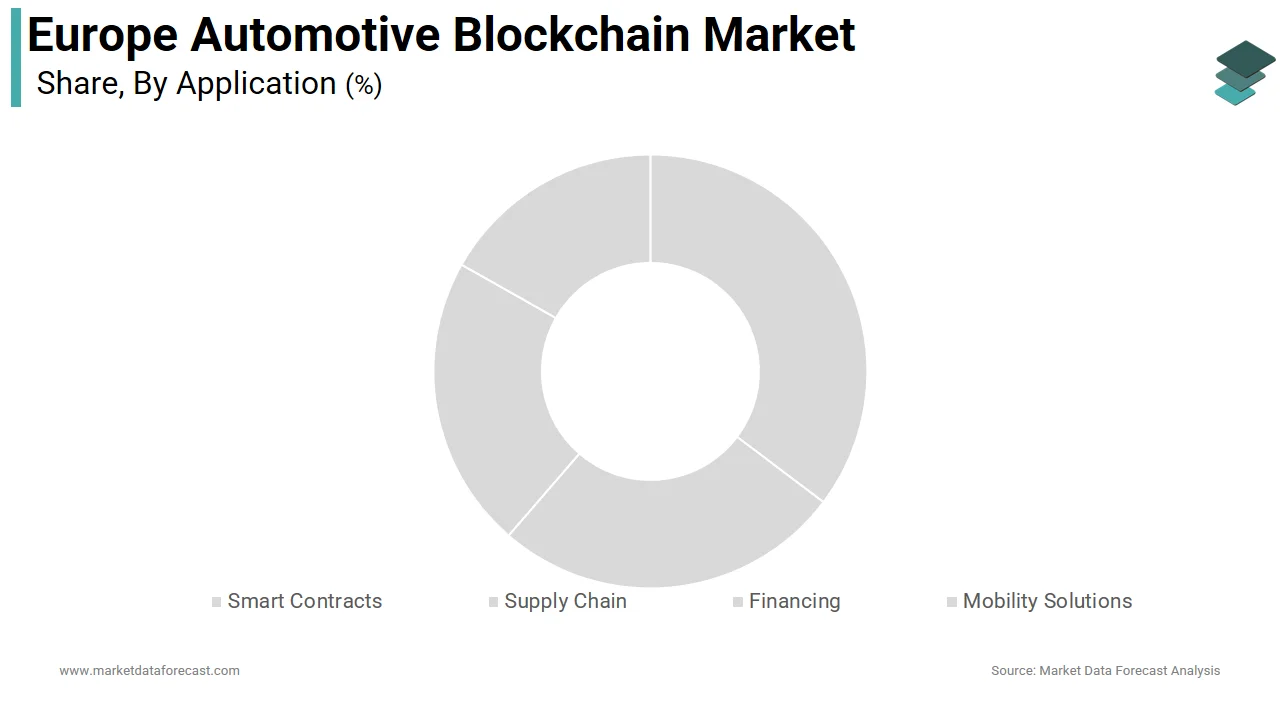
The mobility solutions segment is anticipated to grow at the fastest CAGR of 30.9% over the forecast period in the regional market, owing to the continent’s aggressive shift toward integrated, user-centric transportation ecosystems under the EU Mobility Package. Over 150 European cities now operate Mobility as a Service platforms, serving millions of users in 2024, yet interoperability between ride-hailing, car sharing, and public transit providers remains fragile. Blockchain enables decentralized identity management and automated micropayments through smart contracts, eliminating reliance on centralized intermediaries. As per a Helsinki-based trial supported by the Finnish Transport Agency, a reduction in billing disputes among six mobility operators was achieved using a shared permissioned ledger. Additionally, the European Investment Bank allocated billions of euros in 2023 specifically for digital mobility infrastructure, with blockchain cited as a core enabler in many funded projects. As urban congestion and emissions targets tighten, blockchain-based mobility platforms offer scalable, auditable, and privacy-compliant frameworks to unify fragmented services into seamless user experiences.
By Provider Insights
The application and solution providers segment dominated the market by accounting for 45.5% of the regional market share in 2024. The growth of the application and solution providers segment in the European market is driven by automakers’ preference for turnkey, industry-specific blockchain deployments over building infrastructure from scratch. Companies like R3, VeChain, and Bosch Mobility Solutions deliver pre-configured modules for vehicle history tracking, warranty validation, and parts authentication that integrate with existing enterprise resource planning systems. According to the European Automobile Manufacturers Association, many OEMs lack in-house blockchain development capacity, which is making third-party solutions essential for rapid pilot scaling. Furthermore, the EU’s Digital Europe Programme allocated millions of euros in 2023 to support application layer innovation in transport, with automotive use cases receiving a significant share. A joint initiative between Renault and Microsoft Azure Blockchain enabled real-time recall management across multiple European markets, reducing notification time from days to under 48 hours. As regulatory complexity grows, specialized solution providers offer compliant, auditable architectures that balance functionality with legal adherence, which is likely to contribute to the expansion of the application and solution providers segment in the European market.
The middleware providers segment is the fastest-growing segment in the Europe automotive blockchain market and is predicted to witness a CAGR of 30.5% over the forecast period, owing to the industry’s shift from isolated pilots to interoperable, multi-ecosystem deployments requiring standardized communication layers between heterogeneous ledgers and legacy IT systems. Middleware acts as the translation engine that connects blockchain networks with telematics platforms, supplier databases, and regulatory reporting tools without exposing core data logic. The Gaia X framework identified middleware as critical for cross-sectoral data spaces, with automotive listed as a priority vertical. In 2023, the German Federal Ministry for Economic Affairs funded several middleware startups under its “Blockchain in Mobility” grant program, which is citing their role in enabling real-time data validation across numerous Tier 2 suppliers. According to Capgemini Research Institute, a majority of European automakers plan to adopt blockchain middleware by 2026 to future-proof against vendor lock-in and support evolving EU data governance standards. As blockchain moves from single use cases to enterprise-wide integration, middleware becomes the indispensable connective tissue.
By Mobility Type Insights
The personal mobility segment accounted for 40.9% of the European automotive blockchain market in 2024. The dominance of the personal mobility segment in the European market is attributed to the concentration of blockchain use cases in individual vehicle ownership contexts, including digital vehicle passports, maintenance history verification, and insurance fraud prevention. There are over 250 million light-duty vehicles registered in the EU, with the majority under private ownership, which is creating a vast addressable base for blockchain-enabled services. According to the German Federal Motor Transport Authority, a notable share of used car transactions in 2023 involved concealed accident history, driving demand for tamper-proof digital records. Automakers like Mercedes-Benz have embedded blockchain-based vehicle identity systems in new models sold across Western Europe, which is allowing owners to share verified service data with dealers or insurers via secure APIs. Additionally, the European Commission’s push for standardized On Board Diagnostics data access under the revised Type Approval Regulation facilitates blockchain integration for real-time health monitoring. As consumers increasingly view vehicle data as personal property, blockchain provides the cryptographic assurance needed to assert data ownership without sacrificing utility, which is propelling the dominance of the personal mobility segment in the European market.
The shared mobility segment is anticipated to register a promising CAGR of 31.6% over the forecast period in the European automotive blockchain market, owing to the urban policy shifts favouring fleet-based transportation over private car ownership. The European Commission’s Urban Mobility Framework targets a significant reduction in private vehicle use in cities with over 100,000 residents by 2030, accelerating investment in shared fleets. Blockchain addresses core operational pain points: identity portability across platforms, dynamic pricing transparency, and usage-based insurance. In Paris, a blockchain-enabled car-sharing consortium reduced customer onboarding time by enabling reusable digital identities compliant with the General Data Protection Regulation. Furthermore, Eurostat data shows that shared mobility fleets in Europe grew in 2023, reaching millions of vehicles, yet many operate on incompatible backend systems. Blockchain’s ability to standardize data exchange across operators like Share Now, Free2Move, and local municipal services creates a unified trust layer essential for scaling. As cities mandate open data access for shared mobility providers under the Digital Transport and Logistics Forum guidelines, blockchain becomes the neutral infrastructure for compliant, auditable, and interoperable urban mobility networks.
COUNTRY LEVEL ANALYSIS
Germany Automotive Blockchain Market Analysis
Germany had 23.9% of the European automotive blockchain market in 2024 and emerged as the most dominating regional segment. The dominating position of Germany in the European market is driven by its position as the continent’s automotive engineering hub and early adoption of digital traceability mandates. Home to Volkswagen, BMW, and Mercedes-Benz, the country has institutionalized blockchain through national initiatives like the “Blockchain Strategy for Mobility” launched by the Federal Ministry for Digital and Transport in 2022. Among German companies, 6.9% are currently using or planning to use blockchain technology for their business processes, primarily in supply chain provenance and vehicle identity management. The country’s enforcement of the End of Life Vehicles Directive has catalyzed partnerships such as BMW’s blockchain-based battery passport with Circulor. Germany is also actively participating in the European Blockchain Sandbox initiative, enabling real-world regulatory testing. Significant investments in automotive digitalization continue to strengthen Germany’s market leadership, reflecting both industrial scale and regulatory foresight, which is positioning it as the primary innovation engine for blockchain in European automotive ecosystems.
France Automotive Blockchain Market Analysis
France captured a substantial share of the Europe automotive blockchain market in 2024 due to the strong state-led digital sovereignty policies and Renault Group’s strategic blockchain investments. The French government’s “France 2030” investment plan allocated 1.2 billion euros to secure and sovereign digital technologies, with automotive blockchain designated as a national priority. The EU Battery Regulation requires digital passports for electric vehicle batteries, and Renault has begun implementing this using blockchain solutions. France also leads in public-private blockchain consortia: the Mobilité Blockchain France initiative unites Renault, PSA, energy provider TotalEnergies, and infrastructure operator IZIVIA to standardize EV charging data on a shared ledger. Growing consumer demand for transparent vehicle histories is driving OEM adoption of immutable maintenance logs. With Paris targeting a ban on internal combustion vehicles by 2035 and Lyon expanding its Mobility as a Service coverage, France’s regulatory ambition and industrial alignment create a fertile ground for blockchain integration across personal and shared mobility segments.
United Kingdom Automotive Blockchain Market Analysis
The United Kingdom is anticipated to account for a promising share of the European automotive blockchain market over the forecast period, owing to its agile regulatory sandbox environment and concentration of mobility tech startups. Despite its post-Brexit status, the UK remains deeply integrated into European automotive data flows through the Digital Trade Framework. Jaguar Land Rover’s partnership with IOTA for vehicle-generated data monetization and Ford’s London-based car-sharing blockchain pilot exemplify OEM engagement. The UK’s Department for Transport has announced plans to introduce digital service histories for new vehicles from 2025, a rule expected to accelerate blockchain adoption among domestic dealerships. According to the Society of Motor Manufacturers and Traders, over 2.1 million used vehicles changed hands in the UK in 2023. London’s congestion charge and ultra-low emission zone further incentivize shared and electric mobility, where blockchain enables dynamic pricing and compliance verification. The UK’s blend of regulatory experimentation, tech entrepreneurship, and automotive legacy sustains its position as a key Western European node in the blockchain mobility network.
Sweden Automotive Blockchain Market Analysis
Sweden is predicted to witness a notable CAGR in the Europe automotive blockchain market during the forecast period. Sweden is emerging as a Nordic leader through its commitment to green mobility and digital public infrastructure. The Swedish Transport Administration mandates full lifecycle documentation for all vehicles sold domestically from 2026, aligning with the EU’s circular economy goals and accelerating blockchain adoption among domestic OEMs like Volvo Cars. According to Statistics Sweden, over 60 per cent of new passenger vehicles sold in 2024 were either hybrid or fully electric, creating demand for battery traceability solutions. Volvo’s blockchain collaboration with Circulor to verify cobalt and lithium sources supports improved supply chain transparency. Sweden’s national digital identity system, BankID, integrates seamlessly with automotive blockchain applications, enabling secure user authentication for car sharing and insurance services. The Swedish Energy Agency reported that around 98 per cent of the country’s electricity comes from renewable sources, making blockchain-based green charging certificates a viable market product. With Gothenburg piloting a city-wide Mobility as a Service platform using distributed ledger technology and the government targeting fossil-free vehicle fleets by 2030, Sweden’s market position reflects its fusion of sustainability policy, digital maturity, and automotive innovation.
Italy Automotive Blockchain Market Analysis
Italy is estimated to exhibit a healthy CAGR in the Europe automotive blockchain market during the forecast period due to its robust luxury and performance vehicle sector and rising demand for anti-counterfeiting solutions in the used car market. The Italian National Institute of Statistics reported that over 38 million vehicles are registered in the country, creating fertile ground for blockchain-based vehicle history verification. Ferrari and Lamborghini have initiated blockchain pilots to authenticate limited edition models and track maintenance records, preserving resale value in a market where provenance directly influences price. Counterfeit parts cost the domestic industry hundreds of millions of euros annually, prompting OEMs like Stellantis to adopt Hyperledger Fabric for parts traceability across its Melfi and Pomigliano plants. Italy’s National Recovery and Resilience Plan allocates 2.4 billion euros to digital transport innovation, with blockchain receiving dedicated funding under the “Smart Mobility” pillar. Milan’s congestion charge zone and Rome’s upcoming low-emission zone further incentivize shared electric mobility, where blockchain enables transparent usage tracking and automated payments. Italy’s unique blend of high-value vehicle manufacturing and regulatory modernization positions it as a strategic Southern European hub for automotive blockchain deployment.
COMPETITIVE LANDSCAPE
The Europe automotive blockchain market features intense but collaborative competition among automakers, technology providers, and infrastructure enablers. Unlike winner-take-all digital markets competition, here it is defined by consortium building, standard setting, and regulatory co-innovation rather than direct product rivalry. Established OEMs like BMW and Renault leverage their scale to drive adoption across supplier networks, while specialized solution providers such as Bosch and R3 offer modular tools that meet stringent EU data governance requirements. New entrants face high barriers due to the need for domain expertise in both automotive engineering and distributed ledger design, yet opportunities exist in niche areas like battery passporting and Mobility as a Service integration. The European Commission’s active role through funding sandboxes and policy frameworks ensures no single entity dominates, fostering an ecosystem where interoperability and compliance outweigh proprietary control. This dynamic encourages continuous innovation while maintaining a focus on public interest objectives such as circularity, transparency, and digital sovereignty.
KEY MARKET PLAYERS
The leading companies operating in the Europe automotive blockchain market include:
- Microsoft
- BigchainDB GmbH
- BMW Group
- Bosch Mobility Solutions
- IBM Corporation
- ShiftMobility Inc.
- Accenture
- Tech Mahindra Limited
- GEM
- HCL Technologies Limited
- Renault Group
- NXM Labs, Inc.
- CONSENSYS
TOP PLAYERS IN THE MARKET
- BMW Group has established itself as a pioneer in deploying blockchain technology across its European automotive operations with a focus on supply chain transparency and circular economy compliance. The company launched its “Verified History” platform, enabling tamper-proof vehicle service records accessible to owners and service centers. In 2024, BMW expanded its partnership with Circulor to trace battery raw materials across multiple tiers using a permissioned ledger, ensuring adherence to the EU Battery Regulation. The automaker also participates in the European Blockchain Partnership’s mobility working group, shaping cross-border data standards. BMW’s integration of blockchain into its digital vehicle passport initiative demonstrates its commitment to regulatory alignment and consumer trust in used car markets across Germany, France, and the Netherlands.
- Renault Group actively leverages blockchain to enhance vehicle identity management and electrified mobility services throughout Europe. The company deployed a blockchain-based maintenance ledger that securely logs all service interventions across its dealer network ensuring data integrity for warranty and resale purposes. In early 2024, Renault collaborated with Microsoft Azure Blockchain to accelerate recall notifications, reducing response time from weeks to under forty-eight hours. Renault also co-founded the Mobilité Blockchain France consortium uniting energy providers, charging operators, and OEMs to standardize EV data exchange. Its strategic alignment with the EU’s Digital Product Passport framework and focus on second-life battery tracking position Renault as a key enabler of sustainable and transparent automotive ecosystems in Southern and Western Europe.
- Bosch Mobility Solutions plays a critical role in the Europe automotive blockchain market by providing application layer software that bridges vehicle systems with decentralized ledgers. The company offers modular blockchain solutions for parts authentication, predictive maintenance, and usage-based insurance tailored to European OEMs and Tier one suppliers. In 2024, Bosch integrated its IoT sensors with Ethereum-based smart contracts, enabling real-time vehicle health monitoring and automated service scheduling. It also joined the Gaia X automotive data space initiative to ensure its blockchain tools comply with EU data sovereignty requirements. Bosch’s focus on interoperability, privacy, privacy-preserving computation, and regulatory alignment allows it to serve as a trusted technology enabler for both legacy automakers and new mobility entrants across the region.
TOP STRATEGIES USED BY THE KEY MARKET PARTICIPANTS
Key players in the Europe automotive blockchain market primarily pursue strategic partnerships with technology providers to co-develop industry-specific solutions that comply with evolving EU regulations. They actively participate in public-private consortia such as the European Blockchain Partnership and Gaia X to shape interoperability standards and accelerate regulatory acceptance. Companies invest in pilot programs focused on battery traceability, vehicle identity, and mobility data exchange to demonstrate real-world viability and secure government funding. They integrate blockchain with existing IoT and cloud infrastructure to minimize disruption to legacy systems while enhancing data security. Additionally, leading firms prioritize General Data Protection Regulation-compliant architectures using zero-knowledge proofs and permissioned ledgers to balance transparency with user privacy in personal and shared mobility applications.
MARKET SEGMENTATION
This research report on the Europe automotive blockchain market has been segmented and sub-segmented into the following categories.
By Application
- Smart Contracts
- Supply Chain
- Financing
- Mobility Solutions
- Others
By Provider
- Middleware
- Infrastructure and Protocols
- Application and Solution
By Mobility Type
- Personal Mobility
- Shared Mobility
- Commercial Mobility
By Country
- United Kingdom
- France
- Spain
- Germany
- Italy
- Russia
- Sweden
- Denmark
- Switzerland
- Netherlands
- Rest of Europe
Frequently Asked Questions
1. What is the Europe automotive blockchain market?
The Europe automotive blockchain market involves blockchain tech adoption in vehicles for security, supply chain, and EV integration, growing rapidly with government support
2. What drives growth in the Europe automotive blockchain market?
Growth in the Europe automotive blockchain market is driven by rising EV adoption, regulatory mandates, and demand for secure vehicle data management
3. Which countries dominate the Europe automotive blockchain market?
Germany, UK, and France lead the Europe automotive blockchain market, fueled by strong automotive sectors and blockchain innovation initiatives
4. How does blockchain improve vehicle security in Europe?
Blockchain enhances vehicle security in the Europe automotive blockchain market by enabling tamper-proof software updates and secure data exchanges
5. What role do smart contracts play in the Europe automotive blockchain market?
Smart contracts automate processes like payments and servicing in the Europe automotive blockchain market, improving efficiency and trust
6. How is blockchain used in the Europe automotive supply chain market?
Blockchain ensures transparency and traceability across the supply chain in the Europe automotive blockchain market, reducing fraud and errors
7. What impact do EU regulations have on the Europe automotive blockchain market?
EU regulations promoting sustainability and data security accelerate blockchain adoption in the Europe automotive blockchain market
8. How does the Europe automotive blockchain market support electric vehicles?
Blockchain supports electric vehicle battery tracking and charging infrastructure management in the Europe automotive blockchain market
9. What challenges affect the Europe automotive blockchain market?
Key challenges include integration with legacy systems and ensuring blockchain scalability in the Europe automotive blockchain market
10. How are car manufacturers collaborating in the Europe automotive blockchain market?
Automakers in Europe collaborate on data-sharing platforms using blockchain to enhance vehicle lifecycle management in the Europe automotive blockchain market
Related Reports
Access the study in MULTIPLE FORMATS
Purchase options starting from
$ 2000
Didn’t find what you’re looking for?
TALK TO OUR ANALYST TEAM
Need something within your budget?
NO WORRIES! WE GOT YOU COVERED!
Call us on: +1 888 702 9696 (U.S Toll Free)
Write to us: sales@marketdataforecast.com