- Product Description Description
- Table of Contents TOC
- List of Table & Figure LOT
- Get Free Sample PDF Sample PDF
Market Size, 2025
$60.06 BnMarket Estimate, 2026
$63.31 BnMarket Forecast, 2034
$96.50 BnCAGR, 2026–2034
5.41%Europe Clinical Laboratory Tests Market Size
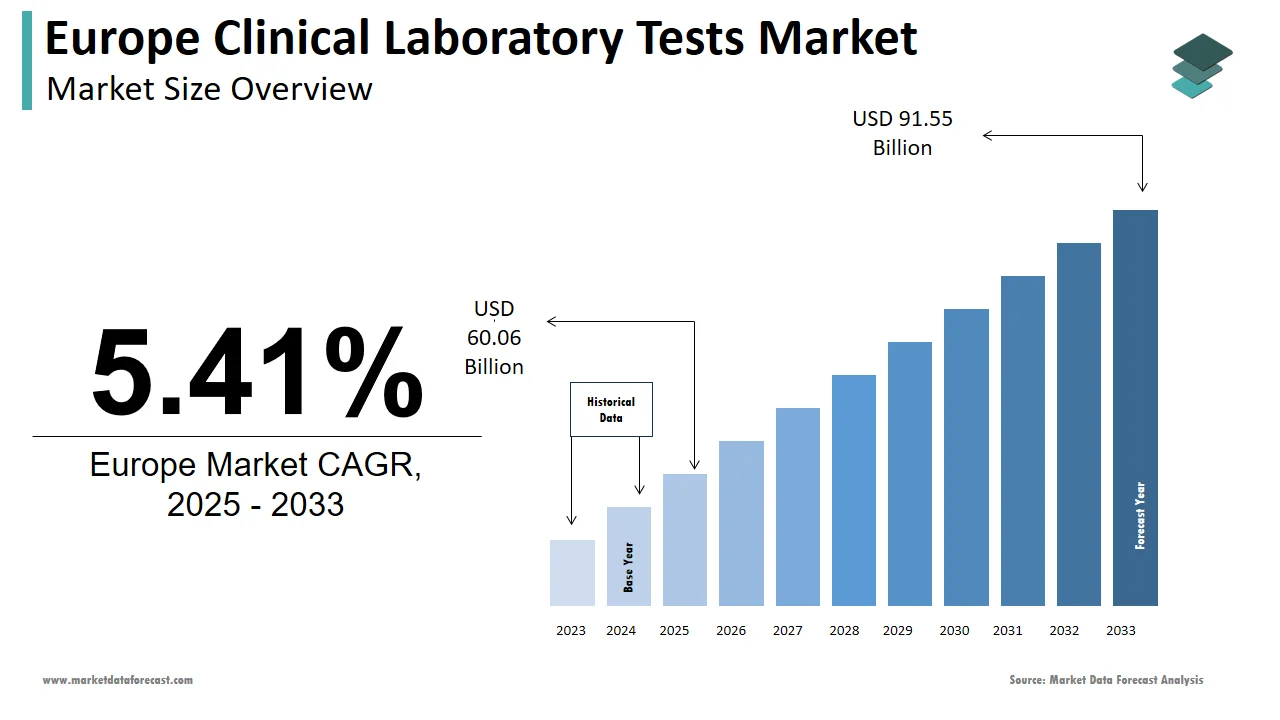
The clinical laboratory tests market size in Europe was valued at USD 60.06 billion in 2025. The European market is estimated to be worth USD 96.50 billion by 2034 from USD 63.31 billion in 2026, growing at a CAGR of 5.41% from 2026 to 2034.
Clinical Laboratory Tests refers to the diagnostic procedures performed on biological specimens to support clinical decision-making across preventive, curative, and chronic care settings. These tests include clinical chemistry, hematology, microbiology, immunodiagnostics, and molecular diagnostics, delivered through hospital laboratories, independent diagnostic centers, and academic institutions. Laboratory data informs a portion of all clinical decisions in the European Union, according to sources. As per research, European healthcare systems collectively conduct a large number of diagnostic tests annually, which reflects the deep integration of laboratory medicine into national health infrastructures. The changing landscape of healthcare, marked by an aging population, rising multimorbidity, and digital advancements, has transformed clinical labs from mere testing facilities into active partners in precision medicine and population health.
MARKET DRIVERS
Rising Burden of Chronic and Infectious Diseases Fuels Diagnostic Demand
Rising burden of chronic and infectious diseases fuels diagnostic tests, escalating the growth of the Europe clinical laboratory tests market. Non-communicable diseases are the leading cause of death across Europe, according to sources. This epidemiological shift has intensified reliance on routine and specialized laboratory monitoring. A large number of people in the European Union are living with diabetes or prediabetes, as per research. Simultaneously, antimicrobial resistance remains a critical public health threat. The European Centre for Disease Prevention and Control (ECDC) released figures in 2022 stating that in 2020, there were over 670,000 resistant infections in EU/EEA countries, leading to more than 33,000 deaths annually. The dual pressure of managing long-term chronic conditions and responding to emerging infectious threats has elevated clinical laboratories to central roles in both individual care pathways and national surveillance systems. Consequently, diagnostic testing is no longer ancillary but foundational to Europe’s healthcare resilience and responsiveness.
Advancements in Diagnostic Technologies Enhance Testing Capabilities
Technological innovation is redefining the efficiency, scope, and accessibility of laboratory diagnostics, which further boosts the expansion of the Europe clinical laboratory tests market. Automation, digital pathology, and next-generation sequencing have significantly improved analytical precision and workflow throughput. According to sources, a majority of laboratories across Europe have adopted digital workflow systems, which have improved efficiency and accuracy in testing processes. As per research, a wide range of genetic tests are now available in Western Europe, allowing early identification of hereditary and metabolic conditions. Point-of-care testing has also expanded. According to sources, decentralized diagnostic testing has become a major component of primary healthcare, especially for heart and respiratory conditions. These advancements not only enhance diagnostic accuracy but also support integrated care models by enabling real-time decision support at the point of care, and thereby supporting the laboratory’s strategic value in modern health systems.
MARKET RESTRAINTS
Stringent Regulatory Frameworks Impede Market Agility
Stringent regulatory frameworks are degrading the growth of the Europe clinical laboratory tests market. The European Union’s In Vitro Diagnostic Regulation, fully applicable since May 2022, has introduced rigorous conformity assessment pathways that significantly affect laboratory-developed tests and legacy assays. According to sources, 80-90% percent of existing in vitro diagnostic products required recertification under the new regime, causing delays in test availability and increasing compliance costs. National divergences in accreditation standards further complicate harmonization; for example, a test validated in Germany may not meet evidentiary thresholds in Poland or Greece. As per the European Federation of Laboratory Medicine, nearly 40 percent of small and medium-sized laboratories lack the administrative capacity to navigate the updated documentation and personnel qualification requirements. Despite improving patient safety and test reliability, these regulations unintentionally hinder the fast-paced development of novel diagnostics, particularly in areas like liquid biopsy and multi-analyte algorithms, thus slowing the sector's response to new clinical needs.
Workforce Shortages and Skill Gaps Constrain Operational Capacity
Region faces a shortfall in qualified laboratory professionals, which affects the sustainability of diagnostic services, and thereby hinders the expansion of the Europe clinical laboratory tests market. There is a considerable shortage of medical laboratory professionals across the European region, according to sources. Germany faces a significant demand for additional laboratory technicians to address current workforce needs, as per research. Compounding this issue, the rapid pace of technological change demands continuous upskilling, yet only a limited number of laboratories in Europe provide structured continuing education or skill development programs, according to sources. This mismatch between workforce competencies and diagnostic complexity increases the risk of analytical errors, particularly in high complexity areas such as flow cytometry and genomic variant interpretation. Escalating test volumes and technological advancements could undermine the service quality of Europe's laboratory infrastructure without specific investment in training, recruitment, and retention
MARKET OPPORTUNITIES
Expansion of Preventive Healthcare Initiatives Creates New Testing Avenues
Region’s strategic emphasis on prevention is generating sustained demand for population-level screening and risk stratification tests, which is setting up new opportunities for the growth of the Europe clinical laboratory tests market. Organized cancer screening initiatives have expanded across Europe, with countries conducting large-scale colorectal cancer testing and follow-up molecular confirmation. Comprehensive newborn screening programs now cover most births in the European Union, enabling early identification of inherited metabolic conditions, as per research. Countries such as Sweden and the Netherlands have included advanced biomarker testing in primary healthcare to evaluate long-term cardiovascular risk, aligning with preventive care goals, according to sources. These initiatives transform laboratories from episodic service providers into longitudinal data custodians, enabling early intervention and cost avoidance. The shift towards predictive and preventative healthcare across the region is made possible by increasing support for preventative policies, with clinical laboratories at the forefront of this transformation.
Integration of Artificial Intelligence and Data Analytics Unlocks Diagnostic Potential
The fusion of laboratory medicine with artificial intelligence and health data science is opening new frontiers in diagnostic intelligence, which drives the growth of the Europe clinical laboratory tests market. According to sources, many European countries are testing artificial intelligence platforms that link laboratory data with electronic health records to anticipate medical complications. As per research, predictive models developed at Dutch medical universities have shown high accuracy in identifying the risk of sepsis using common clinical markers. According to sources, AI-based image analysis has helped reduce diagnostic errors in cervical cytology across several European medical laboratories. These tools not only enhance diagnostic yield but also optimize resource allocation by flagging high risk cases for urgent review. Laboratories are primed to become predictive analytics hubs, aiding in individualized care and public health forecasting, as the EU’s digital health strategy matures with better data governance and interoperability.
MARKET CHALLENGES
Fragmented Healthcare Systems Hinder Standardization and Interoperability
Decentralized healthcare governance, which results in significant heterogeneity in laboratory practices, reimbursement rules, and data systems, impedes the growth of the Europe clinical laboratory tests market. As per the European Commission and demonstrated by projects like the Joint Action on Health Information (InfAct), the European Union faces significant challenges in achieving full interoperability for health data, including laboratory information. This fragmentation impedes coordinated responses during health emergencies. During the 2022 monkeypox outbreak, inconsistent PCR protocols and reporting formats across France, Germany, and Italy initially delayed case confirmation and contact tracing, as per the European Centre for Disease Prevention and Control. Moreover, the absence of harmonized reference intervals for common analytes, such as vitamin D or thyroid-stimulating hormone, leads to clinical misinterpretation, especially for mobile patients. The absence of stronger EU alignment on technical standards, data semantics, and quality indicators hinders the creation of a coherent and scalable European diagnostic network.
Cost Containment Burdens Limit Investment in Advanced Diagnostics
Public healthcare budget constraints exert persistent downward pressure on laboratory funding that often prioritizes cost over innovation, and this affects the expansion of the Europe clinical laboratory tests market. Public health spending in Europe has increased at a slow pace in recent years, according to sources. In Italy and Spain, centralized procurement policies favor low-cost reagents, sometimes compromising analytical performance, according to studies. Many clinical laboratories in Southern Europe continue to operate older diagnostic equipment, as per research. Reimbursement barriers further stifle adoption. Whole exome sequencing is still not covered by reimbursement programs in several European countries, according to sources. These financial limitations not only delay technological modernization but also exacerbate regional disparities in diagnostic access, ultimately affecting the goal of equitable, high-quality healthcare across the continent.
REPORT COVERAGE
| REPORT METRIC | DETAILS |
| Market Size Available | 2025 to 2034 |
| Base Year | 2025 |
| Forecast Period | 2026 to 2034 |
| Segments Covered | By Analytics Type, Component, Delivery Mode, Application, End-User, and Country. |
| Various Analyses Covered | Global, Regional and Country-Level Analysis, Segment-Level Analysis, Drivers, Restraints, Opportunities, Challenges; PESTLE Analysis; Porter’s Five Forces Analysis, Competitive Landscape, Analyst Overview of Investment Opportunities |
| Countries Covered | UK, France, Spain, Germany, Italy, Russia, Sweden, Denmark, Switzerland, Netherlands, Turkey, Czech Republic, and the Rest of Europe. |
| Market Leaders Profiled | Eurofins Scientific, Fresenius Medical CareSiemens Healthineers, Charles River Laboratories International, Inc., Roche Diagnostics, Siemens Healthineers, Thermo Fisher Scientific, and Others. |
SEGMENTAL ANALYSIS
By Analytics Type Insights
The descriptive analytics segment held the largest share of 58.4% of the Europe clinical laboratory tests market in 2024. The descriptive analytics remained dominant due to its foundational role in routine laboratory reporting and retrospective data summarization. Most European laboratories rely on this approach to generate standard test reports, quality control metrics, and operational dashboards. According to research, a portion of accredited laboratories in the EU use descriptive analytics for daily workflow monitoring and regulatory compliance documentation. Besides, national health systems mandate standardized reporting formats for infectious disease surveillance and chronic disease registries, further entrenching descriptive tools. This entrenched integration into both clinical and administrative workflows ensures sustained dominance despite the emergence of more advanced analytics layers.
The prescriptive analytics segment is likely to experience the fastest CAGR of 18.3% from 2026 to 2034. The rapid growth of the prescriptive analytics segment is attributed to its capacity to recommend actionable interventions based on integrated diagnostic and clinical data. Hospitals in the Netherlands achieved noticeable improvements in patient safety through the use of prescriptive algorithms, according to sources. Institutions in Sweden have successfully lowered unnecessary antibiotic use through data-driven clinical models, as per research. Several European countries, including Finland, Belgium, and Austria, are implementing AI-based decision support systems in healthcare under regional digital initiatives, according to sources.
By Component Insights
The services segment led the Europe clinical laboratory tests market by capturing 62.1% share in 2024. The prominence of the services segment is mainly propelled by the labor-intensive nature of test execution, interpretation, and regulatory compliance management across Europe’s fragmented healthcare landscape. Unlike software, which can be standardized, laboratory services require localized expertise in accreditation, sample logistics, and clinician consultation. According to sources, most diagnostic laboratories across the European region rely on external partners for specialized services such as data management or quality control. As per research, public laboratories in Italy have increasingly turned to third-party diagnostic service providers to address staffing constraints. Furthermore, the In Vitro Diagnostic Regulation mandates ongoing post-market surveillance, compelling laboratories to engage external auditors and data validation services. This regulatory and operational dependency sustains the services segment’s leadership.
The software segment is on the rise and is expected to be the fastest-growing segment in the global market by witnessing a CAGR of 15.7% during the forecast period, owing to digital transformation in laboratory infrastructure. Many European countries are upgrading their laboratory information systems to ensure better integration with national electronic health records, according to sources. France has dedicated significant funding to incorporating AI-driven diagnostic tools into public laboratories under national health data initiatives, as per research. Germany has seen rapid adoption of cloud-based laboratory software solutions supported by healthcare digitalization policies, according to sources. Furthermore, the European Commission’s Cybersecurity Act ensures certified software solutions meet stringent data protection standards, boosting institutional confidence. These policy and investment tailwinds position software as the dynamic engine of future market evolution.
By Delivery Mode Insights
In 2024, the on-premises delivery segment was the prominent segment and occupied 65.7% share of the Europe clinical laboratory tests market. Stringent data sovereignty requirements and integration needs with existing hospital IT ecosystems have majorly contributed to the growth of the on-premises delivery segment. Most European public hospitals operate legacy laboratory information systems that are deeply embedded in on-site networks, making migration costly and complex. According to research, a share of national health authorities classify patient diagnostic data as critical infrastructure, mandating physical control over servers. In Germany, the Federal Office for Information Security requires all diagnostic data to remain within national borders, effectively discouraging cloud-based alternatives in public institutions. Similarly, France’s Health Data Hosting certification restricts data processing to approved domestic facilities. These regulatory imperatives, combined with concerns over latency in high-volume testing environments, sustain the preference for on-premises architectures despite higher maintenance costs.
The on-demand delivery segment is expected to exhibit a noteworthy CAGR of 19.1% during the forecast period due to scalability needs and the rise of decentralized diagnostics. Independent laboratories and private clinics, particularly in Spain and the Netherlands, are adopting cloud-based platforms to manage fluctuating test volumes without capital expenditure. According to sources, many small diagnostic companies across Europe have adopted on-demand laboratory analytics platforms to enhance operational flexibility. As per research, laboratories in Italy utilized digital platforms to manage testing volumes more efficiently during high-demand periods, leading to faster processing times. Moreover, the General Data Protection Regulation’s updated guidelines on encrypted cloud processing have alleviated earlier privacy concerns. These operational and regulatory enablers are rapidly shifting market preference toward flexible, subscription-based models.
By Application Insights
The clinical and preclinical trials segment dominated the Europe clinical laboratory tests market by accounting for 34.7% share in 2024. The dominance of the clinical and preclinical trials segment is fuelled by Europe’s robust pharmaceutical research ecosystem and stringent trial validation requirements. A significant share of global clinical trials is conducted within the European region, involving detailed laboratory testing and safety verification, according to sources. Germany has a large number of ongoing clinical trials that depend on centralized laboratory support for data consistency and quality assurance, as per research. Apart from these, the EU Clinical Trials Regulation mandates standardized laboratory data submission across all member states, driving uniform adoption of certified testing protocols. Academic medical centers in the UK and France routinely process a large number of trial samples monthly, which necessitates high-throughput analytics. This regulatory and operational density ensures sustained leadership for this application segment.
The pharmacovigilance segment is predicted to witness the highest CAGR of 16.9% from 2026 to 2034, owing to post-market safety monitoring mandates. The European Medicines Agency requires all marketing authorization holders to submit periodic safety update reports supported by laboratory adverse event data. The rise of biologics and gene therapies, whose safety profiles require long-term hematological and immunological tracking, has further intensified demand. Sweden’s Medical Products Agency now mandates quarterly liver enzyme and cytokine monitoring for all patients on novel immunotherapies. These evolving pharmacovigilance standards are transforming laboratories into continuous safety surveillance hubs.
By End User Insights
The pharmaceutical and biotechnology companies segment captured 42.7% share of the Europe clinical laboratory tests market in 2024. Their extensive reliance on laboratory data for drug discovery, biomarker validation, and regulatory submissions drives the growth of the pharmaceutical and biotechnology companies segment. Europe is home to a notable number of biotech companies, each conducting routine molecular and immunoassays during development phases. In 2024, the top ten European pharma companies collectively spent a substantial amount on R and D, with a portion allocated to laboratory testing services, according to sources. The EU’s Innovative Medicines Initiative has funded public-private partnerships since 2020, all requiring centralized laboratory analytics. This deep integration of diagnostics into the drug development lifecycle secures the segment’s leading position.
The third-party administrators segment is estimated to register the fastest CAGR of 14.2% over the forecast period due to the outsourcing of diagnostic claims validation and utilization management. With rising insurance penetration in Central and Eastern Europe, TPAs increasingly use laboratory data to verify medical necessity and detect fraud. According to sources, the implementation of third-party audits in Poland has helped minimize the number of unnecessary thyroid tests. As per research, many private health insurers across Europe now collaborate with third-party administrators to enable real-time verification of laboratory data. This convergence of diagnostics and insurance analytics is creating a new demand corridor.
COUNTRY LEVEL ANALYSIS
Germany Clinical Laboratory Tests Market Analysis
Germany outperformed other regions in the Europe clinical laboratory tests market by capturing 22.8% share in 2024. The growth of Germany is attributed to its advanced diagnostic infrastructure and high healthcare expenditure. The country operates numerous accredited medical laboratories, processing more than 500 million tests annually, according to research. Statutory health insurance covers a portion of the population, ensuring consistent test reimbursement. Apart from these, Germany hosts Europe’s highest concentration of biopharmaceutical R and D centers, driving demand for specialized assays. The Federal Ministry of Health’s National Decentralized Diagnostic Strategy further promotes point-of-care integration, reinforcing Germany’s leadership through both volume and innovation.
United Kingdom Clinical Laboratory Tests Market Analysis
The United Kingdom was the second largest region in the Europe clinical laboratory tests market and accounted for a 16.1% share in 2024. NHS England oversees core laboratory hubs that processed a large number of diagnostic tests in 2023, as per research. The UK’s dominance in genomic medicine has spurred the adoption of next-generation sequencing in routine diagnostics. The Medicines and Healthcare products Regulatory Agency mandates laboratory validation for all companion diagnostics, supporting advanced testing volumes. Despite Brexit-related supply chain adjustments, the UK maintains a strong public. This blend of scale, policy support, and genomic integration sustains the UK’s second position.
France Clinical Laboratory Tests Market Analysis
France grew steadily in the Europe clinical laboratory test market due to a hybrid public-private laboratory model. France has a large network of private and public laboratories performing a vast number of diagnostic tests every year, according to sources. Updated national diagnostic guidelines have expanded the use of liquid biopsy in cancer care, leading to higher molecular testing activity, as per research. Most laboratories in France are now linked to national health databases through secure cloud systems, supporting real-time disease monitoring, according to sources. France is also advancing in the use of artificial intelligence within hospitals for predictive diagnostics and early detection, as per research. These structural and technological advantages position France as a dynamic and high-volume market.
Italy Clinical Laboratory Tests Market Analysis
Italy grew moderately in the Europe clinical laboratory test market and was driven by an aging population and rising chronic disease burden. A share of Italians are aged 65 or older, necessitating frequent monitoring for diabetes, renal function, and cardiovascular markers, as per studies. The National Health Service funds millions of laboratory tests annually, though regional disparities persist. According to sources, recent policy reforms in Italy have focused on upgrading laboratory information systems to improve efficiency and reduce outdated equipment. As per research, new regulatory measures now require laboratory confirmation for serious drug-related side effects, increasing the demand for advanced testing services. Despite historical fragmentation, Italy’s strategic investments are consolidating its role as a key Southern European diagnostic hub.
Spain Clinical Laboratory Tests Market Analysis
Spain is likely to grow in the Europe clinical laboratory tests market from 2026 to 2034, owing to digital health initiatives and preventive care expansion. Spain has introduced a national digital health plan to integrate its public laboratories through a unified data-sharing network, according to sources. The country has also implemented large-scale colorectal cancer screening initiatives supported by widespread laboratory testing, as per research. The country also leads in point-of-care adoption, with numerous primary care centers using rapid diagnostic devices for infectious diseases. Besides, Spain’s biotech sector has grown annually since 2021, which increases demand for contract laboratory services. These coordinated public health and innovation policies are elevating Spain’s diagnostic footprint across the Iberian Peninsula and beyond.
COMPETITIVE LANDSCAPE
The Europe clinical laboratory tests market features intense competition among global diagnostics leaders and specialized regional providers. Major players differentiate themselves through technological innovation, regulatory preparedness, and integration capabilities with national health systems. The enforcement of the In Vitro Diagnostic Regulation has raised entry barriers, favoring established firms with robust quality management systems. Simultaneously, demand for advanced testing in oncology, infectious diseases, and pharmacovigilance drives continuous product development. Competition extends beyond hardware to encompass software, data analytics, and service models, with companies increasingly offering end-to-end diagnostic ecosystems. Regional disparities in healthcare funding and digital maturity create opportunities for agile players to capture underserved markets. Strategic acquisitions, public-private partnerships, and localized support networks further shape the competitive dynamics, making the European landscape both sophisticated and highly regulated.
KEY MARKET PLAYERS
Some of the companies that are playing a dominating role in the Europe clinical laboratory tests market include
- Eurofins Scientific
- Fresenius Medical Care
- Siemens Healthineers
- Charles River Laboratories International, Inc.
- Roche Diagnostics
- Thermo Fisher Scientific
TOP 3 PLAYERS IN THE MARKET
- Roche Diagnostics maintains a prominent position in the Europe Clinical Laboratory Tests Market through its comprehensive portfolio spanning clinical chemistry, immunoassays, molecular diagnostics, and laboratory automation. The company actively supports integrated diagnostics by aligning its platforms with digital health initiatives across European healthcare systems. It has also strengthened collaborations with academic medical centers in Germany and the Netherlands to validate novel biomarkers for early disease detection. These efforts reinforce Roche’s role in advancing precision medicine and enhancing laboratory efficiency throughout the region without relying solely on product sales, but through strategic ecosystem integration.
- Siemens Healthineers contributes significantly to the Europe Clinical Laboratory Tests Market by offering high-throughput diagnostic systems and digital laboratory solutions tailored to European regulatory and operational requirements. The company has intensified its focus on sustainability and interoperability, which ensures its platforms comply with the EU’s In Vitro Diagnostic Regulation and cybersecurity mandates. It also launched a modular automation suite designed for mid-sized laboratories, addressing a critical gap in Southern and Eastern Europe. These initiatives demonstrate its commitment to scalable, future-ready diagnostic infrastructure aligned with Europe’s public health priorities.
- Thermo Fisher Scientific plays a vital role in the Europe Clinical Laboratory Tests Market by supplying advanced analytical instruments, reagents, and laboratory informatics tools to hospitals, research centers, and biopharmaceutical companies. The company has reinforced its European footprint through strategic investments in local manufacturing and regulatory compliance capabilities. In response to rising demand for genomic testing, Thermo Fisher expanded its CE-marked next-generation sequencing panels for hereditary cancer and rare diseases across multiple EU countries. It also enhanced its laboratory software to support real-time data exchange under the European Health Data Space framework. These actions emphasize its dedication to enabling both clinical diagnostics and translational research within Europe’s evolving regulatory landscape.
TOP STRATEGIES USED BY THE KEY MARKET PARTICIPANTS
Key players in the Europe Clinical Laboratory Tests Market prioritize regulatory compliance, digital integration, and strategic partnerships to strengthen their foothold. Companies actively align their platforms with the European Union’s In Vitro Diagnostic Regulation to ensure uninterrupted market access. Investment in laboratory automation and cloud-based informatics supports interoperability with national health data infrastructures. Firms also collaborate with academic institutions and public health bodies to co-develop and validate novel diagnostic assays. Furthermore, expansion of CE-marked test menus, particularly in molecular and genetic diagnostics, addresses growing demand for precision medicine. Geographic diversification within Europe, especially into Central and Eastern markets, further enhances reach. These strategies collectively reinforce operational resilience, technological leadership, and alignment with Europe’s preventive and data-driven healthcare vision.
MARKET SEGMENTATION
This Europe clinical laboratory tests market research report is segmented and sub-segmented into the following categories.
By Analytics Type
- Descriptive Analytics
- Predictive Analytics
- Prescriptive Analytics
By Component
- Software
- Services
By Delivery Mode
- On-demand
- On-premises
By Application
- Clinical and Preclinical Trials
- Research and Development
- Regulatory Compliance
- Sales and Marketing
- Supply Chain Management
- Pharmacovigilance
By End-User
- Pharmaceutical and Biotechnology Companies
- Medical Device Companies
- Biomedical Research Centers
- Third-party Administrators (TPA)
By Country
- UK
- France
- Spain
- Germany
- Italy
- Russia
- Sweden
- Denmark
- Switzerland
- Netherlands
- Turkey
- Czech Republic
- Rest of Europe