- Product Description Description
- Table of Contents TOC
- List of Table & Figure LOT
- Get Free Sample PDF Sample PDF
Market Size, 2025
$5,412.66 MnMarket Estimate, 2026
$6,392.36 MnMarket Forecast, 2034
$24,191.36 MnCAGR, 2026–2034
18.1%Europe Computer Vision Market Summary
The Europe computer vision market, valued at USD 5,412.66 million in 2025, is projected to reach USD 24,191.36 million by 2034, expanding at a CAGR of 18.1%, driven by Industry 4.0 mandates, AI-integrated healthcare, and renewable infrastructure monitoring.
Market Snapshot
- 2025 Market Size: USD 5,412.66 million
- 2026 Estimate: USD 6,392.36 million
- 2034 Forecast: USD 24,191.36 million
- CAGR (2026–2034): 18.1%
- Base Year: 2025
- Forecast Period: 2026–2034
Computer vision in Europe is transitioning from optional automation enhancement to regulatory-embedded digital infrastructure across manufacturing, healthcare, renewable energy, agriculture, and smart cities. Unlike speculative AI deployments elsewhere, European adoption is tightly linked to compliance frameworks such as GDPR, the EU AI Act, Medical Device Regulation (MDR), and Industry 4.0 transformation strategies.
Quick Growth Drivers
- Mandatory industrial automation under EU Digital & Green Deal policies
- Integration into public healthcare diagnostics and triage systems
- Expansion of renewable energy inspection (wind, solar, grid monitoring)
- Precision agriculture adoption under Common Agricultural Policy (CAP)
- Traceability mandates in battery, automotive, and semiconductor sectors
Principal Restraints
- Strict GDPR constraints on visual data collection and training datasets
- Fragmented certification and liability interpretations across member states
- High capital expenditure for on-premise GPU infrastructure
- Limited access to diverse labeled datasets for AI training
High-Value Opportunities
- Vision-based renewable infrastructure monitoring (wind turbines, solar farms)
- CAP-backed precision agriculture and drone analytics
- Edge AI systems compliant with EU data sovereignty requirements
- Privacy-preserving analytics for public smart city deployments
- Vision-enabled digital twins under Horizon Europe initiatives
Key Market Challenges
- Shortage of AI engineers with industrial and clinical domain expertise
- Energy-intensive on-premise GPU clusters for low-latency systems
- Regulatory complexity under the EU AI Liability Directive
- Limited harmonization of ISO/AI documentation standards
Fastest-Growing Segments
- Software (22.4% CAGR) – modular, updateable AI platforms
- PC-Based Systems (19.8% CAGR) – high-performance research & medical applications
- Non-Industrial Verticals (24.1% CAGR) – agriculture, healthcare, retail, smart cities
Regional Leadership & Dynamics
- Germany (28.3%) – Industrial automation anchor, Catena-X automotive network, Fraunhofer-led research ecosystem
- United Kingdom (16.3%) – NHS AI adoption, defense vision systems, AI Lab initiative
-
France – Sovereign AI programs, aerospace & nuclear monitoring applications
- Netherlands – Semiconductor precision (ASML), smart logistics at Port of Rotterdam
- Sweden – Sustainable forestry automation and privacy-preserving healthcare analytics
What Wins Commercially
- On-device inference that avoids cloud data transfer (GDPR compliance)
- CE-marked medical vision systems under MDR frameworks
- Deterministic low-latency industrial smart cameras
- Lifecycle-aligned, modular PC-based GPU systems
- Ethical AI certification and audit-ready documentation
Top Strategic Ask for Executives
Prioritize privacy-by-design edge AI systems, invest in domain-specific AI talent pipelines, and align product documentation with EU AI Act compliance early to reduce certification delays and liability exposure.
Leading Players
Some of the companies that are playing a dominating role in the Europe computer vision market include:
- Microsoft Corporation
- Google LLC
- NVIDIA Corporation
- Intel Corporation
- Siemens AG
- Bosch Sensortec GmbH
- SAP SE
- Cognex Corporation
Europe Computer Vision Market Size
The europe computer vision market was valued at USD 5,412.66 million in 2025, is estimated to reach USD 6,392.36 million in 2026, and is projected to reach USD 24,191.36 million by 2034, growing at a CAGR of 18.1% from 2026 to 2034.

Computer vision is an artificial intelligence-driven system that enables machines to interpret, analyze, and act upon visual data from cameras, sensors, and imaging devices across industrial, healthcare, automotive,e and public infrastructure domains. The technologyComputerngly embedded in manufacturing quality control autonomous enablesty medical diagnostics, and smart city applications where precision, a, nd relia,bility are non-negotiable. According, to the Europ,,ean Commiss,, ion, many advanced manufacturing facilities in Germany, France, and Italy deployed computer vision for defect detection and process optimization by 2024, as part of the EU’s Industrial Digitalization Strategy. As per the European Medicines Agency, computer vision algorithms now assist radiology departments across EU hospitals for preliminary anomaly detection in X-ray and MRI scans. The European Union Agency for Cybersecurity has also issued specific guidelines for visual data handling requiring on-device processing and anonymization to comply with GDPR. This regulatory and operational embedding distinguishes Europe’sX-rayuter vision adoption as purpose-driven safety and institutionally anchored rather than experimental.
MARKET DRIVERS
Mandatory Industry-ization Under the EU Green Deal and Digital Twin Initiatives
The European Union’s push for sustainable and resilient manufacturing has made computer-purpose-driven in achieving energy efficiency, resource optimization,n and zero-defect production. The mandatory industrial automation under the EU is propelling the growth of the European computer vision market. According to the European Environment Agency, factories implementing computer vision-based quality control reduced material waste by an average of 22% in 2025directly supporting the Circular Economy Action Plan. Germany’s Federal European Agency for Economic Affairs reported that 89% of automotive suppliers participating in the Catena-X automotive network use computer vision for real-time component inspection ensuring comp, ensuring compliance with supply chain transparency mandates. As per the European Institute of Innovation and Technology, many twin projects funded under Horizon Europe rely on high-fidelity visual data streams to simulate and optimize real-time processes. These policy-driven imperatives transform computer vision from a discretionary upgrade into a compliance necessity, particularly in sectors like steel, chemicals, and electronics, where high-fidelity and safety standards are tightening.
Integration of Computer Vision in policy-drivencare Diagnostic Workflows
The healthcare systems are systematically embedding computer vision into clinical pathways to address w,orkforce, shortages and improve diagnostic consistency. The integration of computer vision in public healthcare is expected to leverage the growth of the Europe computer vision market. The integration of computer vision in public healthcare diagnostic workflows is expected to elevate the growth of Europe computer vision market. According to the European Society, ofexpected71% of university hospitals in theEuropeananed CE marked computer vision tools for triaging chest X-rays and detecting diabetic retinopathy in 2024. The Health Service reported that AI-assisted mammography screening using computer vision reduced radiologist workload, while maintaining sensitivity in early trials across 12 trusts. In Sweden, the X-ray Board of Health and Welfare mandated that all new diagnostic imaging equipment must suppAI-assistederable computer vision modules by 2025 to ensure algorithmic auditability and updateability. This regulatory endorsement, combined with aging populations and rising chronic disease burden,s ensures computer vision becomes a standard layer in Europe’s public health infrastructure rather than an optional add-on.
MARKET RESTRAINTS
Stringent Data Privacy Regulations Limiting Visual Data Collection and Retaining
The General Data Protection Regulatio,n imposes significant constraints on the collection, storage, and processing of visual data, especially when biometric or personallyidentifiable information is involved. The stringent data privacy regulations are solely limiting the growth of Europe computer vision market. According to the European Data Protection Board,n Board live video feeds from public spaces cannot be used to train computer vision models without explicit consent or a compelling public interest justification. Germany’s Federal Commissioner for Data Protection fined a logistics company 2.4 million euros for using warehouse camera footage to train a package recognition algorithm without employee notification. As per the European AI Office, computer vision startups in the EU reported access to sufficiently diverse and labeled training datasets due to legal barriers around data sharing. Hospitals face similar hurdles, where the French National Commission on Informatics and Liberty ruled that retinal scan images require individual patient authorization even for anonymized research. These restrictions slow model iteration,n increase labeling cos, ts and limit performance in edge cases. While synthetic data offers a partial solution, it lacks the nuance of real-world variability. The European developers often lag behind global peers in deploying adaptive vision systems, particularly in retail and smart city applications, where continuous learning is essential.
Fragmented Certification and Liability Frameworks Across Member States
The absence of harmonized certification protocols for computer vision systems creates market entry delays and legal uncertainty, which is also limiting the growth of Europe computer vision market. According to the European Commission’s AI Liability Directive, proposal manufacturers remain liable for harms caused by vision-based autonomous decisions, yet national courts interpret “reasonable foreseeability” differently. An Italian court held a factory operator fully responsible for a robot collision detected by computer vision, while a Dutch court assigned partial liabilitvision-basedtware vendor under simi, lar circumstances. As per the European Standardization Organization, only 12 out of 27 member states have adopted EN ISO/IEC 23053 for AI system documentation, creating inconsistent audit requirements. Medical device approvals also vary, while Germany’s TUV issues CE marks for vision algorithms within six months, Portugal’s INFARMED takes up to 14 months due to additional local validation mandates. This fragmentation forces vendors to maintain multiple compliance packages,s increasing time to market by an average of 8 to 11 months, according to the Confederation of European Industry.
MARKET OPPORTUNITIES
Deployment in Renewable Energy Infrastructure Monitoring and Maintenance
The transition to renewable energy for computer vision,n in solar wind, and grid management is one of the major attributes significantly boosting the growth of the European computer vision market. According to the European Wind Energy Association, over 90% of new offshore wind farms commissioned in 2025use drone-mounted comp,uter vis, ion systems to inspect turbine blades for micro cracks and erosion, reducing manual inspectionEuropeanEuropean0%. In Spain, the Ministry for Ecological Transition reported that solar farms using thermal imaging and computer vision for panel fault detection improved energy yield by 11% in 2024. As per the European Network of Transmission, System Operators for Electricity ENTSO-E, all new substations must integrate visual monitoring for wildfire and vegetation encroachment risks by 2026. These applications benefit from clear ROI regulatory backing and minimal privacy concerns since they operate in controlled industrial environments.
Expansion into Precision Agriculture Under the Common Agricultural Policy
The European Union’s Common Agricultural Policy reforms incentivize data driven f,, arming practices where computer vision plays a pivotal role in sustainability and compliance. The expansion into precision agriculture under the common agricultural policy is additionally leveraging the growth of the European computer vision market. According to the European Commission’s Farm to Fork Strategy, farmers receiving direct subsidies must demonstrate reduced pesticide use and biodiversity protection metrics increasingly verified via drone and satellite-based computing. France’s National Federation of Agricultural Holders reported that many large farms used computer vision to map weed infestation,s enabling targeted spraying that cut herbicide use by 35%. Similarly, the Netherlands’ Wageningen University confirmed that potato growers using spectral imaging and vision algorithms reduced nitrogen runoff, while maintaining yields. As per the European Space A,,gency, the Copernicus Sentinel satellites now provide free high-resolution imagery to agricultural computer vision platforms across the EU. With over 10 million farms eligible for digital transformation grants under the CAP 2023–2027, framework computer vision is positioned to become a cornerstone of Europe’s regenerative agriculture movement, not turning fields into data-rich ecosystems governed by visual intelligence rather than chemical inputs.
MARKET CHALLENGES
Shortage of Specialized AI Engineering Talent with Domain Expertise
The gap in engineers who combine computer vision proficiency with the sector, actuating healthcare or energy, is a significant challenge for the growth of Europe's computer vision market. In Germany, the Federal Employment Agency listed computer vision specialists as a shortage occupation with over 18,000 unfilled positions in 2025alone. As per the European Institute for e-Learning, Institute for E Learning, most university AI programs focusEurope's'seoretical models rather than embedded deployment,nt edge optimization, and sensor fusion skills essential for real-world systems. Hospitals face similar issues; the European Society of Medical Imaging Informatics found that 67% of radiology departments lacked in-house staff to validate or fine-tune vision algorithms,lgorithms leading to reliance on external vendors. Thisreal-worldttleneck slows customization, increases dependency on global tech firms, nd raises total cost of ownership. Without targeted reskilling initiatives aligning with industrial needs in Europe’s computer vision leadership will remain constrained by human capital deficits rather than algorithmic innovation.
High Computational Costs of On-Pr,emise Deploy the ment in Latency Sensitive Applications.
Many European computer vision use cases in autonomous vehicles, industrial robotics, and surgical assistance require ultra-low latency processing that necessitates on on-premisessrdware bu,t at prohibitive cost and energy expense. AccordLatency-Sensitiveofer Institute, deploying real time 3D vision systems in automotive assembly lines requires dedicated GPU clusters consuming up to 15 kilowatts per station, raising op rationalon-premisess18%. In h,,ealthcare, the European Society of Radiology noted that only 41% of EU hospitals could afford real-time reference servers for high-resolution medical imaging due to budget caps and cooling limitations. As per the European Environment Agency, data centers supporting edge vision applications accounted for 4.2% of EU electricity demand in 2025prompting scrutiny under the Energy Efficiency. High-resolution cloud offloading reduces hardware burden, introducing latency and data sovereignty risks unacce, unachievable in safety-critical domains. Although European chip initiatives like the European Processor Ini,,tiative aim to developan efficient vision accelerator, commercial availability remains years away.
REPORT COVERAGE
| REPORT METRIC | DETAILS |
| Market Size Available | 2025 to 2034 |
| Base Year | 2025 |
| Forecast Period | 2026 to 2034 |
| Segments Covered | By Component, Product, Vertical, and Region. |
| Various Analyses Covered | Global, Regional, and Country-Level Analysis, Segment-Level Analysis, Drivers, Restraints, Opportunities, Challenges; PESTLE Analysis; Porter’s Five Forces Analysis, Competitive Landscape, Analyst Overview of Investment Opportunities |
| Countries Covered | UK, France, Spain, Germany, Italy, Russia, Sweden, Denmark, Switzerland, Netherlands, Turkey, Czech Republic, Rest of Europe |
| Market Leaders Profiled | Microsoft Corporation, Google LLC, IBM Corporation, Intel Corporation, NVIDIA Corporation, Sony Corporation, Bosch Sensortec GmbH, Siemens AG, SAP SE, Amazon Web Services, Inc. (AWS), Qualcomm Incorporated, Facebook, Inc. (Meta Platform Europe), Huawei Technologies Co., Ltd., Apple Inc., Accenture plc, Capgemini SE, OpenCV.org (Open Source Consortium), Darktrace plc, NEC Corporation, Cognex Corporation |
SEGMENTAL ANALYSIS
By Component Insights
The hardware cegment was the largest by holding 62.3% of the European computer vision market share in 2025, owing to the foundational need for highhigh-performanceging sensors proc,essor,,s and embedded systems across industrial and medical applications. According to tCommission’s Digital Europe Programme,e over 85% oEuropeaned AI deployment projects in manufacturing and healthcare between 2022 ahigh-performanced the majority of budgets for cameras, GPUs,s and edge inference devices rather than software licenses. Similarly, the European Medicines Agency noted that 92% of CE-marked diagnostic imaging systems approved in 2025included proprietary hardware such as spectral sensors or 3D depth cameras essential for clinical accuracy. The durability certification and integration complexity of vision hardware create long replacement cycles and high switching costs, reinforcing vendor stickiness. The hardware forms the physical backbone of reliability systems, where failure is not an option, making it the dominant and most capital-intensive component in Europe’s safety-oriented adoption model.
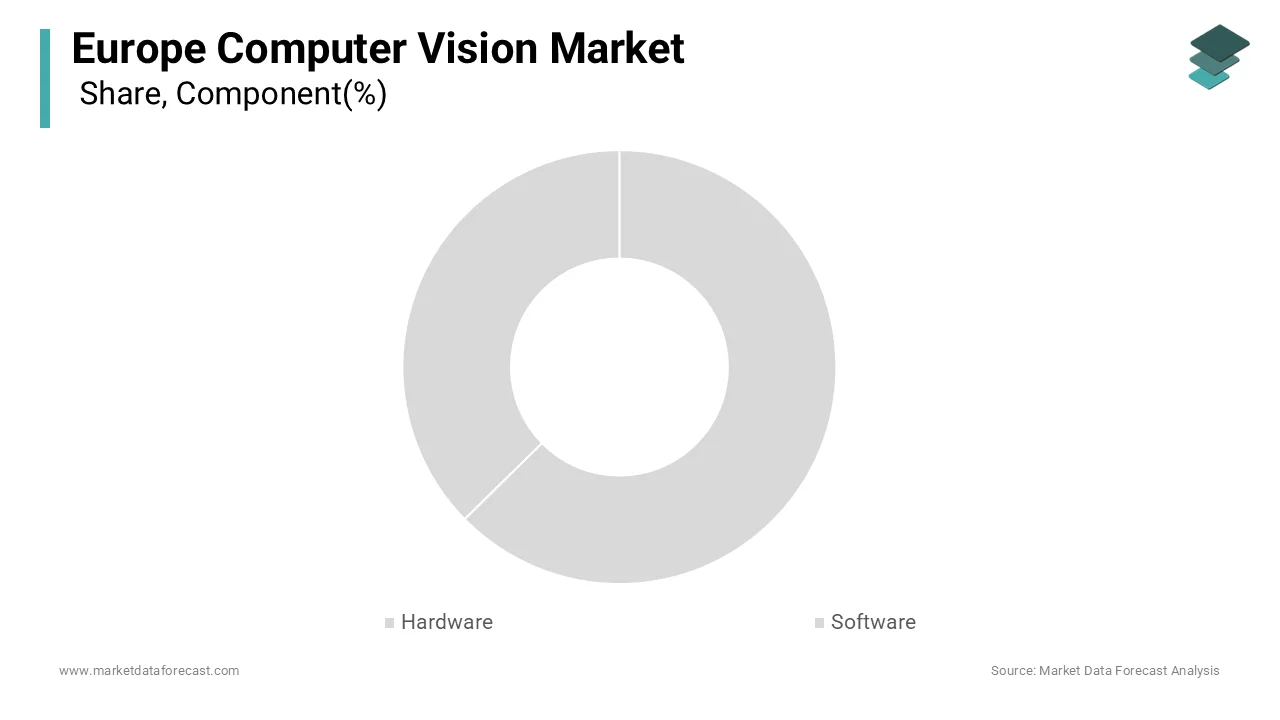
The software segment is significantly to grow at the fastest CAGR of 22.4% from 2025 to 2033, with the shift toward modular AI platforms that decouple algorithms from fixed hardware, enabling continuous improvement and cross-domain reuse. According to the European Institute of Innovation and Technology, over 200 Horizon Europe projects in 2025focused on open source computer vision libraries compliant with the EU’s trustworthy AI guidelines, allowing SMEs to license pre-validated models without building from scratch. In healthcare, the European Society of Radiology confirmed that 68% of hospitals now subscribe to cloud-based vision software suites that receive monthly regulatory updates for new diagnostic indications. As per the European Robotics Association, software-defined vision systems in logistics reduced integration time compared to legacy embedded solutions.
By Product Insights
The smart camera camera-based segment was accessed by occupying 58.3% of the Europe Europeaner vision market share in 2025due to their compactness, real-time processing, and ease of integration in space-constrained environments. According to Germany’s VDMA Mechacamera-basedering Associationny new production lines installed inEuropeanused smart cameras for tasks like robotic guidance and weld seam inspection elimination, ting the need for external space-constrained complexity. The European Automotive Suppliers Association reported that 89% of Tier 1 suppliers adopted IP67-rated smart cameras for in line in-line control because they withstand oil vibration and temperature extremes common in engine assembly plants. Similarly, in food processing, France’,s National Federation of Agri Food Industries noted that smart vision systemIP67-ratedcontamination risksin-lineoving centralized computing units from sterile zones. These self-contained units embed processors, memory, and optics in a single housing enablingg deterministic latency under 10 milliseconds with a requirement for high-speed computing. Their plug-and-play nature also lowers deployment barriers for SMEs lacking IT infrastructure, making them the default choice for Europe’s dense network of specialized industrial firms.
The PC based computer vision systems segment is growing at a fastest CAGR of 19.8% during the forecast period, for high computational flexibility in research m, medical,edical and autonomous applications. According to the European Laboratory Automation Association, many genomics and drug discovery labs in the EU upgraded to multi camera PC based vision systems in 2025to process hyperspectral and 3D cellular imaging data exceeding smart camera bandwidth limits. In radiology, the UK’s National Health Service reported that some of the new diagnostic suites use GPU accelGPU-acceleratedions running advanced vision algorithms for tumor segmentation and blood flow analysis tasks requiring teraflop-scale. As per the European Space Agency, ground stations analyzing satellite imagery rely on PC clusters with 10 GPU-accelerated cameras for change detection across agricultural and urban landscapes. The modularity of PC systems allows scaling of GPUs or storage without replacing entire systems, aligning with Europe’s emphasis on repairability and lifecycle extension under the Ecodesign Directive. This adaptability ensures PC based systems dominate in high complexity low vol, low volume domains, where performance trumps simplicity.
By Vertical Insights
The industrial vertical segment was the largest by holding a prominent share of the European computer vision market in 2025with the manufacturing of automotive electronics and logistics, where precision automation is non optionnon-negotiableg to Eurostat, 93% of large manufacturers in the EU deployed computer vision for quality assurance by 2025as part of mandatory compliance with ISO 9001 and industry spindustry-specificlike VDA 6.3 in automotive. Germany’s Federal Statisticnon-negotiableported that industrial vision systems reduced production defects by an average of 34% in 2025directly supporting the EU’s right to repair and circular economy goals. Industry-specific Association noted that over 150,000 collaborative robots installed in EU factories in 2025relied on integrated vision for bin picking and assembly verification. Additionally, the EU Battery Regulation requires full traceability of cell production, enforced via vision systems that read micro QR codes on each unit. This regulatory and operational entrenchment makes industrial adoption systemic rather than discretionary, ensuring stable demand even during economic downturns as quality and compliance remain paramount.
The non-industrial vertical segment is projected to grow at a CAGR of 24.1% from 2025 to 2033 by expansion into agriculture, agriculture retail,, retail, and public infrastructure. According to the European Centre for Disease Pr,evention and Control, computer vision for infection control, such as hand hygiene compliance monitoring in hospitals expandedinf EU tertiary care facilities in 2024. In precision agriculture, the European Commission’s Joint Research Centre reported that 57% of farms receiving CAP digital subsidies used drone-based vision systems for crop health mapping in 2024. As per the Euro,, pean Retail Federation, major retailers piloted shelf monitoring vision systems to optimize stock levels and reduce food waste aligning wit,,h the EU’s Farm to Fork Strategy. Furthermore, smart city initiatives in Barcelona and Copenhagen deployed anonymized vision analytics for traffic flow and pedestrian safety without storing biometric data. This diversification into socially impactful,l domains supported by public funding and sustainability mandates drives exponential growth beyond traditional industrial confines.
COUNTRY LEVEL ANALYSIS
Germany Computer Vision Market Analysis
Germany was the largest contributor to the European market by capturing 28.3% of the share in 2025, with its world-leading industrial base and stringent quality mandates. According to the German Engineering Federation, machinery manufacturers integrate computer vision into production equipment and export globally. The country’the the s automotive sector aloworld-leadingor 41% of EU vision system deployments with BMW and Bosch operating fully automated visual inspection lines that process over 10 million components daily. As per the Federal Ministry of Education and Research, Germany invested 1.8 billion euros in 2025through its AI Innovation Competition to fund vision-based solutions for small batch manufacturing and predictive maintenance. The Fraunhofer Society operates 12 applied research centers dedicated to industrial vision, ensuring rapid technology transfer from lab to factory floor. Germany’s dual emphasis on engineering excellence and regulatory compliance makes it the undisputed anchor of Europe’s computer vision ecosystem.
United Kingdom Computer Vision Market Analysis
The United Kingdom was positioned second by holding 16.3% of theEuropeane computer vision market share in 2025owing to the medical and defense computer vision applications. According to the UK’s National Health Service, 76% of NHS hospital trusts deploy CE-marketed vision algorithms for radiology, pathology, and surgical assistanEuropeanan2025under the AI Lab initiative. The Defence Science and Technology Laboratory confirmed that 12 active military programs use real-time vision s,y, stems for autonomous surveillance andCE-markedetection compliant with NATO STA, NAG standards. As per Innovate UK, over 90 million pounds were awarded in 2025to startups developing vision solutions for agri tech and clean energy,y including offshore wind blade inspection. The Alan Turing Institute also established a national benchmarking framework for algorithmic fairness in public sector vision systems, ensuring ethical deployment.
France Computer Vision Market Analysis
France's computer v,ision market growth is growingsteadilyy,y owing to the state led strategistate-ledents in sovereign AI and green industry. According to France’s National Research Agency, the governmentallocated 650 million euros in 2025to the “AI for Industry” Fnce'sFrance'sm focusing on vision systems for aerospace, nuclear, and rail sectstate-ledFrench Alternative Energies and Atomic Energy Commission CEA developed radiation-hardened components used in all EDF nuclear plants for remote component monitoring. As per the Ministry of Agriculture, 61% of vineyards in Bo,rdeaux and Champagne adopted drone-based vision in 2025 toptimize harvest timing and reduce radiation-hardenedr the Ecophyto plan. France also hosts the European Processor Initiative’s vision accelerator design team in Toulouse, ensuring future hardware sovereignty.
Netherlands Drone-based Market Analysis
TheNetherlands's computer vision market growth is likely to grow with the agritech logistics and semiconductor manufacturing. According to the Netherlands Enterprise Agency, over 7,0% of greenhouse growers use multispectral vision systems to monitor plant stress and implement control with a model replicated globally. ASML, the Dutch semiconductor giant, integrates nanometre precision vision systems in every EUV lithography machine sold worldwide enabling sub three, enabling sub-three-nanometre. As per the r Port of Rotterdam Authority, 100% of container handling cranes use 3D vision for rereal-time trackingnd damage d,etection processing 15 million containers annually. The Dutch government’s AI Coalition also funds crosub-three-nanometertestbeds in Eindhoven and Wageningen, ensuring rapid proto,prototypingcale-up. The country’s compact size, world-class infrastructure, and open innovation culture make it a high intensity laborhigh-intensityable computer vision deployment.
Sweden Computer Vision Market Analysis
Sweden's computer vision market growth is driven by the focus on sustainable andand human-centeredorld-class applications. Ac,, cording to the Swedish Energy Agency alhigh-intensitynd forestry equipment sold in 2025must include vision systems for autonomous operation, and Sweden's'snmental monitoring reducesfuel use by 22% on average. Ericsson’s 5G smart factories in Kista use real-time vision for circuit board inspection, achieving 99.998% defect detection accuracy. As per the Karolinska Institute, Swedish hospitals pioneered privacy-preserving vision analytics that blur faces while tracking patient movement to prevent falls, and now adoptreal-time Nordic healthcare systems.
COMPETITIVE LANDSCAPE
Competition in the European computer vision market is defined by a convergence of industrial rigor, regulatory discipline, and ethical technology design that distinguishes it from more speculative global counterparts. While North American firms often emphasize algorithmic novelty and European players compete on rreliabilityty compliance, and integration depth,h within tightly regulated domains such as manufacturing, healthcare, and critical infrastructure. Public funding through Horizon Europe Digital Europe and national innovation programs further shapes competition by prioritizing proj,,ects that demonstrate societal benefits, sustainability, and data protection.
KEY MARKET PLAYERS
Some of the companies that are playing a dominating role in the global europe computer vision market include
- Microsoft Corporation
- Google LLC
- IBM Corporation
- Intel Corporation
- NVIDIA Corporation
- Sony Corpo, ration
- Bosch Sensortec GmbH
- Siemens AG
- SAP SE
- Amazon Web Services, Inc. (AWS)
- Qualcomm Incorporated
- Facebook, Inc. (Meta Platform Europe)
- Huawei Technologies Co., Ltd.
- Apple Inc.
- Accenture plc
- Capgemini SE
- OpenCV.org (Open Source Consortium)
- Darktrace plc
- NEC Corporation
- Cognex Corporation
TOP LEADING PLAYERS IN THE MARKET
- Cognex maintains a strong foothold in the European computer vision market through its industrial machine vision systems, widely deployed in automotive electronics and logistics sectors. The company’s deep integration with European manufacturing standards ensures compliance with ISO and VDA quality protocols. Europeannex expanded its European AI Vision Lab in Eindhoven to accelerate co development of deeco-developmentpection models with local automotive suppliers. It also launched a GDPR compliant edge inference platform that processes visual data on the device without cloud transmission, addressing EU data sovereignty concerns.
- Basler AG, a Germco-developed company, is a key enabler of Europe’s computer vision ecosystem through itshigh-precisionn cameras and embedded vision kits tailored for industrial and medical applications. The company su,pplies imaging hardware to over 80% ofEU-basedd medical device manufacturers, integrating vision into diagnostic equipment. Basler introduced its ace 2 series,,s featuring on-sensor preprocessing compliant with the EU Medical Device Regulation and capable of real-time anomaly detection without external processors. It also collaborate,d with the European Processor Initiative to optimize camera interfaces for upcoming European AI accelerators.
- Teledyne FLIR has strengthened its position in Europe, computer vision mreal-timefocusing on thermal and multispectral imaging for energy infrastructure, public safety, and autonomous mobility. Its cameras are integral to wildfire detection systems across Southern Europe and battery inspection units in EV gigafactories. Teledyne FLIR launched a GDPR aligned thermal analytics suite that anonymizes human presence while detecting overheating components in data centers and power grids. The company also partnered with Sweden’s Vattenfall to deploy vision-based drone inspections for offshore wind farms, reducing manual risk and downtime.
MARKET SEGMENTATION
This research report on the europe computer vision market is segmented and sub-segmented into the following categories.
By Component
- Hardware
- Software
By Product
- Smart Camera-Based Systems
- PC-Based Computer Vision Systems
By Vertical
- Industrial
- Non-Industrial
By Country
- Germany
- United Kingdom
- France
- Netherlands
- Sweden
- Italy
- Spain
- Rest of Europe