- Product Description Description
- Table of Contents TOC
- List of Table & Figure LOT
- Get Free Sample PDF Sample PDF
Market Size, 2025
$709.5 BnMarket Estimate, 2026
$881.91 BnMarket Forecast, 2034
$5,026 BnCAGR, 2026–2034
24.30%Europe AI Training Dataset Market Report Summary
The Europe AI training dataset market was valued at USD 709.5 million in 2025, is forecast to reach USD 881.91 million in 2026, and is estimated to grow to USD 5,026 million by 2034, registering a strong CAGR of 24.30% from 2026 to 2034. Market growth is driven by the rapid adoption of artificial intelligence across industries, rising demand for high-quality labeled data, and increasing investments in AI model development. The expansion of computer vision, natural language processing, and healthcare AI applications, along with regulatory emphasis on trustworthy and compliant AI, is accelerating demand for curated and domain-specific training datasets across Europe.
Key Market Trends
- Rising demand for high-quality, annotated datasets to improve AI model accuracy and reliability.
- Strong growth in computer vision and multimodal datasets supporting automation and analytics use cases.
- Increasing adoption of AI in healthcare, driving demand for compliant and high-integrity medical datasets.
- Growing focus on sovereign data, ethical AI, and regulatory-compliant dataset sourcing.
- Expansion of public–private collaborations to develop sector-specific AI training data.
Segmental Insights
-
Based on application, the image and video datasets segment was the largest in 2025, driven by widespread adoption of computer vision across healthcare, automotive, surveillance, and industrial automation applications.
-
Based on end user, the healthcare segment accounted for the largest share of the Europe AI training dataset market in 2025, supported by intense regulatory scrutiny, high-stakes clinical decision-making, and the urgent need for AI-driven diagnostic support amid workforce shortages.
Regional Insights
The Europe AI training dataset market is witnessing rapid growth across major economies, supported by AI policy initiatives, strong research ecosystems, and increasing enterprise AI deployment.
- Germany emerged as the top-performing market in 2025, driven by strong industrial AI adoption, advanced data infrastructure, and regulatory-aligned AI development.
- France is expected to grow steadily, supported by its strategic focus on sovereign language models, public-sector AI programs, and health data innovation.
- The United Kingdom continues to be a key growth market, driven by world-class academic research, agile health-tech innovation, and post-Brexit regulatory autonomy enabling faster AI experimentation.
Competitive Landscape
The Europe AI training dataset market is characterized by the presence of global cloud providers, specialized data annotation firms, and AI-focused service companies offering scalable and domain-specific datasets. Market participants are focusing on improving data quality, expanding multilingual and multimodal datasets, and ensuring compliance with European data protection and AI regulations. Strategic partnerships with enterprises, research institutions, and public agencies are strengthening competitive positioning in this rapidly evolving market.
Prominent companies operating in the Europe AI training dataset market include Google, LLC (Kaggle), Appen Limited, Cogito Tech LLC, Telus International (Telus Corporation), Amazon Web Services, Inc., Microsoft Corporation, Scale AI Inc., Sama Inc., Alegion, and Kinetic Vision, Inc. (Deep Vision Data).
Europe AI Training Dataset Market Size
The Europe AI training dataset market was worth USD 709.5 million in 2025, is forecast to reach USD 881.91 million in 2026, and is estimated to grow to USD 5,026 million by 2034, growing at a CAGR of 24.30% from 2026 to 2034.

The AI training dataset is a curated collection of structured and unstructured data, including text, images, audio, video, and sensor readings that are annotated, labeled, and validated to train, supervise, and evaluate artificial intelligence and machine learning models. According to Eurostat, over 260000 enterprises across the European Union used AI technologies in 2023, with healthcare, manufacturing, and finance leading adoption. As per the European Commission’s 2023 AI Watch report, public sector AI deployments in areas like border control, healthcare diagnostics, and urban mobility require datasets compliant with the EU AI Act’s high-risk classification framework. Furthermore, the European Data Protection Board issued 18 formal guidance documents in 2023, clarifying lawful bases for processing personal data in AI training under the General Data Protection Regulation. This regulatory and operational context positions the AI training dataset market not as a commodity exchange but as a precision infrastructure layer underpinning Europe’s trustworthy and human-centric AI vision.
MARKET DRIVERS
EU AI Act Mandates High Quality and Representative Datasets for High Risk Applications
The European Union’s AI Act, adopted in 2023, requires high-integrity training datasets by legally requiring that high-risk AI systems use data that is “sufficiently representative, relevant, free of errors, and complete.” This factor is driving the growth of Europe AI training dataset market. According to the regulation, all AI systems used in medical diagnosis, biometric identification, critical infrastructure, and law enforcement must undergo conformity assessments that include rigorous documentation of dataset provenance, annotation methodology, and bias testing. The European Commission’s impact assessment estimates that over 85000 AI deployments across the EU will fall under the high-risk category by 202,6 necessitating certified training data. In healthcare, the European Medicines Agency now requires that AI tools for radiology or pathology include datasets validated for demographic diversity covering age, gender, ethnicity, and disease prevalence, as confirmed in its 2023 guidance on AI as a medical device. Similarly, Germany’s Federal Office for Information Security mandates that autonomous vehicle training data include rare edge cases like fogged sensors or jaywalking pedestrians across 15 European cities. This regulatory pull transforms dataset curation from a technical exercise into a legal prerequisite for market access and liability mitigation.
Rapid Expansion of AI Adoption in Regulated Sectors Drives Demand for Domain-Specific Labeled Data
The deployment of artificial intelligence in highly regulated industries has intensified demand for expert-annotated and contextually accurate training datasets, which is additionally prompting the growth of Europe AI training dataset market. According to the European Banking Authority, over 72% of major EU banks now use AI for anti-money laundering transaction monitoring, systems that require millions of labeled financial records annotated by compliance specialists to distinguish legitimate from suspicious behavior. In healthcare, the European Society of Radiology reported that 68% of university hospitals in Germany, France, and the Netherlands deployed AI tools for chest X-ray analysis in 2023, each trained on datasets containing over 100000 images validated by board-certified radiologists. Similarly, the European Aviation Safety Agency mandated that drone traffic management AI must be trained on real-world European airspace scenarios, including urban canyons, alpine terrain, and coastal wind patterns. This domain specificity ensures that dataset providers must combine technical annotation capabilities with deep subject matter expertise, a barrier that favors specialized vendors over generic data aggregators.
MARKET RESTRAINTS
Strict GDPR and Data Localization Requirements Limit Data Sourcing and Annotation Scalability
The significant operational constraints due to the General Data Protection Regulation’s stringent rules on processing personal data for automated decision-making are limiting the growth of the AI training dataset market. According to the European Data Protection Board, any dataset containing biometric facial, voice, or behavioral data requires explicit consent or must rely on narrow public interest exceptions, conditions that drastically limit available training material. In 2023, France’s CNIL fined a health tech startup 1.2 million euros for using patient images without granular consent for AI training, even though the data was anonymized. Cross-border data transfers are further restricted, where the European Commission’s adequacy decisions cover only 14 countries as of 2024, meaning annotation work cannot be outsourced to major global hubs like India or the Philippines without complex Standard Contractual Clauses. These legal complexities slow dataset development timelines and inflate costs, particularly for startups lacking legal infrastructure.
Lack of Standardized Annotation Protocols and Quality Benchmarks Across Member States
The absence of harmonized technical standards for data-labeling and validation creates inconsistency in dataset quality, and interoperability is hampering the growth of Europe AI training dataset market. According to the European Committee for Standardization, no EU-wide framework exists for annotation accuracy, inter-annotator agreement, or bias metrics, even for high-risk domains like healthcare or transport. Similarly, Germany’s VDA automotive association documented that lane detection datasets from five European providers used incompatible semantic definitions for road markings, hindering model portability. The European AI Alliance has proposed a certification mark for training data, but implementation remains voluntary. Without binding quality benchmarks, end users must conduct costly in-house validation for every new dataset, delaying AI deployment and fragmenting the market along national or vendor-specific lines.
MARKET OPPORTUNITIES
Establishment of European Data Spaces Under the Data Governance Act Unlocks Public Sector Data
The rollout of sectoral European Data Spaces under the 2022 Data Governance Act presents a transformative opportunity to access high-value public and industrial datasets for AI training, while ensuring privacy and sovereignty. The establishment of European data spaces under the data governance act is likely to pose new opportunities for the growth of Europe AI training dataset market. According to the European Commission, nine data spaces are under development, including in health, agriculture, energy, and manufacturing, with the European Health Data Space alone expected to harmonize access to over 400 million patient records across 27 member states by 2028. In 2023, the French Health Data Hub granted researchers access to 85 million anonymized hospital records for AI model development under strict ethical oversight. Similarly, the Gaia-X initiative certified 12 trusted data intermediaries in 2023 that facilitate secure data sharing between companies without transferring ownership by enabling collaborative dataset creation in sectors like mobility and logistics. The European Investment Bank allocated 220 million euros in 2023 to support data space infrastructure, including annotation platforms compliant with the AI Act.
Growth of Synthetic Data Generation to Address Privacy and Bias Constraints
The emergence of advanced synthetic data technologies offers a strategic pathway to overcome GDPR limitations and representation gaps in real-world datasets, which is also boosting the growth of Europe AI training dataset market. According to the European Innovation Council, over 45 startups received funding in 2023 to develop generative models that produce statistically accurate but non-identifiable training data for healthcare finance and autonomous systems. In Sweden, the Karolinska Institute used synthetic patient records to train an AI model for sepsis prediction, achieving 94% accuracy without accessing real medical histories. Similarly, Germany’s Bundesbank piloted synthetic transaction data to improve anti-money laundering algorithms while fully complying with banking secrecy laws. The European AI Office’s 2023 technical guidance explicitly recognizes high-fidelity synthetic data as a valid alternative for high-risk AI systems if bias and distributional fidelity are validated. Companies like Hazy and Syntheticus now offer EU-hosted platforms that generate GDPR compliant datasets with built-in fairness constraints. This innovation not only resolves privacy dilemmas but also enables the creation of edge case scenarios, such as rare diseases or extreme weather events that are underrepresented in real data yet critical for robust AI.
MARKET CHALLENGES
Shortage of Skilled Data Annotators with Domain Expertise in High Risk Sectors
The human capital deficit in professionals capable of performing high-quality annotation in regulated domains, such as radiology, legal compliance, and engineering, is one of the challenges for the growth of Europe AI training dataset market. According to the European Centre for the Development of Vocational Training, fewer than 12000 certified medical data annotators operate in the EU despite demand from over 600 AI health startups and hospital innovation units. In 2023, Germany’s Federal Employment Agency reported a 68% vacancy rate for roles requiring both clinical knowledge and data labeling skills. Similarly, the European Banking Federation documented that only 37% of financial institutions could source annotators trained in anti-fraud pattern recognition within the EU, forcing reliance on slower and costlier in-house teams. Universities like ETH Zurich and Sorbonne have launched micro credentials in AI data curation, but graduate output remains insufficient. This specialization bottleneck delays dataset delivery, increases costs, and risks model inaccuracies due to mislabeled examples, posing a systemic constraint on Europe’s AI ambitions.
Fragmented National Approaches to AI Ethics and Data Consent Undermine Cross-Border Dataset Reuse
The divergent national interpretations of ethical data use and consent requirements that block pan-European dataset scalability, which is inhibiting the growth of Europe AI training dataset market. According to the European AI Alliance, as of 2024, seven member states, including Germany, France, and Italy, have introduced additional national AI ethics guidelines that impose stricter consent or transparency rules than the EU AI Act. In 2023, a Dutch health AI developer was prohibited from using publicly funded German hospital data because Bavarian consent forms did not explicitly mention “AI training” as a use case, rendering the dataset legally unusable under local interpretation. Similarly, Spain’s data protection agency requires a separate opt-in for each AI application, while Sweden permits broad research consent. These inconsistencies force dataset providers to maintain multiple versions of the same corpus with country-specific metadata and consent layers, a practice that increases management complexity and reduces economies of scale.
REPORT COVERAGE
| REPORT METRIC | DETAILS |
| Market Size Available | 2025 to 2034 |
| Base Year | 2025 |
| Forecast Period | 2026 to 2034 |
| Segments Covered | By Application, End User, and Country. |
| Various Analyses Covered | Global, Regional, and Country-Level Analysis, Segment-Level Analysis, Drivers, Restraints, Opportunities, Challenges; PESTLE Analysis; Porter’s Five Forces Analysis, Competitive Landscape, Analyst Overview of Investment Opportunities |
| Countries Covered | UK, France, Spain, Germany, Italy, Russia, Sweden, Denmark, Switzerland, Netherlands, Turkey, Czech Republic, and the Rest of Europe. |
| Market Leaders Profiled | Google, LLC (Kaggle), Appen Limited, Cogito Tech LLC, Telus International (Telus Corporation), Amazon Web Services, Inc., Microsoft Corporation, Scale AI Inc., Sama Inc., Alegion, Kinetic Vision, Inc. (Deep Vision Data), and Others. |
SEGMENTAL ANALYSIS
By Application Insights
The image and video datasets segment was the largest by holding 52.4% of the Europe AI training dataset market share in 2024, with the proliferation of computer vision applications across high-priority sectors, including autonomous mobility, healthcare, diagnostics, and industrial automation, all designated as high risk under the EU AI Act. In healthcare, the European Society of Radiology reported that over 70% of university hospitals in Germany, France, and the Netherlands deployed AI tools for medical imaging in 2023, requiring datasets with hundreds of thousands of expert-annotated X-rays, CT scans, and MRIs validated under EN ISO 13485. Similarly, the European Union Agency for Railways mandated that all Level 2+ autonomous trains must be trained on video datasets capturing diverse European weather conditions, track geometries, and infrastructure signage, spurring national rail operators like SNCF and Deutsche Bahn to commission large-scale data collection campaigns. The automotive sector further drives demand with the European New Car Assessment Programme requiring driver monitoring systems to be trained on facial and gaze datasets representing European demographic diversity.
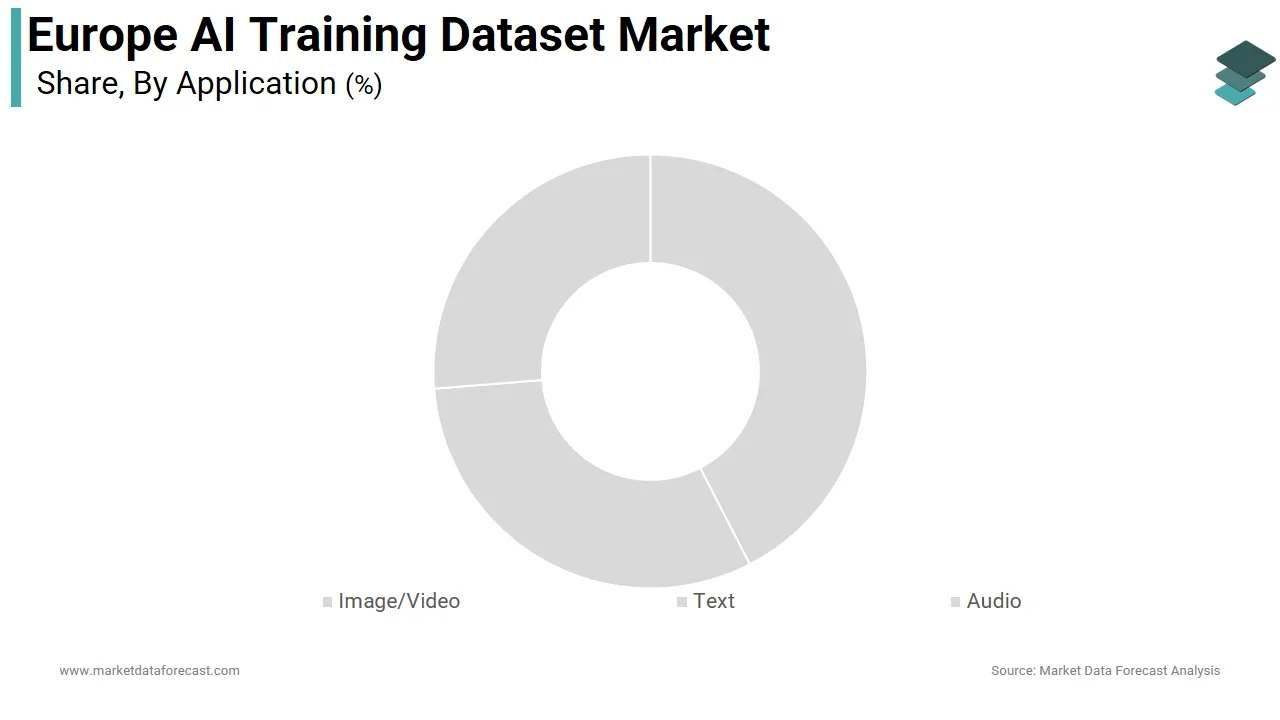
The text datasets segment is projected to expand at a CAGR of 28.4% from 2025 to 2033, owing to the EU’s multilingual digital sovereignty agenda and the rise of large language models tailored for European languages and legal contexts. The European Commission’s European Language Equality project allocated 250 million euros in 2023 to build high-quality monolingual and multilingual corpora for all 24 official EU languages, which is addressing historical underrepresentation of languages like Hungarian, Finnish, and Maltese in global models. In 2023, France’s Ministry of Justice launched the “AI Justice” initiative using legally annotated court rulings in French to train AI for case law prediction, while Germany’s Federal Ministry of Labour commissioned datasets of anonymized employment contracts to power AI tools for compliance checking. The European Banking Authority also mandated that anti-money laundering AI systems must be trained on transaction narratives in local languages.
By End User Insights
The healthcare segment was the largest by accounting for 29.3% of the Europe AI training dataset market share in 2024, with the sector’s intense regulatory scrutiny high stakes decision making and urgent need for diagnostic augmentation amid workforce shortages. The European Medicines Agency classifies AI used in radiology, pathology, and drug discovery as high risk under the AI Act, requiring datasets that are demographically representative, clinically validated, and bias audited. In 2023, the UK’s National Health Service commissioned a pan-cancer imaging dataset of over 500000 annotated scans across 20 tumor types to train AI for early detection. Similarly, Germany’s University Hospital Heidelberg established a federated data hub pooling annotated dermatology images from 12 clinics to ensure skin tone diversity in melanoma detection models. The European Commission’s 2023 funding call for “AI for Health” awarded 85 million euros to projects developing validated training datasets for rare diseases and mental health.
The automotive segment is expected to grow with aa fastest CAGR of 31.2% throughout the forecast period with the EU’s aggressive timeline for advanced driver assistance systems and the unique complexity of European driving environments. The General Safety Regulation mandates that all new vehicles sold from 2024 must include driver drowsiness detection and intelligent speed assistance systems trained on vast datasets of European facial expressions, road signs, and urban layouts. In 2023, Volkswagen invested 120 million euros in a data collection fleet across 15 EU countries to capture rare edge cases like roundabouts in Italy, alpine tunnels in Austria, and bicycle interactions in the Netherlands. Similarly, the European New Car Assessment Programme now includes AI-driven safety scoring, requiring manufacturers to submit proof of dataset diversity covering age, gender, and regional driving behaviors. The European Union Agency for Cybersecurity also issued guidelines in 2023 requiring that autonomous vehicle datasets include adversarial scenarios such as sensor spoofing or extreme weather.
COUNTRY-LEVEL ANALYSIS
Germany AI Training Dataset Market Analysis
Germany was the top performer of the Europe AI training dataset market by holding 24.4% of the share in 2024, with its advanced industrial base, stringent regulatory culture, and leadership in automotive and manufacturing AI. According to the Federal Ministry for Economic Affairs and Climate Action, over 85000 enterprises adopted AI in 2023, with 62% using computer vision for quality control or predictive maintenance. The country hosts flagship initiatives like the German AI Platform, which funded 42 dataset projects in 2023, including annotated factory floor videos and multilingual technical manuals. Germany’s Federal Office for Information Security enforces strict AI Act compliance, requiring high-risk systems to document dataset representativeness and bias testing a rule accelerating demand for certified data. The Fraunhofer Society operates six AI data hubs that curate sector-specific datasets for SMEs under the “KI für KMU” program. Additionally, Germany’s dual vocational system now includes AI data annotation certifications, producing 4500 trained annotators annually.
France AI Training Dataset Market Analysis
France AI training dataset market growth is likely to grow with its strategic focus on sovereign language models, public sector AI, and health data innovation. According to the French National Research Agency, over 180 million euros were allocated in 2023 to the “France IA” initiative for building French and multilingual training corpora compliant with the EU AI Act. The Ministry of Justice’s “AI Justice” project compiled 2.1 million annotated court rulings to train legal reasoning models, while the Health Data Hub granted access to 85 million anonymized patient records for AI development under ethical oversight. France’s CNIL issued detailed guidance in 2023 on lawful data sourcing for AI, reinforcing demand for compliant datasets. Additionally, the country leads in synthetic data adoption, with startups like Mimesis and Virtual Fortknox receiving state support to generate GDPR safe training material for defense and mobility.
United Kingdom AI Training Dataset Market Analysis
The United Kingdom AI training dataset market growth is driven by the world-class academic research, agile health tech innovation, and post Brexit regulatory autonomy. The National Health Service’s AI Lab funded 31 dataset projects in 2023, including a national diabetic retinopathy imaging library with over 300000 graded scans. The UK’s Information Commissioner’s Office issued its own AI auditing framework in 2023, mirroring EU AI Act principles and requiring documentation of dataset lineage and fairness metrics. The UK maintains technical alignment with EU standards through the UK GDPR and participates in Horizon Europe collaborative data spaces. Companies like BenevolentAI and Faculty AI export dataset curation services across Europe, leveraging British expertise in bioinformatics and natural language processing.
Netherlands AI Training Dataset Market Analysis
The Netherlands AI training dataset market growth is expected to grow with the agritech logistics and multilingual AI. The Port of Rotterdam’s AI initiative commissioned datasets of container handling operations to train autonomous crane systems, while Schiphol Airport developed video datasets of passenger flows for crowd management AI. The Netherlands is also home to the European Language Grid’s technical hub, which curates multilingual text corpora for Dutch, Flemish, and Frisian, languages historically underrepresented in global models. The Dutch Data Protection Authority issued one of the EU’s first enforcement actions in 2023 against an AI firm for inadequate dataset documentation, setting a precedent for compliance.
Sweden AI Training Dataset Market Analysis
Sweden AI training dataset market growth is likely to grow with its integration of AI into sustainable innovation, public services, and synthetic data. The Karolinska Institute pioneered the use of synthetic patient records to train sepsis prediction models without accessing real medical histories, a practice now endorsed by the Swedish Data Protection Authority. Sweden’s Viable Cities program created urban mobility datasets from 12 municipalities, including annotated video of pedestrian, cyclist, and vehicle interactions in winter conditions. Additionally, the country leads in ethical AI, with the Swedish AI Society publishing detailed dataset auditing guidelines adopted by public agencies.
COMPETITIVE LANDSCAPE
Competition in the Europe AI training dataset market is highly specialized and shaped by regulatory intensity rather than volume. Global leaders like Scale AI and Appen compete with European ethical data specialists such as Aligned AI and Lightly based on compliance, domain expertise, and data sovereignty rather than price. Startups focusing on synthetic data federated learning and language-specific corpora are gaining traction, particularly in Nordic and Benelux countries. Barriers to entry are high due to the need for legal infrastructure, annotation quality control, and alignment with national AI ethics guidelines.
KEY MARKET PLAYERS
The leading companies operating in the Europe AI training dataset market include:
- Google, LLC (Kaggle)
- Appen Limited
- Cogito Tech LLC
- Telus International (Telus Corporation)
- Amazon Web Services, Inc.
- Microsoft Corporation
- Scale AI Inc.
- Sama Inc.
- Alegion
- Kinetic Vision, Inc. (Deep Vision Data)
TOP PLAYERS IN THE MARKET
- Scale AI is a global leader in AI data infrastructure with a significant and growing footprint in the Europe AI training dataset market. The company provides high-quality labeled datasets for computer vision, natural language processing, and sensor fusion used by automotive, healthcare, and public sector clients across the EU. Scale AI’s European operations comply with GDPR and the EU AI Act through localized data processing centers in Ireland and Germany, and annotation teams trained in sector-specific compliance. Scale AI launched a sovereign European data labeling platform enabling clients to retain full control over data residency and audit trails. It also partnered with major European automakers to build driving datasets capturing regional road conditions, signage, and pedestrian behaviors. These initiatives reinforce its role as a trusted enabler of high-risk AI applications requiring certified data governance and domain expertise.
- Appen Limited is an Australia-headquartered but Europe-deeply embedded provider of training data for machine learning with extensive operations in the UK, France, and Poland. The company leverages a global crowd of over 1 million linguists and annotators to deliver multilingual text, audio, and image datasets tailored for European languages and regulatory contexts. Appen’s European clients include national health services, financial institutions, and technology firms deploying AI under the EU AI Act’s high-risk framework. Appen established a dedicated AI Act compliance unit in London to validate dataset documentation for bias representativeness and provenance. It also launched synthetic data generation services hosted on EU cloud infrastructure to address GDPR constraints in healthcare and finance.
- Samasource, rebranded as Aligned AI, is a mission-driven data services company with a strong presence in Europe’s ethical AI ecosystem. The company specializes in high-accuracy image, video, and text annotation for social impact and regulated sectors, including public health, climate modeling, and inclusive AI. Its European operations in the Netherlands and Sweden focus on datasets that meet the EU’s stringent requirements for fairness, transparency, and human oversight. Aligned AI introduced a bias auditing toolkit integrated into its annotation workflow that quantifies representation gaps across gender, age, and ethnicity in real time. It also partnered with the European Language Equality project to build training corpora for underrepresented languages like Sami and Sorbian. These efforts position the company as a pioneer in responsible data curation aligned with Europe’s human-centric AI principles.
TOP STRATEGIES USED BY THE KEY MARKET PARTICIPANTS
Key players in the Europe AI training dataset market prioritize compliance with the EU AI Act and GDPR through localized data processing, sovereign cloud hosting, and detailed dataset documentation. They invest in domain-specific annotation teams with expertise in healthcare finance and automotive sectors to ensure contextual accuracy. Companies develop synthetic data generation capabilities to overcome privacy constraints while maintaining statistical fidelity. Strategic partnerships with public institutions and research consortia enable access to high-value data under ethical governance frameworks. Additionally, firms implement real-time bias detection and multilingual validation tools to meet Europe’s requirements for representative and inclusive AI.
MARKET SEGMENTATION
This research report on the Europe AI training dataset market has been segmented and sub-segmented into the following categories.
By Application
- Image/Video
- Text
- Audio
By End User
- IT & Telecom
- Retail & E-commerce
- Government
- Healthcare
- Automotive
- Others
By Country
- United Kingdom
- France
- Spain
- Germany
- Italy
- Russia
- Sweden
- Denmark
- Switzerland
- Netherlands
- Rest of Europe