- Product Description Description
- Table of Contents TOC
- List of Table & Figure LOT
- Get Free Sample PDF Sample PDF
Market Size, 2025
$2.77 BnMarket Estimate, 2026
$3.24 BnMarket Forecast, 2034
$11.38 BnCAGR, 2026–2034
16.99%Executive Summary: Europe Femtech Market
- Market Scope: Regional European femtech market analysis covering software and device types, clinical application areas, end-user integrations, country leadership frameworks, and digital women's healthcare adoption metrics.
- Market Valuation: Valued at USD 2.77 billion in 2025, estimated at USD 3.24 billion in 2026, and projected to reach USD 11.38 billion by 2034, registering a CAGR of 16.99% from 2026 to 2034.
- Primary Growth Drivers: Rising prevalence of reproductive health conditions such as endometriosis and PCOS, growing integration of femtech into employer-sponsored wellness programs, expansion of AI-driven symptom tracking, fertility management, and tele-gynecology, alongside increasing adoption of digital therapeutics and personalized women's healthcare.
Key Market Segment Metrics (2026–2034)
| Category | Leading Segment (Position) | Fastest-Growing / Key Growth Segment |
|---|---|---|
| By Type & Application | General fertility and reproductive tracking platforms | Subscription & Telehealth Services (22.7% CAGR) & Menopause Solutions (24.1% CAGR) |
| By End User Segment | Direct-to-consumer digital applications and standalone wellness users | Fertility Clinic Integrations (projected at a 21.3% CAGR) |
| By Technology & Innovation | Standard mobile health applications and tracking logs | AI-driven symptom tracking, CE/DiGA-certified digital therapeutics, and interoperable clinician dashboards |
| By Region / Country | Germany (largest country with 22.5% market share) | United Kingdom, France, Sweden, Spain, and Rest of Europe |
Major Market Players & Market Structure
Market Structure: Highly competitive European digital health landscape characterized by regulatory-first product development (CE/DiGA certification), clinical evidence generation, employer/insurer partnerships, privacy-by-design frameworks, and expansion into menopause and home hormone monitoring solutions.
Key Companies: Clue (BioWink), Natural Cycles, Flo Health, Ava Science, Elvie, FemTec Health, Inne, Fertility Focus, and Bayer (Women's Health Initiatives).
Europe Femtech Market Size
The Europe Femtech Market is projected to grow from USD 2.77 billion in 2025 to USD 3.24 billion in 2026 and reach USD 11.38 billion by 2034, registering a CAGR of 16.99% from 2026 to 2034.
Femtech refers to the tech-driven products and services focused on women's health, addressing areas like menstrual cycles, fertility, pregnancy, menopause, sexual health, and chronic conditions disproportionately affecting women, by filling gaps left by traditional healthcare's historical underinvestment in female biology. These include but are not limited to menstrual cycle tracking, fertility management, pregnancy and postpartum care, menopause support, sexual wellness, and chronic condition monitoring such as endometriosis and polycystic ovary syndrome. Women form a significant portion of the regional population. Technology is emerging as a critical avenue for developing gender-responsive healthcare. Historical underinvestment in women's health research has led to care delivery gaps, despite the presence of established healthcare systems and digital infrastructure. There is a high level of preparedness for the integration of digital health solutions. Evolving policy discussions indicate a growing institutional interest in the role of digital health in supporting personalized, preventive, and equitable care for women.
MARKET DRIVERS
Rising Prevalence of Reproductive Health Conditions Fuels Demand for Personalized Digital Solutions
Endometriosis affects an estimated one in ten women of reproductive age across the region, which drives the growth of the European femtech market. This translates to millions of individuals. Affected individuals often endure a diagnostic delay of several years due to normalized symptoms and fragmented clinical pathways. Similarly, Polycystic ovary syndrome affects a notable portion of women, with inconsistent care access contributing to long-term metabolic and reproductive complications. In this context, femtech applications offering AI-driven symptom correlation, ovulation prediction, and personalized lifestyle recommendations serve as essential self-advocacy tools. These platforms enable users to generate longitudinal health records that can accelerate clinical evaluation and improve provider communication. Given that public healthcare systems are struggling with increasing patient demand and a lack of workers, digital self-management technologies present a scalable adjunct to conventional medical services, with particular promise in high-income regions where regulatory frameworks for digital therapeutics are developing.
Growing Integration of Femtech into Employer-Sponsored Wellness Programs
Corporate health strategies in the region are undergoing a gender inclusive transformation, with femtech solutions increasingly embedded into employer-sponsored digital wellness offerings, which in turn propels the growth of the European femtech market. There is a growing trend among employers to offer digital health benefits focused specifically on women's health issues. Many large organizations are providing, or plan to introduce, these types of benefits in the near future. This shift responds to compelling evidence that reproductive health significantly affects workplace productivity. Menstrual health concerns contribute to the time taken off work. Leading multinational corporations have launched pilot programs granting employees access to certified femtech platforms for fertility support, menopause coaching, and mental health resources. Private channels offer femtech startups a faster path to market validation, user acquisition, and real-world evidence, which sidesteps public reimbursement challenges.
MARKET RESTRAINTS
Fragmented Regulatory Classification Creates Market Access Uncertainty
Inconsistent regulatory treatment under the EU Medical Device Regulation, which depends on claimed functionalities, is thereby hampering the growth of the European femtech market. Applications that provide general health and wellness information usually operate without formal medical device regulation. In contrast, apps designed to make a diagnosis or offer treatment are subject to specific regulatory review. Achieving the required approval for these regulated apps can be a time-consuming and expensive process. This ambiguity deters early-stage innovators, especially in Southern and Eastern Europe, where regulatory expertise and venture support are scarce. National competent authorities further exacerbate uncertainty through divergent interpretations ofthe software as a medical device guideline, leading to asymmetric approval timelines. For instance, a fertility prediction algorithm cleared in Sweden may face extended scrutiny in Italy. Regulatory changes can create challenges for femtech startups when planning their expansion into the European market. The absence of a harmonized classification system specifically for women’s digital health will lead to continued market fragmentation, impeding the sector's ability to scale and discouraging investors.
Persistent Gender Bias in Health Technology Investment and Clinical Validation
Persistent gender bias in health technology investment and clinical validation hampers the expansion of the European femtech market. Despite women constituting the majority of healthcare consumers, femtech received only a portion of total European digital health venture funding in 2024. This underinvestment stems from entrenched gender bias in both capital allocation and clinical research design, where women have historically been excluded from trials. Consequently, few femtech solutions possess the robust clinical validation required for physician endorsement or public reimbursement. Investor skepticism often mischaracterizes women’s health as a narrow vertical rather than a cross-cutting domain influencing fertility, chronic disease, mental health, and workforce participation. This evidence deficit perpetuates a cycle where limited funding yields insufficient validation, which in turn restricts adoption. The market's shift from lifestyle tools to clinically integrated interventions will be hampered if funding mechanisms do not explicitly prioritize sex-disaggregated clinical evidence.
MARKET OPPORTUNITIES
Expansion of Virtual Care Models in Public Health Systems Creates Scalable Integration Pathways
The region’s public health systems are rapidly institutionalizing virtual-first care models, which offer new opportunities for the growth of the European femtech market. This creates structured entry points for femtech integration. The UK's health service has incorporated certified women's health services into its patient application, providing direct access to digital platforms for related counseling. Sweden's national digital health strategy encourages local regions to implement e-health services specifically for reproductive care. Clinicians across various European states are increasingly using digital tools for telegynecology consultations. Recent regulatory changes in France have allowed digital health providers to develop integrated care models, combining app-based monitoring with professional clinical oversight. These public infrastructure investments reduce customer acquisition costs, enhance equity of access, and position femtech as a core component, not an add-on, of future care delivery.
Untapped Potential in Perimenopause and Menopause Digital Health Solutions
Untapped potential in perimenopause and menopause digital health solutions is providing fresh prospects for the expansion of the European femtech market. A significant number of women across Europe are currently experiencing menopause, with a large additional population expected to enter the perimenopausal phase in the coming years. Most women experiencing menopause do not receive structured clinical support, which is often attributed to the limited number of available healthcare providers and prevalent societal stigma. This unmet need represents one of the most significant white spaces in femtech. Digital platforms offering holistic menopause management, including symptom tracking, hormone therapy decision aids, cognitive behavioral therapy, and peer support, are gaining traction. Workplace support initiatives related to menopause are growing in certain regions, creating new avenues for business-to-business and business-to-consumer engagement. The inclusion of menopause-focused applications within some health coverage systems indicates a growing acknowledgment of their potential clinical use. There appears to be a limited number of certified digital health products for menopause available in the market. Organizations introducing products in this category may find opportunities to establish a significant market presence. Consumer interest is rising, alongside the development of supportive policies, which may favor market entry.
MARKET CHALLENGES
Data Privacy Concerns Undermine User Trust and Long-Term Engagement
Women across the region express deep reservations about the handling of sensitive reproductive health data by digital platforms, which poses a major issue for the European femtech market. Many women express significant reluctance to use period-tracking applications if they believe their personal health information might be shared with external parties without clear and specific permission. Heightened awareness of data vulnerabilities has intensified scrutiny even in jurisdictions with robust legal protections. Although the General Data Protection Regulation provides a strong foundation, enforcement remains inconsistent, and sector-specific guidance for health apps is lacking. Concerns exist that a notable number of popular femtech applications may be transmitting identifiable health data to advertising networks using consent processes that are not fully compliant with privacy expectations. Such practices severely damage user trust, contributing to high churn rates. A substantial number of users tend to stop using femtech apps relatively quickly after downloading them. Widespread adoption of strong data privacy standards and transparent data management is essential for long-term patient involvement and effective clinical outcomes.
Limited Interoperability with National Electronic Health Record Systems Hinders Clinical Utility
Its inability to integrate with national electronic health record systems across the region slows down the expansion of the European femtech market. A minority of femtech solutions are able to securely share data with primary care electronic health record (EHR) platforms. Interoperability challenges exist within several regional healthcare systems. Data exchange capabilities between many femtech solutions and established healthcare platforms remain limited. This isolation prevents clinicians from accessing patient-generated insights during consultations, relegating femtech to a passive lifestyle tool rather than an active component of care coordination. For example, a woman meticulously logging ovulation symptoms via a fertility app cannot seamlessly share this dataset with her gynecologist through existing digital health infrastructures. The absence of standardized application programming interfaces and common data models tailored to women’s health perpetuates this fragmentation. Femtech's path to provider buy-in, insurance coverage, and widespread clinical adoption is blocked until interoperability challenges are resolved.
REPORT COVERAGE
| REPORT METRIC | DETAILS |
| Market Size Available | 2025 to 2034 |
| Base Year | 2025 |
| Forecast Period | 2026 to 2034 |
| Segments Covered | By Type, Application, End User, and Region. |
| Various Analyses Covered | Global, Regional, and Country-Level Analysis, Segment-Level Analysis, Drivers, Restraints, Opportunities, Challenges; PESTLE Analysis; Porter’s Five Forces Analysis, Competitive Landscape, Analyst Overview of Investment Opportunities |
| Countries Covered | UK, France, Spain, Germany, Italy, Russia, Sweden, Denmark, Switzerland, Netherlands, Turkey, Czech Republic, Rest of Europe |
| Market Leaders Profiled | Clue (BioWink GmbH), Natural Cycles Nordic AB, Flo Health Inc., Ava Science Inc., Elvie (Chiaro Technology Ltd.), Lifeness AS, Fertility Focus Ltd., Bayer AG, HeraMed Ltd., Joylux Inc., Yona Care, Pregnolia AG, Dermacare Direct Ltd., Bonzun AB, Lady Technologies Inc., Tampax (Procter & Gamble Co.), MyLevels Health, Inne (Hormone Monitoring System), Ovira, Daye Ltd. |
SEGMENTAL ANALYSIS
By Type Insights
The software segment held the largest share of 58.3% of the European femtech market in 2025. The prominence of the software segment is driven by the widespread adoption of mobile-based health applications addressing reproductive fertility, pregnancy, and hormonal wellness. The accessibility of smartphones across the European Union has enabled the rapid scaling of app-based solutions. Furthermore, consumer preference for non-invasive, low-cost self-management tools aligns with Europe’s preventive healthcare ethos. Initiatives are promoting the greater use of digital solutions in healthcare. Regulatory changes at national levels support the inclusion of certain digital health applications in established health pathways. Specific types of health applications are being recognized for potential coverage by health systems, which can support their perceived reliability. Investment patterns indicate a preference for digital health approaches over those reliant primarily on physical components.
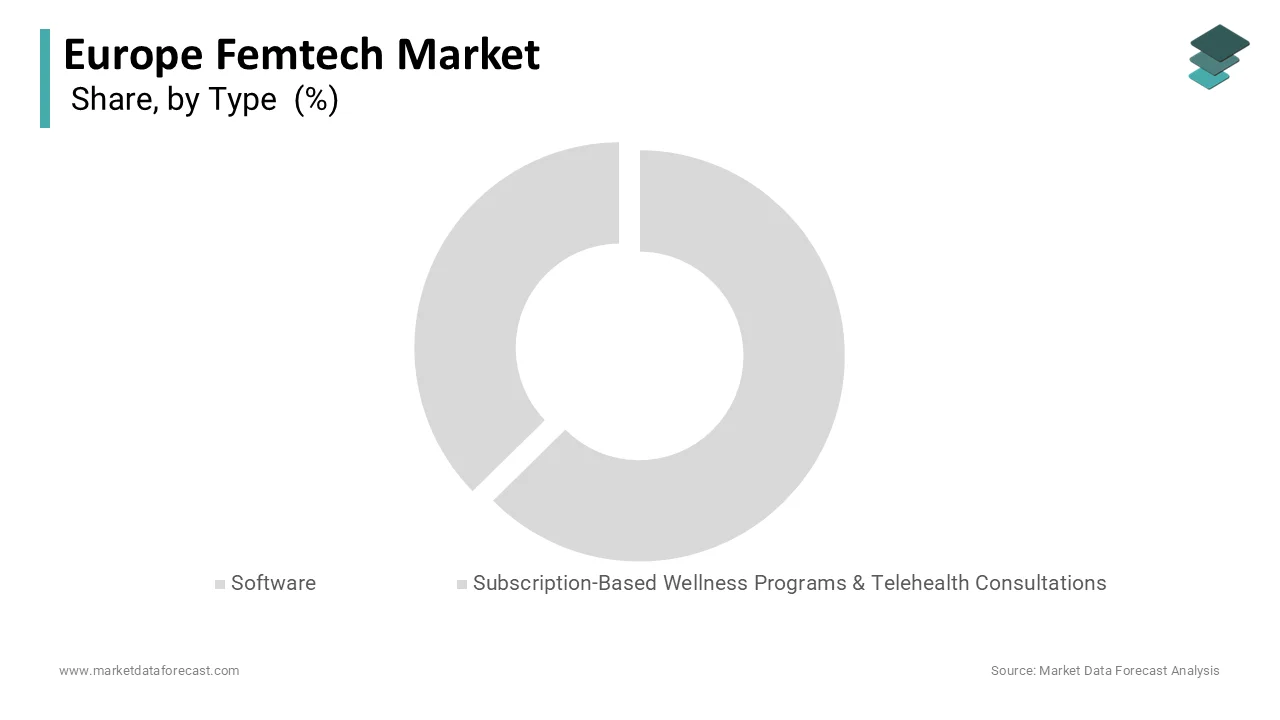
The subscription-based wellness programs and telehealth consultations segment is estimated to register the fastest CAGR of 22.7% from 2025 to 2033. The swift acceleration of this segment is driven by the integration of femtech into structured care delivery models, particularly through employer-sponsored benefits and public virtual care initiatives. Digital women’s health services are increasingly prevalent in workplace wellness packages across Western Europe. National health services in various countries, including the United Kingdom, have incorporated telegynecology and menopause coaching into their standard digital care infrastructure. Concurrently, there has been significant growth in the availability and use of virtual consultations for reproductive health across the European Union. Unlike one-time app downloads,s subscription models generate recurring revenue and deeper user engagement, which appeals to both providers and payers seeking long-term health outcomes.
By Application Insights
The menstruation and fertility tracking segment remained the prominent segment in the European femtech market by occupying a share of 41.6% in 2025. The leading position of the menstruation and fertility tracking segment is credited to early market entry, widespread consumer awareness, and high daily engagement. The segment benefits from strong cultural normalization of period tracking as a wellness practice, particularly among women who represent a notable share of femtech app users. Major apps have achieved regulatory certification in multiple EU countries, enhancing clinical credibility. Moreover, the diagnostic delay for conditions like endometriosis has pushed users toward self-monitoring tools to document symptoms and advocate for care. National health literacy campaigns have further promoted cycle awareness as a pillar of preventive health, solidifying this segment’s dominance through both consumer behavior and public health alignment.
The menopausal health segment is anticipated to witness the fastest CAGR of 24.1% during the forecast period due to demographic shift, growing employer support, rt and evolving clinical guidelines. Menopause is a natural part of a woman's life cycle, marking the end of the reproductive years. This life stage can involve significant physical and emotional changes that impact overall well-being. Historically underserved, this cohort is now driving demand for digital solutions offering symptom logging, hormone therapy guidance, cognitive support, rt and community connection. The United Kingdom's national menopause workplace pledge has been adopted by many companies, supporting the development of business-to-business distribution channels. Germany has seen a policy shift regarding the inclusion of menopause support applications within its health reimbursement systems. There is considerable interest among perimenopausal women in utilizing digital support options, though access to structured care remains limited. supply-demand imbalance, combined with aging workforce retention pressures, is accelerating investment and adoption at an unprecedented rate.
By End User Insights
The individual consumers segment dominated the European femtech market by occupying a substantial share in 2025, as most solutions are designed for direct-to-consumer self-management rather than clinical deployment. This reflects Europe’s strong emphasis on personal health autonomy and digital literacy, with a notable share of women aged using the internet daily. The absence of gatekeeping in app stores enables immediate access to reproductive and wellness tools without clinician referral. Furthermore, cultural openness to digital health in countries has normalized personal health tracking as part of everyday life. Consumer-driven adoption is further reinforced by social media discourse and peer recommendations, which significantly influence femtech app downloads. Unlike hospital-based digital tools, which require procurement cycles and integration testing, individual user models scale rapidly through freemium strategies and in-app purchases, making this segment the primary revenue engine for femtech companies across the region.
The fertility clinics segment is likely to experience the fastest CAGR of 21.3% over the forecast period as assisted reproductive technology demand rises and digital integration becomes standard practice. The number of assisted reproductive technology cycles performed annually in Europe is high and continues to show an increasing trend, with countries like Spain and the Czech Republic serving as prominent destinations for cross-border fertility care, particularly for egg donation treatments. Clinics are increasingly adopting femtech platforms for remote monitoring of ovarian stimulation medication adherence and patient communication to improve cycle outcomes and reduce in-person visits. Fertility clinics are increasingly adopting integrated digital tools for patient engagement, reflecting a broader trend in healthcare toward digital transformation. The industry is seeing a rise in partnerships between clinics and femtech companies, which are enabling improved data flow from home tracking to clinical dashboards. The segment is poised for sustained high growth, driven by the evolution of reimbursement policies to include digital adjuncts for in vitro fertilization care.
COUNTRY LEVEL ANALYSIS
Germany Femtech Market Analysis
Germany stood as the leading country in the European femtech market and accounted for a share of 22.5% in 2025. A robust regulatory framework, strong consumer spending, and progressive digital health policies are contributing to the domination of the German market. Germany's Digital Health Applications (DiGA) Directive has resulted in the certification of numerous digital health solutions for reimbursement by statutory health insurers. This number continues to grow, fostering a market where femtech solutions are emerging and gaining regulatory approval. The high rate of smartphone ownership among women, coupled with a significant interest in digital health tools. Germany also hosts several leading femtech startups, including Inne and femtas, which benefit from access to venture capital and research collaborations with institutions. The nation’s aging population and low birth rate have further intensified policy focus on reproductive and menopausal health, creating a favourable environment for scalable digital interventions.
United Kingdom Femtech Market Analysis
The United Kingdom was the next biggest country in the European femtech market and captured an 18.7% share in 2024. The growth of the UK is credited to proactive public health integration and strong employer engagement. The National Health Service NHS has embedded certified women’s health apps into its NHS App, which serves millions of active users. The country’s leadership in menopause support is particularly notable. This initiative has catalyzed corporate adoption of digital wellness programs, creating a unique B2B2C pathway. Apart from these, the Medicines and Healthcare products Regulatory Agency has streamlined digital therapeutic evaluations, enabling faster market access. High health literacy and consumer willingness to pay for premium digital services further differentiate the UK market from its continental peers.
France Femtech Market Analysis
France occupies a noteworthy position in the European femtech market because of strong government backing for digital health innovation and universal healthcare infrastructure. The local health insurance system has introduced a pathway for funding of digital therapeutic services, allowing eligible health platforms to receive public money if clinical criteria are met. Digital readiness appears to be widespread among a key demographic of women. Public awareness initiatives promoting health literacy have increased the desire for various health-related tracking and support tools. Paris-based femtech incubators and EU funding through programs like Horizon Europe further bolster the ecosystem, making France a key innovation hub.
Sweden Femtech Market Analysis
Sweden is moderately expanding in the European femtech market due to high gender equality, digital infrastructure, and preventive health orientation. The country’s national digital health strategy mandates that all counties offer health services for reproductive care. Public trust in data sharing under the national e-health record system enables seamless app integration, a rarity in other EU countries. Furthermore, Swedish femtech companies such as Natural Cycles have achieved global reach from a small domestic base, demonstrating the export-oriented nature of the local ecosystem. Strong collaboration between startups, academia, and public agencies ensures rapid validation and scaling.
Spain Femtech Market Analysis
Spain is anticipated to grow in the European femtech market from 2025 to 2033, particularly as a hub for cross-border fertility services and digital health tourism. Spain is a leading destination for assisted reproductive technology treatments in Europe, drawing numerous patients from across the continent for care. This concentration of clinical activity has spurred the adoption of digital monitoring tools by leading clinics such as IVI and Grupo Eugin. Besides, national health authorities have launched pilot programs in regions like Catalonia to integrate menstrual and fertility tracking apps into primary care pathways. Supportive visa policies for health tech entrepreneurs and EU digital innovation grants further enhance Spain’s attractiveness as a femtech growth corridor.
COMPETITIVE LANDSCAPE
The European femtech market features a dynamic competitive landscape characterized by a mix of agile startups and established digital health players vying for differentiation through clinical validation, user experience, and strategic integration. While numerous apps compete in the fertility tracking space, only a fraction have achieved CE marking under the Medical Device Regulation, underscoring a quality-based stratification. Hardware innovators like Elvie face challenges in scaling manufacturing yet benefit from premium positioning. Software companies increasingly pivot toward hybrid care models combining telehealth and data analytics to move beyond basic tracking. Intense competition is also evident in employer wellness partnerships where companies compete for inclusion in corporate health packages. Despite fragmentation, the market is consolidating around solutions that demonstrate real-world outcomes, interoperability, and compliance with Europe’s stringent data and medical regulations.
KEY MARKET PLAYERS
Some of the companies that are playing a dominant role in the European femtech market include:
- Clue (BioWink GmbH)
- Natural Cycles Nordic AB
- Flo Health Inc.
- Ava Science Inc.
- Elvie (Chiaro Technology Ltd.)
- Lifeness AS
- Fertility Focus Ltd.
- Bayer AG
- HeraMed Ltd.
- Joylux Inc.
- Yona Care
- Pregnolia AG
- Dermacare Direct Ltd.
- Bonzun AB
- Lady Technologies Inc.
- Tampax (Procter & Gamble Co.)
- MyLevels Health
- Inne (Hormone Monitoring System)
- Ovira
- Daye Ltd.
TOP LEADING PLAYERS IN THE MARKET
- Natural Cycles is a Stockholm-based femtech pioneer that developed the first CE-marked and FDA-cleared digital contraceptive app grounded in algorithmic fertility tracking. The company has significantly influenced global regulatory pathways for software as a medical device by demonstrating clinical validation through peer-reviewed studies published in journals such as The European Journal of Contraception and Reproductive Health Care. In recent years, Natural Cycles has expanded its clinical collaborations across Germany, France, and the United Kingdom to integrate its platform into public health services.
- FemTec Health operates as a digital health ecosystem headquartered in Berlin, offering an integrated platform that spans fertility, ty menopa, sexual wellness, and mental health through personalized content and telehealth services. The company distinguishes itself by combining artificial intelligence with clinical expertise to deliver condition-specific care journeys tailored to women’s life stages. Its white label solutions for pharmaceutical and diagnostics companies have also extended its influence into the broader global women’s health value chain, positioning FemTec as a scalable B2B2C enabler beyond direct consumer reach.
- Elvie is an on-demand innovator renowned for developing discreet wearable devices, including smart pelvic floor trainers and silent breast pumps that merge medical functionality with consumer electronics design. The company has redefined product expectations in the femtech hardware segment by prioritizing aesthetics, usability, and data-driven feedback. Elvie’s products are now available in multiple countries with strong distribution across European pharmacies, hospitals, and e-commerce platforms. This strategic pivot enhances Elvie’s relevance in professional care settings and amplifies its global impact in postnatal and pelvic health innovation.
TOP STRATEGIES USED BY THE KEY MARKET PARTICIPANTS
Key players in the European femtech market primarily employ regulatory certification through EU medical device pathways to establish clinical credibility. They pursue strategic partnerships with public health systems and private insurers to secure reimbursement and scale adoption. Companies invest in artificial intelligence integration to enhance personalization and predictive health insights. They expand into underserved domains such as menopause and sexual wellness to diversify beyond fertility. Additionally, they developed clinician-facing board and interoperable data features to embed solutions within professional care workflows rather than operating solely as direct-to-consumer tools.
MARKET SEGMENTATION
This research report on the European femtech market is segmented and sub-segmented into the following categories.
By Type
- Software
- Subscription-Based Wellness Programs & Telehealth Consultations
By Application
- Menstruation & Fertility Tracking
- Menopausal Health
By End User
- Individual Consumers
- Fertility Clinics
By Country
- Germany
- United Kingdom
- France
- Sweden
- Spain
- Rest of Europe