Europe Controlled Environment Agriculture Market Size, Share, Growth, Trends, And Forecasts Report, Segmented By Component, Technology, And By Region (UK, France, Spain, Germany, Italy, Russia, Sweden, Denmark, Switzerland, Netherlands, Turkey, Czech Republic and Rest of Europe), Industry Analysis From 2026 to 2034
Market Size, 2025
$32.51 BnMarket Estimate, 2026
$37.58 BnMarket Forecast, 2034
$105.98 BnCAGR, 2026–2034
15.59%Europe Controlled Environment Agriculture Market Size
The Europe controlled environment agriculture market size was valued at USD 32.51 billion in 2025 and is anticipated to reach USD 37.58 billion in 2026 and USD 105.98 billion by 2034, growing at a CAGR of 15.59% from 2026 to 2034.
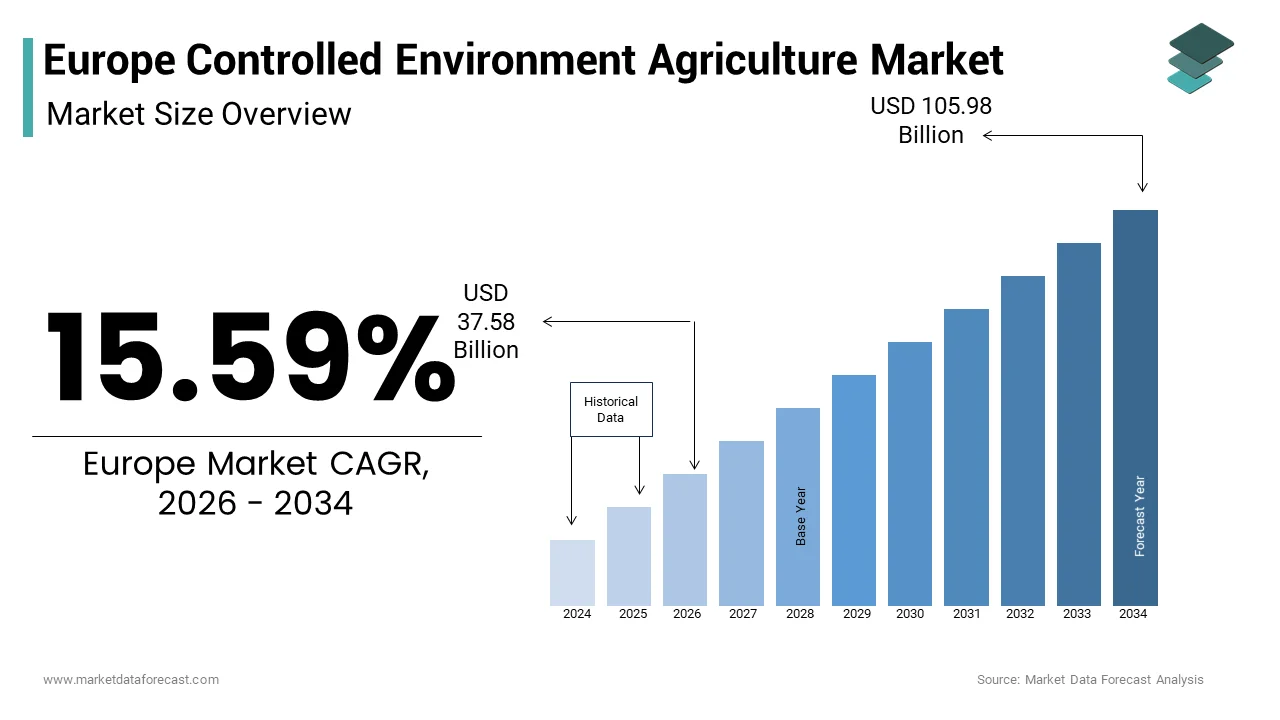
Controlled environment agriculture encompasses advanced agricultural systems such as greenhouses, vertical farms, and plant factories that utilize technology to regulate environmental factors including temperature, humidity, light, and carbon dioxide levels. These systems enable year-round crop production independent of external weather conditions, thereby enhancing food security and supply chain resilience. The European Union has prioritized this sector as a critical component of its sustainable food strategy, aiming to reduce the environmental footprint of agriculture while meeting the dietary needs of a growing urban population. According to Eurostat, the area under glass or high accessible plastic cover in the EU amounted to approximately 95,000 hectares in recent assessments, with Spain and the Netherlands leading in infrastructure density. The Farm to Fork Strategy targets a significant reduction in pesticide use and nutrient losses, which controlled environment agriculture facilitates through precise resource management and closed-loop water systems. As per the European Environment Agency, these systems can reduce water consumption by up to 90% compared to traditional open-field farming. Furthermore, the increasing frequency of extreme weather events across the continent has highlighted the vulnerability of conventional agriculture, driving investment in climate-resilient production methods. The integration of Internet of Things sensors, artificial intelligence, and renewable energy sources is transforming these facilities into highly efficient, data-driven ecosystems. This technological evolution supports the transition towards localised food production, reducing transportation emissions and ensuring fresher produce for consumers.
MARKET DRIVERS
Climate Change Induced Volatility in Traditional Crop Yields
The escalating impact of climate change on traditional agricultural productivity is majorly propelling the expansion of the European controlled environment agriculture market. Increasingly frequent extreme weather events such as heat waves, droughts, and unseasonal frosts have disrupted open-field crop cycles, leading to significant yield instability and economic losses for farmers. According to the European Commission's Joint Research Centre, climate-related anomalies have contributed to significant yield fluctuations across European regions over the last decade. This volatility threatens food security and price stability, prompting governments and private investors to seek resilient alternatives. Controlled environment agriculture provides a buffer against these external shocks by maintaining optimal growing conditions regardless of external weather patterns. As per data from the European Drought Observatory, the severity and frequency of droughts have intensified, particularly in Southern Europe, making water-intensive open-field farming increasingly risky. Greenhouses and vertical farms utilize recirculating irrigation systems that minimize water usage and eliminate dependency on rainfall. This reliability ensures consistent supply contracts with retailers who prioritize steady inventory levels. Furthermore, the ability to predict harvest times with high accuracy allows for better logistical planning and reduced food waste. The strategic imperative to decouple food production from climatic variability drives substantial capital inflow into protected cultivation technologies, ensuring long-term operational stability for agribusinesses.
Stringent Regulatory Frameworks Promoting Sustainable Resource Use
The implementation of rigorous environmental regulations under the European Green Deal and the Farm to Fork Strategy are further contributing to the European controlled environment agriculture market expansion. These policies mandate substantial reductions in the use of chemical pesticides, synthetic fertilizers, and freshwater resources in agricultural practices. According to the European Commission, the Farm to Fork Strategy aims to reduce the overall use of chemical pesticides by 50% and nutrient losses by at least 50% by 2030. Controlled environment systems inherently support these goals by enabling precise application of inputs and preventing runoff into surrounding ecosystems. As per the European Food Safety Authority, enclosed production environments drastically lower the risk of pest infestations, reducing the need for chemical interventions. Additionally, the Water Framework Directive imposes strict limits on agricultural water abstraction and pollution, encouraging the adoption of closed-loop hydroponic and aeroponic systems that recycle nearly all water used. Compliance with these regulations is not only a legal requirement but also a prerequisite for accessing government subsidies and green financing instruments. Farmers and agribusinesses are increasingly viewing controlled environment agriculture as a viable pathway to meet these regulatory benchmarks while maintaining profitability. The alignment of technological capabilities with policy objectives creates a favorable ecosystem for investment and innovation in sustainable farming infrastructure across the continent.
MARKET RESTRAINTS
Prohibitive Initial Capital Expenditure and Operational Costs
The substantial financial burden associated with establishing and operating controlled environment agriculture facilities acts as a major restraint to widespread market adoption. Constructing high-tech greenhouses or vertical farms requires significant upfront investment in specialized infrastructure, including climate control systems, LED lighting arrays, hydroponic setups, and automation software. According to industry cost analyses, the capital expenditure for a modern vertical farm can exceed 1,000 euros per square meter, which is substantially higher than traditional open-field farming. Furthermore, the operational costs, particularly energy consumption for artificial lighting and heating, remain exceptionally high in Northern and Central Europe where natural light is limited during winter months. As per energy price monitoring data from Eurostat, the surge in electricity and natural gas prices in recent years has squeezed profit margins for many controlled environment operators, forcing some to cease operations. The high energy intensity of these systems makes them vulnerable to market fluctuations in utility costs, which are often beyond the control of individual farmers. While technological advancements are gradually improving energy efficiency, the initial barrier to entry remains prohibitive for small and medium-sized enterprises. This financial constraint limits market participation to well-capitalized corporations or heavily subsidized projects, slowing the democratization of these technologies. Without significant reductions in equipment costs or stable energy pricing, the scalability of controlled environment agriculture faces persistent economic headwinds.
Technical Complexity and Shortage of Skilled Labor
The intricate technical requirements of controlled environment agriculture create a significant barrier due to the scarcity of skilled personnel capable of managing these sophisticated systems. Operating a modern facility demands expertise in horticulture, data analytics, engineering, and software management rather than traditional farming skills. According to the European Centre for the Development of Vocational Training, there is a growing mismatch between the skills possessed by the current agricultural workforce and the demands of high-tech farming environments. Many existing farmers lack the digital literacy required to interpret sensor data, manage automated irrigation systems, or troubleshoot complex climate control algorithms. As per industry surveys, recruitment difficulties are cited as a top challenge by over 60% of controlled environment agriculture operators in Europe. The interdisciplinary nature of the work requires continuous training and education, which is not yet widely available in vocational programs across the region. This labor gap leads to suboptimal system performance, increased maintenance costs, and a higher risk of crop failure due to human error. Furthermore, the reliance on specialized technicians for repairs and updates creates dependencies on external service providers, increasing downtime risks. Until educational institutions and industry bodies develop comprehensive training pipelines, the shortage of qualified professionals will continue to hinder the efficient expansion and operational excellence of the controlled environment agriculture sector.
MARKET OPPORTUNITIES
Integration of Renewable Energy and Circular Economy Models
The convergence of controlled environment agriculture with renewable energy technologies and circular economy principles presents a substantial opportunity for European controlled environment agriculture market expansion. Integrating solar photovoltaic panels, wind turbines, or geothermal systems can significantly offset the high energy costs associated with artificial lighting and climate control. According to the International Renewable Energy Agency, the cost of solar energy has decreased by over 80% in the last decade, making it an increasingly viable option for powering agricultural facilities. Some innovative projects in the Netherlands are utilizing waste heat from nearby industrial processes or data centers to warm greenhouses, creating symbiotic industrial ecosystems. As per case studies from the European Innovation Partnership on Agricultural Productivity and Sustainability, these integrated models can reduce energy costs by up to 40% while lowering the carbon footprint. Additionally, the adoption of circular practices such as using organic waste for biogas production or recycling nutrient-rich wastewater enhances resource efficiency. These innovations align with EU funding priorities for green technologies, opening access to grants and low-interest loans. By positioning controlled environment agriculture as a key node in the circular bio-economy, operators can differentiate their products and appeal to environmentally conscious consumers. This holistic approach transforms energy from a cost center into a managed asset, driving long-term economic viability.
Expansion into Urban Areas and Short Supply Chains
The strategic placement of controlled environment agriculture facilities within or near urban centers offers a significant opportunity to the European controlled environment agriculture market growth. Urban vertical farms and rooftop greenhouses drastically reduce transportation distances, minimizing logistics costs and carbon emissions associated with long-haul freight. According to the United Nations Department of Economic and Social Affairs, over 75% of the European population lives in urban areas, creating a dense consumer base for hyper-local produce. As per retail trends, consumers are increasingly willing to pay a premium for vegetables harvested within hours of purchase due to superior taste and nutritional value. Short supply chains also enhance food safety by reducing handling points and potential contamination risks. Municipalities are supporting these initiatives through urban planning policies that allocate space for agricultural use in city developments. Furthermore, these facilities can serve educational and social functions, engaging communities in sustainable food practices. The ability to provide consistent, year-round supply of leafy greens, herbs, and strawberries to urban supermarkets and restaurants strengthens market position. This proximity to end consumers allows for real-time feedback and customization of crop varieties, fostering brand loyalty and market resilience against global supply disruptions.
MARKET CHALLENGES
Energy Dependency and Grid Stability Concerns
The heavy reliance on continuous energy supply is a significant challenge Europe controlled environment agriculture market, particularly in regions with unstable grid infrastructure or high dependence on imported fossil fuels. Artificial lighting, heating, and ventilation systems require uninterrupted power to maintain optimal growing conditions, any disruption of which can lead to rapid crop loss. According to the European Network of Transmission System Operators for Electricity, grid congestion and fluctuating renewable energy output create reliability issues in several member states. As per operational reports, sudden power outages or voltage spikes can damage sensitive electronic controls and disrupt climate regulation, causing stress to plants. The transition to renewable energy sources, while beneficial, introduces intermittency challenges that require expensive battery storage solutions to ensure continuity. Furthermore, the geopolitical tensions affecting natural gas supplies have highlighted the vulnerability of energy-intensive agricultural models. Operators face the dual challenge of securing affordable energy contracts while investing in backup systems to mitigate risk. This uncertainty complicates long-term financial planning and deters investment in large-scale projects. Without robust grid infrastructure or affordable decentralized energy storage options, the sector remains exposed to systemic energy risks that threaten operational continuity and profitability.
Limited Crop Diversity and Economic Viability Constraints
The current economic viability of controlled environment agriculture is largely restricted to high-value, fast-growing crops such as leafy greens, herbs, and strawberries, which is another key challenge to the European controlled environment agriculture market. Growing staple crops like wheat, maize, or potatoes in vertical farms or greenhouses is currently prohibitively expensive due to low market prices relative to production costs. For instance, the energy and infrastructure costs per kilogram for staple crops in controlled environments are significantly higher than those for open-field production. As per market data, this limitation prevents controlled environment agriculture from contributing meaningfully to the caloric needs of the population, focusing instead on niche premium segments. The lack of technological breakthroughs that drastically reduce energy consumption for biomass accumulation restricts the range of economically feasible crops. This narrow focus makes the sector vulnerable to market saturation in specific categories such as baby spinach or basil, leading to price wars and margin compression. Diversifying into fruiting crops like tomatoes or peppers requires more complex pollination and support structures, increasing capital and operational expenses. Until technological advancements lower the cost of production for a wider variety of crops, the sector will struggle to achieve mainstream acceptance as a comprehensive solution for sustainable food production beyond luxury or specialty items.
REPORT COVERAGE
| REPORT METRIC | DETAILS |
| Market Size Available | 2025 to 2034 |
| Base Year | 2025 |
| Forecast Period | 2026 to 2034 |
| CAGR | 15.59% |
| Segments Covered | By Component, Technology, By Country |
| Various Analyses Covered | Global, Regional & Country Level Analysis; Segment-Level Analysis, DROC, PESTLE Analysis, Porter’s Five Forces Analysis, Competitive Landscape, Analyst Overview of Investment Opportunities |
| Regions Covered | UK, France, Spain, Germany, Italy, Russia, Sweden, Denmark, Switzerland, Netherlands, Turkey, Czech Republic,c & Rest of Europe |
| Market Leaders Profiled | Aero Farms, Bowery Farming, Priva Group BV, Signify Holding, Netafim Ltd, Freight Farms, Eden Green Technology, Bright Farms, Plenty Unlimited Inc, Infarm, Soli Organics, 80 Acre Farms |
SEGMENTAL ANALYSIS
By Components Insights
The lighting segment dominated the market by capturing the largest share of the European market in 2025. The dominance of lighting systems segment in the European market is attributed to their fundamental role in driving photosynthesis and enabling year-round crop production independent of natural sunlight. In regions with limited daylight hours such as Northern Europe, artificial lighting is indispensable for maintaining consistent growth cycles and maximizing biomass accumulation. For instance, LED lighting systems can improve crop yields by up to 40% compared to traditional high-pressure sodium lamps by providing specific light spectra tailored to plant developmental stages. According to the European Commission’s research initiatives, precise light management reduces energy waste while enhancing nutritional content in leafy greens and herbs. For instance, the adoption of smart LED fixtures has surged because they allow for dynamic adjustment of light intensity and duration based on real-time crop needs. This precision ensures optimal photon use efficiency, which is critical for profitability in energy-intensive vertical farms. The ability to stack growing layers in vertical farms further amplifies the demand for compact and efficient lighting solutions. Manufacturers are increasingly integrating lighting with climate control software to create holistic growth recipes. This technological integration cements the dominance of lighting components as the primary driver of productivity in controlled environments where natural light is insufficient or inconsistent.
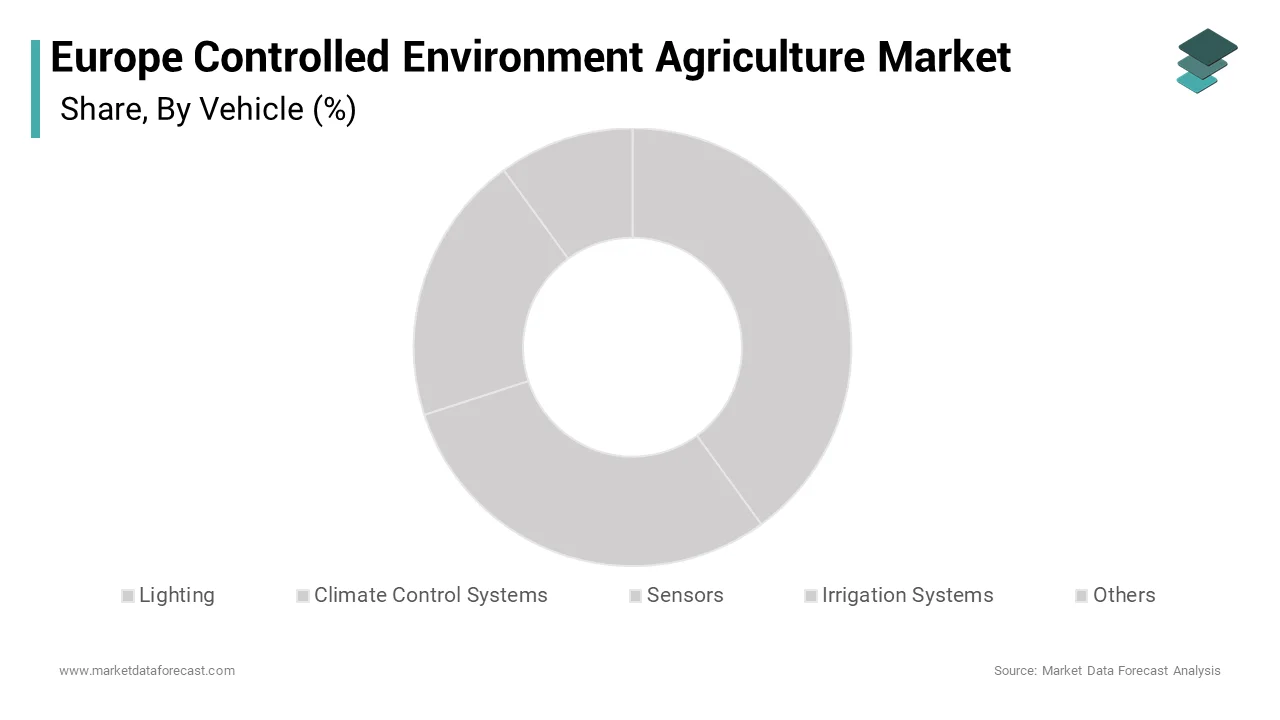
On the other side, the sensors segment is expected to showcase a CAGR of 13.8% over the forecast period in the European market. The rapid integration of Internet of Things platforms and precision agriculture technologies are majorly driving the expansion of the sensors segment in the European market. Modern facilities rely on a dense network of sensors to monitor parameters such as temperature, humidity, CO2 levels, soil moisture, and nutrient concentration in real-time. According to the European Association for Innovation in Agriculture, the adoption of digital monitoring tools has increased by over 30% in recent years as growers seek to optimize resource use and minimize human error. Sensors provide the data foundation for automated decision-making, allowing systems to adjust irrigation, lighting, and ventilation instantly. As per industry analysis, the granularity of data collected enables predictive analytics that can forecast pest outbreaks or nutrient deficiencies before they impact yield. This proactive approach reduces crop loss and enhances quality consistency, which is crucial for premium markets. The decreasing cost of microelectromechanical systems has made sensor deployment economically feasible even for smaller operations. Connectivity improvements via 5G networks facilitate seamless data transmission to cloud platforms for remote management. This technological synergy transforms sensors from passive monitoring devices into active control elements, driving their rapid adoption across the sector.
By Technology Insights
The hydroponics segment dominated the market by holding the largest share of the European market in 2025 due to its proven scalability, established technical knowledge base, and superior resource efficiency compared to soil-based farming. This method involves growing plants in nutrient-rich water solutions, eliminating the need for arable land and significantly reducing water usage. According to the Food and Agriculture Organization, hydroponic systems can reduce water consumption by up to 90% compared to conventional agriculture, a critical advantage in water-stressed regions of Southern Europe. The technology is well understood by growers with decades of operational experience, particularly in the Netherlands and Spain, which host some of the largest greenhouse complexes in the world. As per industry data, hydroponics supports a wide variety of high-value crops including tomatoes, peppers, cucumbers, and leafy greens, ensuring diverse revenue streams. The modular nature of hydroponic systems allows for easy expansion and adaptation to different facility sizes. Established supply chains for nutrients and substrates further lower operational barriers. The reliability of hydroponic yields makes it the preferred choice for commercial operators supplying large retail chains. Its balance of cost-effectiveness and productivity ensures its continued dominance in the regional market.
However, the aeroponics segment is emerging as the fastest-growing segment in the Europe controlled environment agriculture market and is estimated to register a CAGR of 15.5% over the forecast period owing to its superior oxygenation capabilities and accelerated plant growth rates. In aeroponic systems, plant roots are suspended in air and misted with nutrient solution, providing maximum oxygen exposure which stimulates rapid root development and nutrient uptake. According to agricultural research studies, aeroponically grown crops can mature up to 30% faster than those grown in hydroponic systems, allowing for more harvest cycles per year. This efficiency is particularly valuable for high-turnover crops like strawberries and medicinal herbs. As per technical evaluations, the absence of substrate eliminates the risk of soil-borne diseases and reduces cleaning requirements between cycles. The precise delivery of nutrients minimizes waste and allows for fine-tuning of plant physiology. Although technically complex, the high yield potential attracts innovative startups and research institutions. The ability to grow plants in vertical stacks without heavy growing media reduces structural load requirements, facilitating urban installations. These biological and operational advantages drive interest and investment in aeroponic technologies.
COUNTRY LEVEL ANALYSIS
Netherlands Controlled Environment Agriculture Market Analysis
The Netherlands led the market by capturing the highest share of the regional market in 2025 and is likely to maintain its lead by focusing on energy-neutral and automated greenhouse solutions over the next few years. The Netherlands holds the most prominent position in the Europe controlled environment agriculture market, serving as a global hub for greenhouse technology and innovation. The country boasts the highest density of greenhouses in the world, with approximately 10,000 hectares dedicated to protected cultivation. According to Statistics Netherlands, the agricultural sector is a major exporter driven by high-tech greenhouse production of tomatoes, peppers, and flowers. The Cluster approach, involving collaboration between universities, research institutes, and private companies, fosters continuous innovation in climate control and breeding. As per industry data, Dutch companies supply a significant portion of the global greenhouse equipment market. The government’s commitment to sustainable agriculture through initiatives like the Green Deal supports the transition to energy-neutral greenhouses. The presence of major technology providers ensures that the latest advancements in lighting, sensors, and automation are rapidly adopted. This ecosystem of expertise and infrastructure makes the Netherlands the leader in setting standards for controlled environment agriculture in Europe.
Spain Controlled Environment Agriculture Market Analysis
Spain is expected to pivot toward water-saving and semi-closed technology to mitigate climate-related risks over the next few years. Spain occupies a significant share in the Europe controlled environment agriculture market, characterized by its extensive greenhouse areas primarily located in Almeria and Murcia. The region is known as the orchard of Europe, producing vast quantities of vegetables for export during winter months. According to the Spanish Ministry of Agriculture, Fisheries and Food, Spain has over 60,000 hectares of greenhouses, making it the largest area under plastic cover in Europe. The favorable climate reduces heating costs but increases the need for cooling and ventilation systems. As per trade data, Spanish producers are increasingly adopting semi-closed greenhouse technologies to improve water efficiency and pest control. The focus on export markets drives adherence to strict quality and sustainability standards. Investment in renewable energy integration is growing to address environmental concerns. The scale of production allows for economies of scale in technology adoption. Spain’s role as a major supplier ensures steady demand for advanced controlled environment solutions.
Germany Controlled Environment Agriculture Market Analysis
Germany is likely to expand its urban and high-tech vertical farming capacity to reduce food miles over the next few years. Germany holds a strong position in the Europe controlled environment agriculture market, driven by high domestic demand for fresh produce and strong regulatory support for sustainability. The country has a growing number of high-tech greenhouses and vertical farms, particularly near urban centers. According to the Federal Ministry of Food and Agriculture, there is increasing investment in urban farming projects to reduce food miles. German engineering prowess contributes to the development of precise climate control and automation systems. As per industry reports, the market is characterized by a focus on energy efficiency and integration with renewable sources. The strict environmental regulations drive adoption of closed-loop water systems and organic-compliant practices. Consumer willingness to pay for locally produced sustainable food supports the economic viability of high-cost facilities. Research institutions actively collaborate with industry to develop next-generation growing technologies. This focus on quality and sustainability defines the German market landscape.
France Controlled Environment Agriculture Market Analysis
France is expected to modernize its horticultural sector through increased investment in biological control and sustainable urban agriculture over the next few years. France is a key player in the Europe controlled environment agriculture market with a diverse range of greenhouse operations producing vegetables, fruits, and ornamental plants. The country has a strong tradition of horticulture and is increasingly adopting modern technologies to improve efficiency. According to the French Ministry of Agriculture, the sector is undergoing modernization to meet environmental targets and reduce pesticide use. Regions like Brittany and the South West have significant greenhouse concentrations. As per market analysis, there is growing interest in vertical farming for leafy greens in urban areas like Paris. Government incentives for agroecological transitions support the adoption of sustainable practices. The focus on local sourcing by retailers drives investment in nearby production facilities. French companies are also active in developing biological control methods compatible with controlled environments. The combination of traditional expertise and modern innovation sustains market growth.
Italy Controlled Environment Agriculture Market Analysis
Italy is likely to adopt smart, water-efficient technologies to sustain its high-value crop exports over the next few years. Italy holds a notable share in the Europe controlled environment agriculture market, driven by its production of high-value specialty crops such as tomatoes, basil, and strawberries. The country has a significant area of greenhouses, particularly in the South and islands like Sicily. According to ISMEA, the sector is focusing on improving water efficiency and energy sustainability. Italian manufacturers are known for designing aesthetically pleasing and functional greenhouse structures. As per industry data, there is increasing adoption of smart technologies for climate management. The strong culinary culture drives demand for high-quality fresh produce year-round. Export markets for Italian specialties support investment in advanced production methods. The integration of tourism with agricultural experiences also adds value. The focus on quality and tradition, combined with technological adoption, characterizes the Italian market.
COMPETITIVE LANDSCAPE
The competition in the Europe controlled environment agriculture market is characterized by a mix of established technology providers specialized startups and traditional greenhouse manufacturers who compete on innovation reliability and service quality. Leading players leverage their extensive experience and global reach to offer comprehensive turnkey solutions that integrate lighting climate control and irrigation systems. Specialized startups often differentiate themselves through niche technologies such as AI driven analytics or novel vertical farming designs targeting urban markets. The market is driven by the urgent need for sustainability and resource efficiency prompting intense rivalry in developing energy saving technologies. Regulatory compliance with EU environmental standards serves as a key competitive factor favoring companies with proven sustainable solutions. Price competition is moderate as buyers prioritize long term operational efficiency and yield consistency over initial cost. Strategic alliances between technology providers and large scale growers facilitate pilot projects and rapid commercialization of new innovations. The fragmented nature of the market allows regional players to maintain strong positions by offering localized support and customized solutions. Overall success depends on the ability to demonstrate measurable improvements in productivity and sustainability.
KEY MARKET PLAYERS
A few of the market players that are dominating the Europe controlled environment agriculture market are
- Aero Farms
- Bowery Farming
- Priva Group BV
- Signify Holding
- Netafim Ltd
- Freight Farms
- Eden Green Technology
- Bright Farms
- Plenty Unlimited Inc
- Infarm
- Soli Organics
- 80 Acre Farms
Top Players In The Market
- Priva Group BV is a leading technology provider specializing in climate control and process automation for greenhouses and indoor farms across Europe. The company delivers integrated hardware and software solutions that optimize growing conditions for various crops ensuring high yields and resource efficiency. Priva recently launched advanced cloud based platforms that enable remote monitoring and data driven decision making for growers. The company strengthens its market position by collaborating with research institutions to develop algorithms that enhance energy savings and crop quality. Their focus on sustainability aligns with European regulatory goals driving adoption among professional growers. By providing reliable and innovative automation systems Priva supports the modernization of protected cultivation infrastructure throughout the continent.
- Signify Holding formerly Philips Lighting is a global leader in LED lighting solutions for horticulture with a strong presence in the European controlled environment agriculture market. The company offers specialized LED fixtures that deliver optimal light spectra for different plant growth stages enhancing photosynthesis and yield. Signify recently expanded its portfolio with dynamic lighting systems that adjust intensity and spectrum in real time based on crop needs. The company strengthens its market position through strategic partnerships with greenhouse builders and vertical farm operators. Their commitment to energy efficiency and sustainability helps growers reduce operational costs and carbon footprints. By leveraging extensive research in plant physiology Signify provides tailored lighting recipes that maximize productivity for diverse crops.
- Netafim Ltd is a pioneer in precision irrigation and fertigation solutions serving the European controlled environment agriculture sector with advanced hydroponic technologies. The company provides comprehensive systems for water and nutrient delivery ensuring optimal root zone conditions for greenhouse crops. Netafim recently introduced smart irrigation controllers integrated with sensor networks to automate dosing and minimize waste. The company strengthens its market position by offering end to end services including design installation and agronomic support. Their focus on water conservation addresses critical sustainability challenges in Southern Europe. By delivering reliable and efficient irrigation solutions Netafim enables growers to achieve consistent high quality production while reducing environmental impact.
Top Strategies Used By Key Market Participants
Key players in the Europe controlled environment agriculture market primarily employ technological innovation and strategic partnerships to enhance their competitive positioning. Companies invest heavily in research and development to create energy efficient lighting advanced climate control systems and precise irrigation technologies that reduce operational costs. Collaborations with agricultural research institutions and universities allow firms to validate new technologies and develop optimized growth recipes for specific crops. Expansion into software and data analytics services enables providers to offer holistic solutions that integrate hardware with digital management platforms. Focus on sustainability and compliance with EU regulations drives the development of eco friendly products such as recyclable substrates and low energy LEDs. Educational initiatives and technical support programs help growers adopt complex technologies effectively. Diversification into urban farming and vertical agriculture segments allows companies to tap into emerging markets. These strategies collectively help participants address the high capital and operational barriers of the sector while demonstrating tangible value to customers.
MARKET SEGMENTATION
This research report on the Europe controlled environment agriculture market is segmented and sub-segmented into the following categories.
By Components Type
- Lighting
- Climate Control Systems
- Sensors
- Irrigation Systems
- Others
By Technology Type
- Hydroponics
- Aeroponics
- Aquaponics
- Others
By Country
- UK
- France
- Spain
- Germany
- Italy
- Russia
- Sweden
- Denmark
- Switzerland
- Netherlands
- Turkey
- Czech Republic
- Rest of Europe
Frequently Asked Questions
What is driving the growth of the Europe controlled environment agriculture market?
The Europe controlled environment agriculture market is growing due to increasing demand for sustainable food production, rising adoption of vertical farming and greenhouse technologies, and the need to improve crop yields while minimizing land and water usage. Growing concerns over climate change, food security, and year-round crop cultivation are also accelerating investments in controlled environment agriculture across Europe.
Which technologies are widely used in the Europe controlled environment agriculture market?
The Europe controlled environment agriculture market includes technologies such as hydroponics, aeroponics, aquaponics, vertical farming systems, climate-controlled greenhouses, LED grow lighting, automated irrigation, AI-powered crop monitoring, and IoT-enabled environmental control systems. These technologies help optimize plant growth, improve resource efficiency, and increase agricultural productivity.
What are the key trends shaping the Europe controlled environment agriculture market?
Key trends in the Europe controlled environment agriculture market include the adoption of AI and IoT for precision farming, expansion of vertical farming facilities, increasing use of renewable energy in greenhouses, automation and robotics for crop management, and the development of energy-efficient LED lighting systems. Growing investments in urban farming and sustainable agricultural practices are also transforming the market.
Which countries are leading the Europe controlled environment agriculture market?
The Netherlands, Germany, France, Spain, and the United Kingdom are among the leading contributors to the Europe controlled environment agriculture market. The Netherlands is recognized for its advanced greenhouse technologies, while other European countries are increasing investments in smart farming, indoor agriculture, and high-tech food production systems to strengthen agricultural sustainability.
What is the future outlook for the Europe controlled environment agriculture market?
The Europe controlled environment agriculture market is expected to witness strong growth over the forecast period, driven by increasing demand for locally produced fresh food, continued investments in agricultural technology, and supportive sustainability initiatives. Advancements in automation, data-driven crop management, climate control systems, and resource-efficient farming solutions are expected to create significant opportunities for CEA technology providers, greenhouse operators, and commercial growers.
Related Reports
Access the study in MULTIPLE FORMATS
Purchase options starting from
$ 2000
Didn’t find what you’re looking for?
TALK TO OUR ANALYST TEAM
Need something within your budget?
NO WORRIES! WE GOT YOU COVERED!
Call us on: +1 888 702 9696 (U.S Toll Free)
Write to us: sales@marketdataforecast.com