- Product Description Description
- Table of Contents TOC
- List of Table & Figure LOT
- Get Free Sample PDF Sample PDF
Market Size, 2025
$33.83 BnMarket Estimate, 2026
$35.56 BnMarket Forecast, 2034
$52.93 BnCAGR, 2026–2034
5.1%Europe Crop Protection Pesticides Market Size
The European crop protection pesticides market was valued at USD 33.83 billion in 2025 and is anticipated to be USD 35.56 billion in 2026 to USD 52.93 billion by 2034, growing at a CAGR of 5.1% during the forecast period from 2026 to 2034.
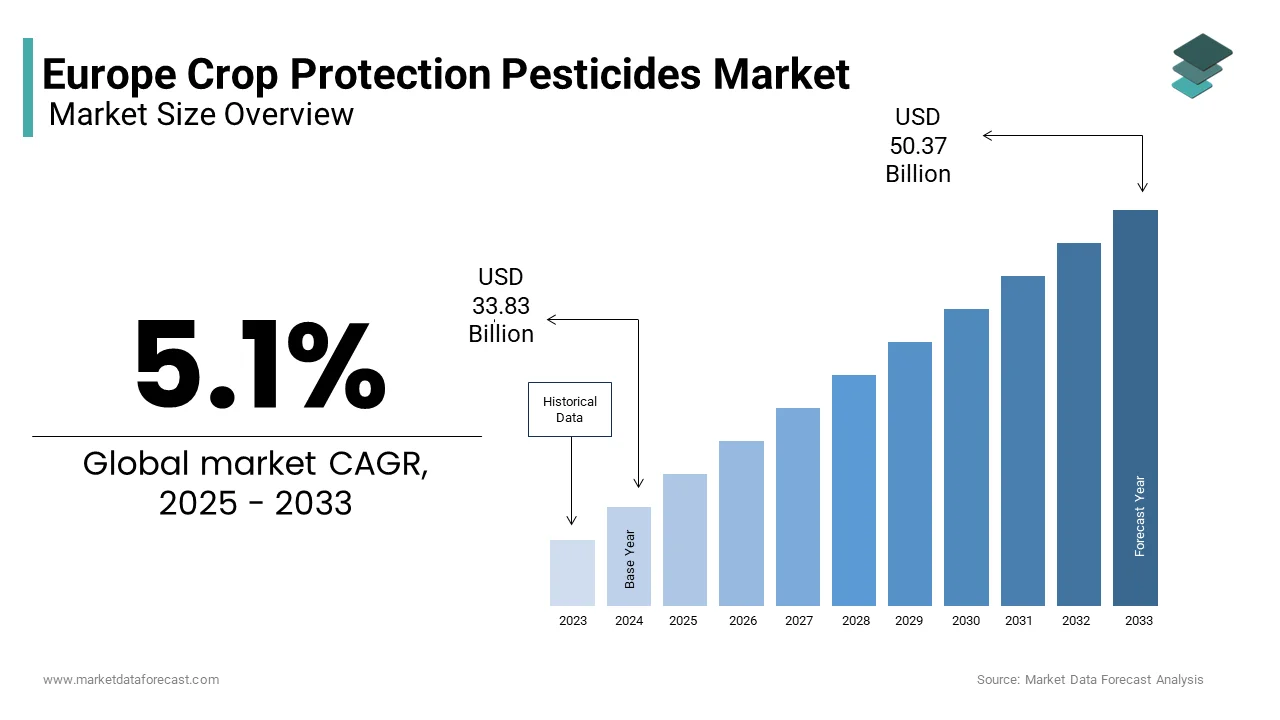
Crop protection pesticides are chemical and biological agents that are designed to safeguard crops from pests, diseases, and weeds. These include herbicides, insecticides, fungicides, and emerging biopesticides deployed across arable, horticultural, and permanent crop systems. The market operates within a tightly regulated framework shaped by the European Union’s Sustainable Use of Pesticides Directive and the Farm to Fork Strategy, which aims to reduce chemical pesticide use by 50 percent by 2030. According to Eurostat, agricultural land under organic farming in the EU reached 16.3 million hectares in 20,22, representing 10.5 percent of total utilized agricultural area, reflecting a structural shift toward reduced synthetic inputs. This evolving regulatory and ecological landscape defines the contours of Europe’s approach to crop protection, balancing productivity with environmental stewardship.
MARKET DRIVERS
Intensifying Pressure from Invasive Pest Species
Mounting threats from invasive pest species, which compromise crop yields and necessitate targeted pesticide interventions, are driving the growth of the European crop protection pesticides market. Climate change and global trade have accelerated the establishment of non native organisms such as the fall armyworm Drosophila suzukii and the tomato leafminer Tuta absoluta, which lack natural predators in European ecosystems. According to the European and Mediterranean Plant Protection Organization, many pest species were reported in EU member states between 2015 and 202,3, with some classified as high risk to major crops. Conventional monitoring systems often fail to detect early incursion, prompting emergency authorizations for restricted pesticides under Article 53 of Regulation EC 1107 2009. These reactive measures underscore the persistent demand for effective chemistries despite regulatory headwinds as farmers seek to protect livelihoods against rapidly evolving biological threats.
Rising Adoption of Precision Agriculture Technologies
The integration of precision agriculture is another propellant of the expansion of the European crop protection pesticides market. This is transforming pesticide application from blanket spraying to targeted delivery, significantly influencing product demand and formulation design. Digital tools such as drone-based multispectral imaging, soil sensors, and AI-driven decision support systems enable real-time pest and disease detection, allowing for site-specific interventions. According to the European Commission, a large portion of large-scale farms in the EU utilized precision spraying equipment in 2023, up from that in 2020. This shift reduces chemical usage per hectare while maintaining efficacy. Manufacturers are responding by developing low-dose high-efficacy formulations compatible with micro spray nozzles and electrostatic applicators. Precision agriculture is becoming mainstream. This drives demand for smarter, more efficient pesticide solutions that align with sustainability mandates while preserving crop productivity.
MARKET RESTRAINTS
Stringent Regulatory Restrictions on Active Substances
The European Union enforces one of the world’s most rigorous regulatory regimes for pesticide approval, which restricts the growth of the European crop protection pesticides market. These stringent regulations significantly constrain product availability and innovation pipelines. Regulation EC mandates that active substances must demonstrate no endocrine disruption potential, no carcinogenicity, and minimal risk to non-target organisms, including pollinators and aquatic life. According to the European Commission, the number of active substances was withdrawn or not renewed between 2018 and 2023, including widely used compounds like chlorpyrifos and mancozeb, due to unresolved safety concerns. The regulatory environment, while protective of public health and biodiversity, creates operational challenges for growers and disincentivizes R and D investment in new synthetic molecules within the European market.
Growing Consumer and Retailer Demand for Residue-Free Produce
Consumers and major retail chains in the region increasingly demand agricultural produce with minimal or zero pesticide residues and are driving restrictive procurement policies that limit pesticide use at the farm level, thereby impeding the expansion of the European crop protection pesticides market. According to the European Consumer Organisation, a portion of shoppers consider pesticide residue levels a key factor in fresh produce purchases. This sentiment is institutionalized through retailer standards, which impose maximum residue limits far below EU legal thresholds and ban entire chemical classes. Also, the commercial pressures compel farmers to adopt non-chemical alternatives or use only short pre-harvest interval products even when pest pressure warrants stronger interventions. The disconnect between regulatory approvals and market acceptance creates a de facto ban on many legally authorized pesticides, narrowing the effective toolbox available to European growers and increasing vulnerability to yield loss.
MARKET OPPORTUNITIES
Expansion of Biopesticides and Biological Control Agents
Accelerated development and adoption of biopesticides as viable alternatives to synthetic chemicals give new opportunities for the expansion of the European crop protection pesticides market. These are derived from microorganisms, plant extracts, or natural compounds. Driven by the EU’s Farm to Fork Strategy, which targets an increase in biocontrol product usage by 2030, the regulatory pathway for biologicals has been streamlined. According to the European Commission, the number of biopesticide active substances received approval between 2020 and 2023, compared to only a few in the preceding five years. Companies have launched microbial fungicides based on Bacillus subtilis and Trichoderma harzianum that effectively suppress powdery mildew and root rots in vineyards and greenhouse vegetables. Advanced research in formulation stability and field efficacy is transitioning biologicals from niche supplements to core components of sustainable crop protection strategies, providing growers with compliant and effective tools within tightening regulatory boundaries.
Integration of Digital Platforms for Integrated Pest Management
Digital platforms are enabling the systematic implementation of Integrated Pest Management, which generates potential opportunities for the expansion of the European crop protection pesticides market. This integration is made by consolidating data on weather, pest scouting, and historical infestations to optimize pesticide use. Systems such as Syngenta’s Cropwise and Bayer’s Climate FieldView provide predictive analytics that forecast pest outbreaks and recommend precise intervention windows. According to sources, a notable number of European farms subscribed to digital IPM platforms, which represents an increase from 2021. These tools reduce unnecessary sprays by aligning applications with actual risk levels rather than calendar-based schedules. More accessible and interoperable platforms create a structural shift toward data-informed, minimal intervention crop protection. The result is improved economic efficiency and environmental objectives, along with new opportunities for digital services in the pesticide industry.
MARKET CHALLENGES
Emergence of Pest Resistance to Existing Chemistries
Repeated use of limited pesticide modes of action challenges the growth of the European crop protection pesticide market. This has accelerated the development of resistance in key pest populations, which affects the efficacy of available crop protection tools. The regulatory withdrawal of older chemistries has narrowed the rotation options needed to manage resistance, with only three new insecticide modes of action approved in the EU since 2010. This scarcity forces reliance on remaining effective compounds, increasing selection pressure. Without timely access to novel chemistries or a robust resistance monitoring network, farmers face diminishing returns from existing pesticides. This threatens both productivity and the long-term viability of chemical crop protection in key production systems..ms.
Fragmented National Implementation of EU Pesticide Policies
A harmonized EU regulatory framework exists, yet pesticide rule enforcement and interpretation vary significantly across member states, further obstructing the expansion of the European crop protection pesticides market. This causes market fragmentation and compliance uncertainty for growers and manufacturers. According to the European Court of Auditors, national action plans under the Sustainable Use Directive exhibit wide disparities in reduction targets, monitoring mechanisms, and sand buffer zone requirements. These inconsistencies complicate cross-border farming operations and supply chains, particularly in regions like the Rhine Valley, where farms span multiple jurisdictions. Apart from these, emergency authorizations for banned substances are granted unevenly. This regulatory patchwork increases administrative burden, discourages investment in new products, and creates competitive distortions where farmers in stricter countries face higher production costs and reduced pest control options compared to their counterparts in more permissive regions.
REPORT COVERAGE
| REPORT METRIC | DETAILS |
| Market Size Available | 2025 to 2034 |
| Base Year | 2025 |
| Forecast Period | 2026 to 2034 |
| CAGR | 5.1% |
| Segments Covered | By Application, Type, And Region. |
| Various Analyses Covered | Global, Regional, and Country Level Analysis, Segment-Level Analysis, DROC, PESTLE Analysis, Porter’s Five Forces Analysis, Competitive Landscape, Analyst Overview of Investment Opportunities |
| Regions Covered | UK, France, Spain, Germany, Italy, Russia, Sweden, Denmark, Switzerland, Netherlands, Turkey, Czech Republic, & Rest of Europe |
| Market Leaders Profiled | Marrone Bio Innovations, DuPont, Arysta Life Sciences, BASF, Dow AgroSciences, Vanguard, Cheminova, Chemtura Corp, Monsanto, Natural Industries, Bayer CropScience, Novozymes A/S, Nufarm Ltd, Sumitomo Chemical, Syngenta AG, Valent Biosciences, FMC Corp, Isagro SpA, Ishihara Sangyo Kaisha, Makhteshim Agan, Chr Hansen, and BioWorks |
SEGMENTAL ANALYSIS
By Application Insights
The crop-based application segment remained the dominant segment by capturing a substantial share of the European crop protection pesticides market in 2024. The dominance of the crop-based application segment is driven by the fundamental role of pesticides in safeguarding food and feed production across the continent’s millions of hectares of utilized agricultural area. Moreover, a further driver of this segment is the economic necessity of minimizing pre-harvest losses in high-value crops such as cereals,frfruitsnd vegetables, which collectively contribute billions of euros annually to the EU agricultural economy, as per sources. Besides, the EU’s Common Agricultural Policy links direct payments to farmers who implement integrated pest management, which often includes judicious pesticide use as a last resort. The structural dependence of European agriculture on consistent yields to meet domestic food security and export obligations ensures that crop-based pesticide use remains the cornerstone of the market despite regulatory and environmental pressures.
The non-crop-based application segment is expected to exhibit a noteworthy CAGR of 6.8% from 2025 to 2033. The growth of the non-crop-based application segment is fueled by increasing urbanization, infrastructure development, and public health mandates that require vegetation and pest control beyond agricultural fields. Key applications include railway track maintenance, road verge management, and mosquito control in public health programs. According to the European Centre for Disease Prevention and Control, outbreaks of West Nile virus in Southern Europe have prompted intensified vector control with larvicide applications in urban water bodies rising across Italy, Greece, and Spain. Furthermore, municipalities are also investing in non-crop pest management to protect public green spaces.
By Type Insights
The synthetic pesticides segment led the European crop protection pesticides market by accounting for a significant share in 2024. The prominence of the synthetic pesticides segment is because of their proven efficacy, broad-spectrum activity,n and cost-effectiveness in large-scale farming systems. Despite regulatory attrition, synthetic chemistries remain indispensable for managing high-pressure pest and disease outbreaks where biologicals lack sufficient knockdown power. According to the European Commission, synthetic herbicides account for a portion of total pesticide sales volume due to their critical role in weed control in cereal and oilseed production. The reliability of synthetics is further underscored by their integration into resistance management programs, where they are rotated with newer modes of action to prolong effectiveness. Synthetic products will remain the backbone of European crop protection until biopesticides achieve comparable field performance across diverse climatic and crop conditions.
The biopesticides segment is predicted to witness the highest CAGR of 13.5% from 2025 to 2033, owing to direct alignment with the EU’s Farm to Fork Strategy, which mandates a reduction in chemical pesticide use and an increase in biocontrol adoption by 2030. Regulatory reforms have streamlined approval pathways, with the European Commission reducing the average evaluation time for microbial active substances between 2020 and 2023. Retailer pressure further drives adoption with supermarket chains requiring suppliers to document biopesticide use in fresh produce supply chains. Investment is surging with companies launching dedicated biotech innovation hubs. Formulation stability has improved, and farmer training programs are expanding through the European Innovation Partnership. Biopesticides are now transitioning from niche supplements to core components of sustainable crop protection systems. These are being used across vineyards, ds orchards, and greenhouse vegetables.
COUNTRY ANALYSIS
France Crop Protection Pesticides Market Analysis
France was the top performer in the European crop protection pesticides market in 2024 and occupied a 22.7% share in 2024. The dominant position of France in the regional market is primarily driven by its status as the EU’s top agricultural producer. Millions of hectares of farmland cultivate cereals, wine, fruit, and vegetables. Despite ambitious national reduction targets under the Ecophyto plan, pesticide use remains substantial due to high pest pressure in intensive cropping systems. According to sources, sales of crop protection products totaled notable tons of active substances, with herbicides dominating. The government actively promotes integrated pest management. However, er emergency authorizations for banned substances persist. The tension between production demands and ecological transition defines France’s complex role as both the largest consumer and a policy driver in the European crop protection landscape.
Germany Crop Protection Pesticides Market Analysis
Germany is another key region in the European crop protection pesticide market, capturing 16.3% of the regional market in 2024. Its highly mechanized and export-oriented agriculture, particularly in cereals, sugar beet,,s and potatoes, significantly contributed to the growth of the European crop protection market. German farmers operate under some of the strictest national regulations in the EU, including mandatory buffer zones and digital spray logs. According to studies, pesticide sales declined between 2020 and 2022, yet remain essential for disease control in high-value crops. Germany is also a hub for agrochemical innovation. The country leads in precision application, with 54 percent of large farms using GPS-guided sprayers as per the Thünen Institute. Hence, it remains a critical market for both conventional and biological crop protection solutions as Germany balances productivity with its National Action Plan on Sustainable Use.
Spain Crop Protection Pesticides Market Analysis
Spain continues to grow steadily in the European crop protection pesticides market due to its vast horticultural sector, which supplies a portion of the EU’s fresh fruits and vegetables, including tomatoes, peppers, and citrus. Intensive greenhouse farming in Almería covers notable hectares requiring year-round pest and disease management. According to sources, pesticide use intensity is among the highest in Europe, with kilograms of active substance per hectare annually. Climate change exacerbates pressure with invasive species absoluta causing recurrent outbreaks. Spain also leads in emergency authorizations. However, the country is rapidly adopting biopesticides, with sales growing, and is driven by retailer demands and organic export requirements. This duality of high-intensity conventional use and expanding biological adoption defines Spain’s dynamic and strategically vital role in the European crop protection ecosystem.
Italy Crop Protection Pesticides Market Analysis
Italy expanded gradually in the European crop protection pesticide market. The growth of thaly is fuelled by its diverse agricultural landscape, spanning rice paddies in the Po Valle, vineyards in Tuscany, and citrus groves in Sicily,ily each with distinct pest profiles. Italy faces severe pressure from Xylella fastidiosa, which has infected a large number of olive trees by prompting extensive insecticide use to control the vector spittlebug, as per sources. Italy also leads in organic farming, with a portion of its agricultural area certified organic, requiring compliant biopesticide solutions. Besides, Italian farmers are early adopters of precision spraying. Italy remains a high-value market for both emergency synthetic interventions and long-term biological strategies while navigating disease crises and sustainability mandates.
United Kingdom Crop Protection Pesticides Market Analysis
The United Kingdom is likely to grow in the European crop protection pesticide market. Post Brexit, the UK maintains alignment with EU pesticide regulations through the retained REACH and Biocidal Products frameworks, but now operates an independent approval process. The growth of the United Kingdom is driven by high-value arable and horticultural production, including oilseed rape, wheat, and soft fruits, which face significant pest pressure from cabbage stem flea beetle and spotted wing drosophila. The UK is also advancing integrated approaches with the Sustainable Farming Incentive,e rewarding reduced chemical inputs. Apart from these, the UK leads in digital advisory tools. The UK is refining its independent regulatory stance. It remains a sophisticated market balancing productivity, innovation, and environmental stewardship in crop protection.
COMPETITIVE LANDSCAPE
TheEuropeane crop protection pesticides market is characterized by intense competition among multinational agrochemical companies, niche specialty firms, and emerging biocontrol innovators. Multinationals leverage scale R and D capabilities,s, and digital ecosystems to maintain leadership while facing pressure from regulatory attrition and retailer demands. National players differentiate through localized solutions and strong agronomic advisory networks, particularly in Southern Europe. The rise of biopesticides has lowered the entry barrier, enabling agile startups to capture niche segments with microbial and botanical formulations. Competition is increasingly defined by sustainability credentials, with companies competing on environmental footprint, stewardship programs, and compatibility with organic systems. Price competition remains limited due to high regulatory costs and product differentiation through formulation technology and digital integration. However, the fragmented regulatory landscape across member states creates uneven playing fields where emergency authorizations and national action plans influence market access. As the EU pushes for chemical reduction, the competitive edge is shifting toward integrated solutions that combine chemistry,ry, biology, and data rather than standalone products.
KEY MARKET PLAYERS
A few of the market players in theEuropeane crop protection pesticides market include
- Marrone Bio Innovations
- DuPont
- Arysta Life Sciences
- BASF
- Dow AgroSciences
- American Vanguard
- Cheminova
- Chemtura Corp
- Monsanto
- Natural Industries
- Bayer CropScience
- Novozymes A/S
- Nufarm Ltd
- Sumitomo Chemical
- Syngenta AG
- Valent Biosciences
- FMC Corp
- Isagro SpA
- Ishihara Sangyo Kaisha
- Makhteshim Agan
- Chr Hansen
- BioWorks
Top Players In The Market
- Bayer AG is a leading innovator in the European crop protection pesticides market, offering a comprehensive portfolio of herbicides, insecticides, and fungicides alongside digital farming solutions. The company plays a pivotal role globally by advancing integrated pest management through its Climate FieldView platform and next-generation molecules like isoflupyrad. In Europe, Bayer has intensified its focus on sustainability by launching biopesticide lines and phasing out high-risk substances ahead of regulatory deadlines. Recent initiatives include partnerships with EU research institutions to develop resistance monitoring tools and farmer training programs on precision application. Bayer also actively contributes to the global discourse on pesticide stewardship by publishing environmental fate data and supporting the EU’s Farm to Fork objectives through science-based innovation.
- Syngenta Group maintains a strong presence in the European crop protection pesticides market with a diverse range of synthetic and biological solutions tailored to regional cropping systems. The company is globally recognized for its leadership in sustainable agriculture and digital agronomy through platforms like Cropwise. In Europe, Syngenta has accelerated the rollout of biopesticides and seed treatment technologies that reduce field spray requirements. It recently expanded its biocontrol production facility in France to meet rising demand for microbial solutions. Syngenta also collaborates with European retailers and cooperatives to implement residue management protocols and promote IPM adoption. Its global contribution includes advancing regulatory science for biologicals and advocating for harmonized approval pathways that support innovation while ensuring environmental safety.
- BASF SE is a key player in the European crop protection pesticides market, known for its robust R and D pipeline and commitment to sustainable crop protection. The company offers innovative fungicides, herbicides, and insecticides complemented by biologicals under its Biological Solutions division. In Europe, BASF has strengthened its position by investing in digital tools that optimize pesticide use and by aligning its portfolio with the EU’s reduction targets. Recent actions include the launch of new low-dose formulations compatible with precision spraying equipment and the establishment of demonstration farms across Germany and Spain to showcase integrated approaches. Globally, BASF contributes by developing next-generation active ingredients with improved environmental profiles and by supporting farmer education on responsible pesticide stewardship through international partnerships.
Top Strategies Used by the Key Market Participants
Key players in the European crop protection pesticides market prioritize regulatory compliance by proactively reformulating products to meet EU safety and environmental standards. They invest heavily in research and development to create low-dose, high-efficacy molecules and expand their biopesticide portfolios in alignment with the Farm to Fork Strategy. Companies integrate digital agriculture platforms to enable precision application and data-driven pest management, enhancing product value beyond chemistry. Strategic collaborations with research institutions, farmers, ER, SS, rs, and retailers facilitate the adoption of integrated pest management and residue reduction protocols. Additionally, firms focus on sustainability communication by publishing environmental impact assessments and supporting certification schemes that build trust with consumers and policymakers across the European Union.
MARKET SEGMENTATION
This research report on the European crop protection pesticides market has been segmented and sub-segmented into the following regions.
By Application
- Crop-Based Application:
- Grains & Cereals
- Oilseeds and Fruits & Vegetables
- Non-Crop Based Application:
- Turf & Ornamental Grass
- Other Applications
By Type Insights
- Synthetic
- Bio-pesticides
By Country
- United Kingdom
- France
- Spain
- Germany
- Italy
- Russia
- Sweden
- Denmark
- Switzerland
- Netherlands
- Rest of Europe