- Product Description Description
- Table of Contents TOC
- List of Table & Figure LOT
- Get Free Sample PDF Sample PDF
Market Size, 2025
$0.56 BnMarket Estimate, 2026
$0.69 BnMarket Forecast, 2034
$3.70 BnCAGR, 2026–2034
23.36%Europe Data Collection and Labeling Market Report Summary
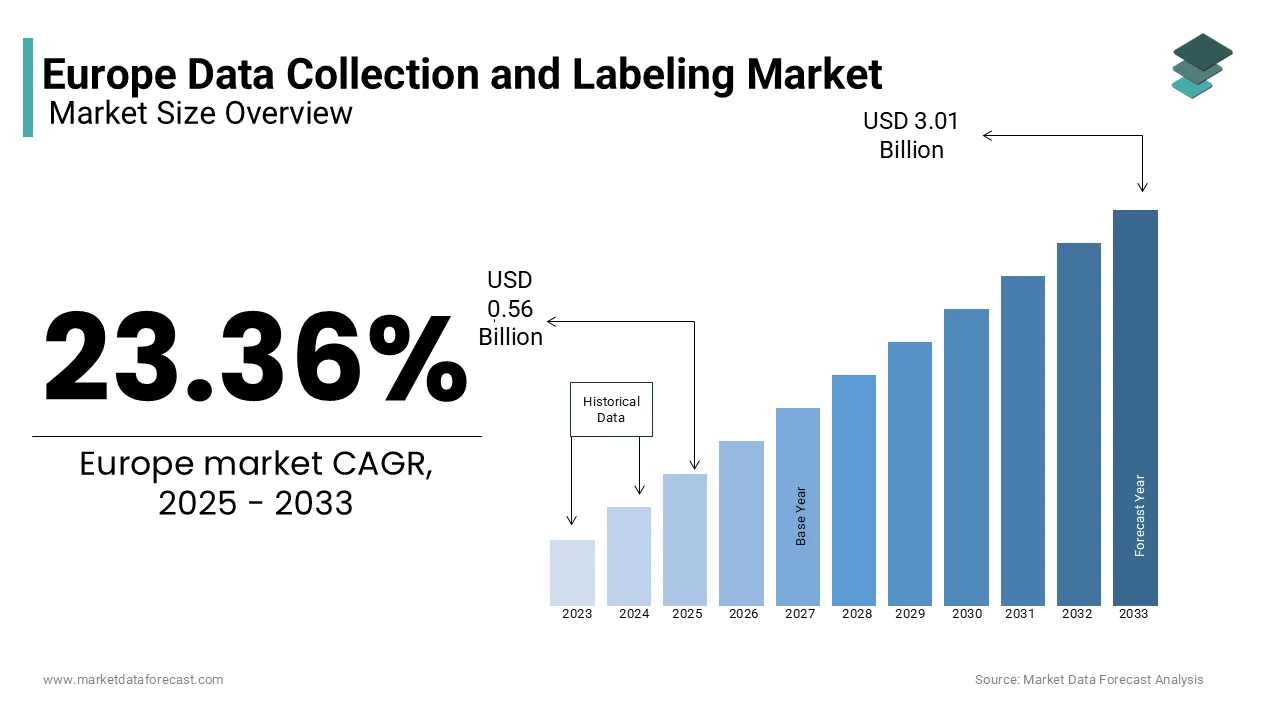
The Europe data collection and labeling market was valued at USD 0.56 billion in 2025, is estimated to reach USD 0.69 billion in 2026, and is projected to reach USD 3.70 billion by 2034, growing at a CAGR of 23.36% from 2026 to 2034. Market growth is driven by the rapid expansion of artificial intelligence (AI) and machine learning (ML) applications, which require high-quality annotated datasets for training models. Increasing adoption of autonomous systems, computer vision, and natural language processing across industries such as IT, telecom, automotive, and healthcare is further fueling demand. Additionally, growing investments in AI innovation and data-driven decision-making are accelerating market expansion across Europe.
Key Market Trends
- Rising demand for AI and machine learning training data.
- Increasing adoption of computer vision and NLP technologies.
- Growth in autonomous systems and smart applications.
- Expansion of data-driven business strategies.
- Increasing investments in AI research and development.
Segmental Insights
- Based on data type, the image/video segment dominated the Europe data collection and labeling market by capturing 42.5% share in 2025, driven by its critical role in computer vision applications.
- Based on application, the IT and telecom segment led the market with 30.6% share in 2025, supported by rapid digital transformation and AI integration.
Regional Insights
The Europe data collection and labeling market is witnessing strong growth across major technology hubs.
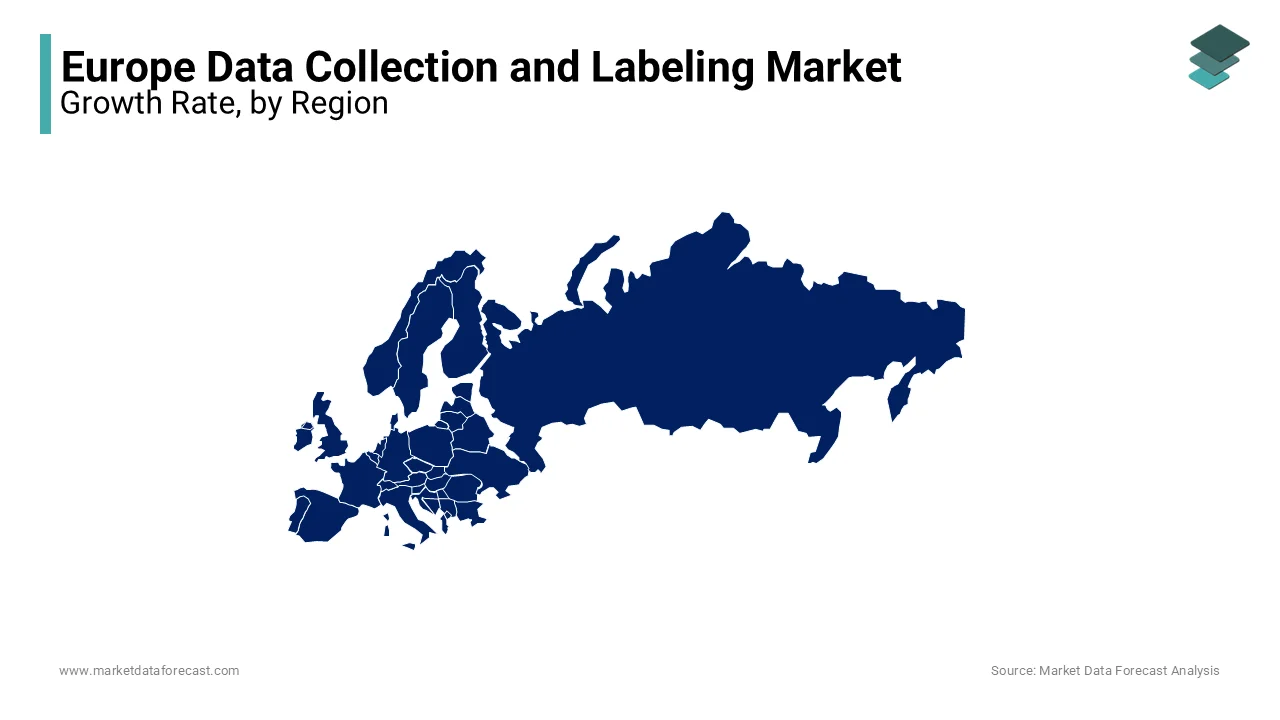
- Germany led the market in 2025 with 27.7% share, driven by strong industrial AI adoption and technological innovation.
- The United Kingdom followed with 22.8% share, supported by a robust AI ecosystem and startup environment.
- France plays a key role due to its national AI strategy and increasing investments in digital transformation.
Competitive Landscape
The Europe data collection and labeling market is highly competitive, with companies focusing on scalable annotation platforms, automation tools, and high-quality data services. Strategic partnerships, acquisitions, and investments in AI-driven labeling technologies are shaping the competitive landscape.
Prominent companies operating in the Europe data collection and labeling market include Globalme Localization Inc., Trilldata Technologies Pvt. Ltd., Alegion, Reality AI, Dobility Inc., Global Technology Solutions, Telus International, Playment Inc., Appen Limited, Labelbox Inc., Scale AI, Avery Dennison Corporation, and Summa Linguae Technologies S.A.
Europe Data Collection and Labeling Market Size
The Europe data collection and labelling market was worth USD 0.56 billion in 2025. The European market is expected to reach USD 3.70 billion by 2034 from USD 0.69 billion in 2026, rising at a CAGR of 23.36% from 2026 to 2034.
Data collection is the act of gathering relevant raw information, such as images, text, audio, or video, from various sources like web scraping, open-source datasets, or internal logs. Data labeling (or annotation) is the process of identifying and tagging specific elements within that raw data to provide context for an algorithm. For example, labeling an image of a street with tags like "car," "pedestrian," or "stop sign". This domain encompasses diverse activities ranging from image segmentation and text classification to audio transcription and sensor data tagging, serving as the critical fuel for algorithmic accuracy across the continent. The region distinguishes itself through a rigorous adherence to ethical standards and data privacy, which shapes the methodologies employed by service providers and enterprises alike. As per Eurostat, 45.2% of enterprises in the European Union utilized cloud computing services (rising to 52.7% by 2025), while recent reports highlight that 92% of the region's cloud data is hosted by U.S.-based providers, underscoring a critical dependency that requires strategic data sovereignty measures. Furthermore, a 2024 European Commission Eurobarometer revealed that while cybersecurity is a priority, 68% of SMEs believed no additional cybersecurity training was needed, a concerning gap given that industry reports indicate around 40% of businesses actually faced cybersecurity incidents in the same period. The International Telecommunication Union (ITU) reported in 2024 that 91% of individuals in Europe used the internet, creating a continuous stream of digital interactions that must be captured and annotated to refine user experience algorithms. This market acts as the essential bridge between raw digital noise and intelligent decision-making, enabling sectors from automotive to healthcare to deploy reliable AI solutions while navigating the complex regulatory landscape of the European Union.
MARKET DRIVERS
Accelerated Adoption of Autonomous Systems in Automotive and Logistics
The accelerated adoption of autonomous systems in the automotive and logistics sectors serves as a key factor propelling the Europe Data Collection and Labeling Market forward. The development of self-driving vehicles and automated delivery robots relies entirely on massive volumes of precisely annotated sensor data, including LiDAR point clouds, camera images, and radar signals, to navigate complex European urban environments safely. Manufacturers must label millions of objects, such as pedestrians, traffic signs, and road markings, with pixel-level accuracy to train perception algorithms that meet stringent safety standards. According to various sources, investments in connected and automated driving technologies remain a dominant share of the automotive research and development budget, creating a steady demand for high-fidelity labeled datasets to train perception systems. The diverse weather conditions and intricate road infrastructures across European nations necessitate localized data collection efforts to ensure model robustness in varied scenarios. A study indicated that achieving high levels of vehicle autonomy requires validating safety over vast distances of simulated and real-world driving exposure, a validation process that necessitates extensive labeling projects to process critical scenarios. Furthermore, the rise of smart logistics hubs in countries like Germany and the Netherlands demands accurate spatial data labeling to optimize warehouse automation and last-mile delivery routes. As per findings from the European Commission, the deployment of intelligent transport systems is a key pillar of the EU mobility strategy, compelling industry players to secure reliable data partners capable of delivering scalable and precise annotation services to sustain innovation in this critical sector.
Surging Demand for Natural Language Processing in Multilingual Contexts
The surging demand for Natural Language Processing applications tailored to the region's linguistic diversity drives the growth of the Europe data collection and labeling market. With numerous official languages and countless dialects spoken across the continent, developing AI models that understand and generate human language requires extensive collections of annotated text and speech data specific to each locale. Enterprises in customer service, legal tech, and healthcare are increasingly deploying chatbots and virtual assistants that must comprehend nuanced cultural references and grammatical structures unique to European languages. According to research, the market for language technologies in Europe is undergoing a significant structural transformation driven by the integration of artificial intelligence, increasing the necessity for specialized datasets to train and fine-tune conversational models. The General Data Protection Regulation mandates strict handling of personal data, forcing organizations to source locally collected and ethically labeled datasets to ensure compliance while training their models. Research consistently emphasizes that a vast majority of European consumers prefer interacting with brands in their native language, motivating companies to invest in multilingual data processes to ensure effective localization. Furthermore, the emergence of large language models has intensified the requirement for high-quality human feedback data to align AI outputs with regional values and facts. As per multiple studies, European AI initiatives and startups are increasingly prioritizing the acquisition of native language data to build linguistically accurate models that comply with regional diversity and regulatory standards.
MARKET RESTRAINTS
Stringent Data Privacy Regulations and Compliance Complexities
Stringent data privacy regulations and the associated compliance complexities impose significant restraints on the operations of the Europe data collection and labeling market. The General Data Protection Regulation establishes rigorous standards for the collection, processing, and storage of personal data, requiring explicit consent and strict purpose limitation, which often hampers the aggregation of large-scale datasets needed for AI training. Annotators frequently encounter difficulties when working with data containing personally identifiable information, as any mishandling can result in severe financial penalties and reputational damage. According to data on GDPR enforcement, European authorities continued to impose significant penalties in 2024, with aggregate fines reaching over a billion euros. This rigorous enforcement environment, particularly targeting major technology platforms for data processing violations, has sustained a climate of strict compliance and caution among data buyers and vendors. The requirement for data minimization conflicts with the AI industry's desire for massive datasets, forcing companies to invest heavily in anonymization techniques that can sometimes degrade data utility. Research indicates that a significant portion of European enterprises have become more hesitant in their data acquisition strategies. Concerns regarding evolving compliance standards and legal clarity, stemming from regulations like the AI Act and GDPR, have led many organizations to rigorously vet data sources, occasionally slowing the pace of new data collection initiatives. Additionally, the fragmented interpretation of GDPR rules across different member states creates operational hurdles for cross-border data labeling projects, increasing administrative burdens and costs. Reports aligned with the European Data Strategy emphasize that the fragmented landscape of standards for privacy-enhancing technologies, including synthetic data, creates friction in the market. This lack of harmonized operational frameworks serves as a barrier to the wider availability of diverse, legally compliant datasets needed for training robust AI models.
High Operational Costs and Scarcity of Specialized Annotation Talent
High operational costs coupled with a severe scarcity of specialized annotation talent also hinder the scalability of the Europe data collection and labeling market. Producing high-quality labeled data requires skilled human annotators who possess domain expertise in fields such as medicine, law, or engineering, a demographic that is in critically short supply across the continent. The cost of labor in Western Europe is significantly higher compared to emerging markets, making it challenging for service providers to offer competitive pricing while maintaining profitability and adhering to fair wage standards. Assessments by European bodies such as Cedefop and Eurostat confirm a persistent shortage of ICT specialists across the continent. While the deficit is acute in high-level technical roles, the growing demand for AI development has also created a bottleneck in finding skilled professionals capable of managing high-quality data pipelines and annotation workflows. This talent gap drives up salary expectations and recruitment costs, inflating the total cost of ownership for AI projects. A study suggests that the production of high-quality annotated video data in Europe remains a resource-intensive process. The high labor and quality assurance costs associated with compliant, human-in-the-loop annotation create significant financial barriers, often limiting the ability of smaller enterprises to access premium, custom-annotated datasets. Furthermore, the repetitive nature of annotation work leads to high turnover rates, necessitating continuous investment in training and quality assurance processes. Data from Eurostat reveals that only a minority of European enterprises provide specialized ICT training to their staff. This lack of internal proficiency compels many companies to rely on external vendors for complex technical tasks, such as data labeling and AI model validation, thereby shaping the market's growth around third-party service providers.
MARKET OPPORTUNITIES
Integration of Synthetic Data Generation to Overcome Privacy Barriers
The integration of synthetic data generation offers a transformative opportunity for the Europe data collection and labeling market. It allows them to bypass privacy restrictions while expanding dataset diversity. Synthetic data involves creating artificially generated information that mimics the statistical properties of real-world data without containing any actual personal identifiers, thereby offering a compliant solution for training AI models under the General Data Protection Regulation. This approach allows European organizations to generate unlimited volumes of labeled data for sensitive applications in healthcare, finance, and public sector services without risking privacy breaches. Various sources predict a massive surge in the use of synthetic data, estimating it will account for a significant majority of all data used in AI projects by 2026, driven by the need for privacy and speed. In the medical field, researchers can create realistic patient records and imaging data to train diagnostic algorithms without compromising patient confidentiality, accelerating the development of life-saving technologies. As per research, healthcare providers are increasingly investing in privacy-enhancing technologies, including synthetic data, to facilitate research and data sharing while adhering to strict regulations like the GDPR and the European Health Data Space guidelines. Furthermore, synthetic data enables the simulation of rare edge cases and extreme scenarios that are difficult to capture in real life, improving the robustness and safety of autonomous systems. A study by the Fraunhofer Institute highlighted that AI models trained on high-quality synthetic data achieved comparable accuracy to those trained on real data, validating its efficacy. This technological leap offers vendors a chance to differentiate their offerings and provides organizations with a powerful tool to scale their AI initiatives responsibly.
Expansion of Sovereign Cloud Infrastructure for Secure Data Operations
The expansion of sovereign cloud infrastructure is creating new prospects for the Europe data collection and labelling market. Consequently, secure and compliant data collection and labeling services are set to grow within the region. European governments and enterprises are increasingly demanding that their data be stored and processed exclusively within national borders on infrastructure controlled by European entities. This shift is driven by rising geopolitical tensions and data sovereignty concerns. This shift drives the demand for local data labeling platforms that operate on sovereign cloud environments, ensuring that sensitive information never leaves the jurisdiction of the EU. According to multiple studies, the Gaia-X initiative aims to create a secure and federated data infrastructure, with over 400 organizations joining the framework to promote data sovereignty in 2024. Reports from firms like Capgemini indicate that a vast majority of European organizations are now prioritizing data sovereignty, with many planning to adopt sovereign cloud frameworks to mitigate regulatory risks and ensure data immunity from foreign access. This trend benefits local data collection firms that can guarantee end-to-end data residency and compliance with strict European standards. As per sources, the market for sovereign cloud services is projected to experience robust double-digit annual growth, driven by geopolitical tensions and regulatory compliance needs, creating significant opportunities for specialized service providers. The ability to offer secure, localized data processing capabilities positions these companies as trusted partners for government agencies and critical infrastructure operators, opening new revenue streams and fostering long-term strategic relationships in a security-conscious market.
MARKET CHALLENGES
Ensuring Consistent Quality and Accuracy Across Diverse Annotation Teams
Ensuring consistent quality and accuracy across diverse annotation teams is a significant challenge to the Europe Data Collection and Labeling Market. This is particularly true given the linguistic and cultural fragmentation of the region. Maintaining high inter-annotator agreement is crucial for training reliable AI models, yet variations in interpretation, cultural context, and language nuances among workers from different European countries can lead to inconsistent labeling outcomes. According to sources, a majority of AI projects face abandonment or fail to move past the proof-of-concept stage, largely due to poor data quality, inadequate governance, and labeling inconsistencies that lead to ineffective models. The complexity of tasks such as sentiment analysis or object detection in varied environments requires rigorous guidelines and continuous training, which are difficult to standardize across a distributed workforce. A study emphasizes that data labeling and preparation processes are highly iterative and labor-intensive, often consuming the bulk of project timelines and budgets due to the need for constant review and correction. Furthermore, the subjective nature of certain labeling tasks, such as content moderation or emotional recognition, exacerbates the difficulty of achieving uniformity. Research into AI dataset integrity indicates that error rates in large-scale and multilingual datasets remain a persistent challenge, necessitating robust quality assurance mechanisms to prevent performance degradation and maintain trust in AI systems. Addressing this challenge requires substantial investment in advanced quality control tools, standardized protocols, and continuous education programs, which strain resources and complicate scalability for market participants.
Ethical Concerns Regarding Labor Conditions and Algorithmic Bias
Ethical concerns regarding labour conditions and the potential perpetuation of algorithmic bias further impede the expansion of the Europe data collection and labeling market. Consequently, these issues are threatening its social license to operate. The industry relies heavily on human labor for annotation, often involving repetitive and low-paid tasks that raise questions about worker exploitation and fair compensation, issues that are scrutinized heavily under European labor laws and social values. The European Trade Union Confederation and other labor advocacy groups emphasize that a significant portion of workers in the digital gig economy face precarious employment conditions, driving demands for stronger social protections and stricter regulation of platform work. Additionally, if the data collection process lacks diversity or if annotators harbor unconscious biases, the resulting datasets can train AI systems that discriminate against specific demographic groups, violating EU anti-discrimination laws. Studies by the University of Oxford Internet Institute and other research bodies suggest that a lack of transparency and potential bias in AI systems significantly hinder public trust, creating resistance to widespread adoption among European citizens. The lack of transparency in how data is sourced and labeled further erodes trust among stakeholders. The European Group on Ethics in Science and New Technologies warns that neglecting fair labor practices and bias mitigation in AI development risks undermining fundamental rights, which could provoke regulatory intervention and limit the sustainable deployment of these technologies across the continent.
REPORT COVERAGE
| REPORT METRIC | DETAILS |
| Market Size Available | 2025 to 2034 |
| Base Year | 2025 |
| Forecast Period | 2026 to 2034 |
| Segments Covered | By Data Type, Application, and Country. |
| Various Analyses Covered | Global, Regional, and Country-Level Analysis, Segment-Level Analysis, Drivers, Restraints, Opportunities, Challenges; PESTLE Analysis; Porter’s Five Forces Analysis, Competitive Landscape, Analyst Overview of Investment Opportunities |
| Countries Covered |
|
| Market Leaders Profiled | Globalme Localization Inc., Trilldata Technologies Pvt Ltd, Alegion, Reality AI, Dobility Inc., Global Technology Solutions, Telus International, Playment Inc., Appen Limited, Labelbox Inc., Scale AI, Avery Dennison Corporation, and Summa Linguae Technologies S.A.
|
SEGMENTAL ANALYSIS
By Data Type Insights
The image/video segment led the Europe data collection and labeling market and captured a 42.5% share in 2025. This position of the segment is mainly driven by the explosive growth of autonomous vehicle development and advanced surveillance systems across the continent, both of which rely heavily on precise visual data annotation. The complexity of European urban environments, characterized by narrow streets, diverse architectural styles, and varying weather conditions, necessitates massive volumes of labeled video footage to train perception algorithms for self-driving cars. According to the European Automobile Manufacturers Association, the automotive industry continues to dedicate a substantial portion of its annual research and development budget to connected and automated driving technologies, driving a significant need for acquiring and labeling high-definition sensor data. Furthermore, the security sector utilizes extensive video analytics for public safety, requiring frame-by-frame annotation to detect anomalies and track objects in real time. Studies indicate that investments in AI-driven surveillance solutions are growing, necessitating accurately labeled visual datasets, while the European Union Agency for Cybersecurity emphasizes the importance of securing these AI systems against emerging threats. The rise of retail analytics also contributes, as stores deploy computer vision to monitor inventory and customer behavior, creating a continuous need for annotated image streams. Studies by McKinsey and Company emphasize that while Generative AI adoption is surging, computer vision applications remain a critical resource for enterprise AI deployments in Europe, particularly in sectors requiring image and video analysis.
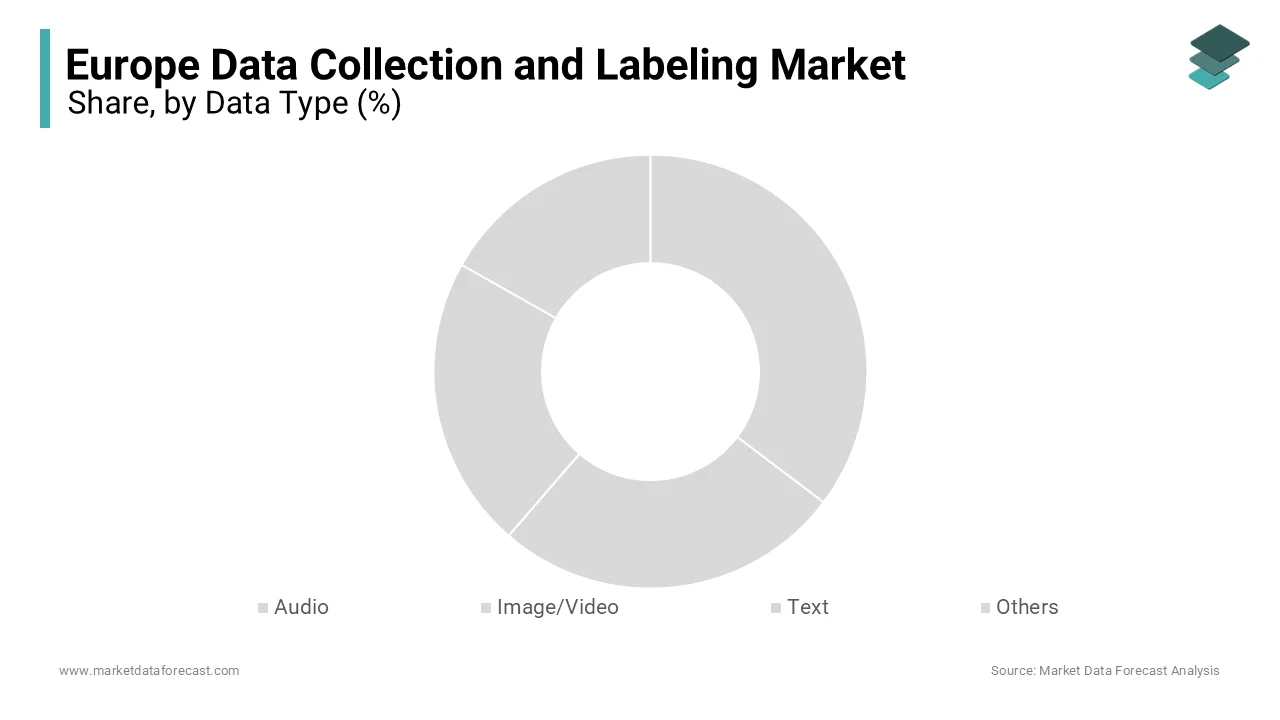
The audio segment is predicted to witness the highest CAGR of 26.8% from 2026 to 2034. This rapid expansion of the segment is fueled by the surging adoption of voice-activated assistants, multilingual customer service bots, and speech-to-text transcription services tailored to Europe's linguistic diversity. With numerous official languages and countless dialects, there is an urgent need for vast repositories of annotated speech data to train natural language processing models that can understand regional accents and colloquialisms accurately. The European Language Industry Association acknowledges the increasing integration of voice and audio technologies within the language market, a trend that correlates directly with the sustained demand for diverse and labeled audio datasets. The automotive industry is also a key driver, as modern vehicles integrate sophisticated voice control systems that require extensive training in noisy cabin environments and various speaking styles. Reports by Capgemini indicate that a majority of European consumers have shown a strong preference for using voice commands for in-car interactions, prompting manufacturers to invest in high-quality audio labeling to ensure seamless user experiences. Additionally, the healthcare sector is increasingly utilizing speech recognition for clinical documentation, necessitating precise transcription of medical terminology in multiple languages. Research by institutions like the Fraunhofer Institute demonstrates that the reliability of voice AI models improves significantly when trained on diverse, locally sourced audio data, encouraging organizations to prioritize the collection of native speech samples.
By Application Insights
In 2025, the IT and Telecom application segment held the majority share of 30.6% of the Europe Data Collection and Labeling Market. This supremacy of the segment is supported by the sector's role as the primary developer and deployer of artificial intelligence solutions, requiring immense quantities of labeled data to build and refine algorithms for network optimization, cybersecurity, and software development. Telecommunications operators leverage annotated data to predict network failures, optimize traffic routing, and enhance customer service through intelligent chatbots, driving consistent demand for high-quality datasets. According to industry associations like ETNO, telecom operators in Europe have maintained substantial annual investments in network infrastructure and digital services, with a growing strategic focus on AI-driven automation tools. The IT sector also leads in the creation of foundational large language models and computer vision libraries, which serve as the backbone for applications across other industries, thereby multiplying the need for raw and labeled data. As per data from Eurostat, a majority of enterprises in the EU utilize paid cloud computing services, generating significant volumes of unstructured data that require systematic labeling to become actionable insights. Furthermore, the rise of cyber threats has compelled IT firms to collect and label massive datasets of malicious code and network anomalies to train robust defense mechanisms. Various sources indicate that a vast majority of IT leaders prioritize data quality as a critical determinant for AI success, ensuring that the IT and Telecom sector remains a primary consumer of data collection and labeling services.
The Healthcare application segment is estimated to register the fastest CAGR of 28.5% during the forecast period due to the increasing integration of artificial intelligence in medical diagnostics, drug discovery, and personalized medicine, all of which depend on meticulously annotated clinical data. European hospitals and research institutions are rapidly adopting AI tools to analyze medical imaging, such as X-rays and MRIs, requiring pixel-perfect labeling by specialized professionals to identify tumors, fractures, and other anomalies with high precision. According to the European Commission, the EU mission on cancer aims to improve the lives of more than 3 million people by 2030 through better prevention and treatment, heavily relying on AI models trained on diverse patient data. The General Data Protection Regulation has spurred the development of secure, compliant data labeling frameworks that allow researchers to utilize sensitive health information without compromising patient privacy. Reports on the European market indicate continued investment in digital health technologies, with capital increasingly directed towards data annotation projects to support diagnostic algorithms. Furthermore, the rise of wearable health devices generates continuous streams of physiological data that must be labeled to monitor chronic conditions and predict health events. Studies in the field of radiology highlight that AI-assisted diagnosis can significantly improve operational efficiency and assist in reducing diagnostic discrepancies, incentivizing healthcare providers to invest in high-quality labeled datasets.
COUNTRY-LEVEL ANALYSIS
Germany Data Collection and Labeling Market Analysis
Germany maintained dominance in the Europe Data Collection and Labeling Market and accounted for a 27.7% share in 2025. The country's dominance is fuelled by its robust automotive industry, which is aggressively pursuing autonomous driving technologies and requires vast amounts of labeled sensor data for validation and training. The German government's strong support for Industry 4.0 and artificial intelligence initiatives has created a fertile ecosystem for data service providers and tech innovators. According to federal strategy reports, the German government has committed substantial cumulative funding to AI promotion to be deployed over several years, with a strong emphasis on developing high-quality datasets for industrial and mobility applications. The presence of major car manufacturers and tier-one suppliers drives continuous demand for image and video labeling to ensure the safety and reliability of self-driving systems. As per data from Bitkom, a growing proportion of German enterprises are planning or investing in AI projects, with an increasing recognition of the need for external data support services. The country's strict adherence to data privacy standards also fosters trust, making it a preferred location for handling sensitive data projects. Research involving institutes like Fraunhofer reveals that German automotive companies generate massive volumes of driving data, necessitating scalable labeling and processing solutions. The convergence of industrial strength, regulatory clarity, and technological ambition ensures Germany remains the primary engine for market growth in the region.
United Kingdom Data Collection and Labeling Market Analysis
The United Kingdom was the second largest country in the Europe Data Collection and Labeling Market and captured a 22.8% share in 2025. Despite economic fluctuations, the UK remains a global hub for artificial intelligence research and fintech innovation, driven by a concentrated cluster of technology companies and world-class universities in London and Cambridge. The country's National AI Strategy emphasizes the importance of data availability and quality, fostering a supportive environment for the data labeling industry. According to the UK National Cyber Security Centre, the financial services sector has faced a rise in sophisticated cyber activity, prompting aggressive investment in datasets for training advanced fraud detection and threat intelligence models. The presence of leading AI startups and research labs fuels continuous innovation in natural language processing and computer vision, creating sustained demand for diverse data types. As per reports regarding the UK tech sector, the UK AI industry continues to attract billions in investment, with a significant portion allocated to data infrastructure and annotation capabilities. The healthcare sector is also a major contributor, leveraging labeled medical data to drive breakthroughs in diagnostics and drug discovery. A survey indicates that a majority of tech leaders consider high-quality data to be a critical component of their successful AI strategies. The strong regulatory framework, combined with a culture of innovation, positions the UK as a critical market for advanced data collection and labeling solutions.
France Data Collection and Labeling Market Analysis
France is another key player in the Europe Data Collection and Labeling Market due to its ambitious national strategy for artificial intelligence and the modernization of its public and private sectors. The French government's "France 2030" investment plan allocates significant resources to developing sovereign AI capabilities, encouraging organizations to adopt advanced data labeling practices to protect national interests and foster innovation. The country's diverse economy, spanning aerospace, luxury goods, and telecommunications, creates varied use cases for data annotation ranging from satellite imagery analysis to multilingual customer service optimization. According to the ANSSI (National Agency for the Security of Information Systems) "Panorama de la cybermenace 2024," the agency handled a significantly higher number of security events compared to the previous year, driven by the Paris 2024 Olympics and a persistent threat landscape. This heightened activity has underscored the critical need for robust defense mechanisms, with ransomware and espionage remaining primary concerns for French organizations. The banking and insurance sectors are particularly active adopters, utilizing these tools to comply with strict European regulations and prevent financial crimes. As per data from Numeum, the French digital industry organization, the digital market continued to grow in 2024, although at a more moderate pace compared to the post-COVID surge. Artificial Intelligence remained the primary growth engine for the ecosystem, driving a substantial portion of funding rounds and motivating digital transformation projects across the tech sector. The emphasis on preserving linguistic heritage also drives demand for high-quality French language datasets for training large language models. The strategic alignment of government policy and industrial needs fosters a dynamic market environment.
Italy Data Collection and Labeling Market Analysis
Italy holds a significant position in the Europe Data Collection and Labeling Market, with growth primarily driven by the digital transformation of its manufacturing sector and the burgeoning startup ecosystem. The Italian market is witnessing a steady uptake of data labeling services as organizations recognize the need to modernize their operations and leverage artificial intelligence for competitive advantage. The National Recovery and Resilience Plan includes specific provisions for digitalizing businesses and enhancing connectivity, providing grants and incentives that facilitate the adoption of advanced data management tools. According to reports by Clusit (Italian Association for Information Security) and the ACN (National Cybersecurity Agency), Italy experienced a severe escalation in cyber incidents in 2024, with the number of confirmed serious attacks and security alerts rising sharply compared to the previous year. This surge has accelerated the focus on strengthening national cyber resilience and securing critical infrastructure. The fashion and design industries, central to the Italian economy, are increasingly using labeled image data to optimize supply chains, manage inventory, and create personalized customer experiences. As per research by the Politecnico di Milano (Smart Manufacturing Observatory), the Italian manufacturing sector is steadily integrating Artificial Intelligence, with a majority of companies viewing the technology as a key driver for future competitiveness. The adoption of AI solutions is expanding beyond pilot projects to support process automation, quality control, and operational efficiency. The tourism sector also leverages these tools to analyze visitor behavior and enhance service delivery. The gradual but consistent modernization of IT infrastructure across the country is paving the way for broader market penetration.
Spain Data Collection and Labeling Market Analysis
Spain is likely to grow notably in the Europe Data Collection and Labeling Market over the forecast period, owing to a booming tourism industry, a rapidly evolving e-commerce landscape, and strong government initiatives to boost digital competitiveness. The Spanish business sector is leveraging data labeling to cater to a diverse influx of international visitors and to secure its growing digital infrastructure against emerging cyber threats. Major Spanish banks and telecommunications companies are investing heavily in these solutions to detect fraud and optimize network performance in real time. The retail and hospitality industries are key adopters, utilizing labeled data to enhance customer satisfaction and streamline operations during peak tourist seasons. The rise of smart city initiatives in Barcelona and Madrid also creates opportunities for applying data labeling to urban management and public safety. The supportive regulatory environment and increasing awareness of digital risks are expected to sustain this upward trajectory.
COMPETITIVE LANDSCAPE
The competition in the Europe Data Collection and Labeling Market is characterized by intense rivalry between global data service giants and agile regional specialists who vie for dominance in a rapidly evolving sector. Large multinational corporations leverage their extensive networks and advanced technological platforms to offer end-to-end solutions that cover everything from data collection to model evaluation. These incumbents focus on building trust through strict adherence to European data protection laws and providing robust security features for sensitive projects. Conversely, emerging startups differentiate themselves by delivering highly specialized services for niche industries such as medical imaging or legal text analysis with superior flexibility and personalized support. The market landscape is dynamic with frequent collaborations and joint ventures as companies seek to combine complementary strengths and expand their geographic reach. Competitive advantage increasingly depends on the ability to demonstrate exceptional data quality and rapid turnaround times while maintaining cost efficiency. Organizations are becoming more discerning and demand transparent pricing models and clear evidence of ethical labor practices throughout the supply chain. This environment forces all participants to continuously innovate their technologies and adapt to the shifting regulatory and operational demands of diverse European clients.
KEY MARKET PLAYERS
The major players in the Europe data collection and labelling market include
- Globalme Localization Inc.
- Trilldata Technologies Pvt. Ltd.
- Alegion
- Reality AI
- Dobility Inc.
- Global Technology Solutions
- Telus International
- Playment Inc.
- Appen Limited
- Labelbox Inc.
- Scale AI
- Avery Dennison Corporation
- Summa Linguae Technologies S.A.
TOP PLAYERS IN THE MARKET
- Appen Limited stands as a preeminent force in the Europe Data Collection and Labeling Market by providing high-quality training data for machine learning models across diverse industries. The Australian multinational contributes significantly to the global landscape through its vast crowd-sourced workforce and specialized annotation tools that support numerous languages. Recently, Appen has intensified its focus on establishing secure data centers within Europe to ensure strict compliance with General Data Protection Regulation requirements for local clients. These initiatives allow European automotive and technology firms to access sovereign data solutions while maintaining rigorous quality standards. The company actively collaborates with major research institutions to develop advanced synthetic data generation capabilities that address privacy concerns. By continuously expanding its linguistic expertise and integrating artificial intelligence into its quality assurance workflows, Appen reinforces its position as a trusted partner for organizations seeking scalable and ethically sourced data assets to power next-generation algorithms.
- Telus International maintains a critical presence in the Europe Data Collection and Labeling Market through its AI Data Solutions division, which offers comprehensive services ranging from image annotation to complex semantic analysis. The global technology leader leverages its extensive network of certified annotators to deliver precise datasets tailored to the specific cultural and linguistic nuances of European markets. Recent strategic actions include the acquisition of specialized European data firms to enhance its capacity for handling sensitive healthcare and financial information under local regulatory frameworks. Telus focuses heavily on human-in-the-loop methodologies to ensure exceptional accuracy for large language model training and content moderation tasks. The company partners with leading tech giants to provide continuous feedback loops that refine algorithmic performance over time. Telus also invests in proprietary platforms that streamline project management and enable real-time collaboration between clients and annotators. This holistic approach, combining global scale with localized expertise, solidifies their role as a key enabler of responsible and effective artificial intelligence deployment throughout the region.
- Scale AI Inc. operates as a specialized leader in the Europe Data Collection and Labeling Market with a strong emphasis on autonomous vehicle development and defense applications requiring extreme precision. The American company differentiates itself through its proprietary platform that combines automated labeling with expert human review to achieve unmatched accuracy levels for complex sensor data. Recent initiatives involve establishing dedicated European operations to serve the continent's growing robotics and self-driving car sectors with low-latency data processing capabilities. Scale AI has forged strategic partnerships with major automotive manufacturers in Germany and France to annotate massive volumes of LiDAR and camera footage essential for safe navigation systems. The company also expands its offerings to include generative AI training data that helps enterprises build custom models securely. Scale AI acts as a vital ally for organizations seeking to accelerate their innovation cycles and deploy robust AI solutions in critical environments. They achieve this by prioritizing speed and reliability while adhering to strict European security standards.
TOP STRATEGIES USED BY THE KEY MARKET PARTICIPANTS
Key players in the Europe Data Collection and Labeling Market primarily employ strategic acquisitions and partnerships to expand their linguistic capabilities and acquire specialized domain expertise in sectors like healthcare and automotive. Companies frequently invest heavily in developing proprietary software platforms that integrate artificial intelligence to automate routine labeling tasks and enhance overall quality assurance processes. Another dominant strategy involves establishing local data centers and operational hubs within European borders to ensure full compliance with stringent data sovereignty regulations and build trust with regional clients. Major vendors also focus on diversifying their workforce by recruiting annotators with niche skills to handle complex multilingual projects and sensitive content moderation requirements. Enhancing security certifications and adhering to international standards remain a priority to attract government and enterprise contracts involving classified or personal information. Furthermore, participants actively engage in thought leadership initiatives and industry collaborations to shape ethical guidelines and promote best practices for responsible data usage across the continent.
MARKET SEGMENTATION
This research report on the Europe data collection labelling market is segmented and sub-segmented into the following categories.
By Data Type
- Audio
- Image/Video
- Text
- Others
By Application
- Manufacturing
- IT
- Healthcare
- BFSI
- E-Commerce and Retail
- Government
- Others
By Country
- UK
- France
- Spain
- Germany
- Italy
- Russia
- Sweden
- Denmark
- Switzerland
- Netherlands
- Turkey
- Czech Republic
- Rest of Europe