- Product Description Description
- Table of Contents TOC
- List of Table & Figure LOT
- Get Free Sample PDF Sample PDF
Market Size, 2025
$1.60 BnMarket Estimate, 2026
$1.91 BnMarket Forecast, 2034
$7.99 BnCAGR, 2026–2034
19.57%Europe Data Governance Market Summary
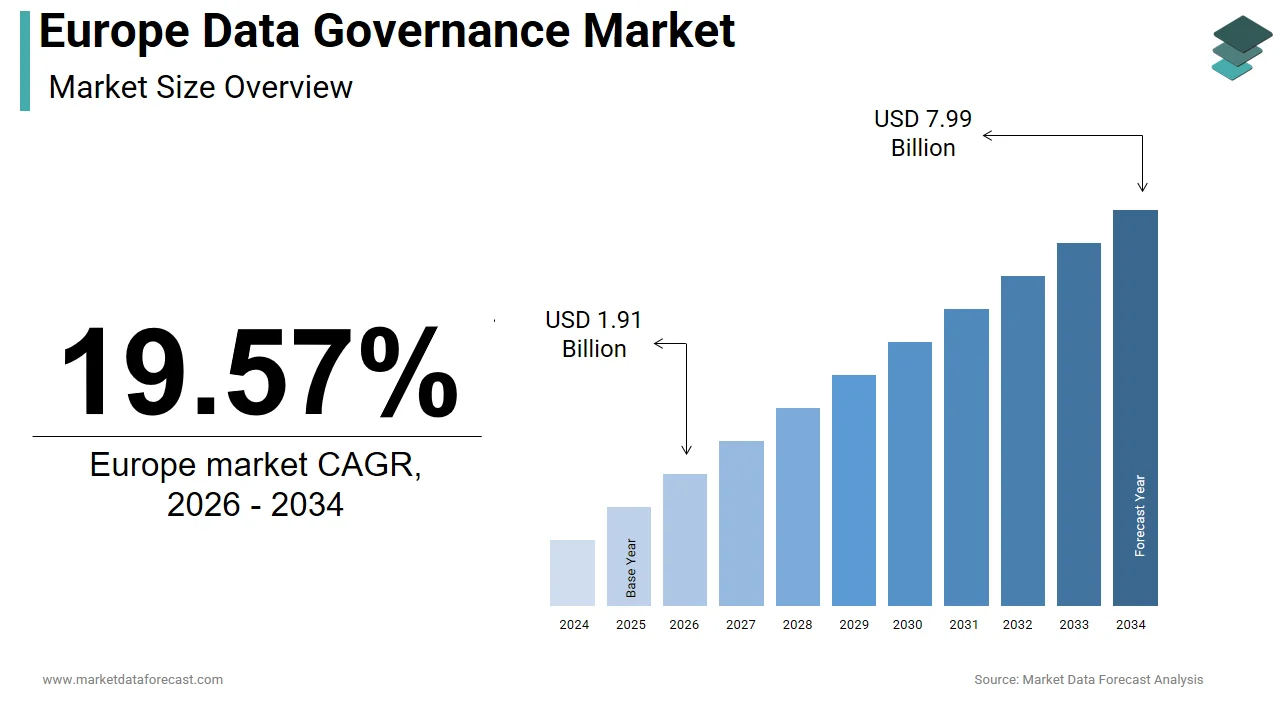
The Europe data governance market reached a value of USD 1.60 billion in 2025 and is expected to grow to USD 1.91 billion in 2026. The market is further projected to reach USD 7.99 billion by 2034, registering a strong compound annual growth rate (CAGR) of 19.57% from 2026 to 2034.
This rapid expansion is primarily driven by the enforcement of the EU Data Governance Act and the EU Data Act, which are compelling enterprises to strengthen compliance, data transparency, and data-sharing frameworks across industries. As organizations increasingly rely on data for operational and strategic decision-making, the demand for structured governance solutions continues to rise across the European region.
Market Drivers and Challenges
The Europe data governance market is shaped by a combination of regulatory enforcement and operational challenges related to data management.
- Regulatory Enforcement: The implementation of the EU Data Governance Act and the Data Act is driving enterprises to adopt comprehensive data governance frameworks. These regulations aim to improve data sharing, ensure data protection, and promote trust in data ecosystems, thereby accelerating market growth.
- Data Quality and Interoperability Challenges: A major challenge in the market is the lack of standardized data quality and interoperability metrics across different sectors. Inconsistent data formats and governance standards make it difficult for organizations to integrate, analyze, and share data effectively, creating barriers to seamless digital transformation.
Market Segmentation
- By Offering: The solutions segment dominated the Europe data governance market in 2024, accounting for 64.4% of the total market share. This dominance reflects the growing adoption of software platforms that provide data quality management, compliance monitoring, metadata management, and data security functionalities.
- By Deployment Mode: The cloud segment held the largest share of the market at 59.7% in 2024. Cloud-based data governance solutions are increasingly preferred due to their scalability, flexibility, lower infrastructure costs, and ease of integration with advanced analytics and AI tools.
Key European Countries
- Germany: Germany dominated the Europe data governance market by accounting for a 23.1% share in 2024. The country’s strong industrial base, digital transformation initiatives, and strict regulatory environment continue to drive demand for advanced data governance solutions.
- United Kingdom: The United Kingdom was the second-largest market, capturing an 18.5% share in 2024. The UK’s focus on digital innovation, cloud adoption, and data-driven business models supports sustained growth in the data governance sector.
Leading Companies
The European data governance market is highly competitive, with the presence of several global technology leaders and specialized solution providers. Key market players include:
-
IBM Corporation, Oracle Corporation, Informatica Inc., SAP SE, SAS Institute, TIBCO Software, Collibra, Qlik (Talend), Varonis Systems, Ataccama Group.
Europe Data Governance Market Size
The Europe data governance market reached USD 1.60 billion in 2025, is expected to grow to USD 1.91 billion in 2026, and is anticipated to touch USD 7.99 billion by 2034, at a CAGR of 19.57% from 2026 to 2034.
Data governance refers to the integrated framework of policies, technologies, and organizational practices that ensure data accuracy, availability, integrity, security, and compliance across enterprise and public sector ecosystems. The market has evolved from a regulatory compliance function into a strategic enabler of data-driven decision-making, artificial intelligence deployment, and cross-border data sharing. Europe’s regulatory landscape, anchored by the General Data Protection Regulation, the Data Governance Act, and the upcoming Data Act, mandates rigorous controls over data lineage, access rights, and usage transparency. European enterprises are increasingly migrating to sophisticated hybrid and multi-cloud environments, leading to fragmented data landscapes that highlight the need for centralized data governance and robust security measures. Many large European businesses gather substantial volumes of data from numerous external sources to gain a competitive edge. A considerable gap exists in the formal establishment of dedicated data governance and stewardship roles across the continent. Concurrently, the European Health Data Space and Green Deal Data Space initiatives are establishing sector-specific governance models to facilitate trusted data reuse for the public good. These intersecting legal, technological, and societal forces position data governance not as a back-office function but as a foundational pillar of Europe’s digital sovereignty and innovation capacity.
MARKET DRIVERS
Enforcement of the EU Data Governance Act and Data Act Driving Enterprise Compliance
The binding requirements of the EU Data Governance Act (DGA) enacted in 2023 and the Data Act effective from 2025 mandate structured data sharing governance and interoperability across sectors, which fuels the growth of the Europe data governance market. The DGA establishes a legal framework for data altruism, data intermediation services, and public sector data reuse, requiring organizations to implement data cataloging, lineage tracking, and consent management systems. The European Union is implementing new regulations, such as the Data Governance Act, that require data intermediation service providers to register with national authorities and adhere to strict independence and transparency rules. Simultaneously, the Data Act compels manufacturers of connected devices, including industrial IoT and smart appliances, to enable user access to generated data through standardized interfaces. Enterprises across the European Union are actively evaluating their internal data governance and management practices to ensure compliance with comprehensive new regulations, including the Data Governance Act and the Data Act. These regulations transform data governance from voluntary best practice into a legal necessity, with non-compliance risking fines of a portion of global turnover. As a result, organizations are investing in metadata management, data quality tools, and policy automation to achieve audit readiness across complex data ecosystems.
Proliferation of AI and Machine Learning Requiring Trusted and Traceable Data Pipelines
The rapid adoption of artificial intelligence across European industries further contributes to the expansion of the Europe data governance market. This has intensified demand for robust data governance to ensure model reliability, regulatory compliance, and ethical accountability. The EU AI Act classifies high-risk AI systems, such as those used in hiring, credit scoring, and medical diagnosis, as requiring high-quality training data with documented provenance bias assessments and version control. European regulatory bodies anticipate that a significant number of AI systems deployed across the EU will be classified as high-risk under the new AI Act, requiring stringent compliance measures. Financial institutions like Deutsche Bank and BNP Paribas have implemented data lineage and drift monitoring platforms to satisfy the European Banking Authority’s expectations on AI model validation. Similarly, healthcare AI developers must comply with the European Health Data Space’s data quality and anonymization standards before accessing cross-border patient datasets. Insufficient data documentation and inconsistent labeling practices present a common and substantial challenge, frequently causing project delays in the development and implementation of artificial intelligence systems. The transition of AI into a mission-critical component requires data governance to adapt from merely maintaining data hygiene to performing a strategic risk management role, thereby guaranteeing the legal defensibility and operational reliability of intelligent systems.
MARKET RESTRAINTS
Fragmented National Interpretations of EU Data Regulations Increasing Compliance Complexity
Divergent national implementations of EU-wide data regulations create operational ambiguity and elevate compliance costs, and thereby restrain the growth of the Europe data governance market. The GDPR provides a foundational standard for data protection. However, national data protection authorities in each member state offer additional guidance concerning data retention policies, the granularity of consent, and specific breach notification procedures. Enterprises operating across multiple European Union member states face significantly increased data governance complexities and costs due to the need to navigate varied interpretations and enforcement by national data protection authorities. For instance, France’s CNIL requires explicit opt-in for biometric data processing, while Germany’s BfDI permits implied consent in workplace monitoring under certain conditions. The Data Governance Act further complicates matters by delegating data intermediary registration to national authorities with varying technical standards. Multinational firms frequently encounter challenges and delays in implementing cross-border data sharing initiatives, a situation exacerbated by the lack of fully harmonized national rules and legal interpretations across EU jurisdictions. This regulatory fragmentation forces organizations to deploy region-specific governance policies, undermining the goal of a unified European data space and increasing reliance on costly legal consultation.
Shortage of Skilled Data Governance Professionals and Stewardship Capabilities
The region contends with a critical deficit in data governance expertise that impedes effective implementation of regulatory and operational frameworks. This hinders the expansion of the Europe data governance market. There is a notable gap between the demand for professionals skilled in data governance and the current availability of experts in technical fields such as metadata and policy management. Educational institutions appear to offer few specialized programs dedicated to data stewardship, which may contribute to the difficulty organizations face when seeking qualified candidates. Internal corporate initiatives aimed at upskilling existing staff often struggle to fully address the complex competencies required for advanced data oversight. Many large organizations operate without formal roles dedicated to data management, even when their daily operations involve processing significant amounts of sensitive information. A general pattern suggests that organizational structures for managing data quality and compliance have not yet aligned with the increasing complexity of modern data environments. This gap manifests in poor data lineage documentation, inconsistent classification, and delayed subject access request fulfilment, issues that directly trigger regulatory scrutiny. As per sources, a notable share of GDPR fines in 2024 stemmed from inadequate data inventory and access controls attributable to understaffed governance teams. European data governance won't become practical for most businesses until public-private efforts create enough skilled data professionals through academies and certifications.
MARKET OPPORTUNITIES
Integration of Data Governance into European Health and Green Data Spaces
Sector-specific data spaces mandated under the European Strategy for Data open major opportunities for the Europe data governance market. The European Health Data Space Regulation requires all member states to establish federated infrastructures with standardized governance for secondary use of health data in research and policymaking. European Union initiatives are increasingly focused on enabling secure, governed access to a growing volume of patient health information through digital portals, emphasizing strict data protection measures like anonymization and access logging. Similarly, the Green Deal Data Space mandates harmonized governance for environmental data on emissions, energy consumption, and biodiversity, enabling public and private actors to develop climate models and sustainability reporting tools. Environmental monitoring networks across the European Union generate substantial volumes of data daily, contributing to a massive, continuously growing pool of information used for climate and environmental research. Companies like SAP and IBM are developing sector-specific data governance platforms compliant with these frameworks, offering pre-built policy templates and consent management workflows. Europe is positioned to lead the world in ethical data sharing as mature data spaces drive the need for governance frameworks that balance accessibility and control.
Adoption of Automated Data Governance Platforms for Multi-Cloud and Hybrid Environments
The complexity of managing data across dispersed cloud and on-premise systems is generating fresh prospects for the Europe data governance market. This is driving European enterprises to adopt AI-powered data governance platforms that automate discovery, classification, and policy enforcement. Large businesses across the European Union are increasingly relying on sophisticated cloud computing services, a trend that highlights the growing need for robust data governance frameworks to manage complex, interconnected data landscapes effectively. Automated platforms now use machine learning to scan petabytes of data across AWS, Azure, and Google Cloud, identifying sensitive fields applying GDPR or DGA labels and enforcing access controls in real time. The development of the GAIA-X framework is enabling numerous public and private sector participants to collaborate on creating secure, interoperable data spaces for enhanced cross-border data sharing, aligning with Europe's digital sovereignty ambitions. Financial institutions are early adopters. Leading financial institutions like ING Bank are leveraging enhanced data governance frameworks to streamline compliance processes and improve their readiness for stringent European banking authority data reporting requirements. Additionally, these platforms integrate with data catalogs and lineage tools to support the EU AI Act’s transparency mandates. The expanding data volumes and tightening regulations mean automation has become a necessity for scalable, consistent, and auditable governance across Europe’s hybrid digital landscape.
MARKET CHALLENGES
Lack of Standardized Data Quality and Interoperability Metrics Across Sectors
The region lacks universally accepted metrics for data quality interoperability and fitness for reuse, despite regulatory mandates, which creates inconsistency in governance outcomes, and thereby negatively impacts the growth of the Europe data governance market. The Data Governance Act encourages data sharing but does not define minimum quality thresholds, leaving organizations to establish ad hoc standards. A significant minority of public sector datasets lack machine-readable quality indicators, according to research. The absence of harmonized clinical data models in healthcare often leads researchers to spend a considerable amount of project time on data cleaning. Similarly, industrial data from connected machinery uses proprietary formats that hinder cross-manufacturer analysis required under the Green Deal. The European Committee for Standardization has initiated work on quality frameworks aligned with ISO 8000, but their adoption largely remains voluntary. Failure to enforce binding interoperability standards means data governance efforts could become isolated and ineffective, disconnected from real-world usability needs, and thus undermine the EU’s single data market goals.
Difficulty in Balancing Data Monetization Ambitions with Ethical and Legal Constraints
European organizations increasingly seek to derive commercial value from data assets yet struggle to align monetization strategies with stringent ethical and legal boundaries, which in turn impede the growth of the Europe data governance market. The Data Governance Act permits data sharing through registered intermediaries but prohibits exclusive arrangements and mandates transparency on data usage, constraints that deter traditional data brokerage models. Automotive manufacturers collecting telematics data face particular challenges. While the Data Act grants vehicle owners access to their data, it restricts resale to third parties without explicit consent, complicating partnerships with insurers or urban planners. Additionally, the EU’s ethical guidelines for trustworthy AI discourage profiling and automated decision-making in sensitive domains, limiting predictive analytics applications. This tension between economic potential and regulatory caution creates strategic paralysis where organizations collect vast data but hesitate to activate it. The focus of data governance will likely remain on risk avoidance, not value creation, until clear guidelines and standardized data agreements are established.
REPORT COVERAGE
| REPORT METRIC | DETAILS |
| Market Size Available | 2025 to 2034 |
| Base Year | 2025 |
| Forecast Period | 2026 to 2034 |
| Segments Covered | By Offering, Application, Deployment Mode, Organization Size, Vertical, and Country. |
| Various Analyses Covered | Global, Regional, and Country-Level Analysis, Segment-Level Analysis, Drivers, Restraints, Opportunities, Challenges; PESTLE Analysis; Porter’s Five Forces Analysis, Competitive Landscape, Analyst Overview of Investment Opportunities |
| Countries Covered | UK, France, Spain, Germany, Italy, Russia, Sweden, Denmark, Switzerland, Netherlands, Turkey, Czech Republic, and the Rest of Europe. |
| Market Leaders Profiled | U.S. Cold Storage, AmeriCold Logistics LLC, LINEAGE LOGISTICS HOLDING, LLC, VersaCold Logistics Services, NICHIREI LOGISTICS GROUP INC., CONGEBEC LOGISTICS INC., Burris Logistics, CONESTOGA COLD STORAGE, Kloosterboer, COLD BOX EXPRESS, INC, and others. |
SEGMENTAL ANALYSIS
By Offering Insights
The solutions segment captured the majority share of 64.4% of the Europe data governance market in 2024. The leading position of the solutions segment is driven by the urgent need for scalable automated platforms that enforce regulatory compliance and manage data across complex hybrid environments. European enterprises increasingly deploy integrated software suites for metadata management, data cataloging, policy orchestration, and lineage tracking to address mandates under the General Data Protection Regulation, the Data Governance Act, and the EU AI Act. According to sources, a growing number of large organizations are adopting dedicated data governance platforms to automate the management of subject access requests and consent lifecycles. Vendors have localized their solutions to support EU data sovereignty requirements, including on-premises deployment and multilingual policy templates. Studies indicate that companies leveraging automated governance solutions experience significant reductions in the time required for audit preparation compared to manual, spreadsheet-based methods. The annual growth of data volumes and intensifying regulatory oversight necessitate software-based governance as a critical infrastructure for both legal protection and streamlined operations.
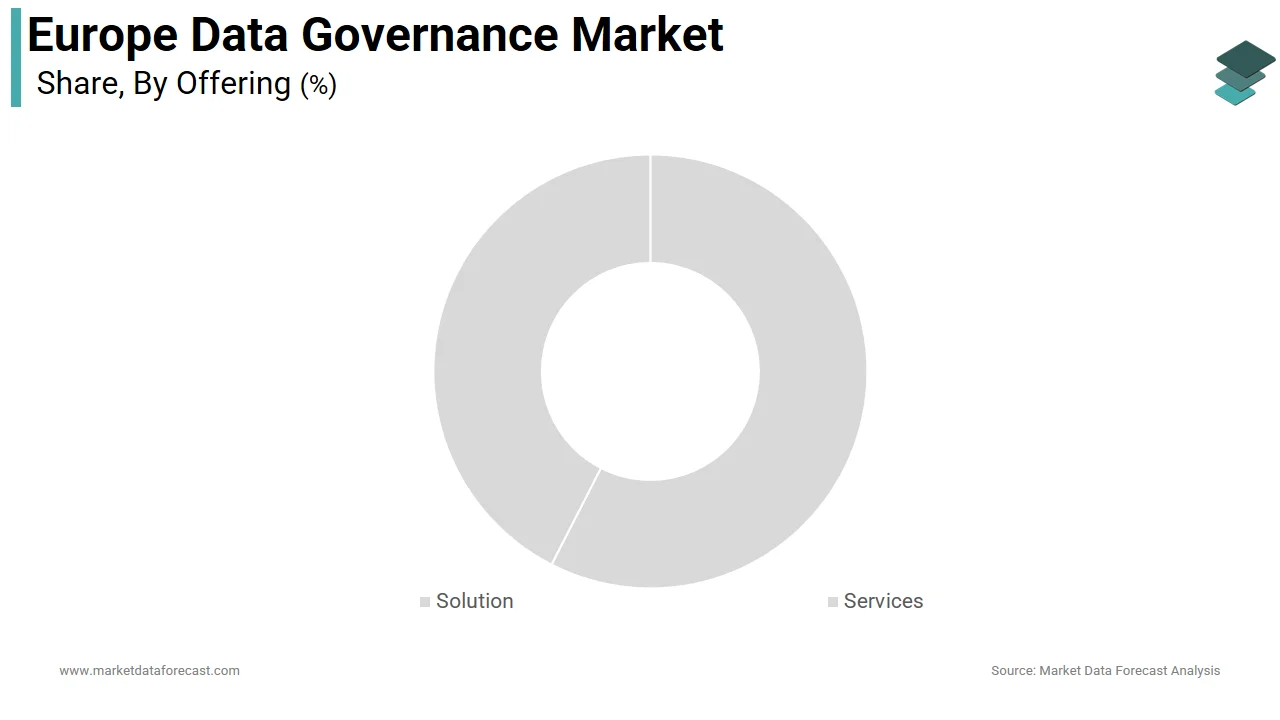
The services segment is anticipated to witness the fastest CAGR of 15.2% percent from 2026 to 2034. The rapid acceleration of the services segment is propelled by the acute shortage of in-house data governance expertise and the complexity of aligning legacy systems with new EU regulations. There is a significant and persistent need for external expertise and support for businesses to fully adopt and integrate advanced digital technologies, such as data analytics, cloud services, and artificial intelligence, across the European Union. Major system integrators have expanded their data governance practices to deliver end-to-end services, including regulatory gap assessments, data stewardship training, and AI Act compliance readiness. European banking supervisors are intensifying their scrutiny of how significant financial institutions manage their data governance and risk reporting capabilities, emphasizing the need for robust internal frameworks to manage risks effectively. Additionally, public sector agencies under the GAIA X initiative engage service providers to design federated data sharing frameworks compliant with the Data Governance Act. Evolving regulations and expanding data ecosystems are driving organizations to re-evaluate governance, moving beyond viewing it as a mere software purchase towards embracing it as a long-term advisory and operational collaboration.
By Deployment Mode Insights
The cloud segment was the largest in the Europe data governance market by holding a 59.7% share in 2024. The prominence of the cloud segment is attributed to the continent’s rapid migration to multi-cloud data architectures and the operational advantages of scalable managed services. A very large majority of large enterprises across the European Union have adopted and utilize cloud computing services, a proportion that has grown consistently in recent years. Cloud native platforms offer real-time metadata scanning, automated policy enforcement, and seamless integration with data lakes and warehouses, capabilities difficult to replicate on premise. The European Commission’s GAIA X initiative further incentivizes cloud adoption by certifying data governance providers that adhere to European data sovereignty and interoperability standards. Public sector cloud adoption in Europe is a growing priority, driven by various European Union initiatives and regulatory requirements aimed at enhancing digital services and ensuring data sovereignty. Additionally, cloud vendors embed compliance templates for GDPR, the Data Act, and sector-specific frameworks, reducing configuration time. This combination of agility, compliance, and cost efficiency solidifies cloud as the default deployment model for modern European data governance.
The on-premises segment is likely to experience the fastest CAGR of 13.7% during the forecast period due to stringent data localization requirements in highly regulated sectors such as defense finance and healthcare where sensitive data cannot reside outside national borders. German authorities, such as the Federal Office for Information Security (BSI), require operators of critical infrastructure to meet stringent security standards, which is leading to an increased focus on developing and adopting sovereign cloud solutions that meet specific national data protection requirements. Similarly, the French National Cybersecurity Agency requires defense contractors to maintain data governance systems on isolated networks with air-gapped backups. The European Banking Authority has established detailed guidelines for financial institutions on managing risks associated with information and communication technology, including comprehensive rules for outsourcing to cloud service providers, rather than mandating a specific preference for on-premise platforms. In addition, the European Health Data Space regulation aims to enhance the secure and seamless sharing of health data across the European Union for secondary uses like research, establishing a framework that encourages interoperability and data access while ensuring stringent data protection and privacy measures are in place. Elevated global tensions and the critical need for data control necessitate the use of on-premise solutions for managing Europe's most sensitive data.
COUNTRY LEVEL ANALYSIS
Germany Data Governance Market Analysis
Germany dominated the Europe data governance market by accounting for a 23.1% share in 2024. The dominance of the German market is credited to its dense concentration of critical infrastructure operators, stringent data protection enforcement, and advanced industrial base. The Federal Office for Information Security administers some of the EU’s strictest cybersecurity and data governance audits under the IT Security Act 2.0, which aligns closely with the Data Governance Act and NIS2 requirements. German financial institutions are increasingly adopting automated data lineage and consent management frameworks to meet rigorous operational resilience requirements and ensure transparency in regulatory reporting. Germany’s manufacturing sector, home to automotive and engineering giants like Siemens and Bosch, drives demand for industrial data governance to manage IoT sensor data under the Green Deal Data Space. The German industrial sector is moving toward on-premise and sovereign governance platforms to maintain strict control over proprietary process data while integrating with broader digital ecosystems. Europe's stringent enforcement and numerous GDPR fines are driving organizations to adopt a dual approach, positioning data governance as an essential legal imperative and a strategic tool for innovation and compliance.
United Kingdom Data Governance Market Analysis
The United Kingdom was the next prominent player in the Europe data governance market by capturing a 18.5% share in 2024. The expansion of the UK market is fuelled by its globally integrated financial sector and early adoption of cloud native governance architectures. Despite Brexit, the UK’s Financial Conduct Authority enforces data governance standards equivalent to the EU Data Act, requiring banks to log and review all data access in real time. UK financial institutions are increasingly adopting cloud-based infrastructure and data management tools, including data catalogs, to enable flexible working models and sophisticated data analytics across hybrid and multi-cloud environments. Following recent guidance on AI data security issued by the UK’s National Cyber Security Centre in collaboration with international agencies, organizations are focusing on data provenance as an essential security measure. This emphasis is encouraging wider public and private sector cooperation to implement effective automated data lineage and validation solutions. Additionally, the UK’s Digital Data Economy Strategy promotes trusted data intermediation under a framework mirroring the EU Data Governance Act. The demand for scalable governance remains acute, with most UK enterprises operating multi-cloud environments, a finding supported by Ofcom's research. This blend of regulatory rigor, technological maturity, and global connectivity solidifies the UK’s position as Europe’s data governance innovation hub for finance and digital services.
France Data Governance Market Analysis
France is another key player in the Europe data governance market and stands out for its strategic investment in sovereign data infrastructure and centralized public sector governance. Public services are being directed to use government platforms that establish stringent, consistent requirements for managing information, including tracking usage permissions and activity logs. A substantial number of citizen records are now governed by these rules, ensuring data remains within specific domestic cloud storage providers. Financial regulators are encouraging institutions to adopt advanced tools that can identify unusual data access in real-time to build stronger operational systems, while data protection authorities are penalizing organizations for not adequately documenting their data holdings, encouraging the adoption of comprehensive governance solutions across the enterprise sector. These actions indicate a consistent and broad push across both public and private sectors in the country toward more structured and transparent data governance practices. France is fostering a unique ecosystem where the state's dual role as regulator and anchor customer enables public policy to directly shape private sector data architecture and vendor capabilities.
Netherlands Data Governance Market Analysis
The Netherlands experienced a consistent growth in the Europe data governance market and serves as a major data logistics nexus due to its concentration of hyperscalers, internet exchanges, and multinational headquarters. Amsterdam hosts major European data centers for Microsoft, Google, and AWS, making it a focal point for cloud governance deployment. International corporations are increasingly establishing regional data processing centers in the Netherlands, suggesting a pattern of centralizing European Union operations within this location. This pattern underscores the need for effective data governance across borders that aligns with existing data protection rules. The national digital identification system has integrated with private sector services, creating an environment that facilitates smooth citizen information exchange. This system integration adheres to a framework that supports the cross-border usability of digital identification and includes mechanisms designed to monitor data exchanges. The Dutch Central Bank’s operational guidelines require financial institutions to implement immutable data lineage logs, a key driver for governance platform adoption. The Netherlands provides an excellent environment for testing scalable governance solutions due to its adoption of English as a business lingua franca and its highly digitized economy, serving pan-European operations in finance, logistics, and technology.
Sweden Data Governance Market Analysis
Sweden is predicted to expand in the Europe data governance market from 2026 to 2033. It exemplifies Europe’s most advanced digital society with data governance embedded in civic trust and ethical AI principles. The use of BankID for secure digital identification and signing in Sweden is widespread across the adult population for both private and public sector services. This cultural normalization of trusted data exchange creates low-friction adoption of enterprise governance solutions aligned with national standards. Sweden’s implementation of the EU AI Act includes stricter requirements for public sector algorithms, mandating full data provenance and bias documentation. There is an ongoing push within the Swedish public sector to enhance data govern4nce, promoting the availability and reuse of public information in compliance with the Open Data Directive and general data protection regulations. Additionally, Sweden’s strong privacy ethos influences vendor design. Local startups prioritize consent granularity, purpose limitation, and data minimization features that resonate with GDPR’s spirit. Sweden's tech fluency makes it a prime location for developing ethical governance, which promotes openness, responsibility, and public confidence.
COMPETITIVE LANDSCAPE
Competition in the Europe data governance market is defined by a dynamic interplay between global cloud vendors, European enterprise software leaders, and specialized governance startups, each vying for dominance through regulatory precision technical depth, and data sovereignty. Collibra excels in standalone governance with strong metadata and lineage capabilities, while SAP leverages deep ERP integration to embed governance into core business processes. IBM offers hybrid flexibility, appealing to highly regulated sectors requiring on premise control. The market is further intensified by European startups like OvalEdge and Atlan that provide agile cloud native alternatives with multilingual support. Regulatory pressure from the Data Governance Act, the Data Act, and the EU AI Act creates high barriers to entry favoring vendors with certified compliance frameworks. At the same time, the rollout of sectoral data spaces is reshaping buyer priorities toward interoperability and public private data sharing. This environment rewards both global scale and regional adaptability with competition centering on trust, transparency, and the ability to turn compliance into strategic advantage.
KEY MARKET PLAYERS
The leading companies operating in the Europe data governance market include:
- IBM Corporation
- Oracle Corporation
- Informatica Inc.
- SAP SE
- SAS Institute, Inc.
- TIBCO Software, Inc. (Vista Equity Partners Management, LLC)
- Collibra, Inc.
- QlikTech International AB (Talend, Inc.)
- Varonis Systems, Inc.
- Ataccama group
TOP PLAYERS IN THE MARKET
- Collibra NV is a Brussels-based global leader in data intelligence and governance with a dominant presence across Europe’s financial public sector and healthcare industries. The company contributes globally by offering a cloud native data governance platform that automates metadata management, data lineage, and policy enforcement in alignment with GDPR the EU AI Act, and the Data Governance Act. In Europe, Collibra has strengthened its position by achieving GAIA X compliance and establishing localized data centers in Germany and France to ensure EU data residency. The company recently launched pre-built regulatory templates for the European Health Data Space and Green Deal Data Space, enabling public agencies to accelerate compliant data sharing. These initiatives reinforce Collibra’s role as a trusted partner for enterprises navigating Europe’s complex and evolving data regulatory landscape.
- SAP SE is a German multinational technology corporation providing integrated data governance capabilities within its enterprise resource planning and data management suites. The company contributes globally by embedding data cataloging stewardship workflows and consent management directly into business processes across finance, supply chain, and human resources. In Europe, SAP has reinforced its market presence by aligning its SAP Master Data Governance and SAP Datasphere platforms with the EU Data Act and NIS2 requirements. The company recently introduced AI-powered data classification and lineage features compliant with the European AI Act’s high-risk system obligations. SAP also collaborates with national governments, including Germany and the Netherlands, to deploy sovereign data governance infrastructures for public administration and industrial data spaces under the EU Strategy for Data.
- IBM Corporation maintains a strong footprint in the Europe data governance market through its Cloud Pak for Data platform, which combines governance metadata management and AI lifecycle tracking in a hybrid deployment model. The company contributes globally by pioneering automated data privacy and ethical AI governance tools that support regulatory compliance across jurisdictions. In Europe, IBM has deepened its presence by achieving certifications under the EU Cloud Code of Conduct and partnering with public sector agencies to implement federated data governance for the European Health Data Space. The company recently enhanced its Watson Knowledge Catalog with multilingual policy engines and data quality scoring aligned with Eurostat standards. These capabilities position IBM as a strategic enabler for organizations seeking to balance innovation with compliance in Europe’s regulated data ecosystem.
TOP STRATEGIES USED BY THE KEY MARKET PARTICIPANTS
Key players in the Europe data governance market prioritize regulatory alignment by embedding GDPR, Data Governance Act, and EU AI Act requirements directly into platform workflows through automated policy enforcement and audit logging. They invest in European data residency by deploying localized cloud infrastructure in Germany, France, and the Netherlands to meet data sovereignty mandates. Companies enhance interoperability by supporting GAIA X standards and integrating with national data spaces like the Health Data Hub and Industrial Data Commons. Strategic partnerships with system integrators, consultants, and public sector bodies accelerate deployment in complex legacy environments. Additionally, they advance AI governance by offering bias detection, data provenance, and model monitoring features that satisfy the EU AI Act’s transparency obligations for high risk systems.
MARKET SEGMENTATION
This research report on the Europe data governance market has been segmented and sub-segmented into the following categories.
By Offering
- Solution
- Services
By Application
- Risk Management
- Process Management
- Incident Management
- Audit Management
- Compliance Management
- Data Quality & Security Management
- Others
By Deployment Mode
- Cloud
- On-premise
By Organization Size
- Large Enterprises
- Small & Medium Enterprises
By Vertical
- BFSI
- Government
- Energy & Utilities
- Healthcare & Lifesciences
- Transportation & Logistics
- Manufacturing
- Retail & Consumer Goods
- Telecom & IT
- Others
By Country
- United Kingdom
- France
- Spain
- Germany
- Italy
- Russia
- Sweden
- Denmark
- Switzerland
- Netherlands
- Rest of Europe