- Product Description Description
- Table of Contents TOC
- List of Table & Figure LOT
- Get Free Sample PDF Sample PDF
Market Size, 2025
$0.36 BnMarket Estimate, 2026
$0.50 BnMarket Forecast, 2034
$6.94 BnCAGR, 2026–2034
38.92%Europe Deepfake AI Market Size
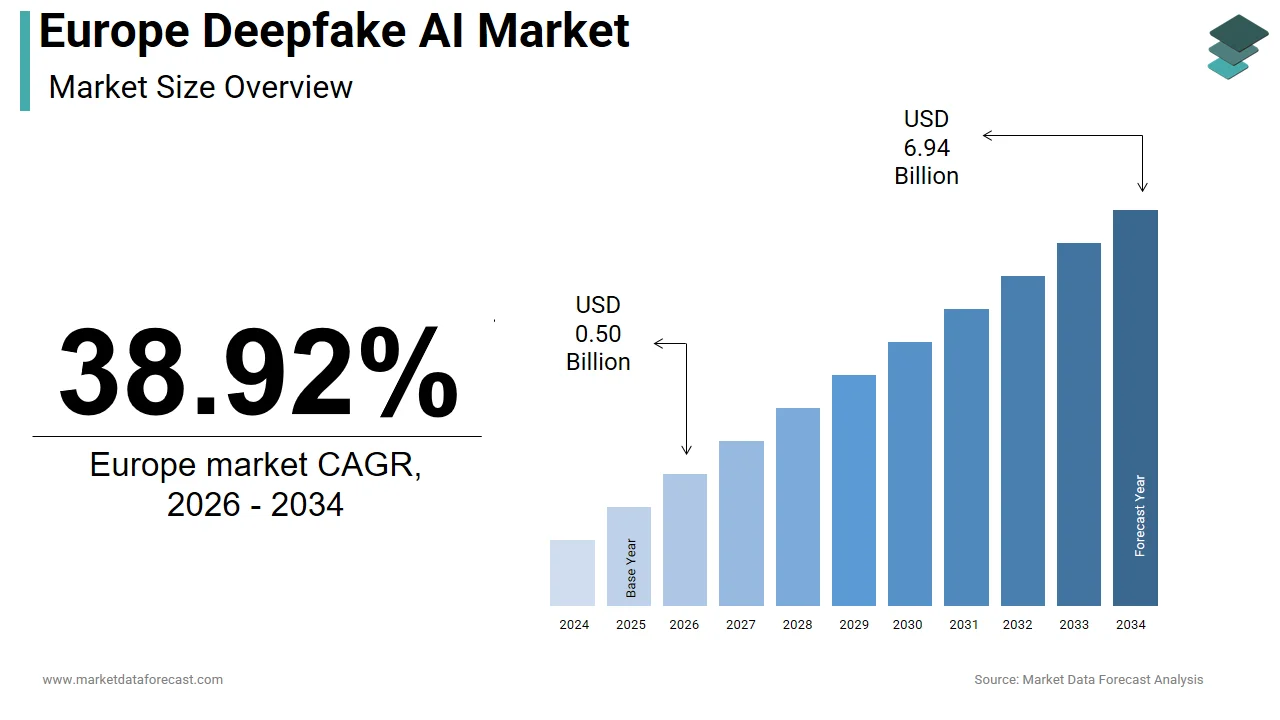
The Europe deepfake AI market reached USD 0.36 billion in 2025, is expected to grow to USD 0.50 billion in 2026, and is anticipated to reach USD 6.94 billion by 2034, registering a CAGR of 38.92% from 2026 to 2034. The rapid growth of the market is driven by the increasing adoption of artificial intelligence in media production, entertainment, marketing, and cybersecurity applications. Deepfake AI is being widely used for content localization, virtual influencers, personalized marketing, and digital media enhancement. At the same time, growing concerns about misinformation, identity fraud, and cybersecurity threats are accelerating demand for deepfake detection and authentication solutions. Furthermore, strong investments in AI research, the presence of advanced digital infrastructure, and the rapid expansion of generative AI technologies are supporting market growth across Europe.
Key Market Trends
- Rising adoption of generative AI in media, entertainment, and advertising.
- Increasing demand for deepfake detection and digital identity verification solutions.
- Growing use of AI-generated video and synthetic media for content creation.
- Strong investment in AI research, innovation, and regulatory frameworks.
- Expansion of enterprise use cases in marketing, training, and virtual assistants.
Segmental Insights
- Based on component, the software segment dominated the Europe deepfake AI market by accounting for a 66.5% share in 2025, driven by increasing adoption of deepfake generation, detection, and editing tools across media, cybersecurity, and enterprise applications.
- Based on type, the video deepfakes segment held the largest share of 56.5% in 2025, supported by growing use of AI-generated video content in entertainment, marketing, training simulations, and virtual communication.
Regional Insights
The Europe deepfake AI market is experiencing rapid growth across major economies, supported by strong AI ecosystems, expanding digital media industries, and increasing focus on cybersecurity and synthetic media regulation.
- Germany held the leading position in the Europe deepfake AI market by accounting for a 22.9% share in 2025, driven by its strong AI research ecosystem, advanced enterprise adoption, and leadership in digital innovation.
- France captured a promising share of the Europe deepfake AI market in 2025, supported by national AI strategies, strong government investment, and growing adoption across media, defense, and cybersecurity sectors.
- The United Kingdom is anticipated to occupy a prominent share of the Europe deepfake AI market over the forecast period, supported by its advanced technology sector, strong startup ecosystem, and increasing investment in AI-driven content creation and digital security.
Competitive Landscape
The Europe deepfake AI market is highly competitive, with major technology companies and AI startups focusing on developing advanced synthetic media generation and detection solutions. Companies are investing in AI innovation, strategic partnerships, and product development to strengthen their market presence. The growing demand for content creation tools, cybersecurity solutions, and digital identity verification is encouraging market players to expand their capabilities and offer comprehensive deepfake AI platforms.
Leading companies operating in the Europe deepfake AI market include Amazon Web Services, Google, Intel, Microsoft, Synthesia, Truepic, BioID, and DeepBrain AI.
Europe Deepfake AI Market Size
The Europe deepfake AI market reached USD 0.36 billion in 2025, is expected to grow to USD 0.50 billion in 2026, and is anticipated to touch USD 6.94 billion by 2034, at a CAGR of 38.92% from 2026 to 2034.
Deepfake AI encompasses technologies that use generative adversarial networks and neural rendering to create or manipulate audiovisual content with high realism. Unlike entertainment-focused applications elsewhere in Europe, this capability is primarily developed and deployed within tightly regulated frameworks for detection, forensic analysis, and ethical synthetic media production. The market operates under the overarching governance of the EU AI Act, which classifies deepfake generation as a high-risk activity requiring transparency watermarking and human oversight. According to the European Commission, deepfake incidents in 2024 were largely associated with political disinformation and financial fraud, which prompted urgent regulatory action. As per the European Union Agency for Cybersecurity, ENISA highlighted a sharp rise in deepfake-related cyber threats that targeted critical infrastructure and electoral processes. The Digital Services Act further mandates that online platforms deploy robust detection systems and label synthetic content. National initiatives such as France’s Vrai ou Faux and Germany’s Deepfake Detection Challenge have allocated significant funding since 2023 to support research in forensic AI. This unique ecosystem, where innovation is driven by defense rather than creation, positions Europe’s deepfake AI market as a global leader in responsible synthetic media governance.
MARKET DRIVERS
Rising Political Disinformation Threats Drive Demand for Detection Systems
The escalating use of deepfakes in political manipulation has become a primary catalyst for investment in detection and verification technologies across Europe. According to the European External Action Service, AI-generated disinformation targeting EU elections was documented in 2024, including fake videos of candidates making inflammatory statements. In response, the European Commission mandated that all Very Large Online Platforms implement real-time deepfake detection under the Digital Services Act. As per ENISA, national election commissions now contract forensic AI vendors to scan campaign content for synthetic manipulation. In France, the Ministry of the Interior deployed a deepfake monitoring system during the 2024 European Parliament elections. Similarly, Germany’s Federal Office for Information Security partnered with Fraunhofer Institute to develop a blockchain-based verification tool that embeds provenance metadata at the point of capture. These measures transform deepfake detection from a niche cybersecurity function into a core component of democratic integrity infrastructure, ensuring sustained public sector demand.
Financial Fraud Using Synthetic Identity Accelerates Banking Sector Adoption
The surge in deepfake-enabled financial fraud has compelled European banks and payment processors to integrate real-time voice and face verification systems, which is also contributing to the expansion of the European deepfake AI market. According to Europol, synthetic identity fraud involving AI-generated faces and cloned voices increased in 2024, with losses reported across the EU. Criminals use deepfakes to bypass biometric authentication during remote account openings or authorize fraudulent wire transfers via video calls. In response, the European Banking Authority issued binding guidelines requiring strong customer authentication to include liveness detection and deepfake resilience. ING and BNP Paribas implemented multimodal AI systems that analyse micro expressions, voice harmonics, and background inconsistencies to detect spoofing attempts. The European Central Bank also mandated that all payment service providers undergo annual deepfake penetration testing starting in 2025. This regulatory and threat-driven imperative ensures continuous investment in defensive AI regardless of broader market cycles.
MARKET RESTRAINTS
Stringent EU AI Act Compliance Requirements Increase Development Costs
The European Union’s AI Act imposes significant operational and financial burdens on deepfake technology developers by mandating rigorous transparency and risk management protocols, which is a significant restraint on the growth of the European deepfake AI market. Under the regulation, any system generating synthetic media must embed visible or machine-readable disclosures and undergo third-party conformity assessments before deployment. According to the European Commission, compliance costs for high-risk AI systems are substantial, including data governance audits, algorithmic impact assessments, and human oversight integration. Startups like Reality Defender and Sentinel AI reported that certification timelines extend development cycles, delaying time to market. Additionally, the requirement to maintain detailed technical documentation for post-market surveillance increases administrative overhead. While these measures enhance trust, they disproportionately affect small innovators lacking legal and compliance resources, potentially stifling competition and favoring large tech firms with established regulatory teams. This regulatory friction creates a high barrier to entry that may limit the diversity of solutions available for both defensive and creative applications.
Public Distrust and Ethical Concerns Suppress Commercial Creative Adoption
Despite technological advances, European consumers and brands remain deeply sceptical of deepfake applications in advertising, entertainment, and media due to ethical concerns and privacy fears, which further hinders the regional market expansion. According to the European Consumer Organisation, a majority of respondents oppose the use of AI-generated likenesses without explicit consent, even for deceased celebrities. High-profile scandals such as the unauthorized deepfake of a French politician in 2023 have intensified public backlash. Consequently, major broadcasters like the BBC and ARD restrict synthetic media to clearly labeled educational or archival uses. The European Group on Ethics in Science and New Technologies issued guidelines discouraging the commercial exploitation of biometric data for synthetic content creation. This cultural resistance suppresses demand in creative industries where deepfakes could enable cost-effective localization or accessibility features. Without clear ethical frameworks and consumer reassurance, the market remains skewed toward detection rather than generation, limiting economic potential and innovation in legitimate synthetic media applications.
MARKET OPPORTUNITIES
Integration of Deepfake Detection into EU Digital Identity Frameworks Creates Institutional Demand
The European Union’s rollout of the European Digital Identity Wallet presents a major opportunity for the European deepfake AI market. According to the European Commission, the wallet will be used widely by citizens by 2030 for accessing public services, banking, and travel. To prevent identity spoofing, the framework mandates liveness detection and deepfake resilience in all biometric authentication modules. In 2024, the European Blockchain Partnership selected AI vendors to develop standardized verification protocols that analyze facial micro movements and voice spectral patterns in real time. National governments, including Estonia and the Netherlands, are piloting these systems for digital residency and e-voting applications. The European Investment Bank allocated significant funding to support SMEs developing compliant detection tools. As digital identity becomes central to Europe’s digital single market, deepfake detection transitions from optional security to mandatory infrastructure, creating a stable institutional market insulated from consumer sentiment fluctuations.
Development of Forensic Watermarking Standards Enables Content Provenance Tracking
The emergence of standardized forensic watermarking protocols offers a transformative opportunity for the European deepfake AI market. Under the EU Code of Practice on Disinformation, major platforms, including Meta and Google, committed to implementing C2PA-compatible watermarks that survive compression and editing. In 2024, the European Telecommunications Standards Institute published EN 303 856 specifying technical requirements for invisible metadata embedding in images, video, and audio. Companies like Truepic and Intel’s FakeCatcher are integrating these standards into cameras and editing software, enabling end-to-end provenance tracking. The European Broadcasting Union adopted these protocols for all member content, ensuring that news footage can be verified against manipulation. As the Digital Services Act enforces labeling obligations, watermarking shifts from an experimental feature to an essential compliance tool. This infrastructure enables legitimate synthetic media use in education, healthcare, and accessibility while providing law enforcement with traceability, creating a dual-use market for both generation and verification technologies.
MARKET CHALLENGES
Lack of Harmonized Cross-Border Enforcement Undermines Deterrence
Despite EU-wide regulations, the absence of unified judicial mechanisms for prosecuting deepfake crimes creates safe havens and enforcement gaps across member states, which is challenging the growth of the European deepfake AI market. According to Europol, cross-border deepfake fraud cases often fail to result in convictions due to divergent national laws on digital impersonation and evidence admissibility. In Eastern Europe, several jurisdictions lack specific legislation criminalizing non-consensual synthetic media, enabling the hosting of malicious tools. The European Judicial Network confirmed that mutual legal assistance requests for server data take a long time, far too slow to mitigate real-time disinformation campaigns. This fragmentation allows bad actors to operate from low-enforcement zones while targeting victims in Western Europe. Without a centralized EU cybercrime prosecution unit and standardized evidentiary rules, deepfake perpetrators face minimal risk, reducing the deterrent effect of existing regulations and undermining public confidence in digital content ecosystems.
Adversarial Evolution of Deepfake Generation Outpaces Detection Capabilities
The rapid advancement of generative models continuously erodes the effectiveness of forensic detection systems, which is creating a persistent technological arms race and further challenging the expansion of the European deepfake AI market. According to the Fraunhofer Institute for Digital Media Technology, detection accuracy has declined as diffusion models and 3D neural rendering eliminated traditional artifacts like inconsistent blinking or lighting. New techniques, such as latent space manipulation, produce deepfakes that are mathematically indistinguishable from real content using current forensic methods. As per ENISA, state-sponsored disinformation campaigns increasingly use next-generation deepfakes that bypass commercial detection APIs. Research labs require months to develop new classifiers after each generative breakthrough, leaving critical windows of vulnerability. This asymmetry, where generation is cheap and detection is complex, threatens the viability of reactive security models and demands proactive approaches like cryptographic provenance and hardware-based attestation to restore trust in digital media.
REPORT COVERAGE
| REPORT METRIC | DETAILS |
| Market Size Available | 2025 to 2034 |
| Base Year | 2025 |
| Forecast Period | 2026 to 2034 |
| Segments Covered | By Component, Type, Technology, Vertical, and Country. |
| Various Analyses Covered | Global, Regional, and Country-Level Analysis, Segment-Level Analysis, Drivers, Restraints, Opportunities, Challenges; PESTLE Analysis; Porter’s Five Forces Analysis, Competitive Landscape, Analyst Overview of Investment Opportunities |
| Countries Covered | UK, France, Spain, Germany, Italy, Russia, Sweden, Denmark, Switzerland, Netherlands, Turkey, Czech Republic, and the Rest of Europe. |
| Market Leaders Profiled | Amazon Web Services, Inc. (Amazon.com, Inc.), Google LLC (Alphabet Inc.), Intel Corporation, Microsoft Corporation, Sensity B.V., Truepic, Inc., BioID GmbH, DeepBrain AI Inc., Synthesia Limited, Rephrase.ai, and Others. |
SEGMENTAL ANALYSIS
By Component Insights
The software segment dominated the market by accounting for 66.5% of the European market share in 2025. The dominance of the software segment in the European market is attributed to the urgent need for scalable automated detection integrated directly into digital platforms and enterprise workflows. Under the EU Digital Services Act, Very Large Online Platforms must deploy real-time deepfake identification systems to scan user-generated content before publication. According to the European Commission, mandated detection deployments in 2024 were primarily implemented through software APIs rather than manual review services. Companies like Microsoft and Intel offer SDKs that analyze facial landmarks, voice harmonics, and metadata inconsistencies at the point of upload. The European Banking Authority requires financial institutions to embed liveness detection software into mobile banking apps to prevent synthetic identity fraud. In Germany, the Federal Office for Information Security certified deepfake detection software tools under its BSI C5 framework, enabling public sector procurement. Additionally, software allows continuous model updates as new generative techniques emerge. This integration capability, regulatory alignment, and scalability ensure software remains the backbone of Europe’s defensive AI infrastructure.
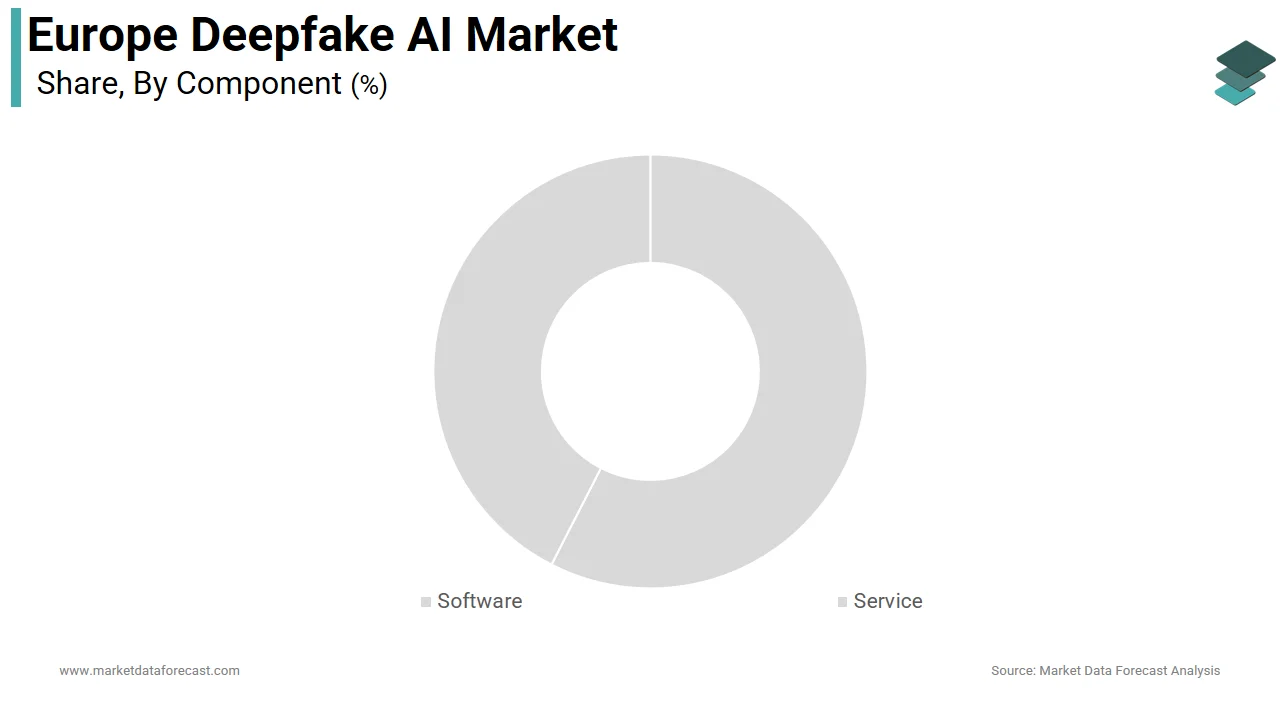
The services segment is growing at the fastest rate and is expected to register a CAGR of 33.8% over the forecast period, owing to the rising demand for expert forensic analysis, legal testimony, and incident response that automated systems cannot provide. According to Europol, deepfake fraud cases in 2024 often required human expert validation for court admissibility, particularly in high-value financial or political disinformation investigations. National election commissions in France and Sweden now contract specialized forensic firms to conduct manual verification of flagged media during campaigns. The European Judicial Training Network reported a rise in requests for deepfake expert witnesses in civil and criminal proceedings in 2024. Additionally, corporate security teams engage managed detection services for proactive monitoring of executive impersonation on social media. As the EU AI Act mandates human oversight for high-risk AI applications, service providers offering audit interpretation and ethical review are becoming essential partners for compliant deployment, transforming deepfake defense from a technical tool into a professional discipline.
By Type Insights
The video deepfakes segment held 56.5% of the European market share in 2025. The growth of the video deepfakes segment in the European market can be credited to their high impact in political disinformation, financial fraud, and social engineering attacks. According to ENISA, video-based synthetic media represented the majority of malicious deepfake incidents reported in 2024, including fake press conferences, fraudulent CEO video calls, and manipulated election footage. The realism of modern video deepfakes, enabled by diffusion models and 3D face reconstruction, makes them particularly dangerous as they exploit human trust in moving imagery. The European External Action Service documented multiple instances of state-sponsored video disinformation targeting EU institutions in 2024. Consequently, detection efforts focus heavily on video, with the European Broadcasting Union mandating frame-level forensic analysis for all news content. Banks like ING and Santander deploy real-time video liveness checks during remote onboarding that analyze micro expressions and head pose consistency. The computational complexity and evidentiary weight of video ensure it remains the primary battleground for both attackers and defenders in Europe’s synthetic media landscape.
The image deepfakes segment is another promising segment and is predicted to witness a CAGR of 35.5% over the forecast period. The proliferation of AI-generated profile pictures, synthetic identities, and manipulated evidence in online fraud is primarily driving the growth of the image deepfakes segment in the European market. According to Europol, image-based deepfakes were widely used in synthetic identity cases in 2024, with criminals creating realistic passport photos and social media avatars. The European Banking Authority reported that AI-generated faces were increasingly involved in remote account openings that bypassed basic biometric checks. In response, platforms like LinkedIn and Facebook now scan profile images for GAN artifacts using convolutional neural networks. The European Commission’s Digital Identity Wallet initiative mandates that all identity documents include forensic image analysis to detect manipulation. As generative models become more accessible and detection lags, static images present a low-cost, high-volume attack vector, making them the fastest evolving frontier in synthetic media threats and defences.
COUNTRY-LEVEL ANALYSIS
Germany Deepfake AI Market Analysis
Germany held the leading position in the European deepfake AI market with a 22.9% of the regional market share in 2025. The dominance of Germany in the European market is majorly driven by its robust cybersecurity infrastructure, stringent data protection laws, and leadership in forensic AI research. The Federal Office for Information Security has certified deepfake detection tools under its C5 framework, enabling public sector adoption across law enforcement and electoral bodies. According to the German Federal Criminal Police Office, deepfake-related incidents were investigated in 2024, primarily involving financial fraud and political disinformation. The Fraunhofer Institute for Digital Media Technology operates Europe’s largest deepfake forensics lab, developing open-source detection models used by Europol and national agencies. Germany’s NetzDG law mandates rapid takedown of manipulated media, further driving platform investment in automated detection. Additionally, strong industrial partnerships between SAP, Siemens, and AI startups foster innovation in enterprise-grade solutions. This blend of regulatory rigor, technical excellence, and institutional demand solidifies Germany’s dominance in defensive deepfake technologies.
France Deepfake AI Market Analysis
France had a promising share of the European deepfake AI market in 2025. The growth of France in the European deepfake AI market is driven by its proactive stance against electoral disinformation and leadership in digital sovereignty. The Ministry of Interior launched the Vrai ou Faux initiative in 2023, allocating funding to combat synthetic media during elections. According to the National Cybersecurity Agency, deepfake detection systems scanned millions of media files during the 2024 European Parliament elections and flagged manipulations. France’s SecNumCloud certification enables sovereign AI deployment in sensitive government applications. The French National Research Institute for Digital Sciences leads the DEEPFAKE project, developing explainable detection models that provide judicially admissible evidence. Additionally, Paris hosts major tech firms like Mistral AI that integrate deepfake resilience into large language multimodal systems. With strong state backing and academic excellence, France maintains a strategic edge in both detection and ethical governance of synthetic media.
United Kingdom Deepfake AI Market Analysis
The United Kingdom is predicted to occupy a prominent share of the European deepfake AI market during the forecast period. The advanced financial crime prevention ecosystem and world-class academic research are propelling the UK market growth. The National Crime Agency reported that deepfake-enabled fraud increased in 2024, with significant financial losses, primarily through CEO video impersonation. In response, the Financial Conduct Authority mandated that all banks implement liveness detection and deepfake resilience in customer authentication systems. Universities like Oxford and Cambridge lead in adversarial machine learning research, with the Alan Turing Institute coordinating national efforts in synthetic media forensics. The UK’s Online Safety Act requires platforms to proactively detect and label manipulated content, creating strong commercial demand. Despite Brexit, the UK remains integrated with EU threat intelligence sharing through Europol, ensuring continued relevance in the regional security architecture.
Netherlands Deepfake AI Market Analysis
The Netherlands is anticipated to record a healthy CAGR in the European deepfake AI market over the forecast period. The role of the Netherlands as a digital hub and leader in ethical AI governance is driving the market growth in the Netherlands. The Dutch National Cyber Security Centre coordinates the Deepfake Detection Coalition, which includes banks, broadcasters, and tech firms sharing threat intelligence and detection models. According to the Public Prosecution Service, deepfake cases were prosecuted in 2024 under the country’s strict digital impersonation laws. The Netherlands hosts major platform headquarters, including Booking.com and Uber, which invest heavily in synthetic media screening to protect users. The Delft University of Technology leads the EU-funded TRUSTED project, developing blockchain-based provenance tracking for digital media. Additionally, the Dutch Data Protection Authority enforces strict GDPR compliance on biometric data usage, limiting malicious generation while promoting ethical detection. This convergence of regulation, innovation, and corporate responsibility positions the Netherlands as a trusted node in Europe’s deepfake defense network.
Sweden Deepfake AI Market Analysis
Sweden is projected to witness a notable CAGR in the European deepfake AI market during the forecast period, owing to its focus on democratic integrity, digital public services, and privacy-preserving AI. The Swedish Election Authority deployed real-time deepfake monitoring during the 2024 municipal elections, scanning social media for synthetic disinformation with support from the Defence Research Agency. According to the Swedish Civil Contingencies Agency, public sector digital identity systems now include deepfake resilient liveness checks. The KTH Royal Institute of Technology leads research in lightweight detection models suitable for mobile devices, ensuring accessibility without compromising privacy. Sweden’s implementation of the EU AI Act emphasizes human oversight and transparency, requiring detailed documentation for all high-risk AI systems. With strong civic trust and technological maturity, Sweden exemplifies a balanced approach where innovation serves democratic resilience without eroding fundamental rights.
COMPETITIVE LANDSCAPE
The Europe deepfake AI market features intense rivalry among global technology giants, specialized forensic startups, and academic spin-offs operating under strict ethical and legal constraints. Competition is defined less by detection accuracy alone and more by regulatory compliance, data sovereignty, and integration depth with critical infrastructure. Microsoft, Intel, and Truepic lead through certified solutions adopted by governments and financial institutions, while European startups like Reality Defender and Sentinel AI focus on niche forensic services and judicial admissibility. The EU AI Act creates high barriers to entry, favoring incumbents with legal and compliance resources, yet fosters innovation through public funding via Horizon Europe. Unlike other regions where generative applications drive growth, Europe’s market is almost entirely defensive, shaped by threats to democracy, finance, and identity. This unique orientation rewards transparency, explainability, and human oversight over raw algorithmic performance, creating a distinct competitive landscape centered on trust rather than novelty.
KEY MARKET PLAYERS
The leading companies operating in the Europe deepfake AI market include:
- Amazon Web Services, Inc. (Amazon.com, Inc.)
- Google LLC (Alphabet Inc.)
- Intel Corporation
- Microsoft Corporation
- Sensity B.V.
- Truepic, Inc.
- BioID GmbH
- DeepBrain AI Inc.
- Synthesia Limited
- Rephrase.ai
TOP PLAYERS IN THE MARKET
- Microsoft Corporation plays a pivotal role in the Europe deepfake AI market through its Video Authenticator and Azure AI Content Safety tools that detect manipulated media across cloud and enterprise environments. The company contributes globally by integrating deepfake detection into Microsoft Teams, Outlook, and Azure Cognitive Services, used by governments and corporations worldwide. In Europe, Microsoft partners with ENISA and national election commissions to provide real-time synthetic media screening during electoral cycles. Recently, the company enhanced its detection models to identify diffusion-based deepfakes and launched a forensic watermarking SDK compliant with the EU’s C2PA standards. It also joined the European Digital Media Observatory to share threat intelligence. These actions reinforce Microsoft’s position as a trusted infrastructure provider for ethical AI aligned with EU regulatory frameworks.
- Intel Corporation has emerged as a leader in the Europe deepfake AI market through its FakeCatcher technology, which claims 96 percent accuracy in detecting synthetic videos by analyzing blood flow patterns in facial pixels. The company integrates this capability into its hardware and software stack, serving broadcasters, financial institutions, and public sector agencies across the EU. Globally, Intel collaborates with Interpol and Europol to combat cross-border deepfake fraud and disinformation. In recent actions, Intel open-sourced its detection model for academic use and partnered with the Fraunhofer Institute to validate performance under EU forensic standards. It also embedded FakeCatcher into its Edge AI platforms, enabling real-time analysis without cloud dependency. These moves position Intel as a pioneer in physics-based detection that complements data-driven approaches in high-stakes European applications.
- Truepic Inc, although US headquartered, has established a strong European presence by developing cryptographic provenance solutions that embed tamper-proof authenticity markers at the point of image and video capture. The company’s Verified Capture SDK is integrated into smartphones, drones, and broadcast cameras used by news agencies, banks, and government bodies across Europe. Truepic contributes globally by co-founding the Coalition for Content Provenance and Authenticity, which developed the C2PA standard adopted by the EU Code of Practice on Disinformation. In recent actions, Truepic launched a GDPR compliant verification API for European enterprises and partnered with the European Broadcasting Union to certify news footage. It also achieved certification under France’s SecNumCloud label, enabling sovereign deployment. These initiatives establish Truepic as a foundational layer for trustworthy digital media in Europe’s regulated environment.
TOP STRATEGIES USED BY THE KEY MARKET PARTICIPANTS
Key players in the Europe deepfake AI market prioritize regulatory alignment by embedding EU AI Act and Digital Services Act compliance directly into detection algorithms and data workflows. They develop hybrid detection systems combining neural network analysis with physics-based signals such as blood flow or lighting consistency to improve robustness. Companies actively participate in European standardization bodies like ETSI and C2PA to shape forensic watermarking and metadata protocols. Strategic partnerships with law enforcement, election commissions, and financial regulators ensure adoption in high-impact institutional use cases. Additionally, firms offer both on-device and cloud-based solutions to function in privacy-sensitive environments while maintaining scalability across diverse European digital ecosystems.
MARKET SEGMENTATION
This research report on the Europe deepfake AI market has been segmented and sub-segmented into the following categories.
By Component
- Software
- Service
By Type
- Image Deepfake
- Video Deepfake
- Other Type
By Technology
- Generative Adversarial Networks (GANs)
- Auto encoders
- Recurrent Neural Networks (RNNs)
- Transformative Models
- Natural Language Processing (NLP)
- Other Technology
By Vertical
- Media & Entertainment
- BFSI
- Healthcare & lifesciences
- Telecommunications
- Government & Defense
- Legal
- Retail & Ecommerce
- Other Vertical
By Country
- United Kingdom
- France
- Spain
- Germany
- Italy
- Russia
- Sweden
- Denmark
- Switzerland
- Netherlands
- Rest of Europe