- Product Description Description
- Table of Contents TOC
- List of Table & Figure LOT
- Get Free Sample PDF Sample PDF
Market Size, 2025
$4.19 BnMarket Estimate, 2026
$4.84 BnMarket Forecast, 2034
$15.33 BnCAGR, 2026–2034
15.50%Europe Identity Verification Market Insights Summary:
Market Size & Growth Projections:
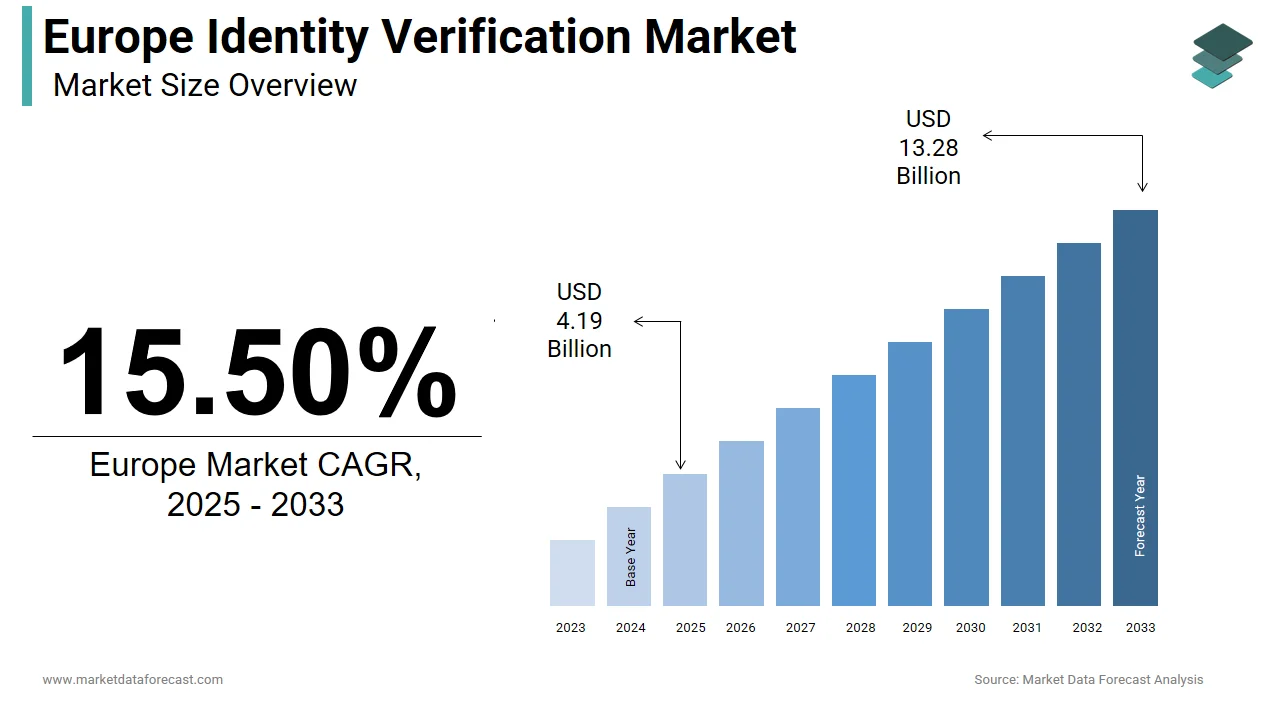
- 2025 Market Size: USD 4.19 billion
- 2026 Market Size: USD 4.84 billion
- Projected Market Size: USD 15.33 billion by 2034
- Growth Forecasts: 15.50% CAGR (2026–2034)
Key Regional Dynamics:
- Largest Country Market: United Kingdom
- Second Largest Market: Germany
- High-Growth Markets: France, Netherlands, Sweden
- Emerging Growth Regions: Spain, Italy, Eastern Europe
Regional Highlights:
- The United Kingdom leads the Europe identity verification market due to strong fintech penetration, AML/KYC enforcement, and early biometric adoption across banking and mobility platforms.
- Germany demonstrates robust growth driven by NFC-enabled national ID adoption, strict financial sector compliance, and public e-ID onboarding requirements.
- France, the Netherlands, and Sweden reflect accelerating digital identity penetration supported by national e-ID ecosystems, public sector digitization, and cross-border verification initiatives.
Segment Insights:
- The cloud deployment model segment held a significant share of the Europe identity verification market in 2025, driven by regulatory agility, rapid onboarding needs, and cross-border service scalability.
- The cloud segment is also projected to grow at the fastest CAGR, supported by EU Digital Identity Wallet integration, sovereign cloud certification, and embedded-finance platform adoption.
- The biometric identification segment accounted for the largest market share in 2025, supported by PSD2 strong customer authentication mandates, eIDAS high-assurance services, and rising use of liveness and anti-spoofing verification.
- The behavioral biometrics segment is expected to record the fastest growth, driven by continuous authentication, account takeover prevention, and risk-based authentication frameworks.
- The large enterprises segment dominated the market in 2025 due to high transaction volumes, cross-border operations, and stringent AML/KYC risk obligations.
Key Growth Drivers:
- Enforcement of Anti-Money Laundering (AMLD) and Know Your Customer (KYC) regulations
- Expansion of eIDAS-based digital public services and national e-ID schemes
- Growth of embedded finance, gig-economy and fintech ecosystems
- Adoption of liveness detection, anti-spoofing, and passive biometric verification
- Preparation for EU Digital Identity Wallet and eIDAS 2.0 rollout
Major Challenges & Restraints:
- Strict GDPR constraints on biometric data storage & retention
- Fragmented national e-ID architectures limiting interoperability
- Bias & accuracy gaps in biometric algorithms
- Rising deepfake, synthetic identity & document fraud sophistication
Key Players:
- Equifax, Inc., Jumio, Thales Group, TransUnion, Experian, Trulioo, Onfido, IDnow, Shufti Pro, Mitek Systems, Inc., DocuSign, Inc., Veriff, and Others.
Europe Identity Verification Market Size
The Europe identity verification market was valued at USD 4.19 billion in 2025. The regional market is projected to grow from USD 4.84 billion in 2026 to reach USD 15.33 billion by 2034, exhibiting a compound annual growth rate (CAGR) of 15.50% from 2026 to 2034.
Identity verification is the technological and procedural framework used by public and private entities to authenticate the identity of individuals during digital and physical interactions. These systems employ a combination of document validation, biometric analysis, liveness detection, and database cross-referencing to mitigate fraud, ensure regulatory compliance, and enable secure access to services. According to the European Commission, over 85% of EU citizens now access public services digitally through national eID schemes, which require verified identity credentials under the eIDAS Regulation. In this context, identity verification transcends a compliance function to become a critical infrastructure layer for digital trust, enabling everything from banking and healthcare to age-restricted content and cross-border mobility within the European single market.
MARKET DRIVERS
Enforcement of Anti-Money Laundering and Know Your Customer Regulations
The rigorous implementation of the EU’s Anti Money Laundering Directives and associated Know Your Customer requirements serves as identity verification adoption across financial and regulated sectors, which is majorly fuelling the growth of Europe identity verification market. The Sixth Anti Money Laundering Directive mandates that all obliged entities, including banks, crypto asset service providers, and even luxury goods dealers, verify customer identity using reliable independent sources before establishing business relationships. According to the European Banking Authority, over 92% of EU financial institutions implemented automated identity verification systems in 2023 to comply with these obligations and reduce manual review costs. The directive’s risk-based approach further compels enhanced due diligence for high-risk customers by requiring biometric verification and ongoing monitoring. Germany’s Federal Financial Supervisory Authority documented a reduction in suspicious transaction reports after banks adopted AI-powered verification in 2022, demonstrating operational efficacy alongside compliance.
Mandated Digital Public Service Access Through the eIDAS Framework
The European Union’s eIDAS Regulation has institutionalized identity verification as a foundational element of digital citizenship by enabling secure cross-border access to public services through nationally issued electronic identities. This factor is also boosting the growth of Europe identity verification market. As per the European Commission, all 27 member states now offer at least one eID scheme recognized across the bloc, allowing citizens to authenticate for services like tax filing, healthcare registration, and university enrollment in any EU country. Countries like Estonia and Finland lead adoption with over 98% of adults possessing digital IDs, while Germany’s AusweisApp recorded 15 million active users by the end of 2023. The regulation’s Level of Assurance framework requires high assurance services, such as legal contracts or medical records, to use identity verification methods that include biometric or cryptographic authentication. This legal architecture transforms identity verification from a private sector tool into a public infrastructure obligation, ensuring consistent investment in secure, interoperable, and privacy-preserving verification technologies across Europe’s digital government landscape.
MARKET RESTRAINTS
Strict GDPR Constraints Limit Data Collection and Retention Practices
The General Data Protection Regulation imposes significant operational and technical constraints on identity verification providers by restricting the collection, storage, and processing of biometric and identity data, classified as special category personal data under Article 9. The strict GDPR constraints limit data collection and retention practises is substantially hindering the growth of Europe identity verification market. As per the European Data Protection Board, any processing of biometric data for identification purposes requires explicit consent or must be necessary for a substantial public interest with robust safeguards. In 2023, France’s data authority CNIL fined a fintech company 500000 euros for retaining facial recognition templates beyond the verification session. According to the European Consumer Organisation, many EU citizens are reluctant to submit biometric data due to privacy concerns, even when legally required. This tension forces verification vendors to implement complex data minimization architectures, such as zero-knowledge proofs or on-device processing, that increase development costs and reduce verification accuracy. Germany’s Federal Commissioner for Data Protection notes that 42% of identity verification startups delay market entry due to compliance uncertainty.
Fragmented National eID Schemes Hinder Cross-Border Interoperability
Despite the eIDAS Regulation’s goal of seamless digital identity across the EU, significant technical and policy divergences among national electronic identity schemes impede true interoperability and complicate private sector adoption. This factor is also degrading the growth of Europe verification market. According to the European Commission, only 19 of 27 member states have notified eID schemes at the high or substantial assurance level required for financial and healthcare services. Countries like Italy and Spain rely on mobile-based eIDs, while Germany uses a physical ID card with NFC, creating incompatible authentication protocols. This fragmentation forces private companies to maintain parallel verification systems, increasing cost and complexity.
MARKET OPPORTUNITIES
Deployment of the EU Digital Identity Wallet Creates Unified Verification Layer
The upcoming EU Digital Identity Wallet is to establish a standardized, secure, and privacy-preserving identity verification framework across all member states. The deployment of the EU digital identity wallet creates a unified verification layer, which is solely creating new opportunities for the growth of Europe identity verification market. As per the European Commission, this government-issued digital credential, available to all 450 million EU citizens by 2026, will store verified attributes like name, age, nationality, and professional qualifications in a user-controlled mobile wallet compliant with eIDAS 2.0. The wallet will enable selective disclosure, allowing citizens to prove they are over 18 without revealing their birthdate or confirm residency without exposing their full address. Pilot programs in the Netherlands and Portugal demonstrated 99.8% verification accuracy with zero false accepts using decentralized identifiers and qualified electronic signatures. Financial institutions anticipate 40% reduction in onboarding costs once the wallet is operational, as confirmed by the European Banking Federation.
Integration of Identity Verification in Embedded Finance and Fintech Ecosystems
The rapid expansion of embedded finance, where financial services are seamlessly integrated into non-financial platforms, is creating unprecedented demand for lightweight real-time identity verification across retail mobility and gig economy applications. The integration of identity verification in embedded finance and fintech ecosystems is ascribed to bolster the growth of Europe verification market. According to the European Fintech Association, over 12000 non-bank platforms now offer payment, lending, or insurance products in Europe, requiring compliant customer onboarding under AMLD6. Ride-hailing apps like Bolt and food delivery services like Deliveroo must verify driver and courier identities to comply with labor and safety regulations, processing over 8 million verifications monthly across the EU. In 2023, Klarna launched its “Pay now” feature across 20 European countries, requiring instant age and identity checks at checkout to prevent fraud. The European Commission’s Open Finance framework further accelerates this trend by enabling third-party providers to access financial data contingent on verified customer consent. Companies like Solaris and Railsbank now embed identity verification APIs directly into their banking-as-a-service platforms, allowing fintechs to onboard users in under 90 seconds.
MARKET CHALLENGES
Bias and Inaccuracy in Biometric Algorithms Undermine Fairness
The persistent bias and reduced accuracy of biometric algorithms, particularly facial recognition, when applied to elderly women and people of color, is one of the challenges for the growth of Europe identity verification market. According to a 2023 study by the European Union Agency for Fundamental Rights, commercial verification systems exhibited false non-match rates up to 10 times higher for dark-skinned women compared to light-skinned men under standard lighting conditions. The European Commission’s AI Office notes that many verification vendors train algorithms on non-representative datasets dominated by young Caucasian males, leading to systemic exclusion. This not only erodes user trust but also exposes organizations to legal risk under the EU’s upcoming AI Act, which prohibits discriminatory AI systems in high-risk contexts like identity verification.
Sophistication of Deepfake and Synthetic Identity Fraud
The escalating use of AI-generated deepfakes, synthetic identities, and high-quality document forgeries presents a systemic threat to the reliability of current identity verification systems, is to limit the growth of Europe identity verification market. According to Europol, over 60000 synthetic identities were detected in EU financial applications in 2023, up from 18000 in 2021, with criminals combining real stolen data with AI-fabricated elements to bypass basic checks. Deepfake videos used in liveness detection challenges have grown increasingly convincing, able to mimic blinking head movement and speech patterns with minimal artifacts. Furthermore, dark web markets now offer “verification as a service, where fraudsters use real people, often in low-income countries, to complete biometric checks on behalf of synthetic identities.
REPORT COVERAGE
| REPORT METRIC | DETAILS |
| Market Size Available | 2025 to 2034 |
| Base Year | 2025 |
| Forecast Period | 2026 to 2034 |
| Segments Covered | By Deployment Model, Type, Enterprise Type, End-user Industry, and Country. |
| Various Analyses Covered | Global, Regional, and Country-Level Analysis, Segment-Level Analysis, Drivers, Restraints, Opportunities, Challenges; PESTLE Analysis; Porter’s Five Forces Analysis, Competitive Landscape, Analyst Overview of Investment Opportunities |
| Countries Covered | UK, France, Spain, Germany, Italy, Russia, Sweden, Denmark, Switzerland, Netherlands, Turkey, Czech Republic, and the Rest of Europe. |
| Market Leaders Profiled | Equifax, Inc., Jumio, Thales Group, TransUnion, Experian, Trulioo, Onfido, IDnow, Shufti Pro, Mitek Systems, Inc., DocuSign, Inc., Veriff, and Others. |
SEGMENTAL ANALYSIS
By Deployment Model Insights
The cloud deployment model segment held a significant share of the Europe identity verification market in 2025, with its alignment with regulatory agility, scalability needs, and the rapid onboarding requirements of digital-first businesses across the EU. The operational flexibility is required to comply with evolving anti-money laundering and eIDAS mandates without heavy upfront infrastructure investment. Cloud-based verification platforms enable real-time updates to document templates, biometric algorithms, and sanction list databases for maintaining compliance across 27 diverse regulatory regimes. According to the European Banking Authority, new fintechs and digital banks launched in Europe in 2023 selected cloud verification APIs to achieve regulatory readiness within weeks rather than months. These platforms integrate seamlessly with existing onboarding workflows via RESTful APIs and support automatic versioning when national ID formats change, as occurred in Italy and Poland in 2023. The European Commission’s Digital Europe Programme actively promotes cloud adoption by public agencies through its Gaia-X framework, which certifies sovereign European cloud providers like OVHcloud and Deutsche Telekom. This ensures data residency while enabling scalable verification for cross-border services.
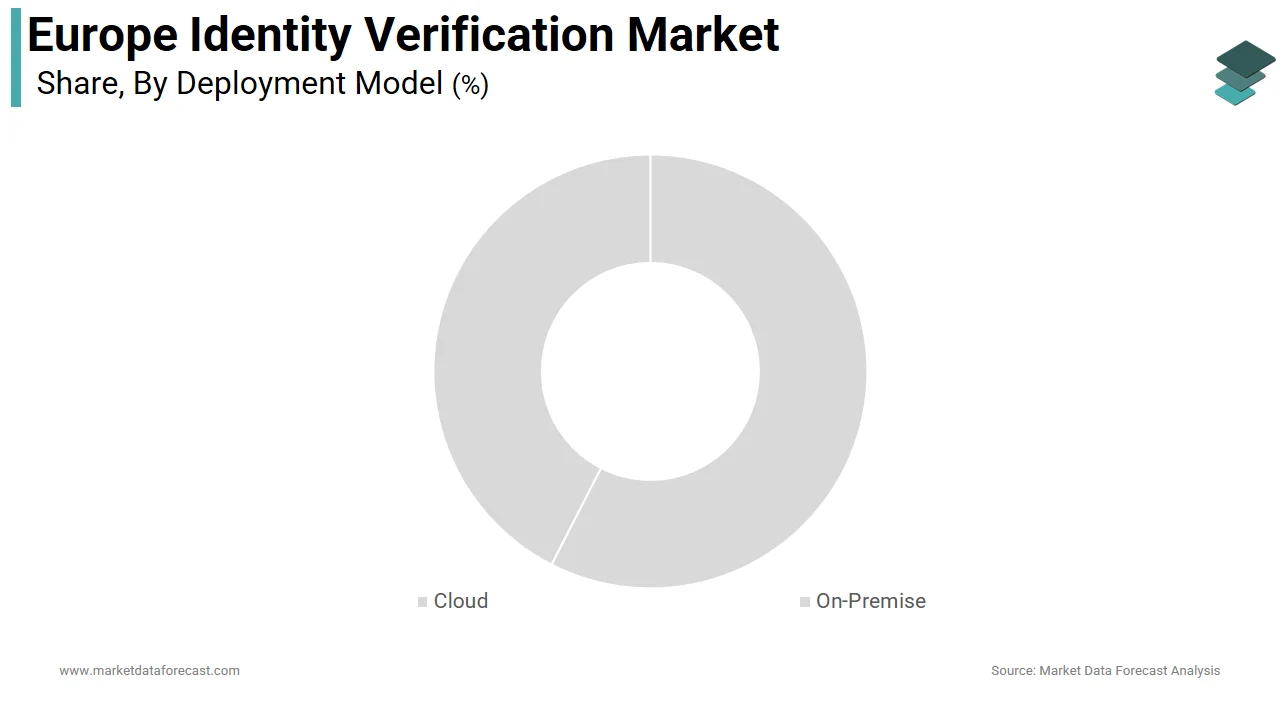
The cloud deployment model segment is likely to grow at the fastest CAGR of 13.8% from 2025 to 2033, owing to the integration of cloud verification platforms with the upcoming EU Digital Identity Wallet, a government-issued mobile credential that will store verified attributes for 450 million citizens by 2026. As per the European Commission, cloud providers are being certified as qualified trust service providers under eIDAS 2.0 to validate wallet credentials in real time in the private sector onboarding. Companies like Onfido and Veriff are already piloting wallet verification flows in the Netherlands and Portugal that reduce onboarding to under 10 seconds with zero data storage. This public-private interoperability creates massive demand for cloud infrastructure that can handle cryptographic validation, selective disclosure, and cross-border attribute exchange at scale. The proliferation of embedded finance and gig economy platforms that require lightweight on-demand verification is also propelling the growth of Europe identity verification market. According to the European Fintech Association, over 12000 non-bank services, from ride hailing to buy now pay later, must perform compliant identity checks without dedicated IT teams. Cloud APIs enable these businesses to embed verification in minutes via SDKs with pay-per-use pricing.
By Type Insights
The biometric identification segment in the Europe identity verification market held 58.3% of the share in 2024, with the Revised Payment Services Directive, which requires strong customer authentication for most electronic payments. According to the study, over 92% of EU banks implemented facial or fingerprint recognition in their mobile banking apps by 2023 to comply with SCA while reducing friction through biometric exemptions. In public services, the eIDAS Regulation’s high assurance level mandates biometric verification for access to sensitive data like health records or tax filings. Law enforcement agencies increasingly use biometric verification to combat identity fraud. Europol’s 2023 Fraud Report credits facial recognition with preventing over 18000 synthetic identity attempts in financial applications. The advancement of liveness detection and anti-spoofing technologies that address early concerns about photo or video replay attacks is also escalating the growth of the segment. Modern systems use passive liveness analyzing micro movements, texture, and 3D depth without user interaction to achieve spoof false acceptance rates below 0.1%, as confirmed by iBeta PAD certification data widely adopted in EU procurement. In Germany, the Federal Office for Information Security mandates ISO 30107 compliance for all biometric verification used in public sector onboarding by ensuring robustness against deepfakes. Banks like ING and BNP Paribas now achieve over 99.5% first time pass rates using adaptive lighting and AI-enhanced facial matching that works across diverse skin tones and lighting conditions.
The behavioral biometrics segment is likely to register the fastest CAGR of 18.2% during the forecast period, with the shift from one-time verification to ongoing risk assessment during digital sessions. Behavioral biometrics analyzes patterns like keystroke dynamics, mouse movements, touchscreen pressure, and navigation flow to build unique user profiles that detect account takeover in real time. Revolut and N26 now deploy these systems across their mobile apps, monitoring how users scroll through transaction history or enter amounts to distinguish genuine behavior from robotic scripts. The technology operates silently in the background, requiring no user action by aligning with the EU’s Digital Services Act principle of least intrusive security. The integration of behavioral signals into regulatory-compliant risk-based authentication frameworks is also fuelling the growth of Europe identity verification market. Under PSD2’s transaction risk analysis exemptions, low-risk payments can bypass strong customer authentication if real-time fraud scoring remains below thresholds. Behavioral biometrics provide the continuous data stream needed for these dynamic assessments by allowing seamless payments up to 500 euros without biometric prompts.
By Enterprise Type Insights
The large enterprises segment was the largest by holding 64.3% of the Europe identity verification market share in 2024, due to their regulatory exposure, high transaction volumes, and complex cross-border operations that necessitate robust verification infrastructure. The stringent compliance obligations faced by multinational banks, telecom operators, and public agencies under anti-money laundering and eIDAS regulations. According to the European Banking Authority, all significant institutions must implement enterprise-wide identity verification systems capable of handling millions of verifications annually with audit trails and role-based access controls. Similarly, telecom giants like Vodafone and Orange verify over 10 million SIM card activations yearly to comply with EU Know Your Customer mandates for mobile subscriptions. The scale and regulatory risk compel large enterprises to invest in high assurance verification with redundancy failover and SOC 2 compliance features rarely needed by smaller firms. The integration of identity verification into broader customer identity and access management ecosystems is also expected to elevate the growth of the segment. This strategic role elevates verification from a point solution to a core security layer, justifying significant investment in scalability and interoperability.
The small and medium-sized enterprises segment is projected to expand at a CAGR of 16.5% from 2025 to 2033, owing to the rise of fintech-enabled SMEs that must comply with anti-money laundering rules despite limited IT resources. Online marketplaces, crypto exchanges, and buy now pay later providers with employees are now classified as obliged entities under the Sixth Anti Money Laundering Directive. According to the European Fintech Association, many SMEs launched in Europe in 2023, each requiring compliant verification at launch. Cloud-based verification APIs with pay-per-use pricing and pre-built regulatory templates enable these businesses to achieve compliance in days rather than months. In the Netherlands, the startup Taxly uses an identity verification API to onboard freelance accountants in under 60 seconds, validating national ID and professional licenses against government databases.
By End User Industry Insights
The BFSI sector held 39.3% of the Europe identity verification market share in 2024, with the comprehensive scope of the Sixth Anti Money Laundering Directive, which requires banks, payment institutions, crypto asset service providers, and even high-value art dealers to verify customer identity before establishing business relationships. The directive’s risk-based approach further mandates enhanced due diligence for politically exposed persons and cross-border transactions requiring biometric verification and ongoing monitoring. In response to rising crypto fraud, the European Securities and Markets Authority now requires all licensed virtual asset service providers to use liveness detection and document authentication, leading to 100% adoption of advanced verification in this segment. The integration of identity verification into open banking and payment initiation services under PSD2 is also elevating the growth of the segment. Third-party providers must verify user identity before accessing bank data or initiating payments by creating millions of daily verification events. Banks like ING and Santander now use adaptive verification, combining device fingerprinting, behavioral analytics, and facial recognition to balance security and conversion.
The healthcare and life sciences segment is projected to expand at a CAGR of 19.3% during the forecast period, with the EU’s MyHealth@EU framework, which enables citizens to access electronic health records, prescriptions, and vaccination certificates across member states by 2025. As per the European Commission, this requires a verified digital identity to prevent unauthorized access to sensitive health data. Countries like Estonia and Denmark already use national eIDs with biometric authentication for cross-border teleconsultations processing over 500000 verified sessions monthly. In Germany, the electronic patient record system mandates strong authentication for both patients and healthcare professionals, with over 35 million records created by 2023 requiring secure onboarding. The General Data Protection Regulation classifies health data as special category information by making robust identity verification a legal prerequisite for any digital health service. The European Medicines Agency confirms that all clinical trial platforms must verify participant identity to ensure data integrity and prevent fraud by driving adoption among research institutions.
The rise of direct-to-consumer digital health services, including telemedicine, mental health apps, and personalized medicine platforms, is also propelling the growth of the segment. Babylon Health and Kry use facial recognition to confirm patient identity before video consultations by reducing misdiagnosis and insurance fraud. In France, the Health Insurance system reimburses teleconsultations only if identity is verified through approved methods by creating a compliance mandate for all providers.
COUNTRY-LEVEL ANALYSIS
United Kingdom Identity Verification Market Analysis
The United Kingdom was the top performer of the Europe identity verification market by holding 19.3% of the share in 2024, with its advanced fintech ecosystem, stringent anti-fraud regulations, and early adoption of biometric verification in both public and private sectors. The UK’s Joint Money Laundering Steering Group mandates rigorous customer due diligence for all financial institutions, with the adoption of automated verification among banks and crypto firms. London serves as a global hub for identity verification innovation, home to companies like Onfido and Sumsub that serve millions of European customers with AI-powered document and facial recognition. The UK maintains alignment with EU data protection principles through the UK GDPR and participates in international law enforcement cooperation via Europol. The National Cyber Security Centre’s guidelines for digital identity further reinforce high assurance standards across critical infrastructure.
Germany Identity Verification Market Analysis
Germany was positioned second by holding 17.3% of the Europe identity verification market share in 2024, with its robust data protection culture, strong banking sector, and leadership in eID implementation. According to the German Federal Office for Information Security, the country’s national ID card with NFC capability has been issued to over 60 million citizens and is the foundation for high assurance verification in banking, healthcare, and public services. The Federal Financial Supervisory Authority enforces strict anti-money laundering rules requiring biometric verification for all new bank accounts and crypto transactions, resulting in near universal adoption of advanced verification in the financial sector. Germany’s Bundesdruckerei and Giesecke+Devrient are global leaders in secure identity document production, supplying passports and ID cards to over 50 countries.
France Identity Verification Market Analysis
France identity verification market was positioned second by holding 12.3% of the share in 2024, with its centralized digital identity strategy, strong public sector digitization, and leadership in AI-driven verification. According to the French National Cybersecurity Agency, the country’s FranceConnect platform enables 45 million citizens to access over 3000 public and private services using verified identity from national databases. The government actively promotes biometric verification in regulated sectors, mandating liveness detection for all remote onboarding in finance and telecom as per the Autorité de Contrôle Prudentiel et de Résolution. French tech firms like Thales and Morpho are global leaders in biometric algorithms and secure document verification, exporting solutions worldwide.
Netherlands Identity Verification Market Analysis
The Netherlands identity verification market growth is likely to grow with its open banking leadership, gig economy density, and progressive regulatory sandbox for identity innovation. The country’s advanced eID system DigiD, is used by 15 million citizens for tax, healthcare, and education services with high assurance levels requiring biometric mobile authentication. Its pragmatic regulatory approach, data-sharing culture, and multilingual population make it an ideal launchpad for pan-European identity services.
Sweden Identity Verification Market Analysis
Sweden identity verification market growth is likely to grow with its near cashless society, digital public services, and strong fintech collaboration. According to the Swedish Authority for Digital Government, over 99% of citizen interactions with the state occur through digital channels using the BankID system, verified by biometric mobile authentication, and used by 8.5 million adults. Sweden’s eID is deeply integrated into daily life, from signing leases to age verification in Systembolaget liquor stores, creating a high-trust ecosystem where identity verification is seamless and ubiquitous. The Swedish Financial Supervisory Authority mandates strict anti-money laundering compliance but encourages innovation through its regulatory sandbox, approving real-time verification flows for neobanks like Klarna and Klippa.
COMPETITIVE LANDSCAPE
Competition in the Europe identity verification market is defined by a strategic divide between European providers emphasizing data sovereignty, regulatory alignment, and global vendors offering scale and AI innovation. Companies like IDnow and Veriff compete on local compliance certifications, data residency, and integration with national eID schemes, while Onfido and international players leverage advanced AI and global document expertise. The market is highly dynamic with differentiation centered on fraud detection accuracy, user conversion rates, and adherence to GDPR and eIDAS. Fragmentation persists due to national ID variations and uneven eID adoption, yet the upcoming EU Digital Identity Wallet is driving convergence toward standardized verification protocols. Startups focusing on behavioral biometrics, decentralized identity, or synthetic fraud detection are gaining traction through regulatory sandboxes.
KEY MARKET PLAYERS
The leading companies operating in the Europe identity verification market include:
- Equifax, Inc.
- Jumio
- Thales Group
- TransUnion
- Experian
- Trulioo
- Onfido
- IDnow
- Shufti Pro
- Mitek Systems, Inc.
- DocuSign, Inc.
- Veriff
TOP PLAYERS IN THE MARKET
- Onfido is a London-based global leader in AI-powered identity verification with deep integration across Europe’s fintech banking and mobility sectors. The company specializes in document and biometric verification using advanced computer vision and liveness detection to authenticate over 2500 global ID types. Onfido achieved eIDAS 2.0 compliance for its cloud platform, enabling seamless integration with the upcoming EU Digital Identity Wallet. The company also enhanced its passive liveness technology to detect deepfakes with 99.9% accuracy while operating entirely on the device to ensure GDPR compliance.
- Veriff is an Estonian identity verification provider that leverages real-time video and AI to deliver high-assurance identity checks for regulated industries across Europe. Founded in a country renowned for digital governance, Veriff’s platform is deeply aligned with EU data protection and eIDAS principles, featuring end-to-end encryption, local data residency, and human-in-the-loop review for edge cases. In 2024, Veriff launched its Identity Intelligence Graph, which correlates verification attempts across clients to detect synthetic identity fraud networks in real time. The company also obtained Qualified Trust Service Provider status under eIDAS 2.0 by allowing it to validate EU Digital Identity Wallet credentials. Through its unique blend of Baltic digital trust heritage and adaptive AI, Veriff has become a preferred partner for banks, gig platforms, and public agencies seeking compliant and future-ready verification.
- IDnow is a German identity verification company offering a comprehensive suite of video-based and automated verification solutions tailored to Europe’s stringent regulatory environment. The company’s AutoIdent and VideoIdent platforms are widely used by banks, insurers, and telecom operators to meet anti-money laundering and strong customer authentication requirements with high conversion rates. In 2023, IDnow expanded its document coverage to include all EU national IDs with AI trained on regional security features and lighting conditions. The company also integrated behavioral biometrics into its video sessions to detect coercion or remote access fraud.
TOP STRATEGIES USED BY THE KEY MARKET PARTICIPANTS
Key players in the Europe identity verification market prioritize GDPR compliant architectures by implementing on-device processing, data minimization, and zero retention policies to build consumer and regulator trust. They invest heavily in anti-spoofing and deepfake detection using passive liveness behavioral biometrics and 3D depth analysis to counter evolving fraud tactics. Companies align with eIDAS 2.0 by pursuing Qualified Trust Service Provider status to enable interoperability with the EU Digital Identity Wallet. Strategic partnerships with banks, fintechs, and public agencies ensure integration into regulated onboarding workflows and access to real-world verification data for model refinement.
MARKET SEGMENTATION
This research report on the Europe identity verification market has been segmented and sub-segmented into the following categories.
By Deployment Model
- On-premises
- Cloud
By Type
- Biometric Identification
- Non-biometric Identification
- Document Verification
- Knowledge-based Verification
- Two-Factor Authentication
- Others (Online Verification and others)
By Enterprise Type
- Small and Medium-sized Enterprises
- Large Enterprises
By End-user Industry
- BFSI
- E-commerce & Retail
- Government
- IT & Telecom
- Healthcare & Life Sciences
- Others (Education and Gaming & Entertainment)
By Country
- United Kingdom
- France
- Spain
- Germany
- Italy
- Russia
- Sweden
- Denmark
- Switzerland
- Netherlands
- Rest of Europe