- Product Description Description
- Table of Contents TOC
- List of Table & Figure LOT
- Get Free Sample PDF Sample PDF
Market Size, 2025
$12.17 BnMarket Estimate, 2026
$12.81 BnMarket Forecast, 2034
$19.32 BnCAGR, 2026–2034
5.27%Europe Dental Laboratories Market Size
The dental laboratories market size in Europe was valued at USD 12.17 billion in 2025. The European market is anticipated to be worth USD 19.32 billion by 2034 from USD 12.81 billion in 2026, growing at a CAGR of 5.27% from 2026 to 2034.

Dental laboratories are specialized facilities that fabricate custom dental prosthetics such as crowns, bridges, dentures, orthodontic appliances, and implant-supported restorations based on prescriptions from dental practitioners. These laboratories operate at the intersection of clinical dentistry and precision manufacturing by increasingly integrating digital workflows, including CAD/CAM systems, 3D printing, and intraoral scanning technologies. According to the European Federation of Dental Laboratory Owners, the dental industry employs a large number of skilled technicians across the European Union. Unlike generic manufacturing, dental laboratories are governed by stringent regulatory frameworks under the European Union Medical Device Regulation 2017/745 that mandates traceability, biocompatibility validation, and quality management systems. The profession faces evolving dynamics due to demographic shifts, technological disruption, and cross-border service models, particularly with the rise of centralized production hubs serving multiple countries. Contextual indicators such as workforce distribution, regulatory compliance burdens, and digital adoption rates are promoting the growth of the dental laboratories market in Europe.
MARKET DRIVERS
Ageing Population Drives Demand for Prosthetic Dental Solutions
The rapidly growing ageing demographic exerts sustained pressure on restorative dental services is one of the major factors propelling the growth of the European dental laboratories market. According to Eurostat, individuals aged 65 and older constituted 21.3% of the EU population in 2023. According to the OECD/EU, that cohort is projected to reach about 29% of the EU population by 2050. This cohort exhibits significantly higher rates of tooth loss and edentulism. As per the data from the World Health Organization, some older Europeans have lost all natural teeth, requiring full or partial dentures. Among adults aged 65 to 74, the average number of missing teeth exceeds eight, which is creating consistent demand for crowns, bridges, and implant-supported prostheses. National health systems in countries like Germany and Sweden partially reimburse prosthetic treatments for seniors, reinforcing utilisation. According to the reports of the German Federal Statistical Office, over 4.1 million denture prescriptions were issued to patients aged 60 and above in 2022, which directly translates into laboratory orders. This demographic inertia ensures a baseline volume of analog and digital prosthetic cases, even as younger populations shift toward preventive care. Consequently, dental laboratories in regions with pronounced elderly concentrations, such as Southern and Eastern Europe, experience steady case inflows that are stabilizing their operational viability despite broader market fluctuations.
Digital Integration Enhances Precision and Turnaround Efficiency
The rapid adoption of digital dentistry technologies is further boosting the European dental laboratories market growth. This transition reduces manual labour errors and shortens production cycles. Also, intra-oral scanners eliminate physical impressions and enable same-day design transmission. As per the European Commission’s Digital Economy and Society Index, a large share of EU healthcare providers, including dental practices, increased investment in digital tools between 2020 and 2023, which is further fostering seamless laboratory-clinician collaboration. According to the National Council of Dental Surgeons, in France, a significant year-on-year increase in digital case submissions to laboratories in 2022 was seen, which reflects clinician-side adoption. Additionally, 3D printing has gained traction for temporary crowns, surgical guides, and denture bases, with European dental labs attaining a considerable share of global dental 3D-printer shipments in recent years. These technologies not only improve anatomical accuracy but critical for implant restorations and allow laboratories to handle higher case volumes without proportional staffing increases. As digital literacy improves among both dentists and technicians, this driver sustains long-term demand for technologically-equipped laboratories capable of meeting evolving clinical expectations.
MARKET RESTRAINTS
Stringent Regulatory Compliance Increases Operational Burden
The enforcement of the European Union Medical Device Regulation 2017/745 imposes significant administrative and technical obligations on dental laboratories, constraining agility and raising operational costs. This factor is likely to restrain the growth of the European dental laboratories market. According to the European Commission, all custom-made dental devices, including crowns, bridges, and dentures, are subject to the Medical Device Regulation (EU) 2017/745 and require compliance with quality management systems, post-market surveillance, and traceability protocols. Dental technicians who manufacture such custom-made devices must register with their national competent authority and assume manufacturer responsibilities under the regulation. The regulatory burden disproportionately affects micro-enterprises, which constitute the vast majority of businesses in the EU. Consequently, many small laboratories either consolidate with larger entities or exit the market, which is reducing local service diversity and increasing dependency on centralized production centres, thereby altering the traditional decentralised structure of the European dental-laboratory market.
Workforce Shortages Threaten Technical Capacity and Continuity
The shortage of qualified dental technicians is also impeding the growth of the European dental laboratories market. According to the European Federation of Dental Laboratory Owners, the average age of certified dental technicians in the EU is 52, with fewer than 4,000 new entrants completing formal training programs annually across all member states. According to the Italian National Institute for Statistics and the National Association for Dental Laboratory Owners, 44% of active dental labs in Italy operate with only one technician. As per Germany’s Federal Employment Agency, 23% decline in vocational apprenticeships in dental technology between 2015 and 2023, while Italy’s National Institute for Statistics noted that 38 percent of active dental labs operate with only one technician. The attrition is exacerbated by competition from adjacent fields. As per the observations of the European Centre for the Development of Vocational Training, biomedical engineering and digital design programs attract students who might otherwise pursue dental technology. In Sweden, the Dental Technicians Association warned in 2023 that over 30 percent of laboratories face case backlogs exceeding two weeks due to staffing gaps. The problem is structural, and training programs often lack alignment with digital workflow competencies, which leaves graduates unprepared for modern CAD/CAM environments. Without intervention, this human capital deficit will constrain the growth of the European dental laboratories market to scale, adopt emerging technologies, or respond to rising clinical demand, particularly in rural and underserved regions where recruitment is most difficult
MARKET OPPORTUNITIES
Cross-Border Digital Laboratories Offer Scalable Service Models
The emergence of centralized and digitally enabled dental laboratories is a significant opportunity for the European dental laboratories market. Unlike traditional local labs, these entities leverage cloud-based design platforms and automated manufacturing to serve clinicians in multiple countries from a single facility. Cross-border digital labs processed a significantly increased number of cases by 2023, which reflects strong growth in multi-country case handling. Companies such as Straumann and Dentsply Sirona operate such hubs in Switzerland and Germany that are utilizing AI-assisted design validation and robotic milling to achieve turnaround times under 48 hours. As per the European Commission’s 2023 report, cross-border healthcare services acknowledged that digital interoperability standards now enable seamless data exchange between clinics in France, Spain, and the Netherlands with centralized labs that are reducing regional disparities in access to advanced prosthetics. For instance, these models can significantly optimise resource use as high-throughput 3D-printing lines at advanced facilities have demonstrated large-scale daily outputs of denture-base production. For smaller clinics lacking in-house digital infrastructure, outsourcing to such labs provides cost-effective access to precision restorations without capital investment. This opportunity not only enhances service equity but also fosters economies of scale that can lower per-unit costs, particularly for public health systems seeking efficient prosthetic solutions for ageing populations.
Sustainable Material Innovation Aligns with EU Green Policy Mandates
The Green Deal and Circular Economy Action Plan of the European Union are catalyzing demand for eco-conscious dental materials, which is creating a strategic opening for laboratories that adopt sustainable alternatives. According to the European Academies of Science and Medicine commentary, the healthcare sector contributes about 5 % to the European Union’s total greenhouse-gas emissions. The shift toward bio-based resins, recyclable alloys, and reduced waste workflows is underway in dental laboratories in response to regulatory scrutiny on single-use and non-biodegradable products. Sweden’s Public Dental Service mandated in 2022 that all contracted laboratories submit environmental-impact assessments, and this is leading to a rise in the use of recycled cobalt-chromium alloys in prosthetic frameworks. The European Chemicals Agency has restricted certain monomers used in traditional acrylics, which is accelerating the adoption of plant-derived polymers. Laboratories investing in closed-loop material-recovery systems, such as those recovering precious metals from milling waste-gain a competitive advantage in public tenders and private partnerships.
MARKET CHALLENGES
Price Sensitivity in Public Reimbursement Systems Limits Revenue Potential
Reimbursement policies across several European countries impose rigid price ceilings on prosthetic dental services, which is primarily challenging the expansion of the European dental laboratories market. In countries like France and Italy, national health insurance schemes reimburse fixed amounts for standard crowns and dentures, irrespective of material quality or manufacturing method. The reimbursement for full acrylic dentures in France has remained low relative to rising material costs, which is limiting laboratories’ ability to compensate for cost increases. In Italy, publicly reimbursed tariffs for prosthetic crowns are modest, which leads laboratories to either bear extra costs or reduce material quality. A study of dental labs in Italy found that a substantial proportion are achieving only breakeven or incurring losses when handling publicly reimbursed prosthetic cases. This pricing rigidity disincentivises the adoption of premium digital workflows, as the added value cannot be recouped. Consequently, laboratories either avoid public sector contracts or cross-subsidise losses with private pay cases, creating market segmentation. The result is a bifurcated system where innovation thrives only in private channels, while public patients receive lower-tier prosthetics, further undermining equity in oral health outcomes and constraining regional market growth.
Fragmented National Regulatory Interpretations Hinder Harmonized Operations
Despite the existence of EU-wide medical device regulations, divergent national interpretations and enforcement practices create operational inefficiencies for dental laboratories operating across borders and challenging the growth of the European dental laboratories market. As per the European Commission’s 2023 Mutual Recognition Report, member states maintain additional national requirements for dental laboratories beyond the baseline stipulated in Regulation 2017/745, including mandatory local quality audits, language-specific labeling, and country-specific registration fees. For instance, Spain requires all dental devices to include patient identifiers in Castilian Spanish, while Poland mandates separate notifications for each batch of custom devices. In 2022, a German-based lab reported a three-week delay in delivering cases to Greece due to conflicting interpretations of sterilization documentation. Such inconsistencies increase administrative overhead and legal risk, particularly for small and medium enterprises lacking dedicated regulatory affairs staff. According to the European Court of Auditors (2023), fragmentation of national requirements within the EU single market undermines cross-border service expansion. Until harmonization is achieved through standardized implementation guidelines, laboratories face persistent barriers to scaling operations efficiently across the European Union, which is further limits their ability to leverage digital connectivity and centralized production models.
REPORT COVERAGE
| REPORT METRIC | DETAILS |
| Market Size Available | 2025 to 2034 |
| Base Year | 2025 |
| Forecast Period | 2026 to 2034 |
| Segments Covered | By Material, Equipment, Prosthetic Type, and Region. |
| Various Analyses Covered | Global, Regional and Country-Level Analysis, Segment-Level Analysis, Drivers, Restraints, Opportunities, Challenges; PESTLE Analysis; Porter’s Five Forces Analysis, Competitive Landscape, Analyst Overview of Investment Opportunities |
| Countries Covered | UK, France, Spain, Germany, Italy, Russia, Sweden, Denmark, Switzerland, Netherlands, Turkey, Czech Republic, and the Rest of Europe. |
| Market Leaders Profiled | Dentsply Sirona, Straumann Group, Ivoclar Vivadent, Zimmer Biomet Holdings Inc. and Henry Schein Inc. |
SEGMENTAL ANALYSIS
By Material Insights
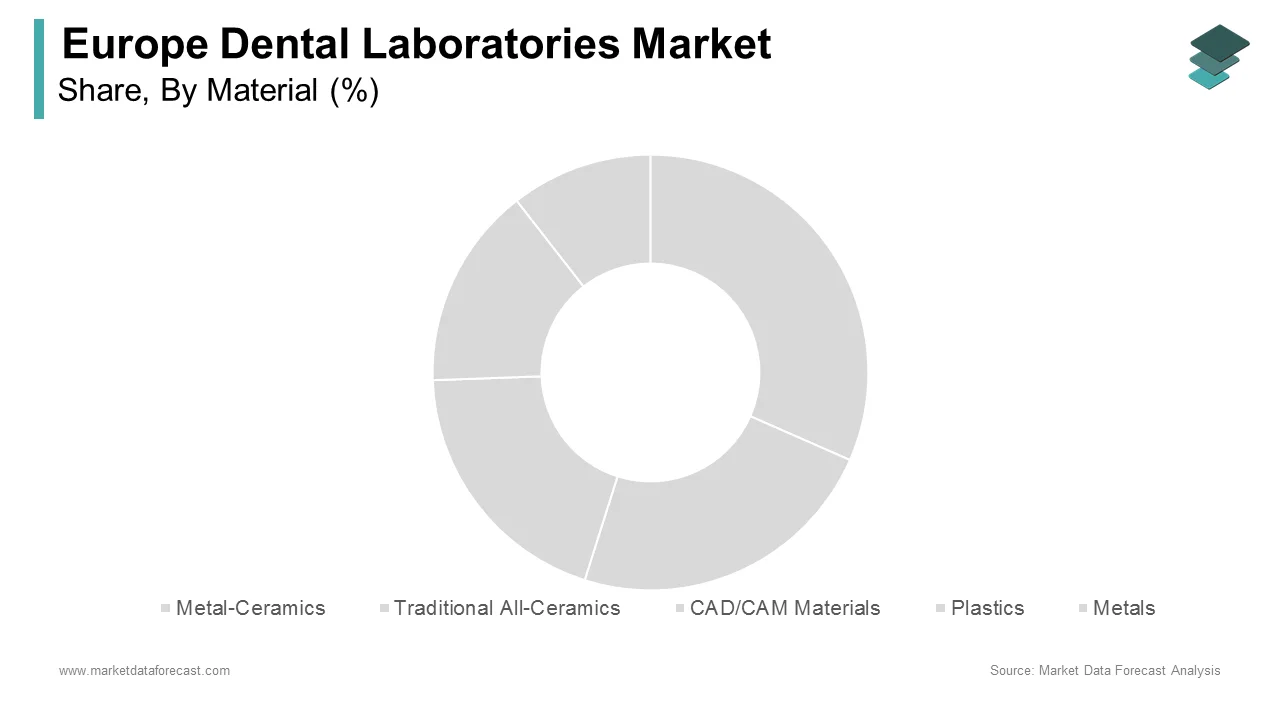
In 2024, the CAD/CAM materials segment dominated the market by accounting for 32.3% of the regional market share. The dominance of the CAD/CAM materials segment is majorly attributed to their integration into digital workflows, superior mechanical properties, and compatibility with high-precision restorations. Clinical Preference for Monolithic Zirconia in posterior restorations is further boosting the expansion of the segment in the European market. Monolithic zirconia is a primary CAD/CAM material and has become the material of choice for posterior crowns and bridges due to its fracture resistance and biocompatibility. As per the European Federation of Periodontology, over 65 percent of implant-supported single crowns placed in Germany and Switzerland in 2023 used zirconia-based CAD/CAM blocks. According to a multicenter clinical study published in the Journal of Dentistry in 2023, a 97.2% five-year survival rate is reported for monolithic zirconia crowns, which is significantly higher than layered ceramics. This clinical reliability drives laboratories to stock zirconia blanks despite their higher cost. Additionally, the European Commission’s Medical Devices Coordination Group listed zirconia as a preferred biomaterial under its 2022 guidance on implantable devices, reinforcing its adoption. The convergence of clinical evidence, regulatory endorsement, and digital compatibility is majorly driving the growth of the CAD/CAM materials segment in the European market.
By Equipment Insights
The integrated CAD/CAM systems segment captured 29.9% of the European market share in 2024. Consolidation of design and production in single platforms is majorly driving the domination of the integrated CAD/CAM systems segment in the European market. Integrated CAD/CAM systems combine scanning, design, and milling in a unified workflow and minimize data transfer errors and reducing technician training time. Laboratories using integrated systems report fewer remakes compared to those using modular setups. This reliability is critical in high-volume environments. In France, a substantial share of laboratories processing over 500 cases monthly operate integrated units. Manufacturers like Dentsply Sirona and Amann Girrbach have tailored their European offerings to support multilingual interfaces and EU-specific material libraries, which are enhancing usability. The operational efficiency and error reduction offered by integration make these systems the default choice for modern labs seeking throughput and consistency.
The 3D printing systems segment is projected to exhibit a CAGR of 18.8% over the forecast period in the European dental laboratories market, owing to the cost-effective production of temporary and orthodontic devices. Resin-based 3D printing enables laboratories to produce surgical guides, temporary crowns, and denture bases at a fraction of traditional costs. Laboratories using 3D printing for surgical guides report lower per-unit costs compared to outsourcing. In 2023, many clear aligner models were 3D printed in Europe, which reflects a significant year-on-year increase in the adoption of this technology. The 3d printing systems can print a full arch model in under 30 minutes, and this allows same-day turnaround and meets rising patient expectations. This economic and temporal advantage is particularly compelling for small labs lacking milling capacity, which is significantly contributing to the growth of the 3D printing systems segment in the European market.
By Prosthetic Type Insights
The crowns segment accounted for the dominating share of 28.1% of the European market in 2024, owing to the high prevalence of tooth decay and restoration needs. Dental caries remains a very common chronic oral disease in Europe and affects a substantial portion of adults. This widespread decay necessitates single tooth restorations is making crowns the most frequently prescribed prosthetic. In Germany alone, statutory health insurers reimburse a large volume of crown procedures annually. The durability of modern crowns, particularly zirconia-based, ensures long-term clinical utility, which reinforces their prescription. Additionally, the aging population’s retention of natural teeth longer than previous generations increases demand for crown coverage over extraction, which is further contributing to the domination of the crown segment in the European dental laboratories market.
The clear aligners segment is expected to register the highest CAGR of 18.8% over the forecast period in the European dental laboratories market due to the rising aesthetic demand among adults. Adult orthodontic treatment has surged, with a large share of new orthodontic patients in Europe being aged 25 or older. Clear aligners offer discreet correction and align with aesthetic preferences that traditional braces cannot satisfy. According to the British Orthodontic Society, private orthodontic practices reported a substantial year-on-year increase in aligner starts in the United Kingdom. Social media influence and employer-sponsored dental plans covering cosmetic treatments further accelerate adoption, particularly in urban centers. Additionally, the integration with intraoral scanning and cloud-based treatment planning is boosting the expansion of the clear aligners segment in the European market. The digital ecosystem surrounding clear aligners streamlines laboratory involvement. Clinicians capture scans that are directly transmitted to labs or manufacturers via cloud platforms, which eliminates physical models. According to the company’s fiscal 2023 results of Aligntech, approximately 92.7% of its cases in the Americas in the fourth quarter originated from digital scans, and international scans reached 88.1%. This efficiency enables even small laboratories to participate in the value chain through model printing or refinement services. The seamless digital pipeline transforms aligner production into a scalable, low-friction workflow, which is driving the exponential growth of the clear aligners segment in the European market.
COUNTRY LEVEL ANALYSIS
Germany Dental Laboratories Market Analysis
Germany held the leading position in the Europe dental laboratories market with 22.9% of the regional market share in 2024. The dominating position of Germany in the European market is driven by its dense network of highly regulated, technologically advanced laboratories and a robust public dental care system. According to the Federal Statistical Office of Germany, Germany hosts over 3,100 registered dental labs, the highest in Europe. Statutory health insurance covers basic prosthetics for a large majority of the population, which ensures consistent case volume. According to a cross-sectional study (2022–2024), CAD/CAM systems were in use by about 55 % of digitised general dental practices in Germany and Switzerland. According to the Association of German Dental Technicians (VDZI) and industry market data, Germany’s dual education system produces thousands of qualified dental technicians annually, which further helps to mitigate workforce shortages seen elsewhere.
France Dental Laboratories Market Analysis
France is another major market for dental laboratories and accounted for a substantial share of the European market in 2024. The hybrid public-private delivery model of France and a strong emphasis on aesthetic dentistry are majorly propelling the growth of the French market. According to national reimbursement tables, the French statutory health insurance pays about 70 % of the official tariff for a crown. According to the IGAS, around 93 % of the French population has complementary health insurance. Paris hosts a substantial cluster of dental labs specialising in premium ceramics and veneers.
Italy Dental Laboratories Market Analysis
Italy is likely to exhibit a promising CAGR in the European dental laboratories market over the forecast period, owing to a high density of small, family-run laboratories and strong regional manufacturing clusters in Lombardy and Tuscany. Italy has about 2,691 active dental laboratories. According to a 2021 industry survey, about 44% of Italian dental labs are made up of just one technician, and 31% have two technicians. The Italian Ministry of Health’s 2023 reform introduced partial reimbursement for implant-supported prosthetics, boosting crown and bridge volumes. Price controls remain stringent, and the national tariff for a metal-ceramic crown is around €120, which is limiting margins. The craftsmanship reputation of Italy and proximity to raw material suppliers in Switzerland and Germany support its enduring relevance in the premium segment.
United Kingdom Dental Laboratories Market Analysis
The United Kingdom is anticipated to account for a considerable share of the European market over the forecast period due to the growing private dental expenditure. The National Health Service covers only basic dentures and extractions, which results in a substantial portion of prosthetic dental work being handled in the private sector, and this dynamic fosters innovation. UK laboratories are increasingly active in clear-aligner model production and are positioned among Europe’s leading providers in this field. The MHRA’s streamlined approval processes for digital devices have helped accelerate the adoption of 3D printing technology across UK dental laboratories. Despite workforce challenges post-Brexit, the UK’s entrepreneurial lab culture and focus on digital orthodontics sustain its competitive standing.
Spain Dental Laboratories Market Analysis
Spain is estimated to grow at a healthy CAGR in the European market over the forecast period, owing to the recovery from austerity-driven dental care cuts and a resurgence in public investment. Spain’s Ministry of Health reintroduced partial prosthetic reimbursement around 2022 for older citizens, which directly increased denture and crown demand. According to the reports of the Spanish Dental Council, a significant rise in laboratory case volume was seen in 2023, which is the highest in Southern Europe. Spain also benefits from medical tourism; the dental tourism segment has seen large numbers of visitors for implant and aesthetic work, according to the Spanish Association of Dental Tourism. Laboratories in Barcelona and Madrid have responded with ISO-certified digital workflows to meet international standards. This combination of domestic policy reversal and cross-border demand positions Spain as a high-growth market within the top five.
COMPETITIVE LANDSCAPE
The Europe Dental Laboratories Market features a highly fragmented landscape with thousands of small independent laboratories coexisting alongside a few multinational corporations that dominate the digital and materials segments. Competition is intensifying as large players leverage economies of scale, regulatory expertise, and digital ecosystems to consolidate market influence. Independent labs compete on craftsmanship and local relationships but face pressure from centralized production hubs offering lower costs and faster turnaround. Technological capability has become the primary differentiator, with laboratories lacking digital infrastructure struggling to retain clients. Regulatory compliance under EU MDR further raises barriers to entry, favoring established entities with quality management systems. Meanwhile, material and equipment manufacturers increasingly bypass traditional distributors by offering direct workflow solutions, reshaping competitive dynamics across the value chain.
KEY MARKET PLAYERS
Some of the companies that are playing a dominating role in the Europe dental laboratories market include
- Dentsply Sirona Inc.
- Straumann Group
- Ivoclar Vivadent AG
- Zimmer Biomet Holdings, Inc.
- Henry Schein, Inc.
TOP PLAYERS IN THE EUROPE DENTAL LABORATORIES MARKET
- Straumann Group is a leading global provider of dental implants and digital prosthetic solutions with a strong footprint across Europe. The company integrates materials science, digital dentistry, and laboratory services through its Cares and Neodent ecosystems. In recent years, Straumann has expanded its centralized digital laboratory network in Germany and Switzerland, enabling same-day restorations for clinicians across the EU. It has also invested heavily in AI-driven design software and sustainable zirconia production. These initiatives reinforce its role as a vertically integrated partner for dental laboratories seeking end-to-end digital workflows and biomaterial innovation without reliance on third-party suppliers.
- Dentsply Sirona plays a pivotal role in shaping digital dental laboratory infrastructure in Europe through its comprehensive CAD/CAM portfolio. The company offers integrated systems such as CEREC and inLab, alongside a wide range of ceramics and resins tailored for European regulatory standards. Recently, Dentsply Sirona launched cloud-based collaboration platforms that connect dental practices directly with laboratories, streamlining case submission and approval. It has also partnered with vocational training institutes in France and the Netherlands to certify technicians on its digital workflows. These actions enhance ecosystem lock-in and ensure long-term adoption of its equipment and consumables across independent and corporate laboratories.
- Ivoclar is a globally recognized developer of dental materials with deep integration into European dental laboratories through its high-performance ceramics, resins, and processing equipment. The company supplies materials compatible with all major CAD/CAM systems and maintains application centers in 18 European countries for technician training. In 2023 and 2024, Ivoclar accelerated its sustainability agenda by introducing biosourced resins and recyclable packaging aligned with EU Green Deal objectives. It also expanded its digital shade-matching technology to reduce remakes. These innovations position Ivoclar as a materials science leader that supports both analog craftsmanship and digital precision across the continent.
TOP STRATEGIES USED BY THE KEY MARKET PARTICIPANTS
Key players in the Europe Dental Laboratories Market employ vertical integration to control the entire value chain from material production to digital design and manufacturing. They invest heavily in research and development to launch biomaterials compliant with the European Union Medical Device Regulation. Strategic partnerships with dental schools and technician associations ensure workforce readiness for new technologies. Companies also establish centralized digital laboratories to serve multiple countries efficiently. Additionally, they prioritize sustainability by developing eco-friendly materials and closed-loop recycling systems to align with EU environmental policies and gain a competitive advantage in public procurement.
EUROPE DENTAL LABORATORIES MARKET NEWS
- In March 2024, Straumann Group inaugurated a new digital dental laboratory in Berlin, Germany, to serve Central and Eastern Europe with AI-assisted prosthetic design and same-day zirconia milling capabilities. This expansion enhances its pan-European service network and reinforces its integrated digital dentistry strategy.
- In January 2024, Dentsply Sirona launched the CEREC Omnicam Connect platform, enabling real-time collaboration between dental clinics and laboratories across the European Union. This cloud-based solution reduces case turnaround time and strengthens its ecosystem dominance.
- In November 2023, Ivoclar introduced its new line of biosourced dental resins certified under ISO 14001 and compliant with the European Chemicals Agency restrictions. This move aligns with EU sustainability mandates and appeals to environmentally conscious laboratories.
- In September 2023, Straumann Group partnered with the German Dental Technicians Association to launch a certification program for digital prosthetic design. This initiative builds workforce capacity and deepens its integration into Europe’s technical education infrastructure.
- In May 2024, Dentsply Sirona acquired a minority stake in a Dutch 3D printing material startup specializing in biocompatible photopolymers for permanent dental restorations. This investment accelerates its entry into next-generation additive manufacturing for European laboratories.
MARKET SEGMENTATION
This research report on the Europe dental laboratories market has been segmented and sub-segmented into the following categories.
By Material
- Metal-Ceramics
- Traditional All-Ceramics
- CAD/CAM Materials
- Plastics
- Metals
By Equipment
- 3D Printing Systems
- Integrated CAD/CAM Systems
- Casting Machines
- Milling Equipment
- Furnaces
- Articulators
- Dental Scanners
- Others
By Prosthetic Type
- Bridges
- Crowns
- Veneers
- Dentures
- Clear Aligners
By Country
- UK
- France
- Spain
- Germany
- Italy
- Russia
- Sweden
- Denmark
- Switzerland
- Netherlands
- Turkey
- Czech Republic
- Rest of Europe