- Product Description Description
- Table of Contents TOC
- List of Table & Figure LOT
- Get Free Sample PDF Sample PDF
Market Size, 2025
$19.83 BnMarket Estimate, 2026
$21.19 BnMarket Forecast, 2034
$35.98 BnCAGR, 2026–2034
6.84%Europe Edible Mushroom Market Size
The Europe edible mushroom market size was valued at USD 19.83 billion in 2025, and the market size is expected to reach USD 35.98 billion by 2034 from USD 21.19 billion in 2026. The market is expected to grow at a CAGR of 6.84%.
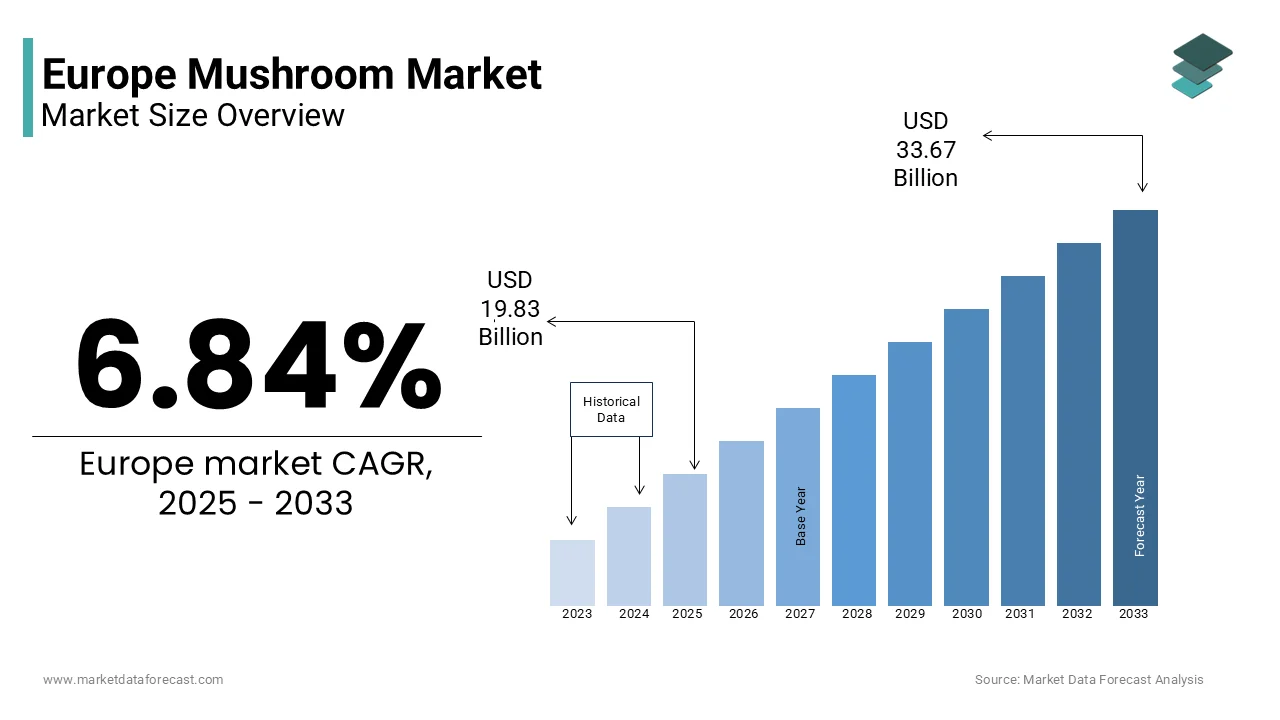
Edible mushroom are fungi species deemed safe and nutritious for human consumption, including Agaricus bisporus (white button mushroom), Pleurotus ostreatus (oyster mushroom), and Lentinula edodes (shiitake). It is known for a growing integration into mainstream culinary practices and health-centric diets. Edible mushrooms in Europe are cultivated both conventionally and through advanced agro-technological methods such as controlled-environment agriculture. As per study, notable tonnes of mushrooms were reported as harvested across EU member states. According to research, in Europe, many wild fungal species foraged annually, emphasizing the cultural and gastronomic significance of mushrooms.
MARKET DRIVERS
Mushrooms Lead Europe’s Shift to Plant-Based Protein
The surging consumer inclination toward plant-based and protein-rich diets, a response to rising health consciousness and dietary diversification that propels the growth of Europe edible mushroom market. Like, Europeans are turning to alternative protein sources, and mushrooms offer a low-fat, fiber-rich, and selenium-abundant option because of the increasing awareness of chronic diseases linked to high meat consumption. According to the study, a portion of EU citizens consider protein content an important factor in food selection, with a share actively increasing intake of plant-based proteins. Apart from these, as per the research, retail sales of plant-forward products grew, with mushrooms increasingly incorporated into meat analogs, which strengthens their role in clean-label nutrition strategies across Germany, Sweden, and the Netherlands.
Europe Taps Mushrooms for Nutraceutical Innovations
The integration into functional foods and nutraceuticals due to their bioactive compounds, such as beta-glucans and ergothioneine is enhancing the growth of Europe edible mushroom market. These bioactive compounds exhibit immunomodulatory and antioxidant properties. Scientific validation of these health benefits has driven product innovation across the European food and supplement industry. As per a study, daily consumption of shiitake mushrooms was associated with a reduction in C-reactive protein levels, a marker of systemic inflammation. Furthermore, the European Medicines Agency has recognized medicinal mushroom extracts, particularly from Ganoderma lucidum and Cordyceps militaris, in traditional herbal formulations. There has been an increase in sales of mushroom-based dietary supplements.
MARKET RESTRAINTS
Labor Shortages Slow Growth of Europe Mushroom Market
The high dependency on labor-intensive cultivation processes in small and medium-sized farms across Eastern and Southern Europe, hampers the growth of Europe edible mushroom market. Mushroom farming requires precise environmental control, manual harvesting, and sterile substrate preparation, all of which demand skilled labor and continuous oversight. According to the study, the agricultural workforce in the EU declined, with a pronounced shortage in specialized agri-technicians capable of managing modern mushroom facilities. In Poland, which accounts for a portion of EU mushroom production, farm operators reported a increase in labor costs due to worker scarcity, as per research. This labor deficit limits scalability and increases production costs, which deters investment in new facilities and constraining output despite rising demand.
Energy Costs and Climate Risks Challenge EU Mushroom Farms
The susceptibility of mushroom cultivation to climate variability and energy price fluctuations, particularly due to the sector’s reliance on climate-controlled growing environments, restricts the growth of Europe edible mushroom market. Mushroom farms require stable temperatures (14–18°C), high humidity (85–95%), and continuous ventilation, all of which are energy-intensive. During the 2022 European energy crisis, electricity prices surged per MWh across Europe, leading to production cuts in some sectors. Belgian mushroom farms, like other growers in the EU, faced enormous pressure from unaffordable energy and input costs, which created huge uncertainty and made cultivation significantly more challenging.
MARKET OPPORTUNITIES
Vertical Farming Spurs Growth in Europe Mushroom Market
The advancement of vertical farming and controlled environment agriculture (CEA) technologies, enabling year-round and localized mushroom production with reduced environmental footprint, are setting up new opportunities for the growth of Europe edible mushrooms market. Urban farming startups in cities are deploying modular, AI-driven growing systems that optimize yield per square meter while minimizing water and substrate waste. According to the research, many vertical farms dedicated to fungi cultivation are operational across Europe, collectively producing notable tonnes annually. These facilities achieve lower water usage than traditional farms, as per the study.
Valorizing Farm By-Products Fuels EU Mushroom Market
The valorization of agricultural by-products as mushroom cultivation substrates, aligning with the EU’s circular economy objectives, is also leveraging the growth of Europe edible mushroom market. Species like Pleurotus can grow on lignocellulosic waste such as straw, corn cobs, and coffee grounds, transforming low-value residues into high-nutrient food. As per the study, millions of tonnes of agricultural waste are generated annually in the EU, with less share currently repurposed. Hence, Integrating mushroom cultivation into waste valorization chains offers scalable environmental and economic benefits as the European Commission mandates a 65% municipal waste recycling rate by 2035 under the Circular Economy Action Plan.
MARKET CHALLENGES
Regulatory Gaps Slow Growth of Novel Mushroom Varieties
The lack of harmonized regulatory standards for novel mushroom varieties and functional claims is restricting the growth of Europe edible mushroom market. This absence creates uncertainty for producers and hindering cross-border trade. Traditional species like Agaricus bisporus are well-regulated. On the other hand, newer cultivars and mycelium-based products often fall into legal gray areas under the EU Novel Foods Regulation. As per the study, many novel mushroom-based dossiers were submitted, with only few approved, causing delays in market entry. The European Committee of Home and Herbal Medicinal Products has called for updated guidelines, which emphasizes that inconsistent national interpretations, such as Germany requiring full toxicological dossiers while the Netherlands adopts a risk-based approach.
Consumer Confusion Over Mushroom Safety Limits Growth
Consumer confusion and misinformation regarding mushroom safety between cultivated edible species and toxic wild varieties is also hindering the growth of Europe edible mushroom market. Accidental poisonings from misidentification persist despite educational campaigns, which influences public perception and retail hesitancy. As per the study, many cases of mushroom poisoning were reported across EU countries, with Amanita phalloides responsible a portion of fatalities. In Spain, emergency room visits due to foraging errors increased, according to the Spanish Society of Emergency Medicine. This has led major retailers like Carrefour and Tesco to restrict wild mushroom sales, limiting market diversity.
REPORT COVERAGE
| REPORT METRIC | DETAILS |
| Market Size Available | 2025 to 2034 |
| Base Year | 2025 |
| Forecast Period | 2026 to 2034 |
| CAGR | 6.84% |
| Segments Covered | By Type, Application, and Region |
| Various Analyses Covered | Global, Regional, & Country Level Analysis; Segment-Level Analysis; DROC; PESTLE Analysis; Porter’s Five Forces Analysis; Competitive Landscape; Analyst Overview of Investment Opportunities |
| Regions Covered | UK, France, Spain, Germany, Italy, Russia, Sweden, Denmark, Switzerland, Netherlands, Turkey, Czech Republic, Rest of Europe |
| Market Leaders Profiled | Costa Group, Okechamp S.A., Monterey Mushrooms Inc., Monaghan Mushrooms, Drinkwater’s Mushroom Ltd., The Mushroom Company, Shanghai Finc Bio-Tech Inc., CMP Mushrooms Greenyard NV (Lutèce), and Bonduelle SA, and others. |
SEGMENTAL ANALYSIS
By Type Insights
The button mushrooms (Agaricus bisporus) segment dominated the Europe edible mushroom market by capturing 62.5% of the regional market share in 2025. The growth of the button mushrooms segment is driven by their high yield efficiency and short cultivation cycle, which allows producers to harvest up to six flushes within days from a single substrate block. The species’ adaptability to industrial-scale farming and its widespread culinary acceptance across European cuisines is also driving the growth of this segment. This productivity, coupled with established infrastructure for automated spawning, casing, and harvesting, ensures consistent supply and cost-effective pricing. This strengthens its status as the backbone of Europe edible mushroom market. Their deep integration into retail and foodservice supply chains also drives the growth of this segment. Supermarkets stock button mushrooms as a staple fresh produce item. The mushroom’s neutral flavor, firm texture, and long shelf life make it ideal for pre-packaged salads, ready-to-cook meals, and institutional catering.
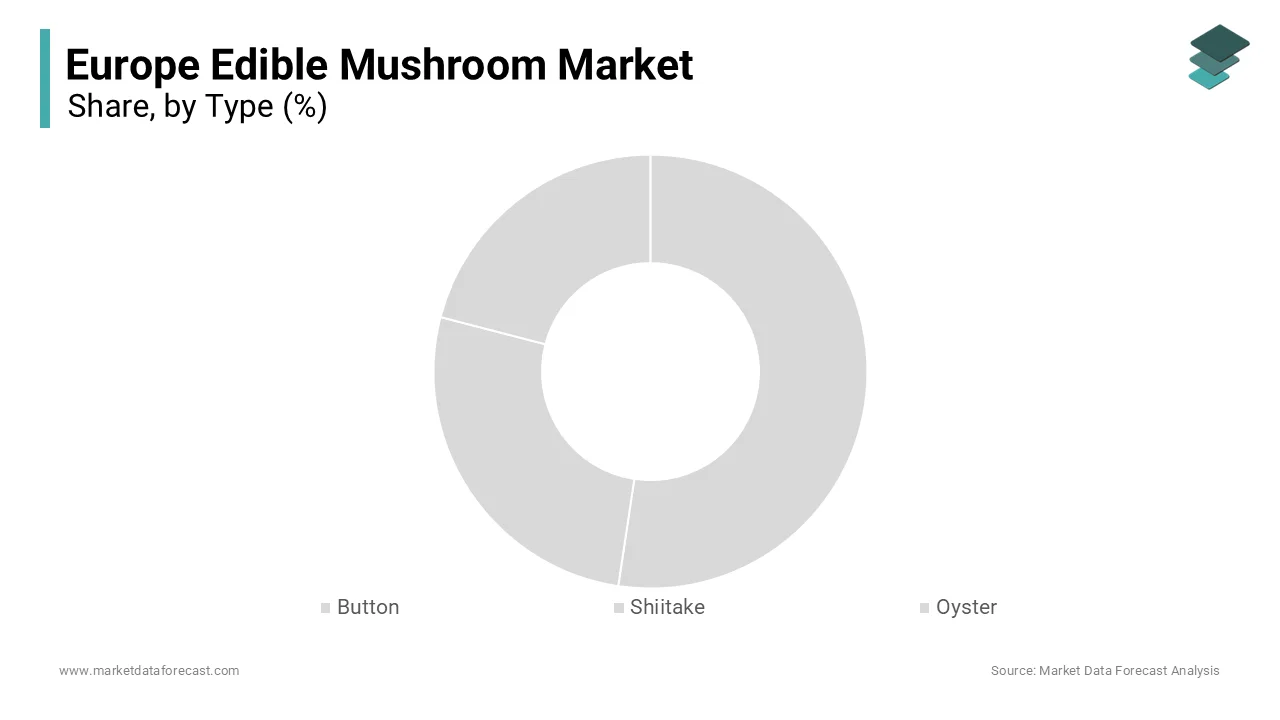
The oyster mushroom (Pleurotus spp.) segment is estimated to register the fastest CAGR of 12.8% between 2026 and 2034 due to the rising demand for sustainable and alternative protein sources, particularly among environmentally conscious urban consumers. Oyster mushrooms stand out due to their ability to grow on agricultural waste substrates such as straw, cotton hulls, and coffee grounds, aligning with circular economy principles. As per a study, oyster mushroom cultivation can utilize a portion of lignocellulosic by-products from cereal and coffee industries, which reducing landfill burden and generating value from waste streams. Its growing presence in functional foods and gourmet culinary applications also drives the growth of this segment. Rich in ergothioneine, beta-glucans, and essential amino acids, oyster mushrooms are increasingly marketed as health-enhancing ingredients.
By Application Insights
The fresh mushrooms segment led the Europe edible mushroom market by capturing substantial share in 2025. The growth of the fresh mushrooms segment is attributable to consumer preference for minimally processed, natural foods, a trend amplified by increasing health awareness and clean-label movements. Fresh mushrooms are perceived as a wholesome, low-calorie ingredient rich in vitamins B and D, selenium, and antioxidants. According to the research, a portion of European consumers rank freshness as the most important factor when purchasing produce, which directly benefiting the fresh mushroom segment. Apart from these, the extended shelf life of modern packaging has improved supply chain reliability by enabling wider distribution and reduced spoilage. Its integration into daily dietary habits and culinary traditions across Europe is a further driver of the fresh segment.
The processed mushrooms segment is estimated to register the fastest CAGR of 10.4% from 2026 to 2034 owing to the rising incorporation of mushroom derivatives into convenience and functional food products. Dried, canned, powdered, and extract-based mushroom ingredients are increasingly used in soups, sauces, plant-based meats, and dietary supplements. According to the study, sales of mushroom powders and extracts in the nutraceutical sector rose, with Germany and Switzerland leading in product innovation. Companies have developed standardized beta-glucan extracts from shiitake and oyster mushrooms for immune-support supplements. The expansion of the plant-based meat industry, which relies heavily on mushroom proteins for texture and umami flavour also drives the growth of this segment. Moreover, processed mushrooms offer logistical advantages, longer shelf life, reduced weight, and ease of transport, which makes them ideal for export. This export potential and industrial scalability positions processed mushrooms as a high-growth vector within the broader market.
COMPETITIVE LANDSCAPE
The competitive landscape of the Europe edible mushroom market is characterized by a mix of large-scale industrial producers, regional specialty growers, and emerging agri-tech startups. Incumbent companies leverage automation, logistics networks, and brand recognition to maintain dominance, particularly in the fresh mushroom segment. At the same time, smaller producers are gaining traction by focusing on organic certification, gourmet varieties, and local distribution, appealing to niche markets. The rise of vertical farming ventures in urban centers introduces disruptive models that challenge traditional supply chains. Intense competition is also driven by price sensitivity in retail channels and the need for continuous innovation in packaging and sustainability. Regulatory compliance, energy efficiency, and consumer education further differentiate players, which creates a dynamic environment where technological advancement and environmental stewardship are key competitive levers.
KEY MARKET PLAYERS
Some of the notable companies in the Europe edible mushroom market are
- Costa Group
- Okechamp S.A.
- Monterey Mushrooms Inc.
- Monaghan Mushrooms
- Drinkwater’s Mushroom Ltd.
- The Mushroom Company
- Shanghai Finc Bio-Tech Inc.
- CMP Mushrooms
- Greenyard NV (Lutèce)
- Bonduelle SA
TOP STRATEGIES USED BY KEY MARKET PLAYERS
Key players in the Europe edible mushroom market are deploying vertical integration, technological automation, sustainability initiatives, product diversification, and strategic partnerships to consolidate their positions. Vertical integration enables control over substrate production, cultivation, packaging, and distribution, reducing costs and ensuring quality. Automation, including AI-driven climate control and robotic harvesting that enhances yield precision and offsets labor shortages. Sustainability strategies such as biogas utilization, water recycling, and spent compost valorization align with EU Green Deal objectives and improve brand equity. Product diversification into ready-to-cook, dried, and nutraceutical formats caters to evolving consumer demands.
TOP PLAYERS IN THE MARKET
- Branston is a leading vertically integrated mushroom producer in Europe by operating one of the largest and most technologically advanced growing facilities in the UK. The company has strengthened its position by investing in automated harvesting systems and climate-controlled tunnels to enhance yield consistency and reduce labor dependency. The company has also expanded its retail partnerships with major supermarkets, supplying fresh and packaged mushrooms under private labels.
- The Mushroom Group operates as a key consolidator of mushroom production and distribution networks across Northwestern Europe. The company has developed a centralized logistics model that enables rapid delivery of fresh mushrooms to many countries, which ensures product freshness and minimizing waste. The initiatives have enhanced operational efficiency and sustainability, which positions the company as a benchmark for scalable, eco-conscious mushroom farming in Europe.
- Champignon du Périgord is a major French producer specializing in both conventional and gourmet mushroom varieties, including shiitake and oyster mushrooms. The company has carved a niche in the premium segment by focusing on artisanal cultivation methods combined with modern food safety protocols. The company also expanded its export operations into Scandinavia and Eastern Europe by leveraging France’s reputation for high-quality agri-food products.
MARKET SEGMENTATION
This research report on Europe edible mushroom market has segmented and sub-segmented into the following categories.
By Type
- Button
- Shiitake
- Oyster
By Application
- Fresh Mushrooms
- Processed Mushrooms
- Dried
- Frozen
- Canned
By Country
- UK
- Germany
- Spain
- France
- Italy
- Russia
- Sweden
- Denmark
- Switzerland
- Netherlands
- Turkey
- Czech Republic
- Rest of Europe