- Product Description Description
- Table of Contents TOC
- List of Table & Figure LOT
- Get Free Sample PDF Sample PDF
Market Size, 2025
$8.93 BnMarket Estimate, 2026
$9.21 BnMarket Forecast, 2034
$11.74 BnCAGR, 2026–2034
3.08%Europe Egg Processing Market Size, Growth, Trends & Forecast (2026–2034)
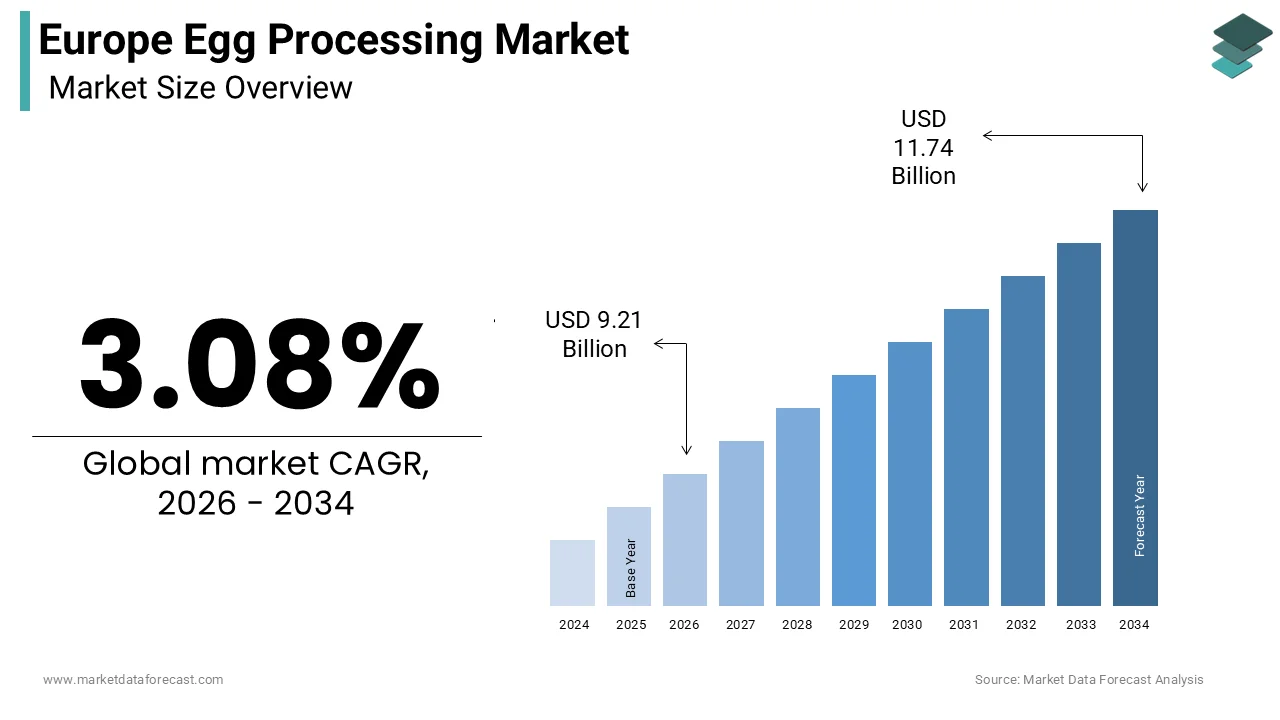
The Europe egg processing market size was calculated to be USD 8.93 billion in 2025, is anticipated to be worth USD 9.21 billion in 2026, and is projected to reach USD 11.74 billion by 2034, registering a compound annual growth rate (CAGR) of 3.08% during the forecast period from 2026 to 2034. Driven by the rising demand for convenience foods, high-protein dietary shifts, and strict food safety compliance across industrial baking and foodservice sectors, the European egg ingredient sector continues to expand steadily.
Key Executive Metrics (At-a-Glance)
- 2025 Base Valuation: USD 8.93 Billion
- 2026 Current Valuation: USD 9.21 Billion
- 2034 Forecast Valuation: USD 11.74 Billion
- Compound Annual Growth Rate (CAGR): 3.08% (2026–2034)
- Dominant Type Segment: Liquid Egg Products (holding a 58.2% share in 2024 backed by automated plant integration and pasteurization efficiency)
- Fastest-Growing Type Segment: Dried Egg Products (projected at a 6.2% CAGR driven by shelf-stable military, emergency, and e-commerce meal kits)
- Dominant Application Segment: Bakery (capturing a 41.2% market share in 2024 anchored by mass-scale commercial bread, pastry, and cake production)
- Fastest-Growing Application: Ready-to-Eat (RTE) Products (expanding at a 7.1% CAGR propelled by convenience foods, chilled meal aisles, and urbanization)
- Dominant Region / Country: Germany (top market performer accounting for 22.1% share in 2025 supported by industrial food manufacturing and Tierwohl regulations)
Core Market Drivers
- Convenience & Protein Demand: Heightened fitness and wellness trends driving liquid and powdered egg usage in ready-to-eat meals and protein formulations.
- Foodservice & Industrial Recovery: Post-pandemic rebound in restaurant turnover and massive B2B bulk procurement for baking and catering uniformity.
Primary Market Restraints & Challenges
- Animal Welfare Compliance: Strict cage-ban mandates (Directive 1999/74/EC) raising per-unit production costs by 18–25% and causing supply volatility.
- Avian Influenza Outbreaks: Recurrent H5N1 episodes triggering flock depopulations, regional supply dips, and biosecurity capital outlays.
Europe Egg Processing Market Segmentation Breakdown
| Segment Category | Largest (Dominant) Sub-Segment | Fastest-Growing Sub-Segment |
|---|---|---|
| By Type | Liquid (58.2% share in 2024 driven by pasteurization standards, high functional versatility, and automated line flow) | Dry Products (Fastest-growing at a 6.2% CAGR driven by shelf-stability, spray-drying reconstitution, and logistics weight reduction) |
| By Application | Bakery (41.2% share in 2024 led by structural consistency, emulsification, and large-scale industrial bread/pastry manufacturing) | Ready-To-Eat (RTE) Products (Fastest-growing at a 7.1% CAGR propelled by convenience lifestyles and retail chilled meal growth) |
| By Region / Country | Germany (22.1% share in 2025 anchored by robust industrial food processing conglomerates and rigorous food safety standards) | United Kingdom / Netherlands (Dynamic markets advancing via sandwich/ready-meal demands and advanced trade hub infrastructures) |
Major Industry Players Profiled
Key enterprises shaping the competitive European egg processing market include Interovo Egg Group B.V., Noble Foods, Sanders International, Moba B.V., OVO Tech, Pelbo S.P.A., Gruppo Eurovo, Glon Group, Actini Group, Sanovo Technology Group, Igreca S.A., and Bouwhuis Enthovan.
Europe Egg Processing Market Size
The size of the Europe egg processing market was calculated to be USD 8.93 billion in 2025 and is anticipated to be worth USD 11.74 billion by 2034, from USD 9.21 billion in 2026, growing at a CAGR of 3.08% during the forecast period.
The egg processing is the industrial transformation of shell eggs into liquid, frozen, or dried formats for use across foodservice, retail, and industrial applications. This sector plays a pivotal role in ensuring consistent supply, extended shelf life, and microbiological safety of egg products while meeting evolving consumer and regulatory standards. As per Eurostat, the European Union produced approximately 7.4 million metric tons of eggs in 2023, with over 30% destined for further processing rather than direct retail sale. According to the European Commission’s Directorate General for Health and Food Safety, more than 150 EU-approved egg processing facilities operate under stringent hygiene regulations outlined in Regulation EC No 853/2004. The structure of poultry farming also influences processing volumes; as per the Food and Agriculture Organization, cage-free systems accounted for nearly 52% of the EU laying hen population by the end of 2023, altering raw material sourcing dynamics for processors. Consumer demand for convenience foods, coupled with food safety protocols post the 2017 fipronil contamination incident, has intensified reliance on pasteurized and standardized egg ingredients. Unlike whole egg markets, processed segments are less volatile to seasonal fluctuations and benefit from integration with bakery, confectionery, and ready meal industries, which collectively represent over 60% of downstream usage according to the European Federation of Manufacturers of Egg Products.
MARKET DRIVERS
Rising Demand for Convenience and Protein-Rich Foods Drives Processed Egg Consumption
The shifting dietary patterns toward high protein, low carbohydrate nutrition have significantly elevated demand for value-added egg products, driving the growth of the Europe egg processing market. Consumers increasingly seek time-efficient meal solutions without compromising nutritional integrity, positioning liquid and powdered eggs as ideal ingredients for ready-to-eat meals, protein bars, and functional beverages. The fitness and wellness trend further amplifies this demand, as per the International Health Racquet and Sportsclub Association, gym membership in Western Europe surpassed 65 million individuals in 2023, many of whom incorporate egg-based proteins into their diets. Food manufacturers respond by reformulating products to include clean-label egg ingredients, avoiding artificial additives. For instance, major bakery chains across Scandinavia now use pasteurized liquid whole egg in place of shell eggs to ensure consistency and reduce labor costs. Additionally, the European Commission’s Farm to Fork Strategy encourages reduced food waste, and processed eggs offer precise dosing that minimizes kitchen losses in commercial kitchens.
Expansion of Foodservice and Industrial Bakery Sectors Fuels Bulk Egg Ingredient Procurement
The institutional and industrial food sectors of processed egg products, driven by standardization needs and scalability requirements, are additionally propelling the growth of Europe egg processing market. Across Europe, the foodservice industry rebounded robustly post-pandemic, with Eurostat recording a 9.3% year on year increase in restaurant and catering turnover in 2023, reaching EUR 612 billion. Large-scale bakeries, pastry manufacturers, and ready meal producers rely heavily on liquid and dried egg products to maintain recipe fidelity, streamline production, and comply with food safety mandates. According to the European Bakery Association, industrial bakeries in Germany, Italy, and Poland collectively produce over 12 million tons of baked goods annually, with eggs featured in more than 70% of formulations ranging from brioche to meringues. Pasteurized egg products eliminate the risk of Salmonella Enteritidis, a concern given that the European Centre for Disease Prevention and Control documented 1,12,000 confirmed human salmonellosis cases in 2022, many linked to raw egg consumption. Furthermore, automation in food manufacturing favors pumpable or powder-based inputs, as per the European Association of Dairy, Food and Environmental Sanitation; over 65% of new food processing lines installed in 2023 were designed for liquid ingredient integration. This infrastructure alignment ensures sustained procurement of processed eggs, decoupling demand from household consumption trends and anchoring it firmly in B2B channels.
MARKET RESTRAINTS
Stringent Animal Welfare Regulations Increase Production Costs and Supply Volatility
The European Union’s progressive animal welfare legislation, particularly Directive 1999/74/EC and its national implementations, imposes significant operational constraints on egg producers, indirectly affecting processors through input cost inflation and supply unpredictability. The stringent animal welfare regulations increase production costs, and supply volatility is degrading the growth of Europe egg processing market. As of January 2024, conventional battery cages are fully banned, and enriched colony systems must meet minimum space allowances of 750 square centimeters per hen. According to the European Commission’s Animal Welfare Platform, compliance investments have raised per-unit production costs by 18 to 25% compared to pre-regulation levels. Countries like Germany and Austria have enacted even stricter rules, mandating outdoor access or organic certification, which further limits scalable egg supply. The European Food Safety Authority estimates that non-compliant farms accounted for nearly 12% of total EU layer flock capacity in 2023, leading to temporary shortages during transition periods. These disruptions ripple through the processing chain; when raw egg availability tightens, processors face bidding wars or must import from non-EU countries, which introduces logistical delays and quality variance. Moreover, welfare-driven labeling requirements, such as mandatory origin and housing system codes on packaging, complicate blending strategies for multi-source processors. While these regulations enhance ethical standards, they impose structural inefficiencies that elevate baseline costs and constrain the agility of egg ingredient manufacturers in responding to sudden demand surges.
Persistent Outbreaks of Avian Influenza Disrupt Raw Material Availability
Highly pathogenic avian influenza H5N1 remains a recurrent threat to Europe’s egg supply chain, causing massive flock depopulations and trade restrictions that directly impair the stability of the egg processing sector. The persistent outbreaks of Avian Influenza In 2023 alone, the World Organisation for Animal Health recorded many outbreaks in European poultry farms, resulting in the culling of more birds. France, Spain, and the Netherlands, three of the EU’s top five egg producing nation, were disproportionately affected, with regional production declines exceeding 20% in severely impacted zones. According to the European Centre for Disease Prevention and Control, movement controls and quarantine zones often halt egg collection for weeks, forcing processors to draw down inventories or suspend operations. Unlike shell egg markets that can partially absorb shocks through imports, processed egg facilities require consistent, large volume inputs to maintain economies of scale; interruptions degrade equipment utilization and increase per unit overhead. Furthermore, biosecurity upgrades mandated post-outbreak, such as air filtration systems and visitor protocols that add 10 to 15% to farm operating expenses, as noted by the European Poultry Industry Federation. These compounding pressures not only inflate procurement costs but also erode investor confidence in long-term supply contracts, thereby constraining capital allocation for processing capacity expansion despite growing end-user demand.
MARKET OPPORTUNITIES
Growing Adoption of Plant-Based Alternatives Creates Niche Innovation Pathways
While plant-based egg substitutes pose competitive pressure, they simultaneously open collaborative opportunities for traditional egg processors to develop hybrid or fortified products that bridge nutritional gaps in vegan formulations. This is a major factor anticipated to boost new opportunities for the growth of Europe egg processing market. According to the Good Food Institute Europe, sales of plant-based egg alternatives grew by 34% in 2023, yet consumer dissatisfaction with texture and protein completeness persists. A 2024 survey by Mintel revealed that 58% of flexitarian buyers still prefer real eggs for baking and binding. This insight has prompted several European egg processors to launch co-formulated ingredients, such as egg white blended with pea protein or chickpea flour, that deliver superior functionality while appealing to semi-vegetarian demographics. Additionally, clean label trends favor recognizable components, giving egg-derived lecithin or lysozyme an edge over synthetic stabilizers in plant-based dairy and meat analogues. As per the European Alternative Proteins Partnership, over 40% of alternative protein startups now list egg proteins as key co-ingredients in their R&D pipelines.
Expansion of Cold Chain Infrastructure Enables Geographic Market Penetration
The advancements in refrigerated logistics and cold storage capacity across Central and Eastern Europe are unlocking new distribution corridors for temperature-sensitive egg products, particularly in regions previously underserved due to infrastructure limitations. The expansion of cold chain infrastructure is significantly escalating the growth of Europe egg processing market. According to the European Logistics Association, refrigerated transport capacity in Poland, Romania, and Hungary grew by 12.5% annually between 2021 and 2023, supported by EU cohesion funds targeting food safety modernization. This expansion allows liquid and frozen egg processors based in Western Europe to reliably supply industrial customers in emerging markets where local processing capabilities remain underdeveloped. For instance, the Romanian foodservice sector expanded by 8.7% in 2023, as per the National Institute of Statistics, yet domestic egg processing meets less than 30% of commercial demand. Pasteurized liquid eggs, which require uninterrupted cold chains below 4 degrees Celsius, can now be transported over 1,500 kilometers with minimal quality degradation thanks to real-time temperature monitoring and insulated container innovations. The European Commission’s Horizon Europe program has also subsidized trials of phase change materials that extend thermal stability during the last mile delivery. These developments reduce spoilage rates, historically as high as 15% in peripheral EU regions, and enable processors to offer extended shelf life products without resorting to excessive preservatives.
MARKET CHALLENGES
Labor Shortages in Poultry Farming Constrain Raw Egg Supply Consistency
A chronic deficit of skilled agricultural labor is undermining the reliability of shell egg supply, thereby jeopardizing the operational continuity of downstream processing facilities. The labor shortage in poultry farming constrains the consistency of raw egg supply, which is one of the challenges for the growth of Europe egg processing market. According to Eurofound, the EU poultry sector faces a workforce gap of approximately 180,000 workers, with vacancy rates exceeding 25% in key producing countries such as the Netherlands and Belgium. This shortage stems from demographic aging, urban migration, and declining interest in manual farm work among younger generations. As per the European Social Survey, only 12% of Europeans aged 18 to 30 express a willingness to pursue careers in livestock farming. The labor scarcity forces farms to reduce flock sizes or delay maintenance cycles, directly impacting egg collection frequency and quality. Irregular supply streams disrupt the just-in-time production models favored by large processors, who require daily deliveries of uniform-grade eggs to maintain throughput efficiency. When farms cannot meet contractual volumes, processors must either idle production lines or source from distant regions at premium freight costs. The European Poultry Association estimates that labor-related supply volatility increased average procurement costs by 7 to 9% in 2023.
Consumer Mistrust Following Historical Food Safety Incidents Hinders Category Growth
The consumer awareness rooted in past contamination events continues to suppress broader adoption of processed egg products among health-conscious and elderly people, which is additionally impeding the growth of Europe egg processing market. The 2017 fipronil scandal, which led to the recall of millions of eggs across 15 EU countries after illegal pesticide use was detected in Dutch farms, left a lasting imprint on public perception. According to a 2023 European Consumer Organisation survey, 31% of respondents still express moderate to great concern about chemical residues in processed egg ingredients, even though the European Food Safety Authority confirms zero fipronil detections in commercial egg products since 2019. This mistrust manifests in purchasing behavior, where NielsenIQ data shows that households with members over 65 years old are 22% less likely to buy pre-cooked or liquid egg products compared to fresh shell eggs. Rebuilding confidence requires continuous transparency efforts, yet many processors lack direct consumer engagement channels, relying instead on B2B relationships. Unlike dairy or meat sectors that have leveraged blockchain traceability for brand storytelling, the egg processing industry has been slower to adopt such tools at scale. Consequently, even facilities operating under ISO 22000 and Global Food Safety Initiative certifications struggle to communicate their safety credentials effectively.
REPORT COVERAGE
| REPORT METRIC | DETAILS |
| Market Size Available | 2025 to 2034 |
| Base Year | 2025 |
| Forecast Period | 2026 to 2034 |
| CAGR | 3.08% |
| Segments Covered | By Type, Application, And Region |
| Various Analyses Covered | Global, Regional & Country Level Analysis; Segment-Level Analysis; DROC, PESTLE Analysis; Porter’s Five Forces Analysis; Competitive Landscape; Analyst Overview of Investment Opportunities |
| Regions Covered | UK, France, Spain, Germany, Italy, Russia, Sweden, Denmark, Switzerland, Netherlands, Turkey, and the Czech Republic |
| Market Leaders Profiled | Moba B.V, OVO Tech, Pelbo S.P.A, Gruppo Eurovo, Glon Group, Actini Group, Sanovo Technology Group, Interovo Egg Group B.V, Igreca S.A, and Bouwhuis Enthovan |
SEGMENTAL ANALYSIS
By Type Insights
The liquid egg products segment accounted in holding 58.2% of the Europe egg processing market share in 2024, owing to their widespread adoption in industrial food manufacturing due to functional versatility, ease of integration into automated production lines, and superior cost efficiency compared to dried or frozen alternatives. According to the European Federation of Manufacturers of Egg Products, over 70% of commercial bakeries and ready meal producers across Germany, France, and the Netherlands rely exclusively on pasteurized liquid whole egg or separated fractions for consistent emulsification and binding performance. The segment benefits from stringent EU food safety protocols that mandate pasteurization for all processed eggs, a process most efficiently applied to liquid formats before packaging. Additionally, cold chain logistics in Western Europe have matured significantly; as per the European Logistics Association, 92% of temperature-controlled transport routes now maintain uninterrupted refrigeration below 4 degrees Celsius, ensuring product integrity without the need for freezing or drying. This logistical reliability reduces spoilage and preserves sensory qualities by making liquid eggs the preferred choice for premium foodservice operators.
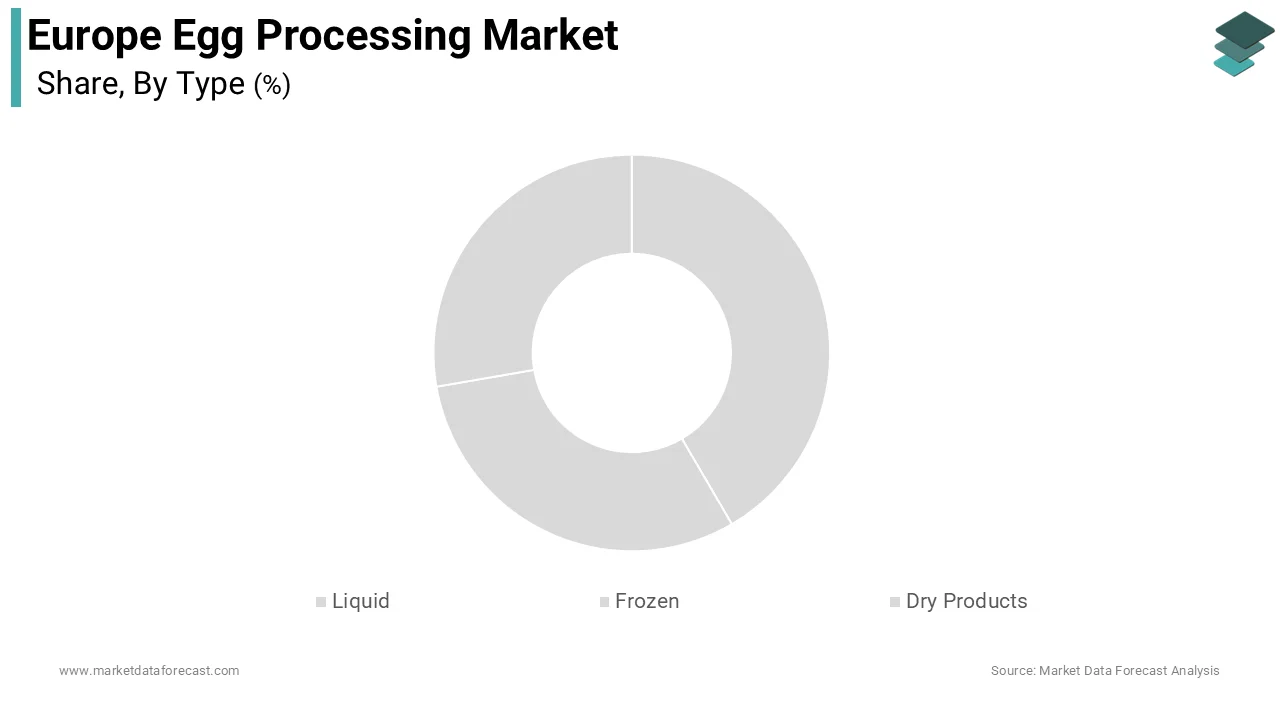
The dried egg products segment is projected to witness the fastest CAGR of 6.2% during the forecast period. This acceleration stems from rising demand in shelf-stable food formulations, particularly in military rations, camping meals, and export-oriented food manufacturing, where ambient storage is essential. According to the European Institute of Food Technology, dried egg powder consumption in the EU’s emergency food aid programs increased by 28% in 2023, driven by humanitarian needs in Eastern Europe and North Africa. Moreover, advancements in spray drying technology have significantly improved solubility and foaming capacity; modern dried egg whites now achieve 95% reconstitution efficiency, closing the performance gap with fresh equivalents. The segment also aligns with the European Commission’s Circular Economy Action Plan, as powdered formats reduce packaging weight and transportation emissions. Dried eggs require 60% less volume than liquid equivalents, lowering carbon footprint per ton delivered. With e-commerce meal kit providers like HelloFresh and Marley Spoon increasingly incorporating shelf-stable ingredients to extend delivery windows, dried egg powders are gaining traction in direct-to-consumer channels, a shift previously dominated by liquid formats.
By Application Insights
The bakery application segment accounted in holding 41.2% of the Europe egg processing market in 2024. Eggs serve irreplaceable functional roles in European baked goods, providing structure through protein coagulation, moisture retention via lecithin, and golden crust color through Maillard reactions. According to the European Bakery Association, industrial bakeries in the EU produce over 14 million tons of bread, pastries, and cakes annually, with enriched doughs, such as brioche, croissants, and sponge cakes requiring egg inclusion rates of 8 to 15% by weight. The consolidation of artisanal bakeries into centralized production facilities has amplified reliance on standardized liquid egg blends, which ensure batch consistency and reduce labor costs associated with shell cracking and separation. In Germany alone, over 85% of commercial bakeries transitioned to processed eggs by 2023, as reported by the German Federal Ministry of Food and Agriculture, citing hygiene compliance and waste reduction as key motivators. Furthermore, the EU’s clean label movement discourages synthetic emulsifiers like DATEM, pushing formulators toward natural alternatives such as egg yolk, which contains inherent phospholipids. This regulatory and consumer-driven shift reinforces eggs as a non-substitutable ingredient in mainstream European bakery production.
The ready-to-eat meals segment is expected to register the fastest CAGR of 7.1% throughout the forecast period. The growth of the segment is propelled by urbanization, dual-income households, and post-pandemic convenience preferences that prioritize time savings without sacrificing nutritional quality. According to Eurostat, 68% of European households now include at least one working adult, and average weekly cooking time has declined to 4.2 hours as of 2023. Major retailers like Tesco, Carrefour, and REWE have responded by expanding chilled meal aisles, with egg-based dishes such as frittatas, quiches, and breakfast bowls featuring prominently. Pasteurized liquid egg enables rapid assembly and consistent texture in these products while meeting strict Listeria and Salmonella controls mandated by Regulation EC No 2073/2005. The European Food Safety Authority notes that 94% of ready-to-eat meal recalls in 2022 were linked to microbial contamination, heightening manufacturer preference for pre-treated ingredients. Additionally, the rise of protein-focused meal kits, backed by a 22% year on year increase in subscription services as per the European Meal Kit Association, has elevated eggs as a clean, affordable protein source.
REGIONAL ANALYSIS
Germany Egg Processing Market Analysis
Germany was the top performer of the Europe egg processing market by capturing 22.1% of the share in 2025, with the presence of an industrialized food manufacturing base, rigorous food safety standards, and strong domestic demand for convenience foods. According to the German Poultry Association, the country houses over 42 million laying hens, with more than 60% operating under free range or organic systems compliant with national Tierwohl regulations. This large-scale production feeds a dense network of 35-EU certified egg processing plants, many integrated with major bakery and meat processing conglomerates, such as Dr Oetker and Tonnies. The German Federal Statistical Office reports that retail sales of ready-to-cook egg products grew by 14% in 2023, reflecting heightened consumer trust in pasteurized formats following nationwide Salmonella reduction campaigns. Furthermore, Germany’s engineering prowess supports advanced processing infrastructure; over 80% of liquid egg lines utilize inline pasteurization with real-time viscosity monitoring, ensuring product uniformity.
France Egg Processing Market Analysis
France was ranked second by occupying 18.2% of the Europe egg processing market share in 2024, owing to the culinary tradition heavily influencing demand, with eggs serving as foundational ingredients in classic preparations such as mayonnaise, custards, and soufflés that dominate both restaurant and industrial production. According to FranceAgriMer, the national agricultural agency, French food manufacturers consumed over 210,000 metric tons of processed eggs in 2023, with sauce and dressing producers representing the single largest user group. The French government’s “Programme National Nutrition Santé” promotes high-quality protein intake, indirectly supporting egg consumption among aging populations. Additionally, France hosts Europe’s highest concentration of organic egg farms, and organic laying hen flocks expanded by 9.3% in 2023, reaching 12.7 million birds, by enabling processors like Sanders and Les Trois Vallees to offer premium organic liquid egg lines. Strict enforcement of the 2022 anti-food waste law also incentivizes precise ingredient dosing, favoring processed over shell eggs in commercial kitchens. These cultural, regulatory, and supply chain factors collectively sustain France’s robust and diversified egg processing ecosystem.
United Kingdom Egg Processing Market Analysis
The United Kingdom egg processing market is expected to grow steadily at the fastest CAGR during the forecasted years. The UK’s dominance in the ready meal and sandwich sectors drives consistent demand for liquid egg products, with major retailers like Sainsbury’s and Marks & Spencer sourcing pasteurized egg exclusively for their private label offerings. According to the British Egg Industry Council, over 95% of UK laying hens are now housed in enriched colony or free-range systems, ensuring a steady supply of high-welfare eggs suitable for processing. Moreover, the UK’s strong bakery heritage, evidenced by annual cake and pastry production exceeding 1.2 million tons, fuels industrial reliance on standardized egg inputs, as per the study.
Netherlands Egg Processing Market Analysis
The Netherlands egg processing market growth is likely to grow with a logistics and export powerhouse rather than sheer domestic consumption. Dutch processors leverage the country’s strategic location and world-class port infrastructure to serve as a redistribution hub for Northern and Western Europe. According to Statistics Netherlands, the nation exported over 180 000 metric tons of processed egg products in 2023, primarily to Germany, Belgium, and Scandinavia. Companies like Kipster and WIMEX operate state-of-the-art facilities that combine animal welfare innovation, such as daylight-enriched barns with high-efficiency fractionation lines capable of separating 120,000 eggs per hour. The Dutch Ministry of Agriculture reports that 73% of domestically produced eggs are processed, the highest ratio in the EU, reflecting limited retail preference for shell eggs in institutional channels. Furthermore, the Netherlands leads in sustainable processing, as per Wageningen University, Dutch plants reduced water usage per kilogram of liquid egg by 22% between 2020 and 2023 through closed-loop recycling systems.
Italy Egg Processing Market Analysis
Italy's egg processing market growth is likely to grow with the strong demand from pasta and confectionery manufacturers, where eggs are indispensable for texture and richness. According to the Italian National Institute of Statistics, over 3.5 billion portions of fresh egg pasta are produced annually, requiring approximately 150 000 metric tons of liquid whole egg. Artisanal producers, particularly in Emilia Romagna, have increasingly adopted pasteurized eggs to comply with EU hygiene regulations while preserving traditional recipes. The Italian Ministry of Agricultural Policies notes that processed egg usage in the confectionery sector grew by 11% in 2023, driven by exports of panettone and tiramisu to North America and Asia. Italy also benefits from a growing cage-free transition, as per Assoprol, 58% of laying hens were housed in alternative systems by late 2023, improving raw material quality for premium processors.
COMPETITION OVERVIEW
The Europe Egg Processing Market features a moderately consolidated competitive landscape dominated by a handful of large integrated players alongside numerous regional specialists. Competition centers on product quality, consistency, supply chain reliability, and compliance with evolving food safety and animal welfare regulations. Leading companies differentiate themselves through technological innovation, such as real-time quality monitoring and sustainable processing methods, including water recycling and renewable energy use. The market also sees active rivalry in clean label positioning with processors emphasizing minimal additives and full traceability. While Western Europe remains the core battleground, Central and Eastern Europe are emerging as strategic zones for capacity expansion due to rising industrial food production and improving cold chain infrastructure.
KEY MARKET PLAYERS
A few major players of the Europe egg processing market include
- Moba B.V
- OVO Tech
- Pelbo S.P.A
- Gruppo Eurovo
- Glon Group
- Actini Group
- Sanovo Technology Group
- Interovo Egg Group B.V
- Igreca S.A
- Bouwhuis Enthovan
Top Strategies Used by the Key Market Participants
Key players in the Europe Egg Processing Market employ several core strategies to maintain competitiveness and drive growth. Vertical integration remains a primary approach, enabling companies to control egg sourcing, processing, and distribution under one operational umbrella. Investment in advanced pasteurization and drying technologies enhances product safety and functionality while reducing environmental impact. Strategic partnerships with food manufacturers secure long-term contracts and co-development opportunities. Geographic expansion into Central and Eastern Europe taps into emerging demand for convenience foods. Additionally, companies are increasingly adopting digital traceability tools and sustainable packaging to align with EU regulatory trends and consumer expectations regarding transparency and eco-responsibility.
Leading Players in the Europe Egg Processing Market
- Interovo Egg Group is a leading European egg processor headquartered in the Netherlands with extensive operations across Germany, France, and the United Kingdom. The company specializes in liquid, frozen, and dried egg products tailored for industrial food manufacturers and foodservice providers. In recent years, Interovo has prioritized sustainability by investing in renewable energy-powered processing facilities and launching a fully recyclable packaging line for its liquid egg products. The company also expanded its organic egg processing capacity in 2024 through a new facility in North Rhine-Westphalia to meet rising demand from premium bakery and confectionery clients across Western Europe.
- Noble Foods is a major UK-based integrated egg producer and processor with significant influence in both retail and ingredient markets. The company operates one of Europe’s largest pasteurization units dedicated to liquid egg production and supplies a wide range of food manufacturers across the continent. To reinforce its market position, Noble Foods launched a blockchain-enabled traceability platform by allowing customers to verify hen welfare standards and processing dates in real time. This initiative aligns with growing EU consumer demand for transparent sourcing and has strengthened partnerships with major ready meal and sauce brands seeking certified high-welfare ingredients.
- Sanders International is a prominent French egg processing company known for its innovation in functional egg ingredients and commitment to animal welfare. The company processes millions of eggs weekly into liquid and dried formats, primarily serving the bakery, dairy, and prepared foods sectors. Sanders completed a strategic upgrade of its Rennes facility to incorporate AI-driven quality control systems that monitor viscosity, protein content, and microbial load in real time. This technological enhancement has improved batch consistency and reduced waste, supporting the company’s expansion into Southern European markets where demand for premium processed eggs is accelerating.
MARKET SEGMENTATION
This research report on the Europe egg processing market has been segmented and sub-segmented based on type, application, and region.
By Type
- Liquid
- Frozen
- Dry Products
By Application
- Soups and Sauces
- Dairy
- Confectionery
- Bakery
- Ready-To-Eat (RTE) Products
By Region
- UK
- France
- Spain
- Germany
- Italy
- Russia
- Sweden
- Denmark
- Switzerland
- Netherlands
- Turkey
- Czech Republic
- Rest of Europe