- Product Description Description
- Table of Contents TOC
- List of Table & Figure LOT
- Get Free Sample PDF Sample PDF
Market Size, 2025
$11.22 BnMarket Estimate, 2026
$11.94 BnMarket Forecast, 2034
$19.58 BnCAGR, 2026–2034
6.38%Europe Interactive Kiosk Market Report Summary
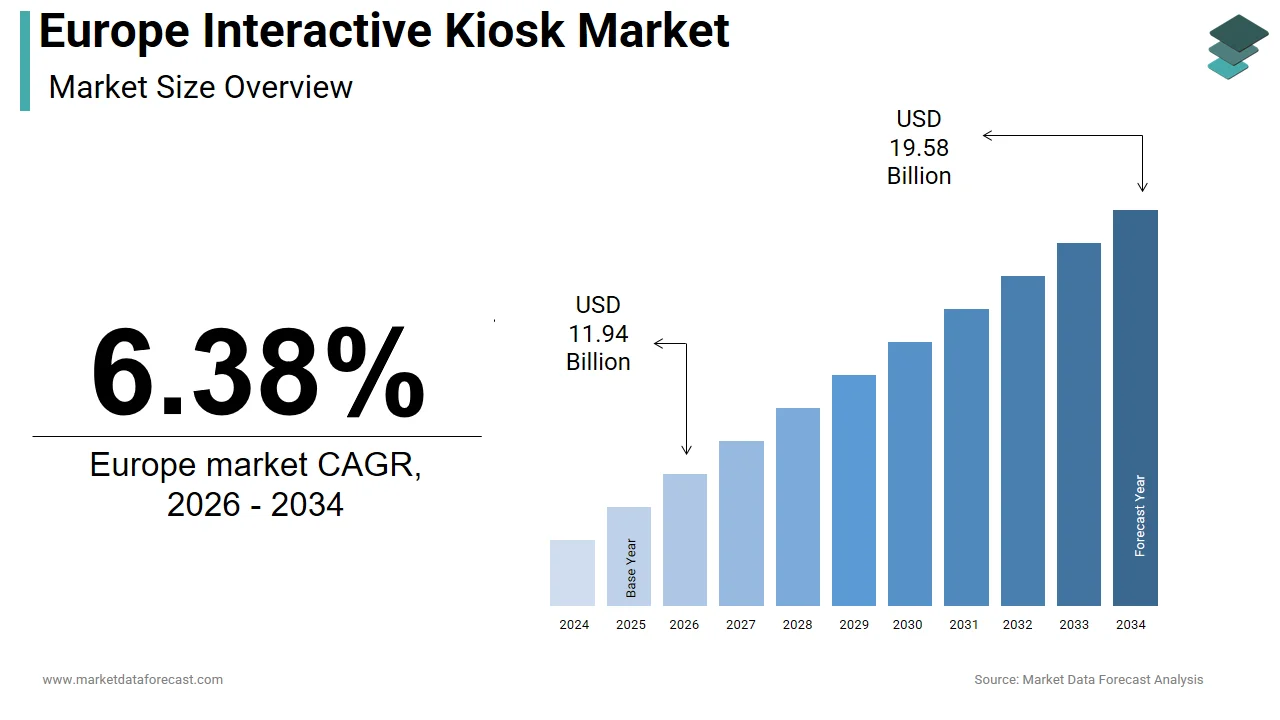
The Europe interactive kiosk market was valued at USD 11.22 billion in 2025, is estimated to reach USD 11.94 billion in 2026, and is projected to reach USD 19.58 billion by 2034, growing at a CAGR of 6.38% during the forecast period from 2026 to 2034.
The growth of the European interactive kiosk market is driven by increasing digital transformation initiatives, growing demand for self-service technologies, and the expansion of contactless and automated customer engagement solutions across retail, transportation, and banking sectors. The rising emphasis on enhancing customer experience, operational efficiency, and real-time information access is further fueling market growth across the region.
Key Market Trends
- Growing deployment of self-service kiosks in retail, hospitality, and public services to enhance customer convenience.
- Increasing integration of AI, IoT, and cloud technologies in interactive kiosks to enable personalized and data-driven services.
- Rising adoption of cashless payment solutions and touchless interfaces for improved hygiene and efficiency.
- Expansion of smart city projects and digital public infrastructure initiatives promoting kiosk installations.
- Growing focus on sustainability and modular kiosk designs that reduce maintenance and energy consumption.
Segmental Insights
- Based on component, the hardware segment was the largest, accounting for 52.3% of the Europe interactive kiosk market share in 2024, driven by increased demand for durable displays, payment terminals, and biometric systems that support high-traffic usage and 24/7 operation.
- Based on type, the self-service kiosks segment held 36.4% of the Europe interactive kiosk market share in 2024, supported by widespread adoption in retail stores, transport hubs, quick-service restaurants, and government service centers, enabling faster transactions and reduced waiting times.
Regional Insights
The European interactive kiosk market is witnessing steady growth across major economies, supported by digitalization programs, smart retail evolution, and modernization of public infrastructure.
- Germany was the largest contributor, capturing a 24.3% share of the regional market in 2024, driven by strong retail automation, banking self-service innovation, and public service digitization.
- The United Kingdom ranked second with a 20.3% share in 2024, supported by widespread use of kiosks in transport, hospitality, and financial service sectors.
- The France interactive kiosk market is expected to grow steadily, supported by the country’s national digital inclusion strategy and focus on citizen empowerment through connected technologies.
Competitive Landscape
The European interactive kiosk market is moderately fragmented, with leading companies focusing on product innovation, user interface design, and omnichannel integration to enhance consumer engagement. Key players are investing in AI-enabled, touchless, and cloud-connected kiosk systems to improve scalability, security, and real-time analytics capabilities. Prominent players include Advantech Co., Ltd., Diebold Nixdorf, DynaTouch Corporation, Embross, Frank Mayer and Associates, Inc., Glory Global Solutions Ltd., GRGBanking, IER, Kiosk Innovations, Meridian Kiosks, NCR VOYIX, Olea Kiosks, Inc., REDYREF, SAMSUNG, and Slabb Kiosks.
Europe Interactive Kiosk Market Size
The size of the Europe interactive kiosk market was worth USD 11.22 billion in 2025. The regional market is anticipated to grow at a CAGR of 6.38% from 2026 to 2034 and be worth USD 19.58 billion by 2034 from USD 11.94 billion in 2026.
The interactive kiosk is a self-service terminal equipped with touchscreens, biometric sensors, payment modules, and connectivity features deployed across retail, transportation, healthcare, and public administration to streamline transactions, deliver information, and reduce human dependency. These systems range from ticketing booths in metro stations to check-in desks at airports and digital concierge units in shopping malls. Furthermore, the European Accessibility Act requires all new public kiosks installed after June 2025 to comply with the WCAG 2.1 standard, ensuring usability for persons with visual motor or cognitive disabilities. This regulatory and behavioral convergence positions interactive kiosks not as optional technology but as essential infrastructure for efficient, equitable, and resilient service delivery.
MARKET DRIVERS
Persistent Labor Shortages in Frontline Service Roles Accelerate Self-Service Adoption
Europe faces a structural deficit in customer-facing workers that is compelling organizations to deploy interactive kiosks as operational stabilizers. The persistent labor shortages in frontline service roles are one of the major driving factors for the growth of the Europe interactive kiosk market. According to the European Labour Authority, there were over 3.8 million unfilled vacancies in retail hospitality and public transport roles in early 2025, despite elevated unemployment in other sectors. This mismatch is especially acute in countries like Germany and the Netherlands, where demographic aging shrinks the available workforce. These deployments are not driven by cost reduction alone but by the impossibility of maintaining service levels through human staffing alone.
Mandates for Inclusive and Accessible Public Service Delivery Under EU Legislation
The European Union’s regulatory framework is actively shaping kiosk design to ensure universal access and digital equity, which is prompting the growth of Europe's interactive kiosk market. The European Accessibility Act, which became enforceable in June 2025, requires all newly installed public interactive terminals to include features such as screen reader compatibility, tactile keypads, voice navigation, and adjustable height mechanisms. The national and regional public agencies are now procuring kiosks that meet these standards, with countries like Sweden and Austria leading implementation. Additionally, the Digital Services Act mandates that kiosks used for essential services must offer clear human assistance options when users encounter difficulties.
MARKET RESTRAINTS
High Upfront Investment and Complex Integration with Legacy Systems
The deployment of interactive kiosks entails significant capital expenditure and technical complexity that deters small and medium enterprises from adoption is hampering the growth of Europe interactive kiosk market. For SMEs in retail or hospitality, this represents a substantial barrier, particularly when legacy point of sale or inventory systems lack modern APIs. Public sector entities face similar hurdles, with municipal IT departments often managing decades-old databases that cannot feed real-time data to kiosks without custom development. Until standardized integration protocols and modular kiosk architectures become widespread, the total cost of ownership will remain a critical constraint on market penetration beyond large enterprises and well-funded agencies.
Vulnerability to Vandalism, Technical Failure, and Cybersecurity Breaches
Interactive kiosks deployed in public spaces face persistent physical and digital threats that undermine reliability and user trust. The vulnerability to vandalism, technical failure, and cybersecurity breaches is another attribute hindering the growth of Europe interactive kiosk market. Attackers often install skimming devices on payment terminals or exploit unpatched software to exfiltrate transaction data. Environmental factors also play a role with outdoor kiosks in Southern Europe suffering from screen glare and overheating, while Northern units face condensation and frost interference. These challenges necessitate ongoing maintenance contracts, robust enclosure design, and zero-trust security architectures that many operators underestimate during procurement.
MARKET OPPORTUNITIES
Integration with EU Digital Identity and Payment Infrastructures
The rollout of the European Digital Identity Wallet and instant payment systems for secure, authenticated kiosk interactions is expected to boost the growth of the Europe interactive kiosk market. As per the European Commission, over twenty member states are piloting wallet-enabled services by 2025, allowing citizens to verify identity and share verified attributes, such as age or residency, directly at kiosks without physical documents. This enables high-trust transactions previously impossible in self-service environments. For example, Dutch municipal offices now use kiosks where residents authenticate via their digital wallet to apply for permits or renew IDs with automatic data prefill. Vendors that build kiosk platforms compliant with eIDAS 2.0 and PSD3 will gain privileged access to next-generation public and financial services where security, convenience, and regulatory alignment converge.
Deployment in Rural and Underserved Communities to Bridge the Digital Divide
Interactive kiosks offer a tangible solution to Europe’s urban-rural digital gap by bringing essential services to areas with limited broadband or smartphone penetration. The deployment in rural and underserved communities to bridge the digital divide is also prompting the growth of the Europe interactive kiosk market. In response, countries like Portugal and Greece have installed solar-powered kiosks in village squares offering telemedicine appointments, utility bill payments and agricultural subsidy applications via simple touch interfaces. The EU’s Digital Europe Programme has allocated €620 million through 2027 specifically for inclusive kiosk deployments in cohesion regions.
MARKET CHALLENGES
Ensuring Multilingual and Culturally Adaptive User Interfaces Across Diverse Regions
Europe’s linguistic and cultural diversity poses a persistent challenge for kiosk usability as static interfaces fail to accommodate regional preferences and language needs. Therefore, ensuring multilingual and culturally adaptive user interfaces across diverse regions is likely to challenge the growth of the Europe interactive kiosk market. Even in major languages, interface design assumptions can alienate users, where German preference for detailed instructions versus Italian preference for visual cues, for example.
Balancing Automation with Human Oversight in Sensitive Service Contexts
Domains like healthcare, immigration, and social welfare concerns grow about the erosion of human judgment and empathy in interactions as kiosks expand into high-stakes situations. The balancing automation with human oversight in sensitive service contexts is also expected to degrade the growth of the Europe interactive kiosk market. A French asylum seeker was incorrectly denied service due to a kiosk’s inability to interpret non-Latin script documents, triggering a national review. The Digital Services Act mandates a human fallback for automated decisions affecting legal rights, yet implementation remains inconsistent. Public trust hinges on seamless escalation paths and clear signage elements often overlooked in cost-driven deployments.
REPORT COVERAGE
| REPORT METRIC | DETAILS |
| Market Size Available | 2025 to 2034 |
| Base Year | 2025 |
| Forecast Period | 2026 to 2034 |
| Segments Covered | By Component, Type, End-use, and Country. |
| Various Analyses Covered | Global, Regional and Country-Level Analysis, Segment-Level Analysis, Drivers, Restraints, Opportunities, Challenges; PESTLE Analysis; Porter’s Five Forces Analysis, Competitive Landscape, Analyst Overview of Investment Opportunities |
| Countries Covered | UK, France, Spain, Germany, Italy, Russia, Sweden, Denmark, Switzerland, Netherlands, Turkey, Czech Republic, and the Rest of Europe. |
| Market Leaders Profiled | Advantech Co., Ltd., Diebold Nixdorf, DynaTouch Corporation, Embross, Frank Mayer and Associates, Inc., Glory Global Solutions Ltd., GRGBanking, IER, Kiosk Innovations, Meridian Kiosks, NCR VOYIX, Olea Kiosks, Inc., REDYREF, SAMSUNG, and Slabb Kiosks. |
SEGMENTAL ANALYSIS
By Component Insights
The hardware segment was the largest by accounting for 52.3% of the Europe interactive kiosk market share in 2024, from the foundational role of physical terminals that include touchscreens, processors, payment modules, biometric scanners, and enclosures in enabling any self-service interaction. Over 85% of public and retail kiosk deployments in 2024 involved new hardware procurement due to aging legacy units failing to meet accessibility or security standards. The European Accessibility Act mandates tactile interfaces, adjustable height mechanisms, and screen readability that require specialized hardware, not achievable through software alone. Additionally, outdoor kiosks in transport and tourism demand ruggedized components resistant to weather, vandalism, and temperature extremes. Vendors like Diebold Nixdorf and NCR invest heavily in modular chassis designs that support future upgrades, yet the initial hardware outlay remains the largest cost center.
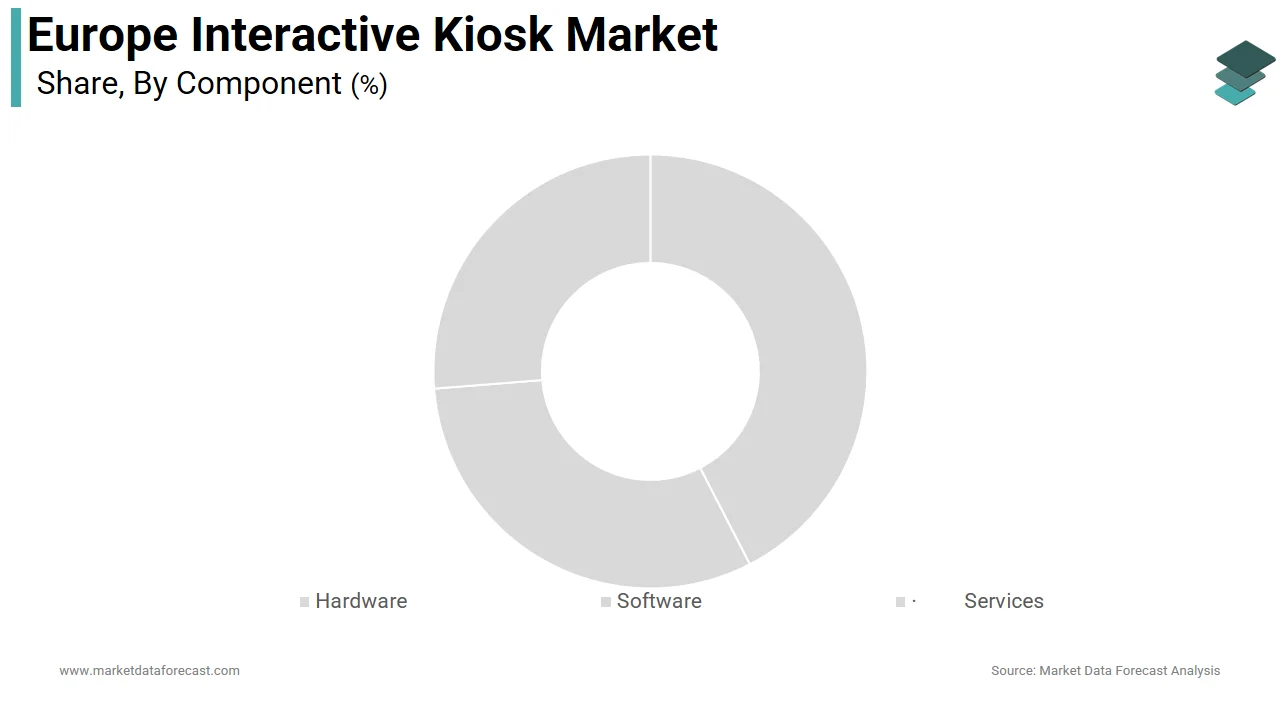
The services segment is anticipated to grow with a CAGR of 18.9% throughout the forecast period, owing to the operational complexity of maintaining large-scale kiosk fleets across diverse environments. Preventive maintenance is equally important, as Deutsche Bahn reported that kiosks under proactive service contracts experienced 40% less downtime than those managed in-house as per its 2024 reliability audit. Furthermore, the Digital Services Act requires public kiosks to offer real-time human assistance via video or phone escalation, necessitating 24/7 support centers. Vendors now bundle installation, integration training, and compliance auditing into subscription-based service packages that ensure continuous regulatory alignment and user satisfaction.
By Type Insights
The self-service kiosks segment accounted in holding 36.4% of the Europe interactive kiosk market share in 2024, with check-in terminals, information desks, and service portals in transport, healthcare, and government, from the continent’s strong push for digital public administration and citizen self-reliance. As per the European Commission, over 90% of member states now mandate digital alternatives for core services such as license renewals, benefit applications, and tax filings, tasks that are increasingly fulfilled via kiosks in libraries, post offices, and municipal halls. Airports like Amsterdam Schiphol and Frankfurt operate over 500 check-in and bag drop kiosks, each handling 70% of passenger processing without staff. Similarly, hospitals in Sweden and Spain use symptom registration kiosks to streamline triage and reduce waiting times.
The retail self-checkout kiosks segment is lucratively to witness a fastest CAGR of 21.3% throughout the forecast period, with acute labor shortages and changing consumer expectations for speed and autonomy. The technology has also evolved beyond barcode scanning to include AI-powered weight sensors, computer vision for item recognition, and integrated loyalty systems by reducing theft and improving accuracy. Moreover, the European Accessibility Act has spurred the development of voice-guided and height-adjustable units, ensuring inclusivity.
COUNTRY LEVEL ANALYSIS
Germany Interactive Kiosk Market Analysis
Germany was the largest contributor to the Europe interactive kiosk market by capturing 24.3% of share in 2024 with its engineering rigor, public service digitization, and transport infrastructure demands. Deutsche Bahn operates one of the continent’s largest kiosk networks with more than 12,000 ticketing and information terminals across stations, 70% of which were upgraded to meet European Accessibility Act standards by year's end. Strong data protection laws also favor on-premises kiosk architectures with local data processing.
United Kingdom Interactive Kiosk Market Analysis
The United Kingdom interactive kiosk market was positioned second by holding 20.3% of share in 2024, with its advanced retail sector and dense ATM and self-checkout penetration. The financial sector remains a key driver with LINK reporting over 65,000 ATMs nationwide, many upgraded to support contactless cardless withdrawals via mobile authentication. Post Brexit, the UK has maintained alignment with EU accessibility standards while enabling agile fintech integrations, such as Zapp’s instant payment kiosks in convenience stores.
France Interactive Kiosk Market Analysis
France interactive kiosk market growth is likely to grow with its national strategy for digital inclusion and citizen empowerment. These units feature voice navigation, symbol-based interfaces, and hearing aid compatibility that was designed in collaboration with disability advocacy groups. The country also leads in secure identity verification with kiosks integrated into FranceConnect, the national digital ID system.
COMPETITIVE LANDSCAPE
The Europe interactive kiosk market features a dynamic mix of global technology leaders, European engineering firms, and agile regional integrators. Competition is defined not by price alone but by depth of regulatory alignment, durability of hardware, and quality of post-deployment support. Global vendors leverage scale and R&D, while European companies differentiate through data sovereignty, local language support, and public sector trust. The market is highly fragmented by application, with transport, healthcare, retail, and government each demanding specialized form factors, security protocols, and user flows. Regulatory complexity acts as both a barrier and a differentiator for vendors that proactively certify for the European Accessibility Act, GDPR, and NIS2 gain preferential access to institutional contracts. New entrants face high hurdles in certification integration and service logistics, yet succeed in niche verticals like rural service kiosks or circular economy returns.
KEY MARKET PLAYERS
Some of the companies that are playing a dominating role in the Europe interactive kiosk market include
- Advantech Co., Ltd.
- Diebold Nixdorf
- DynaTouch Corporation
- Embross
- Frank Mayer and Associates, Inc.
- Glory Global Solutions Ltd.
- GRGBanking
- IER
- Kiosk Innovations
- Meridian Kiosks
- NCR VOYIX
- Olea Kiosks, Inc.
- REDYREF
- SAMSUNG
- Slabb Kiosks
TOP PLAYERS IN THE EUROPE INTERACTIVE KIOSK MARKET
- NCR Corporation is a global leader in interactive kiosk solutions with deep penetration across Europe’s retail banking and hospitality sectors. The company provides end-to-end kiosk systems ranging from self-checkout terminals to advanced ATM platforms that support biometric authentication and contactless transactions. NCR has strengthened its European position by aligning its hardware with the European Accessibility Act, ensuring features like voice guidance, tactile keypads, and adjustable height mechanisms are standard.
- Diebold Nixdorf plays a pivotal role in the Europe interactive kiosk market through its integrated self-service platforms for banking and retail. Headquartered in Germany, the company leverages its European engineering heritage to deliver kiosks that emphasize data sovereignty, robust security, and multilingual user interfaces. Diebold Nixdorf has reinforced its market presence by upgrading its DN Series kiosks with GDPR compliant data handling and real-time fraud detection capabilities.
- GRGBanking Equipment is a key global player with expanding influence in the Europe interactive kiosk market through its cost-efficient and modular kiosk platforms. Originally known for ATMs, the company now offers versatile self-service kiosks for retail healthcare and public administration, featuring open architecture and rapid deployment capabilities. GRG has enhanced its European footprint by certifying its hardware for CE marking, European Accessibility Act compliance, and ENISA cybersecurity standards.
TOP STRATEGIES USED BY THE KEY MARKET PARTICIPANTS
Key players in the Europe interactive kiosk market pursue five core strategies to maintain competitiveness and address regional complexities. They embed European Accessibility Act requirements directly into hardware design, including tactile interfaces, voice navigation, and adjustable ergonomics. They ensure full GDPR and NIS2 compliance through on-device data minimization, encrypted communications, and remote wipe capabilities. They offer modular and ruggedized chassis that support outdoor deployment in diverse climates while enabling future upgrades. They provide managed services for remote monitoring, predictive maintenance, and cybersecurity patching to reduce operator burden. Additionally, they integrate kiosks with EU digital infrastructure such as eIDAS wallets, instant payment systems, and national service portals. These strategies reflect a market where physical terminals must function as secure, compliant, and inclusive nodes within Europe’s broader digital public ecosystem.
MARKET SEGMENTATION
This research report on the Europe interactive kiosk market has been segmented and sub-segmented into the following categories.
By Component
- Hardware
- Display
- Printer
- Others
- Software
- Windows
- Android
- Linux
- Others
- Services
- Integration & Deployment
- Managed Services
By Type
- Automated Teller Machines (ATMs)
- Retail Self-checkout Kiosk
- Self-service Kiosk
- Vending Kiosk
By End-use
- BFSI
- Retail
- Food & Beverage
- Healthcare
- Government
- Travel & Tourism
- Others
By Country
- United Kingdom
- France
- Spain
- Germany
- Italy
- Russia
- Sweden
- Denmark
- Switzerland
- Netherlands
- Rest of Europe