- Product Description Description
- Table of Contents TOC
- List of Table & Figure LOT
- Get Free Sample PDF Sample PDF
Market Size, 2025
$15.74 BnMarket Estimate, 2026
$17.39 BnMarket Forecast, 2034
$38.51 BnCAGR, 2026–2034
10.45%Europe Lead Acid Battery Scrap Market Size
The Europe lead acid battery scrap market size was calculated at USD 15.74 billion in 2025 and is anticipated to reach USD 38.51 billion by 2034, from USD 17.39 billion in 2026, growing at a CAGR of 10.45% during the forecast period.
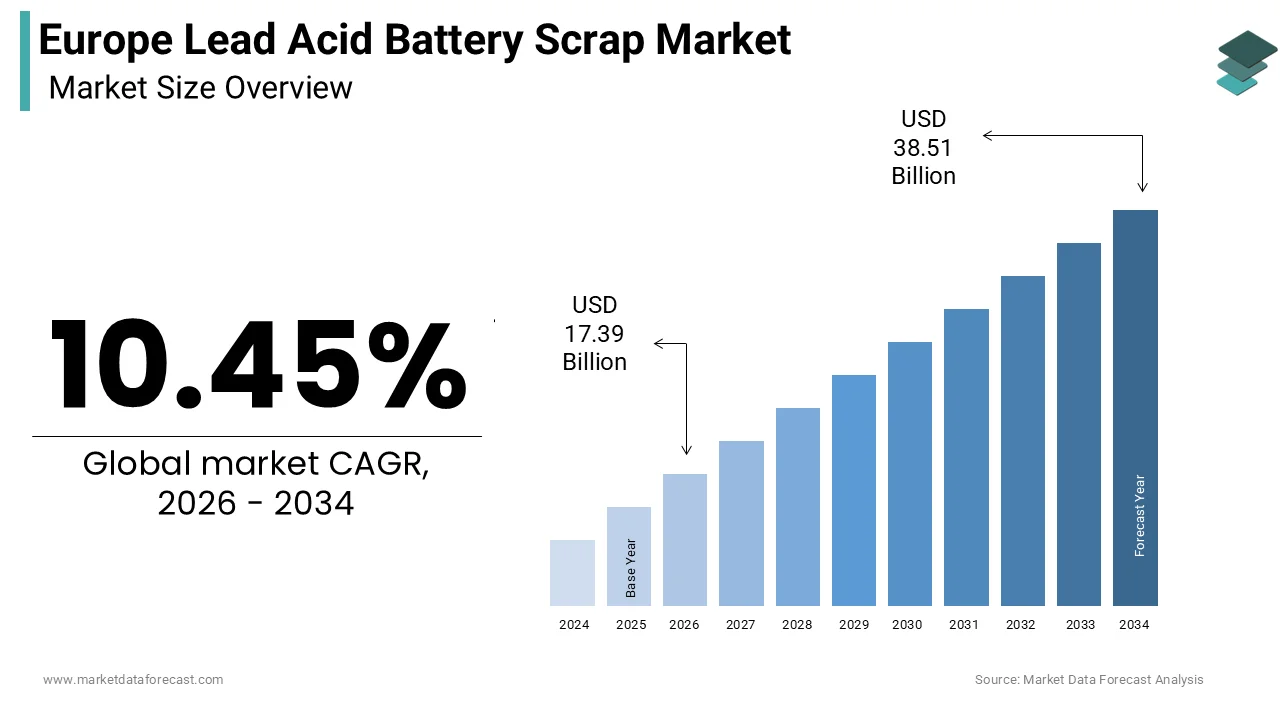
Lead-acid battery scrap refers to used, damaged, or expired lead-acid batteries that are no longer functional and have been discarded for disposal or recycling. These are the typical heavy batteries found in cars, motorcycles, trucks, UPS systems, and industrial equipment. Because they contain valuable materials like lead, they are highly sought after for recycling, but they are also classified as hazardous waste due to their toxic contents. This market is driven by stringent environmental regulations and the high value of recovered materials such as lead and plastic. According to the International Lead Association, 99% of lead batteries in Europe are successfully collected and recycled at end-of-life, maintaining one of the highest resource recovery rates of any consumer product. According to the International Lead Association, over 60% of global refined lead production now comes from recycled sources, making it the most recycled metal in the world. These statistics underscore the maturity and efficiency of the existing collection infrastructure. The market functions through a network of authorised treatment facilities that ensure safe dismantling and material recovery while preventing hazardous substance leakage. According to Eurostat, hazardous waste treatment in the European Union reached 99.6 million tonnes in 2022, driven by expanding industrial outputs and stricter classifications for electronic and battery components. The regulatory landscape mandates producer responsibility, compelling manufacturers to manage the end-of-life phase of their products. This legal framework ensures a steady supply of scrap material to recyclers. The market dynamics are influenced by fluctuating lead prices and evolving battery technologies, yet the established recycling ecosystem remains robust due to economic incentives and compliance requirements.
MARKET DRIVERS
Automotive Sector Dominance Drives Scrap Volume Generation
The automotive industry is among the major factors boosting the growth of the European lead-acid battery scrap market. It generates consistent volumes due to the widespread use of these batteries in conventional vehicles. According to the European Automobile Manufacturers Association, there are over 250 million passenger cars registered across the European Union, with the vast majority relying on lead-acid batteries for starting, lighting, and ignition systems. This vast vehicle parc ensures a continuous flow of end-of-life batteries into the recycling stream as vehicles reach the end of their operational lifespan. The average lifespan of a lead-acid battery ranges from 3 to 5 years, creating a predictable replacement cycle that sustains scrap availability. As per the Society of Motor Manufacturers and Traders, European new vehicle demand historically stabilizes around 15 million registrations annually, with every vehicle requiring a reliable starter battery that eventually feeds into the secondary metal scrap pool. The high penetration rate of internal combustion engine vehicles, despite the rise of electric mobility, maintains substantial demand for lead-acid battery recycling services. The correlation between vehicle sales and future scrap volume is direct, with each sold vehicle representing a future unit of recyclable material. This steady influx allows recycling facilities to operate at optimal capacity, ensuring economic viability. The established logistics network for collecting used batteries from service centres and dismantling facilities further enhances the efficiency of scrap aggregation. The automotive sector's dominance ensures that the Europe lead-acid battery scrap market remains resilient against short term fluctuations in other segments.
Stringent Regulatory Frameworks Mandate High Collection Rates
The region’s environmental legislation imposes strict obligations on battery producers and consumers, which in turn fuels the expansion of the Europe lead-acid battery scrap market. This ensures high collection and recycling rates for lead-acid batteries. According to the European Commission, the baseline framework established a minimum collection rate of 45% for portable batteries, whereas automotive lead-acid configurations consistently exceed this baseline due to their high commercial value and industrial collection architecture. The directive requires producers to finance the collection and treatment of waste batteries, creating a financially sustainable system for scrap management. As per the European Environment Agency, developed waste management systems in countries like Germany and France successfully maintain collection rates exceeding 90% for automotive batteries, proving the efficacy of strict closed-loop regulatory enforcement. These laws prevent improper disposal and channel scrap material to authorised recyclers, thereby supporting the formal market structure. According to the European Commission, the updated EU Batteries Regulation reinforces Extended Producer Responsibility frameworks, legally and financially holding manufacturers accountable for the entire lifecycle management, collection, and resource recovery of their products. The regulatory pressure also discourages illegal export of hazardous waste, ensuring that scrap is processed within Europe under controlled conditions. Compliance with these regulations requires robust tracking and reporting mechanisms, which enhance transparency in the supply chain. The legal mandate creates a level playing field for recyclers who invest in compliant technologies. The consistent enforcement of these rules across member states reduces regional disparities in collection efficiency. This regulatory certainty attracts investment in recycling infrastructure, strengthening the overall market foundation.
MARKET RESTRAINTS
Volatility in Secondary Lead Prices Impacts Profit Margins
Fluctuations in global lead prices significantly affect the profitability of recycling operations in the European lead-acid battery scrap market. This creates financial uncertainty for processors. According to the London Metal Exchange, cash settlement prices for refined lead fluctuate by over 20% within individual calendar years, directly setting the revenue and profitability benchmarks for secondary lead smelters and scrap battery recyclers. Since the primary output of battery recycling is secondary lead, any decline in commodity prices reduces the margin between collection costs and sales revenue. As per the International Lead Association, secondary lead commodity prices closely track global primary lead benchmarks, rendering secondary processors highly vulnerable to macro-level commodity price fluctuations over local scrap market conditions. The volatility complicates long-term planning and investment decisions for recycling facilities. When prices drop, smaller operators may struggle to cover operational expenses, leading to consolidation or exit from the market. The dependence on a single commodity output limits diversification opportunities for many recyclers. Price instability also affects the willingness of collectors to gather scrap, as lower prices reduce incentives for informal sector participation. Hedging strategies can mitigate some risks, but they require financial expertise and capital that smaller entities may lack. The correlation between energy costs and lead production further exacerbates price sensitivity, as energy-intensive smelting processes become less economical during low price periods. This financial unpredictability remains a persistent restraint on market expansion and stability.
High Operational Costs for Compliance and Safety Standards
Recycling lead-acid batteries involves handling hazardous materials, which requires significant investment in safety equipment and ultimately impedes the expansion of the Europe lead acid battery scrap market. Consequently, meeting these environmental compliance measures increases operational costs. According to the European Agency for Safety and Health at Work, occupational exposure to lead poses severe reproductive and neurological health risks, necessitating strict adherence to newly updated biological limit values and comprehensive protective measures across e-waste and battery recycling installations. Implementing these safety protocols adds substantial overhead to the recycling process, reducing overall profit margins. As per the European Commission, industrial compliance with the updated Industrial Emissions Directive forces secondary smelting installations to deploy Best Available Techniques to minimize heavy metal dust and toxic gas emissions into surrounding ecosystems. These regulatory requirements ensure environmental protection but create barriers to entry for new players and strain the finances of existing operators. The cost of treating acidic electrolytes and separating plastic components further adds to the operational burden. Facilities must regularly upgrade their technology to meet evolving standards, leading to recurring capital outlays. The complexity of managing hazardous waste logs and conducting regular audits also increases administrative costs. Smaller recyclers may find it difficult to compete with larger entities that benefit from economies of scale in compliance management. The high fixed costs associated with safe and legal operations limit flexibility in pricing and service offerings. This financial pressure acts as a restraint on market growth, particularly for small and medium-sized enterprises seeking to enter the sector.
MARKET OPPORTUNITIES
Advancements in Hydrometallurgical Recycling Technologies
Emerging hydrometallurgical processes offer a cleaner and more efficient alternative to traditional pyrometallurgical smelting for recovering lead from battery scrap, which provides significant growth opportunities for the European lead-acid battery scrap market. According to the Journal of Cleaner Production, advanced hydrometallurgical processing achieves lead recovery rates exceeding 95% from spent battery paste while cutting operational carbon emissions and energy inputs compared to traditional pyrometallurgical smelting. The technological shift aligns with European sustainability goals and reduces the environmental footprint of recycling operations. As per the European Innovation Council, targeted deployment and scaling frameworks fund pilot projects to prove the commercial viability of green battery recycling processes, accelerating technology transfer to major commercial recycling firms. The ability to operate at lower temperatures reduces fuel costs and greenhouse gas emissions, enhancing the economic and environmental appeal of these technologies. Adopting such innovations allows recyclers to differentiate themselves in a competitive market and comply with increasingly strict environmental regulations. The improved purity of recovered lead from hydrometallurgical processes also commands higher prices in speciality applications. Investment in research and development for these technologies is supported by European Union funding programs focused on circular economy initiatives. Early adopters can secure intellectual property rights and establish leadership in next-generation recycling solutions. This technological evolution opens new revenue streams and improves the overall sustainability profile of the European lead-acid battery scrap market. It positions the industry for long term viability amidst growing environmental scrutiny.
Expansion into Energy Storage System Battery Recycling
The growing deployment of stationary energy storage systems using lead-acid batteries creates a new source of scrap material in the Europe lead-acid battery scrap market. This expands the market beyond traditional automotive applications. According to the European Association for Storage of Energy, European grid infrastructure requires 200 gigawatts of deployed energy storage capacity by 2030, establishing a massive domestic market segment for cost-effective battery technologies. These stationary batteries have longer lifespans than automotive ones, but their eventual replacement will generate a substantial volume of high-quality scrap. As per the International Renewable Energy Agency, rapid global integration of solar and wind installations drives extensive demand for stationary storage networks, expanding the long-term circular supply pool of recyclable battery infrastructure. This segment offers a more predictable collection timeline compared to the variable discard patterns of consumer vehicles. Recyclers can establish dedicated collection channels for industrial and utility-scale battery installations, ensuring efficient material recovery. The uniform size and composition of stationary batteries simplify the recycling process, potentially lowering processing costs. Engaging with energy storage providers early in the lifecycle allows recyclers to secure future supply contracts. This diversification reduces dependence on the automotive sector and stabilises scrap inflows. The trend toward decentralised energy generation further amplifies this opportunity, creating a distributed network of future scrap sources. Capitalising on this emerging segment positions companies for sustained growth in the Europe lead-acid battery scrap market.
MARKET CHALLENGES
Complexity in Cross-Border Waste Transportation Regulations
Navigating the diverse regulatory frameworks for hazardous waste transportation across the region’s borders is a significant challenge for scrap collectors and recyclers in the European lead-acid battery scrap market. According to the European Commission, the Waste Shipment Regulation enforces strict prior informed consent frameworks for moving hazardous lead-acid battery scrap across internal borders, ensuring rigorous environmental traceability between member states. Each country may interpret these rules differently, leading to inconsistencies in enforcement and processing times. As per the European Federation of Waste Management and Environmental Services, bureaucratic notification procedures for cross-border hazardous waste transfers frequently exceed several weeks, forcing recycling operators to manage increased logistical storage costs and delayed processing timelines. This regulatory fragmentation hinders the optimisation of recycling networks, as scrap may not always flow to the most efficient or capable facilities. The risk of non-compliance penalties discourages some operators from engaging in international trade of battery scrap. Language barriers and differing national procedures further complicate the logistics of cross-border movements. Small and medium-sized enterprises often lack the resources to manage these complex regulatory requirements effectively. The uncertainty surrounding permit approvals can lead to stockpiling of scrap, posing environmental and safety risks. Harmonising these regulations across the European Union remains an ongoing challenge, limiting the seamless operation of the pan-European recycling market. This administrative complexity acts as a barrier to efficient resource allocation.
Competition from Informal and Illegal Recycling Channels
The presence of informal and illegal recycling operations weakens the formal European lead-acid battery scrap market. This diverts material away from compliant facilities and causes environmental damage. According to Interpol, transnational criminal organisations systematically exploit regulatory vulnerabilities to illegally traffic hazardous electronic and lead-acid battery waste out of Europe toward destinations with weaker environmental enforcement. These illicit operations avoid the costs associated with safety and environmental compliance, allowing them to offer higher prices to collectors and distort the market. As per the European Environment Agency, informal and substandard waste processing channels release highly concentrated lead particles and acid effluents directly into local ecosystems, driving severe occupational poisoning and environmental contamination risks. This unfair competition pressures legitimate recyclers who must adhere to strict regulations, squeezing their profit margins. The lack of traceability in some parts of the supply chain facilitates the diversion of scrap to illegal handlers. Enforcement efforts are often hampered by limited resources and the cross-border nature of these activities. Consumers and small businesses may unknowingly sell their used batteries to illegal operators due to convenience or higher immediate returns. Addressing this challenge requires enhanced monitoring, stricter penalties, and greater awareness among stakeholders. The persistence of illegal channels threatens the integrity and sustainability of the formal recycling ecosystem in Europe.
REPORT COVERAGE
| REPORT METRIC | DETAILS |
| Market Size Available | 2025 to 2034 |
| Base Year | 2025 |
| Forecast Period | 2026 to 2034 |
| CAGR | 10.45% |
| Segments Covered | By Battery Type and Region |
| Various Analyses Covered | Global, Regional, & Country Level Analysis; Segment-Level Analysis; DROC; PESTLE Analysis; Porter’s Five Forces Analysis; Competitive Landscape; Analyst Overview of Investment Opportunities |
| Regions Covered | UK, France, Spain, Germany, Italy, Russia, Sweden, Denmark, Switzerland, Netherlands, Turkey, Czech Republic, Rest of Europe |
| Market Leaders Profiled | Clarios, Exide Technologies, Ecobat, Umicore, Aurubis, Campine, Recylex, EnerSys, Glencore, Stena Recycling, Enva, GME Recycling |
SEGMENTAL ANALYSIS
By Battery Type Insights
The flooded lead-acid batteries segment led the Europe lead acid battery scrap market and captured a significant share in 2025. This leading position of the segment was attributed to its ubiquitous presence in conventional internal combustion engine vehicles across the continent. According to the European Automobile Manufacturers’ Association, over 250 million passenger cars are in circulation across the European Union, with conventional flooded lead-acid starter batteries continuing to power the predominant share of the operating fleet. The relatively short service life of these batteries, typically ranging from 3 to 5 years, ensures a continuous and predictable flow of end-of-life units into the recycling stream. As per the European Association of Automotive Suppliers, European aftermarket demand generates tens of millions of automotive starter battery replacements annually, with flooded chemistries sustaining dominant unit volumes across older internal combustion vehicle fleets. This high turnover rate directly correlates with the dominance of this segment in the scrap market, as recyclers rely on steady inflows to maintain operational efficiency. The lower initial cost of flooded batteries compared to advanced alternatives makes them the preferred choice for budget-conscious consumers and fleet operators, further sustaining their market share. The established collection infrastructure is optimized for handling these standardized units, reducing processing complexity and costs. The widespread availability of replacement services at automotive repair shops ensures that used flooded batteries are efficiently captured and directed toward authorized treatment facilities. This structural advantage solidifies the position of flooded batteries as the primary source of recyclable material in the European market.
The economic advantage of flooded lead-acid batteries drives their continued prevalence in the automotive and industrial sectors, thereby securing their leading position in the scrap market. According to the International Lead Association, standard flooded lead-acid batteries maintain an approximate 30% lower acquisition cost relative to valve-regulated AGM or gel variants, reinforcing their dominance in cost-sensitive standard-duty vehicle segments. This price sensitivity ensures that despite technological advancements, flooded batteries retain a significant share of new sales, which translates directly into future scrap generation. As per the European Federation of Automotive Aftermarket Distributors, the wider European automotive aftermarket ecosystem represents over 200 billion euros in annual economic value, driven by steady maintenance and electrical component renewal cycles. The affordability of flooded batteries encourages frequent replacements rather than repairs, accelerating the cycle of waste generation. Industrial applications such as backup power systems also favor flooded types due to their lower upfront investment and proven reliability in stationary settings. The simplicity of their design facilitates easier dismantling during the recycling process, allowing facilities to recover materials more efficiently compared to complex sealed units. This operational ease reduces processing costs for recyclers, incentivising the preferential handling of flooded battery scrap. The combination of high volume, low cost, and straightforward recycling mechanics ensures that this segment remains the cornerstone of the Europe lead-acid battery scrap market.
The Absorbed Glass Mat (AGM) batteries segment is estimated to register the fastest CAGR of 5.7% from 2026 to 2034, due to the widespread adoption of start-stop technology in modern vehicles to meet emission standards. According to the European Commission, fleet-wide carbon emission reduction targets have pushed micro-hybrid start-stop system penetration past 60% in European passenger cars, driving substantial original-equipment transitions toward high-durability AGM batteries. These batteries offer enhanced performance and longer life spans compared to traditional flooded types, but their eventual end of life will contribute significantly to the scrap stream in the coming years. As per the European Association of Motorcycle Manufacturers, rapid adoption of high-performance electronics and electrification across mopeds and motorcycles is accelerating the replacement demand and scrap inflow of compact valve-regulated lead-acid units. The growth of this segment is driven by the rapid turnover of newer vehicle models equipped with these technologies. The higher value of recovered materials from AGM batteries, including purer lead and specialised separators, attracts recyclers seeking to maximise revenue per unit. The increasing complexity of these batteries necessitates specialised handling protocols, driving investment in advanced recycling infrastructure. As the vehicle parc modernises, the proportion of AGM batteries in the total scrap mix will rise steadily. This transition reflects the broader automotive industry shift toward efficiency and electrification, positioning AGM as a key growth driver in the scrap market.
The deployment of AGM batteries in renewable energy storage systems is another critical factor accelerating their growth in the scrap market, as these applications require robust and maintenance-free power solutions. According to the European Association for Storage of Energy, Europe's grid infrastructure deployment requires up to 200 gigawatts of total stationary storage capacity by 2030, spurring auxiliary demand for industrial valve-regulated lead batteries alongside lithium chemistries. These stationary systems often operate in demanding conditions that favor the spill-proof and vibration-resistant properties of AGM technology, ensuring their preference over flooded alternatives in sensitive environments. As per the International Renewable Energy Agency, residential solar storage installations are rapidly adopting lithium-based systems over conventional AGM lead-acid batteries due to superior round-trip efficiency and higher depth of discharge. Although these batteries have longer lifespans than automotive counterparts, the rapid expansion of the storage sector means a significant volume will reach end of life simultaneously in the next decade. The centralised nature of many storage projects facilitates efficient collection and recycling logistics, reducing barriers to entry for scrap processors. The high purity of lead recovered from AGM batteries used in storage applications commands premium prices, enhancing the economic attractiveness of this segment. Recyclers are adapting their processes to handle the specific material composition of AGM units, preparing for the anticipated surge in supply. This strategic alignment with the green energy transition ensures sustained growth for the AGM scrap segment.
REGIONAL ANALYSIS
Germany Lead Acid Battery Scrap Market Analysis
Germany dominated the European lead-acid battery scrap market and accounted for a substantial share in 2025. This dominance of the German market was driven by its robust automotive industry and stringent environmental enforcement. According to the Federal Environment Agency, Germany maintains strict closed-loop waste systems where automotive lead-acid battery collection rates consistently approach 100% due to mandatory consumer deposit schemes, ensuring a predictable supply of secondary raw materials. The country is home to several major automotive manufacturers and a dense network of service centres, generating substantial volumes of end-of-life batteries annually. As per the German Association of the Automotive Industry, new passenger car registrations fluctuate between 2.8 million and 3.0 million units annually, with each vehicle installation anchoring the future supply cycle of secondary metals. The well-established infrastructure for hazardous waste management allows for efficient aggregation and processing of battery scrap. Strict compliance with the Battery Act mandates producer responsibility, compelling manufacturers to fund and organise collection systems. This regulatory framework minimises leakage to informal channels and supports formal recycling operations. The presence of advanced smelting and refining facilities within the country reduces transportation costs and enhances the economic viability of local recycling. Germany’s leadership in circular economy initiatives further promotes innovation in recycling technologies. The high level of public awareness regarding environmental protection ensures strong consumer participation in collection programs. This combination of industrial scale, regulatory rigour, and infrastructural maturity cements Germany’s dominant role in the European market.
France Lead Acid Battery Scrap Market Analysis
France is a significant contributor to the European lead-acid battery scrap market. The country is known for a strong regulatory framework and active producer responsibility schemes. As per the French Ministry of Ecological Transition, structural Extended Producer Responsibility frameworks maintain automotive battery recovery and collection rates above 90% through localized repair networks and retail collection infrastructure. According to the French Ministry of Ecological Transition, the total national passenger car fleet in circulation exceeds 38 million vehicles, representing a massive operational base that drives stable end-of-life battery replacement cycles. As per the Plateforme Automobile, new passenger car registrations in France are below 2 million units annually, stabilizing post-pandemic market demand while continually refreshing the vehicle fleet with advanced electrical systems. The legal requirement for producers to manage end-of-life batteries creates a structured and transparent supply chain for recyclers. Advanced recycling facilities in France employ state-of-the-art technologies to maximise material recovery and minimise environmental impact. The government’s commitment to reducing hazardous waste disposal encourages investment in modern recycling infrastructure. Public awareness campaigns promote proper battery disposal, enhancing collection efficiency. The integration of battery recycling into broader waste management strategies ensures coordinated efforts across sectors. France’s focus on sustainability and circular economy principles drives continuous improvement in recycling rates. The stable regulatory environment provides confidence for long-term investments in the sector. This systematic approach ensures that France remains a key player in the regional scrap market.
United Kingdom Lead Acid Battery Scrap Market Analysis
The United Kingdom maintains a prominent position in the European lead-acid battery scrap market. This presence is supported by a mature automotive sector and comprehensive waste management regulations. According to the Department for Environment, Food and Rural Affairs, specific Extended Producer Responsibility frameworks under the Waste Batteries and Accumulators Regulations successfully maximise secondary resource recovery from large-scale lead-acid configurations. As per the Society of Motor Manufacturers and Traders, the overall motor parc operating on British roads has reached an all-time high of over 42 million licensed vehicles, providing an expansive circular foundation for secondary scrap metal flows. According to the Society of Motor Manufacturers and Traders, robust mechanical parts distribution networks and recurring electrical system maintenance generate steady, high-volume consumer demand for vehicle battery replacements across domestic garages. The exit from the European Union has not diminished the UK’s commitment to environmental standards, with domestic laws continuing to enforce strict recycling targets. Established recycling companies operate efficient collection networks that capture scrap from diverse sources, including households and businesses. The presence of specialised treatment facilities ensures compliant processing of hazardous materials. Industry initiatives promote best practices in battery collection and recycling, enhancing overall system efficiency. Consumer engagement in recycling programs is supported by widespread availability of drop-off points. The UK’s focus on resource efficiency drives innovation in recycling technologies. Strong enforcement mechanisms prevent illegal dumping and export of hazardous waste. This regulatory and operational framework sustains the UK’s significant contribution to the regional market.
Italy Lead Acid Battery Scrap Market Analysis
Italy plays a vital role in the European lead-acid battery scrap market. It leverages its substantial automotive industry and growing emphasis on circular economy practices. As per the Italian National Institute for Environmental Protection and Research, collection rates for lead-acid automotive batteries consistently lead domestic waste streams by approaching 100% efficiency due to high metal residual values and mature supply loops. According to the Italian National Institute for Environmental Protection and Research, the total pool of passenger vehicles operating across Italy has expanded past 41 million units, representing the densest motorization concentration in Europe. As per the Italian Association of the Automotive Industry, active consumer usage parameters and structural maintenance cycles dictate aftermarket component turnover, ensuring consistent feedstock inflows into domestic heavy metal processing networks. Regulatory frameworks mandate producer responsibility, encouraging manufacturers to establish efficient collection and recycling systems. Several advanced recycling facilities operate in Italy, utilizing modern technologies to recover lead and plastic materials effectively. The government’s support for sustainable waste management practices promotes investment in infrastructure. Public awareness campaigns educate consumers on the importance of proper battery disposal. Collaboration between industry stakeholders and regulatory bodies enhances the effectiveness of collection networks. The focus on reducing environmental impact drives continuous improvement in recycling processes. Italy’s strategic location facilitates trade and logistics within the Mediterranean region. These factors collectively strengthen Italy’s position in the European scrap market.
Spain Lead Acid Battery Scrap Market Analysis
Spain is also a key player in the European lead-acid battery scrap market, owing to a growing automotive sector and improving waste management infrastructure. According to the Spanish Ministry for Ecological Transition, automotive battery collection and closed-loop material returns reliably achieve rates near 100% due to the integration of strict industrial handling parameters and professional workshop recovery channels. As per the Spanish Ministry for Ecological Transition, the national automotive infrastructure in circulation tracks at an all-time high of over 34 million total registered vehicles, maintaining a vast active base for recurring component replacements. According to the Spanish Association of Automobile and Truck Manufacturers, the progressive aging of the domestic car fleet to an average of over 14 years accelerates component replacement cycles and expands seasonal battery scrap pools. Producer responsibility schemes require manufacturers to finance and organise collection systems, ensuring structured scrap management. Modern recycling facilities in Spain employ efficient processes to recover valuable materials while minimising environmental harm. Government initiatives promote circular economy principles, encouraging investment in recycling technologies. Public participation in collection programs is supported by accessible drop-off points at retail locations. Industry collaborations enhance the efficiency of logistics and processing operations. The focus on sustainability drives continuous improvements in collection rates and recycling quality. Spain’s strategic position in Southern Europe facilitates regional cooperation on waste management. These efforts solidify Spain’s role as a key participant in the European market.
COMPETITION OVERVIEW
The competition in the European lead-acid battery scrap market is characterized by a mix of large multinational corporations and specialized regional processors who compete on efficiency, compliance, and technological capability. Major players leverage economies of scale to offer competitive pricing for collected scrap while maintaining high standards for environmental protection. The market exhibits moderate consolidation as larger entities acquire smaller operators to expand their geographic reach and processing capacity. Regulatory compliance serves as a significant barrier to entry, ensuring that only well-capitalized firms with advanced infrastructure can operate effectively. Competition is also driven by the ability to secure long-term supply contracts with automotive manufacturers and waste management agencies. Companies differentiate themselves through innovative recycling technologies that achieve higher purity levels and lower environmental impact. Price volatility of secondary lead influences competitive dynamics, prompting firms to optimize operational costs and explore hedging mechanisms. The threat of informal recycling channels remains a challenge requiring formal players to advocate for stricter enforcement and consumer awareness. Collaborative efforts among competitors to standardize collection practices are emerging to enhance overall system efficiency. This dynamic landscape encourages continuous innovation and strategic agility among market participants to sustain profitability and growth.
KEY MARKET PLAYERS
A few major players in the Europe lead-acid battery scrap market include
- Clarios
- Exide Technologies
- Ecobat
- Umicore
- Aurubis
- Campine
- Recylex
- EnerSys
- Glencore
- Stena Recycling
- Enva
- GME Recycling
Top Strategies Used by Key Market Participants
Key players in the European lead-acid battery scrap market primarily employ vertical integration strategies to control the entire value chain from collection to refined material production. This approach ensures supply security and cost efficiency while maximizing profit margins through internal processing. Companies increasingly invest in advanced hydrometallurgical and pyrometallurgical technologies to enhance recovery rates and meet stringent environmental standards. Digitalization of logistics networks is another major strategy enabling real-time tracking of hazardous waste and optimizing collection routes for efficiency. Strategic partnerships with automotive manufacturers and retailers facilitate established take-back schemes that secure consistent scrap inflows. Expansion into adjacent markets such as lithium-ion battery recycling allows firms to diversify revenue streams and future-proof operations against technological shifts. Compliance with evolving European Union regulations drives continuous improvement in safety and environmental protocols. Mergers and acquisitions are frequently used to consolidate market presence and acquire specialized technical capabilities. These combined strategies enable companies to maintain competitive advantages and sustain growth in a regulated environment.
Leading Players in the Europe Lead Acid Battery Scrap Market
- Ecobat Group operates as a global leader in battery recycling and logistics with a significant footprint across Europe. The company manages an extensive network of collection points and advanced recycling facilities that process millions of lead-acid batteries annually. Ecobat focuses on closing the loop by supplying recovered lead back to battery manufacturers, ensuring material circularity. Recent actions include expanding its processing capacity in Central Europe to handle increasing volumes from electric vehicle support systems. The company invests heavily in proprietary technologies that improve lead recovery rates and reduce environmental emissions. Its integrated logistics platform ensures efficient transportation of hazardous waste while maintaining strict compliance with European regulations. Ecobat collaborates with automotive manufacturers to design take-back schemes that enhance collection efficiency. These strategic initiatives strengthen its position as a preferred partner for sustainable battery management solutions in the region.
- Veolia Environnement provides comprehensive environmental services, including specialized hazardous waste management for lead-acid batteries throughout Europe. The company leverages its vast industrial infrastructure to offer safe collection, transportation, and recycling services for end-of-life batteries. Veolia emphasizes digital solutions to track waste flows and ensure regulatory compliance across multiple jurisdictions. Recent expansions in its treatment facilities in France and Germany have enhanced its ability to process complex battery chemistries efficiently. The company actively partners with municipal authorities and private enterprises to establish robust collection networks. Veolia’s commitment to circular economy principles drives innovation in material recovery processes, minimizing waste generation. Its strong focus on safety and environmental stewardship builds trust among stakeholders. These efforts reinforce its role as a key enabler of sustainable resource management in the European battery recycling sector.
- Umicore NV is a materials technology and recycling group with deep expertise in precious and base metal recovery, including lead from batteries. The company operates state-of-the-art smelting and refining facilities in Europe that process large volumes of lead-acid battery scrap. Umicore focuses on high-purity output suitable for advanced battery manufacturing applications supporting the transition to cleaner energy. Recent investments in automation and emission control technologies have improved operational efficiency and environmental performance at its sites. The company engages in research collaborations to develop next-generation recycling methods for emerging battery types. Umicore’s vertical integration allows it to capture value across the entire recycling chain from collection to refined metal sales. Its reputation for quality and sustainability attracts long term contracts with major industrial clients. These strategic moves solidify its standing as a premier recycler in the European market landscape.
MARKET SEGMENTATION
This research report on the Europe lead-acid battery scrap market has been segmented and sub-segmented based on battery type and region.
By Battery Type
- Flooded
- Sealed
- AGM
- Gel
By Region
- UK
- France
- Spain
- Germany
- Italy
- Russia
- Sweden
- Denmark
- Switzerland
- Netherlands
- Turkey
- Czech Republic
- Rest of Europe