- Product Description Description
- Table of Contents TOC
- List of Table & Figure LOT
- Get Free Sample PDF Sample PDF
Market Size, 2025
$109.03 BnMarket Estimate, 2026
$115.41 BnMarket Forecast, 2034
$181.87 BnCAGR, 2026–2034
5.85%Europe Leather Goods Market Summary
The Europe Leather Goods Market is witnessing steady expansion, supported by its deep-rooted artisanal heritage, strong luxury brand presence, and growing consumer preference for ethically sourced and traceable premium products. Strict EU regulations on material sourcing, chemical usage, and sustainability are shaping production practices, while rising demand for authentic, high-quality craftsmanship continues to sustain market momentum across both luxury and accessible segments.
Market Size & Growth:
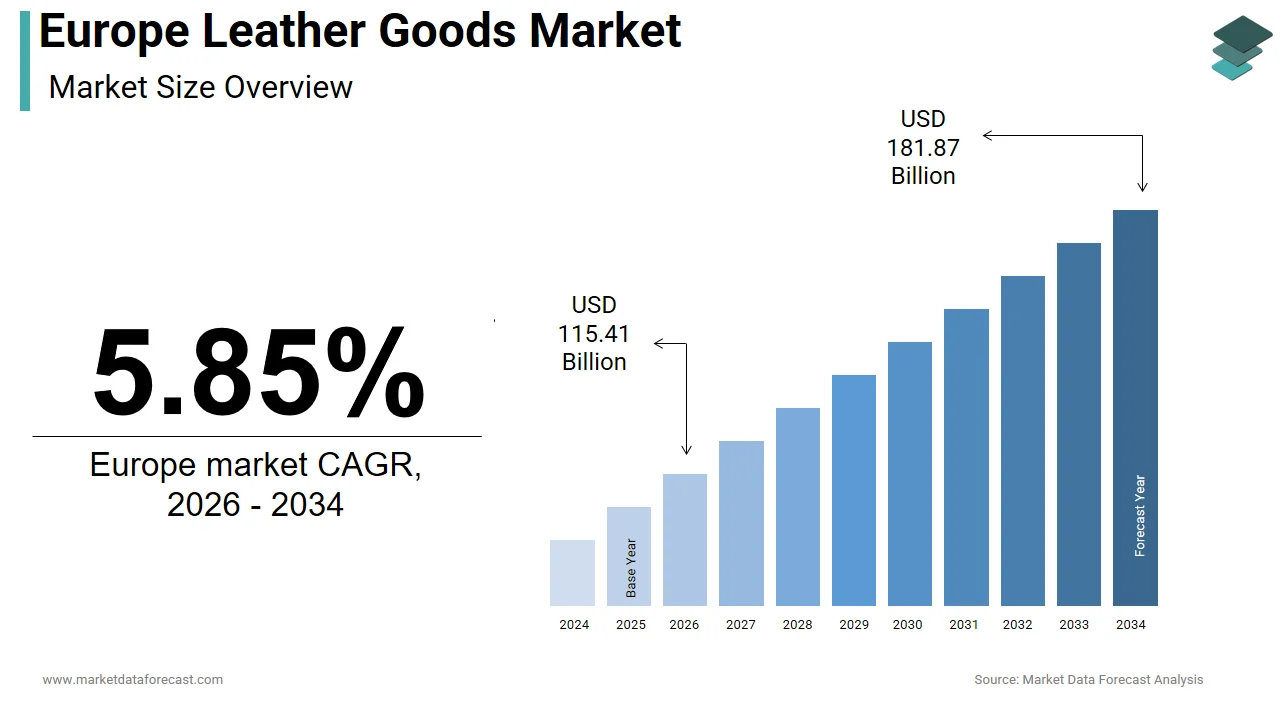
- Valued at USD 109.03 billion in 2025, with projected growth to USD 115.41 billion in 2026 and USD 181.87 billion by 2034.
- CAGR estimated at 5.85% for the 2026–2034 period.
Key Drivers:
- Artisanal Heritage & Craftsmanship: Italy, France, and Spain dominate luxury leather production with centuries-old skills, boosting global trust in European-made leather goods.
- Ethical & Traceable Sourcing: Rising demand for animal welfare compliance, chemical safety, and transparent supply chains under EU regulations.
- Luxury Brand Influence: Strong presence of heritage brands such as Hermès, Chanel, and Louis Vuitton sustains premium market demand.
- Cultural Value & Identity: Leather goods remain symbols of status, tradition, and personal identity across Europe.
Leading Segments:
- Product Type: Handbags, Luggage: Handbags lead due to fashion relevance and emotional value, while luggage is the fastest-growing with rising travel demand.
- End Users: Female, Male: Female consumers dominate, while male demand is rising with growth in professional and minimalist luxury accessories.
- Distribution: Offline, Online: Physical stores lead for premium purchases, while online channels grow rapidly through digital storytelling and resale platforms.
Key Trends:
- Circular Economy Adoption: Expansion of repair, resale, and refurbishment services for leather goods.
- Digital Authentication: Use of QR codes and NFC chips for product traceability and anti-counterfeiting.
- Sustainable Production: Shift toward vegetable tanning, reduced chemical use, and eco-certified tanneries.
- Reshoring of Manufacturing: Revival of local European craft clusters for supply chain resilience.
Major Players:
- Hermès International S.A., Chanel SA, Capri Holdings Limited, Kering S.A., LVMH Moët Hennessy Louis Vuitton SE.
Europe Leather Goods Market Size
The Europe leather goods market size was USD 109.03 billion in 2025, is anticipated to be USD 115.41 billion in 2026, and is projected to reach USD 181.87 billion by 2034, registering a CAGR of 5.85% from 2026 to 2034.
The leather goods are a refined intersection of artisanal heritage, advanced craftsmanship, and regulated material sourcing, centered on high-quality products such as handbags, footwear, wallets, and travel accessories. As per Eurostat, the European Union produced 780,000 metric tons of bovine hides in 2023, with over 60% processed within the EU under strict environmental and animal welfare standards. The European Commission’s REACH regulation governs chemical use in tanning, ensuring that chromium and other substances remain within safe thresholds for both workers and consumers. Cultural institutions further reinforce value, with UNESCO recognizing Italian leather craftsmanship as intangible cultural heritage. Additionally, the European Observatory on Counterfeiting and Piracy estimates that genuine leather goods contribute over 40 billion euros annually to the EU’s creative economy through exports, tourism, and skilled employment.
MARKET DRIVERS
Strong Cultural Legacy and Artisanal Excellence in Luxury Craftsmanship
The globally recognized heritage in luxury craftsmanship, particularly in Italy, France, and Spain, where generational skills are preserved through formal apprenticeships and protected designations, is a major factor driving the growth of Europe leather goods market. According to the European Institute for Luxury Goods, over 85% of the world’s top 50 luxury brands originate from or maintain primary manufacturing in these three countries. In Italy alone, the Tuscan region employs more than 45,000 artisans in leather workshops certified under the “Pelle Conciata al Vegetale” standard, which mandates natural tanning agents and traceable hides. The French Ministry of Culture reports that over 120 state-recognized “Maitres d’Art” specialize in leather maroquinerie preserving techniques that date back to the 17th century. This artisanal depth translates into consumer trust, with a 2024 YouGov survey indicating that 72% of European luxury shoppers consider “made in Europe” a decisive factor in purchasing leather goods. UNESCO’s inclusion of Italian leather artisanship in its Intangible Cultural Heritage list further legitimizes this heritage as a living cultural asset rather than a commercial trend, ensuring sustained demand for authentic European craftsmanship.
Rising Demand for Traceable and Ethically Sourced Premium Products
European consumers increasingly prioritize transparency in material origins and production ethics, driving demand for certified and locally sourced leather goods. As per the European Consumer Organisation, 68% of adults aged 25 to 45 consider animal welfare and environmental impact when purchasing leather products. The European Union’s Farm to Fork Strategy now requires full traceability of raw hides from slaughterhouses to tanneries, with 92% of EU tanneries participating in the Leather Working Group audit system as documented by EUROPEN. In France, the “Origine France Garantie” label has been adopted by over 200 leather goods brands, certifying that at least 50% of production occurs domestically. Similarly, Italy’s “Made in Italy” law mandates rigorous verification of design and assembly location. A 2024 study by the University of Bologna found that products with visible traceability QR codes saw a 33% higher conversion rate among Gen Z shoppers. This convergence of ethical consumption policy enforcement and digital transparency transforms leather goods from mere accessories into statements of responsible luxury aligned with European values.
MARKET RESTRAINTS
Stringent Environmental Regulations on Tanning and Chemical Use
The rigorous environmental legislation governing tannery emissions, chemical usage, and waste management is restricting the growth of Europe leather goods market. As per the European Environment Agency, tanneries are classified as intensive pollution sources under the Industrial Emissions Directive, requiring Best Available Techniques compliance that can cost small workshops up to 1.2 million euros in retrofitting. The REACH regulation has banned over 30 substances commonly used in traditional tanning, including certain azo dyes and formaldehyde-based finishes. The European Chemicals Agency added dimethylformamide, a solvent used in synthetic leather coatings, to the authorization list, effectively phasing it out by 2025. According to EUROPEN, over 180 small tanneries in Southern Europe ceased operations between 2021 and 2024 due to compliance costs. While these rules enhance sustainability, they disproportionately impact artisanal producers who lack capital for green technology adoption.
Intensifying Competition from Vegan and Synthetic Alternatives
The leather goods market is increasingly challenged by the rapid normalization of high-quality vegan and bio-based alternatives endorsed by sustainability narratives and fashion brands, which is also one of the factors hampering the growth of Europe leather goods market. According to the European Commission, over 220 new plant-based “leather” materials received Novel Food or bioproduct approvals between 2022 and 2024, including mycelium mushroom, cactus, and apple fiber composites. Major retailers like Zalando and H&M now allocate dedicated sections to vegan accessories, with sales growing by 41% year on year in 2023, as per IRI Europe. A 2024 Eurobarometer survey revealed that 39% of Europeans aged 18 to 34 believe synthetic alternatives are more ethical than animal leather, regardless of durability or origin. Even luxury houses like Gucci and Stella McCartney promote hybrid collections featuring bio-based materials to appeal to conscious consumers. This shift is amplified by media narratives that conflate all leather with intensive farming despite EU regulations ensuring by-product status and traceability.
MARKET OPPORTUNITIES
Revival of Localized Production Through Reshoring and Craft Clusters
The renaissance of localized leather production driven by consumer demand for authenticity and supply chain resilience, which is setting up new opportunities for the growth of Europe leather goods market. As per the European Commission’s 2023 Industrial Strategy, update 67% of EU consumers prefer products made within 500 kilometers of their purchase location. Countries like Portugal and Spain are revitalizing historic tannery districts with public-private investment, where the Santa Croce cluster in Italy received 85 million euros from the EU Recovery Fund to modernize 120 small workshops with solar-powered drying and closed-loop water systems. In France, the “Fabriques de la Cité” initiative supports micro factories that blend handcraft with digital tools like laser cutting for bespoke leather goods. The European Institute of Innovation and Technology launched the CRAFT 2030 program in 2024, funding 30 artisanal cooperatives to integrate blockchain traceability and e-commerce. This localization not only reduces carbon footprint but also preserves rural employment with over 12,000 jobs created in peripheral regions through craft cluster policies, as noted by Eurostat.
Integration of Digital Authentication and Circular Business Models
The adoption of digital passports and circular service models to enhance product longevity and combat counterfeiting, which is gearing up the growth of Europe leather goods market. In response, the European Commission’s Digital Product Passport framework, mandated under the Ecodesign for Sustainable Products Regulation, will require all high-value leather items to embed NFC chips or QR codes by 2027, disclosing material origin care instructions and repair options. Brands like Louis Vuitton and Loewe have already piloted these systems, enabling customers to access lifetime repair services and resale authentication. Furthermore, platforms like Vestiaire Collective now prioritize verified European leather items for their “Pre Loved Luxury” segment. This fusion of heritage durability and digital stewardship positions European leather goods as pioneers in the circular economy rather than relics of a linear past.
MARKET CHALLENGES
Volatility in Raw Material Availability and Rising Input Costs
The leather goods manufacturers face persistent instability in raw hide supply due to declining EU cattle slaughter rates and competition from the food and pharmaceutical sectors. The volatility in raw material availability and rising input costs is also limiting the growth. According to Eurostat, the number of bovine animals slaughtered in the EU fell by 11% between 2020 and 2024 as a result of farm consolidation and shifting dietary patterns. Since hides are a by-product of meat production, reduced slaughter directly constrains leather availability regardless of demand. Simultaneously, tannery input costs have surged with vegetable tannins up 34% and water treatment chemicals rising 28% in 2023, as per the European Tanners Confederation. Energy prices further compound pressure with Italian workshops reporting a 45% increase in drying and finishing costs due to gas dependency. Unlike synthetic alternatives whose feedstocks are petrochemical and scalable, leather remains subject to biological and agricultural cycles. This supply inelasticity forces brands to raise prices or compromise on thickness and grain quality, eroding the very attributes that define premium European leather.
Generational Skills Gap and Declining Artisan Workforce
The acute shortage of skilled artisans, as younger generations gravitate toward digital or service sector careers, is also expected to impede the growth of Europe leather goods market. According to the European Centre for the Development of Vocational Training, fewer than 8,000 apprentices enrolled in leather craftsmanship programs across the EU in 2023, a 38% decline from 2015. In France, the average age of master saddlers and maroquiniers exceeds 57 years, with only 12% of workshops having a succession plan as documented by the National Institute of Crafts. Italy’s Confindustria Pelle reports that 60% of small tanneries struggle to recruit pattern cutters and hand stitchers despite offering above average wages. Although the EU’s Erasmus+ program funds craft exchanges, participation remains low due to a perceived lack of prestige. A 2024 OECD review warned that without urgent intervention, Europe could lose 40% of its specialized leather skills by 2035.
REPORT COVERAGE
| REPORT METRIC | DETAILS |
| Market Size Available | 2025 to 2034 |
| Base Year | 2025 |
| Forecast Period | 2026 to 2034 |
| Segments Covered | By Product Type, End User, Category, Distribution Channel, and Country. |
| Various Analyses Covered | Global, Regional, and Country-Level Analysis, Segment-Level Analysis, Drivers, Restraints, Opportunities, Challenges; PESTLE Analysis; Porter’s Five Forces Analysis, Competitive Landscape, Analyst Overview of Investment Opportunities |
| Countries Covered | UK, France, Spain, Germany, Italy, Russia, Sweden, Denmark, Switzerland, Netherlands, Turkey, Czech Republic, and the Rest of Europe. |
| Market Leaders Profiled | Hermès International S.A., Chanel SA, Capri Holdings Limited, Kering S.A., LVMH Moët Hennessy Louis Vuitton SE, and Others. |
SEGMENTAL ANALYSIS
By Product Type Insights
The handbags segment was the largest by capturing 38.3% of the Europe leather goods market share in 2024, with the dual role as functional accessories and symbols of personal identity and social status. According to the European Institute for Luxury Goods, over 70% of European women aged 25 to 55 own at least three leather handbags, with replacement cycles averaging every 18 to 24 months for mid to high-end pieces. Italy and France dominate production, with the Tuscany and Paris regions alone accounting for 62% of EU handbag exports in 2023, as per Eurostat. Iconic designs, such as the Hermès Birkin or Prada Re-Edition, benefit from decades of heritage storytelling. The segment also thrives on limited editions and artisanal customization, with brands like Furla and Longchamp offering monogramming and color personalization in flagship stores. This blend of emotional resonance, practicality, and cultural capital ensures handbags remain the cornerstone of Europe’s leather goods ecosystem.
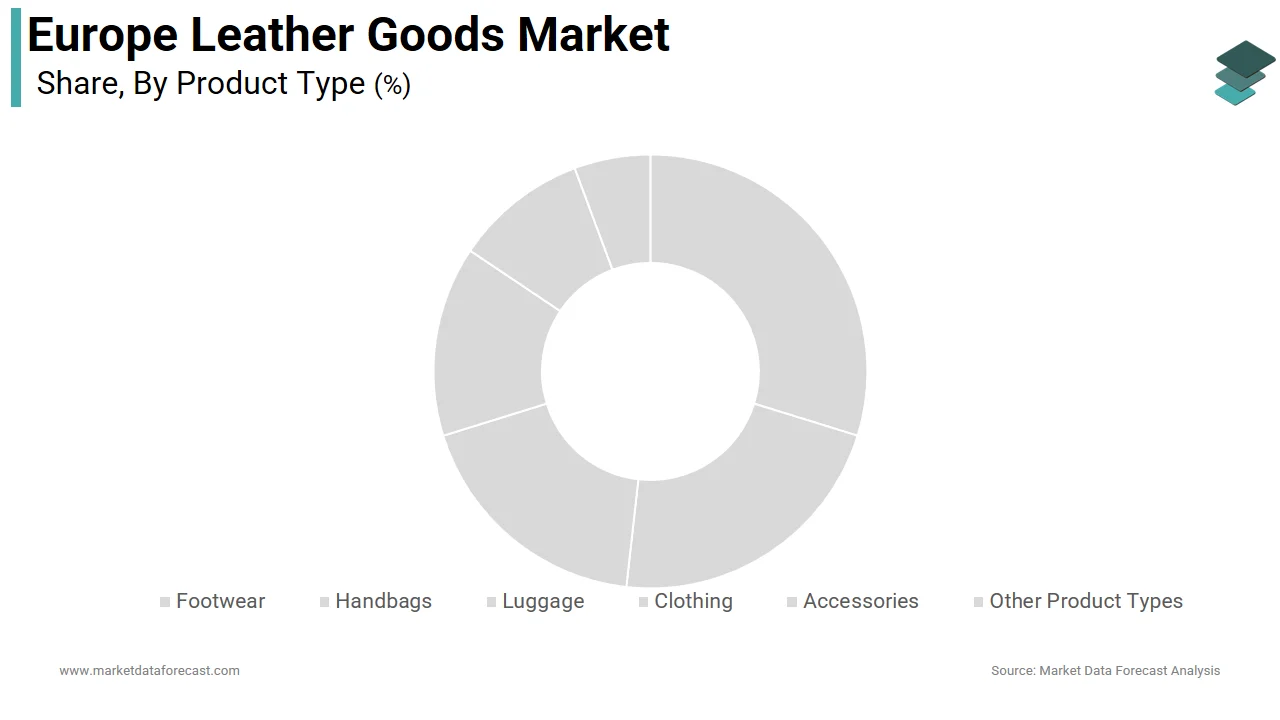
The luggage segment is more likely to register the fastest CAGR of 9.6% from 2026 to 2034, with the post pandemic resurgence of international travel, sustainable tourism, and demand for durable, long-lasting travel solutions. As per the European Travel Commission, international tourist arrivals to and from the EU reached 620 million in 2023, exceeding pre-pandemic levels by 8%. Brands like Rimowa and Tumi have reintroduced leather trim collections, while Italian labels such as Valextra and Vuitton emphasize lifetime repair guarantees aligned with the EU Right to Repair initiative. The European Commission’s Ecodesign for Sustainable Products Regulation further incentivizes durable design by mandating reparability scoring from 2026. Moreover, business travel rebounded up 22% in 2023 has revived demand for professional leather briefcases and carry-ons.
By End User Insights
The female consumers segment accounted in holding 54.3% of the Europe leather goods market share in 2024. The rise of female economic empowerment further amplifies this trend, where 78% of European women aged 30 to 50 are primary household income earners or co-earners, as per the European Institute for Gender Equality, increasing discretionary spending power. Fashion weeks in Paris, Milan, and London consistently spotlight women’s leather collections. Retail strategies also cater heavily to female preferences, with 85% of leather goods flagship store layouts designed around women’s browsing and fitting behaviors, as documented by the European Retail Research Network. Additionally, social media platforms like Instagram drive discovery, with 69% of European women reporting they discovered their last leather purchase through influencer content, according to a 2024 Kantar study.
The male segment is likely to witness the fastest CAGR of 8.9% during the forecast period, with the evolving masculinity norms rising demand for minimalist luxury, and workplace formality in professional sectors. As per the European Commission’s 2023 labor statistics, over 42 million men in Europe work in finance, law, consulting, and executive roles where leather briefcases, portfolios, and high-quality footwear signal professional credibility. The “quiet luxury” trend, which is emphasizing understated quality over logos, has particularly resonated with male consumers, with brands like Brunello Cucinelli and Serapian reporting 35% year on year growth in men’s leather goods in 2023. Additionally, the rise of remote work has increased demand for functional, yet refined home office accessories like laptop sleeves and document holders.
By Distribution Channel Insights
The offline retail stores segment was the largest by holding 56.3% of the Europe leather goods market share in 2024 due to the tactile nature of leather products, the importance of craftsmanship demonstration, and the experiential value of in-store service. According to the European Retail Confederation, 82% of consumers who purchase leather goods priced above 300 euros prefer to touch, feel, and inspect stitching and grain in person before buying. Flagship stores in luxury districts like Paris’s Rue Saint Honoré or Milan’s Quadrilatero della Moda serve as brand temples, where artisans often conduct live demonstrations of hand stitching and patina development. The European Institute for Luxury Goods notes that offline channels account for over 90% of full-price sales, as discounting is minimized to preserve brand equity. Moreover, personalized services such as embossing repairs and bespoke consultations are predominantly offered in physical stores, with 74% of high-net-worth clients citing in-person interaction as critical to loyalty, as per a 2024 Altagamma Foundation report.
The online retail segment is anticipated to witness the fastest CAGR of 12.3% during the forecast period, with the enhanced digital storytelling, immersive technologies, and the rise of authenticated pre-owned platforms. As per the European E-Commerce Association, online sales of leather goods grew by 29% in 2023, with luxury brands investing heavily in 360-degree product views, material close-ups, and artisan interview videos to replicate tactile trust digitally. Platforms like Mytheresa and Net-a-Porter now offer virtual try-on for handbags using augmented reality, reducing return rates by 18% as documented in their 2024 sustainability reports. Furthermore, EU consumer protection laws like the Digital Services Act have increased trust in online authenticity guarantees. While offline remains dominant for first-time purchases, online channels are capturing repeat buyers, secondary markets, and younger demographics seeking convenience without compromising on heritage verification.
COUNTRY-LEVEL ANALYSIS
Italy Leather Goods Market Analysis
Italy was the largest contributor to the Europe leather goods market by holding 28.3% of the share in 2024, with its unrivaled artisanal ecosystem and vertical integration from tannery to boutique. The country is home to over 5,200 registered leather workshops, with the Arno Valley near Florence recognized as the world’s premier hub for vegetable-tanned leather as per the Italian National Institute of Statistics. Brands like Gucci, Prada, and Bottega Veneta operate heritage ateliers, where master artisans with decades of experience handcraft limited edition pieces. According to Confindustria Moda, Italian leather goods accounted for 41% of EU luxury exports in 2023, with the “Made in Italy” label serving as a global trust signal. The government actively protects this heritage through the “Distretto della Pelletteria” initiative, which provides tax incentives for workshops that train apprentices. Additionally, Florence’s annual Pelletteria Italiana exhibition attracts over 15,000 international buyers annually.
France Leather Goods Market Analysis
France leather goods market is witnessing a steady growth opportunity with its haute maroquinerie tradition, iconic luxury houses, and state-backed craftsmanship preservation. Paris remains the global capital of luxury leather design, housing the headquarters of Hermes, Louis Vuitton, and Longchamp, where leather goods are crafted in historic workshops using techniques passed down for generations. Hermes alone employs more than 3,500 leather artisans across France, with each Birkin bag requiring 18 to 25 hours of hand stitching as verified in its annual transparency report. The country also leads in sustainable innovation, with the “Origine France Garantie” label certifying domestic production for over 200 leather brands. This strategic blend of heritage innovation and cultural diplomacy cements France’s position as Europe’s second-largest yet most influential leather goods market.
Spain Leather Goods Market Analysis
Spain leather goods market growth is likely to grow with its strong regional craftsmanship clusters, affordable luxury positioning, and growing export orientation. The regions of Catalonia and Andalusia host over 1,800 small and medium leather workshops specializing in handbags, footwear, and equestrian goods, many of which supply private label collections for European retailers. Brands like Loewe, a heritage house now revitalized under LVMH, have elevated Spanish design on the global stage, while accessible labels, such as Desigual and Cuyana, leverage local production for ethical storytelling. The Spanish government’s “Marca Espana” initiative promotes artisanal leather as part of national cultural identity, with EU funding supporting solar-powered tanneries in Extremadura.
United Kingdom Leather Goods Market Analysis
The United Kingdom leather goods market growth is propelled by the heritage brands strong retail infrastructure and a mature pre-owned luxury ecosystem. London is home to iconic houses like Mulberry and Aspinal of London, which emphasize British craftsmanship with workshops in Somerset and East Sussex employing over 600 artisans, as per the British Leather Confederation. The UK leads Europe in authenticated resale, with platforms like Vestiaire Collective and Cudini reporting that 44% of European pre-owned leather transactions originate from British sellers. According to the Office for National Statistics, UK consumers spend the highest per capita on leather accessories in Europe, driven by gifting culture and professional norms in finance and law. A 2024 YouGov survey found that 68% of British shoppers associate leather goods with longevity and anti-fast fashion values.
Germany Leather Goods Market Analysis
Germany leather goods market growth is likely to grow with the engineering precision, functional design, and demand for understated quality. While less associated with fashion, Germany excels in business leather goods such as briefcases, portfolios, and travel accessories, where durability and ergonomic design are paramount. Brands like Braun Buffel and MCM, though MCM is now global, originated in Germany with a focus on technical leather treatment and hardware integration. According to the German Fashion Industry Association, over 70% of German leather goods buyers prioritize repairability and material origin over brand logos. The country’s strong vocational training system produces highly skilled leather technicians, with over 1,200 apprentices enrolled in saddlery and leathercraft programs in 2023, as per the Federal Institute for Vocational Education. This rational value-driven approach positions Germany for functional, high-integrity leather goods that align with European circular economy principles.
COMPETITIVE LANDSCAPE
Competition in the Europe leather goods market is defined by a dual dynamic where heritage luxury houses compete on authenticity, craftsmanship, and legacy, while contemporary and accessible brands differentiate through design innovation, sustainability narratives, and digital engagement. The market is not price-driven but value anchored, with consumers willing to pay premiums for demonstrable origin, artisanal quality, and repairability. Dominant players leverage vertically integrated production to maintain control over every stage from tannery to boutique, ensuring consistency and exclusivity. Meanwhile, emerging brands gain traction through transparency, vegan hybrid materials, and direct-to-consumer storytelling. Regulatory pressures such as the EU Digital Product Passport and Ecodesign Directive raise the bar for all participants requiring investments in traceability and circular services. Counterfeit goods remain a persistent threat, yet also validate the desirability of genuine European leather.
KEY MARKET PLAYERS
The leading companies operating in the Europe leather goods market include:
- Hermès International S.A.
- Chanel SA
- Capri Holdings Limited
- Kering S.A.
- LVMH Moët Hennessy Louis Vuitton SE
TOP PLAYERS IN THE MARKET
- LVMH is a global luxury conglomerate with deep roots in Europe’s leather goods heritage through iconic houses such as Louis Vuitton Loewe and Celine. The group maintains over 120 leather ateliers across France, Spain, and Italy, employing thousands of master artisans who uphold traditional techniques while integrating modern design. LVMH launched its “Leather Traceability Initiative,” embedding NFC chips in select handbags to provide full lifecycle transparency from raw hide to final product. The company also expanded its repair and restoration services across 30 European cities, reinforcing its commitment to longevity and circularity. These actions position LVMH not only as a commercial leader but as a steward of European craftsmanship on the global stage.
- Kering SA is a French multinational that champions sustainable luxury through its portfolio of leather goods brands, including Gucci, Saint Laurent, and Bottega Veneta. The company has embedded environmental accountability into its supply chain by requiring all tanneries to achieve Gold or Silver certification under the Leather Working Group. Kering introduced its “Craftsmanship Academy” in Florence, training over 500 young artisans annually in hand stitching, leather cutting, and material sourcing. It also partnered with the European Institute of Innovation and Technology to develop bio-based leather alternatives that retain the aesthetic of calfskin.
- Hermes International is synonymous with exceptional leather craftsmanship, renowned for its meticulous hand assembled products, such as the Birkin and Kelly bags. The company operates over 50 production sites in France, where each item undergoes 15 to 25 hours of artisanal labor, ensuring uncompromising quality. Hermes inaugurated a new leather training center in Normandy to address the generational skills gap and secure the future of French maroquinerie. It also enhanced its digital passport system, allowing clients to access repair history and material origin via a dedicated app. Hermes’ unwavering dedication to human skill over automation preserves Europe’s artisanal legacy while setting global benchmarks for timeless luxury.
TOP STRATEGIES USED BY THE KEY MARKET PARTICIPANTS
Key players in the Europe leather goods market prioritize artisanal preservation by investing in training programs and heritage ateliers to sustain generational craftsmanship. They implement full supply chain traceability using digital passports and blockchain to authenticate origin and comply with EU sustainability regulations. Strategic expansion of repair, restoration, and resale services reinforces circular economy principles and enhances customer lifetime value. Companies also collaborate with European research institutions to develop next-generation bio-based leathers that meet luxury standards without compromising ethics.
MARKET SEGMENTATION
This research report on the Europe leather goods market has been segmented and sub-segmented into the following categories.
By Product Type
- Footwear
- Handbags
- Luggage
- Clothing
- Accessories
- Other Product Types
By End User
- Male
- Female
By Category
- Mass
- Premium
By Distribution Channel
- Offline Retail Stores
- Online Retail Stores
By Country
- United Kingdom
- France
- Spain
- Germany
- Italy
- Russia
- Sweden
- Denmark
- Switzerland
- Netherlands
- Rest of Europe