- Product Description Description
- Table of Contents TOC
- List of Table & Figure LOT
- Get Free Sample PDF Sample PDF
Market Size, 2025
$32.99 BnMarket Estimate, 2026
$40.57 BnMarket Forecast, 2034
$212.27 BnCAGR, 2026–2034
22.98%Europe Live Streaming Market Report Summary
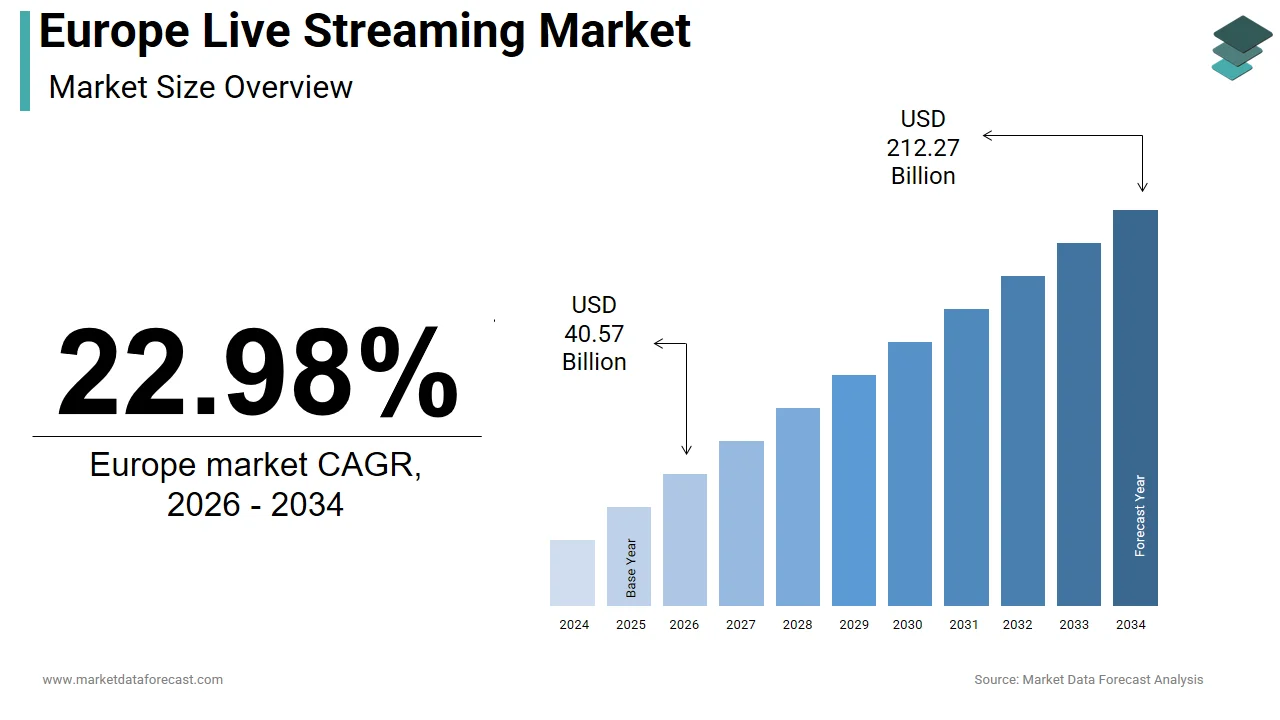
The Europe live streaming market was valued at USD 32.99 billion in 2025, is estimated to reach USD 40.57 billion in 2026, and is projected to reach USD 212.27 billion by 2034, growing at a strong CAGR of 22.98% from 2026 to 2034. The growth of the Europe live streaming market is driven by rising internet penetration, high-speed broadband availability, and the increasing adoption of real-time digital engagement across entertainment, education, commerce, and civic platforms. Over 74% of European internet users engage with live video content weekly, supported by widespread fiber connectivity and the European Commission’s Digital Decade initiative. The cultural shift toward interactive media, live commerce, and community-driven digital participation continues to accelerate market expansion across the region.
Key Market Trends
- Rapid integration of live streaming into e-commerce enables real-time shopping experiences with higher conversion rates.
- Rising use of live platforms for civic engagement, public discourse, and cultural participation across Europe.
- Growing adoption of interactive formats such as live Q&A, polls, and multi-angle streaming for enhanced audience engagement.
- Expansion of public broadcaster live content, strengthening regional and cultural identity.
- Increasing focus on media literacy and digital inclusion under EU digital transformation programs.
Segmental Insights
- Based on component, the platforms segment accounted for a prominent share of the Europe live streaming market in 2025. This dominance is driven by major platforms such as YouTube, Twitch, and Instagram Live, which aggregate large user bases and offer integrated tools for discovery, interaction, and monetization. These platforms provide end-to-end solutions, including encoding, moderation, and payment processing, reducing technical barriers for creators and supporting scalable audience engagement.
- Based on end user, the media and entertainment sector held the largest share with 41.3% in 2024, driven by live sports, concerts, and cultural events that attract massive concurrent viewership. These broadcasts generate high advertising revenue and premium subscriptions while enabling interactive features such as live chat and audience polling.
Regional Insights
The Europe live streaming market is witnessing rapid growth across major economies, supported by advanced digital infrastructure, strong creator ecosystems, and increasing adoption of live engagement formats across entertainment, education, and commerce.
- United Kingdom held 19.2% market share in 2024, driven by high 5G penetration, strong live commerce adoption, and regulatory clarity for content moderation.
- Germany ranked second, supported by enterprise adoption, GDPR compliance leadership, and secure corporate live communication systems.
- France continues to grow steadily, fueled by state-backed cultural broadcasting, nationwide fiber connectivity, and exclusive sports streaming rights.
Competitive Landscape
The Europe live streaming market features a highly dynamic competitive environment shaped by global technology leaders, regional platforms, and traditional media companies undergoing digital transformation. Large players benefit from scale, infrastructure, and ecosystem integration, while smaller platforms differentiate through niche content such as live education, civic engagement, and sustainable broadcasting. Regulatory frameworks such as the Digital Services Act favor well-resourced firms but also encourage privacy-focused innovation. Public broadcasters are launching proprietary platforms to retain audience control and data sovereignty. Companies that successfully combine technological reliability, regulatory compliance, cultural relevance, and creator support are best positioned for long-term leadership in Europe’s evolving live streaming ecosystem.
Prominent companies in the Europe live streaming market include AfreecaTV Corp., Alphabet Inc., Amazon.com Inc., BoxCast Inc., Brightcove Inc., Dacast Inc., Dailymotion (Vivendi), Empire Video Productions LLC, and EventStreaming.TV (WaveFX), Flux Broadcast, Google LLC, International Business Machines Corporation, Meta Platforms Inc., and Microsoft Corporation.
Europe Live Streaming Market Size
The Europe live streaming market was valued at USD 32.99 billion in 2025, is estimated to reach USD 40.57 billion in 2026, and is projected to reach USD 212.27 billion by 2034, growing at a CAGR of 22.98% from 2026 to 2034.
Live streaming is a real-time digital interaction, immersive content delivery, and audience participation, reshaping entertainment, education, commerce, and civic engagement. As per the European Audiovisual Observatory, over 74% of internet users aged 16 to 64 in the EU engaged with live video content at least once per week in 2024. According to Eurostat, 89% of European households now have fixed broadband connections with average download speeds exceeding 150 Mbps, enabling high-quality real-time transmission without significant buffering. The cultural adoption of live formats is further amplified by the European Commission’s Digital Decade initiative, which prioritizes media literacy and digital infrastructure investment. Additionally, UNESCO has recognized community-driven live documentation during social movements in cities like Athens and Warsaw as emerging forms of digital heritage.
MARKET DRIVERS
Accelerated Integration of Live Streaming in E-Commerce and Retail Experiences
Live commerce has emerged as a powerful driver of live streaming adoption as brands seek to replicate the social energy of in-store shopping in digital environments, which is accelerating the growth of Europe live streaming market. In the UK, live shopping events during the 2023 holiday season generated 2.3 times higher average order values than static product pages, as per the British Interactive Media Association. The appeal lies in the fusion of entertainment and transaction, with viewers able to purchase instantly, while engaging with hosts and fellow shoppers. A 2024 survey by GfK found that 58% of European consumers aged 18 to 45 trust product demonstrations in live streams more than traditional advertisements due to perceived authenticity and unscripted interaction. This behavioral shift is particularly strong in Southern Europe, where social shopping traditions translate seamlessly into digital formats. Platforms like TikTok LIVE and Instagram Live have expanded localized payment integrations and seller verification systems to support commercial reliability while maintaining spontaneity.
Rising Demand for Real-Time Civic and Cultural Participation
European audiences increasingly use live streaming to engage with public discourse, cultural events, and community narratives, fostering a sense of collective presence beyond physical boundaries. According to the European Cultural Participation Index 2024, over 67% of national festivals, museums, and theater institutions across Europe now offer live-streamed access to performances or exhibitions, with 42% reporting higher domestic viewership than in-person attendance. During the 2023 European Parliament elections, live Q&A sessions with candidates reached 12 million unique viewers across Germany, Spain, and Sweden, as per the European Democracy Lab. Similarly, grassroots movements such as climate strikes in Berlin and linguistic heritage celebrations in Catalonia routinely use live video to mobilize support and document events in real time. This democratization of visibility empowers local voices while preserving cultural continuity. The European Broadcasting Union notes that public service broadcasters like France Télévisions and RAI have increased live streaming of regional content by 38% since 2022 to strengthen local identity in an age of global platforms.
MARKET RESTRAINTS
Fragmented Data Privacy and Content Moderation Regulations Across Member States
The complex and inconsistent regulations that complicate compliance and content governance are restraining the growth of Europe live streaming market. While the EU’s Digital Services Act establishes baseline obligations for very large online platforms, the implementation of national laws on hate speech data retention and real-time content removal varies significantly. According to the European Data Protection Board, 17 EU countries have enacted additional streaming-specific provisions beyond the DSA, creating operational friction for pan-European broadcasters. In Germany, for instance, the Network Enforcement Act requires platforms to remove illegal content within 24 hours or face fines up to 50 million euros, whereas Sweden applies a more contextual evaluation process. This divergence forces live streaming services to deploy multiple moderation protocols, increasing costs and response latency. A 2024 audit by the European Policy Centre found that 63% of mid-sized European streaming platforms delayed event launches due to legal uncertainty around cross-border live content. The absence of a unified real-time compliance framework thus acts as a structural brake on scalability and innovation, particularly for emerging players lacking legal infrastructure.
Persistent Gaps in Rural and Eastern European Broadband Infrastructure
Despite overall high connectivity levels, live streaming penetration remains uneven due to persistent infrastructure disparities, particularly in rural and Eastern European regions. This factor is also limiting the growth of Europe live streaming market. According to Eurostat, only 58% of households in Romania, Bulgaria, and parts of Greece had access to fixed broadband speeds above 100 Mbps in 2024, compared to over 92% in the Nordic countries. This gap directly impacts both content creation and viewership quality as live streams require stable upstream bandwidth rarely available in underserved areas. The European Electronic Communications Observatory reports that average upload speeds in rural Hungary and Slovakia fall below 15 Mbps, insufficient for HD live broadcasting without frequent interruptions. Consequently, creators in these regions face exclusion from mainstream live ecosystems while audiences experience buffering and low resolution, reducing engagement. Although the EU’s Connecting Europe Facility allocated 3.2 billion euros in 2023 to close the digital divide, deployment timelines remain slow.
MARKET OPPORTUNITIES
Expansion of Immersive Live Streaming through Extended Reality Integration
The emergence of live streaming with augmented and virtual reality technologies to deepen audience immersion and interactivity is setting up new opportunities for the growth of Europe live streaming market. According to the European Immersive Media Adoption Survey 2024, 31% of consumers in Germany, France, and the Netherlands expressed willingness to attend live events, such as concerts, lectures, or product launches in virtual environments if offered by trusted brands. Platforms like Meta and Spatial are piloting 360-degree live streams with spatial audio and avatar-based interaction, enabling users to navigate virtual venues and socialize in real time. The Vienna State Opera launched a monthly VR live broadcast series attracting over 200,000 virtual attendees per performance, as per Austria’s Federal Ministry for Arts and Culture. Educational institutions are also adopting this model, with the University of Copenhagen hosting live interactive lectures in virtual classrooms attended by students across 18 countries. As per the European Innovation Council, extended reality live streaming is projected to grow at 34% annually through 2027, driven by falling hardware costs and 5G-enabled low-latency transmission. This shift moves live streaming beyond flat screens into experiential digital spaces, creating new revenue models and audience relationships.
Growth of Niche Community-Driven Live Platforms for Specialized Interests
The proliferation of vertically focused live streaming platforms catering to specific hobbies, professions, or cultural identities is another attribute escalating the growth of Europe live streaming market. Unlike generalist platforms, these services foster deeper trust, engagement, and monetization through highly targeted content. According to the European Digital Communities Monitor 2024, over 220 specialized live platforms now operate across Europe, focusing on areas such as classical music, artisanal crafts, sustainable farming, and regional language preservation. In Finland, the live platform “MusiikkiSuora” streams real-time folk music sessions from rural villages, connecting diaspora communities and attracting educational partnerships. Similarly, “GreenStream EU” enables live tours of organic farms in France and Denmark, with viewers purchasing produce directly during broadcasts. GfK’s 2024 Creator Economy Report notes that niche streamers earn 2.8 times more per viewer than on mainstream platforms due to higher loyalty and lower acquisition costs.
MARKET CHALLENGES
Scalability of Real-Time Content Moderation for Harmful or Illegal Material
The instantaneous and unpredictable nature of live content poses severe challenges for timely detection and removal of harmful material, including hate speech, harassment, and disinformation, which is one of the challenges for the growth of Europe live streaming market. Unlike pre-recorded video live streams offer no opportunity for pre-screening, and AI moderation systems often lag in contextual understanding, particularly for regional languages or coded speech. According to a 2024 study by the European Institute for Security and Democracy, live streams containing extremist rhetoric during political rallies in Belgium and Poland remained online for an average of 47 minutes before human moderators intervened. The European Union Agency for Fundamental Rights reports that 68% of European users have encountered disturbing or illegal content during live broadcasts, with only 29% confident that platforms would act swiftly. While large tech firms employ thousands of moderators, the volume and velocity of live content, especially during global events, overwhelm existing systems. Moreover, the DSA’s requirement for rapid response creates pressure to over moderate the risk of censorship of legitimate expression.
Monetization, Fragmentation, and Creator Revenue Instability
Many European live streamers struggle with inconsistent and fragmented income streams, undermining professional sustainability, which is another factor hampering the growth of Europe live streaming market. Platform economics rely heavily on viewer donations, subscriptions, and ad shares, but payout structures vary widely with no standardized transparency. According to the European Creator Economy Observatory 2024, only 14% of active live streamers in Europe earn a livable income solely from streaming, with the majority supplementing through offline work or brand deals. In Southern and Eastern Europe, where payment integration is less developed, creators report 30 to 50% lower earnings than their Western counterparts for comparable audience sizes, as per the European Freelancers Union. Additionally, frequent algorithm changes on major platforms can abruptly reduce visibility, leading to revenue volatility. A 2023 survey found that 59% of European streamers abandoned live content within 18 months due to financial unpredictability. While the EU’s proposed Fair Digital Markets Act aims to improve creator protections, implementation remains distant.
REPORT COVERAGE
| REPORT METRIC | DETAILS |
| Market Size Available | 2025 to 2034 |
| Base Year | 2025 |
| Forecast Period | 2026 to 2034 |
| Segments Covered | By Component, End-user, and Region. |
| Various Analyses Covered | Global, Regional, and Country-Level Analysis, Segment-Level Analysis, Drivers, Restraints, Opportunities, Challenges; PESTLE Analysis; Porter’s Five Forces Analysis, Competitive Landscape, Analyst Overview of Investment Opportunities |
| Regions Covered | North America, Europe, Asia Pacific, Latin America, Middle East & Africa |
| Market Leaders Profiled | AfreecaTV Corp., Alphabet Inc., Amazon.com Inc., BoxCast Inc., Brightcove Inc., Dacast Inc., Dailymotion (Vivendi), Empire Video Productions LLC, EventStreaming.TV (WaveFX), Flux Broadcast, Google LLC, International Business Machines Corporation, Meta Platforms Inc., Microsoft Corporation, and Others. |
SEGMENTAL ANALYSIS
By Component Insights
The platforms segment accounted for a prominent share of the Europe live streaming market in 2025. Major platforms function as gatekeepers of audience attention by aggregating users and offering integrated tools for discovery, interaction, and monetization. According to the European Audience Behavior Monitor 2024, over 82% of live streaming viewers in Europe access content primarily through five dominant platforms, including YouTube, Twitch, and Instagram Live. These platforms leverage algorithmic curation network effects and mobile optimization to retain users with average session durations exceeding 38 minutes per live event, as per Eurostat’s Digital Engagement Metrics. They provide end-to-end solutions from encoding and transcoding to chat moderation and tipping, thereby reducing technical barriers for creators. In Germany and France, 74% of professional streamers rely exclusively on these platforms due to their plug-and-play reliability and built-in payment processing. Platforms are no longer generic broadcasters but are evolving into industry-tailored environments. According to the European Tech Innovation Council 2024, YouTube introduced shoppable live streams for European retailers in 2023, thereby enabling real-time product tagging and checkout without leaving the video. Similarly, Twitch launched “Learn” categories in partnership with universities in Sweden and the Netherlands, offering accredited coding workshops via live interaction. These vertical integrations deepen utility beyond entertainment and lock in sector-specific user bases. The European Commission’s Digital Markets Unit noted that 61% of new live streaming adoption in education and retail since 2022 occurred through platform native features rather than third-party services.
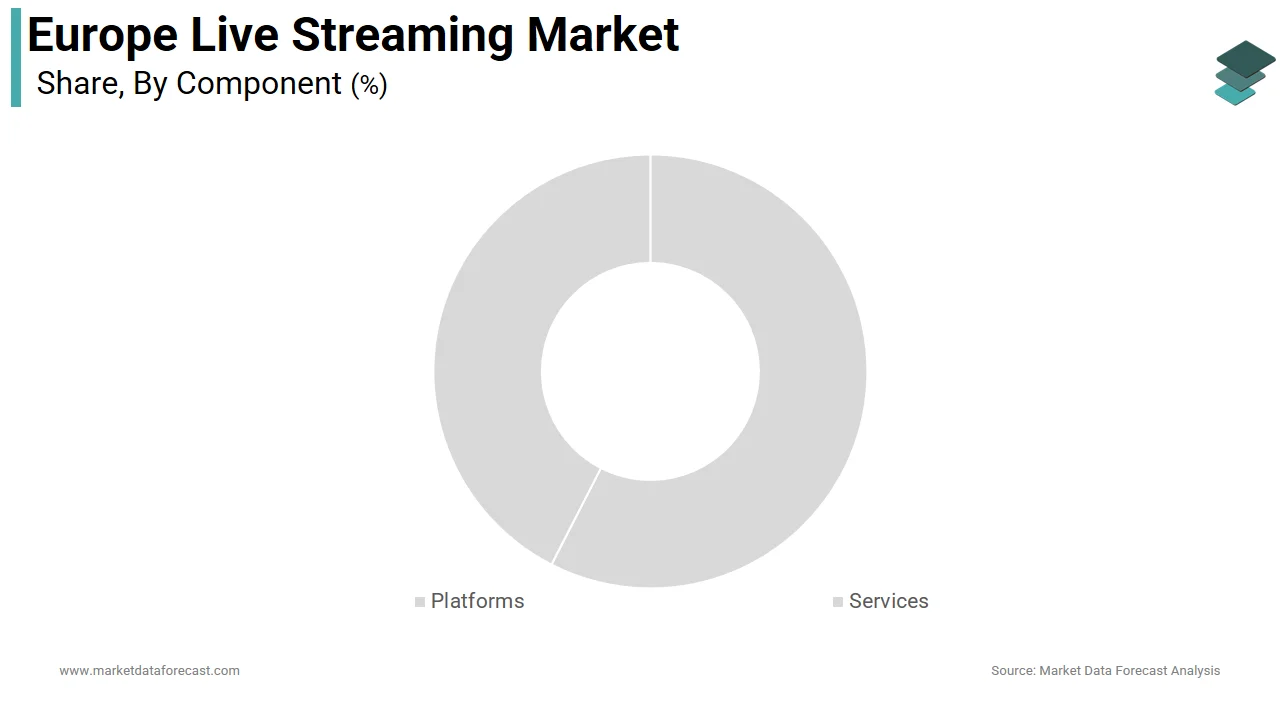
The services segment is likely to grow with an anticipated CAGR of 18.6% throughout the forecast period. As corporations, governments, and institutions adopt live streaming for high-stakes communication, they require professional-grade production far beyond consumer platforms. According to the European Corporate Digital Engagement Survey 2024, 73% of Fortune 500 companies operating in Europe now outsource live event production to ensure broadcast quality, security, and archival compliance. Financial institutions in Switzerland and the Netherlands, for instance, mandate end-to-end encryption and real-time transcription for investor calls, capabilities rarely available on public platforms. Language diversity and content safety regulations have increased demand for specialized support services. The European Union’s requirement under the Digital Services Act for the rapid removal of illegal content has made real-time moderation essential. According to the European AI Deployment Tracker 2024, AI-driven moderation services analyzing speech tone and visual cues in 24 European languages grew by 42% in 2023. Companies like LiveModerate, EU-based in Denmark, now offer live subtitling and hate speech detection with 92% accuracy, as verified by the Technical University of Berlin. Additionally, cultural localization services adjusting content tone and references for regional audiences have become a pan-European campaign. A GfK study found that live streams using localized moderation and subtitles achieved 3.1 times higher viewer retention in Southern and Eastern Europe. This surge in compliance and customization needs is transforming services from ancillary support into a core strategic layer of the live streaming value chain.
By End User Insights
The media and entertainment sector segment was the largest by holding 41.3% of Europe’s live streaming market share in 2024. Live sports and concerts generate unparalleled concurrent viewership, driving platform adoption and advertising revenue. According to UEFA, over 18 million European viewers tuned in to the 2023 Champions League final via official live streams with a 27% increase from 2022. Similarly, the Glastonbury Festival’s 2024 live stream reached 4.3 million unique viewers across 32 countries, as per the UK’s Office of Communications. These events create cultural moments that platforms monetize through ads, premium tiers, and data collection. In France, Canal+ reported that 68% of its new streaming subscribers in 2023 cited live football as the primary reason for signing up. The scalability of entertainment content, where one broadcast serves millions, makes it economically superior to niche verticals and ensures consistent investment in streaming infrastructure by broadcasters and rights holders alike. Media companies are embedding polls, chat overlays, and multi-angle feeds to transform passive viewing into participatory experiences. This interactivity not only boosts engagement but also generates rich behavioral data used to refine future programming.
The education segment is more likely to grow with an expected CAGR of 22.3% from 2026 to 2034. Universities and vocational schools are embedding live streaming into core curricula to support flexible learning. The University of Copenhagen’s live biology dissections and ETH Zurich’s real-time engineering labs have become models for experiential remote education. This institutional backing ensures consistent demand independent of consumer trends. Moreover, the European Student Mobility Index shows that 47% of Erasmus+ students now use live sessions to stay connected with home institutions, further embedding the technology into academic life. Beyond academia, live streaming is transforming workforce development. Platforms like OpenClassrooms and 360Learning report 55% year on year growth in live cohort-based courses for digital skills. These sessions offer real-time Q&A, code debugging, and peer collaboration unattainable through static video. The European Commission’s Digital Skills and Jobs Coalition notes that live training improved certification pass rates by 28% compared to self-paced modules.
COUNTRY-LEVEL ANALYSIS
United Kingdom Live Streaming Market Analysis
The United Kingdom accounted in holding 19.2% of the Europe live streaming market share in 2024, with platform revenue and user engagement, advanced digital infrastructure, robust creator ecosystems, and regulatory clarity. The UK boasts the highest 5G penetration in Western Europe, with 78% population covered, enabling high-quality mobile streaming. London serves as a hub for live commerce, with brands like Selfridges and ASOS hosting weekly live shopping events that average 120,000 concurrent viewers. UK consumers have purchased a live stream at double the EU average. Additionally, the UK’s Ofcom enforces clear guidelines on live content moderation, reducing legal ambiguity for platforms.
Germany Live Streaming Market Analysis
Germany live streaming market was positioned second by holding a prominent share in 2025, with the enterprise adoption of data privacy compliance and technical precision. German corporations lead in using live streaming for internal communication, with 79% of DAX 30 companies conducting quarterly CEO town halls via secure live platforms, as per the German Industry Association. The country’s strict adherence to GDPR has spurred demand for locally hosted streaming services with data centers in Frankfurt and Berlin handling over 60% of enterprise live traffic. This blend of industrial rigor, regulatory alignment, and educational integration creates a stable, high-value market distinct from entertainment-driven peers.
France Live Streaming Market Analysis
France live streaming market growth is growing steadily, with the anchoring of cultural policy supporting public broadcasting innovation and live sports rights. The French government’s “France Very High Broadband” plan has achieved 92% fiber coverage, enabling nationwide HD streaming access. Additionally, France holds exclusive European rights to key rugby and cycling events, with live streams of the Tour de France 2023 attracting 9.7 million unique European viewers through French platforms. The fusion of state-backed cultural prestige and sporting passion creates a uniquely diversified live streaming ecosystem that balances public service and commercial interests.
Italy Live Streaming Market Analysis
Italy live streaming market growth is anticipated to grow with social engagement, fashion retail, and regional content localization. The country’s fashion houses, including Gucci and Prada, pioneered live runway shows with real-time shopping integration reaching global audiences, while retaining Italian aesthetic narrative control. Moreover, regional dialects and local festivals are increasingly streamed on platforms like Facebook Live, fostering community cohesion in rural areas. This organic blend of commerce culture and connectivity drives inclusive growth beyond metropolitan centers.
Sweden Live Streaming Market Analysis
Sweden live streaming market growth is likely to grow with itself through sustainability-focused content, public innovation, and Nordic digital leadership. Swedish public institutions use live streaming for transparent governance, with parliamentary sessions and municipal debates routinely broadcast in real time, attracting youth participation. EdTech platforms like Sana Labs use live AI tutoring to personalize education across the Nordics. Additionally, Swedish game developers and music artists leverage Twitch and YouTube Live to build global fanbases, with ABBA’s 2023 virtual concert drawing 5 million live viewers.
COMPETITIVE LANDSCAPE
The Europe live streaming market features a highly dynamic competitive environment shaped by global tech giants, agile regional startups, and traditional media companies undergoing digital transformation. While dominant platforms leverage scale infrastructure and ecosystem integration, smaller players differentiate through niche verticals such as live education, civic broadcasting, or sustainable content. Competition centers not only on audience size but on trust, compliance, interactivity, and creator economics. Regulatory scrutiny under the Digital Services Act has raised operational barriers favoring well-resourced incumbents, yet also created opportunities for privacy-focused alternatives. Simultaneously, traditional broadcasters like BBC, RAI, and ARD are launching proprietary live platforms to retain audience control and data sovereignty. The absence of a unified European streaming standard fosters innovation but also fragmentation. Companies that successfully blend technological reliability, cultural relevance, and regulatory diligence are best positioned to lead in this evolving and increasingly institutionalized live digital sphere.
KEY MARKET PLAYERS
The leading companies operating in the Europe live streaming market include:
- AfreecaTV Corp.
- Alphabet Inc.
- Amazon.com Inc
- BoxCast Inc
- Brightcove Inc
- Dacast Inc.
- Dailymotion (Vivendi)
- Empire Video Productions LLC
- EventStreaming.TV (WaveFX)
- Flux Broadcast
- Google LLC
- International Business Machines Corporation
- Meta Platforms Inc
- Microsoft Corporation
TOP PLAYERS IN THE MARKET
- Meta Platforms Inc plays a pivotal role in the Europe live streaming market through its integration of live video across Facebook and Instagram, which serve millions of European users daily. The company has prioritized interactivity and commerce by introducing real-time shopping tags, multilingual auto captioning, and co-streaming features for creators. Meta launched Live Studio Europe, a creator support hub in Berlin offering training, legal guidance, and technical resources tailored to EU digital regulations. It also enhanced its AI-driven moderation systems to comply with the Digital Services Act, ensuring faster detection of harmful content during live broadcasts. These initiatives reinforce Meta’s commitment to responsible, scalable live engagement while deepening its integration into European social and commercial ecosystems.
- Google LLC significantly influences the Europe live streaming landscape primarily through YouTube, which hosts a vast array of live content from entertainment and gaming to education and civic events. The company has invested in low-latency streaming infrastructure across European data centers to ensure high-quality playback even during peak viewership. Google introduced YouTube Live Commerce, enabling European retailers to embed shoppable product displays directly within live streams. It also partnered with public broadcasters in France and Sweden to pilot AI generated real time subtitles in local languages, improving accessibility.
- Com Inc contributes to the Europe live streaming market chiefly through Twitch, the leading platform for live gaming and creative content, which maintains a strong community presence across Germany, the UK, and Nordic countries. Beyond entertainment, Amazon has expanded Twitch’s utility into education and music through initiatives like Twitch Learn and live concert partnerships with European festivals. Amazon enhanced Twitch’s compliance architecture to meet EU data localization and content moderation requirements, including real-time age verification for restricted streams. It also launched localized creator funds in Italy and Spain to support regional talent. These actions reflect Amazon’s broader ambition to embed live interactivity into its digital ecosystem while fostering local relevance and regulatory adherence across diverse European countries.
TOP STRATEGIES USED BY THE KEY MARKET PARTICIPANTS
Key players in the Europe live streaming market deploy four core strategies to sustain leadership and drive innovation. First, they invest in localized compliance frameworks to align with the Digital Services Act, GDPR, and national content laws, ensuring legal resilience. Second, they integrate e-commerce functionalities such as real-time shopping tags, tipping, and subscription tiers to diversify creator monetization. Third, they enhance accessibility through AI-powered multilingual subtitles, sign language avatars, and low-bandwidth streaming options to broaden audience reach. Fourth, they establish creator support ecosystems, including regional hubs, training programs, and legal advisory services, to foster trust and retention.
MARKET SEGMENTATION
This research report on the Europe live streaming market has been segmented and sub-segmented into the following categories.
By Component
- Platforms
- Services
By End-user
- Media and Entertainment
- Education
- Events
- Retail
- Government
- Others
By Country
- United Kingdom
- France
- Spain
- Germany
- Italy
- Russia
- Sweden
- Denmark
- Switzerland
- Netherlands
- Rest of Europe