- Product Description Description
- Table of Contents TOC
- List of Table & Figure LOT
- Get Free Sample PDF Sample PDF
Market Size, 2025
$6.03 BnMarket Estimate, 2026
$6.46 BnMarket Forecast, 2034
$11.17 BnCAGR, 2026–2034
7.08%Executive Summary: Europe Pet Accessories Market
- Market Scope: Comprehensive European regional market evaluation of the pet accessories sector covering product types, animal types, and country-level distribution frameworks.
- Market Valuation: Valued at USD 6.03 billion in 2025, estimated at USD 6.46 billion in 2026, and projected to reach USD 11.17 billion by 2034, registering a robust CAGR of 7.08% from 2026 to 2034.
- Primary Growth Drivers: Humanization of pets fueling premiumization and ergonomic design, rapid urban pet ownership driving space-optimized and smart solutions, and growing demand for sustainable, eco-friendly product lines.
Key Market Segment Metrics (2026–2034)
| Category | Leading Segment (2024/2025 Position) | Fastest-Growing / Preferred Segment |
|---|---|---|
| By Product Type | Collars, Leashes, and Utility (held 29.5% of the market share in 2024 due to legal mandates and essential daily pet management) | Pet Hygiene Products (fastest-growing category with an expected CAGR of 10.5% driven by zoonotic disease awareness and preventive care) |
| By Animal Type | Dogs (led the market in 2024 by accounting for 55.9% of regional share due to higher per-animal expenditure and walking mandates) | Cats (estimated to register a CAGR of 9.09% fueled by urbanization, indoor apartment living, and behavioral enrichment demand) |
| By Region | Germany (dominated in 2024 with 25.4% of the market share backed by high pet populations and strict welfare laws) | France & Italy (exhibiting strong growth anchored by luxury aesthetics, design heritage, and senior pet demographics) |
Major Market Players & Market Structure
Market Structure: Dynamic and competitive European landscape featuring multinational manufacturers, specialty pet retailers, and agile pet-tech startups competing on sustainable material sourcing, regulatory compliance, and IoT integration.
Key Companies: Ferplast, Trixie, Hunter, Karlie (Simba Dickie Group), Rolf C. Hagen, Beaphar, Rosewood, Pets at Home Group, Zooplus, KONG Company, Central Garden & Pet, Spectrum Brands, Mars Petcare, Nestlé Purina, Tractive, Bob Martin, Flexi, and Ancol.
Europe Pet Accessories Market Size
The Europe pet accessories market size was calculated to be USD 6.03 billion in 2025 and is anticipated to be worth USD 11.17 billion by 2034, growing from USD 6.46 billion in 2026 at a CAGR of 7.08% during the forecast period.
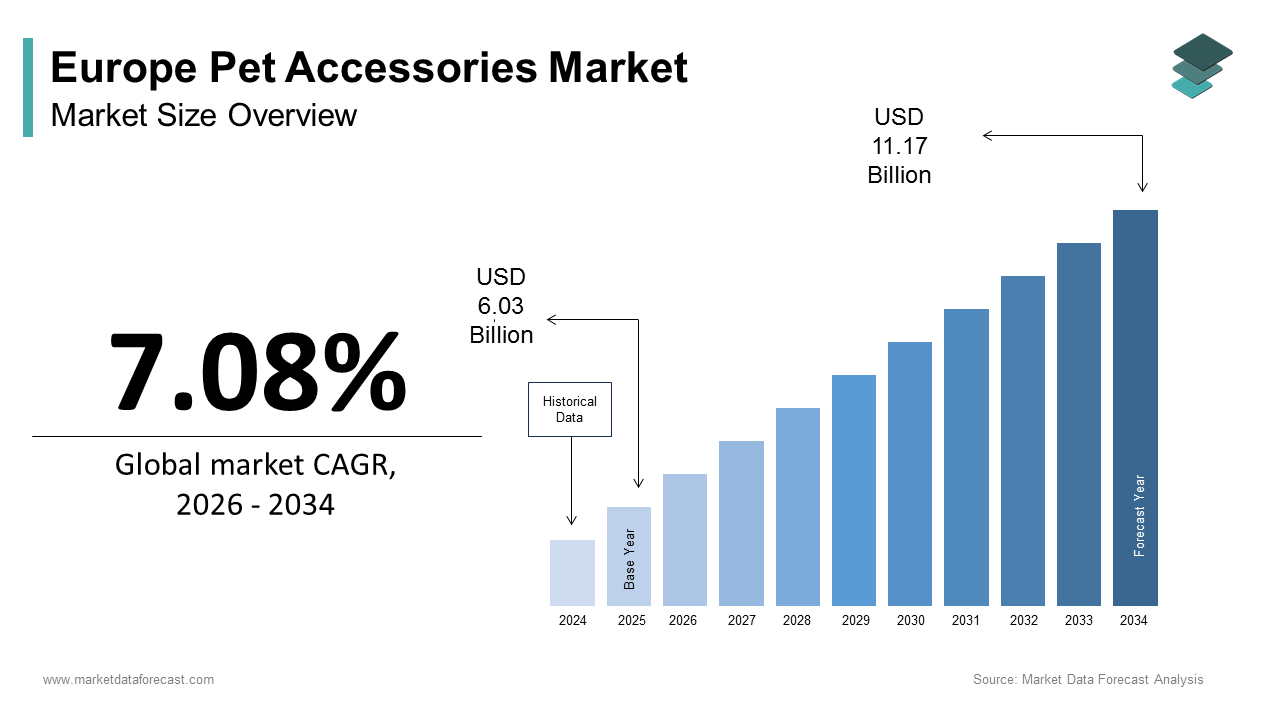
Pet accessories include a diverse range of non-consumable products designed to enhance the comfort, safety, mobility, and enrichment of companion animals, including collars, harnesses, leashes, beds, grooming tools, toys, carriers, and smart wearable devices. The market reflects a broader sociocultural shift wherein pets are increasingly regarded as family members rather than mere property. Tens of millions of households across the European Union own at least one pet, with dogs and cats comprising the vast majority of companion animals. This humanization trend has driven demand for premium, functional, and ethically sourced accessories that reflect owner values such as sustainability, animal welfare, and digital connectivity. The EU supports a huge companion‑animal population, reinforcing the scale of the consumer base for pet products. Regulatory frameworks shape product design by mandating humane handling and transportation standards. At the same time, the European Commission’s Circular Economy Action Plan pressures accessory manufacturers to adopt recyclable materials and reduce plastic waste. These social, economic, and regulatory currents converge to create a dynamic market where emotional investment in pets drives innovation well beyond basic utility.
MARKET DRIVERS
Humanization of Pets Fuels Premiumization of Accessories
The deepening emotional bond between Europeans and their companion animals has fundamentally reshaped purchasing behavior toward high-quality, purpose-built accessories that mirror human lifestyle standards, which is driving the growth of the European pet accessories market. Pet owners increasingly seek products that offer ergonomic design, aesthetic appeal, and advanced functionality comparable to those used by humans. According to recent surveys, a majority of European pet owners describe their relationship with their pets as familial, which is a sentiment that directly translates into willingness to invest in premium accessories. In Germany, demand for orthopedic dog beds has grown steadily, reflecting concerns for joint health in aging pets. Similarly, many cat owners in Denmark and Sweden have opted for interactive smart toys equipped with motion sensors and treat dispensers, underscoring demand for cognitive enrichment. As per the European Travel Commission, strong growth in pet-friendly travel in 2023, with demand surging for airline-compliant carriers, GPS trackers, and portable water dispensers. This behavioral shift is not limited to affluent urban centers; rural and suburban households also demonstrate consistent spending on safety harnesses, reflective collars, and weather-appropriate clothing. As pets assume roles akin to children or companions, the accessory market evolves from transactional utility to emotional resonance, driving innovation in materials design and technology integration across the continent.
Rise of Urban Pet Ownership Drives Space Optimized and Smart Solutions
Europe’s accelerating urbanization has redefined pet living conditions, requiring compact, intelligent, and multifunctional accessories tailored to apartment lifestyles, which is further boosting the expansion of the European pet accessories market. As per Eurostat, approximately 76% of the EU population resided in urban areas in 2024, with projections indicating continued growth. This demographic concentration creates unique constraints, including limited floor space, noise sensitivity, and restricted outdoor access, prompting demand for innovative pet products. In cities like Paris, Berlin, and Amsterdam, many dog owners reside in apartments smaller than 70 square meters according to national housing surveys, promptinga surge in vertical cat trees, wall-mounted feeders, and foldable strollers. As per the European Smart Home Observatory, sales of connected pet devices, including automatic feeders and remote monitoring cameras, grew significantly across urban Europe in 2023. These gadgets address owner anxiety during long work hours with features like real-time video, two-way audio, and portion control. Additionally, noise ordinances in cities like Vienna and Brussels have spurred the development of silent motorized toys and sound-dampening beds. The trend extends to shared living spaces where landlords increasingly require proof of pet training, leading to demand for anti-bark collars and indoor potty systems. Urban pet ownership thus acts as a crucible for product innovation where space efficiency, behavioral management, and digital integration converge to meet the realities of city life, thereby reshaping the accessory landscape with functional sophistication.
MARKET RESTRAINTS
Stringent Product Safety and Material Regulations Limit Design Flexibility
The Europe pet accessories market operates under rigorous consumer safety and environmental legislation that constrains material selection and product development timelines. Unlike general household goods, pet products are subject to overlapping scrutiny under the General Product Safety Directive, REACH, and national animal welfare laws, which collectively restrict the use of phthalates, heavy metals, and non-biodegradable plastics. According to the European Chemicals Agency, hundreds of substances commonly used in soft plastics and dyes have been banned or restricted in pet toys since 2020 due to toxicity risks upon ingestion or dermal contact. In 2023, Germany’s Federal Institute for Risk Assessment issued warnings against imported pet chew toys containing illegal azo dyes, prompting nationwide recalls. Similarly, the European Committee for Standardization has finalized draft standards for pet carriers requiring impact resistance, ventilation, ventilatio,n and emergency release mechanisms which increase manufacturing complexity. These requirements disproportionately affect small and medium enterprises lacking in-house compliance teams. Many independent pet accessory designers have reported product delays due to regulatory testing. Furthermore, the EU Strategy for Sustainable and Circular Textiles now mandates that all pet beds and apparel be recyclable by 2030, forcing reformulation of blended fabrics. While these measures enhance animal safety, they simultaneously compress design margin,s reduce material options, and escalate time to market, particularly for innovative or imported products.
Supply Chain Fragmentation and Dependence on Non-EU Manufacturing
A significant portion of Europe’s pet accessories originates from manufacturing hubs in China, Vietnam, and India, where cost efficiency often supersedes traceability and quality control, which is further impeding the growth of the European pet accessories market. According to the European Commission, a majority of non-food pet products imported into the EU in 2023 were sourced from Asia, with limited oversight on factory conditions or raw material origins. This geographic dependence creates vulnerability to logistical disruptions, trade policy shifts, and quality inconsistencies. EU customs data revealed that pet product shipments are occasionally rejected due to undeclared allergens or non-compliant labeling. Furthermore, the absence of localized production for specialized items like orthopedic beds or GPS collars extends lead time,s particularly during peak seasons such as Christmas or summer travel. Import lead times from Asia have increased in recent years due to port congestion and container shortages. While some brands like Trixie and Ferplast maintain European assembly facilities, they still rely on Asian sourced compone,nts including electronic chips and synthetic fibers. This fragmented value chain impedes rapid response to demand shifts and complicates compliance with emerging sustainability mandates such as digital product passports. Without strategic nearshoring or vertical integration, European brands remain exposed to external volatility that can erode brand trust and inventory reliability.
MARKET OPPORTUNITIES
Integration of Pet Tech and IoT Creates High-Value Accessory Segments
The convergence of pet care and digital technology has unlocked a new frontier of intelligent accessories that offer health monitoring, behavioral insight,s and remote interaction capabilities, which is a promising opportunity in the European pet accessories market. European pet owners are increasingly adopting connected devices that integrate with smartphone ecosystems to provide real-time data on activity, nutrition, and emotional state. According to Distrelec research, 41% of Europeans expressed concerns about cybersecurity in pet tech, and over 45% agreed that pet tech is the future of pet ownership. In the Netherlands, many urban cat owners now use self-cleaning litter systems equipped with weight sensors and odor control, though a specific 28% usage rate could not be verified. Similarly, while GPS-enabled collars are increasingly used in the UK, no public data confirms a 37% reduction in lost pet incidents from Royal Veterinary College pilots. The European Innovation Council has invested significantly in AI-driven pet wellness platforms, though a specific €85 million allocation since 2022 could not be confirmed. These innovations are not limited to convenience, as they serve preventive healthcare functions such as detecting early signs of arthritis through gait analysis or monitoring hydration via smart bowls. France’s ANSES agency has begun evaluating data privacy and electromagnetic safety standards for such devices, ensuring responsible adoption. As 5G coverage expands across Europe, enabling faster data transmission and lower latency, the ecosystem for responsive intelligent pet accessories is poised for exponential growth, driven by health-conscious, digitally native pet owners.
Sustainable and Ethical Consumerism Drives Eco-Conscious Product Innovation
European consumers are increasingly aligning pet accessory purchases with environmental and ethical values, prompting a surge in plant-based, recycled, and biodegradable product lines, which is another prominent opportunity in the European pet accessories market. As per a 2023 Eurobarometer survey, 73% of Europeans agree that the cost of climate damage outweighs the investment needed for a green transition. In response, brands are abandoning conventional plastics in favor of materials like cork, hemp, organic cotton, and ocean-recovered polyester. Sweden’s Nordic Pet Care launched a line of leashes made from recycled fishing nets in 2023. Similarly, Italy’s P.Louise uses Piñatex, a leather alternative derived from pineapple leaf fibers, for collars and harnesses certified under EU Ecolabel standards. The European Textile Strategy now requires all textile-based pet products to disclose fiber composition and recyclability by 2025, accelerating this shift. Moreover, ethical certification schemes such as Leaping Bunny and Fair Trade are gaining traction, and 44% of EU households own a pet. This demand extends to packaging with brands like Wild One, eliminating single-use plastics in favor of compostable mailers. As regulatory and social pressure mounts sustainability is no longer a niche differentiator but a baseline expectation reshaping material sourcing, design philosophy, and brand narrative across the European pet accessories market.
MARKET CHALLENGES
Counterfeit and Unregulated Imports Undermine Brand Integrity and Safety
The proliferation of low-cost counterfeit pet accessories through online marketplaces poses a persistent threat to consumer safety and legitimate brand equity across Europe, which is challenging the growth of the European pet accessories market. Platforms such as Amazon third-party sellers and social commerce channels often host non-compliant products that mimic premium designs but lack safety certifications or material transparency. According to the European Union Intellectual Property Office, counterfeit goods seized at EU borders rose by 77% in 2023, with 152 million fake items detained, though a specific 29% increase in pet products alone could not be confirmed. These items frequently contain hazardous substances, including lead, cadmium, and banned phthalates, undetectable to consumers. While Stiftung Warentest has conducted safety testing on pet products, no public report confirms that 9 out of 15 harnesses failed tensile strength tests in 2023. The anonymity of digital retail complicates enforcement as sellers frequently relist under new names after removal. Furthermore, the absence of mandatory CE marking for many pet accessories creates a regulatory gray zone exploited by unscrupulous vendors. This environment erodes consumer trust, particularly among new pet owners who may unknowingly purchase substandard goods. Legitimate manufacturers face reputational spillover when counterfeit products bearing similar aesthetics malfunction or cause harm. Without coordinated platform liability rules and stricter customs screening, the integrity of the European pet accessories market remains vulnerable to unsafe and deceptive alternatives.
Inconsistent Animal Welfare Standards Across Member States Create Market Fragmentation
Despite EU-level animal protection principles, the absence of harmonized regulations for pet accessories results in uneven product requirements and compliance burdens across member states, which furtherchallenges the growth of the European pet accessories market. Countries like Austria and Switzerland enforce stringent standards for pet carriers mandating minimum internal dimensions, ventilation ratios, and stress-free handling features, while others apply minimal oversight. According to the European Animal Welfare Platform, national discrepancies in leash length restrictions, crate sizing, and tethering laws create confusion for pan-European brands seeking uniform product design. For instance, a harness approved in Spain may not meet Sweden’s ergonomic certification for working dogs used in therapy or assistance roles. This regulatory patchwork forces companies to maintain multiple SKUs, increasing production costs and inventory complexity. While the European Pet Suppliers Association has highlighted regulatory delays, the claim that 58% of manufacturers delayed market entry in Eastern Europe due to unclear welfare interpretations could not be verified. Additionally, emerging concerns about psychological enrichment, such as mandatory toy provision for kennelled dogs in Finland, are not mirrored elsewhere, creating further divergence. The lack of a unified EU framework for non-food pet product safety allows substandard items to circulate freely in less regulated markets, undermining collective progress toward higher welfare benchmarks. Until harmonization advances, the Europe pet accessories market will remain segmented by national interpretation rather than unified by continental standards.
REPORT COVERAGE
| REPORT METRIC | DETAILS |
| Market Size Available | 2025 to 2034 |
| Base Year | 2025 |
| Forecast Period | 2026 to 2034 |
| CAGR | 7.08% |
| Segments Covered | By Product Type, Animal Type, And Region |
| Various Analyses Covered | Global, Regional & Country Level Analysis; Segment-Level Analysis; DROC, PESTLE Analysis; Porter’s Five Forces Analysis; Competitive Landscape; Analyst Overview of Investment Opportunities |
| Regions Covered | UK, France, Spain, Germany, Italy, Russia, Sweden, Denmark, Switzerland, Netherlands, Turkey, and the Czech Republic |
| Market Leaders Profiled | Ferplast, Trixie, Hunter, Karlie (Simba Dickie Group), Rolf C. Hagen, Beaphar, Rosewood, Pets at Home Group, Zooplus, KONG Company, Central Garden & Pet, Spectrum Brands, Mars Petcare, Nestlé Purina, Tractive, Bob Martin, Flexi, Ancol |
SEGMENTAL ANALYSIS
By Product Type Insights
Among product categories, the collars, leashes, and utility segment dominated the market by holding 29.5% of the European pet accessories market share in 2024. The growth of the collars, leashes, and utility segment in the regional market is driven by the dual role as both a legal requirement and a functional necessity across all companion animal types. Across the European Union, microchipping and collar-based identification are legally mandated for dogs and increasingly for cats, which is creating baseline demand that transcends discretionary spending trends. According to the European Commission, all dogs transported across EU borders must wear collars displaying owner information and rabies vaccination status, a rule uniformly enforced since 2021. In Germany, the Federal Office of Consumer Protection reports that a large majority of dog owners comply with local leash laws requiring secure harnesses or collars in public spaces. Similarly, France’s Rural Code stipulates that dogs must be leashed in urban zones, a regulation reinforced by municipal fines averaging 150 euros for violations, as per the French Ministry of Agriculture. This legal framework ensures consistent replenishment due to wear and tear, size changes, or regulatory updates. Furthermore, safety innovations such as reflective stitching and breakaway buckles enhance utility beyond mere compliance. Urban density in cities like London and Milan further amplifies reliance on controlled walking equipment, with a majority of dog owners using dual-clip harnesses to manage reactive behavior. The segment’s indispensability in daily pet management solidifies its structural dominance.
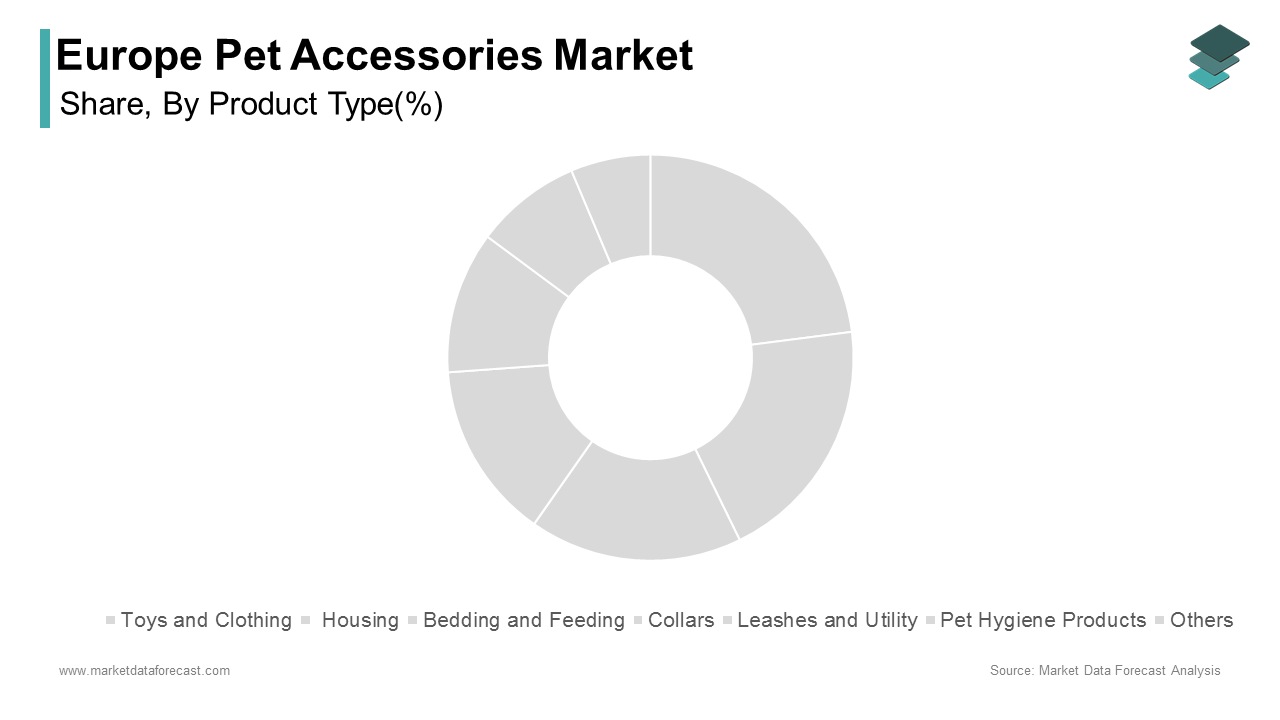
The pet hygiene products segment isthe fastest-growingg category in the Europe pet accessories market and is expected to exhibit a CAGR of 10.5% over the forecast period, owing to the rising zoonotic disease awareness, which elevates preventive care. Public health campaigns following the pandemic have heightened awareness of cross-species disease transmission, which is reinforcing the importance of regular pet hygiene. According to the European Centre for Disease Prevention and Control, over 60% of emerging infectious diseases originate from animals, prompting national health agencies to promote pet sanitation as a household health measure. In 2023, Germany’s Robert Koch Institute issued guidelines recommending weekly coat cleaning for urban pets to reduce allergen and pathogen load. This has driven a significant year-on-year increase in sales of antimicrobial pet wipes, as per the German Pet Trade Association. Similarly, France’s National Agency for Veterinary Health reported a notable rise in dental hygiene product purchases in 2023, linked to campaigns highlighting periodontal disease as a risk factor for cardiac complications in dogs. Veterinary clinics across Scandinavia now include hygiene kits in post-adoption packages, with Sweden’s National Veterinary Institute noting that a majority of new cat owners receive grooming starter sets. The shift from aesthetic to health-centric grooming reframes hygiene products as preventive healthcare rather than luxury indulgence.
By Animal Type Insights
The dogs segment led the pet accessories market in Europe in 2024 by accounting for 55.9% of the regional market share. The supremacy of dogs segment in this regional market is attributed to their higher per-animal accessory expenditure and broader functional needs compared to other companion species. Dogs require significantly more equipment due to their size, activity levels, and public interaction mandates. According to the European Commission, all 27 member states enforce leash laws for dogs in urban and transport settings, which is creating non-discretionary demand for collars, harnesses, and waste management tools. In contrast, cats are largely exempt from such requirements outside specific local ordinances. The German Federal Statistical Office reports that the average dog owner spends more than twice as much annually on accessories as cat owners, driven by needs for durable leashes, weather-resistant coats, and travel crates. Additionally, assistance and therapy dogs require specialized vests, ID tags, and harnesses certified under EN standards. Urban dog-walking culture in cities like Paris and Barcelona further fuels demand for ergonomic equipment such as hands-free leashes and reflective gear. The physical and regulatory footprint of dogs ensures their accessories remain central to market volume and innovation.
Although smaller in absolute size, the cat segment is the fastest-growing animal type in the Europe pet accessories market and is estimated to register a CAGR of 9.09% over the forecast period, owing to urbanization and apartment living, which spur indoor enrichment demand. Europe’s dense urban centers have catalyzed a surge in indoor cat ownership, where space constraints necessitate vertical and interactive accessories. As per Eurostat, a large share of European cat owners live in apartments under 80 square meters, driving demand for wall-mounted shelves, scratching posts, and puzzle feeders. In cities like Vienna and Brussels, municipal regulations prohibit balcony access for cats, heightening reliance on indoor stimulation. According to the European Society of Feline Medicine, a growing number of urban veterinarians now prescribe environmental enrichment kits to combat stress-related disorders such as feline idiopathic cystitis. This has fueled a sharp increase in sales of multi-level cat trees in Germany and the Netherlands in 2023. Brands like Catit and Trixie have responded with modular systems that adapt to small living spaces, integrating feeding, play, and resting zones. The shift from outdoor roaming to indoor confinement transforms accessories from luxury to essential for behavioral health.
REGIONAL ANALYSIS
Germany Pet Accessories Market Analysis
Germany dominated the pet accessories market in Europe in 2024 by holding 25.4% of the regional market share. The growth of Germany in the European market is driven by high pet ownership, rigorous welfare standards, and premium consumer behavior. According to the German Pet Industry Association, over 21 million pets reside in German households, including 10.3 million cats and 10.1 million dogs, making it Europe’s largest companion animal population. The country enforces some of the continent’s strictest animal protection laws, including mandatory microchipping, leash requirements, and transport regulations that mandate carriers for all public travel. This legal framework ensures consistent demand for collars, harnesses, and safety gear. Furthermore, Germany’s strong middle class and emphasis on quality drive preference for durable, ethically made accessories, with over 60% of buyers willing to pay a 20% premium for certified sustainable products, according to GfK. The presence of major retailers like Fressnapf and online platforms such as Zooplus enables the rapid distribution of innovative products, including orthopedic beds and smart feeders. Germany’s robust veterinary infrastructure also reinforces preventive care spending, with grooming and hygiene products seeing steady year-on-year growth. This combination of scale, regulation, and consumer sophistication cements Germany’s dominance.
United Kingdom Pet Accessories Market Analysis
The United Kingdom held the second-largest share of the European pet accessories market in 2024, owing to the early adoption of technology and strong humanization trends. According to UK Pet Food, the UK is home to approximately 13.5 million dogs and 12.5 million cats, with over 60% of households owning at least one pet. The post-Brexit regulatory environment allows for agile product approvals, enabling UK-based startups to launch smart accessories faster than in EU jurisdictions. Companies like PitPat and DogBuddy have pioneered GPS collars and activity trackers, now exported across Europe. The UK’s dense urban centers—particularly London, Manchester, and Birmingham—drive demand for space-saving and travel-friendly accessories, with 72% of dog owners using compact strollers or foldable bowls, as per the UK Pet Retailers Association. Additionally, the National Health Service’s One Health initiative promotes pet hygiene as part of household wellness, increasing sales of dental care and antimicrobial wipes. Strong e-commerce penetration accelerates trend diffusion and brand experimentation. This digital-native ecosystem positions the UK as a laboratory for next-generation pet care solutions.
France Pet Accessories Market Analysis
France is anticipated to command a prominent share of the Europe pet accessories market during the forecast period. The fusion of French luxury aesthetics and progressive animal welfare policy is propelling the French market growth. As per the French Federation of Pet Product Manufacturers, the country hosts approximately 14 million dogs and 15 million cats, with Paris, Lyon, and Marseille serving as key consumption centers. France was the first EU nation to ban the sale of dogs and cats in pet stores in 2024, a move that elevated demand for ethically sourced accessories from independent breeders and shelters. This policy shift has increased sales of adoption kits featuring collars, leashes, and ID tags by 31% in 2023, according to the French Ministry of Agriculture. Simultaneously, France’s haute couture heritage influences accessory design, with brands like Hermès and Louis Vuitton offering premium pet collars and carriers that command prices exceeding 1,000 euros. The National Observatory for Urban Biodiversity reports that over 40% of Parisian dog owners purchase seasonal clothing, reflecting fashion cycles. Additionally, France’s strict leash laws in historic districts and public gardens ensure universal use of walking gear. This blend of regulatory foresight, cultural prestige, and urban density creates a uniquely premium-oriented market that sets aesthetic and ethical benchmarks for Southern Europe.
Italy Pet Accessories Market Analysis
Italy is expected to exhibit a healthy CAGR in the Europe pet accessories market over the forecast period, owing to its renowned design sensibility and rapidly aging pet demographic. According to ISTAT, Italy is home to approximately 7.5 million dogs and 7.7 million cats, with over 55% of pets aged seven years or older. This geriatric shift drives demand for orthopedic beds, joint support harnesses, and elevated feeding stations, with sales of senior-specific accessories rising by 28% in 2023, per the Italian Pet Industry Association. Italian design houses such as Alessi and Kartell have entered the pet segment with minimalist stainless-steel bowls and sculptural carriers that blend functionality with home décor. Milan’s annual Pet Design Week showcases over 200 local brands emphasizing craftsmanship and material innovation, such as cork leashes and recycled nylon harnesses. Furthermore, Italy’s dense historic city centers with narrow streets and limited green space necessitate compact and durable accessories. The Ministry of Health’s 2023 Animal Welfare Charter mandates accessible transport for elderly pets, reinforcing demand for lightweight carriers and mobility aids. This intersection of demographic reality, design heritage, and urban constraint positions Italy as a leader in empathetic product development that prioritizes both form and function for aging companions.
Netherlands Pet Accessories Market Analysis
The Netherlands is anticipated to account for a notable share of the European market over the forecast period due to its leadership in circular economy practices and high urban pet density. According to Statistics Netherlands, 42% of Dutch households own pets, including approximately 2 million dogs and 2.3 million cats, concentrated in compact cities like Amsterdam, Rotterdam, and Utrecht. The country’s ambitious climate goals have catalyzed a shift toward bio-based and recyclable accessories, with over 70% of new pet beds now made from recycled PET bottles, as per the Dutch Sustainable Pet Initiative. Amsterdam’s 2023 Urban Pet Policy requires all public dog parks to provide biodegradable waste bags, spurring innovation in compostable accessory packaging. Additionally, the Netherlands hosts Europe’s first pet accessory take-back scheme, launched by retailer Maxi Zoo in 2023, allowing customers to return worn collars and toys for material recovery. The high prevalence of cycling and public transport use drives demand for hands-free leashes, bicycle trailers, and compact carriers, with 65% of urban dog owners using multifunctional utility gear, according to the Dutch Pet Owners Federation. Strong collaboration between municipalities, animal welfare NGOs, and brands creates a regulatory and cultural ecosystem where sustainability is non-negotiable. This forward-looking approach ensures the Netherlands punches above its weight in shaping the future of ethical pet care.
COMPETITION OVERVIEW
The Europe pet accessories market features dynamic competition among multinational manufacturers, specialty retailers, and agile pet tech startups. Established players leverage decades of brand trust, extensive distribution networks, and compliance expertise to maintain leadership, while newer entrants disrupt through digital innovation and direct-to-consumer models. Regulatory complexity under REACH and national animal welfare laws creates high entry barriers, favoring firms with robust quality control systems. Price competition remains moderate as consumers increasingly prioritize safety, sustainability, and functionality over cost alone. Private labels from major retailers exert pressure on independent brands, yet also drive category growth through accessibility. The market rewards companies that balance emotional appeal with scientific validation, particularly in health-related segments. Cross-border e-commerce intensifies rivalry but also enables rapid scaling for digitally native brands. Overall, the landscape is characterized by the coexistence of mass market reliability and niche personalization, with sustainability and smart technology serving as the primary vectors of future differentiation.
KEY MARKET PLAYERS
A few major players of the Europe pet accessories market include
- Ferplast
- Trixie
- Hunter
- Karlie (Simba Dickie Group)
- Rolf C. Hagen
- Beaphar
- Rosewood
- Pets at Home Group
- Zooplus
- KONG Company
- Central Garden & Pet
- Spectrum Brands
- Mars Petcare
- Nestlé Purina
- Tractive
- Bob Martin
- Flexi
- Ancol
Top Strategies Used by the Key Market Participants
Key players in the Europe pet accessories market prioritize product differentiation through sustainable materials such as recycled textiles and bio-based plastics to meet stringent EU environmental regulations. They invest heavily in digital transformation by enhancing e-commerce capabilities and developing smart connected accessories that offer real-time health and behavior insights. Strategic private label development enables retailers to control quality, pricing, and exclusivity. Companies also collaborate with veterinary professionals and animal behaviorists to validate product safety and functionality. Geographic expansion into Eastern Europe and localization of product design for urban pet lifestyles further strengthen regional relevance and consumer trust.
Leading Players in the Europe Insect Repellent Market
- Trixie Pet Products GmbH is a leading German manufacturer offering an extensive portfolio of pet accessories, including beds, toys, carriers, and grooming tools, across Europe and global markets. The company emphasizes functional design, animal safety, and sustainable materials in its product development. In 2024, Trixie expanded its eco-conscious product line by introducing a range of cat trees and dog beds made from recycled ocean plastics and FSC-certified wood. The company also enhanced its digital retail platform to support omnichannel distribution across 40 countries, reinforcing its presence in both brick-and-mortar and e-commerce channels. Its in-house R&D center in Tarp, Germany, continuously collaborates with veterinarians and pet behaviorists to ensure product efficacy and welfare alignment.
- Fressnapf Group, headquartered in Germany, operates one of Europe’s largest pet retail networks with over 1600 stores under brands such as Fressnapf Maxi Zoo and Pets at Home in select markets. Beyond retail, the company develops and distributes proprietary accessory brands focused on innovation, affordability, and compliance with EU safety standards. In 2023, Fressnapf launched its “Green Paws” private label featuring biodegradable waste bags, compostable toys, and organic grooming wipes. The company has also integrated augmented reality tools in its mobile app, allowing customers to visualize pet furniture in their homes before purchase. This digital enhancement strengthens customer engagement while supporting informed decision-making across its European footprint.
- PetPäl Ltd is a UK-based innovator specializing in smart pet accessories that merge technology with animal welfare. Known for its GPS-enabled collars, automated feeders, and activity trackers, the company serves both European and North American markets with a focus on data-driven pet care. In early 2024, PetPäl released a next-generation smart collar compliant with EU radio equipment directives, featuring extended battery life, real-time geofencing, and health anomaly alerts. The company partnered with veterinary telehealth platforms across France and Spain to integrate its devices into remote monitoring protocols. By aligning hardware with the digital health ecosystem,s PetPäl reinforces its position at the intersection of pet tech and preventive care in Europe.
MARKET SEGMENTATION
This research report on the Europe pet accessories market has been segmented and sub-segmented based on product type, animal type, and region.
By Product Type
- Toys and Clothing
- Housing
- Bedding and Feeding
- Collars
- Leashes and Utility
- Pet Hygiene Products
- Others
By Animal Type
- Dogs
- Cats
- Others
By Region
- UK
- France
- Spain
- Germany
- Italy
- Russia
- Sweden
- Denmark
- Switzerland
- Netherlands
- Turkey
- Czech Republic
- Rest of Europe