- Product Description Description
- Table of Contents TOC
- List of Table & Figure LOT
- Get Free Sample PDF Sample PDF
Market Size, 2025
$577.59 BnMarket Estimate, 2026
$616.12 BnMarket Forecast, 2034
$1,032.76 BnCAGR, 2026–2034
6.67%Europe Pharmaceutical Market Report Summary
The Europe pharmaceutical market was valued at USD 577.59 billion in 2025 and is projected to grow from USD 616.12 billion in 2026 to USD 1,032.76 billion by 2034, registering a CAGR of 6.67% from 2026 to 2034. Market growth is driven by the rising prevalence of chronic diseases, an aging population, growing investments in pharmaceutical research and development, and expanding adoption of innovative biologics and specialty medicines. Advances in precision medicine, personalized therapies, and digital healthcare technologies, along with supportive healthcare policies, are further contributing to market expansion.
Key Market Trends
- Increasing demand for oncology, biologic, and specialty pharmaceutical products.
- Growing investments in research and development of innovative therapies.
- Rising adoption of personalized medicine and precision therapeutics.
- Expansion of biosimilars and advanced biologic drug development.
- Increasing integration of digital health technologies and AI-driven drug discovery.
Segmental Insights
- Based on type, the oncology drugs segment dominated the Europe pharmaceutical market in 2025, driven by the rising incidence of cancer, continuous development of targeted therapies and immunotherapies, and increasing investments in oncology research.
- Based on distribution channel, the hospital pharmacies segment held the leading market share in 2025, supported by the growing use of specialty drugs, biologics, injectable therapies, and the management of complex chronic diseases within hospital settings.
Regional Insights
The Europe pharmaceutical market continues to expand across major economies, supported by strong healthcare systems, increasing pharmaceutical innovation, and growing investments in life sciences research.
- Germany dominated the European pharmaceutical market in 2025, driven by its robust pharmaceutical manufacturing industry, advanced healthcare infrastructure, strong research ecosystem, and significant investments in innovative drug development.
- France held a significant share of the regional market, supported by its well-established healthcare system, extensive pharmaceutical research capabilities, and favorable government initiatives promoting healthcare innovation.
- The United Kingdom is expected to witness steady growth during the forecast period, driven by continued pharmaceutical innovation, expanding biotechnology investments, and evolving regulatory frameworks following Brexit that support the development and commercialization of new therapies.
Competitive Landscape
The Europe pharmaceutical market is highly competitive, with global pharmaceutical companies focusing on innovative drug development, biologics, specialty medicines, and precision healthcare solutions. Market participants are investing heavily in research and development, strategic collaborations, mergers and acquisitions, and expansion of manufacturing capabilities to strengthen their market position. Continuous advancements in biotechnology, gene therapies, and personalized medicine continue to shape the competitive landscape.
Prominent companies operating in the Europe pharmaceutical market include Pfizer Inc., Johnson & Johnson Services Inc., GSK plc, Novartis AG, Merck & Co., Inc., Sanofi, F. Hoffmann-La Roche Ltd., AstraZeneca, and Novo Nordisk A/S.
Europe Pharmaceutical Market Size
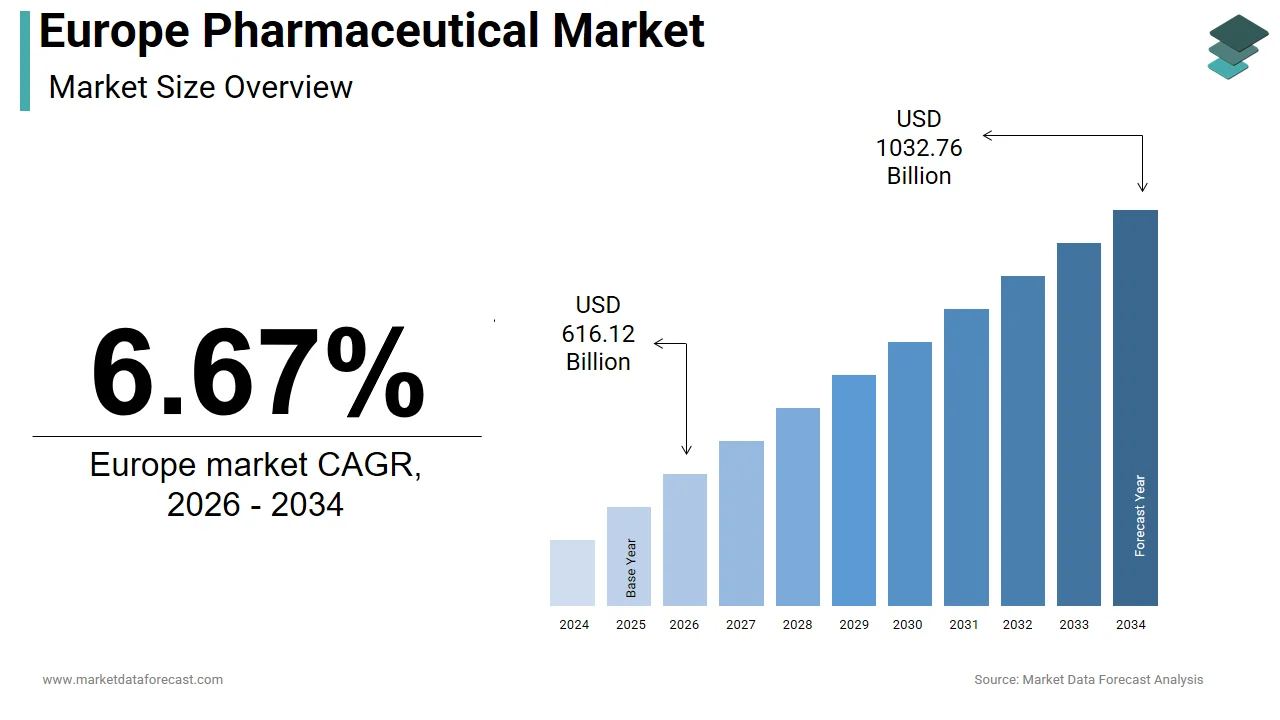
The size of the Europe pharmaceutical market was worth USD 577.59 billion in 2025. The market is anticipated to grow at a CAGR of 6.67% from 2026 to 2034 and be worth USD 1032.76 billion by 2034 from USD 616.12 billion in 2026.
The pharmaceuticals are a complex, highly regulated ecosystem, which includes the research, development, manufacturing, and distribution of prescription, over-the-counter, and specialty medicines. Diverse healthcare systems, centralized pricing mechanisms, robust public health infrastructure, and millions of people characterize the pharmaceuticals. The rise in the aging population is enhancing the drug demand across the pharmaceutical industry. According tothe World Health Organization, chronic diseases account for 70–80% of healthcare expenditures in most countries, which is reinforcing the centrality of pharmacological interventions in long-term care strategies and public health planning.
MARKET DRIVERS
Rising Prevalence of Chronic and Age-Related Diseases Across Aging Populations
The rapid increase in aging people across the region is primarily driving the Europe Pharmaceutical Market. The rising concerns regarding the treatments addressing cardiovascular conditions, neurodegenerative disorders, and oncology are significantly enhancing the drug demand. As per Eurostat, the number of Europeans aged 80 and above is increasing, with growth from 3.8% to 6.1% of the total population between 2004 and 2024, which is exhibiting disproportionately high medication use. The European Heart Network reports that cardiovascular diseases remain the leading cause of death, responsible for 4 million fatalities annually, or 42.5% of all deaths in the region. According to the European Cancer Organisation, 2.74 million new cancer cases were diagnosed in 2022, with incidence rates rising due to lifestyle factors and extended life expectancy. These case scenarios compel national health systems to maintain steady procurement of chronic disease therapies by ensuring consistent market demand and incentivizing investment in geriatric medicine innovation.
Expansion of Biosimilars and Generics to Address Cost-Effectiveness Imperatives
European healthcare systems are increasingly reliant on biosimilars and generic drugs to manage the burden of healthcare expenditures, which is promoting the growth of the Europe Pharmaceutical Market. As reported by the Norwegian Medicines Agency, in Norway, biosimilar uptake in rheumatology reached a major share in 2023. Generics represent over 67% of dispensed prescriptions across the EU, with countries like Spain and Portugal achieving over 90% of the generic penetration for off-patent drugs. According to the European Generic and Biosimilar Medicines Association (Medicines for Europe), these products saved EU health systems an estimated €130 billion between 2018 and 2022. This policy-driven shift supports market sustainability and frees up resources for novel therapies is reinforcing the role of cost-effective medicines in shaping pharmaceutical demand.
MARKET RESTRAINTS
Stringent Pricing and Reimbursement Regulations Limiting Market Entry and Profitability
The centralized pricing controls and prolonged reimbursement assessments across the pharmaceutical industry are hindering the growth of the Europe Pharmaceutical Market. These are delaying patient access and dampening the commercial returns. As per the European Observatory on Health Systems and Policies, 28 out of 31 European countries employ external reference pricing by benchmarking drug costs against lower-priced markets, thereby suppressing launch prices. France’s HAS (Haute Autorité de Santé) requires robust clinical added-value evidence, with only 38% of submissions receiving premium pricing between 2020 and 2023. These mechanisms, while ensuring affordability, discourage investment in high-risk therapeutic areas and delay innovation diffusion, particularly for orphan drugs and niche biologics.
Fragmented Regulatory and Market Access Landscapes Across Member States
The significant disparities in national regulatory frameworks, prescribing practices, and reimbursement are solely to blame for the decline in the growth of the Europe Pharmaceutical Market. As per the European Federation of Pharmaceutical Industries and Associations (EFPIA), the average time to achieve full market access across all EU countries is 578 days post-EMA approval, with delays exceeding two years in nations like Greece and Hungary. The BeNeLuxA collaboration and Visegrad Group have attempted joint health technology assessments, but divergent health priorities persist. The variations in labeling, packaging, and pharmacovigilance requirements increase compliance costs. These inconsistencies hinder pan-European commercialization strategies, forcing companies to tailor submissions and pricing models to individual markets, thereby increasing time-to-revenue and reducing economies of scale.
MARKET OPPORTUNITIES
Accelerated Adoption of Real-World Evidence in Regulatory and Reimbursement Decisions
The integration of real-world data (RWD) and real-world evidence (RWE) into regulatory and payer decision-making is an emerging opportunity for expansion of the Europe Pharmaceutical Market. As per the European Medicines Agency’s 2023 Big Data Steering Group report, over 61 pilot projects are underway to assess RWE for post-authorization safety monitoring, label expansions, and treatment effectiveness in diverse populations. In Sweden, the national healthcare registry has enabled longitudinal studies on drug outcomes across millions of patients by supporting value-based pricing models. The European Health Data Space (EHDS) regulation, entered into force in 2025, will standardize access to anonymized health data across member states by enabling faster, more representative evidence generation.
Growth of Digital Therapeutics and Software-as-a-Medical-Device Integration
The integration of digital therapeutics (DTx) and software-based interventions into mainstream care pathways is creating new avenues for pharmaceutical collaboration and product diversification, which is creating new opportunities to the Europe Pharmaceutical Market growth. Germany’s DiGA (Digitale Gesundheitsanwendungen) framework approved 59 digital health apps for prescription and insurance coverage by March 2025. Novartis and Sanofi have partnered with digital health firms to embed cognitive behavioral therapy modules into their chronic disease management platforms. The European Commission’s Horizon Europe program allocated €8.3 billion to healthcare research and innovation between 2021 and 2027, which signals strong institutional support. These developments enable pharma companies to transition from product-centric to outcome-based models by enhancing patient adherence and generating differentiated value in competitive therapeutic areas.
MARKET CHALLENGES
Supply Chain Vulnerabilities and Dependence on External API Sources
The dependence of the pharmaceutical supply chains on active pharmaceutical ingredients (APIs), which are sourced outside the region, especially from India and China, is creating geopolitical and logistical disruptions by limiting the growth of the Europe Pharmaceutical Market. As per the European Commission’s 2023 Pharmaceutical Strategy, over 80% of API production for key antibiotics, antivirals, and generics occurs in Asia, with only 10% manufactured within the EU. The French National Agency for Medicines and Health Products Safety (ANSM) reported the shortage of significant drugs due to a lack of supply and marketing discontinuation. Efforts to onshore production face challenges including high energy costs, regulatory fragmentation, and skilled labor shortages. The war in Ukraine and Red Sea shipping disruptions further exacerbated delivery timelines by prompting calls for strategic stockpiling and regional manufacturing incentives under the EU Pharmaceutical Act proposal.
Escalating Cybersecurity Threats to Clinical Data and Digital Health Infrastructure
The rising cyberattacks on the pharmaceutical organizations is another factor challenging the growth of the Europe Pharmaceutical Market. The cyberattacks are majorly aiming to steal clinical trial data, disrupting manufacturing systems, and compromising patient registries. In 2023, Europol published its Internet Organised Crime Threat Assessment (IOCTA), which detailed the rising and evolving threat of cybercrime, including ransomware and data theft targeting businesses. In the Ponemon Institute's 2023 Cost of a Data Breach Report, the average financial impact of a data breach in the healthcare industry reached $10.93 million in the Europe pharma sector. Companies face growing compliance burdens with the rollout of the EU’s Cyber Resilience Act and stricter GDPR enforcement. The integration of AI, cloud platforms, and connected medical devices expands the attack surface, which requires substantial investment in zero-trust architectures and continuous monitoring to safeguard intellectual property and patient safety.
REPORT COVERAGE
| REPORT METRIC | DETAILS |
| Market Size Available | 2025 to 2034 |
| Base Year | 2025 |
| Forecast Period | 2026 to 2034 |
| Segments Covered | By Type, Distribution Channel, and Region. |
| Various Analyses Covered | Global, Regional and Country-Level Analysis, Segment-Level Analysis, Drivers, Restraints, Opportunities, Challenges; PESTLE Analysis; Porter’s Five Forces Analysis, Competitive Landscape, Analyst Overview of Investment Opportunities |
| Countries Covered | UK, France, Spain, Germany, Italy, Russia, Sweden, Denmark, Switzerland, Netherlands, Turkey, Czech Republic, Rest of Europe |
| Market Leaders Profiled | Pfizer Inc. (U.S.), Johnson & Johnson Services Inc. (U.S.), GSK plc (U.K.), Novartis AG (Switzerland), Merck & Co., Inc. (U.S.), Sanofi (France), F. Hoffmann-La Roche Ltd. (Switzerland), AstraZeneca (U.K.), Novo Nordisk A/S (Denmark), and Others. |
SEGMENTAL ANALYSIS
By Type Insights
The oncology drugs segment dominated the Europe pharmaceutical market share in 2025. The rising incidence of cancer and the increasing adoption of high-cost targeted therapies, immunotherapies, and personalized treatment regimens is enhancing the segment growth. The IARC reported around 2.5 million new lung cancer cases, 2.3 million new female breast cancer cases, and 1.9 million new colorectal cancer cases worldwide in 2022. As per the European Society for Medical Oncology, the survival rates have improved due to advanced pharmacotherapies, which are extending treatment durations and cumulative drug utilization. The European Medicines Agency approved novel oncology agents in 2023, which include bispecific antibodies and CAR-T cell therapies is reinforcing clinical dependency on pharmaceutical innovation.
The vaccines segment is projected to expand at a CAGR of 10.4% from 2026 to 2034 in the Europe Pharmaceutical Market. The sustained public investment in preventive healthcare, the expansion of national immunization programs, and the development of next-generation platforms such as mRNA and viral vector technologies are propelling the segment. The EU’s HERA Incubator initiative, launched in 2021, has allocated €6 billion to strengthen pandemic preparedness and accelerate vaccine development for emerging pathogens.
By Distribution Channel Insights
The hospital pharmacies segment led the Europe pharmaceutical market share in 2025. The administration of high-cost specialty drugs, biologics, and intravenous therapies within inpatient and outpatient hospital settings is primarily escalating the segment growth. A significant proportion of oncology, rare disease, and care medications are dispensed directly through hospital-affiliated pharmacies, where reimbursement is integrated into facility budgets under national health systems. According to the European Observatory on Health Systems and Policies, in countries like Germany and France, over 70% of monoclonal antibody treatments are administered in hospitals, where infrastructure supports cold-chain logistics and clinical monitoring. The rise of advanced therapies such as gene and cell-based treatments, which require hospital-based infusion and observation, further consolidates the institutional channel’s centrality in the pharmaceutical value chain.
The online pharmacies segment is estimated to witness a CAGR of 13.2% from 2026 to 2034 in the Europe Pharmaceutical Market. The digital transformation, regulatory modernization, and shifting consumer behavior are driving the segment growth. The expansion is particularly pronounced for chronic disease maintenance medications, which include those for hypertension, diabetes, and mental health. The European Directorate for the Quality of Medicines & HealthCare (EDQM) reported that most online pharmacies were certified under the EU Falsified Medicines Directive by 2023, which is enhancing consumer trust. Countries like the Netherlands and Denmark have integrated e-prescriptions into national digital health platforms by enabling seamless routing to licensed online dispensers.
COUNTRY LEVEL ANALYSIS
Germany Pharmaceutical Market Analysis
Germany was the top performer in the Europe pharmaceutical market in 2025. The continent’s largest economy and healthcare spender, Germany, combines a strong industrial base with a universal health coverage system that prioritizes access to innovative therapies. The country’s statutory health insurance system covers over 90% of the population and maintains a positive list for reimbursable drugs by ensuring broad market access. The Food and Drug Administration (FDA) approved 55 new drugs in 2023, which reflects robust clinical research activity. Germany is a hub for biotech innovation, which is hosting over 6,000 life sciences firms, including BioNTech, which played a pivotal role in mRNA vaccine development. Its dual emphasis on generics and cutting-edge therapeutics positions Germany as both a volume leader and an innovation driver in the European pharmaceutical landscape.
France Pharmaceutical Market Analysis
France held a significant share by contributing 16.7% share in the Europe Pharmaceutical Market, with a healthcare system that balances cost containment and therapeutic access. The French National Authority for Health (HAS) evaluates all new drugs for clinical added value, directly influencing pricing and reimbursement levels. In 2023, French health insurance reimbursed €25.5 billion for drugs, and chronic diseases accounted for a significant portion. France has actively promoted biosimilar adoption by achieving over 80% market share for filgrastim and etanercept. The country also leads in rare disease treatments, with most of the designated orphan drugs available through its national plan.
United Kingdom Pharmaceutical Market Analysis
The United Kingdom Pharmaceutical Market is likely to grow with the Brexit-related regulatory divergence. According to NHS Digital, the NHS remains the primary purchaser of medicines with expenditure reaching £19.9 billion on medicines, medical devices, and other supplies in the 2023-24 financial year. The UK has retained scientific growth through institutions like the Medicines and Healthcare products Regulatory Agency (MHRA). In 2023, the MHRA became the first regulator in the world to authorize a CRISPR-based gene therapy called Casgevy. The therapy was approved for patients aged 12 and older with sickle cell disease or transfusion-dependent beta thalassemia. The National Institute for Health and Care Excellence (NICE) employs rigorous health technology assessments, but recent reforms have introduced accelerated pathways for innovative medicines.
Italian Pharmaceutical Market Analysis
Italian Pharmaceutical Market is expanding due to its operations within a decentralized healthcare system where regional authorities influence drug access and procurement. In 2023, the total budget allocated to the Italian National Health Service (SSN) 2023 was €126.061 million for healthcare, and the actual spending on direct drug purchasing reached 8.3% of the total budget for the year. The country faces challenges in timely patient access, with the European Commission noting that Italy lags behind peers by an average of 18 months in launching new oncology drugs. However, recent centralization of procurement through the Agenas agency has improved efficiency. Italy has a robust generics market with off-patent drugs representing the highest share of prescriptions by volume. As per ISTAT, the aging population with 24% over age 65 is demanding chronic disease therapies, which remains structurally high, ensuring sustained market relevance.
Spain Pharmaceutical Market Analysis
Spain Pharmaceutical Market is characterized by a publicly funded healthcare system with strong regional autonomy in drug policy. The Spanish Ministry of Health reported that pharmaceutical expenditure totaled €20.6 billion in 2024, with primary care accounting for a major share of dispensing. The country is enhancing its generic penetration rates in Europe with an estimated value of 47.2% in 2025 for off-patent molecules. Biosimilar adoption is also accelerating, particularly in rheumatology and gastroenterology. Spain’s National Health System has integrated digital prescriptions across all 17 autonomous communities, which is enhancing traceability and reducing waste. The Barcelona Biomedical Research Park (PRBB) and Madrid’s Health Research Institute (IdISSC) are key hubs for clinical innovation.
COMPETITION OVERVIEW
The competition in the Europe pharmaceutical market is shaped by a convergence of innovation, regulatory scrutiny, and cost containment pressures across diverse national healthcare systems. Multinational corporations compete with emerging biotechs and generic manufacturers in a landscape where market access depends on demonstrating clinical and economic value. Differentiation is achieved through personalized medicine, digital integration, and outcome-based contracting rather than pricing alone. The European Medicines Agency’s centralized approval process facilitates pan-European entry, but national pricing and reimbursement mechanisms create post-approval fragmentation by intensifying the need for localized strategies. Biosimilars and generics continue to pressure originator brands, particularly in chronic disease segments.
KEY MARKET PLAYERS
Some of the noteworthy companies in the Europe pharmaceutical market profiled in this report are
- Pfizer Inc.
- Johnson & Johnson Services Inc.
- GSK plc
- Novartis AG
- Merck & Co., Inc.
- Sanofi
- F. Hoffmann-La Roche Ltd.
- AstraZeneca
- Novo Nordisk A/S
TOP LEADING PLAYERS IN THE MARKET
- Novartis has established a dominant presence in the Europe Pharmaceutical Market through its advancements in cardiovascular, immunology, and gene therapy segments. In the Asia Pacific region, Novartis has prioritized market expansion in Japan and South Korea by aligning its oncology portfolio with local regulatory pathways, securing approval for ribociclib in HR+ breast cancer. The company’s “European Hub for Innovation” in Basel has been upgraded to include real-world evidence analytics, which is supporting faster health technology assessments. Its focus on divesting generics through Sandoz while advancing high-impact therapeutics is creating a strategic pivot toward sustainable, innovation-driven growth across both continents.
- Roche has maintained a significant role in the European Pharmaceutical Market through its expertise in oncology, neuroscience, and personalized medicine. The company strengthened its position in 2023 by launching the companion diagnostic platform VENTANA for HER2-low breast cancer across major EU hospitals by enabling precise patient stratification. Roche’s AI-powered system, NAVIFY, was adopted across 120 European centers by mid-2024 by improving diagnostic speed and treatment planning. Roche has deepened its influence by establishing a digital health innovation center in Singapore by focusing on liquid biopsy and early cancer detection technologies. It also collaborated with Japan’s Chugai Pharmaceutical to accelerate the approval of emicizumab for hemophilia A under the Sakigake designation. Roche’s investment in decentralized clinical trials and real-world data integration allows it to navigate Europe’s complex reimbursement environment while expanding its footprint in high-growth markets through localized R&D and regulatory agility.
- Sanofi has marked its relevance in the Europe pharmaceutical market through its dual focus on vaccines and metabolic disease management. Sanofi also launched a digital adherence platform, Diabeo, in partnership with French healthcare providers to support insulin management in type 1 diabetes patients. Sanofi has strengthened its position by acquiring Privigen distribution rights in Southeast Asia from CSL Behring by enhancing its immunoglobulin portfolio. Its collaboration with India’s Biocon on biosimilar insulin further extends its reach by combining European regulatory excellence with Asia’s cost-efficient production capabilities.
TOP STRATEGIES USED BY THE KEY MARKET PARTICIPANTS
Key players in the Europe pharmaceutical market are deploying advanced strategies to navigate regulatory complexity, pricing pressures, and evolving patient expectations. Companies are prioritizing R&D in high-value therapeutic areas such as oncology, rare diseases, and gene therapies, where unmet medical needs justify premium pricing. Strategic divestitures of generics and over-the-counter units allow reinvestment in innovative pipelines. Firms are increasingly leveraging real-world evidence to support health technology assessments and expedite reimbursement decisions across fragmented markets. Partnerships with academic institutions and digital health firms are accelerating the integration of AI, telemedicine, and remote monitoring into treatment pathways. The companies are investing in sustainable manufacturing and supply chain resilience, particularly in response to geopolitical disruptions. Patient support programs, including digital adherence tools and financial assistance, are being scaled to improve therapy initiation and retention by ensuring long-term commercial viability in a value-driven environment.
RECENT MARKET DEVELOPMENTS
- In April 2023, Roche introduced its AI-powered platform NAVIFY. The NAVIFY Algorithm Suite is a platform for accessing a library of medical algorithms, which is enhancing cancer diagnosis accuracy and treatment planning, while integrating real-world data to support faster reimbursement decisions in countries like Italy and Spain.
- In November 2023, AstraZeneca launched a new health-tech business, Evinova, to accelerate innovation in clinical trials and other areas using digital health solutions and AI. AstraZeneca's major AI-driven R&D facility in Cambridge known as The Discovery Centre (DISC) was officially unveiled in November 2021.
- In March 2024, Bayer acquired global rights to the cardiovascular drug finerenone from India’s Glenmark Pharmaceuticals, expanding its cardiorenal portfolio and reinforcing its presence in chronic kidney disease management across European healthcare systems.
MARKET SEGMENTATION
This Europe pharmaceutical market research report is segmented and sub-segmented into the following categories.
By Type
- Drugs
- Oncology
- Diabetes
- Infectious Diseases
- Cardiology
- Neurology
- Respiratory
- Hypertension
- Others
- Vaccines
- Viral Diseases
- Bacterial Diseases
By Distribution Channel
- Hospital Pharmacies
- Retail Pharmacies
- Online Pharmacies
By Country
- UK
- France
- Spain
- Germany
- Italy
- Russia
- Sweden
- Denmark
- Switzerland
- Netherlands
- Turkey
- Czech Republic
- Rest of Europe