- Product Description Description
- Table of Contents TOC
- List of Table & Figure LOT
- Get Free Sample PDF Sample PDF
Market Size, 2025
$33.92 BnMarket Estimate, 2026
$36.70 BnMarket Forecast, 2034
$68.94 BnCAGR, 2026–2034
8.2%Europe Pharmaceutical Logistics Market Size
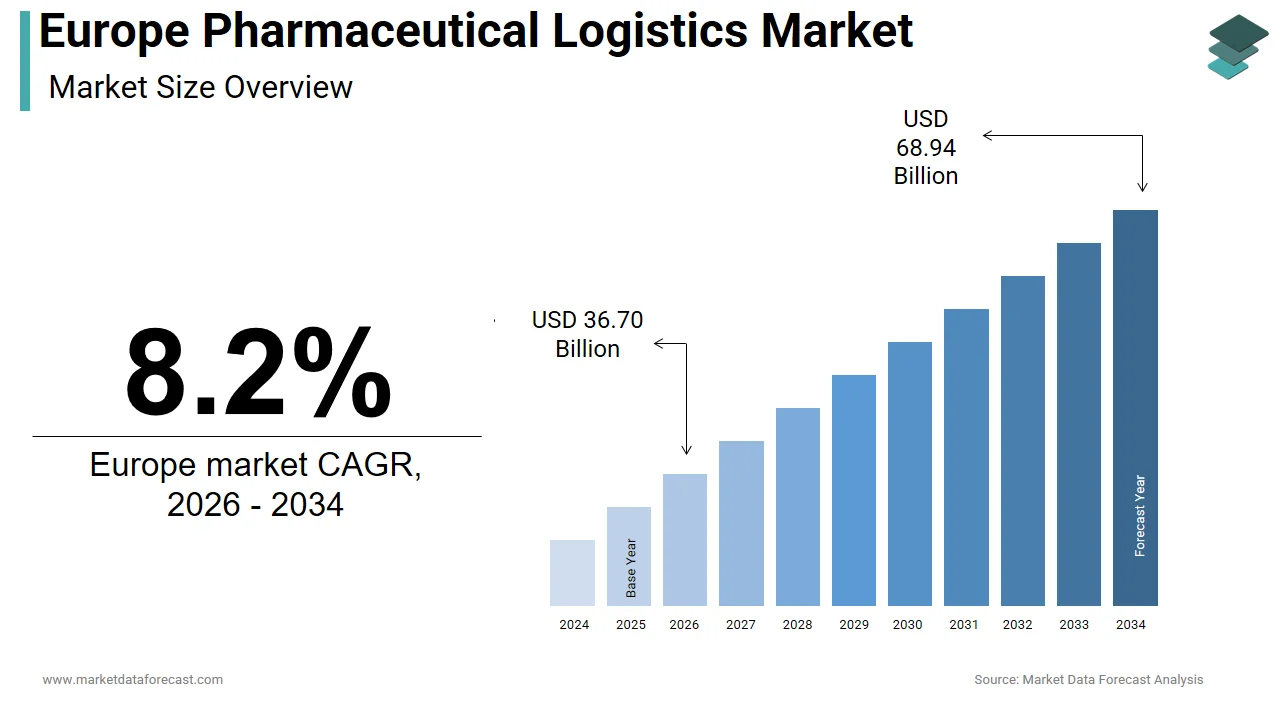
The size of the Europe pharmaceutical logistics market was valued at USD 33.92 billion in 2025. This market is expected to grow at a CAGR of 8.2% from 2026 to 2034 and be worth USD 68.94 billion by 2034, up from USD 36.70 billion in 2026.
Pharmaceutical logistics are the highly regulated end-to-end movement of temperature-sensitive medicinal products from manufacturer to pharmacy, hospital, or patient under stringent conditions of integrity, traceability, and compliance. According to the European Medicines Agency, over 95% of prescription medicines distributed across the EU require temperature control during transit, with the majority needing storage between 2°C and 8°C. The landscape has been reshaped by the post-pandemic expansion of biologics, personalized therapies, and direct-to-patient models, all of which demand unprecedented precision in logistics orchestration. Meanwhile, the European Commission’s 2023 Pharmaceutical Strategy emphasizes supply chain resilience by prompting national health authorities to map critical medicine routes and designate priority lanes for essential drugs.
MARKET DRIVERS
Proliferation of Temperature-Sensitive Biologics and Advanced Therapies
The surge in biologic medicines and advanced therapy medicinal products is a major factor fuelling the growth of the Europe pharmaceutical logistics market. According to the European Medicines Agency, biologics constituted 58% of all new medicine approvals in the EU in 2024, up from 34% in 2018. Many of these require ultra-cold storage at minus 20°C or even minus 70°C with specialized freezers, dry ice logistics, and real-time temperature tracking. The rise of autologous cell and gene therapies further intensifies complexity; each shipment is patient-specific with a shelf life often measured in hours. A 2024 audit by the Paul Ehrlich Institute in Germany revealed that over 1200 individual patient-specific therapy shipments occurred monthly within the EU, each requiring GPS-enabled thermal containers and customs pre-clearance. These products cannot tolerate delays or excursions, compelling logistics providers to invest in dedicated fleets, trained personnel, and digital twin simulations for route planning. This shift from mass distribution to precision logistics redefines service expectations and drives infrastructure modernization across the European pharmaceutical supply chain.
Expansion of Direct-to-Patient and Home Healthcare Models
The rapid adoption of direct-to-patient delivery models is transforming pharmaceutical logistics from a B2B wholesale paradigm to a patient-centric last-mile network is gearing up the growth of the Europe pharmaceutical logistics market. According to the Organisation for Economic Co-operation and Development, 31% of adults aged 65 and over in the EU manage three or more chronic conditions, creating sustained demand for regular medication home delivery. This shift necessitates integration of pharmacy dispensing systems with last-mile carriers capable of temperature-controlled home delivery and identity verification. Companies like Chronopost and DHL have launched dedicated healthcare divisions with trained couriers who handle controlled substances and provide administration support. Regulatory alignment is also important; France’s National Agency for Medicines Safety now requires all direct-to-patient shipments of refrigerated drugs to include temperature logs accessible to the recipient. These developments compel logistics providers to blend medical compliance with consumer-grade service by elevating the strategic importance of patient-facing delivery capabilities.
MARKET RESTRAINTS
Fragmented Cross-Border Regulatory and Customs Procedures
The pharmaceutical logistics across European borders remains hampered by inconsistent national interpretations of regulations and customs bottlenecks that risk product integrity, which is hindering the growth of the Europe pharmaceutical logistics market. Although the EU single market theoretically enables frictionless movement, each member state maintains its own inspectorate and documentation requirements for medicinal products, including batch release certificates and serialization data verification. According to the European Commission’s 2024 Supply Chain Resilience Report, 23% of temperature-controlled pharmaceutical shipments between EU countries experienced delays exceeding four hours at internal borders due to redundant checks or digital system incompatibilities. These delays are particularly critical for time and temperature-sensitive products; a 2023 study by the University of Leiden found that 17% of biologic shipments crossing the Germany-Netherlands border recorded temperature excursions during customs holds. Additionally, the post-Brexit landscape has exacerbated complexitiesmshipments entering the EU from the UK now require full customs declarations and sanitary checks, increasing transit time by up to 48 hours, as per the European Customs Association.
Chronic Shortage of Qualified Cold Chain Logistics Personnel
A persistent deficit of trained professionals capable of managing pharmaceutical cold chain operations is another factor impeding the growth of the Europe pharmaceutical logistics market. Unlike general freight logistics, pharmaceutical transport demands personnel certified in Good Distribution Practices who can handle temperature excursions, manage validated packaging, and respond to chain of custody breaches. According to the European Logistics Association, 68% of healthcare logistics providers in Western Europe reported difficulty recruiting and retaining certified cold chain drivers and warehouse staff in 2024. Moreover, the aging workforce exacerbates the issue; over 35% of current GDP auditors in France and Italy are over 55 years old, as per national pharmacy councils.
MARKET OPPORTUNITIES
Integration of Blockchain for End-to-End Medicine Traceability
The deployment of blockchain technology to enhance transparency, reduce counterfeit risk, and streamline compliance is greatly influencing the growth of the Europe pharmaceutical logistics market. Mandated by the EU Falsified Medicines Directive, serialized product identifiers must be verified at every change of ownership by generating vast data flows that legacy systems struggle to manage efficiently. Blockchain offers a decentralized, immutable ledger where manufacturers, wholesalers, and pharmacies can share real-time verification data without intermediaries. The technology also enables dynamic recall management during a simulated batch contamination event in Germany; the system isolated affected units within 11 minutes compared to 6 hours using conventional databases. Major logistics firms, including Kuehne Nagel and UPS Healthcare, are now offering blockchain-enabled track and trace services compliant with EU safety features.
Growth of Hospital Centric Regional Distribution Hubs
The strategic development of hospitals aligned with regional distribution centers offers a high potential opportunity to optimize inventory, reduce waste, and accelerate access to important medicines, which will additionally elevate the growth of the Europe pharmaceutical logistics market. Instead of relying on centralized national warehouses, healthcare systems are partnering with logistics providers to establish micro hubs near major hospital clusters that store high turnover and emergency drugs under GDP-compliant conditions. According to the European Hospital Association, 62% of tertiary hospitals in the EU now maintain some form of just-in-time inventory agreement with local logistics partners. Supported by EU Horizon Europe grants for supply chain resilience, this model aligns with the shift toward value-based healthcare by ensuring medicines are available when needed while minimizing overstocking.
MARKET CHALLENGES
Vulnerability to Climate-Induced Transportation Disruptions
Extreme weather events linked to climate change are increasingly disrupting pharmaceutical logistics across Europe, threatening the cold chain integrity of life-saving medicines is certainly hampering the growth of the Europe pharmaceutical logistics market. Heatwaves, floods, and wildfires are now recurrent, causing road closures, power outages, and airport shutdowns that delay temperature-controlled shipments. According to the European Environment Agency, the number of days with temperatures exceeding 35°C in Southern and Central Europe rose by 42% between 2015 and 2024, which is directly impacting refrigerated vehicle performance. Similarly, the 2024 Rhine River flooding disrupted rail and road links between Germany and the Netherlands, delaying over 200 specialty drug shipments.
Cybersecurity Threats to Digital Logistics Platforms
The increasing digitization of pharmaceutical logistics has exposed the sector to sophisticated cybersecurity risks that can compromise medicine integrity and patient safety, which is also a factor impeding the growth of the Europe pharmaceutical logistics market. According to the European Union Agency for Cybersecurity, reported cyber incidents targeting healthcare logistics providers rose by 67% in 2024 compared to 2022. The risk is amplified by interconnected systems, where many logistics platforms integrate with hospital electronic health records and national medicine registries, meaning a breach in one node can cascade. Current EU cybersecurity directives do not mandate specific protocols for pharmaceutical logistics software, leaving gaps in encryption and access control.
REPORT COVERAGE
| REPORT METRIC | DETAILS |
| Market Size Available | 2025 to 2034 |
| Base Year | 2025 |
| Forecast Period | 2026 to 2034 |
| Segments Covered | By Type, Component, and Region. |
| Various Analyses Covered | Global, Regional, and Country-Level Analysis, Segment-Level Analysis, Drivers, Restraints, Opportunities, Challenges; PESTLE Analysis; Porter’s Five Forces Analysis, Competitive Landscape, Analyst Overview of Investment Opportunities |
| Countries Covered | UK, France, Spain, Germany, Italy, Russia, Sweden, Denmark, Switzerland, Netherlands, Turkey, Czech Republic, and the Rest of Europe |
| Market Leaders Profiled | DHL Supply Chain, FedEx, Kuehne Nagel International AG, United Parcel Service, CH Robinson, Eurotranspharma, Centre Specialites Pharmaceutiques, PostNL Pharma & Care, DB Schenker, and Trans-o-Flex Schnell-Lieferdienst GmbH. |
SEGMENTAL ANALYSIS
By Type Insights
The cold chain logistics segment accounted in holding a dominant share of the Europe pharmaceutical logistics market in 2024 due to the rising volume of biologics, vaccines, and cell and gene therapies that demand strict temperature control throughout the supply chain. This shift away from stable small-molecule drugs has fundamentally altered logistics requirements. The European Commission’s Good Distribution Practice guidelines mandate real-time temperature monitoring and validated packaging for all such shipments, which is creating structural reliance on cold chain infrastructure. National health systems now maintain strategic cold storage reserves for influenza and emerging pathogen vaccines, ensuring year-round demand.
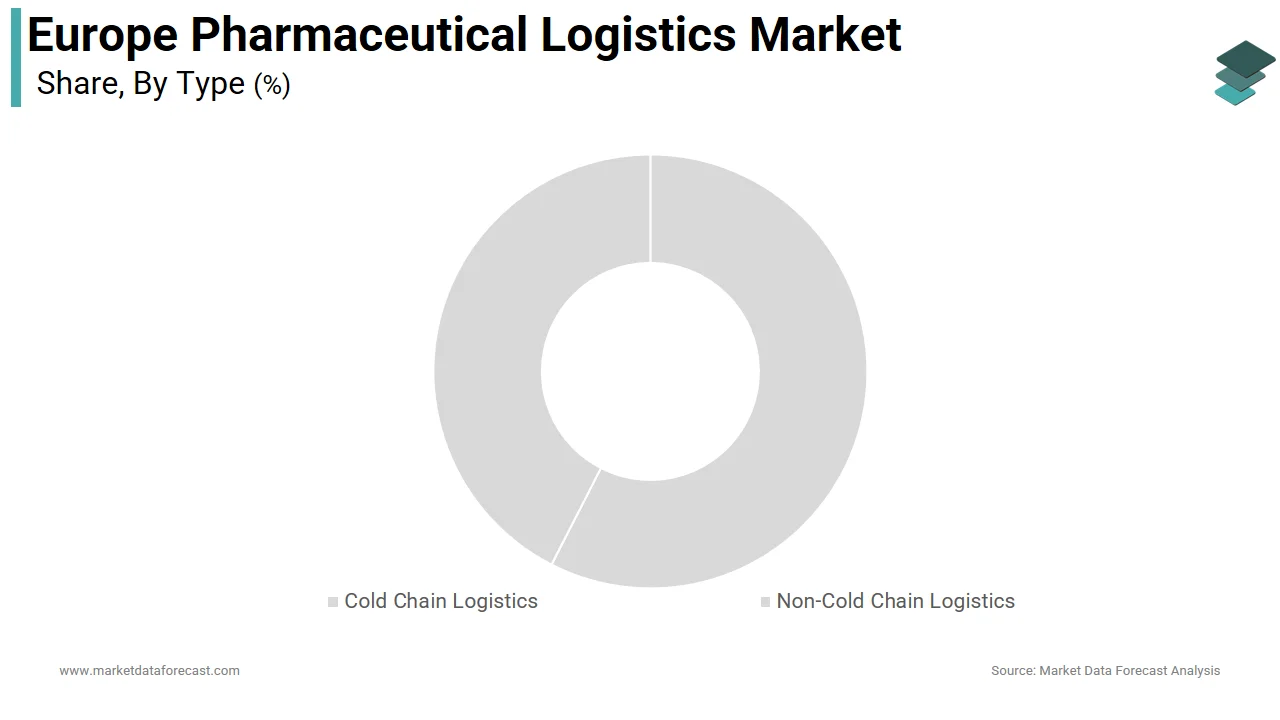
The Cold Chain Logistics segment is growing eventually with an expected CAGR of 14.3% from 2025 to 2033, with the accelerating commercialization of personalized medicines and the geographic expansion of biologics access. Cell and gene therapies are often patient-specific and viable for only 24 to 72 hours that requiring cryogenic transport and hospital-side thawing, which creates hyperlocal cold chain circuits. According to the European Society for Gene and Cell Therapy, the number of approved autologous therapies in the EU rose to 24 in 2024, with over 12000 patient treatments administered annually. Additionally, the European Commission’s 2024 Cancer Mission allocated 1.2 billion euros to decentralize advanced oncology treatments, necessitating cold chain links to regional hospitals previously unaccustomed to handling such products.
By Component Insights
The transportation segment accounted in holding 55.4% of the Europe Pharmaceutical Logistics Market share in 2024 by owing to the complexity and frequency of movements required across a fragmented healthcare landscape. The rise of direct-to-patient models has further intensified last-mile trips, especially for high-cost injectables requiring nurse delivery. Regulatory scrutiny adds cost and complexity; each cross-border shipment must carry electronic consignment notes and serial number verifications under the EU Falsified Medicines Directive. This operational density ensures transportation remains the most resource-intensive and value-generating component of the pharmaceutical logistics chain.
The monitoring components segment is expected to register the fastest CAGR of 6.4% during the forecast period, with the regulatory mandates for real-time visibility and the industry’s shift toward predictive logistics. The EU Falsified Medicines Directive and GDP guidelines require continuous temperature and location tracking for all sensitive shipments, which is driving adoption of IoT-enabled sensors, cloud platforms, and data analytics. Monitoring data enables proactive intervention, where a 2024 study by the Technical University of Munich found that predictive alerts from smart sensors reduced temperature excursions by 41% during summer months. Major players like DHL and Kuehne Nagel have integrated AI-driven dashboards that forecast delays based on weather, traffic, and customs data. Additionally, the European Commission’s Digital Product Passport initiative mandates granular shipment data for environmental and safety reporting, further accelerating sensor deployment.
COUNTRY LEVEL ANALYSIS
Germany Pharmaceutical Logistics Market Analysis
Germany was the largest contributor to the Europe pharmaceutical logistics market by holding 21.3% of the share in 2024, with research hospitals' robust biopharmaceutical manufacturing base and stringent regulatory enforcement. This industrial output necessitates a high frequency of GDP-compliant outbound logistics. According to the Federal Institute for Drugs and Medical Devices, 92% of specialty drug shipments in 2024 used validated cold chain solutions with real-time monitoring.
France Pharmaceutical Logistics Market Analysis
France was the second largest country in the Europe Pharmaceutical Logistics Market by holding 17.4% of the share in 2024, with its centralized healthcare procurement and strong emphasis on medicine security. The French National Agency for Medicines and Health Products Safety enforces some of the strictest GDP audits in Europe, requiring all logistics providers to undergo biannual certification. The country’s investment in rural healthcare access further drives last-mile complexity, where 45% of communes with fewer than 2000 residents receive weekly refrigerated deliveries via state-contracted carriers.
United Kingdom Pharmaceutical Logistics Market Analysis
The United Kingdom Pharmaceutical Logistics Market is expected to have significant growth opportunities with its advanced specialty pharmacy networks and leadership in cell and gene therapy delivery. The National Health Service manages one of the world’s most integrated medicine logistics systems, with over 60% of high-cost biologics delivered directly to patients’ homes. According to NHS England, 280000 patient-specific therapy shipments occurred in 2024, each requiring cryogenic containers and customs pre-clearance for EU-sourced components. Companies like Movianto and World Courier operate dedicated UK hubs with MHRA-approved quarantine zones and rapid release protocols.
Italy Pharmaceutical Logistics Market Analysis
Italy's pharmaceutical logistics market growth is likely to grow with the regional healthcare decentralization and growing demand for temperature-controlled distribution in the south. While northern regions like Lombardy and Emilia Romagna host major pharmaceutical plants, distribution to central and southern Italy faces infrastructural challenges, including mountainous terrain and limited cold storage in rural areas. Italy is also a key market for biosimilars by accounting for 22% of EU biosimilar volume as per Assogenerici, which requires stringent logistics to maintain protein stability. The adoption of GDP-compliant courier networks has accelerated, with Poste Italiane’s healthcare division now handling over 15000 refrigerated deliveries daily. These transformation efforts reflect Italy’s strategic pivot from fragmented local systems toward a unified national pharmaceutical logistics framework.
COMPETITIVE LANDSCAPE
Competition in the Europe Pharmaceutical Logistics Market is defined by a concentrated landscape of global logistics giants and specialized regional providers vying for contracts with pharmaceutical manufacturers, health systems, and government agencies. The top tier is dominated by multinational integrators such as DHL, Kuehne Nagel, and DB Schenker, which leverage scale, regulatory expertise, and digital platforms to win long-term partnerships. These firms compete on reliability, compliance, and technological sophistication rather than price alone. Mid-tier players focus on niche segments such as clinical trial logistics or last-mile delivery in specific countries, often forming alliances to extend reach. Barriers to entry remain high due to capital intensity, certification requirements, and the need for proven GDP compliance records. Innovation in real-time monitoring, blockchain traceability, and sustainable cold chain solutions has become a key battleground. Meanwhile, public procurement frameworks in countries like Germany and France increasingly prioritize resilience and redundancy, further intensifying competition among qualified providers to demonstrate end-to-end control and crisis responsiveness.
KEY MARKET PLAYERS
Some of the companies that are playing a dominating role in the Europe pharmaceutical logistics include
- DHL Supply Chain
- FedEx
- Kuehne Nagel International AG
- United Parcel Service
- H. Robinson
- Eurotranspharma
- Centre Specialites Pharmaceutiques
- PostNL Pharma & Care
- DB Schenker
- Trans-o-Flex Schnell-Lieferdienst GmbH
TOP PLAYERS IN THE MARKET
- DHL Supply Chain is a global leader in life sciences logistics with an extensive pharmaceutical network across Europe. The company operates over 120 GDP-compliant warehouses in the region, equipped with temperature-controlled zones ranging from minus 70°C to plus 25°C. DHL specializes in end-to-end solutions for biologics, vaccines, and clinical trials, including direct-to-patient delivery and return logistics for temperature-sensitive products. In recent years, the company has invested in its MySupplyChain digital platform, offering real-time visibility across shipments. It also launched dedicated cell and gene therapy logistics services with cryogenic packaging and 24/7 command centers. These initiatives reinforce DHL’s role as a strategic partner for global pharma companies requiring resilient, compliant, and patient-centric distribution in Europe and beyond.
- Kuehne Nagel is a prominent player in the Europe Pharmaceutical Logistics Market, offering integrated air, sea, and road solutions tailored for the life sciences sector. Its KN PharmaChain division provides validated packaging temperature monitoring and customs brokerage for high-value medicines across more than 130 countries. The company manages dedicated life sciences hubs in key locations, including Basel, Prague, and Dubai, with European operations certified under EU GDP and US FDA standards. Recently, Kuehne Nagel expanded its IoT-enabled tracking capabilities through its SenseChain platform and introduced blockchain-based documentation for serialization compliance. It also enhanced its last-mile network in Eastern Europe to support clinical trial material delivery. These actions demonstrate its commitment to digital innovation and regulatory excellence in global pharmaceutical supply chains.
- DB Schenker is a major European logistics provider with a specialized focus on pharmaceutical and healthcare transportation. The company operates a pan-European network of GDP-certified facilities and offers multimodal solutions for temperature-sensitive shipments, including passive and active cooling systems. DB Schenker’s Life Sciences division provides services ranging from bulk vaccine distribution to patient-specific therapy logistics with real-time monitoring and contingency planning. In recent years, the company has strengthened its capabilities through strategic partnerships with hospital groups and investments in sustainable cold chain solutions, such as electric refrigerated vans in urban centers. It also implemented AI-driven route optimization to reduce transit times and temperature risks. These efforts position DB Schenker as a trusted partner for both public health systems and private biopharma enterprises across Europe and internationally.
TOP STRATEGIES USED BY THE KEY MARKET PARTICIPANTS
Key players in the Europe Pharmaceutical Logistics Market focus intensely on regulatory compliance, digital integration, and service customization to differentiate themselves. They invest heavily in GDP and FDA-certified infrastructure, including temperature-controlled warehouses and validated packaging solutions. Real-time monitoring through IoT sensors and cloud-based visibility platforms is now standard practice, enabling proactive risk management. Companies are expanding direct-to-patient and clinical trial logistics capabilities to capture growth in personalized medicine. Strategic partnerships with pharmaceutical firms and health authorities ensure alignment with national medicine security goals. Sustainability is also emerging as a core strategy with the adoption of electric vehicles, renewable energy-powered facilities, and reusable packaging systems to meet EU Green Deal targets while maintaining product integrity.
MARKET SEGMENTATION
This Europe pharmaceutical logistics market research report is segmented and sub-segmented into the following categories.
By Type
-
Cold Chain Logistics
-
Non-Cold Chain Logistics
By Component
-
Storage
-
Warehouse
- Refrigerated Container
-
- Transportation
- Sea Freight Logistics
- Airfreight Logistics
- Overland Logistics
- Monitoring Components
- Hardware
- Sensors
- RFID Devices
- Telematics
- Networking Devices
- Software
- Hardware
By Country
- UK
- France
- Spain
- Germany
- Italy
- Russia
- Sweden
- Denmark
- Switzerland
- Netherlands
- Turkey
- Czech Republic
- Rest of Europe