- Product Description Description
- Table of Contents TOC
- List of Table & Figure LOT
- Get Free Sample PDF Sample PDF
Market Size, 2025
$3.26 TnMarket Estimate, 2026
$3.65 TnMarket Forecast, 2034
$9.12 TnCAGR, 2026–2034
12.11%Europe Private Equity Market Report Summary
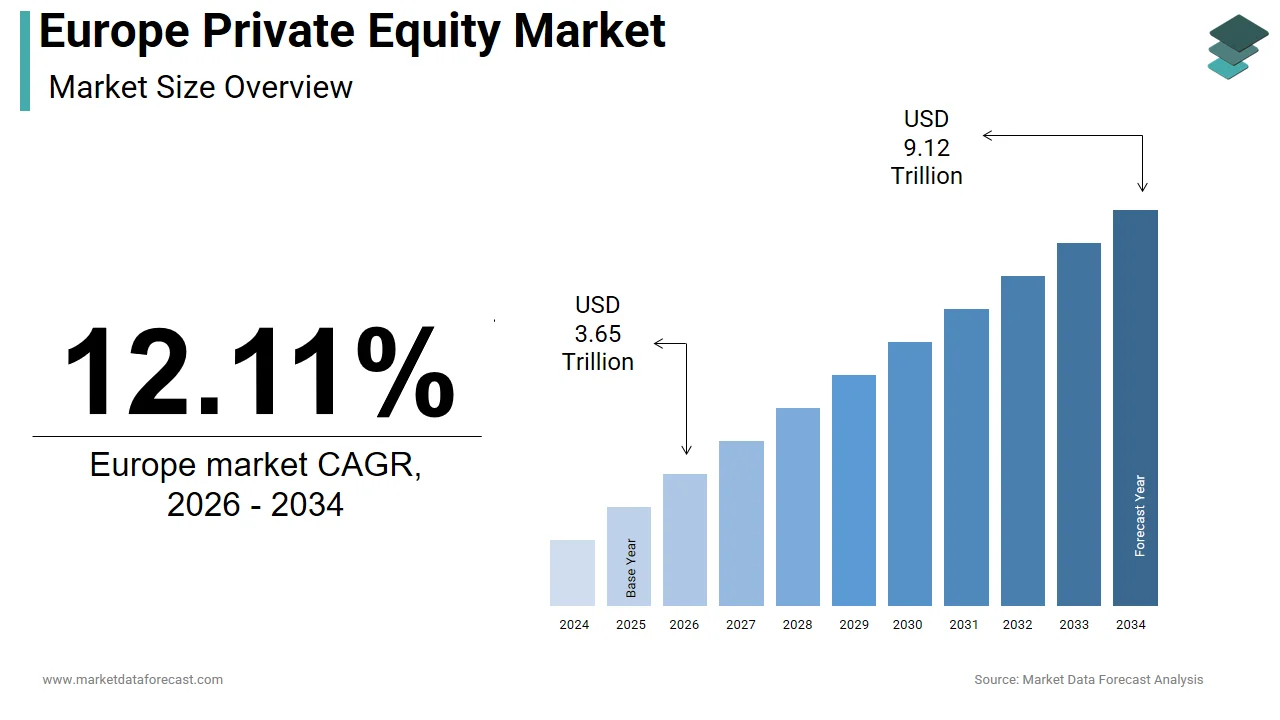
The Europe private equity market was valued at USD 3.26 trillion in 2025, is estimated to reach USD 3.65 trillion in 2026, and is projected to reach USD 9.12 trillion by 2034, growing at a CAGR of 12.11% from 2026 to 2034. Market growth is driven by increasing institutional investments, expanding venture capital ecosystems, and rising demand for capital to support business expansion and innovation. Private equity firms invest in privately held companies or acquire public companies to improve operational efficiency and generate long-term returns. The growing number of technology startups, increasing mergers and acquisitions activity, and favorable investment conditions across European economies are further supporting market expansion.
Key Market Trends
- Increasing investment in technology and high-growth startup sectors.
- Rising demand for buyout and growth capital strategies.
- Expansion of cross-border private equity investments across Europe.
- Growing participation of institutional investors such as pension funds and sovereign wealth funds.
- Increasing focus on sustainable and ESG-driven investment strategies.
Segmental Insights
- Based on fund type, the buyout and growth segment dominated the Europe private equity market by accounting for 60.6% share in 2025, driven by strong demand for capital to support company expansion and restructuring.
- Based on sector, the technology segment led the market by capturing 26.9% share in 2025, supported by the rapid growth of digital businesses, software companies, and technology-driven startups.
- Based on investments, the upper-middle market segment held the largest share of 44.7% in 2025, driven by increasing private equity investments in mid-sized companies with high growth potential.
Regional Insights
The Europe private equity market is witnessing strong investment activity across major economies due to growing entrepreneurial ecosystems and expanding capital markets.
- Germany held the leading position in 2025 with 21.2% share, supported by a strong industrial base, thriving startup ecosystem, and increasing venture capital investments.
- The United Kingdom and Ireland together represent the second-largest private equity market in Europe, driven by strong financial markets and a vibrant fintech and technology startup landscape.
- France is expected to hold a prominent share over the forecast period due to government support for innovation and growing investments in technology and digital transformation sectors.
Competitive Landscape
The Europe private equity market is characterized by strong competition among global investment firms and regional private equity funds focusing on strategic investments and portfolio growth. Market participants are emphasizing sector specialization, operational value creation, and long-term investment strategies. Strategic acquisitions, partnerships, and investments in emerging industries are shaping the competitive dynamics across the region.
Prominent companies operating in the Europe private equity market include Permira Partners, EQT AB, CVC Capital Partners, Apax Partners, and Ardian.
Europe Private Equity Market Size
The Europe private equity market was valued at USD 3.26 trillion in 2025, is estimated to reach USD 3.65 trillion in 2026, and is projected to reach USD 9.12 trillion by 2034, growing at a CAGR of 12.11% from 2026 to 2034.
Private equity functions as a sophisticated capital allocation engine that deploys institutional funds to acquire, restructure, and grow unlisted companies across the continent. This ecosystem serves as a critical alternative to public markets, providing patient capital to mid-market enterprises and facilitating ownership transitions for family-owned businesses. In 2024, the region witnessed a significant recalibration of activity, with fundraising volumes contracting as limited partners adopted a cautious stance amid macroeconomic uncertainty. Despite this slowdown in capital inflow, dry powder, or unspent capital committed to funds, remained robust, indicating substantial liquidity waiting for deployment once valuation gaps narrow. The market is characterized by a distinct shift from leveraged buyouts driven by financial engineering to value creation strategies focused on operational improvements and digital transformation. According to Invest Europe, the number of divestments via trade sales increased as general managers sought liquidity through strategic buyers rather than volatile initial public offerings. Furthermore, as per Invest Europe, the average holding period for assets has extended, reflecting a strategic pause in exiting investments until market conditions stabilize. This definition captures a sector in a phase of consolidation, where the interplay between high interest rates and resilient corporate fundamentals dictates the pace of transactional activity.
MARKET DRIVERS
Succession Planning Needs in Fragmented Family-Owned Enterprises
The urgent need for succession planning within the vast landscape of family-owned small and medium-sized enterprises that lack internal heirs is primarily driving the growth of the Europe private equity market. Europe hosts millions of family businesses, and demographic shifts indicate that a significant portion of founders are reaching retirement age without a clear generational transfer plan. According to the European Commission, a large number of small and medium-sized enterprises in the European Union face ownership transfer issues every year, which creates a massive pipeline of potential acquisition targets for private equity firms. These business owners increasingly view private equity not merely as a buyer but as a partner capable of professionalizing management structures while preserving the company's legacy. The fragmentation of the European industrial base, particularly in Germany and Italy, offers private equity investors a unique opportunity to execute buy-and-build strategies that consolidate fragmented sectors. For instance, the emotional complexity of selling a family legacy often makes trade sales to competitors less attractive, which positions financial sponsors as the preferred exit route. This demographic cliff ensures a steady supply of deal flow regardless of broader economic cycles, as the necessity of exit becomes non-negotiable for aging entrepreneurs.
Institutional Demand for Yield in a Low-Growth Macro Environment
The relentless pursuit of yield by institutional investors who face diminishing returns from traditional fixed-income assets and public equities is further boosting the Europe private equity market expansion. In an environment where sovereign bond yields fluctuate and public market volatility remains high, pension funds and insurance companies across Europe are increasing their allocation to private markets to enhance portfolio performance. According to Preqin, European institutional investors plan to increase their private equity allocations to capture the illiquidity premium. As per surveys conducted by McKinsey, limited partners are prioritizing funds with strong track records in specific sectors like technology and healthcare, viewing these as defensive yet growth-oriented havens. This capital influx is essential for sustaining the fundraising capabilities of general partners, ensuring that, despite a slowdown in new fund closures, the long-term appetite for the asset class remains intact. The structural shift in asset allocation mandates means that private equity is no longer a satellite holding but a core component of institutional portfolios, which is providing a stable base of committed capital that fuels ongoing investment activity across the region.
MARKET RESTRAINTS
Persistent Valuation Gaps Between Buyers and Sellers
The stubborn valuation gap that exists between the price expectations of sellers and the bid levels of buyers is a significant impediment to the growth of the Europe private equity market. Sellers, anchored to the high multiples achieved during the boom years of 2021 and 2022, remain reluctant to accept the lower valuations dictated by the current high-interest-rate environment. According to Bain and Company, the median entry multiple for buyout deals in Europe contracted in 2024, yet many business owners have not adjusted their price expectations accordingly. As per Refinitiv, the number of completed leveraged buyout transactions in Western Europe dropped as parties struggled to bridge the pricing disparity. The cost of capital has risen sharply, forcing private equity firms to model deals with lower leverage and higher equity checks, which inherently compresses potential returns and limits the price they can pay. This mathematical reality clashes with the psychological resistance of sellers to mark down asset values, which is resulting in a frozen mid-market where viable companies remain unsold.
Stringent Regulatory Scrutiny and Antitrust Enforcement
The intensifying regulatory scrutiny and aggressive antitrust enforcement by European authorities, which prolongs deal timelines and increases the risk of transaction failure, are further hindering the regional market expansion. The European Commission and national regulators have adopted a stricter stance on mergers and acquisitions, particularly concerning roll-up strategies and cross-border consolidations in key sectors. According to the European Commission, several high-profile deals were blocked or abandoned in 2024 due to concerns over market concentration and competition. The implementation of the Foreign Subsidies Regulation has added another layer of complexity, which requires extensive notifications and investigations for deals involving non-EU capital and thereby delays closings. According to Clifford Chance, the average time required for regulatory approval in Europe has increased compared to five years ago, creating significant uncertainty for dealmakers. This regulatory headwind forces private equity firms to incur higher legal costs and devote more resources to compliance, often rendering smaller deals economically unviable. The fear of retrospective investigations or forced divestitures post-closing further dampens investor enthusiasm for ambitious consolidation plays. Consequently, the heightened regulatory burden acts as a structural impediment, discouraging large-scale transformative transactions and forcing firms to pursue smaller, less impactful investments that fall below regulatory radar thresholds.
MARKET OPPORTUNITIES
Accelerated Adoption of Artificial Intelligence and Digital Transformation
The aggressive deployment of artificial intelligence and digital technologies within portfolio companies to drive operational efficiency is one of the significant opportunities in the Europe private equity market. Private equity firms are uniquely positioned to fund and oversee the digital overhaul of traditional European industries that have lagged in technology adoption compared to their US counterparts. According to Boston Consulting Group, private equity-backed companies in Europe that implemented AI-driven operational tools experienced notable EBITDA margin expansion within two years of investment. As per industry trends, funds are increasingly hiring dedicated teams of data scientists and digital operators to work alongside portfolio management, which is signalling a shift from financial engineering to tech-enabled value creation. The vast installed base of manufacturing and industrial assets in Germany, France, and Italy presents a ripe target for digital optimization, offering immense upside potential for investors who can successfully integrate smart factory solutions. Furthermore, the European Union’s push for digital sovereignty creates a favorable policy environment for investments in homegrown tech champions. By leveraging technology to streamline supply chains and automate processes, private equity firms can unlock significant hidden value, turning mediocre performers into market leaders and generating superior returns for their limited partners.
Expansion of the Secondaries Market for Liquidity Management
The rapidly expanding secondaries market presents a substantial opportunity for Europe private equity market participants to manage liquidity and recycle capital amidst a constrained initial public offering environment. With traditional exit routes blocked by volatile public markets, the sale of existing limited partner stakes and direct secondary buyouts of portfolio companies have emerged as vital alternatives. According to Jefferies, the European secondaries market volume reached record levels in 2024, which is showing strong growth over the last three years. For instance, structured secondary transactions allow private equity firms to provide liquidity to early investors while retaining control of high-performing assets for longer horizons. The sophistication of secondary instruments has evolved, with GP-led continuation funds becoming a mainstream tool for extending hold periods and avoiding fire sales. This mechanism enables managers to nurture assets through cyclical downturns and realize full value upon eventual exit. The deepening liquidity of the secondaries market effectively unclogs the pipeline, which is allowing the primary market to function more smoothly by offering a reliable pressure valve for capital recycling and portfolio management.
MARKET CHALLENGES
Elevated Interest Rates and Debt Servicing Pressures
The sustained environment of elevated interest rates that drastically increases debt servicing costs and erodes the profitability of leveraged buyouts is one of the major challenges to the Europe private equity market growth. The business model of private equity relies heavily on the spread between the cost of debt and the return on invested capital, a spread that has narrowed significantly as central banks maintained restrictive monetary policies. According to S&P Global, the average interest coverage ratio for leveraged loans in Europe fell to its lowest level in a decade in 2024, which is putting immense strain on portfolio companies with high debt loads. As per Moody’s, the default rate for speculative-grade borrowers in Europe, a category that includes many private equity-backed firms, rose during the same period, which is signalling growing distress among highly leveraged assets. The high cost of capital forces general partners to inject more equity into deals, which dilutes returns and reduces the overall capacity of funds to deploy capital. Furthermore, the uncertainty regarding the timing and magnitude of future rate cuts makes financial modeling difficult, which is causing investors to delay commitment decisions.
Talent Shortage and Operational Execution Risks
The acute shortage of specialized talent required to execute complex operational turnarounds and drive growth in portfolio companies is further challenging the regional market expansion. As private equity firms shift their focus from financial engineering to operational value creation, the demand for executives with expertise in digital transformation, supply chain optimization, and international expansion has outpaced supply. According to EY, a majority of European private equity leaders cited the inability to attract and retain top-tier management talent as the single biggest obstacle to realizing their investment thesis. As per Korn Ferry, the time taken to fill C-suite positions in private equity-backed firms has increased significantly, which is delaying the implementation of critical strategic initiatives. This talent gap poses a significant execution risk, as even the most well-capitalized deals can fail without the right human capital to drive change. The scarcity of experienced operators also drives up compensation costs, further squeezing margins in portfolio companies. Without access to a deep bench of skilled professionals, private equity firms struggle to deliver the operational improvements necessary to justify high entry multiples, which is threatening the overall performance of the asset class and the confidence of limited partners.
REPORT COVERAGE
| REPORT METRIC | DETAILS |
| Market Size Available | 2025 to 2034 |
| Base Year | 2025 |
| Forecast Period | 2026 to 2034 |
| Segments Covered | By Fund Type, Sector, Investments, and Country. |
| Various Analyses Covered | Global, Regional, and Country-Level Analysis, Segment-Level Analysis, Drivers, Restraints, Opportunities, Challenges; PESTLE Analysis; Porter’s Five Forces Analysis, Competitive Landscape, Analyst Overview of Investment Opportunities |
| Countries Covered | UK, France, Spain, Germany, Italy, Russia, Sweden, Denmark, Switzerland, Netherlands, Turkey, Czech Republic, and the Rest of Europe. |
| Market Leaders Profiled | Permira Partners, EQT AB, CVC Capital Partners, Apax Partners, Ardian, and Others. |
SEGMENTAL ANALYSIS
By Fund Type Insights
The buyout and growth segment led the market by capturing the highest share of 60.6% of the regional market in 2025. The dominance of buyout and growth segments in the Europe private equity market is attributed to the mature nature of the European corporate landscape, which features a vast array of established small and medium-sized enterprises requiring succession solutions and operational scaling. The demographic reality of European business ownership, where a significant wave of founders is reaching retirement age without internal successors, is also contributing to the dominance of buyout and growth segments in this regional market. According to the European Commission, a large number of small and medium-sized enterprises face ownership transfer challenges annually, which creates a consistent and deep pipeline of acquisition targets for buyout specialists. These firms possess the capital depth and operational expertise required to manage complex transitions, professionalize family businesses, and execute carve-outs from larger conglomerates. As per Invest Europe, buyout transactions consistently represent the majority of deal volume because they offer limited partners predictable returns through operational improvements rather than speculative growth. Furthermore, the trend of corporate carve-outs has accelerated, with multinational corporations divesting non-core units to focus on strategic priorities, a process that almost exclusively relies on buyout firms with the resources to integrate and stabilize these assets immediately.
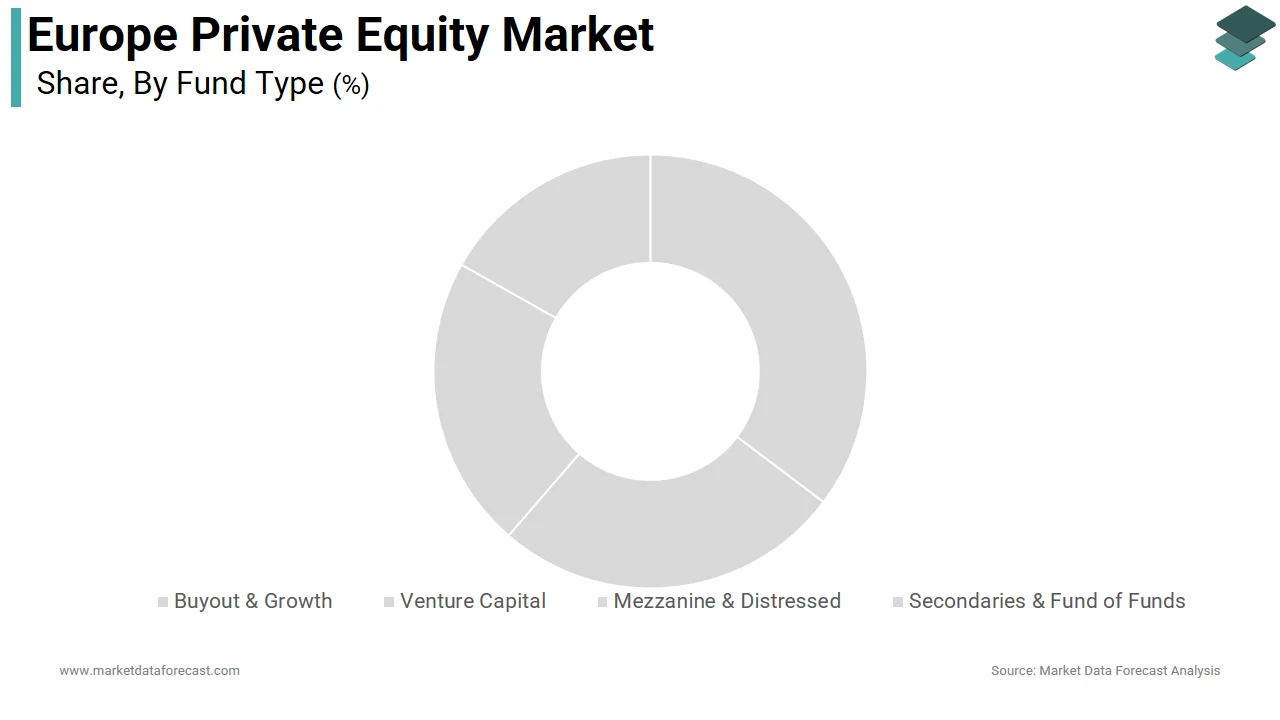
The venture capital segment is projected to witness the fastest CAGR of 13.5% over the forecast period in the Europe private equity market. The emergence of a robust technology ecosystem across Europe, increasing government support for deep tech innovation, and the strategic pivot by European governments and the European Union toward achieving technological sovereignty, particularly in deep tech sectors like artificial intelligence, biotechnology, and clean energy, are driving the growth of the venture capital segment in the European market. According to the European Investment Bank, public funding for venture capital initiatives has increased significantly since 2020, with programs like the European Innovation Council providing equity financing to de-risk early-stage investments for private co-investors. As per Dealroom, the number of unicorns created in Europe has grown strongly in the last five years, which is demonstrating the viability of the region's startup ecosystem and attracting global venture capital attention. Furthermore, the fragmentation of the European market is being overcome by cross-border venture funds that can scale startups across the continent, which offers larger exit opportunities.
By Sector Insights
The technology segment led the market by accounting for 26.9% of the European market share in 2025. The leading spot of the technology segment in the European market is attributed to the pervasive digital transformation occurring across all European industries and the region's status as a global hub for software and fintech innovation. The urgent need for traditional European industries to undergo digital transformation to maintain competitiveness in a globalized economy is also aiding the expansion of the technology segment in the regional market. According to Eurostat, a majority of European enterprises have intensified their investment in cloud computing and big data analytics, creating a massive addressable market for private equity firms specializing in technology buyouts and growth investments. As per Boston Consulting Group, technology-enabled companies in Europe have demonstrated EBITDA margins significantly higher than their non-digital counterparts, making them highly attractive targets for value creation. The fragmentation of the European software market allows for consolidation opportunities, where buyout firms can aggregate niche players to create regional champions. Furthermore, the resilience of technology revenues during economic downturns provides a defensive characteristic that appeals to investors seeking stability.
The healthcare segment is anticipated to register a promising CAGR of 15.9% in the Europe private equity market during the forecast period. Factors such as demographic aging, the rise of personalized medicine, the increasing integration of technology in healthcare delivery, and the profound demographic shift in Europe are propelling the expansion of the healthcare segment in the European market. According to the European Commission, the proportion of Europeans aged 65 and older is expected to rise significantly by 2050, which requires a massive expansion of healthcare infrastructure and services. As per Deloitte, healthcare expenditure in Europe is projected to grow steadily, outpacing GDP growth and creating a resilient revenue base for invested companies. The fragmentation of the healthcare provider market allows for roll-up strategies, where private equity can consolidate independent practices to achieve economies of scale and improve operational efficiency. Furthermore, the shift toward value-based care models rewards providers who can deliver better outcomes at lower costs, a mandate that private equity-backed organizations are well-equipped to meet through data-driven management. The inelastic nature of healthcare demand ensures steady cash flows even during economic contractions, which makes the sector a haven for capital seeking both growth and stability.
By Investments Insights
The upper-middle market segment dominated the Europe private equity market by holding 44.7% of the European market share in 2025. The dominance of the upper-middle segment in the European market is driven by companies in this tier that possess sufficient scale to support professional management teams and complex operational initiatives while remaining agile enough for significant transformation. According to Invest Europe, upper-middle market deals consistently attract the largest pools of capital because they allow private equity firms to deploy substantial checks without encountering the intense competition and inflated valuations seen in the large-cap segment. These companies often have established market positions and diversified revenue streams, which reduces the risk of failure while providing a solid platform for add-on acquisitions and international expansion. As per PwC, upper-middle market companies in Europe have demonstrated stronger EBITDA growth compared to small-cap firms, showing resilience and capacity for value creation. The complexity of these businesses requires the sophisticated operational expertise that top-tier private equity firms bring, creating a natural fit between investor capability and asset needs. Furthermore, the exit landscape for upper-middle market companies is robust, with a wide range of potential buyers including large corporates and other private equity funds, ensuring liquidity for investors.
The large-cap segment is anticipated to experience the fastest CAGR of 11.5% over the forecast period in this regional market, owing to the increasing size of private equity funds and the trend toward mega-buyouts of premier corporate assets. The proliferation of mega-funds that have amassed unprecedented amounts of dry powder that must be deployed into sizable transactions to move the needle on overall fund performance is further boosting the regional market expansion. According to Preqin, the average size of the largest European private equity funds has exceeded several billion euros, forcing managers to pursue deals with enterprise values above 1 billion euros to utilize their capital efficiently. As per Bain and Company, the number of mega-buyouts in Europe has increased in recent years, reflecting the aggressive deployment strategies of top-tier firms. The concentration of capital among a few elite managers allows them to compete for crown-jewel assets that were previously the domain of public markets or strategic buyers. Furthermore, the ability of these large funds to offer certainty of closure and speed of execution makes them preferred partners for sellers of complex, high-value businesses. This dynamic creates a self-reinforcing cycle where larger funds chase larger deals, driving the growth rate of the large-cap segment ahead of smaller tiers.
COUNTRY-LEVEL ANALYSIS
Germany Private Equity Market Analysis
Germany held the largest position in the European private equity market with 21.2% of the regional market share in 2025. The dominating position of Germany in the European market can be credited to the strength of the Mittelstand as family‑owned mid‑sized companies that are attractive buyout targets due to their stability and export orientation. Industrial technology, healthcare, and advanced manufacturing remain the most active sectors, supported by Germany’s engineering excellence and global supply chain integration. Berlin and Munich also serve as hubs for venture and growth equity, particularly in fintech and biotech. Institutional investors, including pension funds and insurers, provide a deep capital pool, while regulatory stability ensures predictable transaction structures. The rebound in leveraged buyouts has been supported by easing financing conditions, with banks and private debt funds actively participating. With its combination of industrial depth, investor confidence, and innovation ecosystems, Germany continues to anchor Europe’s private equity landscape and is expected to remain the benchmark for large‑scale transactions.
United Kingdom Private Equity Market Analysis
The United Kingdom, together with Ireland, had second largest private equity market in Europe. London remains Europe’s financial capital, hosting global PE firms and providing access to deep capital markets. Despite Brexit, the UK has maintained strong deal flow, particularly in technology, software, and healthcare, with exits through IPOs and secondary buyouts driving liquidity. Ireland complements this with favorable tax structures and a growing life sciences cluster, attracting cross‑border investment. Private equity fundraising rebounded in 2024, supported by international investors seeking exposure to resilient UK sectors. The regulatory environment, shaped by the Financial Conduct Authority and post‑Brexit autonomy, has enabled faster approvals for innovative fund structures. With a blend of global connectivity, strong exit opportunities, and sectoral diversity, the UK&I region remains a cornerstone of European private equity, expected to sustain its role as a hub for both domestic and international investors.
France Private Equity Market Analysis
France is predicted to account for a prominent share of the Europe private equity market during the forecast period. The emphasis of France on mid‑market transactions and innovation‑driven sectors is propelling the French market expansion. Paris has become a hub for pan‑European funds, with strong activity in consumer goods, renewable energy, and biotech. The French government has actively supported private equity through initiatives aligned with the France 2030 investment plan, encouraging capital flows into green technologies and digital transformation. France’s private equity ecosystem is characterized by active SME participation, with mid‑cap deals dominating rather than mega‑buyouts. The country also leads in sustainability‑linked PE strategies, reflecting EU green finance regulations and investor demand for ESG compliance. Institutional investors, including state‑backed funds, play a significant role in driving capital into strategic industries. With its combination of policy support, sectoral diversity, and cultural emphasis on innovation, France is expected to remain a stable and high‑value market, bridging traditional industries with emerging growth opportunities.
Netherlands Private Equity Market Analysis
Belgium, the Netherlands, and Luxembourg together accounted for a prominent share of the Europe private equity market in 2025. The region benefits from cross‑border integration, investor‑friendly policies, and strong sectoral specialization. The Netherlands leverages its logistics hub status and advanced agri‑food and biotech industries, attracting significant PE investment. Luxembourg remains a preferred domicile for funds due to its favorable regulatory framework and tax efficiency, while Belgium contributes niche deals in chemicals, pharmaceuticals, and manufacturing. The Benelux region has also embraced sustainability, with funds actively investing in circular economy initiatives and clean technologies. Strategic location and connectivity to broader European markets make Benelux a scalable gateway for international investors. With its blend of financial infrastructure, sectoral diversity, and regulatory clarity, the region is expected to sustain steady growth and remain a key niche hub within Europe’s private equity ecosystem.
COMPETITIVE LANDSCAPE
The competition in the Europe private equity market is intensely fierce as established giants compete with emerging boutique firms and international sponsors for a limited pool of high-quality assets. Large multinational managers leverage their massive capital reserves and global networks to dominate mega-buyout transactions, while smaller niche players differentiate themselves through specialized sector knowledge and agile decision-making processes. The landscape is characterized by a relentless battle for deal flow, where valuation expectations often clash with the realities of higher interest rates and economic uncertainty. Firms are increasingly competing on the quality of their operational support capabilities rather than just financial engineering prowess to win mandates from sellers. The rise of sovereign wealth funds and corporate venture arms has further intensified competition by introducing new sources of patient capital with different return thresholds. Regulatory scrutiny adds another layer of complexity as antitrust authorities closely examine consolidation deals, potentially stifling aggressive growth strategies. This dynamic environment forces all participants to continuously innovate their investment thesis and operational models to maintain relevance and secure superior returns in an increasingly crowded and sophisticated marketplace.
KEY MARKET PLAYERS
The leading companies operating in the Europe private equity market include:
- Permira Partners
- EQT AB
- CVC Capital Partners
- Apax Partners
- Ardian
TOP PLAYERS IN THEMARKET
- CVC Capital Partners stands as a preeminent force in the European private equity landscape with a profound impact on global investment trends. The firm manages a vast portfolio spanning healthcare, technology, and consumer sectors across multiple continents. Recently, CVC has strengthened its market position by launching dedicated credit strategies and expanding its infrastructure capabilities to offer comprehensive solutions to limited partners. They have actively pursued large-scale buyouts in the European mid-market while simultaneously growing their presence in Asia and the Americas through strategic partnerships. The firm recently secured significant commitments for its latest flagship fund, demonstrating strong investor confidence in its operational value creation model. By integrating advanced data analytics into their due diligence processes, CVC enhances decision-making accuracy and portfolio performance. Their commitment to environmental sustainability further distinguishes them as they guide portfolio companies toward net-zero emissions targets globally.
- EQT AB operates as a leading Scandinavian private equity manager that has successfully expanded its footprint to become a major global player with deep European roots. The firm is renowned for its sector-focused approach, particularly in technology, life sciences, and sustainable infrastructure. EQT recently strengthened its market position by establishing a dedicated platform for digital infrastructure and launching a massive seventh generation of flagship funds that attracted record capital inflows. They have pioneered the use of proprietary data tools like EQT Mountaineer to drive operational improvements and identify growth opportunities within portfolio companies. The firm actively collaborates with academic institutions and industry leaders to foster innovation in the healthcare and clean energy sectors. Their recent acquisitions in the renewable energy space highlight a strategic shift toward assets that deliver both financial returns and positive societal impact. EQT continues to expand its team with specialized industry experts to ensure deep sector knowledge drives every investment decision across its global network.
- Permira is a distinguished global investment firm with a strong heritage in Europe that specializes in technology, consumer, healthcare, and industrial sectors. The firm contributes significantly to the global market by backing visionary entrepreneurs and facilitating transformative growth stories across borders. Permira recently strengthened its market position by raising substantial capital for its latest technology-focused funds and expanding its operational capabilities in North America and Asia. They have developed a robust in-house team of digital experts who work directly with portfolio companies to accelerate digital transformation and scale operations. The firm recently executed several high-profile buyouts of leading software companies, reinforcing its reputation as a top-tier technology investor. Permira places a strong emphasis on responsible investing and has integrated rigorous environmental, social, and governance criteria into its entire investment lifecycle. Their strategic focus on building category-leading businesses through organic growth and add-on acquisitions ensures sustained value creation for investors and stakeholders alike.
TOP STRATEGIES USED BY KEY MARKET PARTICIPANTS
Key players in the Europe private equity market primarily employ sector specialization strategies to develop deep industry expertise and uncover unique investment opportunities that generalist firms might miss. Many firms are increasingly adopting buy-and-build approaches to consolidate fragmented markets and create regional champions with enhanced competitive advantages. Another dominant strategy involves leveraging proprietary data analytics and artificial intelligence tools to improve deal sourcing accuracy and optimize operational performance within portfolio companies. Participants are also focusing heavily on environmental, social, and governance integration to attract capital from socially conscious institutional investors and mitigate long-term risks. Furthermore, firms are expanding their geographic reach by establishing local offices in emerging European markets to capture growth before competitors arrive. The development of in-house operational teams dedicated to value creation has become standard practice to drive organic growth and efficiency improvements. These collective strategies enable market participants to navigate complex economic conditions while delivering superior returns to their limited partners through disciplined execution and strategic foresight.
MARKET SEGMENTATION
This research report on the Europe private equity market has been segmented and sub-segmented into the following categories.
By Fund Type
- Buyout & Growth
- Venture Capital
- Mezzanine & Distressed
- Secondaries & Fund of Funds
By Sector
- Technology (Software)
- Healthcare
- Real Estate and Services
- Financial Services
- Industrials
- Consumer & Retail
- Energy & Power
- Media & Entertainment
- Telecom
- Others (Transportation, etc.)
By Investments
- Large Cap
- Upper Middle Market
- Lower Middle Market
- Small & SMID
By Country
- United Kingdom
- France
- Spain
- Germany
- Italy
- Russia
- Sweden
- Denmark
- Switzerland
- Netherlands
- Rest of Europe