Europe Radar Market Size, Share, Trends And Growth Forecasts Research Report, Segmented By Component, Service, Application, Frequency, End Use and Country - Industry Analysis (2026 to 2034)
Market Size, 2025
$14.21 BnMarket Estimate, 2026
$15.01 BnMarket Forecast, 2034
$23.28 BnCAGR, 2026–2034
5.64%Europe Radar Market Report Summary
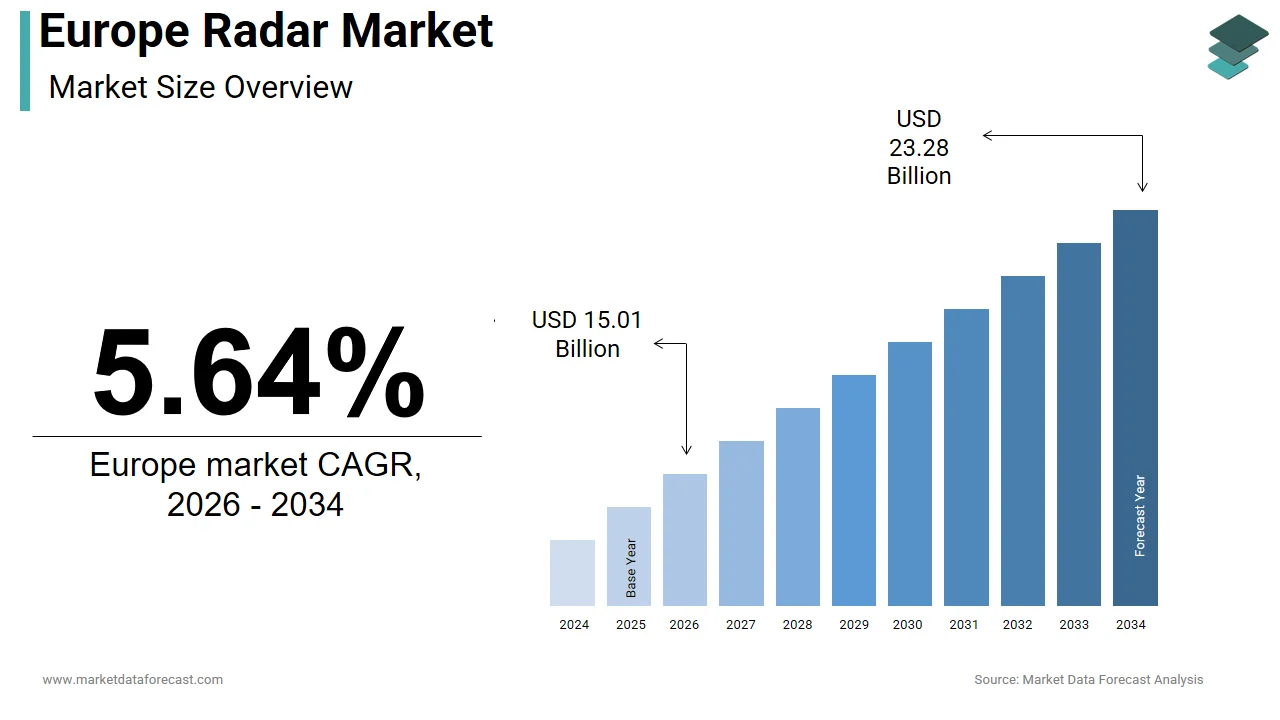
The European radar market was valued at USD 14.21 billion in 2025, is estimated to reach USD 15.01 billion in 2026, and is projected to reach USD 23.28 billion by 2034, growing at a CAGR of 5.64% from 2026 to 2034. The growth of the European radar market is driven by increasing defense modernization programs, rising demand for air and maritime surveillance systems, and advancements in radar technologies such as phased-array, solid-state, and 3D radar systems. Additionally, the growing application of radar in automotive, weather monitoring, and air traffic control is fueling market expansion across the region.
Key Market Trends
- Rising investments in next-generation radar systems for enhanced threat detection and situational awareness.
- Increasing adoption of automotive radar sensors for advanced driver-assistance systems (ADAS) and autonomous vehicles.
- Integration of AI and machine learning into radar systems for improved target recognition and tracking.
- Expansion of dual-use radar systems for both defense and civilian applications, including environmental and aviation monitoring.
- Shift toward compact and energy-efficient radar designs driven by miniaturization and semiconductor innovations.
Segmental Insights
- Based on component, the transmitter segment held the largest share of 32.5% of the Europe radar market in 2024. The dominance of this segment is attributed to the rising deployment of high-frequency transmitters in air defense and marine radar systems, coupled with technological advances in gallium nitride (GaN)-based power amplifiers that enhance performance and reliability.
- Based on service, the support and maintenance segment was the most prominent, capturing 45.4% share in 2024. This segment’s growth is driven by the need for continuous system upgrades, maintenance contracts, and lifecycle management services to ensure optimal radar performance, particularly in military and aviation applications.
- Based on application, the ground-based radar segment led the European radar market, accounting for 41.6% share in 2024. The segment benefits from increased investments in ground surveillance, border security, and air traffic control infrastructure across Europe.
- Based on end use, the military applications segment dominated the European radar market with a 57.3% share in 2024. The growing focus on strengthening defense capabilities, counter-drone operations, and cross-border surveillance has led to strong adoption of advanced radar systems by European armed forces.
Regional Insights
The European radar market is characterized by robust demand from major defense programs, expanding automotive radar applications, and increased investments in airspace monitoring systems.
- Germany was the top performer in the European radar market, accounting for 22.1% share in 2024, driven by extensive defense procurement, technological leadership in radar manufacturing, and the presence of major radar solution providers such as Hensoldt AG.
- France followed closely, supported by strong domestic production and government-backed defense programs led by Thales Group.
- The United Kingdom maintains a significant market presence due to advancements in radar surveillance and maritime defense technology.
- Italy and Sweden continue to contribute notably, benefiting from local players such as Leonardo S.P.A and Saab AB that are enhancing radar innovation and export potential.
- The Nordic countries are increasingly investing in radar systems for climate and airspace monitoring, reflecting a rising focus on dual-use technologies.
Competitive Landscape
The European radar market is moderately consolidated, with key players focusing on technological innovation, system integration, and long-term defense contracts. Companies are prioritizing AI-enabled radar development, lightweight designs, and modular radar architectures to cater to both military and commercial applications. Strategic collaborations between defense agencies and radar manufacturers are fostering growth across the continent. Leading players in the European radar market include Blighter Surveillance Systems Ltd. (U.K.), Leonardo S.P.A (Italy), Hensoldt AG (Germany), Saab AB (Sweden), Terma A/S (Denmark), and Thales Group (France).
Europe Radar Market Size
The Europe radar market was valued at USD 14.21 billion in 2025, is estimated to reach USD 15.01 billion in 2026, and is projected to reach USD 23.28 billion by 2034, growing at a CAGR of 5.64% from 2026 to 2034.
Radar refers to the radio detection and ranging systems across defense, civil aviation, maritime, meteorological, and emerging automotive applications. These systems utilize electromagnetic waves to detect, track, and identify objects at varying ranges and under diverse environmental conditions. Europe’s radar landscape is distinguished by advanced indigenous capabilities, stringent regulatory frameworks for spectrum allocation, and deep integration within NATO and EU security architectures. According to sources, a portion of EU member states operate ground-based air defense radar networks compliant with NATO’s Integrated Air and Missile Defence System. Civil applications are equally critical. As per studies, European airspace handles thousands of commercial flights daily, all monitored by primary and secondary surveillance radar installations. The European Space Agency operates a constellation of synthetic aperture radar satellites, including the Sentinel 1 mission, which provides all-weather Earth observation data for disaster response and environmental monitoring. This multifaceted operational environment, spanning sovereign defense, civilian safety, and scientific observation, defines the strategic contours of Europe’s radar ecosystem.
MARKET DRIVERS
Heightened Geopolitical Tensions and Defense Modernization Imperatives
Escalating security concerns along its eastern and southern flanks are prompting unprecedented defense modernization boosts the growth rate of the Europe radar market. As per research, defense spending across Europe has seen a significant increase, marking one of the fastest growth periods in recent decades. This surge is directly translating into radar procurement. According to sources, several EU countries have moved quickly to modernize and enhance their radar capabilities in response to evolving regional security challenges. As per research, Germany is investing in the replacement of outdated radar infrastructure with more advanced digital and electronically scanned systems. According to sources, Poland is also expanding its long-range radar network through new procurement agreements that strengthen its national air defense readiness. NATO’s 2023 Readiness Initiative mandates that all allied nations maintain persistent airspace surveillance, driving demand for mobile and counter-stealth radar technologies. These coordinated investments reflect a strategic shift from legacy rotating systems to networked, software-defined, and jam-resistant radar architectures capable of countering modern aerial threats.
Integration of Radar in Civil Aviation Safety and Air Traffic Management Modernization
The modernization of the region’s air traffic management infrastructure is a powerful enabler for radar technology adoption, which further fuels the expansion of the Europe radar market. The integration is driven by safety mandates and capacity constraints. A 2025 Eurocontrol forecast projects European air traffic to reach 12.4 million flights by 2031. The transition to Mode-S has been a long-running process and is already largely complete in European airspace. Most air traffic control areas have been using Mode-S for some time. These upgrades not only bolster safety but also increase airspace throughput, making radar an indispensable enabler of Europe’s aviation resilience and efficiency.
MARKET RESTRAINTS
Stringent Export Controls and Dual Use Technology Restrictions
Rigorous export control regimes governing dual-use technologies impede commercial scalability and international collaboration, which restrains the growth of the Europe radar market. As per the European Commission's Regulation (EU) 2021/821 on dual-use items, many radar systems are classified as controlled goods based on specific technical criteria listed in Annex I, which is regularly updated to align with multilateral agreements. Licensing delays are a potential issue for EU exporters of dual-use goods, including advanced radars. This regulatory friction particularly affects small and medium defense enterprises. These controls, while essential for strategic autonomy and ethical oversight, fragment the commercial landscape and limit economies of scale, ultimately raising unit costs and slowing innovation cycles for European radar developers.
Spectrum Congestion and Electromagnetic Interference in Urban Environments
Radio frequency congestion and electromagnetic interference, particularly in densely populated and industrialized regions, continue to be a key obstacle to the Europe radar market. As per research, the frequency range between 1 to 10 gigahertz, which is essential for radar operations, is now being used alongside 5G networks, satellite signals, and vehicle radar systems. This overlap has led to a noticeable rise in interference-related issues in recent years. According to sources, several instances of incorrect radar readings have been observed near major airports in Europe due to the impact of nearby 5G stations. Maritime radars along the North Sea corridor report similar degradation. Urban deployments of automotive radar for autonomous vehicles further exacerbate the problem. The reliability of civil and defense radar systems is steadily declining in Europe's most sensitive operational areas due to a lack of coordinated spectrum management and insufficient emission shielding standards.
MARKET OPPORTUNITIES
Expansion of Space-Based Earth Observation and Synthetic Aperture Radar Constellations
Region is leveraging radar technology to assert dominance in space-based Earth observation, which creates new opportunities for the growth of the Europe radar market. The Copernicus program managed by the European Space Agency runs several Sentinel satellites carrying radar systems capable of capturing clear images in any weather, both day and night. These satellites are mainly used for tracking environmental changes, supporting disaster relief, and monitoring marine activities. As per research, satellite data from this program has played a major role in numerous crisis mapping operations across Europe, such as analyzing floods and identifying unauthorized fishing activities. National initiatives are amplifying this momentum. Private sector participation is also rising. Companies have established European data processing hubs to serve EU institutional clients. This convergence of civil security and scientific objectives positions space-based radar as a strategic asset, which drives demand for miniaturized transceivers high high-throughput data links, and AI-enabled image analytics across the European industrial base.
Adoption of Radar in Autonomous Mobility and Intelligent Transportation Systems
The integration of radar into next-generation mobility solutions generates a key opportunity for the expansion of the European radar market. All new passenger vehicles sold in Europe are expected to have multiple radar sensors to support advanced driver assistance features, according to sources. Most recently registered cars in the region already come equipped with radar-based systems such as adaptive cruise control and blind spot monitoring, as per research. Urban infrastructure is following suit. This cross-sectoral diffusion not only diversifies the radar industry’s customer base but also accelerates miniaturization cost reduction and signal processing innovation.
MARKET CHALLENGES
Shortage of Skilled Workforce in Radar Engineering and Signal Processing
Deficit of specialized engineers capable of designing, integrating, and maintaining advanced radar systems, which inhibits the growth of the Europe radar market. Many defense contractors in Europe are facing major challenges in hiring professionals skilled in microwave engineering, digital beamforming, and electromagnetic simulation, according to sources. The number of graduates from universities with radar-focused programs remains much lower than the industry’s growing need for such specialists, as per research. This shortfall is particularly acute in Eastern Europe, where defense modernization programs are expanding but local talent pools remain underdeveloped. The problem is compounded by competition from the telecommunications and semiconductor sectors, which offer higher salaries for similar skill sets. Europe's security could become dependent on foreign nations unless it strengthens its educational systems, industry apprenticeships, and retention incentives.
High Lifecycle Costs and Obsolescence Risks in Legacy Radar Systems
Many European nations continue to operate aging radar platforms that incur escalating maintenance expenses and face growing obsolescence risks, thereby hampering the expansion of the Europe radar market. This strains defense and civil budgets. As per research, many ground-based air surveillance radars in parts of Southern and Eastern Europe were installed decades ago and now depend on outdated hardware components. According to sources, some air forces in Europe find that operating older radar networks costs significantly more than maintaining modern replacements. Likewise, as per studies, several regional airports in the United Kingdom spend much more on maintaining traditional radar systems compared to newer surveillance technologies with advanced tracking features. Component obsolescence is a persistent issue. These financial and operational burdens delay fleet modernization and reduce system availability, undermining Europe’s collective surveillance readiness at a time of heightened security demands.
REPORT COVERAGE
| REPORT METRIC | DETAILS |
| Market Size Available | 2025 to 2034 |
| Base Year | 2025 |
| Forecast Period | 2026 to 2034 |
| Segments Covered | By Component, Service, Application, Frequency, End-use, and Region. |
| Various Analyses Covered | Global, Regional, and Country-Level Analysis, Segment-Level Analysis, Drivers, Restraints, Opportunities, Challenges; PESTLE Analysis; Porter’s Five Forces Analysis, Competitive Landscape, Analyst Overview of Investment Opportunities |
| Countries Covered | UK, France, Spain, Germany, Italy, Russia, Sweden, Denmark, Switzerland, Netherlands, Turkey, Czech Republic, and the Rest of Europe. |
| Market Leaders Profiled | Blighter Surveillance Systems Ltd. (U.K.), Leonardo S.P.A. (Italy), Hensoldt AG (Germany), Saab AB (Sweden), Terma A/S (Denmark), and Thales Group (France). |
SEGMENTAL ANALYSIS
By Component Insights
The transmitter segment held the largest share of 32.5% of the Europe radar market in 2024. The dominance of the transmitter segment is driven by the transmitter’s critical role in determining radar range, resolution, and power efficiency, especially in modern active electronically scanned array systems. The shift from magnetron-based to solid-state transmitters is a primary driver. Additionally, the European Space Agency requires high-efficiency transmitters for its satellites to maximize imaging duty cycles over polar orbits. The integration of software-defined waveform generation further elevates transmitter complexity and value. These technological imperatives ensure the transmitter remains the highest value and most strategically sensitive component in Europe’s radar ecosystem.
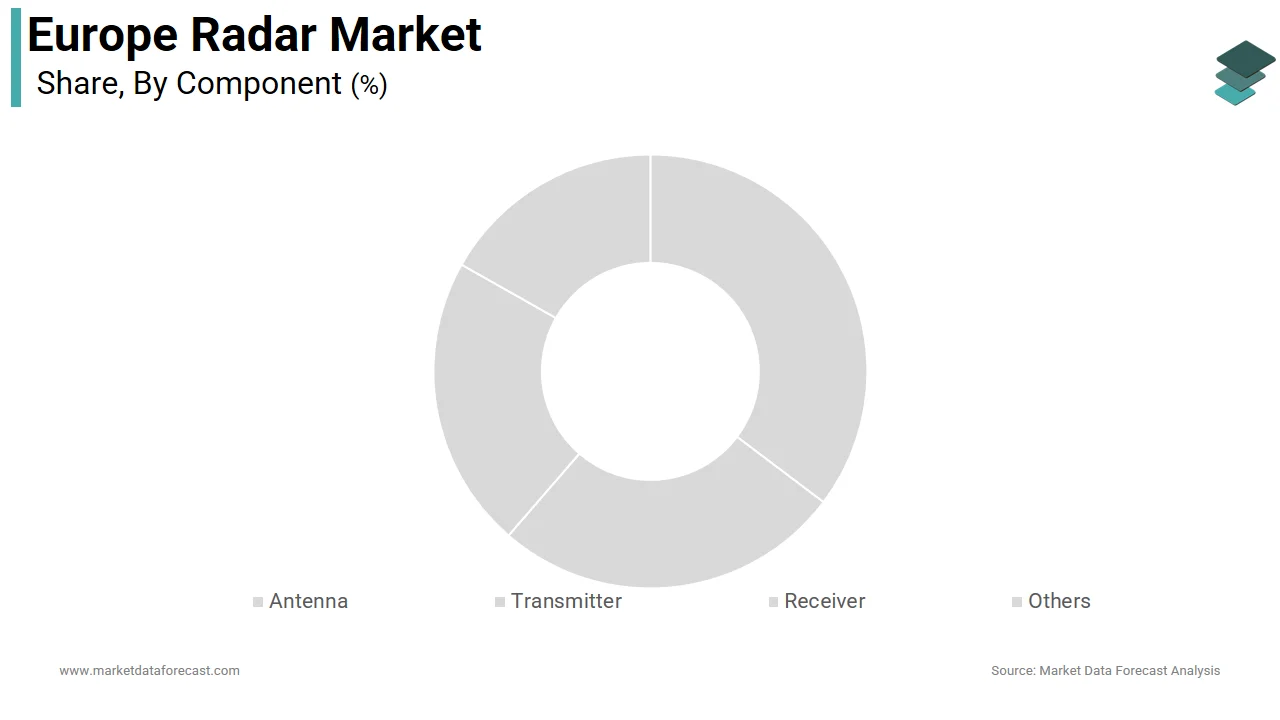
The receiver segment is estimated to register the fastest CAGR of 8.1% from 2025 to 2033. The rapid growth of the receiver segment is fueled by the demand for high-sensitivity digital receivers capable of processing complex waveforms in contested electromagnetic environments. Modern radar systems increasingly rely on wideband digital down conversion and real-time signal processing to detect low-observable targets. Furthermore, space-based synthetic aperture radar missions require cryogenically cooled receivers to achieve sub-decibel noise figures for high-resolution imaging. Academic research is also advancing the field. These innovations position the receiver as the focal point of radar performance evolution across defense, aerospace, and scientific domains.
By Service Insights
The support and maintenance segment was the prominent segment of the Europe radar market and captured 45.4% share in 2024. The prominence of the support and maintenance segment is attributed to the operational reality that radar systems, particularly in defense and air traffic control, require continuous calibration, software updates, and hardware servicing to maintain mission readiness. The aging of legacy fleets exacerbates demand. Apart from these, cybersecurity patches for networked radar systems have become routine. These persistent operational imperatives ensure that support and maintenance remain the financial backbone of the radar service economy.
The training and consulting segment is anticipated to witness the fastest CAGR of 9.3% during to forecast period. The growth of the training and consulting segment is led by the increasing complexity of modern radar systems and the urgent need to build indigenous expertise amid geopolitical uncertainty. As per research, many European countries have identified major gaps in radar signal processing and electronic warfare interpretation skills within their defense sectors. Civil aviation authorities are also investing heavily. These initiatives reflect a strategic pivot from hardware procurement to human capital development, recognizing that system effectiveness ultimately depends on operator proficiency in an era of hybrid threats.
By Application Insights
The ground-based radar segment led the European market and accounted for a 41.6% share in 2024. The prominence of the ground-based radar segment is attributed to Europe’s dense network of national air defense and border surveillance systems, which form the backbone of NATO’s Integrated Air and Missile Defence. Germany manages several fixed and mobile radar sites under its national surveillance program, according to sources. France also relies on its radar network to ensure complete airspace monitoring. Across Europe, numerous radar installations are used to oversee land and sea borders, which help detect unauthorized movements with high precision, as per research. Civil applications further reinforce this segment. These layered operational requirements, spanning sovereignty, security, and safety, ensure ground-based systems remain the most extensively deployed radar application across the continent.
The space-based radar segment is likely to experience the fastest CAGR of 11.2% from 2025 to 2033, owing to the operational success of synthetic aperture radar constellations that provide all-weather day-night imaging for defense and civil purposes. National security programs are equally active. Private sector participation is accelerating. This convergence of scientific, security, and commercial imperatives positions space-based radar as Europe’s most dynamic application frontier.
By End Use Insights
The military applications segment dominated the Europe radar market and occupied a share of 57.3%. The dominance of the military applications segment is because of the continent’s intensified focus on territorial defense and collective security following Russia’s invasion of Ukraine. Several European countries have begun expanding or launching new radar acquisition programs focused on air defense and naval monitoring, according to sources. Apart from these, electronic warfare resilience has become a core requirement. The integration of radar into multi-domain command systems, such as Germany’s Taktisches Luftverteidigungssystem, further elevates its strategic centrality. These sustained defense investments ensure military applications remain the primary engine of Europe’s radar economy.
The remote sensing segment is on the rise and is expected to be the fastest-growing segment in the regional market by witnessing a CAGR of 10.4% from 2025 to 2033. The rapid expansion of the remote sensing segment is driven by the operational indispensability of radar in environmental monitoring, disaster response, and climate science. National meteorological services are also adopting radar. Météo France upgraded its Doppler network to improve precipitation forecasting accuracy. Agricultural applications are emerging. Furthermore, the European Environment Agency employs radar interferometry to detect millimeter-scale ground subsidence in urban areas like Venice and Rotterdam. This scientific and policy integration transforms radar from a defense tool into a public good, unlocking sustained institutional demand across environmental and civil domains.
COUNTRY LEVEL ANALYSIS
Germany Radar Market Analysis
Germany was the top performer in the European radar market and accounted for a 22.1% share in 2024. The country’s dominance over Germany is due to its dual capability in advanced defense systems and civil aerospace radar technologies. Germany is the driving force behind the TLVS ground-based air defense program and operates the SARah military satellite constellation, both featuring indigenous radar developed by Hensoldt and Airbus. The German Aerospace Center maintains one of Europe’s most sophisticated weather radar networks. Government investment is robust. Academic institutions like the Fraunhofer Institute for High Frequency Physics pioneer photonic radar and quantum sensing prototypes. With deep integration into NATO and EU security frameworks and a strong industrial base, Germany anchors Europe’s radar sovereignty through technology, policy, and procurement leadership.
France Radar Market Analysis
France was the next prominent region in the Europe radar market by accounting for a 19.9% share in 2024. The growth of France is fuelled by its autonomous defense industrial complex and space-based radar capabilities. The country designs and produces its entire radar portfolio domestically through Thales and Safran. France operates the CSO military optical satellite system complemented by radar intelligence from foreign partners, but is developing its own SAR microsatellite under the MUSIS program. Civil applications are equally advanced. The French Air and Space Force maintains continuous radar coverage of its overseas territories using mobile systems deployed. France’s strategic autonomy doctrine ensures sustained investment across military, aerospace, and meteorological radar domains.
United Kingdom Radar Market Analysis
The United Kingdom grew steadily in the European radar market because of its world-class radar research and naval surveillance capabilities. The United Kingdom’s naval fleet is equipped with advanced multifunctional radar systems designed for enhanced maritime operations, according to sources. The country also maintains strong participation in NATO’s missile defense radar network through its national early warning facilities. Innovation continues to grow through academic research, with universities developing real-time radar imaging technologies now used in security and law enforcement. Since its exit from the European Union, the UK has placed greater emphasis on independent radar development, supported by substantial government investment in future air defense initiatives. This blend of operational deployment, scientific leadership, and strategic reinvestment sustains the UK’s influential radar posture.
Italy Radar Market Analysis
Italy expanded moderately in the European radar market as it excels in naval and airborne radar integration through Leonardo’s global leadership. The company supplies the Kronos family of ground-based radars to many countries and AESA radar for the Eurofighter Typhoon. Civil applications are robust. Hence, Italy leverages radar as both a defense asset and a diplomatic instrument in Mediterranean security because of its strong export performance and deep NATO integration.
Sweden Radar Market Analysis
Sweden is likely to grow in the Europe radar market due to its niche expertise in electronic warfare, resilient, and low observable radar technologies. Saab’s Giraffe family of agile multi-beam radars is deployed by many nations and forms the core of Sweden’s air defense network. The country pioneered the use of gallium nitride transmitters in tactical radars, reducing power consumption compared to legacy systems, as per sources. Sweden operates one of Europe’s most advanced civil weather radar networks. Academic collaboration is strong. Sweden’s neutrality doctrine has fostered self-reliance by making its radar industry a model of innovation, efficiency, and strategic foresight in Northern Europe.
COMPETITIVE LANDSCAPE
Competition in the Europe radar market is defined by a concentrated yet dynamic landscape where national champions coexist with specialized technology innovators. The sector is dominated by vertically integrated defense primes such as Thales Hensoldt and Saab that control end-to-end development from component design to system integration. However, niche players in photonic radar quantum sensing and passive detection are gaining traction through EU-funded research programs. Intensifying geopolitical pressures have elevated radar from a tactical asset to a strategic imperative, prompting governments to favor domestic suppliers for supply chain security. This has led to increased state-backed consolidation and technology transfer restrictions. At the same time, civil applications in air traffic management, weather forecasting, and Earth observation are creating cross-sectoral competition with commercial satellite and telecommunications firms. The convergence of defense autonomy, civil safety mandates, and dual-use innovation is fostering a highly specialized yet fiercely contested environment where technological differentiation and policy alignment are paramount to sustained market relevance.
KEY MARKET PLAYERS
Some of the companies that are playing a dominating role in the Europe radar market include
- Blighter Surveillance Systems Ltd. (U.K.)
- Leonardo S.P.A (Italy)
- Hensoldt AG (Germany)
- Saab AB (Sweden)
- Terma A/S (Denmark)
- Thales Group (France)
TOP PLAYERS IN THE MARKET
- Thales Group is a French multinational deeply embedded in Europe’s defense and aerospace radar ecosystem, supplying advanced ground-based based airborne, and naval radar systems to several countries globally. The company is a key contributor to NATO’s integrated air defense architecture through its Ground Master and Multi-Mission Radar families. In recent years, Thales has accelerated the deployment of software-defined and gallium nitride-based radar technologies to enhance electronic warfare resilience. Thales also strengthened its civil radar portfolio by integrating AI-powered weather prediction algorithms into its air traffic control systems across European airports, reinforcing its dual role in security and civilian safety infrastructure worldwide.
- Hensoldt AG is a German sensor specialist and a cornerstone of Europe’s sovereign radar capabilities, providing mission-critical systems for air defense, naval surveillance, and electronic intelligence. The company supplies the TRML 4D radar to Germany’s TLVS air defense program and equips Eurofighter fleets with advanced identification friend or foe subsystems. Hensoldt has recently pioneered passive radar and photonic signal processing technologies to counter stealth threats and reduce electromagnetic signatures. The company also expanded its cybersecurity integration for networked radar systems in collaboration with the European Defence Agency, positioning itself at the forefront of next-generation resilient surveillance solutions for global defense markets.
- Saab AB is a Swedish aerospace and defense leader renowned for its agile multi-beam radar systems that combine mobility, precision, and electronic counter-countermeasures. Its Giraffe and Arthur radar families are deployed by NATO allies and partner nations across Europe, Asia, and the Middle East for air and ground surveillance. Saab has intensified its focus on countering emerging aerial threats, including drones and cruise missiles, through software upgrades and modular hardware designs. The company also advanced its digital twin capabilities, enabling remote diagnostics and predictive maintenance for radar operators worldwide. Saab’s emphasis on adaptability and sovereign technology ensures its continued influence in shaping global radar doctrine and deployment strategies.
TOP STRATEGIES USED BY THE KEY MARKET PARTICIPANTS
Key players in the Europe radar market are prioritizing the integration of artificial intelligence and machine learning to enable real-time threat classification and adaptive waveform management. They are shifting toward solid-state gallium nitride-based transmitters to improve power efficiency and reduce cooling requirements. Companies are investing in passive and multistatic radar architectures to enhance stealth detection and minimize electromagnetic emissions. Strategic partnerships with cybersecurity firms are being formed to protect networked radar systems from cyber electronic attacks. Export-oriented firms are aligning product certifications with NATO and EU interoperability standards to facilitate multinational procurement. Concurrently, there is a strong emphasis on digital twin and predictive maintenance platforms to extend system lifespan and reduce lifecycle costs. These strategies collectively reinforce technological leadership, operational resilience, and compliance with evolving European defense and civil safety mandates.
MARKET SEGMENTATION
This research report on the Europe radar market has been segmented and sub-segmented into the following categories.
By Component
- Antenna
- Transmitter
- Receiver
- Others
By Service
- Installation/Integration
- Support & Maintenance
- Training & Consulting
By Application
- Ground-based
- Airborne
- Naval
- Space-based
By Frequency
- L-band
- S-band
- C-band
- X-band
- Ku-band
- Ka-band
- Others
By End Use
- Military Applications
- Air Traffic Control
- Remote Sensing
- Ground Traffic Control
- Others
By Region
- United Kingdom
- France
- Spain
- Germany
- Italy
- Russia
- Sweden
- Denmark
- Switzerland
- Netherlands
- Rest of Europe
Frequently Asked Questions
1. What is the Europe radar market and its key drivers?
The Europe radar market includes automotive, aerospace, defense, and weather domains, driven by ADAS safety, technological advances, and airspace protection
2. Which segments dominate the Europe radar market?
ADAS in automotive leads, with 60% share; defense, weather, and industrial automation also see robust radar adoption
3. How important is ADAS for Europe radar market?
ADAS radar sensors improve vehicle safety, collision avoidance, and cruise control, helping reduce accidents by up to 35% in pilot studies
4. What are the top applications of radar technology in Europe?
Major applications are traffic safety, weather monitoring, defense, border surveillance, maritime navigation, and airspace management
5. Who are the major companies in the Europe radar market?
Infineon, Bosch, Continental, Thales, Valeo, Hella, and NXP lead, offering radar for vehicles and air defense
6. How does AI improve radar sensors in Europe?
AI-powered radar analytics boost response times and detection precision, reducing variability and improving system latency by 25%
7. How are weather radar networks used in Europe radar market?
Networks monitor precipitation, enable aviation safety, flood alerts, and real-time nowcasting for meteorological agencies
8. How does radar technology support industrial automation in Europe?
Industrial radar optimizes resource allocation, monitors movement with high precision, and increases workplace safety
9. What are frequency bands used by European radar systems?
Civil and military radar use various bands—X-band for maritime, S/L-band for weather and airspace control applications
10. How do collaborations advance Europe radar market?
EU research projects and EuroGOOS foster interoperability, tech innovation, and standardization in radar deployments
Related Reports
Access the study in MULTIPLE FORMATS
Purchase options starting from
$ 2000
Didn’t find what you’re looking for?
TALK TO OUR ANALYST TEAM
Need something within your budget?
NO WORRIES! WE GOT YOU COVERED!
Call us on: +1 888 702 9696 (U.S Toll Free)
Write to us: sales@marketdataforecast.com