- Product Description Description
- Table of Contents TOC
- List of Table & Figure LOT
- Get Free Sample PDF Sample PDF
Market Size, 2025
$2,049 MnMarket Estimate, 2026
$2,156.78 MnMarket Forecast, 2034
$3,250 MnCAGR, 2026–2034
5.26%Europe Rare Earth Metals Market Report Summary
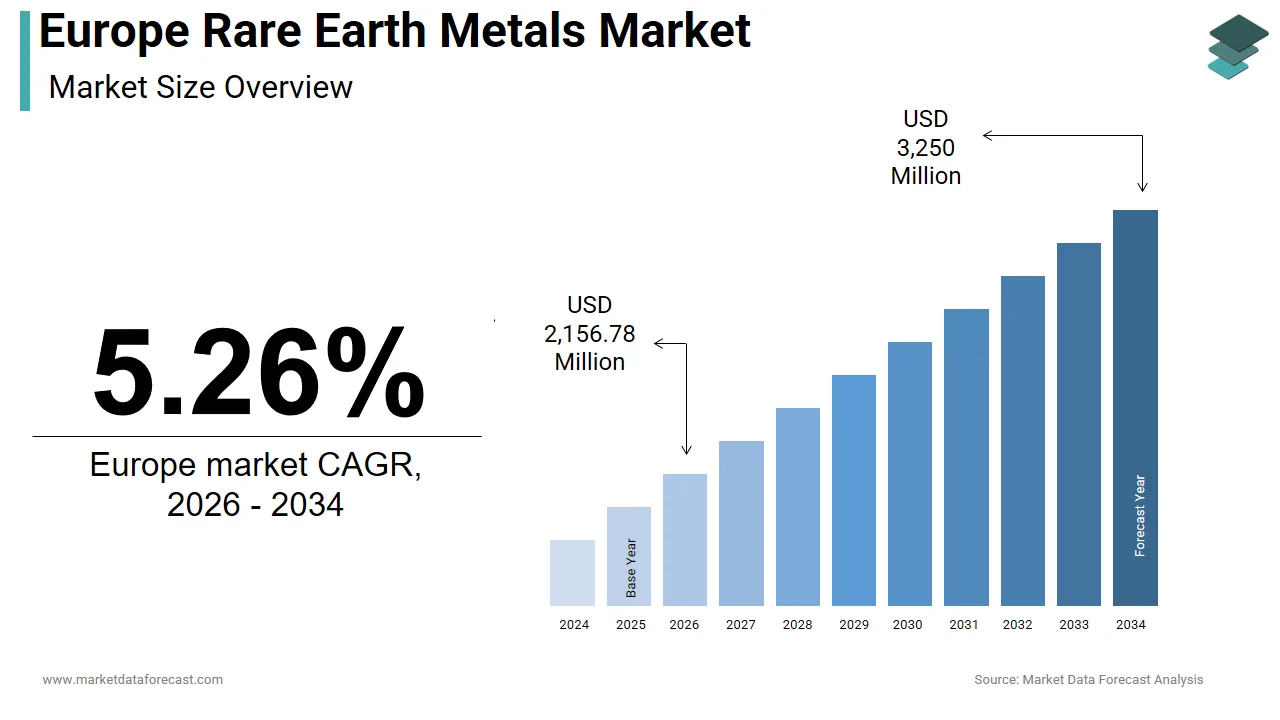
The Europe rare earth metals market was valued at USD 2,049 million in 2025, is estimated to reach USD 2,156.78 million in 2026, and is projected to reach USD 3,250 million by 2034, growing at a CAGR of 5.26% from 2026 to 2034. Market growth is driven by increasing demand for rare earth elements in clean energy technologies, electric vehicles, and advanced electronics. The growing focus on energy transition, particularly wind turbines and EV production, is significantly boosting demand for key materials such as neodymium and dysprosium. Additionally, Europe’s efforts to reduce dependency on imports and strengthen domestic supply chains are supporting market expansion.
Key Market Trends
- Rising demand for rare earth elements in electric vehicles and renewable energy systems.
- Increasing focus on supply chain diversification and strategic independence.
- Growing use of high-performance magnets in industrial applications.
- Expansion of green energy projects across Europe.
- Government initiatives to support local mining and processing capabilities.
Segmental Insights
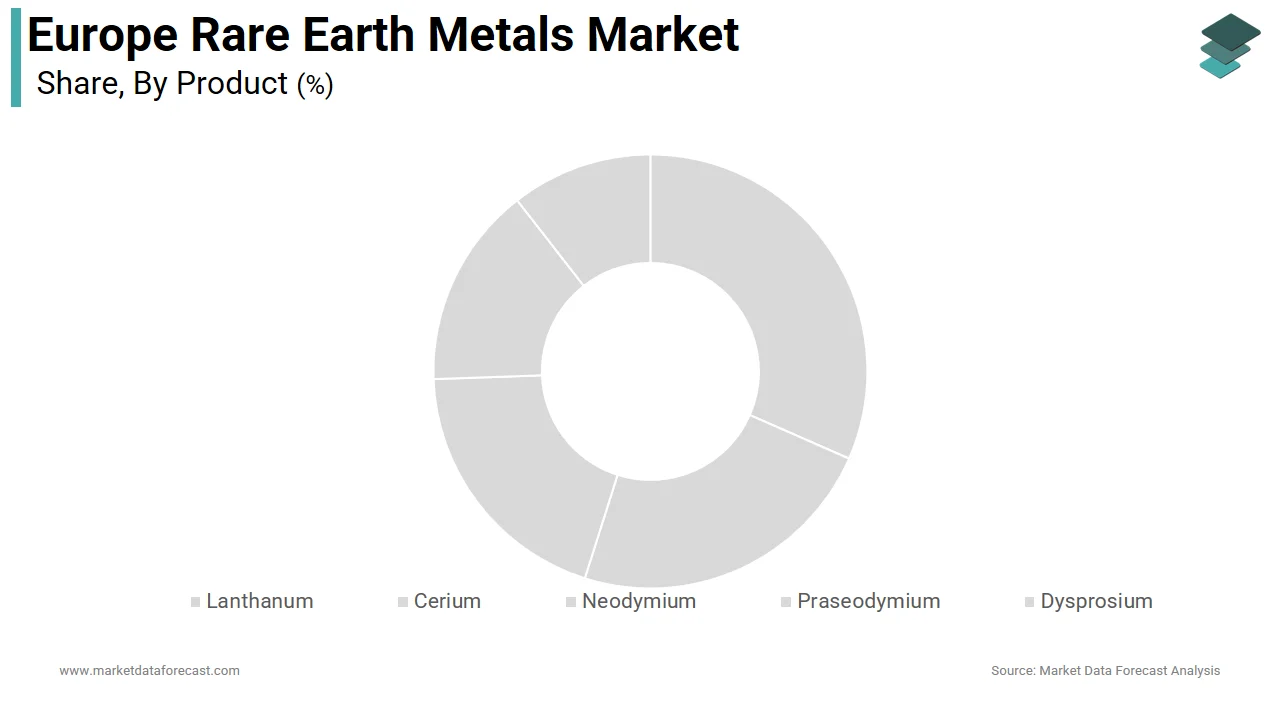
- Based on product type, the neodymium segment dominated the Europe rare earth metals market by capturing 36.3% share in 2025, driven by its critical role in permanent magnets used in EVs and wind turbines.
- Based on application, the magnets segment led the market with 44.7% share in 2025, supported by strong demand from automotive, electronics, and renewable energy sectors.
Regional Insights
The Europe rare earth metals market is witnessing steady growth across major economies due to industrial demand and energy transition initiatives.
- Germany led the market in 2025 with 30.9% share, driven by its strong automotive and industrial manufacturing base.
- France holds a significant position due to its nuclear energy sector and growing electric vehicle industry.
- The United Kingdom is expected to register a promising CAGR during the forecast period, supported by its advanced aerospace, defense, and renewable energy sectors.
Competitive Landscape
The Europe rare earth metals market is moderately consolidated, with key global and regional players focusing on securing supply chains, expanding production capacities, and investing in sustainable extraction and processing technologies. Strategic partnerships and government-backed initiatives are playing a key role in shaping the competitive environment.
Prominent companies operating in the Europe rare earth metals market include China Northern Rare Earth Group, VACUUMSCHMELZE GmbH & Co. KG, Lynas Corporation, MP Materials, Rare Element Resources, Solvay S.A., Alkane Resources, Neo Performance Materials, Arafura Resources, and Iluka Resources.
 Download Free Sample Report
Europe Rare Earth Metals Market Size
The Europe rare earth metals market size was USD 2,049 million in 2025, is anticipated to be USD 2,156.78 million in 2026, and is projected to reach USD 3,250 million by 2034, registering a CAGR of 5.26% from 2026 to 2034.
The Europe rare earth metals market encompasses the extraction, processing, and distribution of seventeen chemically similar elements that are critical for high technology manufacturing and green energy applications. These elements include lanthanum, cerium, neodymium, and dysprosium, which are indispensable for producing permanent magnets, batteries, and catalysts. The market is currently defined by a strategic imperative to reduce dependency on external suppliers, particularly from Asia, and to secure supply chains for the digital and green transitions. According to trade data from Eurostat, the European Union imports approximately 95% of its rare earth elements from China, Malaysia, and Russia combined. The Critical Raw Materials Act, adopted by the European Commission, aims to ensure that by 2030, at least 10% of the EU's annual consumption of strategic raw materials is extracted within the union. This legislative framework is reshaping the market dynamics by incentivizing domestic exploration and processing capabilities. The demand for these metals is intrinsically linked to the expansion of electric vehicle production and renewable energy infrastructure. According to energy statistics, wind turbine installations in Europe require substantial amounts of neodymium and praseodymium for efficient generator operation. The market also faces scrutiny regarding environmental sustainability, as mining and refining processes can generate hazardous waste. Consequently, new projects are increasingly focused on developing cleaner extraction technologies and recycling mechanisms. The interplay between geopolitical security, environmental compliance, and technological innovation defines the current trajectory of the rare earth metals sector in Europe.
MARKET DRIVERS
Accelerated Adoption of Electric Vehicles and Green Mobility
The rising adoption of electric vehicles is majorly driving the growth of the Europe rare earth metals market due to the essential role of rare earth permanent magnets in electric motors. Neodymium iron boron magnets are preferred for their high power density and efficiency, which are critical for maximizing the range and performance of electric vehicles. As per automotive industry reports from the European Automobile Manufacturers Association, electric vehicle sales in Europe accounted for 21% of total car registrations in 2024, reflecting a robust shift away from internal combustion engines. This transition necessitates a substantial increase in the supply of neodymium, praseodymium, and dysprosium. As per the European Automobile Manufacturers Association, the production of electric drivetrains will require three times more rare earth materials compared to traditional vehicles. Government incentives, such as purchase subsidies and stricter emission regulations under the Euro 7 standards, further propel this demand. Additionally, the expansion of charging infrastructure across member states supports the widespread adoption of electric mobility. According to transport data from the European Alternative Fuels Observatory, the number of public charging points in the European Union exceeded 600,000 in 2025, facilitating greater consumer confidence in electric vehicles. The commitment to carbon neutrality by 2050 mandates a complete overhaul of the transportation sector, thereby sustaining long term demand for rare earth components. Automakers are securing long term supply agreements with rare earth producers to mitigate supply risks. This strategic sourcing behavior underscores the critical importance of rare earth metals in the future of European mobility. The continuous innovation in battery and motor technologies also drives the need for high-purity rare earth materials. Consequently, the electric vehicle sector remains a cornerstone of growth for the rare earth metals market in Europe.
Expansion of Offshore Wind Energy Infrastructure
The expansion of offshore wind energy infrastructure is another major driver for the Europe rare earth metals market, given the reliance on direct drive generators that utilize rare earth permanent magnets. Offshore wind turbines are larger and more powerful than their onshore counterparts, requiring highly efficient and reliable magnetic systems to convert kinetic energy into electricity. As per energy sector analysis, the European Union aims to install 300 gigawatts of offshore wind capacity by 2050 to meet its renewable energy targets. This ambitious goal requires a significant volume of neodymium and praseodymium for the construction of permanent magnet synchronous generators. The North Sea, Baltic Sea, and Atlantic coast regions are identified as key zones for wind farm development. According to wind energy statistics from WindEurope, Europe added 15 gigawatts of new wind capacity in 2024, with offshore projects contributing substantially to this growth. The durability and low maintenance requirements of direct drive systems make them ideal for harsh offshore environments, where accessibility is limited. Governments across Europe are providing financial support and streamlined permitting processes to accelerate wind farm deployments. The REPowerEU plan further emphasizes the need for energy independence, driving investments in domestic renewable sources. As per industry reports, the demand for rare earth magnets in the wind sector is expected to grow by 10% annually through 2030. This sustained growth trajectory ensures a steady demand for rare earth metals. Furthermore, the integration of wind energy into the grid requires advanced power electronics, which also utilize rare earth elements. The strategic importance of wind energy in the European energy mix thus solidifies its role as a key driver for the rare earth metals market.
MARKET RESTRAINTS
Geopolitical Supply Chain Vulnerabilities and Import Dependence
The heavy reliance on imports from a limited number of non-European countries is hampering the Europe rare earth metals market growth. Currently, China dominates the global supply chain, controlling approximately 60% of rare earth mining and nearly 90% of processing capacity. This concentration creates substantial geopolitical risks and supply chain vulnerabilities for European industries. Any disruption in trade relations or export restrictions can severely impact the availability of these critical materials. According to trade data from Eurostat, the European Union imported approximately 95% of its rare earth needs from external sources in 2024, highlighting the extent of its dependency. Recent geopolitical tensions have prompted concerns about potential supply cutoffs, which could hinder the production of electric vehicles and renewable energy technologies. The lack of diversified supply sources limits the bargaining power of European buyers and exposes them to price volatility. Additionally, the complex logistics involved in transporting rare earth materials add to the cost and uncertainty of supply. For instance, supply chain disruptions can lead to production delays and increased costs for downstream manufacturers. The European Union has identified rare earths as critical raw materials, but establishing alternative supply chains takes time and significant investment. The slow pace of developing domestic processing capabilities exacerbates the reliance on external suppliers. Furthermore, political instability in potential supplier countries can further complicate procurement strategies. This precarious supply situation acts as a brake on market growth, as companies hesitate to expand production without guaranteed access to raw materials. The need for strategic autonomy remains unfulfilled, thereby restraining the market's potential.
Stringent Environmental Regulations and Permitting Delays
Stringent environmental regulations and prolonged permitting processes is also a major restraint for the Europe rare earth metals market expansion. The extraction and refining of rare earth elements often involve the use of toxic chemicals and generate radioactive waste, due to the presence of thorium and uranium in ore deposits. As per environmental guidelines, the European Union enforces rigorous standards for waste management and water protection, which increase the operational costs and complexity of mining projects. Obtaining permits for new mining operations can take several years, due to extensive environmental impact assessments and public consultations. For instance, the proposed rare earth project in Sweden faced significant delays due to concerns from indigenous communities and environmental groups. These regulatory hurdles discourage investment in domestic exploration and processing facilities. According to industry analysis from the European Raw Materials Alliance, the average time to obtain a mining permit in Europe is 10 to 15 years, which is significantly longer than in other regions. This lengthy timeline impedes the rapid scaling of supply needed to meet growing demand. Additionally, the high cost of compliance with environmental standards makes European production less competitive compared to regions with laxer regulations. The negative public perception of mining activities further complicates project approvals. Community opposition often leads to legal challenges that can halt projects indefinitely. As per sustainability reports, social license to operate is becoming increasingly difficult to secure for extractive industries in Europe. These factors collectively restrain the growth of the domestic rare earth market by limiting the establishment of new supply sources. The balance between environmental protection and resource security remains a challenging policy dilemma.
MARKET OPPORTUNITIES
Development of Urban Mining and Recycling Initiatives
The development of urban mining and recycling initiatives is a significant opportunity for the Europe rare earth metals market by reducing reliance on primary extraction. End of life products, such as electric vehicles, wind turbines, and consumer electronics, contain valuable rare earth elements that can be recovered and reused. As per waste management statistics from the Global E-waste Monitor, the volume of electronic waste in Europe is expected to reach 12 million tons by 2030, providing a substantial feedstock for recycling. Advances in hydrometallurgical and pyrometallurgical processes are improving the efficiency and economic viability of rare earth recovery. The European Union’s Circular Economy Action Plan promotes the recycling of critical raw materials to enhance resource security. According to research findings from the Joint Research Centre, recycling rates for rare earths are currently low but have the potential to meet up to 20% of future demand by 2040. Several pilot projects and commercial facilities are being established across Europe to demonstrate scalable recycling technologies. Companies are investing in closed-loop systems to recover magnets from electric vehicle motors and hard disk drives. The implementation of extended producer responsibility schemes encourages manufacturers to design products for easier disassembly and recycling. As per policy updates, the new Battery Regulation mandates minimum recycled content levels, which will drive demand for secondary rare earth materials. This regulatory push creates a favorable environment for recycling businesses. Furthermore, urban mining offers environmental benefits by reducing the need for new mining and associated ecological impacts. The opportunity to create a circular supply chain aligns with sustainability goals and enhances the resilience of the rare earth market.
Establishment of Domestic Processing and Refining Capacities
The establishment of domestic processing and refining capacities offers a major opportunity for the Europe rare earth metals market to achieve greater strategic autonomy. While Europe has some rare earth deposits, the lack of midstream processing facilities forces the export of raw concentrates for refinement abroad. Investing in local separation and refining infrastructure would capture more value within the region and reduce supply chain risks. As per industrial strategy documents, the European Raw Materials Alliance aims to support the development of a complete rare earth value chain within the EU. Several projects are underway to build separation plants in countries such as Estonia and France. The Estonian company Neo Performance Materials operates a magnet production facility that utilizes recycled materials and imported intermediates, demonstrating the feasibility of local processing. According to investment reports, over 5 billion euros have been allocated to critical raw material projects under the Innovation Fund and other EU mechanisms. These funds support the construction of demonstration plants and commercial-scale facilities. The development of innovative solvent extraction and ion exchange technologies can improve the efficiency and environmental footprint of refining processes. Partnerships between research institutions and industry players are accelerating the commercialization of these technologies. As per market analysis from the European Commission, the establishment of local processing capabilities can reduce import dependency by 15% by 2030. This strategic shift not only enhances supply security but also creates high-skilled jobs and stimulates economic growth. The opportunity to become a leader in clean rare earth processing positions Europe favorably in the global market.
MARKET CHALLENGES
Complexity of Separation and Purification Technologies
The complexity of separation and purification technologies is a significant challenge for the Europe rare earth metals market, due to the chemical similarity of rare earth elements. Separating individual rare earths from each other requires sophisticated and energy-intensive processes, such as solvent extraction, which involves multiple stages and large volumes of chemicals. As per technical assessments from the International Energy Agency, achieving high purity levels suitable for electronic and magnetic applications requires precise control and advanced engineering capabilities. The lack of specialized expertise and infrastructure in Europe, compared to established producers in Asia, hinders the rapid development of domestic processing capabilities. Building and operating separation facilities requires substantial capital investment and long lead times. According to industry experts, the learning curve for optimizing separation processes is steep and requires experienced personnel who are scarce in the European labor market. Additionally, the variability in ore composition from different sources complicates the standardization of processing methods. Each deposit may require a tailored approach, increasing operational complexity and costs. The environmental management of waste streams generated during separation is another technical challenge that requires innovative solutions. As per environmental studies, the disposal of acidic and radioactive waste poses significant logistical and regulatory hurdles. The inability to efficiently and cleanly separate rare earths limits the competitiveness of European producers. Overcoming these technical barriers requires sustained research and development efforts and collaboration across the value chain. The technological gap remains a persistent challenge that must be addressed to establish a robust domestic industry.
High Capital Intensity and Investment Risks
The high capital intensity and associated investment risks are another major challenge for the Europe rare earth metals market. Establishing mining and processing facilities requires billions of euros in upfront capital with long payback periods, due to the complexity of the operations. As per financial analyses, the average capital expenditure for a new rare earth mine and processing plant exceeds 1 billion euros. This high entry barrier discourages private investors, who perceive the sector as risky due to price volatility and regulatory uncertainty. The fluctuation in rare earth prices, influenced by global supply dynamics and geopolitical events, makes revenue projections unpredictable. According to market data from the Shanghai Metals Market, rare earth prices can vary by more than 50% within a single year, affecting the profitability of projects. Additionally, the long lead times for permitting and construction delay the realization of returns on investment. Investors often prefer sectors with quicker turnaround and lower regulatory burdens. The lack of a liquid futures market for rare earth metals further complicates risk management and hedging strategies. As per investment reports, securing financing for rare earth projects in Europe is challenging due to the perceived higher risk profile compared to other commodities. Government subsidies and guarantees are often necessary to attract private capital, but these are limited and competitive. The uncertainty regarding future demand patterns and technological substitutions adds to the investment risk. Companies must navigate these financial challenges carefully to ensure project viability. The high cost of capital and investment uncertainty remain significant obstacles to the expansion of the European rare earth industry.
REPORT COVERAGE
| REPORT METRIC | DETAILS |
| Market Size Available | 2025 to 2034 |
| Base Year | 2025 |
| Forecast Period | 2026 to 2034 |
| Segments Covered | By Product Type, Form, Application, Purity Level, End-Use Industry, and Country. |
| Various Analyses Covered | Global, Regional, and Country-Level Analysis, Segment-Level Analysis, Drivers, Restraints, Opportunities, Challenges; PESTLE Analysis; Porter’s Five Forces Analysis, Competitive Landscape, Analyst Overview of Investment Opportunities |
| Countries Covered | UK, France, Spain, Germany, Italy, Russia, Sweden, Denmark, Switzerland, Netherlands, Turkey, Czech Republic, and the Rest of Europe. |
| Market Leaders Profiled | China Northern Rare Earth Group, VACUUMSCHMELZE GmbH & Co. KG, Lynas Corporation, MP Materials, Rare Element Resources, Solvay S.A., Alkane Resources, Neo Performance Materials, Arafura Resources, and Iluka Resources. |
SEGMENTAL ANALYSIS
By Product Type Insights
The neodymium segment dominated the market by capturing 36.3% of the European market share in 2025. The growth of the neodymium segment in the European market can be credited to the critical role of neodymium in the production of high-strength permanent magnets known as neodymium iron boron magnets. These magnets are essential components in electric vehicle motors, wind turbine generators, and consumer electronics, due to their exceptional magnetic properties and compact size. The rapid expansion of the electric mobility sector in Europe has significantly boosted the demand for neodymium. As per automotive industry data from Stanford Magnets, a pure electric vehicle requires between 5 and 10 kilograms of neodymium-based magnets per vehicle, depending on the motor design. With electric vehicle sales in Europe reaching 3.5 million units in 2024, according to registration data from Electrek, the cumulative demand for neodymium has surged substantially. Furthermore, the offshore wind energy sector relies heavily on direct drive generators that utilize large quantities of neodymium magnets to ensure efficiency and reliability in harsh marine environments. According to energy statistics from SMM analysis, each megawatt of offshore wind capacity requires approximately 600 to 1,000 kilograms of rare earth magnets, with neodymium being the primary constituent. The European Union’s target of installing 300 gigawatts of offshore wind capacity by 2050 further cements the long term demand for this metal. Additionally, the miniaturization trend in consumer electronics, such as smartphones and hard disk drives, continues to drive steady consumption. The lack of viable substitutes that offer comparable performance at a similar cost ensures that neodymium remains indispensable. Consequently, the strategic importance of neodymium in green technologies and digital devices sustains its leading position in the market.
However, the dysprosium segment is estimated to be the fastest-growing segment and record a CAGR of 13.4% over the forecast period, owing to the increasing need for dysprosium as an additive in neodymium iron boron magnets to enhance their thermal stability. As electric vehicles and wind turbines operate at higher temperatures, the addition of dysprosium prevents demagnetization and ensures consistent performance. The trend towards more powerful and compact motors in electric vehicles requires magnets that can withstand elevated operating temperatures without losing magnetic strength. As per technical specifications from ResearchGate, adding dysprosium to neodymium magnets allows them to function effectively at temperatures reaching 150 degrees Celsius. The expansion of the electric vehicle market, particularly in the premium and performance segments, drives this specific demand. According to automotive trends, the average power density of electric motors is increasing by 10% annually, necessitating the use of high-temperature resistant magnets. Furthermore, the aerospace and defense sectors in Europe are also increasing their usage of dysprosium-containing alloys for specialized applications requiring extreme thermal resilience. The limited supply of dysprosium relative to neodymium creates a tight market dynamic that supports price growth and investment interest.
By Application Insights
The magnets segment led the market and occupied 44.7% of the European market share in 2025. The growth of the magnets segment in the European market is attributed to the ubiquitous use of rare earth permanent magnets in a wide array of high technology applications, including electric vehicles, wind turbines, industrial motors, and consumer electronics. Neodymium iron boron magnets are the most widely used type, due to their superior magnetic strength and energy product. The transition to green energy and electric mobility has created an unprecedented demand for these efficient magnetic solutions. As per industrial data from Fastmarkets, the production of rare earth magnets in Europe increased by 20% in 2024 to meet the needs of the expanding electric vehicle and renewable energy sectors. The automotive industry is the largest consumer of rare earth magnets, utilizing them in traction motors, power steering systems, and speakers. The wind energy sector also contributes significantly, with offshore turbines requiring large quantities of magnets for direct drive generators. According to energy statistics, the installation of new wind capacity in Europe drove a 15% increase in magnet demand in 2024. Additionally, the consumer electronics sector relies on rare earth magnets for hard disk drives, headphones, and vibration motors in smartphones. The miniaturization of electronic devices continues to drive the need for compact and powerful magnetic components. The lack of effective substitutes for rare earth magnets in high-performance applications ensures their continued dominance. As per technology assessments, no other magnetic material offers the same combination of strength, size, and weight advantages. This technological superiority cements the magnets segment as the primary application area for rare earth metals in Europe.
On the other side, the batteries segment is another major segment and is expected to exhibit a CAGR of 15.5% over the forecast period. The growing adoption of rare earth elements in advanced battery technologies, particularly for electric vehicles and grid storage systems, is propelling the expansion of the batteries segment in the European market. While lithium-ion batteries are the dominant technology, research and development efforts are focusing on incorporating rare earth elements to improve performance, safety, and sustainability. Lanthanum and cerium are used in nickel metal hydride batteries, which are still utilized in some hybrid vehicles and stationary storage applications. More importantly, emerging battery chemistries, such as solid-state batteries and lithium sulfur batteries, are exploring the use of rare-earth dopants to enhance ionic conductivity and stability. For instance, the addition of rare earth elements can improve the cycle life and energy density of next-generation batteries by up to 20%. The European Union’s Battery Regulation mandates higher sustainability and performance standards, which encourage innovation in battery materials. According to industry reports from PatSnap, investments in battery research and development in Europe exceeded 10 billion euros in 2024, with a significant portion allocated to novel materials, including rare earths. The growing demand for energy storage solutions to support renewable energy integration also drives this segment. Grid-scale storage systems require batteries with long cycle lives and high safety profiles, which rare-earth-enhanced technologies can provide. As per energy storage forecasts, the capacity of stationary battery storage in Europe is expected to grow by 25% annually through 2030. This expansion creates new opportunities for rare earth applications in the battery sector. The combination of technological innovation and regulatory support positions the batteries segment for exceptional growth.
COUNTRY LEVEL ANALYSIS
Germany Rare Earth Metals Market Analysis
Germany held the leading position in the European rare earth metals market in 2025 with 30.9% of the regional market share. The dominance of Germany in the European market is attributed to the German robust automotive and manufacturing industries, which are major consumers of rare-earth-based components. Germany is home to leading automobile manufacturers who are aggressively transitioning to electric mobility, thereby driving demand for neodymium and dysprosium-based magnets. As per industrial data from the VDA, the German automotive sector produced 4.1 million vehicles in 2024, with electric vehicles comprising a growing share of this output. The presence of major chemical and engineering companies also contributes to the demand for rare earths in catalysis and specialized alloys. The German government’s support for the European Chips Act and green technology initiatives further stimulates the market. According to policy announcements from the Federal Ministry for Economic Affairs and Climate Action, Germany has approved 5 billion euros in funding to support industrial decarbonization and the development of strategic raw material supply chains. The country is also a hub for research and development in battery technologies and renewable energy systems. The Fraunhofer Society and other research institutions are actively working on rare earth recycling and alternative materials. As per research reports, Germany accounts for 30% of all rare earth-related patents filed in Europe, highlighting its innovation leadership. The strong industrial base, combined with strategic policy support, ensures Germany’s leading position in the market. The focus on sustainability and circular economy principles also drives investments in urban mining and recycling facilities. These factors collectively sustain Germany’s dominance in the Europe rare earth metals market.
France Rare Earth Metals Market Analysis
France was another significant regional segment for the rare earth metals market in Europe in 2025. The French market is characterized by its strong nuclear energy sector and growing electric vehicle industry. France is a leader in nuclear power generation, which utilizes rare earth elements in control rods and other components. Additionally, the French automotive industry is undergoing a significant transformation towards electrification, with manufacturers like Renault and Peugeot expanding their electric vehicle portfolios. As per automotive statistics from AVERE France, electric vehicle registrations in France reached a market share of 21% in 2024, reflecting strong consumer adoption. The French government has implemented strategic plans to secure critical raw material supplies, including rare earths. The National Strategy for Critical Raw Materials aims to reduce dependency on imports and promote domestic recycling capabilities. According to government reports, France has launched a 2 billion euro critical metals fund as part of the France 2030 investment plan to secure supplies for the energy transition. The country is also home to several research centers focused on rare earth chemistry and materials science. The Commissariat à l’énergie atomique et aux énergies alternatives conducts extensive research on rare earth applications in energy technologies. As per industry analysis, France is developing pilot plants for rare earth recycling from electronic waste and industrial byproducts. These initiatives enhance the country’s resource security and contribute to market growth. The presence of major industrial players and supportive policy frameworks maintains France’s strong position in the regional market.
United Kingdom Rare Earth Metals Market Analysis
The United Kingdom is estimated to register a promising CAGR in the Europe rare earth metals market during the forecast period due to its advanced aerospace and defense sectors, as well as its growing renewable energy industry. The country is a major producer of offshore wind energy, which requires significant amounts of rare earth magnets for turbine generators. As per energy data from the Department for Energy Security and Net Zero, the UK continues to expand its offshore wind capacity, maintaining its global leadership in the sector. The aerospace industry utilizes rare earth alloys in jet engines and avionics systems due to their high temperature resistance and strength. The UK government has identified rare earths as critical materials for national security and economic resilience. The Critical Minerals Strategy outlines plans to diversify supply chains and support domestic exploration projects. According to policy documents, the UK is investing in geological surveys to identify potential rare earth deposits within its territory. Additionally, the country is active in rare earth recycling research, with several universities and companies developing innovative recovery technologies. The Advanced Propulsion Centre supports projects aimed at reducing rare earth usage in electric vehicle motors through improved design and materials. As per industry reports, the UK is collaborating with international partners to secure sustainable supplies of critical raw materials. The combination of strong end-use industries and strategic government initiatives sustains the UK’s significant market share. The focus on innovation and supply chain security ensures continued growth in the rare earth sector.
Italy Rare Earth Metals Market Analysis
Italy is expected to exhibit a notable CAGR in the Europe rare earth metals market during the forecast period, owing to its strong manufacturing base, particularly in the automotive and machinery sectors. Italy is a major producer of luxury and performance vehicles, which increasingly incorporate electric drivetrains requiring rare earth magnets. As per automotive data from the European Alternative Fuels Observatory, hybrid vehicles took over the Italian market with a 40% share in 2024, reflecting the industry’s transition. The country also has a significant presence in the production of industrial machinery and robotics, which utilize rare earth motors for precision and efficiency. The Italian government supports the development of critical raw material supply chains through national recovery and resilience plans. According to funding announcements from the European Commission, Italy has allocated 1.5 billion euros to a state aid scheme for cleantech manufacturing, which includes projects for net zero technologies and resource sustainability. The country is also exploring the potential for rare earth extraction from industrial waste streams, such as red mud from aluminum production. Research institutions are investigating methods to recover valuable elements from these byproducts, reducing environmental impact and creating new supply sources. As per technical studies, Italy has significant reserves of bauxite, which could serve as a secondary source of rare earths. The focus on circular economy principles aligns with European Union directives and enhances market opportunities. The strong industrial tradition and commitment to innovation maintain Italy’s prominent position in the rare earth metals market.
Sweden Rare Earth Metals Market Analysis
Sweden is anticipated to witness a healthy CAGR in the Europe rare earth metals market over the forecast period. The Spanish market is distinguished by its significant rare earth mineral deposits and progressive mining industry. Sweden is home to the largest known deposit of rare earth oxides in Europe, located in Kiruna, which has sparked considerable interest in domestic extraction. As per geological surveys from LKAB, the Per Geijer deposit in Kiruna contains over 1 million tons of rare earth oxides, providing a potential basis for local supply. The Swedish government supports sustainable mining practices and has streamlined permitting processes for strategic projects. The country is also a leader in green steel production, which may indirectly benefit from rare earth applications in industrial processes. Sweden’s strong environmental standards drive innovation in clean extraction and processing technologies. According to industry reports, several companies are conducting feasibility studies for rare earth mining and separation facilities in Sweden. The country’s expertise in metallurgy and materials science supports the development of a complete value chain. Sweden is also active in rare earth recycling, collaborating with European partners to establish closed-loop systems. As per sustainability indices, Sweden ranks highly in resource efficiency and environmental performance, attracting investment in green technologies. The combination of natural resources, technological expertise, and policy support positions Sweden as a key player in the future of the European rare earth market. The potential for domestic production reduces reliance on imports and enhances regional supply security.
COMPETITIVE LANDSCAPE
The competition in the Europe rare earth metals market is characterized by a mix of established chemical companies, emerging specialized processors, and international suppliers seeking local footholds. The market is currently fragmented but consolidating as strategic imperatives drive collaboration and investment. Key competitors differentiate themselves through technological expertise in separation and magnet manufacturing rather than just raw material extraction. The high barriers to entry due to capital intensity and regulatory compliance limit the number of domestic producers. However, new entrants are emerging with support from government funding and private equity focused on critical materials. Competition is intensifying around sustainability credentials with companies vying to offer low-carbon and recycled rare-earth products. Intellectual property related to processing technologies and magnet designs is a crucial competitive asset. Partnerships between European firms and non-European suppliers are common to secure feedstock while building local value addition capabilities. The race to establish first-mover advantage in domestic refining creates a dynamic competitive landscape. Price volatility and supply uncertainty further influence competitive behavior as customers seek reliable long-term partners. The interplay between policy support and market forces shapes the strategic decisions of all participants in this vital sector.
KEY MARKET PLAYERS
The leading companies operating in the Europe rare earth metals market include:
- China Northern Rare Earth Group
- VACUUMSCHMELZE GmbH & Co. KG
- Lynas Corporation
- MP Materials
- Rare Element Resources
- Solvay S.A.
- Alkane Resources
- Neo Performance Materials
- Arafura Resources
- Iluka Resources
TOP PLAYERS IN THE MARKET
- Neo Performance Materials is a leading producer of high-performance magnetic materials and rare earth metals with significant operations in Europe. The company operates a state-of-the-art magnet production facility in Estonia, which serves as a strategic hub for supplying the European automotive and industrial sectors. Neo focuses on producing sintered neodymium iron boron magnets that are essential for electric vehicles and wind turbines. Recently, the company has strengthened its market position by expanding its recycling capabilities to recover rare earth elements from end-of-life products. This initiative aligns with European sustainability goals and reduces dependency on primary mining. Neo also collaborates with original equipment manufacturers to develop customized magnetic solutions that enhance energy efficiency. By integrating vertical supply chain capabilities and focusing on circular economy principles, Neo Performance Materials reinforces its role as a key supplier in the global rare earth industry while addressing regional security concerns.
- VACUUMSCHMELZE is a prominent German manufacturer specializing in advanced magnetic materials and rare earth alloys for high technology applications. The company plays a critical role in the global market by supplying high-precision magnets for aerospace, automotive, and medical industries. VACUUMSCHMELZE is deeply involved in the development of next-generation magnetic materials that offer superior thermal stability and performance. Recent actions to strengthen its position include substantial investments in research and development facilities in Hanau, Germany, to innovate new alloy compositions. The company actively partners with automotive leaders to co-develop lightweight and efficient motor solutions for electric mobility. VACUUMSCHMELZE also emphasizes sustainable manufacturing processes to meet stringent European environmental regulations. Its commitment to quality and technological leadership ensures a strong presence in the premium segment of the rare earth market. By maintaining rigorous quality standards and fostering innovation, VACUUMSCHMELZE continues to be a trusted partner for critical applications worldwide.
- Solvay S.A. is a global chemical company with a significant footprint in the rare earth separation and processing sector through its former Rhodia operations. Although Solvay has divested some assets, it remains influential in the European rare earth landscape due to its expertise in solvent extraction technologies. The company historically contributed to the global supply of separated rare earth oxides used in catalysts, polishing powders, and electronics. Recent strategic moves involve licensing proprietary separation technologies to new European entrants to support the development of local processing capacity. Solvay also engages in joint ventures focused on recycling rare earths from industrial waste streams. These efforts aim to create a more resilient and sustainable supply chain within Europe. By leveraging its chemical engineering prowess, Solvay supports the emergence of a domestic rare earth industry. Its focus on green chemistry and circular solutions positions it as a key enabler of the European Union’s critical raw materials strategy.
TOP STRATEGIES USED BY THE KEY MARKET PARTICIPANTS
Key players in the Europe rare earth metals market primarily employ vertical integration and strategic partnerships to secure supply chains and enhance competitiveness. Companies are increasingly investing in domestic processing facilities to reduce reliance on imported refined materials. This strategy aligns with European Union policies aimed at achieving strategic autonomy in critical raw materials. Collaboration with automotive and renewable energy firms allows producers to develop customized solutions that meet specific performance requirements. Recycling and urban mining initiatives are also central strategies as companies seek to recover rare earth elements from end of life products. This approach addresses environmental concerns and mitigates supply risks associated with primary mining. Innovation in separation technologies is another major focus area, with firms developing cleaner and more efficient methods to process rare earth ores. Geographic diversification of sourcing helps mitigate geopolitical risks, while long-term off-take agreements provide revenue stability. These multifaceted strategies enable market participants to navigate regulatory complexities and capitalize on the growing demand for green technologies.
MARKET SEGMENTATION
This research report on the Europe rare earth metals market has been segmented and sub-segmented into the following categories.
By Product Type
- Lanthanum
- Cerium
- Neodymium
- Praseodymium
- Dysprosium
By Form
- Oxides
- Alloys
- Metals
- Compounds
- Concentrates
By Application
- Catalysts
- Magnets
- Phosphors
- Glass
- Ceramics
By Purity Level
- Standard Purity
- High Purity
- Ultra High Purity
- Technical Grade
- Reagent Grade
By End Use Industry
- Electronics
- Automotive
- Renewable Energy
- Aerospace
- Defense
By Country
- United Kingdom
- France
- Spain
- Germany
- Italy
- Russia
- Sweden
- Denmark
- Switzerland
- Netherlands
- Rest of Europe