- Product Description Description
- Table of Contents TOC
- List of Table & Figure LOT
- Get Free Sample PDF Sample PDF
Market Size, 2025
$2.80 BnMarket Estimate, 2026
$3.14 BnMarket Forecast, 2034
$7.94 BnCAGR, 2026–2034
12.3%Europe Refurbished Medical Devices Market Report Summary
The Europe refurbished medical devices market was valued at USD 2.80 billion in 2025 and is anticipated to reach USD 3.14 billion in 2026 from USD 7.94 billion by 2034, growing at a CAGR of 12.3% during the forecast period from 2026 to 2034. The growth of the Europe refurbished medical devices market is driven by increasing budgetary constraints across public healthcare systems, growing demand for cost-effective medical technologies, and rising adoption of sustainable healthcare practices. Expanding healthcare infrastructure modernization programs, increasing focus on circular economy principles, and growing demand for advanced diagnostic and monitoring equipment at lower acquisition costs are further accelerating market growth. Moreover, the emergence of specialized refurbishment providers, advancements in device restoration technologies, and increasing acceptance of certified pre-owned medical equipment are supporting the expansion of the Europe refurbished medical devices market.
Key Market Trends
-
Rising adoption of refurbished medical devices to reduce healthcare capital expenditure.
-
Increasing emphasis on sustainability and circular economy initiatives in healthcare.
-
Growing demand for certified pre-owned diagnostic imaging equipment.
-
Rising expansion of third-party refurbishment service providers across Europe.
-
Increasing integration of upgraded software and connectivity features into refurbished devices.
Segmental Insights
- Based on product, the patient monitoring devices segment dominated the Europe refurbished medical devices market and held the largest share in 2025. The dominance of the segment is attributed to the increasing demand for continuous patient monitoring, growing utilization of monitoring systems across hospitals and clinics, and the rising need for affordable healthcare technologies. The widespread adoption of patient monitors during public health emergencies and increasing demand for cost-effective monitoring solutions continue to support segment growth.
- The medical imaging devices segment is projected to witness the fastest CAGR during the forecast period owing to the high acquisition costs of new imaging equipment, increasing demand for advanced diagnostic capabilities, and growing availability of high-quality refurbished MRI, CT, ultrasound, and X-ray systems. Healthcare providers are increasingly adopting refurbished imaging equipment to improve diagnostic capacity while minimizing capital investments.
- The operating room and surgical devices segment continues to maintain a significant share of the market due to increasing demand for affordable surgical technologies, growing procedural volumes, and rising investments in healthcare facility modernization programs.
- The cardiovascular and cardiology devices segment is expected to witness notable growth during the forecast period owing to the increasing prevalence of cardiovascular diseases, growing adoption of diagnostic and therapeutic cardiac technologies, and rising demand for cost-effective equipment in specialized healthcare facilities.
- The endoscopy devices segment is anticipated to experience steady growth due to increasing demand for minimally invasive procedures, expanding gastrointestinal diagnostic services, and rising investments in outpatient and ambulatory healthcare settings. Other segments, including defibrillators, neurology devices, IV therapy systems, intensive care systems, and neonatal intensive-care devices, continue to contribute significantly to market expansion.
Regional Insights
- Germany dominated the Europe refurbished medical devices market in 2025 and accounted for the largest regional share owing to its advanced healthcare infrastructure, strong medical device manufacturing ecosystem, increasing adoption of cost-efficient healthcare technologies, and growing exports of refurbished medical equipment. Rising healthcare expenditure optimization initiatives and strong demand from hospitals and diagnostic centers further support market growth.
- The United Kingdom held a substantial share of the Europe refurbished medical devices market due to increasing financial pressures on healthcare providers, growing adoption of refurbished diagnostic equipment, expanding healthcare modernization initiatives, and strong focus on reducing capital expenditure while maintaining healthcare quality standards.
- France continues to maintain a significant position in the European market owing to increasing healthcare infrastructure investments, growing awareness regarding sustainable medical technologies, expanding demand for advanced diagnostic systems, and rising adoption of refurbished medical equipment across public and private healthcare facilities.
- Italy is witnessing steady growth supported by budget-conscious healthcare procurement strategies, increasing demand for affordable medical technologies, growing investments in hospital modernization, and rising utilization of refurbished imaging and patient monitoring systems.
- Spain is expected to experience notable growth during the forecast period due to increasing healthcare cost containment measures, expanding diagnostic service networks, growing acceptance of certified refurbished equipment, and rising demand for advanced healthcare technologies at reduced costs. Other European countries are also witnessing increased adoption of refurbished medical devices due to growing sustainability initiatives and healthcare budget optimization programs.
Competitive Landscape
The Europe refurbished medical devices market is highly competitive and characterized by the presence of original equipment manufacturers, specialized refurbishment companies, and independent service providers competing through quality assurance, certification programs, pricing strategies, and after-sales support services. Leading companies are focusing on expanding refurbishment capabilities, enhancing quality control processes, integrating modern software upgrades, and extending warranty coverage to improve customer confidence. Strategic partnerships with hospitals, healthcare providers, leasing companies, and insurance organizations are further strengthening market positioning across the European refurbished medical devices ecosystem. Increasing emphasis on sustainability, lifecycle management, and regulatory compliance continues to intensify competition within the market. The key players operating in the Europe refurbished medical devices market include Siemens Healthcare Systems, First Source Inc., DMS Topline, Radio Oncology Systems Inc., Johnson & Johnson, GE Healthcare, DRE Inc., Block Imaging International Inc., Integrity Medical Systems Inc., Everx Pvt Ltd., Philips Healthcare, Agito Medical A/S, and Soma Technology.
Europe Refurbished Medical Devices Market Size
The Europe refurbished medical devices market size was valued at USD 2.80 billion in 2025 and is anticipated to reach USD 3.14 billion in 2026 from USD 7.94 billion by 2034, growing at a CAGR of 12.3% during the forecast period from 2026 to 2034.
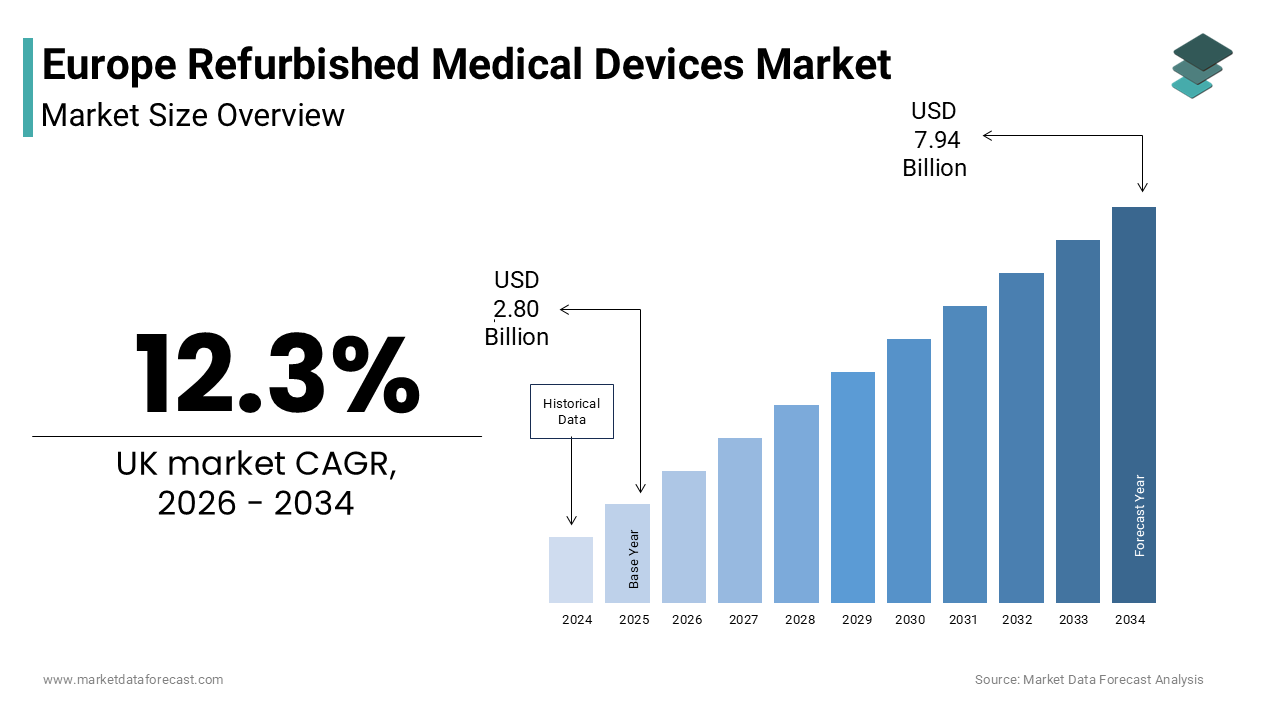
The refurbished medical devices are dedicated to the restoration and redistribution of pre-owned diagnostic imaging, surgical, and patient monitoring equipment. The process involves rigorous testing, repair, and certification to ensure that devices meet original manufacturer specifications and regulatory safety standards. The public healthcare spending in the European Union accounts for approximately 8% of gross domestic product by creating intense pressure on hospitals to optimize capital expenditure. Consequently, healthcare providers are increasingly turning to refurbished solutions to maintain operational capacity without exceeding budget constraints. The European Union Medical Device Regulation establishes strict guidelines for the reprocessing and remarketing of used devices, ensuring patient safety and product reliability. This regulatory framework fosters trust among clinicians and administrators, facilitating wider adoption.
MARKET DRIVERS
Budgetary Constraints and Cost Optimization in Public Healthcare Systems
The severe budgetary constraints within public healthcare systems is majorly amplifying the growth of the Europe refurbished medical devices market. Governments and hospital administrators face mounting pressure to deliver high quality care while managing limited financial resources. According to the Organisation for Economic Co operation and Development, health expenditure per capita in many European countries has stagnated or grown slowly relative to inflation, forcing institutions to seek cost effective alternatives. This financial efficiency enables facilities to upgrade their infrastructure more frequently, ensuring access to modern diagnostic capabilities. In countries like Italy and Spain, where public debt levels influence healthcare funding, the procurement of refurbished devices has become a strategic priority. The ability to extend the lifecycle of expensive medical assets helps hospitals manage depreciation and amortization schedules more effectively. Furthermore, maintenance contracts for refurbished devices are often more affordable, reducing long term operational expenses. This economic advantage is particularly crucial for smaller community hospitals and rural clinics that lack the purchasing power of large university medical centers.
Growing Emphasis on Sustainability and Circular Economy Principles
The growing emphasis on sustainability and circular economy principles is also significantly bosoting the growth of the Europe refurbished medical devices market. Healthcare institutions are increasingly accountable for their environmental footprint, with electronic waste from obsolete medical equipment posing a significant disposal challenge. The healthcare sector contributes substantially to the overall waste stream by prompting initiatives to reduce, reuse, and recycle medical technologies. Refurbishing devices extends their useful life, diverting them from landfills and minimizing the need for raw material extraction associated with manufacturing new units. The European Green Deal sets ambitious targets for resource efficiency by encouraging public procurement policies that favor sustainable practices. Hospitals adopting refurbished equipment can demonstrate compliance with these environmental standards by enhancing their corporate social responsibility profiles. Additionally, patients and staff are becoming more environmentally conscious, preferring healthcare providers that prioritize eco friendly operations. Manufacturers and third party refurbishers are responding by implementing green refurbishment processes that use energy efficient methods and recyclable packaging. This alignment with broader societal values creates a positive brand image for healthcare facilities utilizing refurbished technology. The regulatory support for circular economy models further incentivizes this shift, making refurbished devices not just an economic choice but an ethical imperative.
MARKET RESTRAINTS
Stringent Regulatory Compliance and Certification Complexities
The stringent regulatory compliance and certification complexities by creating barriers to entry and increasing operational costs is restricting the growth of the Europe refurbished medical devices market. The European Union Medical Device Regulation imposes rigorous requirements for the reprocessing, testing, and labeling of used devices to ensure they meet the same safety and performance standards as new products. Obtaining conformity assessment for refurbished devices involves extensive documentation, clinical evaluation, and post surveillance, which can be time consuming and expensive. Small and medium sized refurbishers often struggle to navigate these complex regulatory pathways, limiting competition and innovation in the sector. The lack of harmonized standards across all member states further complicates cross border trade, as devices certified in one country may face additional hurdles in another. Healthcare providers may hesitate to purchase refurbished equipment due to fears of non-compliance liabilities or potential recalls. The uncertainty surrounding regulatory interpretations can delay procurement decisions and increase legal risks. Additionally, the requirement for original manufacturer authorization for certain repairs restricts the availability of spare parts and technical information, hindering the refurbishment process.
Perceived Risks Regarding Reliability and Performance Longevity
The perceived risks regarding the reliability and performance longevity of refurbished medical devices are additionally impeding the growth of the Europe refurbished medical devices market. Despite rigorous testing protocols, some healthcare professionals remain about the durability and accuracy of pre owned equipment compared to new systems. A portion of clinicians express concerns about the potential for higher failure rates and unexpected downtime with refurbished devices. This apprehension is particularly pronounced for critical care equipment where precision and reliability are paramount. The fear of compromised image quality in diagnostic imaging or inconsistent performance in surgical tools can deter hospitals from investing in refurbished options. Additionally, the variability in refurbishment quality among different vendors contributes to this uncertainty, as there is no single universal standard for what constitutes a fully refurbished device. Warranty terms for refurbished equipment are often shorter than those for new devices, raising concerns about long term support and maintenance costs. High profile incidents involving malfunctioning refurbished devices, although rare, receive significant media attention and reinforce negative perceptions. This stigma affects procurement decisions, with risk averse administrators preferring the perceived safety of new equipment despite higher costs.
MARKET OPPORTUNITIES
Expansion of Telemedicine and Remote Diagnostic Services
The expansion of telemedicine and remote diagnostic services is more likely to foster new opportunities for the growth of the Europe refurbished medical devices market. Europe refurbished medical devices market. As healthcare delivery shifts towards decentralized models, there is a growing need for reliable and affordable imaging and monitoring equipment in outpatient clinics, primary care centers, and home healthcare settings. According to the European Health Telematics Association, the adoption of telehealth solutions has accelerated, requiring widespread deployment of connected medical devices. Refurbished portable ultrasound machines, ECG monitors, and patient vital signs monitors offer a cost-effective solution for equipping these remote locations without compromising on functionality. Healthcare providers can scale their telemedicine networks rapidly by utilizing refurbished devices, which are readily available and easier to deploy than custom ordered new equipment. This approach supports the integration of digital health platforms by providing the necessary hardware infrastructure at a lower capital cost. Furthermore, the modular nature of many refurbished devices allows for easy integration with existing software systems, facilitating seamless data transmission and remote consultation. Government initiatives promoting digital health inclusion also favor the use of affordable technology to bridge the urban rural divide.
Emergence of Specialized Third Party Refurbishment Providers
The emergence of specialized third-party refurbishment providers by delivering high quality, certified devices with enhanced service offerings is another factor declining the growth of the Europe refurbished medical devices market. These independent companies often possess deep technical expertise and flexibility that original equipment manufacturers may lack by allowing them to refurbish a wider range of legacy and multi-vendor equipment. The third party refurbishers are gaining trust through transparent processes, extended warranties, and comprehensive training programs for hospital staff. They often provide customized solutions tailored to specific clinical needs, such as upgrading older devices with modern software interfaces or connectivity features. This value added service differentiates them from simple resellers and builds strong relationships with healthcare providers. Additionally, third party providers can offer faster turnaround times and more competitive pricing due to lower overhead costs. Their ability to source parts from multiple channels ensures continuity of supply even when original manufacturers discontinue support for older models. Collaborations between these providers and insurance companies or leasing firms can create innovative financing models, making refurbished devices more accessible to cash strapped clinics.
MARKET CHALLENGES
Supply Chain Disruptions for Spare Parts and Components
The supply chain disruptions for spare parts and components is acting as a barrier for the growth of the Europe refurbished medical devices market. Refurbishing complex medical equipment requires access to specific original parts, sensors, and software licenses, which are often controlled exclusively by original equipment manufacturers. The global supply chain hurdles have led to prolonged lead times for critical components, delaying refurbishment projects and increasing inventory costs. When manufacturers discontinue support for older models, sourcing compatible parts becomes increasingly difficult and expensive, forcing refurbishers to rely on secondary markets with uncertain quality. Geopolitical tensions and trade restrictions further complicate the import of essential components from outside the European Union. These disruptions impact the ability of refurbishers to meet delivery deadlines, affecting customer satisfaction and contractual obligations. Additionally, the lack of standardized parts across different device generations increases the complexity of inventory management. Refurbishers must maintain large stocks of diverse components to ensure readiness, tying up capital and storage space. The unpredictability of supply availability makes long term planning challenging and increases operational risks.
Cybersecurity Vulnerabilities in Legacy Software Systems
The cybersecurity vulnerabilities in legacy software systems, as older devices may lack modern security protocols is another factor to limit the growth of the Europe refurbished medical devices market. With the increasing connectivity of medical equipment to hospital networks and cloud platforms, the risk of cyberattacks and data breaches has escalated. Healthcare is one of the most targeted sectors for ransomware and malware, with outdated software being a common entry point. Refurbished devices often run on older operating systems that no longer receive security patches from manufacturers, leaving them exposed to known vulnerabilities. Ensuring that these devices meet current cybersecurity standards requires significant effort in software updates, network segmentation, and continuous monitoring. However, many refurbishers lack the resources or authority to modify proprietary software, limiting their ability to enhance security features. Healthcare providers are increasingly cautious about integrating legacy devices into their digital infrastructure due to these risks. Regulatory bodies are introducing stricter cybersecurity requirements for medical devices, compelling refurbishers to invest in advanced security assessments and mitigation strategies.
REPORT COVERAGE
| REPORT METRIC | DETAILS |
| Market Size Available | 2025 to 2034 |
| Base Year | 2025 |
| Forecast Period | 2026 to 2034 |
| CAGR | 12.3% |
| Segments Covered | By Product and Region |
| Various Analyses Covered | Global, Regional & Country Level Analysis; Segment-Level Analysis; DROC, PESTLE Analysis; Porter’s Five Forces Analysis; Competitive Landscape; Analyst Overview of Investment Opportunities |
| Regions Covered | United Kingdom, France, Spain, Germany, Italy, Russia, Sweden, Denmark, Switzerland, the Netherlands, Turkey, and the Czech Republic |
| Market Leaders Profiled | Siemens Healthcare Systems, First Source Inc., DMS Topline, Radio Oncology Systems Inc., Johnson & Johnson, GE Healthcare, DRE Inc., Block Imaging International Inc., Integrity Medical Systems Inc., Everx Pvt Ltd., Philips Healthcare, Agito Medical A/S and Soma Technology. |
SEGMENTAL ANALYSIS
By Product Insights
The Patient Monitoring devices segment dominated the European market revenue due to the higher adoption of patient monitors during the Pandemic crisis. Patient monitors are in high demand by healthcare organizations as they are crucial in maintaining patient health.
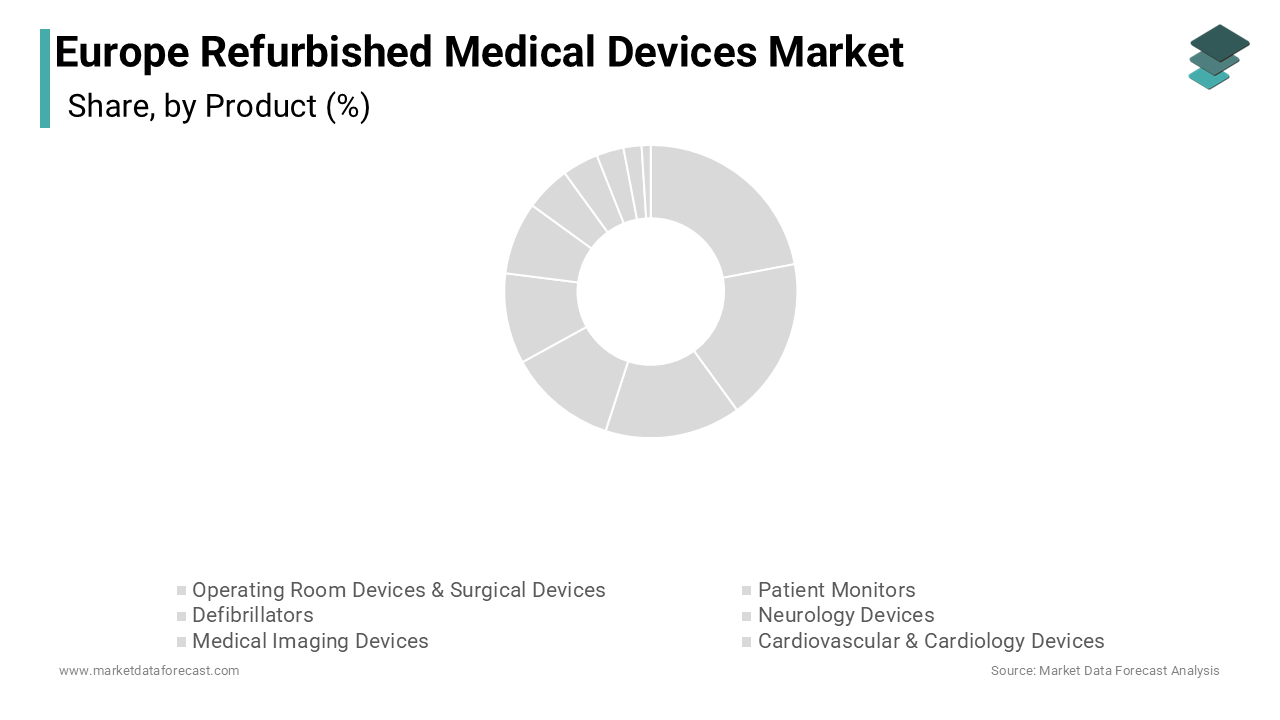
Medical imaging devices are expected to have significant growth during the forecast period. The high cost of medical imaging devices and the presence of large suppliers in the market are anticipated to have segment growth during the forecast period. The investment in the MRI system is vast for healthcare providers, influencing them to choose refurbished devices by enhancing the market revenue of this segment. The growing number of suppliers will enhance the market growth opportunities. For instance, Summus Medical Solutions is Philips' retail partner and offers Philips' C-arms refurbished medical systems. The availability of advanced technological systems at lower prices will propel the European market value.
REGIONAL ANALYSIS
Regionally, Germany and the UK held the dominant share of the European Refurbished Medical Devices Market due to the increasing adoption of refurbished devices because of budget cuts and financial pressures of the healthcare system. The presence of prominent market players in the region and the advanced healthcare infrastructure are significant contributors to the market expansion in these countries. The region's growing healthcare service providers and price sensitivity are estimated to drive the regional market. Germany is well-known for exporting medical devices to countries like India, which fuels the regional market. The increased cost of new medical devices and rising currency exchange rates enhance the adoption of refurbished medical devices, which minimizes capital investment in the country. All these factors are expected to propel the growth of the European market revenue during the forecast period.
COMPETITIVE LANDSCAPE
The competition in the Europe refurbished medical devices market is characterized by a mix of original equipment manufacturers and specialized third party refurbishers vying for market share through quality and service differentiation. Major OEMs leverage their brand reputation and technical expertise to offer certified pre owned programs that guarantee performance and compliance with strict regulatory standards. These companies benefit from established distribution networks and comprehensive service contracts that appeal to risk averse healthcare administrators. Independent refurbishers compete by offering lower prices and greater flexibility in sourcing multi vendor equipment. They often specialize in specific device categories such as imaging or patient monitoring allowing for deeper technical proficiency. Regulatory compliance with the European Union Medical Device Regulation serves as a significant barrier to entry ensuring that only reputable players can operate effectively. Innovation in software upgrades and connectivity features allows competitors to extend the relevance of older hardware. Trust and transparency remain critical factors influencing procurement decisions as hospitals seek reliable alternatives to new equipment without compromising patient safety or operational efficiency.
KEY MARKET PLAYERS
Some of the Key players operating in the Europe Refurbished Medical Devices Market include
- Siemens Healthcare Systems
- First Source Inc.
- DMS Topline
- Radio Oncology Systems Inc.
- Johnson & Johnson
- GE Healthcare
- DRE Inc.
- Block Imaging International Inc.
- Integrity Medical Systems Inc.
- Everx Pvt Ltd.
- Philips Healthcare
- Agito Medical A/S
- Soma Technology.
Top Players in the Europe Refurbished Medical Devices Market
Siemens Healthineers AG
Siemens Healthineers AG maintains a strong presence in the Europe refurbished medical devices market through its dedicated certified pre owned program. The company leverages its extensive engineering expertise to restore imaging and diagnostic equipment to original performance standards. Recent actions include expanding its refurbishment facilities across key European locations to reduce turnaround times and enhance service quality. Siemens Healthineers focuses on integrating advanced software updates into older hardware models, extending their functional lifespan and compatibility with modern hospital networks. The company actively promotes sustainability by highlighting the environmental benefits of choosing certified refurbished systems. Their commitment to quality assurance and regulatory compliance ensures that refurbished devices meet stringent safety requirements.
GE HealthCare Technologies Inc
GE HealthCare Technologies Inc contributes significantly to the Europe refurbished medical devices market through its Gold Seal Certified Pre Owned program. The company utilizes global supply chains to source high quality used equipment which undergoes rigorous testing and restoration processes. Recent initiatives involve launching digital platforms that allow customers to browse and purchase refurbished inventory with transparent condition reports. GE HealthCare has invested in upgrading its remanufacturing centers to incorporate automated testing technologies that ensure consistent quality and reliability. The company emphasizes lifecycle management by offering trade in programs that facilitate the transition from old to refurbished or new systems. Their focus on innovation and customer support helps healthcare facilities optimize capital expenditure without compromising on technological advancement. This comprehensive strategy reinforces their leadership in providing sustainable and cost effective medical imaging solutions across the European region.
Philips Healthcare BV
Philips Healthcare BV plays a pivotal role in the Europe refurbished medical devices market by offering a wide range of restored patient monitoring and imaging systems. The company adheres to strict quality standards ensuring that all refurbished devices meet original manufacturer specifications for safety and performance. Recent actions include partnering with independent refurbishers to expand the availability of specialized equipment such as ultrasound and X ray machines. Philips Healthcare has introduced modular upgrade options that allow hospitals to customize refurbished devices with newer features and connectivity tools. The company actively engages in educational campaigns to dispel myths about the reliability of pre owned equipment and highlight its cost efficiency. This holistic approach enhances customer confidence and drives adoption of refurbished solutions in both large hospital networks and smaller clinical practices throughout Europe.
Top Strategies Used by Key Market Participants
Key players in the Europe refurbished medical devices market primarily focus on quality assurance and certification to build trust among healthcare providers. Companies invest heavily in rigorous testing protocols and restoration processes that ensure devices meet original manufacturer specifications. Strategic partnerships with hospitals and clinics facilitate trade in programs that secure a steady supply of used equipment for refurbishment. Expanding service networks and offering extended warranties help mitigate perceived risks associated with pre owned technology. Digital platforms are utilized to provide transparent inventory visibility and detailed condition reports for potential buyers. Continuous investment in research and development allows firms to upgrade older hardware with modern software capabilities enhancing functionality and longevity.
MARKET SEGMENTATION
This research report on the European Refurbished Medical Devices Market has been segmented and sub-segmented into the following categories
By Product
- Operating Room Devices & Surgical Devices
- Patient Monitors
- Defibrillators
- Neurology Devices
- Medical Imaging Devices
- Cardiovascular & Cardiology Devices
- IV Therapy Systems
- Endoscopy Devices
- Intensive Care Systems
- Neonatal Intensive-Care Devices
- Other Medical Devices
By Country
- UK
- France
- Spain
- Germany
- Italy
- Russia
- Sweden
- Denmark
- Switzerland
- Netherlands
- Turkey
- Czech Republic
- Rest of Europe