- Product Description Description
- Table of Contents TOC
- List of Table & Figure LOT
- Get Free Sample PDF Sample PDF
Market Size, 2025
$4.72 BnMarket Estimate, 2026
$5.02 BnMarket Forecast, 2034
$8.15 BnCAGR, 2026–2034
6.26%Europe RFID Market Valuation and Growth (2026 to 2034)
The European RFID market is moving from a niche tracking technology to a foundational element of digital supply chains and the "Circular Economy."
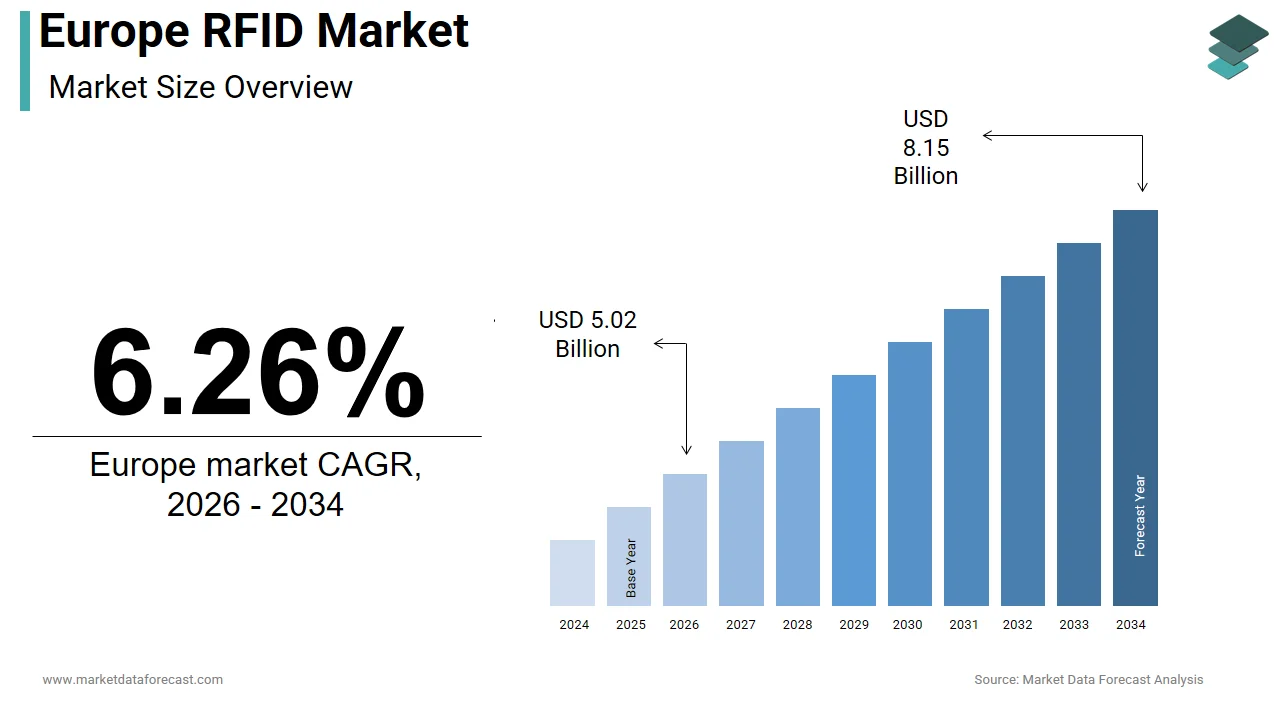
- Current Value (2026): The market is estimated at USD 5.02 billion.
- Future Projection (2033): It is expected to grow to USD 8.15 billion.
- Growth Rate: The market is expanding at a steady CAGR of 6.26%, driven by retail modernization and industrial automation.
Key Market Segments
- Component Dominance (RFID Tags): Tags are the largest segment, accounting for 62.3% of the market share in 2024. Within this, Passive Tags hold the majority share due to their cost-effectiveness and versatility.
- Primary End-User (Retail & Consumer Goods): This segment leads with a 34.6% share. Retailers are increasingly using RFID for item-level inventory accuracy and omnichannel fulfillment.
Country-Level Leadership
- Germany (25.1% share): The top performer in Europe, fueled by high-value manufacturing and automotive logistics.
- United Kingdom (16.1% share): A close second, with strong adoption in retail and asset management.
- France: Focuses on luxury goods authentication and digital supply chains.
- Italy: Seeing rapid expansion in fashion and food, where brands use RFID to provide "product stories" and digital engagement for customers.
Competitive Landscape & Strategic Trends
The market is not solely driven by price but by reliability, interoperability, and compliance with EU regulations (such as GDPR and frequency allocation).
- Digital Product Passports: A major trend is the alignment with the EU Green Deal, where RFID is used to create digital passports for products to track sustainability and recyclability.
- Vertical Integration: Leading players are moving away from just selling hardware to offering end-to-end solutions that include cloud-based middleware and analytics.
Leading Market Players
The market features a mix of global leaders and specialized European innovators:
- Zebra Technologies: A global leader providing end-to-end solutions (readers, printers, and cloud analytics). They focus on deep integration with SAP and Microsoft Azure.
- Impinj: A foundational innovator providing the "brains" (silicon chips) for RFID tags. They work closely with GS1 Europe to promote cross-border supply chain standards.
- Confidex: A Finnish specialist known for "rugged" tags that work in extreme temperatures or on metal, serving the Nordic and German industrial markets.
- Other Key Players: Avery Dennison, Honeywell, NXP Semiconductors, and Siemens.
Strategic Takeaway
The European RFID market is currently being reshaped by Sustainability and Traceability. Vendors that offer RAIN RFID-certified devices and align with the EU Circular Economy Action Plan are gaining a significant competitive advantage over those offering generic tracking solutions.
Europe RFID Market Size
The size of the Europe RFID market was valued at USD 4.72 billion in 2025. This market is expected to grow at a CAGR of 6.26% from 2026 to 2034, reaching a value of USD 8.15 billion by 2034, up from USD 5.02 billion in 2026.
Radio Frequency Identification (RFID) technology enables wireless tracking and identification of objects using electromagnetic fields and embedded tags that store digital data. Unlike traditional barcoding, RFID supports simultaneous reading of multiple items without line of sight, making it pivotal in supply chain automation, retail inventory management, and industrial asset tracking. The European adoption of RFID is shaped by regulatory alignment, digital transformation mandates, and sustainability imperatives. According to multiple sources, large logistics operators in the EU are increasingly adopting advanced tracking technologies as part of a broader push towards digital and interoperable freight transport systems promoted by initiatives like the Digital Transport and Logistics Forum. Furthermore, as per research, Cross-border parcel volumes within the EU have seen consistent growth, intensifying the need for enhanced real-time visibility and automated handling solutions to manage the increasing complexity of e-commerce logistics. National initiatives also accelerate deployment; Germany’s Industry 4.0 roadmap and France’s “AI for Logistics” program explicitly integrate RFID into smart factory and warehouse architectures. Beyond commerce, RFID supports public services. Sweden uses it in pharmaceutical serialization under the Falsified Medicines Directive, while Italy embeds RFID in wine bottle caps to combat counterfeiting. This convergence of policy, operational efficiency, and traceability demands that RFID be positioned not as a niche tool but as a foundational layer of Europe’s digital infrastructure.
MARKET DRIVERS
Mandated Traceability in Pharmaceutical and Food Supply Chains
Regulatory frameworks across the European Union have made RFID indispensable for ensuring end-to-end product traceability in high-risk sectors, and drive the growth of the Europe RFID market. The European Commission's Falsified Medicines Directive (FMD) was implemented through a Delegated Regulation that required most prescription medicine packs sold in the EU to carry a unique identifier (a 2D DataMatrix barcode) and an anti-tampering device as of February 9, 2019. While 2D barcodes dominate due to cost, RFID adoption is growing in hospital pharmacies and high-value biologics where bulk verification is critical. Similarly, the EU's Animal Health Law establishes a comprehensive framework for the individual identification and registration of certain livestock species to support rapid disease tracking and management across member states. Official identification systems for livestock across the European Union facilitate traceability and disease management efforts through national databases and standardized tagging practices. In the food sector, there is a growing trend toward enhanced electronic traceability solutions in France and across the EU, improving the tracking of perishable goods within the supply chain. These legal imperatives transform RFID from an optional efficiency tool into a compliance necessity, driving consistent demand irrespective of market cycles.
Integration into Smart Manufacturing and Industry 4.0 Ecosystems
The region’s strategic push toward industrial digitization has cemented RFID as a core enabler of real time production visibility and asset intelligence to ultimately fuel the expansion of the Europe RFID market. According to research, Germany's "Plattform Industrie 4.0" (Platform Industry 4.0) highlights a growing trend of manufacturers deploying new technologies, including RFID, as key components of the digital transformation to maintain industrial competitiveness. Unlike fixed sensors, RFID tags on jigs, pallets, and components allow dynamic data capture across assembly lines without manual intervention. In Sweden, Volvo's Torslanda manufacturing plant integrates RFID technology for real-time tracking of components and efficient synchronization of parts delivery with robotic assembly, optimizing logistics and reducing excess inventory. Similarly, Italy's National Recovery and Resilience Plan supports the broader "Transition 4.0" initiative with substantial funding for tax incentives to encourage SME digitization and the adoption of advanced technologies like RFID. The technology’s ability to interface with MES and ERP systems, such as SAP’s embedded RFID modules, ensures seamless data flow from the shop floor to cloud analytics. This deep operational integration, backed by national industrial policies, ensures sustained RFID adoption beyond pilot phases into full-scale production environments.
MARKET RESTRAINTS
Data Privacy and Security Concerns Under the GDPR Framework
The European Union’s stringent General Data Protection Regulation imposes significant constraints on RFID deployments that involve personal or identifiable data, which in turn restrains the growth of the European RFID market. This creates compliance uncertainty for enterprises. According to the European Data Protection Board, any RFID system that links a unique tag to an individual, including employee access badges, retail loyalty tags, or delivery tracking linked to customer addresses, triggers GDPR obligations for data minimization, consent, and purpose limitation. In addition, Data protection authorities are increasingly enforcing transparency and data minimization principles under GDPR, leading to significant penalties for organizations that fail to clearly inform individuals about data processing activities, including the use of tracking technologies. This regulatory scrutiny discourages item-level tagging in consumer goods, especially in sectors like fashion, where brands hesitate to risk reputational or financial penalties. Moreover, the lack of standardized RFID security protocols across EU member states complicates cross-border deployments. As per a study, the logistics sector faces challenges in harmonizing technological advancements like RFID with complex data privacy regulations, which often leads to caution and implementation delays as firms seek legal clarity on compliance requirements. Widespread adoption of consumer-facing RFID technology is hampered by existing privacy regulations, a challenge likely to persist until consistent guidelines are established.
Interoperability and Fragmentation Across National Systems
The absence of unified RFID standards across member states hampers seamless cross-border operations and economies of scale, despite EU-level digital strategies, and thereby obstructs the expansion of the Europe RFID market. The European Telecommunications Standards Institute (ETSI) has driven a trend toward harmonizing Ultra High Frequency (UHF) RFID operations within a core frequency band across the continent. For instance, Across Europe, including Germany and Eastern European countries, there is a dominant trend towards utilizing the globally compatible EPC Gen2 protocol within the harmonized 865–868 MHz frequency range. This fragmentation increases system complexity and cost. Despite ongoing efforts to harmonize European frequency bands, some remaining national variations in regulations continue to impact the overall costs and efficiency of large-scale, pan-European RFID deployments. Apart from these, industry-specific standards, such as IATA’s RFID baggage protocols versus GS1’s retail guidelines, create siloed ecosystems that resist integration. The EU's Digital Single Market initiative seeks to fix these differences, but it's slow going. Widespread RFID adoption will face ongoing obstacles until a unified, continent-spanning technical and regulatory structure is established.
MARKET OPPORTUNITIES
Expansion into Circular Economy and Sustainable Product Tracking
Radio Frequency Identification technology is emerging as an important enabler of the region’s circular economy ambitions by facilitating product reuse, recycling, and material recovery, which provides new opportunities for the growth of the Europe RFID market. According to the European Environment Agency, a portion of plastic packaging is currently recycled. RFID embedded in packaging can automate the identification of material composition at recycling facilities, increasing recovery rates. The Packaging and Packaging Waste Regulation (PPWR) was a proposal in late 2022 (not a 2023 proposal) and was adopted in December 2024. This regulation, along with the broader Ecodesign for Sustainable Products Regulation (ESPR), mandates the use of digital product passports (DPPs). These passports require a data carrier, such as a QR code, NFC, or RFID, on the product to provide access to lifecycle and sustainability data, supporting transparency and circularity. Industry consortia are exploring innovative methods for managing medical device waste to reduce environmental impact. Similarly, the legal framework for electronic waste in Germany places significant extended producer responsibility obligations on manufacturers and retailers to ensure end-of-life appliances are properly collected and recycled. These policy-driven circular initiatives position RFID as a sustainability infrastructure layer, opening new revenue streams beyond traditional logistics and retail domains.
Adoption in Smart City and Public Infrastructure Projects
Regional municipalities are increasingly deploying RFID to enhance urban efficiency, public safety, and service delivery, which offers fresh prospects for the expansion of the Europe RFID market. This deployment creates a high-growth non-commercial segment. According to research, Cities across the EU and globally are increasingly integrating IoT (Internet of Things) and identification technologies, such as RFID and GPS, into waste management systems to monitor bin status, optimize collection routes, and reduce operational emissions. In transportation, urban bike-sharing programs, such as Madrid's BiciMAD, are experiencing significant growth in ridership and leverage integrated technology for user authentication and bike tracking to enhance efficiency and user experience. Meanwhile, RFID-enabled parking meters in cities like Lyon and Berlin support contactless payment and occupancy analytics. The EU’s Urban Mobility Framework further incentivizes such deployments through cohesion funds. Significant EU cohesion funds are being allocated to various smart city projects, including smart parking and logistics initiatives, as part of broader regional development and sustainability goals. These municipal applications, though modest in tag volume, establish RFID as a trusted public sector technology and foster ecosystem development through long-term service contracts and data interoperability requirements.
MARKET CHALLENGES
High Initial Deployment Costs and ROI Uncertainty for SMEs
Small and medium enterprises across the region remain hesitant to adopt RFID due to prohibitive upfront investment and unclear return on investment timelines, which ultimately constrains the growth of the Europe RFID market. According to research, RFID implementation among EU-based SMEs in retail and logistics has shown gradual progress, with adoption often influenced by perceived cost barriers and the complexity of integration into existing systems. Unlike large corporations, SMEs lack the scale to amortize reader infrastructure and tag expenses across millions of units. As per a study, the adoption of advanced digital solutions like RFID by small retailers has faced implementation challenges, with some businesses finding initial pilot programs difficult to sustain long-term due to various operational and technical hurdles. Furthermore, the cost of UHF RFID inlays remains prohibitive for low-margin items like groceries or apparel basics. While cloud-based RFID SaaS models are emerging, they introduce recurring fees that strain thin operating budgets. For small and medium enterprises (SMEs) to widely adopt RFID technology, specific public subsidies or managed service models that fit their economic needs are crucial.
Electromagnetic Interference and Environmental Limitations in Industrial Settings
The physical performance of RFID systems in real-world European environments is often compromised by material interference and harsh operating conditions, which limit reliability and negatively impact the expansion of the Europe RFID market. According to research, Metal surfaces and liquids consistently interfere with standard RFID performance, leading to a significant increase in read failures in deployments not specifically optimized for these challenging environmental factors. Specialized metal or waterproof tags are available options, but their higher cost compared to standard inlays can significantly impact project budgets. Apart from these, extreme temperatures in Nordic cold chain logistics or Mediterranean outdoor storage degrade tag adhesives and antenna integrity over time. Field observations indicate that exposure to harsh environmental conditions, such as salt spray in maritime operations, can cause a substantial number of inadequately protected RFID tags to lose functionality over time due to corrosion. These environmental constraints necessitate costly engineering mitigations, such as shielded enclosures or hybrid barcode RFID systems, that undermine the simplicity and automation benefits RFID promises. The persistent issue of operational reliability will continue to hinder adoption until tag technologies become more robust and affordable.
REPORT COVERAGE
| REPORT METRIC | DETAILS |
| Market Size Available | 2025 to 2034 |
| Base Year | 2025 |
| Forecast Period | 2026 to 2034 |
| Segments Covered | By Component Type, Tag Type, End-User, and Country. |
| Various Analyses Covered | Global, Regional, and Country-Level Analysis, Segment-Level Analysis, Drivers, Restraints, Opportunities, Challenges; PESTLE Analysis; Porter’s Five Forces Analysis, Competitive Landscape, Analyst Overview of Investment Opportunities |
| Countries Covered | UK, France, Spain, Germany, Italy, Russia, Sweden, Denmark, Switzerland, Netherlands, Turkey, Czech Republic, and the rest of Europe |
| Market Leaders Profiled | Honeywell International Inc., Checkpoint Systems, Inc, Zebra Technologies, Alien Technology, LLC, Brady Worldwide, Inc., Confidex Ltd, AVERY DENNISON CORPORATION, HID Global Corporation, Impinj, Inc., IBM Corporation, Invengo Technology Pte Ltd., NXP Semiconductors, Protrac Id, ACTATEK (UK) Ltd., BT, Datalogic SpA, RFID, Inc., Siemens, Smartrac NV, and TagMaster. |
SEGMENTAL ANALYSIS
By Component Type Insights
The RFID Tags segment dominated the Europe RFID market by accounting for a 62.3% share in 2024. The foundational role of tags as the physical data carriers in every RFID deployment, with volumes far exceeding readers and software licenses, has mainly contributed to the dominance of the RFID Tags segment. Retailers across Western Europe have accelerated item-level RFID tagging to combat inventory inaccuracies and shrinkage. According to multiple sources, European fashion and grocery chains have increasingly adopted item-level RFID technology to improve inventory management and efficiency, leading to a significant expansion in the use of RFID tags across the continent. Inditex has fully integrated RFID technology across its global operations for all brands to enhance supply chain speed and inventory accuracy, a strategy that has significantly modernised its business model. Similarly, Deutsche Post DHL leverages advanced technologies, including RFID chips, for automated sorting and efficient tracking within its extensive logistics network, though challenges with cost and scalability are noted. The declining cost of UHF inlays has made high-volume tagging economically viable. This scale effect, combined with regulatory pushes for traceability in food and pharmaceuticals, ensures that tags remain the highest volume and highest revenue component in the European RFID value chain. Beyond reusable assets, Europe is witnessing the rapid adoption of low-cost disposable RFID tags in sectors requiring one-time traceability. The European Medicines Verification Organisation oversees an ongoing and expanding system under the Falsified Medicines Directive, where a vast number of prescription medicine packs across the EU are consistently being serialized with 2D DataMatrix codes and verified to prevent falsified medicines from entering the legal supply chain. In waste management, cities like Amsterdam and Helsinki deployed RFID-tagged single-use medical kits and biohazard containers to ensure proper disposal and chain of custody. The European Environment Agency indicates an increasing trend in the adoption of digital technologies, such as RFID, for more efficient and traceable waste management systems in various EU municipalities, though these applications are still in varying stages of implementation and innovation. These applications, though modest in individual tag value, generate immense volume due to regulatory mandates and public health imperatives, reinforcing the segment’s dominance.
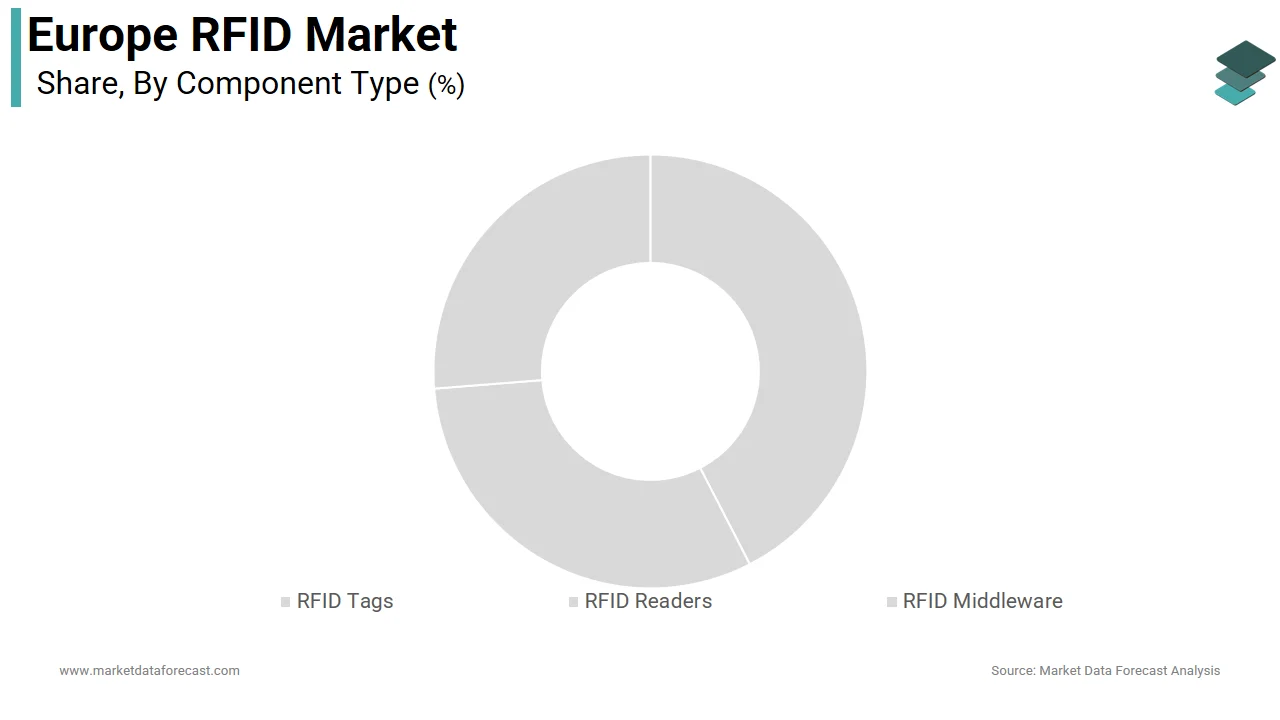
The RFID Middleware segment is on the rise and is expected to be the fastest-growing segment in the market by witnessing a CAGR of 15.3% from 2025 to 2033. The rapid expansion of the RFID Middleware segment is fuelled by the integration of imperatives with legacy enterprise systems, and the rise of edge computing and real-time analytics requirements. The expansion of RFID technology across European enterprises, moving beyond initial pilots to large-scale operations, highlights the critical necessity for middleware capable of connecting RFID data streams to core business systems like ERP, WMS, and cloud services. Middleware resolves protocol heterogeneity, translating data from diverse reader brands into standardized formats, and filters noise from raw RFID signals, ensuring only actionable events reach business systems. This operational necessity transforms middleware from a niche utility into a strategic enabler of digital continuity across the European industrial landscape. The shift toward latency-sensitive industrial automation has elevated middleware from a passive data router to an active edge processing layer. Furthermore, the EU’s Cybersecurity Act mandates on-premises data handling for critical infrastructure, which favours localized middleware solutions that minimize cloud dependency. These technical and regulatory drivers position middleware as the intelligence core of next-generation RFID ecosystems, which fuels its accelerated growth.
By Tag Type Insights
The passive tags segment captured the majority share of the Europe RFID market in 2024. Factors such as its low cost, small form factor, and sufficient read range for most commercial applications are attributed to the supremacy of the passive tags segment. Passive UHF tags require no internal power source, drawing energy from reader signals, which enables mass production at fractions of a euro per unit. According to a study, the cost gap between bulk passive RFID tags and active RFID tags remains substantial, with passive tags being significantly more economical per unit. This economic advantage makes passive RFID viable for tagging low-margin items like apparel, groceries, and pharmaceuticals. H&M has extensively implemented passive UHF RFID technology across its European operations, leading to notably enhanced inventory accuracy. The sheer scale of consumer markets ensures passive tags remain the default choice for item-level identification. Europe’s regulatory and technical ecosystem is optimized for passive UHF RFID operating in the 865 868 MHz band. Regulatory bodies across Europe have successfully established a primary, harmonized frequency band for passive RFID operations to ensure interoperability and consistent deployment across the region. European retailers, including many major market players, are increasingly adopting GS1's EPC/RFID standards and guidelines to enhance supply chain visibility, improve inventory accuracy, and meet consumer demand for omnichannel experiences. This standardization reduces deployment risk and encourages vendor investment in passive tag innovation. The alignment of policy, infrastructure, and industry practice creates a self-reinforcing cycle that entrenches passive RFID as the backbone of European item identification.
The active tags segment is expected to exhibit a noteworthy CAGR of 18.7% during the forecast period, owing to demand for real time location systems in healthcare and industrial safety, and integration with IOT and predictive maintenance in smart factories. Active RFID tags, equipped with batteries and capable of transmitting signals over 100 meters, are essential for real time location systems (RTLS) in complex environments. Healthcare providers in Europe are increasingly adopting Real-Time Location Systems (RTLS) like active RFID for asset tracking and patient flow, improving operational efficiency. Industries, including mining, use location tech to meet stricter EU worker safety directives, focusing on precise location data for hazards and personnel. These applications require continuous, long-range tracking impossible with passive systems. Real-Time Location Systems (RTLS) are showing promise in industrial settings, reducing emergency response times and enhancing overall workplace safety. Active tags are evolving into sensor-enabled IoT nodes that transmit not just location but temperature, vibration, and humidity data. The VDMA and the broader German engineering sector advocate for the increasing adoption of sensor-equipped technologies and data analytics for predictive maintenance programs in the automotive supply chain. BMW Group facilities, such as the Dingolfing plant, implement advanced, AI-supported condition monitoring and predictive maintenance systems to manage equipment health, such as in conveyor systems, and trigger maintenance proactively. The EU's Horizon Europe research and innovation program continues to allocate significant funding to projects within its digital transformation initiatives, supporting the integration of various industrial IoT platforms and related technologies. This convergence transforms active tags from simple beacons into intelligent assets, unlocking new use cases in condition monitoring and energy management that passive tags cannot support, thereby accelerating their adoption in high-value industrial ecosystems.
By End User Insights
The retail and consumer goods segment continued to be the prominent segment in the Europe RFID market by holding 34.6% share in 2024. The prominence of the retail and consumer goods segment is credited to the sector’s relentless pursuit of inventory accuracy, loss prevention, and omnichannel fulfillment efficiency. Retail shrinkage, comprising theft, administrative errors, and supply chain losses, costs European retailersa substantial amount. RFID provides significant inventory accuracy, which enables real-time detection of discrepancies. Marks and Spencer's RFID implementation across its stores led to a notable reduction in product unavailability and improved loss prevention through enhanced stock visibility. Similarly, Decathlon utilizes RFID technology on all of its products in its stores, enabling staff to perform full store inventories significantly faster than with manual barcode systems. This operational transformation directly impacts profitability in a sector operating on razor-thin margins, which makes RFID not a luxury but a financial necessity. The rise of buy online, pick up in store (BOPIS) and ship from store models demands precise item-level visibility. According to a study, a notable share of European consumers now expect same-day or next-day delivery, pressuring retailers to leverage store inventory as fulfillment nodes. Zara's mature RFID system provides store associates with real-time inventory visibility, allowing for efficient product location and enabling a high proportion of online orders to be fulfilled directly from store stock as part of its integrated omni-channel strategy. H&M utilizes RFID technology to enhance inventory accuracy and overall supply chain efficiency, which supports the growth of its omni-channel services, including online sales and in-store pickup options. The growing volume of EU e-commerce sales makes the integration of physical and digital inventories via RFID systems a prerequisite for competitive retail survival.
The healthcare segment is predicted to witness the highest CAGR of 19.2% from 2025 to 2033. The swift expansion of the healthcare segment is driven by patient safety and regulatory mandates. The EU Medical Device Regulation (MDR) requires unique device identification (UDI) for all implantable and high-risk devices, with RFID emerging as the preferred medium for dynamic tracking. According to sources, the European Union medical device regulations increasingly mandate the use of the Unique Device Identification (UDI) system for enhanced traceability and post-market surveillance within the EUDAMED database. Hospitals use RFID to verify implant authenticity before surgery, which reduces counterfeit risk. Across the healthcare supply chain, there is a growing trend toward adopting advanced identification and data capture technologies to improve the monitoring and integrity of sensitive medical products, including temperature-sensitive items. These regulatory imperatives transform RFID from optional to essential in a healthcare sector managing millions of patient procedures annually across the EU. Hospitals face intense pressure to maximize utilization of expensive equipment like infusion pumps and ventilators. According to research, European hospitals generally face challenges in achieving high utilization rates for mobile medical equipment, largely attributed to inefficiencies in traditional tracking and management systems. RFID-enabled real-time location systems have increased utilization in early adopters like Charité Berlin. This focus on operational efficiency in publicly funded health systems ensures rapid and sustained RFID adoption in healthcare.
COUNTRY-LEVEL ANALYSIS
Germany RFID Market Analysis
Germany was the top performer in the Europe RFID market and accounted for a 25.1% share in 2024. Its position as the continent’s industrial and technological powerhouse has largely contributed to the demand for RFID in Germany. The country’s dominance is attributed to the deep integration of RFID into its Industry 4.0 framework and extensive logistics infrastructure. According to research, German mechanical engineering and automotive manufacturers are increasingly adopting advanced tracking technologies, such as RFID, to enhance efficiency in their supply chain and production processes. Major corporations use RFID across their European supply chains to synchronize just-in-time deliveries and manage work-in-progress inventory. Apart from these, Germany hosts Europe’s largest logistics hub in the Rhine-Ruhr region, where DHL and DB Schenker utilize RFID for cross-dock automation and pallet tracking. The German government, often in collaboration with European Union initiatives, has provided significant funding and incentives to support the development and adoption of digital and smart manufacturing technologies as part of broader industrial and climate action strategies. This convergence of industrial policy, manufacturing scale, and logistical density ensures Germany remains the anchor market for RFID innovation and deployment across Europe.
United Kingdom RFID Market Analysis
The United Kingdom followed closely in the Europe RFID market by capturing a share of 16.1% in 2024. Factors such as advanced retail adoption and healthcare digitization, despite Brexit uncertainties, have contributed to the expansion of the UK market. British retailers lead Europe in item-level tagging, with Marks and Spencer, John Lewis, and Tesco implementing RFID across thousands of stores. In healthcare, the National Health Service’s 2023 Digital Transformation Plan prioritized asset and patient tracking, with numerous hospital trusts deploying RFID for equipment management. The UK’s Medicines and Healthcare products Regulatory Agency also enforces strict serialization compliance aligned with EU standards, sustaining demand in pharma. Furthermore, London’s status as a global logistics node fuels RFID use in last-mile delivery and warehouse automation. These commercial and institutional drivers maintain the UK as a high-value, innovation-led RFID market.
France RFID Market Analysis
France is another key player in the Europe RFID market because of strong government support for digital supply chains and luxury goods authentication. Governments and industry players increasingly leverage various technologies, including RFID, to improve supply chain transparency and combat issues like food fraud and counterfeiting. Luxury brands utilize technologies such as RFID to enhance authenticity verification and combat counterfeiting, a persistent issue across the European Union. France maintains a rigorous, mandatory national identification system for all cattle to ensure traceability and disease control, with the option for producers to integrate electronic identification technologies for enhanced management. Major retailers are adopting digital traceability systems and other technologies in their fresh food supply chains to improve inventory management and reduce waste. This blend of regulatory enforcement, brand protection, and retail innovation positions France as a multifaceted RFID adopter.
Italy RFID Market Analysis
Italy experienced a steady expansion in the European RFID market, with growth concentrated in fashion, food, and high-value manufacturing. Italian luxury brands leverage RFID to create richer customer experiences, offering digital access to product stories and boosting post-purchase engagement. The Italian fashion industry, a significant pillar of the national economy, is increasingly exploring and adopting RFID and other digital traceability solutions to enhance supply chain visibility, combat counterfeiting, and prepare for upcoming EU digital product passport regulations. Industrial firms use RFID in aerospace and automotive assembly for part traceability under EU safety directives. Italy's National Recovery and Resilience Plan substantially funds the country's business innovation through a broad initiative, which encourages the adoption of advanced digital technologies and fosters the transition to a more modern, competitive, and innovative economy. Italy’s unique mix of artisanal heritage and industrial ambition creates a distinctive RFID adoption pattern centered on provenance and precision.
Netherlands RFID Market Analysis
The Netherlands is likely to grow in the Europe RFID market from 2025 to 2033 due to its position as a digital logistics and agri-food innovation hub. The country’s strategic location, with Rotterdam handling millions of TEUs annually, drives RFID use in container and pallet tracking. Companies operate fully RFID-enabled distribution centers for EU e-commerce fulfillment. In agriculture, the Netherlands leads in smart farming. The use of RFID technology in dairy farming is an emerging trend in precision livestock farming, with ongoing research and trials at institutions like Wageningen University exploring its application in automated individual animal monitoring for health and welfare. Moreover, the retail sector is increasingly adopting RFID technology to enhance supply chain visibility and inventory accuracy, which in turn helps manage stock levels more efficiently and contributes to ongoing efforts to reduce overall product waste. In addition, the Dutch government, as part of broader initiatives to promote digital transformation in logistics, encourages the adoption of innovative technologies and data sharing to enhance the efficiency and sustainability of supply chains. This integration of logistics scale, agricultural technology, and policy foresight makes the Netherlands a disproportionately influential RFID market in Europe.
COMPETITIVE LANDSCAPE
The Europe RFID Market features a dynamic competitive landscape characterized by a mix of global technology leaders and specialized European innovators. Competition is not primarily price-driven but centers on solution reliability, interoperability with legacy systems, and compliance with stringent EU regulations, including GDPR frequency allocation and product traceability mandates. Global players leverage scale and software integration capabilities while regional specialists excel in application-specific tag design and local regulatory expertise. Barriers to entry remain moderate due to the need for technical certification, RAIN RFID alliance membership, and established logistics partnerships. However, the market is not highly consolidated, allowing agile niche providers to thrive in sectors like healthcare, luxury goods, and smart manufacturing. Strategic differentiation occurs through edge computing capabilities, sustainability alignment, and support for digital product passport initiatives under the EU Green Deal,l fostering continuous innovation and collaboration across the value chain.
KEY MARKET PLAYERS
The leading companies operating in the Europe RFID market include:
- Honeywell International Inc.
- Checkpoint Systems, Inc.
- Zebra Technologies
- Alien Technology, LLC
- Brady Worldwide, Inc.
- Confidex Ltd
- AVERY DENNISON CORPORATION
- HID Global Corporation
- Impinj, Inc.
- IBM Corporation
- Invengo Technology Pte Ltd.
- NXP Semiconductors
- Protrac Id
- ACTATEK (UK) Ltd.
- BT
- Datalogic SpA
- RFID, Inc.
- Siemens
- Smartrac NV
- TagMaster
TOP PLAYERS IN THE MARKET
- Zebra Technologies is a global leader in enterprise asset intelligence with a strong footprint across the Europe RFID Market. The company provides end-to-end RFID solutions, including fixed and handheld readers, embedded RFID printers, and cloud-based analytics software tailored for retail logistics and manufacturing. Zebra has deepened its European presence through strategic collaborations with major fashion retailers and automotive OEMs to deploy item-level and pallet-level tracking systems. In recent years, the company enhanced its portfolio with RAIN RFID-certified devices compliant with EU UHF regulations and expanded its professional services team to support large-scale European deployments. Its focus on interoperability with SAP and Microsoft Azure has further solidified its position as a preferred technology partner for digital transformation initiatives across the region.
- Impinj is a foundational innovator in RAIN RFID technology and a key enabler of the Europe RFID Market through its high-performance endpoint integrated circuits and reader chips. The company supplies core silicon to European tag inlay manufacturers and system integrators, enabling mass production of cost-efficient UHF tags compliant with EPC Gen2 standards. Impinj has strengthened its European engagement by partnering with GS1 Europe and national retail associations to promote RFID adoption for supply chain visibility. Recent initiatives include launching edge connectivity platforms that support real-time item intelligence in cloud environments and collaborating with EU-based logistics providers to validate performance in cross-border operations. Its commitment to open standards and developer ecosystems ensures broad compatibility across European industrial and retail use cases.
- Confidex is a Finnish-headquartered RFID specialist renowned for designing rugged, high-performance passive and active RFID tags for demanding European industrial, automotive, and healthcare environments. The company differentiates itself through application-specific tag engineering, including metal mount on metal and extreme temperature-resistant solutions widely used in German and Swedish manufacturing plants. Confidex has expanded its European reach by co-developing smart packaging tags with pharmaceutical and luxury goods companies to meet EU serialization and anti-counterfeiting mandates. Recent actions include launching RFID-enabled digital product passports aligned with the EU Circular Economy Action Plan and establishing certified tag validation labs in Germany and France to support local compliance and performance testing for enterprise clients across the region.
TOP STRATEGIES USED BY THE KEY MARKET PARTICIPANTS
Key players in the Europe RFID Market focus on vertical integration by developing end-to-end solutions that combine tags, readers, and cloud-based middleware to ensure system compatibility and performance. They actively collaborate with European regulatory bodies and industry consortia like GS1 Europe to align products with regional standards and compliance requirements. Companies invest in application-specific tag innovation to address environmental challenges such as metal interference and extreme temperatures in industrial settings. Strategic partnerships with enterprise software providers like SAP and Microsoft enhance data integration capabilities for large-scale deployments. Additionally, they prioritize local presence through regional support centers and compliance testing labs to build trust and accelerate adoption among European enterprises.
MARKET SEGMENTATION
This Europe RFID market research report is segmented and sub-segmented into the following categories.
By Component Type
- RFID Tags
- RFID Readers
- RFID Middleware
By Tag Type
- Passive Tags
- Active Tags
By End-User
- Logistics and Manufacturing
- Retail and Consumer Goods
- Healthcare
- Aerospace and Defence
- Government
- Others
By Country
- UK
- France
- Spain
- Germany
- Italy
- Russia
- Sweden
- Denmark
- Switzerland
- Netherlands
- Turkey
- Czech Republic
- Rest of Europe