- Product Description Description
- Table of Contents TOC
- List of Table & Figure LOT
- Get Free Sample PDF Sample PDF
Market Size, 2025
$0.90 BnMarket Estimate, 2026
$1.02 BnMarket Forecast, 2034
$2.88 BnCAGR, 2026–2034
13.8%Executive Summary: Europe RNA Analysis Market
- Market Scope: Comprehensive regional RNA analysis market analysis covering technology types, application segments, end-user categories, European country frameworks, and competitive dynamics.
- Market Valuation: Valued at USD 0.90 billion (2025), estimated at USD 1.02 billion (2026), and projected to reach USD 2.88 billion by 2034, registering a robust CAGR of 13.80% (2026–2034).
- Primary Growth Drivers: Single-cell and spatial transcriptomics adoption, RNA biomarker integration into companion diagnostics, precision medicine demand, and regulatory submissions. Opportunities include artificial intelligence convergence with transcriptomic data interpretation and multi-omics core facility expansion.
Key Market Segment Metrics (2026–2034)
| Category | Leading Segment (2025 Position) | Fastest-Growing Segment |
|---|---|---|
| By Segment Architecture | Segmented across Type, Application, and End User (individual shares/percentages not specified in the report) | Single-cell and spatial transcriptomics workflows alongside AI-enabled data interpretation tools |
| By Region / Country | Covers UK, France, Spain, Germany, Italy, Russia, Sweden, Denmark, Switzerland, Netherlands, Turkey, Czech Republic, and Rest of Europe (specific country shares not detailed) | Advanced multi-omics and precision molecular diagnostic research hubs across Europe |
Major Market Players & Market Structure
Market Structure: Highly competitive European life sciences and molecular diagnostics landscape characterized by technological innovation in RNA sequencing, AI integration, multi-omics infrastructure investments, and strict IVDR compliance.
Key Companies: Illumina Inc., Qiagen N.V., Affymetrix Inc., Agilent Technologies Inc., F. Hoffmann-La Roche Ltd., Sigma Aldrich, Fluidigm Corporation, Bio-Rad Laboratories Inc., GE Healthcare, and Thermo Fisher Scientific Inc.
Europe RNA Analysis Market Size
The Europe RNA Analysis Market is projected to grow from USD 0.90 billion in 2025 to USD 1.02 billion in 2026 and reach USD 2.88 billion by 2034, registering a CAGR of 13.80% from 2026 to 2034.
RNA Analysis refers to the technologies and methodologies used to isolate, quantify, sequence, and functionally characterize ribonucleic acid molecules across biomedical research, diagnostics, and therapeutic development. In 2025, RNA analysis has evolved beyond foundational gene expression profiling to include single-cell transcriptomics, spatial RNA mapping, and long non-coding RNAs, RNAsingle-cell assays critical t,,o precision medicine. Europe’s scientific infrastructure provides a robust foundation with a number of academic institutions and public research organizations actively engaged in molecular biology. Landmark initiatives such as the EU-funded LifeTime consortium aim to deploy single-cell RNA sequencing foEU-fundEU-fundedisease detection in clinical settings. The European Molecular Biology Laboratory operates one of the world’s largest RNA sequencing service hubs, processing thousands of samples annually. Regulatory frameworks like the In Vitro Diagnostic Regulation also increasingly require RNA biomarker validation for companion diagnostics. This convergence of institutional capacity, scientific ambition, and regulatory evolution positions RNA analysis as a pivotal enabler of Europe’s transition toward data-driven and molecularly informed healthcare.
MARKET DRIVERS
Expanded data-driven Cell and Spatial Transcriptomics in Academic and Clinical Research
The rapid adoption of single-cell and spatial RNA analysis technologies is transforming biological inquiry and driving demand in the region’s research ecosystem, and is one of the key accelerators of the European RNA analysis market. These advanced methods enable resolution of European heterogeneity and tissue architecture in ways that bulk RNA sequencing cannot replicate the complexity of human disease. According to sources, the use of single-cell transcriptomics as a core methodology is increasing across various research fields, including oncology, neurology, and immunology, in projects funded by programs like Horizon Europe. Institutions with national genomics infrastructure, such as the Karolinska Institute in Sweden, have reported a significant increase in the volume of single-cell RNA sequencing samples processed in recent years, reflecting growing demand. Clinical translation is also accelerating. This scientific pull toward granular molecular understanding ensures sustained investment in high-resolution RNA analysis platforms.
Rising Integration of RNA Biomarkers in Companion Diagnostics and Regulatory Submissions
RNA-based biomarkers, which are increasingly embedded in drug development and diagnostic approval pathways, are fuelling the expansion of the European RNA analysis market. This integration creates a structured demand for standardized analysis workflows. There is a significant increase in the regulatory requirement for the submission and use of RNA expression data in evaluating new personalized medicine therapies, particularly within oncology and rare diseases, as per research. Moreover, the development and submission of new marketing authorization applications increasingly incorporate patient stratification methods based on RNA signatures. RNA profiling is being utilized in the development and approval of advanced diagnostic tools. Diagnostic developers have responded by certifying their RNA extraction and qPCR kits under the In Vitro Diagnostic Regulation, which enables hospital labs to implement compliant workflows. This regulatory and therapeutic integration transforms RNA analysis from a research tool into a clinical necessity.
MARKET RESTRAINTS
High Cost and Technical Complexity of Advanced RNA Sequencing Platforms
The financial and operational barriers associated with next-generation RNA analysis technologies limit their accessibility, particularly in smaller academic centers and public healthcare laboratories, which restrain the growth of the European RNA analysis market. According to studies, a single run on a high-throughput single-cell RNA sequencer involves significant costs for reagents and consumables, which can amount to several thousand euros depending on the platform and scale. Capital equipment such as 10x Genomics Chromium or Nanostring GeoMx systems represents a substantial institutional investment, which often costs hundreds of thousands of euros and potentially requires specialized facility modifications. Moreover, data analysis demands specialized bioinformatics expertise, the shortages of which are acute outside major hubs. These compounded constraints restrict equitable adoption and delay translational projects despite strong scientific interest.
Stringent Data Privacy and Sample Handling Regulations Under GDPR and IVDR
Robust regulatory environment in the region, while protective of patient rights, imposes operational burdens on RNA analysis activities involving human samples, which impedes the growth of the European RNA analysis market. The General Data Protection Regulation (GDPREuropeansifies RNA sequence data as genetic data, a special category of personal and sensitive information, which requires secure storage and donor consent for processing unless robust anonymization is achieved. According to research, a portion of academic biobanks were found non-compliant with GDPR requirements for genomic data processing, leading to temporary research suspensions. These overlapping compliance layers raise costs, deter startups, and slow the clinical deployment of RNA biomarkers, even if scientific validity is established.
MARKET OPPORTUNITIES
Convergence of Artificial Intelligence with Transcriptomic Data Interpretation
The integration of artificial intelligence can help provide novel biological insights and accelerate the discovery timeline, which is setting up new opportunities for the growth of the European RNA analysis market. Deep learning models now enable automated cell European annotation from single-cell datasets, reducing manual curation time, as per sources. As per studies, academic medical centers across Europe are increasingly adopting AI-powered platforms to analyze RNA data for clinical research and application. In addition, research institutions are successfully utilizing advanced AI models to improve the accuracy of predicting patient responses to cancer treatments like immunotherapy. The European bodies provide financial investment and support to startups specializing in the development of AI tools for interpreting complex biological data like RNA. This synergy between open science infrastructure and machine learning innovation is transforming RNA analysis from descriptive profiling to predictive biology.
Growth of Centralized Multi-omics Core Facilities Across EU Research Infrastructures
The region’s strategic investment in shared omics platforms is democratizing access to advanced RNA analysis capabilities and fostering collaborative discovery, which further provides prospects for the European RNA analysis market. The EU-funded Euro-BioImaging and ELIXIR infrastructures strategically collaborate to link imaging datasets with biomolecular data, including in areas like spatial-omics. ELIXIR provides access to data resources like RNA sequencing data. These core facilities not only reduce duplication of capital investment but also enforce standardized protocols, enhancing data reproducibility. This ecosystem of pooled resources and methodological harmonization enables even modestly funded labs to participate in cutting-edge transcriptomic research, reinforcing Europe’s scientific cohesion..
MARKET CHALLENGES
Shortage of Standardized Protocols for Long Non-Coding RNA and Circular RNA Analysis
The lack of universally accepted methodologies for analyzing non-canonical RNA species hampers reproducibility and clinical translationon-canonicalinders the growth of the European RNA analysis market. Long non-coding RNAs and circular RNAs exhibit structural features that are not captured by conventional library preparation and alignment algorithms. According to analyses of the European Nucleotide Archive (ENA), a significant majority of deposited RNA sequencing studies lack crucial metadata, with reports often indicating fewer than 15 percent of studies specifying key library preparation methods such as rRNA depletion or strand specificity. Inter-laboratory studies, such as one conducted under the auspices of the European Molecular Biology Laboratory (EMBL), highlight significant variability in emerging biomarker quantification, with research indicating up to a 12-fold difference in the quantification of the same circular RNA across multiple genomics centers. This inconsistency deters diagnostic developers. The RNA Society's European Chapter is in the process of drafting best practice guidelines, but following these recommendations is entirely voluntary. Harmonized standards are essential to prevent the fragmentation of European research output and the potential delay in bringing emerging RNA classes to the clinic, despite promising discovery prospects.
Dependence on Extra-European Reagents and Instrumentation Supply Chains
Heavy reliance on imported instrumentation consumables and enzyme kits, creating vulnerability to global supply disruptions, is slowing down the expansion of the European RNA analysis market. EU labs, laboratories exhibit a significant reliance on imports from the United States and China for critical single-cell partitioning chips, sequencing reagents, and reverse transcriptases, indicating substantial external dependency in the biotechnology supply chain, as per research. The global reagent shortage demonstrated a substantial vulnerability in the supply chain for essential laboratory materials like RNA extraction kits, which leads to considerable project delays across European omics research, according to sources. The EU Bioeconomy Strategy aims to establish sovereign biomanufacturing, but this effort is advancing at a measured pace, as merely a small number of European companies produce commercial-grade high-fidelity reverse transcriptases. National initiatives include provisions for strategic stockpiling but lack coordination. This external dependency not only inflates costs but also compromises research continuity and data sovereignty in an era where RNA analysis underpins national health security and innovation policy.
REPORT COVERAGE
| REPORT METRIC | DETAILS |
| Market Size Available | 2025 to 2034 |
| Base Year | 2025 |
| Forecast Period | 2026 to 2034 |
| Segments Covered | By Type, Application, End User, and Region. |
| Various Analyses Covered | Global, Regional, and Country-Level Analysis, Segment-Level Analysis, Drivers, Restraints, Opportunities, Challenges; PESTLE Analysis; Porter’s Five Forces Analysis, Competitive Landscape, Analyst Overview of Investment Opportunities |
| Countries Covered | UK, France, Spain, Germany, Italy, Russia, Sweden, Denmark, Switzerland, Netherlands, Turkey, Czech Republic, Rest of Europe |
| Market Leaders Profiled | Illumina Inc., Qiagen N.V., Affymetrix Inc., Agilent Technologies Inc., F. Hoffmann-La Roche Ltd., Sigma Aldrich, Fluidigm Corporation, Bio-Rad Laboratories Inc., GE Healthcare, Thermo Fisher Scientific Inc. |
SEGMENTAL ANALYSIS
By Type Insights
The sequencing technologies segment led the European RNA analysis market by accounting for a 48.3% share in 2025. The prominence of the sequencing technologies segment is driven by their unparalleled resolution in transcriptome characterization and expanding utility in both research and clinical settings. The continent-wide adoption of RNA sequencing in large-scale genomic initiatives also fuels the growth of this segment. As per research, the Implementation of next-generation sequencing (NGS), which includes RNA sequencing, is increasingly common in precision oncology guidelines (e.g., ESMO recommendations). The falling cost of next-generation sequencing also plays a role. Unlike microarrays, sequencing detects novel transcripts, splice variants, and fusion genes without prior probe design, making it indispensable for biomarker discovery. This combination of policy supports technological maturity and scientific necessity, cements sequencing as the backbone of modern RNA analysis in Europe.
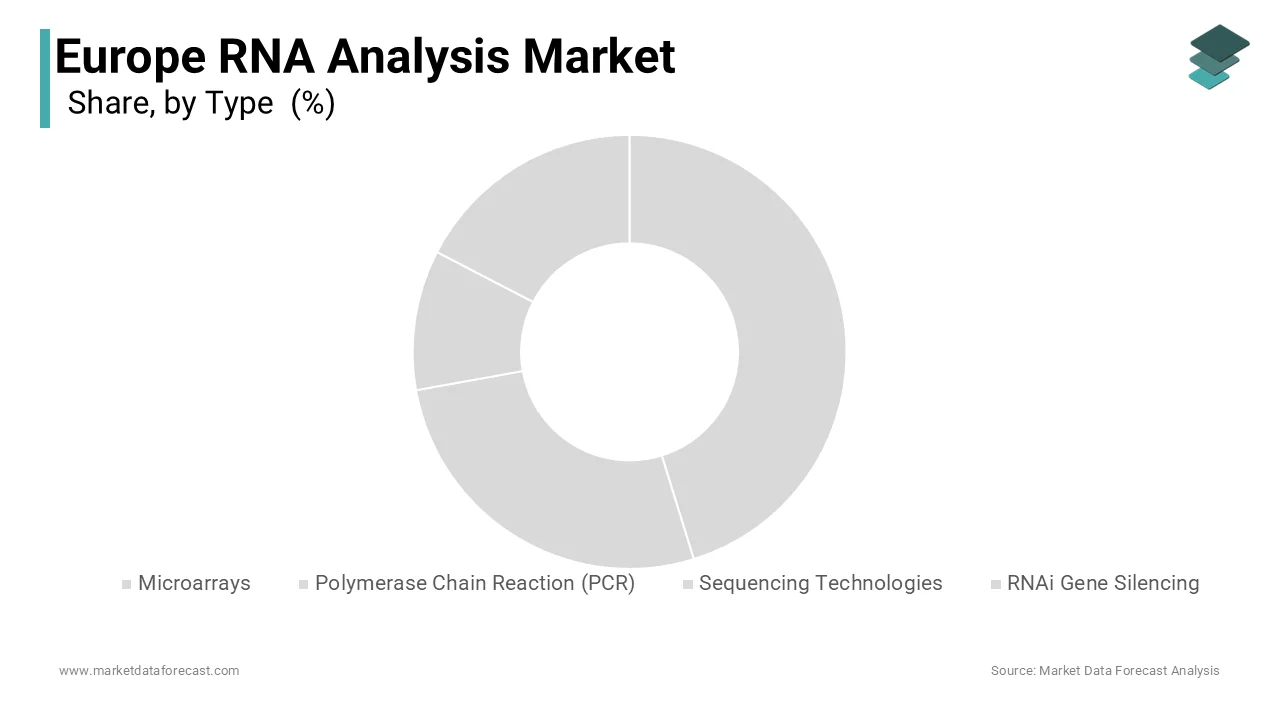
The RNA gene silencing segment is anticipated to witness the fastest CAGR of 13.1% from 2025 to 2033. The growth of the RNA gene silencing segment is fueled by its dual role in functional genomics and therapeutic development. One major driver is Europe’s dominance in RNA therapeutics, with the European Medicines Agency approving multiple siRNA drugs since,202,0 including Alnylam’s lumasiran for primary hyperoxaluria. According to studies, there is substantial investment and collaborative effort through public-private partnerships focused on advancing and optimizing the delivery systems for RNAi therapies. Academic demand is equally robust as the European funding bodies are allocating substantial financial resources to research projects that leverage technologies like siRNA and CRISPRi to understand the functions of noncoding RNAs. Companies have scaled GMP manufacturing of lipnanoparticle-formulated siRNAs in Germany and Denmark. Furthermore, the European Union has strategically designated RNA targeting as a key priority area within its major research funding programs, which highlights its importance for future health innovations. These intersecting therapeutic and discovery applications position RNAi not merely as an analytical method but as an active intervention platform.
By Application Insights
The drug discovery segment dominated the European RNA analysis market and captured a 42.8% share in 2025. The dominant European drug discovery segment is attributed to RNA analysis’s central role in target identification, mechanism of action studies, and toxicity screening across Europe’s pharmaceutical sector. A different driver of this segment is the integration of transcriptomics into early-stage drug development pipelines. As per sources, the use of RNA sequencing (RNA-seq) is a widespread and established technique in the pharmaceutical industry for assessing drug effects and identifying biomarkers due to its power to analyze numerous gene expressions simultaneously. Furthermore, Regulatory bodies like the European Medicines Agency (EMA) and the U.S. Food and Drug Administration (FDA) provide extensive guidance on the use of biomarkers and the assessment of drug interactions by recognizing their increasing importance in drug development, especially in areas like oncology and rare diseases. Companies operate dedicated transcriptomics units that screen compound libraries using high-content RNA profiling. This institutionalization of RNA analysis as a high-content step in risk-averse drug development ensures its sustained dominance in the application-risk landscape.
The clinical diagnosis segment is likely to experience the fastest CAGR of 15.4% during the forecast period owing to factors such as the regulatory endorsement of RNA biomarkers an,d the rollout of molecular diagnostics in routine care. A further accelerator of this segment is the European Union’s In Vitro Diagnostic Regulation, which requires rigorous analytical validation for RNA-based tests, creating a structured pathway to market. As per a study, RNA-based panels for non-small cell lung cancer are increasingly recognized and implemented as the standard of care across numerous EU countries. The UK’s National Health Service implemented the NHS Genomic Medicine Service in 2023, which includes RNA sequencing for 25 rare genetic conditions, reducing diagnostic odysseys from years to weeks. Furthermore, National health services, such as those in the UK, are integrating comprehensive RNA sequencing services for rare genetic conditions to significantly reduce diagnostic timelines. Diagnostic companies have certified their RNA extraction and amplification kits under IVDR, enabling hospital labs to run compliant workflows. This convergence of policy reimbursement and clinical utility is transforming RNA analysis from a research curiosity into a frontline diagnostic modality.
By End User Insights
The academic research and government institutes segment was the largest segment in the European RNA analysis and occupied a 51.4% share in 2025. The growth of the academic research and government institutes segment is the region’s dense public science infrastructure and commitment to fundamental molecular discovery. These entities operate the majority of high-throughput RNA analysis facilities across the continent. As per research, many publicly funded core labs provide RNA sequencing and qPCR services, with Germany, France, and the UK hosting a portion of these centers. The European Research Council allocated funds to frontier projects in RNA biology, including investigations into interphase-separated RNA granules and mitochondrial transcript editing. National initiatives further amplify demand, which has resulted in a large number of RNA. Unlike industry users, academic labs prioritize methodological exploration, often adopting emerging techniques like long-read RNA sequencing before commercial validation. This culture of olong-readry combined with stable public funding ensures that academic institutions remain the primary engine of RNA analysis activity in Europe.
The hospitals and diagnostic centers segment is on the rise and is expected to be the fastest-growing segment in the regional market by witnessing a CAGR of 16.2% during the forecast period due to the clinical implementation of RNA-based tests under Europe’s precision medicine mandates. A key factor in RNA-based integration of RNA analysis into national genomic medicine strategies. Across European Union countries, there is a growing trend towards establishing hospital-based RNA sequencing programs for cancer and rare diseases. National plans are supporting the creation of regional molecular diagnostics hubs. The use of RNA fusion testing for cancers like sarcoma and lung cancer is increasing, as is the adoption of next-generation sequencing-based panels by pathologists. Diagnostic centers are also investing in automated RNA extraction and qPCR platforms to meet compliance,c ee with many hospital labs in Germany are upgrading instrumentation. This rapid, clinical embedding reflects a systemic shift toward molecularly guided patient management.
COUNTRY LEVEL ANALYSIS
Germany RNA Analysis Market Analysis
Germany was the top performer in the European RNA Analysis Market and accounted for a 23.5% share in 2024. The domination of Germany in the regional market is largely attributed to its world-class research hospitals, public genomics initiative,,s and strong biotech industry. The country hosts the German Center for Neurodegenerative Diseases and the Helmholtz ZentrumMünchenh, in which together operate high-throughput RNA sequencing facilities processing thousands of samples. High-throughput major diagnostic centers in Berlin and Heidelberg now offer routine RNA fusion testing for pediatric cancers, while companies like Qiagen maintain European headquarters in Hilden, supporting instrument and reagent distribution. This integration of public science, clinical implementation, and industrial capacity solidifies Germany’s dominant position.
United RNA Analysis Market Analysis
The United Kingdom followed closely in the European RNA analysis market and held an 18.3% share in 2025. Its centralized genomic medicine service and strong academic therapeutics pipeline fuel the growth of RNA analysis in the UK. Companies like Oxford Nanopore Technology, headquartered in Oxford ha,,v e driven the adoption of long-read RNA sequencing across university hospitals. This unique blend of national health integration, academic excellence, and homegrown technology ensures the UK’s prominent market role.
France RNA Analysis Market Analysis
France remains a major player in the European RNA Analysis Market because of its ambitious national genomics strategy and dense network of university hospital research centers. The national genomic medicine strategy involves the widespread establishment of regional infrastructure for advanced molecular diagnostics, specifically incorporating RNA sequencing technology. There is a growing and significant integration of RNA-based diagnostic tests into standard clinical practice within university hospitals. France plays a central role in European-level data infrastructure by hosting a key hub for genomic data sharing and collaboration among multiple member nations. This coordinated ecosystem of public investment, clinical translation, and therapeutic innovation sustains France’s significant market presence.
Netherlands RNA Analysis Market Analysis
The Netherlands is moving ahead steadily in the European RNA Analysis Market due to its command in molecular diagnostics and open science infrastructure. The country’s National Pathology Registry mandates RNA fusion testing for all soft tissue sarcomas and non-small cell lung cancers with notable compliance. The Princess Máxima Center for Pediatric Oncology in Utrecht runs one of Europe’s most advanced RNA diagnostics units, offering real-time transcriptome analysis for treatment adaptation. The Netherlands is also home to the European Bioinformatics Institute’s RNA central team, which curates and standardizes non-coding RNA annotations used globally. Furthermore, Dutch diagnostic companies have certified multiple RNA amplification cartridges under IVDR, enabling decentralized testing. This fusion of clinical rigor, data stewardship, IP, and regulatory agility allows the Netherlands to exert a significant influence on RNA analysis adoption.
Sweden RNA Analysis Market Analysis
Sweden is predicted to grow in the European RNA Analysis Market from 2025 to 2033, owing to its pioneering role in single-cellomics and national commitment to open data sharing. SciLisingle-cellwedish national center for molecular biosciences operates the single-cell RNA sequencing facility in Northern Europe. Sweden also leads the EU-funded Human Brain Project’s transcriptomics module, mapping RNA expression across post-mortem brain samples to understand neurodegenerative mechanisms. Besides, Sweden’s national biobank system links RNA data to electronic health records, enabling large-scale epidemiological studies compliant with GDPR. This culture of large-scale, technological excellence, and public investment enables a small nation to drive continental innovation in RNA analysis.
COMPETITIVE LANDSCAPE
The European RNA Analysis Market features intense competition among global technology leaders and specialized regional innovators, with differentiation driven by regulatory alignment, scientific credibility, and workflow integration. Large firms leverage scale and portfolio breadth to offer end-to-end solutions from extraction to data analysis, while smaller players focus on niche applications such as llong-codingRNA RNA or spatial transcriptomics. Competition is less about instrumentation pricing and more about compliance with IVD, RGD PR, and national genomic medicine frameworks, which act as significant entry barriers. Academic institutions often serve as early adopters and validation partners, influencing purchasing decisions across hospital networks. The market also sees convergence with AI and cloud computing as vendors embed machine learning into RNA interpretation pipelines. Success requires not only technical excellence but also deep engagement with Europe’s fragmented yet policy-driven healthcare and research ecosystems, where trust and standardization outweigh pure performance metrics.
KEY MARKET PLAYERS
Prominent Companies dominating the European RNA analysis market profiled in the report are
- Illumina Inc
- Qiagen N.V
- Affymetrix Inc
- Agilent Technologies Inc
- F. Hoffmann-La Roche Ltd
- Sigma Aldrich
- Fluidigm Corporation
- Bio-Rad Laboratories Inc
- GE Healthcare
- Thermofisher Scientific Inc.
TOP LEADING PLAYERS IN THE MARKET
- Thermo Fisher Scientific maintains a strong presence in the European RNA Analysis Market through its comprehensive portfolio of RNA extraction kits, real-time PCR systems, and anext-generationion sequencing platforms. The com,preal-timerts both academic and next-generation researchers with integrated workflows compliant with the EU’s In Vitro Diagnostic Regulation.
- Qiagen N.V. plays a pivotal role in the European RNA Analysis Market by delivering standardized samples to insight solutions centered on RNA purification and amplification. Headquartered in the Netherlands, the company leverages its European base to align closely with regional regulatory frameworks. Through continuous certification of reagents under IVDR and partnerships with national genomics programs, Qiagen ensures its technologies remain embedded in Europe’s clinical and research RNA analysis infrastructure while serving global diagnostic markets.
- Illumina Inc. contributes significantly to the European RNA Analysis Market through its dominance in high-throughput sequencing technologies that power bulk and andsingle-celll transcriptomics. The company actively collaborates with Eurosingle-cellch infrastructures such as ELIXIR and Euro BioImaging to optimize RNA seq protocols and data standards. The initiatives reinforce Illumina’s commitment to advancing RNA science in Europe while maintaining its global dominance in genomic sequencing.
TOP STRATEGIES USED BY THE KEY MARKET PARTICIPANTS
Key players in the European RNA Analysis Market prioritize regulatory compliance by certifying RNA analysis kits and platforms under the In Vitro Diagnostic Regulation to facilitate clinical adoption. They establish regional application and training centers to support users in academic and diagnostic settings with protocol optimization and data interpretation. Companies invest in automated sample preparation systems to reduce hands-on time and improve reproducibility across laboratories. Strategic collaborations with national genomics initiatives and research infrastructures ensure integration into large-scale scientific programs. Apart from these, they enhance cloud-based bioinformatics solutions compatible with European data sovereignty requirements to address privacy and analytical challenges in RNA data management.
MARKET SEGMENTATION
This research report on the European RNA analysis market has been segmented and sub-segmented into the following categories..
By Type
-
Microarrays
- Reagents
- Instruments
- Software
- Polymerase Chain Reaction (PCR)
- Sequencing Technologies
- RNAi Gene Silencing
By Application
- Clinical Diagnosis
- Drug Discovery
- Toxic genomics
By End User
- Academic Research & Government Institutes
- Pharmaceutical & Biotechnology Companies
- Hospitals & Diagnostic Centres
By Country
- UK
- France
- Spain
- Germany
- Italy
- Russia
- Sweden
- Denmark
- Switzerland
- Netherlands
- Turkey
- Czech Republic
- Rest of Europe