- Product Description Description
- Table of Contents TOC
- List of Table & Figure LOT
- Get Free Sample PDF Sample PDF
Market Size, 2025
$4.20 BnMarket Estimate, 2026
$4.59 BnMarket Forecast, 2034
$9.27 BnCAGR, 2026–2034
9.20%Europe Smart Parking Market Report Summary
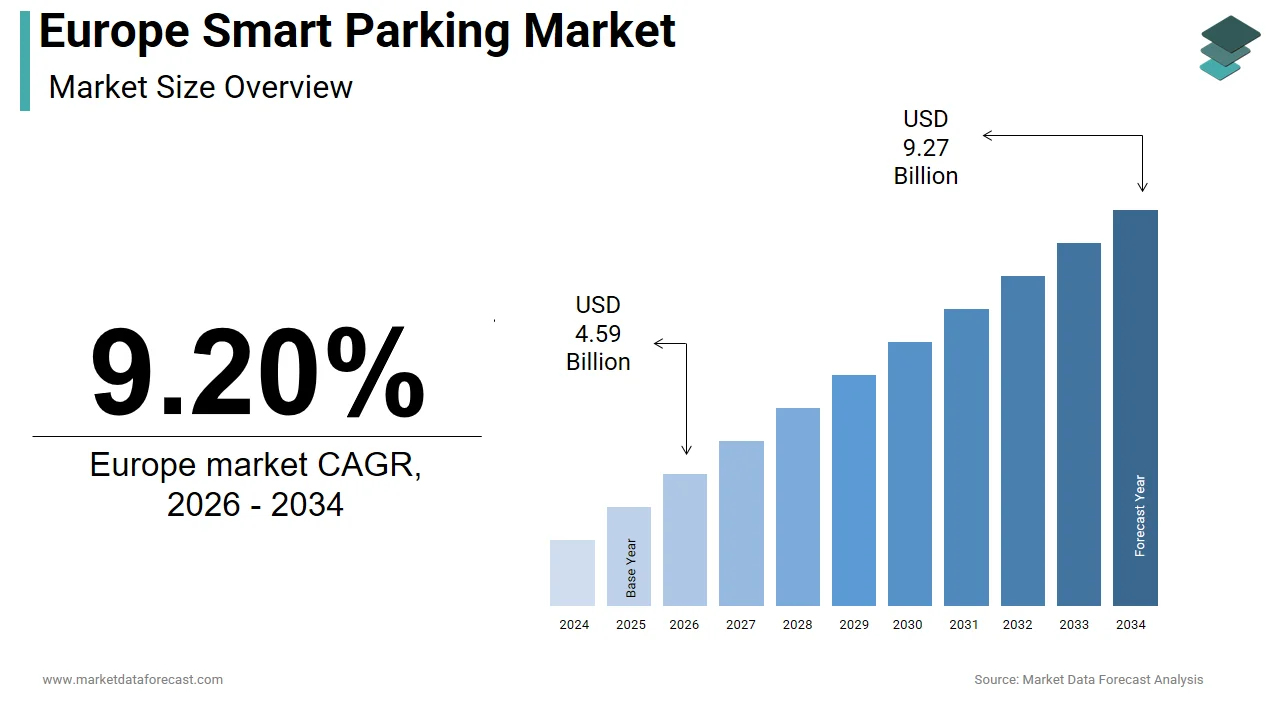
The Europe smart parking market was valued at USD 4.20 billion in 2025, is estimated to reach USD 4.59 billion in 2026, and is projected to reach USD 9.27 billion by 2034, growing at a CAGR of 9.20% from 2026 to 2034. Market growth is driven by increasing urbanization, rising traffic congestion, and the growing need for efficient parking management solutions. The adoption of smart city initiatives and integration of IoT, sensors, and mobile applications are enhancing parking efficiency and user experience. Additionally, environmental concerns and the push to reduce emissions and fuel consumption are encouraging the deployment of smart parking systems across European cities.
Key Market Trends
- Increasing adoption of smart city and urban mobility solutions.
- Rising demand for IoT-enabled parking systems.
- Growing focus on reducing traffic congestion and emissions.
- Integration of mobile apps and digital payment solutions.
- Expansion of data-driven parking management systems.
Segmental Insights
- Based on provider type, the parking operators segment dominated the Europe smart parking market by capturing 45.7% share in 2025, driven by large-scale parking infrastructure management.
- Based on solution, the hardware segment led the market with 50.6% share in 2025, supported by demand for sensors, cameras, and parking meters.
- Based on end user, the municipalities and government segment held the largest share of 55.3% in 2025, driven by smart city initiatives and public infrastructure investments.
Regional Insights
The Europe smart parking market is witnessing strong growth across major urban economies.
- Germany led the market in 2025 with 24.3% share, driven by advanced infrastructure and smart mobility adoption.
- The United Kingdom followed with 19.8% share, supported by smart city initiatives and urban innovation programs.
- France plays a significant role due to the integration of smart parking with public policies focused on emissions reduction and traffic management.
Competitive Landscape
The Europe smart parking market is competitive, with companies focusing on technological innovation, smart infrastructure integration, and partnerships with municipalities. The use of AI, IoT, and cloud-based platforms is shaping the competitive landscape.
Prominent companies operating in the Europe smart parking market include Daimler Mobility, Bosch GmbH, Siemens AG, Flowbird SASU (Parkeon SA), Urbiotica SL, Skidata AG, BMW i Ventures (ParkNow assets), and Q-Park NV.
Europe Smart Parking Market Size
The Europe smart parking market was valued at USD 4.20 billion in 2025, is estimated to reach USD 4.59 billion in 2026, and is projected to reach USD 9.27 billion by 2034, growing at a CAGR of 9.20% from 2026 to 2034.
Smart parking refers to a technology-driven, automated system that uses IoT sensors, cameras, and software to monitor, manage, and optimize parking availability in real-time. These systems integrate sensors, cameras, mobile applications, and cloud-based platforms to guide drivers to available spots, thereby reducing traffic congestion and emissions. In European urban centers, where space is at a premium and environmental regulations are stringent, smart parking has become a critical component of broader smart city initiatives. As of 2023, approximately 75.7% of the European Union population resides in urban areas, a figure projected to grow to over 80% by 2050. Furthermore, the transport sector is responsible for 29% of all EU greenhouse gas emissions as of 2022, with urban congestion heavily influenced by vehicles searching for parking, which can account for up to 74% of traffic volume in specific areas. This environmental imperative drives municipalities to adopt digital tools that minimize idle driving time. The market is characterized by a shift from standalone hardware installations to integrated software ecosystems that offer predictive analytics and dynamic pricing capabilities. Regulatory frameworks such as the Urban Mobility Framework encourage the deployment of intelligent transport systems to enhance urban livability. Consequently, stakeholders, including municipal authorities, private parking operators, and technology providers, are collaborating to create seamless user experiences. The integration of electric vehicle charging infrastructure with smart parking slots further expands the scope of these solutions, aligning with the continent’s sustainability goals and evolving consumer preferences for connected mobility services.
MARKET DRIVERS
Rapid Urbanization and Increasing Vehicle Density
The rapid pace of urbanization and the consequent increase in vehicle density serve as primary drivers for the growth of the Europe smart parking market. Rising migration to cities for economic opportunities is rapidly increasing the demand for personal transportation. Consequently, this surge has resulted in severe traffic congestion and a scarcity of parking spaces. Data from UN DESA shows that the vast majority of the European population now resides in urban centers, creating a permanent and growing requirement for infrastructure that can handle dense traffic and limited space. Traditional parking management methods are insufficient to handle this volume, resulting in prolonged search times and increased fuel consumption. Smart parking systems address this challenge by providing real-time visibility into space availability, allowing drivers to locate spots efficiently via mobile applications. This reduction in cruising time not only improves the user experience but also alleviates traffic bottlenecks in city centers. Municipalities are increasingly recognizing the economic benefits of optimized parking, such as higher turnover rates for retail businesses and reduced maintenance costs for road infrastructure. The integration of smart parking with public transport networks further enhances multimodal mobility, encouraging a balanced approach to urban transit. By leveraging data analytics, city planners can identify high-demand zones and adjust pricing or capacity dynamically. This strategic management of urban space is essential for maintaining the quality of life in densely populated European cities, driving sustained investment in smart parking technologies.
Stringent Environmental Regulations and Sustainability Goals
Strict environmental regulations and ambitious sustainability goals imposed by European governments further accelerate the expansion of the Europe smart parking market. The European Green Deal aims to reduce net greenhouse gas emissions by at least 55 percent by 2030, compelling cities to adopt measures that lower carbon footprints. Idling vehicles searching for parking contribute substantially to local air pollution and carbon emissions. The European Environment Agency reports that while air quality is improving, many urban areas must still implement more aggressive traffic management to align with the stricter pollution limits being phased in toward the end of the decade. Smart parking solutions mitigate this issue by minimizing the time vehicles spend circulating, thereby directly reducing exhaust output. Additionally, these systems facilitate the integration of electric vehicle charging stations, supporting the transition to cleaner mobility. Many European cities have implemented low-emission zones where only compliant vehicles can enter, and smart parking apps help drivers navigate these restrictions effectively. The ability to monitor and report on environmental impact metrics through smart parking platforms enables municipalities to demonstrate compliance with regulatory standards. Furthermore, dynamic pricing models encouraged by these systems can discourage unnecessary car use during peak hours, promoting alternative modes of transport. The alignment of smart parking initiatives with broader climate action plans ensures consistent government support and funding. This regulatory push creates a favorable environment for technology providers to deploy innovative solutions that contribute to cleaner and more sustainable urban environments.
MARKET RESTRAINTS
High Initial Implementation and Infrastructure Costs
High implementation and infrastructure costs significantly hinder the deployment of these systems, and thereby negatively impact the growth of the Europe smart parking market. This is especially true for smaller municipalities with limited budgets. Installing sensors, cameras, and communication networks requires substantial capital investment, which can be prohibitive for cash-strapped local governments. As per the European Investment Bank, infrastructure gaps in digital technologies remain a challenge for many European regions, with funding often prioritized for other critical services such as healthcare and education. The complexity of integrating new smart parking solutions with legacy infrastructure further escalates costs, requiring specialized engineering and prolonged installation periods. Maintenance of these sophisticated systems also incurs ongoing expenses, including software updates, hardware repairs, and data management services. For private parking operators, the return on investment may take several years to materialize, discouraging immediate adoption. Additionally, the need for robust cybersecurity measures to protect user data adds to the overall cost structure. Small and medium-sized enterprises in the parking sector may lack the financial resources to compete with larger players who can afford advanced technologies. This financial barrier limits the widespread deployment of smart parking solutions, particularly in rural or less affluent urban areas. High entry costs currently hinder market expansion. This barrier will remain until technological advancements reduce expenses or government subsidies become more accessible.
Data Privacy and Security Concerns
Data privacy and security concerns also pose a major restraint on the growth of the Europe smart parking market. This challenge is driven by the region's stringent regulatory landscape. Smart parking systems collect vast amounts of personal data, including vehicle location, license plate numbers, and payment information, raising significant privacy issues. As per the European Data Protection Board, compliance with the General Data Protection Regulation requires rigorous data handling practices, which can be complex and costly to implement. Consumers are increasingly aware of digital privacy risks and may hesitate to use smart parking apps if they perceive their data to be vulnerable. Any data breach can result in severe legal penalties and reputational damage for service providers, deterring investment in these technologies. Additionally, the interconnected nature of smart parking systems makes them susceptible to cyberattacks, which could disrupt operations and compromise user safety. Ensuring end-to-end encryption and secure data storage requires continuous investment in cybersecurity infrastructure. The lack of standardized security protocols across different vendors further complicates compliance efforts. Municipalities and operators must navigate a complex web of legal requirements to ensure lawful data processing. This regulatory burden slows down the adoption process, as organizations conduct thorough risk assessments before implementing new systems. Data security trust must be fully established. Until then, privacy concerns will remain a persistent obstacle to market growth.
MARKET OPPORTUNITIES
Integration with Electric Vehicle Charging Infrastructure
The integration of smart parking systems with electric vehicle charging infrastructure offers a significant opportunity for the Europe smart parking market growth. As the adoption of electric vehicles accelerates, the demand for convenient and accessible charging points increases. The International Energy Agency shows that over two and a half million electric vehicles were sold in Europe in 2025, maintaining strong demand for a comprehensive and accessible charging network. Smart parking solutions can identify available charging spots and reserve them for electric vehicle users, optimizing the utilization of charging stations. This integration enhances the user experience by reducing range anxiety and wait times, encouraging further adoption of electric mobility. Municipalities and private operators can leverage this synergy to generate additional revenue streams through charging fees and premium parking services. Furthermore, smart grids can manage energy distribution efficiently, preventing overload during peak hours. The European Union’s Alternative Fuels Infrastructure Regulation mandates the installation of charging points in buildings and parking facilities, driving demand for integrated solutions. Technology providers who offer seamless connectivity between parking management and charging platforms are well-positioned to capture this growing market segment. Collaborations between automotive manufacturers, energy companies, and parking operators can create comprehensive ecosystems that support sustainable urban mobility. This convergence of technologies aligns with Europe’s climate goals and offers substantial potential for innovation and expansion.
Expansion of Smart City Initiatives and IoT Connectivity
The expansion of smart city initiatives and the proliferation of Internet of Things connectivity open up strong possibilities for the Europe smart parking market. European cities are increasingly investing in digital infrastructure to improve urban living standards and operational efficiency. Through the EU Cities Mission, over one hundred European cities have pledged to achieve climate neutrality by the end of the decade, acting as testbeds for integrated smart mobility and parking solutions. Smart parking is a foundational element of these initiatives, providing valuable data on traffic patterns and urban mobility. Integration with other smart city systems, such as traffic light control and public transport scheduling, enables holistic management of urban flows. The widespread adoption of 5G networks enhances the reliability and speed of data transmission, supporting real-time decision making. This connectivity allows for advanced features such as predictive analytics and automated enforcement of parking regulations. Municipalities can use this data to optimize urban planning and resource allocation, leading to cost savings and improved service delivery. Private sector participation in smart city projects through public-private partnerships further drives innovation and investment. The ability to offer comprehensive mobility as a service platforms positions smart parking providers as key enablers of future urban ecosystems. This strategic alignment with broader digital transformation goals ensures sustained demand and long-term growth prospects.
MARKET CHALLENGES
Fragmented Regulatory Landscape Across Member States
The fragmented regulatory landscape across the region creates a serious hurdle for providers in the Europe smart parking market. They struggle to operate on a pan-European scale due to these varying local rules. Each country has distinct laws regarding data privacy, traffic management, and urban planning, requiring customized solutions for different markets. As per the European Parliament, harmonization of digital single market rules remains incomplete, creating barriers to cross-border service provision. Providers must navigate varying technical standards and certification requirements, increasing development costs and complexity. For instance, data retention policies differ significantly between Germany and France, necessitating flexible data management architectures. Additionally, local municipal regulations governing parking enforcement and pricing vary widely, limiting the scalability of standardized software platforms. This heterogeneity hinders the ability of companies to achieve economies of scale and streamline operations. Small and medium-sized enterprises may struggle to comply with diverse legal frameworks, restricting their market reach. The lack of uniform guidelines for Internet of Things devices further complicates interoperability between systems from different vendors. Providers must invest heavily in legal expertise and localized adaptation to remain compliant. This regulatory fragmentation slows down market entry and expansion, forcing companies to adopt a country-by-country approach rather than a unified European strategy. Regulatory complexity will remain a persistent hurdle. This will continue until greater harmonization is achieved.
Technical Interoperability and Legacy System Integration
Technical interoperability and the difficulty of integrating with legacy systems remain a barrier to the Europe smart parking market. Many existing parking facilities rely on outdated hardware and software that are incompatible with modern smart solutions. Research identifies that the majority of European infrastructure operators are hindered by outdated technological frameworks, which complicates the integration of modern sensors and automated management tools. Retrofitting these systems with sensors and connectivity modules requires extensive customization and technical expertise. The lack of standardized communication protocols among different vendors further exacerbates integration issues, leading to siloed data and inefficient operations. Municipalities often operate multiple disparate systems for traffic management, payment processing, and enforcement, making holistic integration difficult. Achieving seamless data exchange between these systems demands robust middleware and application programming interfaces, which can be costly and complex to develop. Additionally, the rapid evolution of technology means that newly installed systems may become obsolete quickly, requiring continuous upgrades. This technological churn creates uncertainty for investors and operators regarding long-term viability. The inability to ensure smooth interoperability limits the effectiveness of smart parking solutions and reduces user satisfaction. Overcoming these technical barriers requires industry-wide collaboration on standardization and significant investment in infrastructure modernization, which remains a formidable challenge for the sector.
REPORT COVERAGE
| REPORT METRIC | DETAILS |
| Market Size Available | 2025 to 2034 |
| Base Year | 2025 |
| Forecast Period | 2026 to 2034 |
| Segments Covered | By Provider Type, Solution, Technology, End User, and Country. |
| Various Analyses Covered | Global, Regional, and Country-Level Analysis, Segment-Level Analysis, Drivers, Restraints, Opportunities, Challenges; PESTLE Analysis; Porter’s Five Forces Analysis, Competitive Landscape, Analyst Overview of Investment Opportunities |
| Countries Covered | UK, France, Spain, Germany, Italy, Russia, Sweden, Denmark, Switzerland, Netherlands, Turkey, Czech Republic, and the Rest of Europe. |
| Market Leaders Profiled |
|
SEGMENTAL ANALYSIS
By Provider Type Insights
The parking operators segment was the largest segment in the Europe smart parking market and secured a 45.7% share in 2025. This prominence of the segment is supported by the direct ownership and management of physical parking assets, which necessitates the adoption of smart technologies to maximize revenue and operational efficiency. Data from the European Parking Association shows that while Europe has a vast total parking inventory, the managed off-street segment is the focus of intense modernization as operators seek to maximize the revenue potential of limited garage and lot space. The core reason for this segment is the imperative to reduce operational costs through automation. Smart systems enable remote monitoring, automated billing, and dynamic pricing, which significantly lowers the need for on-site personnel. Operators leverage these technologies to enhance customer experience by providing real-time availability data via mobile applications, thereby increasing occupancy rates. Additionally, the integration of contactless payment solutions aligns with consumer preferences for seamless transactions. The ability to analyze usage patterns allows operators to implement targeted marketing strategies and loyalty programs. Furthermore, regulatory pressures to reduce emissions in urban centers compel operators to adopt smart solutions that minimize vehicle idling. By controlling the end user interface and the physical infrastructure, parking operators capture the largest share of value in the ecosystem. Their strategic focus on digital transformation ensures sustained leadership in the market as they transition from traditional lot management to comprehensive mobility service providers.
The Infrastructure Providers segment is expected to exhibit a noteworthy CAGR of 16.5% between 2026 and 2034. This rapid expansion of the segment is propelled by the extensive deployment of sensors, cameras, and connectivity hardware required to enable smart parking functionalities. Various sources emphasize a steady and significant increase in the deployment of intelligent sensors across European cities, providing the underlying data layer required for advanced urban mobility projects. The main driver is the modernization of existing parking facilities to support advanced features such as license plate recognition and guided parking. Municipalities and private entities are investing heavily in retrofitting older structures with ultrasonic sensors and smart lighting systems that detect vehicle presence. The rise of electric vehicles further accelerates demand, as infrastructure providers integrate charging stations with parking slots, creating multifunctional hubs. Government funding under the European Green Deal supports the installation of sustainable infrastructure, encouraging providers to innovate in energy-efficient hardware. Additionally, the rollout of 5G networks enhances the reliability of data transmission from sensors to central management platforms, enabling real-time updates. Infrastructure providers benefit from long-term contracts with city councils and large commercial property owners, ensuring steady revenue streams. The continuous technological advancement in sensor accuracy and durability also drives replacement cycles. These factors collectively propel the robust growth of the infrastructure provider segment in the European smart parking landscape.
By Solution Insights
In 2025, the hardware segment led the Europe smart parking market and captured a share of 50.6% because of the foundational requirement of physical devices such as sensors, barriers, cameras, and payment kiosks to collect data and control access. Research indicates that the installation of smart hardware in urban centres continues to grow at a robust pace, as city planners prioritize the physical infrastructure needed for automated parking enforcement and vehicle tracking. One of the major drivers of this segment is the need for accurate real-time data on parking space occupancy. Ultrasonic and magnetic sensors provide precise detection capabilities, which are essential for guiding drivers to available spots and preventing congestion. Additionally, the integration of automatic number plate recognition cameras enhances security and enables frictionless entry and exit processes. The durability and reliability of hardware components are critical for outdoor environments, prompting regular upgrades and replacements. The expansion of electric vehicle charging infrastructure also contributes to hardware demand, as specialized equipment is required to manage power distribution and billing. Municipalities prioritize hardware investments to establish the physical backbone of smart city initiatives. The high initial capital expenditure associated with hardware deployment ensures its dominant share in the early stages of project implementation. Furthermore, the interoperability of hardware with various software platforms allows for flexible system configurations. These factors solidify the hardware segment as the cornerstone of the smart parking ecosystem in Europe.
The software segment is predicted to witness the highest CAGR of 18.2% during the forecast period. This quick surge of the segment is driven by the increasing reliance on cloud-based platforms, mobile applications, and data analytics to manage parking operations efficiently. As per Gartner, spending on smart city software solutions in Europe is expected to grow by 15 percent annually, highlighting the shift towards digital management tools. A key driver is the demand for user-friendly interfaces that allow drivers to locate, reserve, and pay for parking spaces seamlessly. Mobile apps integrated with real-time data enhance customer satisfaction and loyalty, encouraging repeat usage. Additionally, backend software enables operators to implement dynamic pricing models based on demand, maximizing revenue potential. Advanced analytics provide insights into usage patterns, helping municipalities optimize urban planning and traffic flow. The integration of artificial intelligence allows for predictive maintenance and anomaly detection, reducing operational downtime. Software solutions also facilitate compliance with data privacy regulations by managing user information securely. The scalability of cloud-based systems allows for easy expansion across multiple locations without significant hardware upgrades. As cities strive for greater connectivity and efficiency, the demand for sophisticated software platforms continues to accelerate, driving the rapid expansion of this segment.
By End User Insights
The municipalities and government segment dominated the Europe smart parking market and accounted for a 55.3% share in 2025. This dominance of the segment is credited to the critical role of local authorities in managing public infrastructure and addressing urban mobility challenges. As per Eurostat, 75 percent of the European population resides in urban areas, creating immense pressure on public parking resources. The primary driver for this segment is the commitment to sustainability and traffic reduction goals outlined in national and European policies. Municipalities implement smart parking systems to decrease congestion, lower emissions, and improve the quality of life for residents. Public sector projects often involve large-scale deployments across city centers, generating significant revenue for solution providers. Additionally, governments utilize smart parking data to inform urban planning decisions and optimize public transport integration. The availability of EU funding for smart city initiatives further supports municipal investments in these technologies. Regulatory mandates for low-emission zones and digital services also compel local authorities to adopt advanced parking management solutions. By controlling public spaces, municipalities can enforce compliance and standardize user experiences. The focus on citizen-centric services drives the adoption of transparent and efficient parking systems. These factors collectively establish municipalities and government bodies as the primary end users in the European smart parking market.
The transport hubs segment is estimated to register the fastest CAGR of 17.1% from 2026 to 2034. This swift growth of the segment is fueled by the increasing volume of passengers and the need for efficient multimodal connectivity at airports, railway stations, and bus terminals. As per the International Air Transport Association, passenger traffic in Europe is expected to surpass pre-pandemic levels by 2026, driving demand for enhanced parking facilities at airports. A key force behind this segment is the necessity to manage high turnover rates and ensure seamless transitions between different modes of transport. Smart parking solutions enable travelers to reserve spaces in advance, reducing stress and wait times. Integration with ticketing systems allows for bundled services, enhancing the overall travel experience. Airports and railway stations are investing in automated guidance systems and contactless payments to handle peak loads efficiently. The rise of ride-sharing and car rental services at transport hubs also necessitates sophisticated management tools to optimize space utilization. Additionally, the focus on sustainability prompts hubs to install electric vehicle charging stations and monitor environmental impact. The competitive nature of the travel industry encourages hubs to adopt innovative technologies to attract passengers. These dynamics contribute to the robust growth of the transport hubs segment in the smart parking market.
COUNTRY LEVEL ANALYSIS
Germany Smart Parking Market Analysis
Germany outperformed other countries in the Europe smart parking market and captured a 24.3% share in 2025. A top factor for the market in Germany is the integration of smart parking with broader intelligent transport systems. The market position in the country is characterized by a strong automotive industry and a proactive approach to smart city development. German cities are known for their efficient public transport systems and stringent environmental regulations, which drive the adoption of smart parking solutions. Inrix and TomTom reveal that traffic congestion imposes a multi-billion euro burden on the German economy, incentivizing major cities to deploy IoT-based smart parking and AI-driven traffic management to reclaim lost productivity. Cities like Berlin and Munich have implemented comprehensive sensor networks to monitor parking availability and enforce regulations automatically. The strong presence of technology providers and automotive manufacturers fosters innovation in connected vehicle technologies. Additionally, the German government’s support for digital infrastructure through funding programs accelerates project implementation. The emphasis on data privacy and security ensures that solutions comply with strict regulatory standards. Furthermore, the high penetration of smartphones among the population facilitates the adoption of mobile parking applications. These factors collectively sustain Germany’s position as the largest and most advanced market for smart parking in Europe.
United Kingdom Smart Parking Market Analysis
The United Kingdom was the next prominent country in the Europe smart parking market and occupied a 19.8% share in 2025. A key force behind the market is the implementation of clean air zones and low-emission areas, which rely on smart systems for enforcement and monitoring. The market status in the UK is defined by a mature regulatory environment and a high density of urban centers facing significant parking challenges. British cities such as London and Manchester have pioneered the use of smart parking technologies to manage congestion and improve air quality. As per the Office for National Statistics, urban populations in the UK continue to grow, increasing the demand for efficient parking management. Local councils are increasingly adopting digital platforms to streamline permit management and payment processes. The presence of major technology firms and startups drives innovation in app-based solutions and data analytics. Additionally, the private sector plays a significant role, with commercial parking operators investing in automation to enhance customer experience. The UK’s strong legal framework for data protection ensures high standards of privacy and security. Furthermore, the integration of smart parking with public transport apps promotes multimodal mobility. These dynamics maintain the UK’s status as a key market for smart parking innovation and adoption.
France Smart Parking Market Analysis
France occupies a noteworthy position in the Europe smart parking market due to the integration of smart parking with public policy objectives such as emissions reduction and traffic calming. Strong government commitments to urban sustainability and reduced car dependency in city centers are key drivers of the market status in France. Also, French municipalities are actively implementing smart parking solutions to support their climate action plans and improve urban livability. Municipal initiatives in major hubs like Paris and Lyon are drastically reducing the number of traditional parking spots in favour of green zones, making the digital management of the remaining spaces a critical priority for city planners. The use of dynamic pricing and real-time guidance helps regulate demand and encourage the use of alternative transport modes. The French government’s investment in smart city infrastructure provides financial support for local projects. Additionally, the popularity of mobile payment solutions among French consumers drives the adoption of app-based parking services. The presence of leading European technology providers facilitates the deployment of advanced systems. Furthermore, the focus on tourist experience in historic cities encourages the implementation of user-friendly parking solutions. These factors contribute to the steady growth and sophistication of the smart parking market in France.
Italy Smart Parking Market Analysis
Italy is moving ahead steadfastly in the Europe smart parking market, owing to the need to balance accessibility for residents and tourists with environmental protection. However, the Italian market faces unique logistical and operational hurdles due to its reliance on historic, narrow-street city centers, which restrict space and accessibility. Italian municipalities are increasingly turning to smart parking solutions to manage congestion and preserve cultural heritage sites. As per the Italian National Institute of Statistics, tourism remains a vital economic sector, driving the need for efficient visitor parking management in cities like Rome and Florence. Smart systems enable the regulation of traffic flow and the enforcement of restricted zones effectively. The adoption of mobile apps for parking reservation and payment is growing rapidly among Italian users. Government incentives for digital transformation support the modernization of urban infrastructure. Additionally, the integration of smart parking with public transport networks enhances overall mobility efficiency. The presence of local technology firms specializing in urban solutions fosters innovation. Furthermore, the emphasis on reducing air pollution in densely populated areas drives the adoption of technologies that minimize vehicle idling. These elements foster the continued expansion of the smart parking market in Italy.
Spain Smart Parking Market Analysis
Spain is expected to showcase a promising CAGR in the Europe smart parking market over the forecast period due to the implementation of smart city strategies in cities like Barcelona and Madrid, which prioritize digital innovation. Major Spanish cities are transforming through accelerated digital adoption and a strategic focus on improving urban mobility solutions. Spanish municipalities are leveraging smart parking technologies to address congestion and enhance the quality of urban life. As per the National Statistics Institute of Spain, urbanization rates are high, creating sustained demand for efficient parking management solutions. The use of sensors and data analytics helps optimize parking space utilization and reduce traffic bottlenecks. The popularity of mobile payment platforms among Spanish consumers facilitates the widespread adoption of app-based parking services. Government support for sustainable urban mobility plans provides funding for infrastructure upgrades. Additionally, the tourism industry drives demand for convenient parking solutions in coastal and historic areas. The integration of smart parking with electric vehicle charging infrastructure aligns with national sustainability goals. Furthermore, collaborations between public authorities and private technology providers accelerate project deployment. These factors support the dynamic growth of the smart parking market in Spain.
COMPETITIVE LANDSCAPE
The competition in the Europe smart parking market is characterized by a mix of established technology giants, specialized startups, and traditional parking operators transitioning to digital models. Major players compete on the basis of technological innovation, system reliability, and ease of integration with existing urban infrastructure. Differentiation is increasingly achieved through advanced data analytics and artificial intelligence capabilities that provide actionable insights for city planners. The market sees frequent collaborations between hardware manufacturers and software developers to create end-to-end solutions. Price competitiveness remains significant, particularly for municipal contracts where budget constraints are common. Regulatory compliance with data privacy and environmental standards serves as a key differentiator, favoring companies with robust security frameworks. The rise of open source platforms and community-based data sharing introduces new competitive dynamics, challenging proprietary models. Customer retention relies heavily on the quality of user interfaces and the accuracy of real-time information. As smart city initiatives expand, the ability to offer scalable and interoperable solutions determines market leadership in this evolving landscape.
KEY MARKET PLAYERS
The leading companies operating in the Europe smart parking market include:
- Daimler Mobility
- Bosch GmbH
- Siemens AG
- Flowbird SASU (Parkeon SA)
- Urbiotica SL
- Skidata AG
- BMW i Ventures (ParkNow heritage assets)
- Q-Park NV
TOP PLAYERS IN THE MARKET
- Bosch GmbH is a leading provider of smart parking solutions in Europe, leveraging its extensive expertise in sensor technology and Internet of Things connectivity. The company contributes significantly to the global market by offering comprehensive hardware and software ecosystems that optimize urban mobility. Bosch has recently strengthened its position by expanding its community-based parking solution, which utilizes anonymized data from vehicle sensors to identify available spaces. This approach reduces the need for extensive infrastructure installation while enhancing accuracy. The company actively collaborates with municipal authorities to integrate its platforms with broader smart city initiatives. By focusing on sustainability and traffic reduction, Bosch aligns its offerings with European environmental regulations. Its continuous investment in artificial intelligence improves predictive analytics for parking demand. These strategic actions reinforce Bosch’s reputation as an innovator in connected mobility solutions across the continent.
- Siemens AG plays a pivotal role in the Europe smart parking market through its integrated urban mobility platforms and advanced infrastructure solutions. The company contributes to the global market by providing scalable technologies that connect parking facilities with public transport networks. Siemens has recently strengthened its market position by enhancing its digital twin capabilities, which allow cities to simulate and optimize parking flows in real time. This technology enables better planning and resource allocation for municipal authorities. The company also focuses on interoperability, ensuring its systems seamlessly integrate with existing traffic management infrastructure. Siemens prioritizes energy efficiency by incorporating smart lighting and electric vehicle charging into its parking solutions. Its strong partnerships with local governments facilitate the deployment of large-scale projects. These efforts demonstrate Siemens' commitment to creating sustainable and efficient urban environments through innovative digital solutions.
- Skidata AG is a prominent player in the Europe smart parking market, specializing in access control and payment solutions for parking facilities. The company contributes to the global market by delivering reliable hardware and software that streamlines user experiences in commercial and public parking areas. Skidata has recently strengthened its position by launching cloud-based management platforms that enable remote monitoring and dynamic pricing adjustments. This innovation allows operators to maximize revenue and improve operational efficiency. The company emphasizes contactless technologies, including mobile ticketing and license plate recognition, to enhance convenience and hygiene. Skidata actively expands its service network across European countries to provide localized support and maintenance. Its focus on user-centric design ensures high adoption rates among drivers. By integrating with major mobility apps, Skidata enhances visibility and accessibility. These strategic initiatives solidify its standing as a trusted partner for modern parking management solutions.
TOP STRATEGIES USED BY THE KEY MARKET PARTICIPANTS
Key players in the Europe smart parking market predominantly employ strategies focused on digital integration and platform interoperability to enhance user experience. Companies are increasingly adopting cloud-based architectures to enable real-time data processing and remote management capabilities. Strategic partnerships with municipal authorities and automotive manufacturers facilitate the deployment of comprehensive mobility ecosystems. Providers prioritize the development of mobile applications that offer seamless reservation and payment options to drive customer engagement. Investment in artificial intelligence and machine learning allows for predictive analytics and dynamic pricing models that optimize occupancy rates. Sustainability is a core strategic pillar, with firms integrating electric vehicle charging and energy-efficient lighting into their solutions. Standardization of communication protocols ensures compatibility with diverse hardware and software systems. These strategies collectively aim to reduce urban congestion, lower emissions, and improve operational efficiency for parking operators and city planners alike.
MARKET SEGMENTATION
This research report on the Europe smart parking market has been segmented and sub-segmented into the following categories.
By Provider Type
- Parking Operators
- Parking Management Companies
- Infrastructure Providers (HW and SW)
- Peer-to-Peer (P2P) Parking Platforms
- Aggregators and Marketplaces
By Solution
- Hardware
- Software
- Services
By Technology
- In-Ground and Ultrasonic Sensors
- Camera and Computer Vision and ANPR
- IoT Connectivity Platforms
- Mobile Apps and Digital Payments
- EV-Charging Integrated Parking
By End User
- Municipalities and Government
- Commercial Car-Parks and Malls
- Transport Hubs (Airports, Rail)
- Corporate Campuses and Business Parks
- Residential and Mixed-Use Developments
By Country
- United Kingdom
- France
- Spain
- Germany
- Italy
- Russia
- Sweden
- Denmark
- Switzerland
- Netherlands
- Rest of Europe