- Product Description Description
- Table of Contents TOC
- List of Table & Figure LOT
- Get Free Sample PDF Sample PDF
Market Size, 2025
$7.06 BnMarket Estimate, 2026
$7.85 BnMarket Forecast, 2034
$18.41 BnCAGR, 2026–2034
11.24%Europe Smart Windows Market Report Summary
The Europe smart windows market was valued at USD 7.06 billion in 2025, is estimated to reach USD 7.85 billion in 2026, and is projected to reach USD 18.41 billion by 2034, growing at a CAGR of 11.24% from 2026 to 2034. Market growth is driven by increasing demand for energy-efficient building solutions, rising adoption of smart infrastructure, and growing emphasis on sustainable construction practices. Smart windows enable dynamic control of light and heat transmission, helping reduce energy consumption and improve indoor comfort. The expansion of green building initiatives, regulatory mandates for energy efficiency, and technological advancements in glazing solutions are further accelerating market growth across Europe.
Key Market Trends
- Increasing adoption of energy-efficient and smart building technologies.
- Rising demand for sustainable and green construction solutions.
- Growing use of dynamic glazing technologies in commercial and residential buildings.
- Expansion of smart cities and intelligent infrastructure projects.
- Advancements in electrochromic and thermochromic window technologies.
Segmental Insights
- Based on technology, the electrochromic technology segment dominated the Europe smart windows market by capturing 48.5% share in 2025, driven by its ability to dynamically adjust light transmission and improve energy efficiency.
- Based on application, the architectural and construction segment held the largest share of 65.5% in 2025, supported by increasing demand for energy-efficient buildings and modern infrastructure.
Regional Insights
The Europe smart windows market is witnessing strong growth across major countries due to increasing focus on sustainability and smart infrastructure.
- Germany led the regional market in 2025 with 28.6% share, supported by strong construction activity and energy efficiency initiatives.
- The United Kingdom followed with 19.8% share in 2025, driven by growing adoption of smart building technologies.
- France holds a significant position due to its national renovation programs and strong emphasis on architectural aesthetics and sustainability.
Competitive Landscape
The Europe smart windows market is highly competitive, with the presence of global glass manufacturers and specialized smart glazing technology providers. Market players are focusing on product innovation, expanding energy-efficient solutions, and strengthening partnerships with construction and real estate developers. Technological advancements and sustainability-driven strategies are shaping competitive dynamics across the region.
Prominent companies operating in the Europe smart windows market include Saint-Gobain Group, RavenWindow, PPG Industries, Inc., Kinestral Technologies, Inc., Gentex Corporation, Merck KGaA, Pleotint, LLC, E-Chromic Technologies, Inc., ChromoGenics AB, AGC, Inc., Hitachi Chemical Co., Ltd., Nippon Sheet Glass Co., Ltd., Innovative Glass Corporation, Glasnovations Ltd., Heliotrope Technologies, Sage Electrochromics, Inc., Scienstry, Stellaris, View, Inc., and Vista Window Company.
Europe Smart Windows Market Size
The Europe smart windows market was worth USD 7.06 billion in 2025. The European market is projected to reach USD 18.41 billion by 2034 from USD 7.85 billion in 2026, growing at a CAGR of 11.24% from 2026 to 2034.
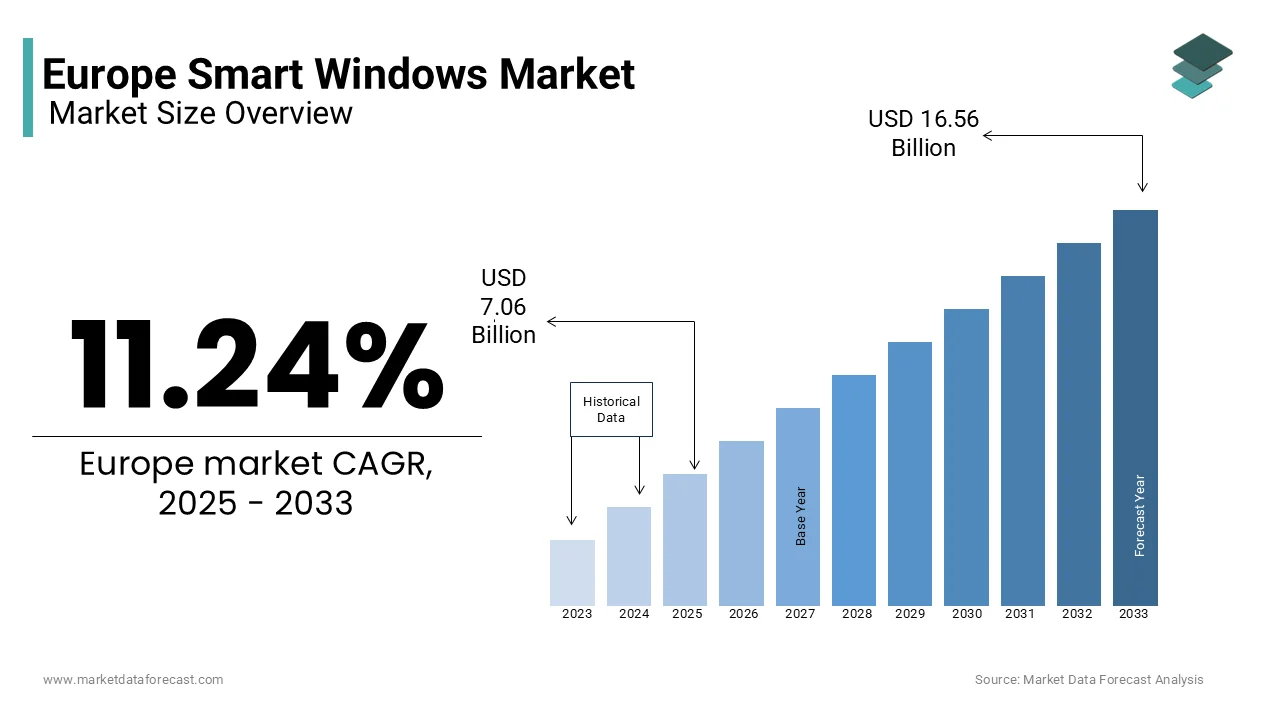
Smart windows, or smart glass, are advanced, energy-efficient glazing systems that change their light-transmitting properties (tint, transparency, or reflectivity) in response to electricity, heat, or light. These advanced fenestration systems, utilizing electrochromic, thermochromic, or photochromic mechanisms, represent a pivotal shift from static building envelopes to adaptive interfaces that optimize energy efficiency and occupant comfort. The region serves as a global testing ground for these innovations due to its rigorous environmental mandates and diverse climatic zones ranging from the Mediterranean sun to the Nordic cold. As per Eurostat, the buildings sector accounts for 40 percent of total energy consumption in the European Union, creating an urgent imperative for technologies that reduce heating and cooling loads. Furthermore, the European Commission stated that nearly 75 percent of the existing building stock in Europe is energy inefficient, driving a massive renovation wave where smart windows play a central role. The International Energy Agency indicates that improving the management and efficiency of building apertures can lead to a substantial decrease in total energy demand, highlighting the strategic importance of these components in achieving climate goals. With the EU targeting climate neutrality by 2050, the integration of intelligent glazing into both new constructions and retrofits has become a critical component of the continent's sustainable infrastructure strategy, transforming how structures interact with their environment.
MARKET DRIVERS
Stringent Regulatory Mandates for Net Zero Energy Buildings
The implementation of stringent regulatory mandates requiring net zero energy performance boosts the expansion of the Europe Smart Windows Market. The European Union has enacted the Energy Performance of Buildings Directive which obliges member states to ensure all new buildings are zero emission by 2030 and existing buildings undergo deep renovation to meet higher efficiency classes. Smart windows directly address these requirements by dynamically controlling solar heat gain in summer and retaining internal heat in winter, thereby drastically reducing the reliance on mechanical HVAC systems. To meet regional climate objectives, the building sector is tasked with drastically lowering its greenhouse gas emissions over the next few years, a goal that makes the integration of both passive and active energy-saving technologies a necessity. A study by the Buildings Performance Institute Europe indicated that dynamic glazing can lower cooling energy consumption by up to 45 percent in commercial structures located in Southern Europe. Additionally, national governments are introducing tax incentives and subsidies for green building certifications like BREEAM and LEED, where smart windows contribute significantly to scoring points. National energy reports indicate that a growing number of commercial developments have integrated advanced glazing solutions to remain in compliance with increasingly stringent regional energy efficiency codes. This regulatory pressure forces architects and developers to prioritize adaptive fenestration, ensuring widespread adoption across the continent to meet legally binding climate targets.
Escalating Energy Costs and Demand for Operational Efficiency
Escalating energy costs coupled with an intense demand for operational efficiency further accelerate the growth of the Europe smart windows market. This serves as a critical economic driver for the adoption of smart windows in the European commercial and residential sectors. The volatility of energy prices following geopolitical disruptions has forced facility managers and homeowners to seek immediate solutions to curb utility expenditures. Smart windows offer a tangible return on investment by minimizing the need for air conditioning and artificial lighting through optimal daylight harvesting and thermal regulation. Multiple studies show that recent fluctuations in energy costs for industrial and commercial users have prompted many organizations to prioritize and implement more aggressive energy conservation strategies. A report by Deloitte emphasized that office buildings equipped with electrochromic glass achieved a significant reduction in total energy bills compared to those with traditional double glazing. The ability of these systems to automate light control also enhances employee productivity and comfort, which translates into economic value for corporations. As per findings from the World Green Building Council, organizations implementing smart building technologies reported a 15% to 25% decrease in operational overheads within the first year. Furthermore, the rising cost of carbon credits under the EU Emissions Trading System adds financial pressure to reduce fossil fuel dependency. Consequently, the economic argument for installing smart windows has shifted from a luxury option to a financial necessity for maintaining profitability and competitiveness in a high-cost energy environment.
MARKET RESTRAINTS
Prohibitive Initial Installation Costs and Capital Intensity
Prohibitive initial installation costs and the capital-intensive nature of smart window technologies inhibit the expansion of the Europe smart windows market. This hinders widespread market penetration across the region. Unlike conventional glazing, smart windows require specialized manufacturing processes, expensive conductive coatings, and complex control systems that significantly elevate the upfront price point. For many small and medium-sized enterprises and residential developers operating on tight budgets, the high initial expenditure presents a significant barrier despite the long term energy savings. Financial assessments from leading research institutes indicate that the initial expense of installing advanced dynamic windows remains significantly higher than that of standard high-efficiency units. This price disparity often leads to value engineering decisions where smart glazing is excluded from final construction plans in favor of cheaper alternatives. Various sources reveal that a majority of project leads identify substantial initial capital requirements as the primary deterrent when considering the inclusion of intelligent window systems in new developments. Additionally, the retrofitting of existing buildings involves further expenses related to electrical wiring and structural modifications, making the total cost of ownership even more daunting. Financial data suggests that the time required to recover the investment in advanced window technology can be quite lengthy in regions with milder weather, which often leads more cautious investors to favor traditional alternatives. Manufacturing must scale up to reduce unit costs, or financing models must become more accessible. Until then, this financial hurdle will continue to limit market growth.
Technical Complexity in Integration and Maintenance Requirements
Technical complexity regarding integration with existing building management systems and the specialized maintenance requirements also act as a significant restraint on the Europe Smart Windows Market. Smart windows are not standalone products but rather components of a broader intelligent building ecosystem that requires seamless connectivity with sensors, actuators, and central control software. Many older European buildings lack the necessary digital infrastructure to support these advanced functionalities, necessitating costly upgrades to wiring and network architecture. Multiple studies note that a significant portion of digital building projects encounter setbacks due to difficulties in ensuring that new smart systems work effectively with existing hardware and software from different providers. Furthermore, the maintenance of smart windows demands specialized technical expertise that is currently scarce in the regional labor market. Issues such as coating degradation, controller failures, or software glitches require trained professionals for repair, leading to higher lifecycle costs and potential downtime. Professional engineering bodies suggest that some facility operators are slow to adopt high-tech glazing solutions because of uncertainties regarding the long-term durability and the availability of specialized maintenance services. The lack of standardized protocols for communication and control further complicates the deployment process, creating fragmentation in the supply chain. As per findings from the European Smart Buildings Alliance, the absence of unified industry standards increases the risk of system obsolescence, deterring stakeholders from committing to these sophisticated technologies until the ecosystem matures and simplifies.
MARKET OPPORTUNITIES
Expansion of Deep Renovation Waves in Historic and Aging Infrastructure
The expansion of deep renovation waves targeting historic and aging infrastructure offers a lucrative opportunity for the Europe Smart Windows Market. This shift aims to revolutionize the continent's building stock. The European Union has launched the Renovation Wave strategy, aiming to double the annual energy renovation rate of buildings by 2030, focusing heavily on improving the performance of structures built before 1990. Smart windows offer a unique solution for these renovations by providing high-performance energy efficiency without altering the aesthetic facade, which is crucial for heritage sites and protected buildings. According to the European Commission, over 85 percent of buildings in the EU were constructed before 2000, representing a vast addressable market for retrofitting initiatives. Technologies such as vacuum-insulated smart glass or thin film electrochromic coatings can be integrated into existing frames or used as secondary glazing, preserving architectural integrity while delivering modern performance. Research shows that advanced glazing techniques can notably decrease thermal energy loss in protected structures while maintaining their original aesthetic and architectural integrity. As per data from the European Heritage Heads Forum, there is growing interest among conservationists in using reversible and non-invasive smart technologies to meet sustainability goals. Governments are increasingly offering grants specifically for heritage renovations that incorporate innovative energy-saving measures. This convergence of regulatory support, funding availability, and technological adaptability creates a substantial opportunity for manufacturers to tap into the massive retrofit sector and drive market expansion.
Integration with Internet of Things and Autonomous Building Ecosystems
The integration of smart windows with the Internet of Things and autonomous building ecosystems provides a transformative prospect for the Europe Smart Windows Market. This allows the market to evolve from passive components to active intelligence nodes. Buildings are becoming smarter. Consequently, the demand for interconnected devices that communicate and respond to real-time data is surging. Smart windows equipped with IoT sensors can autonomously adjust tint levels based on occupancy, weather forecasts, and grid energy prices, optimizing comfort and efficiency without human intervention. Various sources suggest that the total number of networked devices within modern facilities is expected to grow substantially over the next few years, creating a comprehensive infrastructure for digital information sharing. This connectivity enables predictive maintenance, where windows can self-diagnose issues and alert facility managers before failures occur, reducing downtime and costs. Research indicates that connecting various building technologies into a single managed network can provide significantly higher energy savings than using those same technologies independently. Furthermore, the ability to participate in demand response programs allows buildings to sell excess energy or reduce load during peak times, generating revenue streams for owners. Multiple studies suggest that a significant number of upcoming office developments are incorporating automated exterior systems to better manage light and temperature levels. This shift towards autonomy positions smart windows as critical elements in the future of urban infrastructure, opening new avenues for software-driven services and data monetization.
MARKET CHALLENGES
Supply Chain Volatility for Rare Earth Materials and Components
Supply chain volatility for rare earth materials and specialized electronic components poses a significant challenge to the Europe Smart Windows Market. This threatens the production stability and cost predictability. The manufacturing of electrochromic and other smart glazing technologies relies heavily on scarce resources such as tungsten, nickel, and indium tin oxide, as well as complex semiconductor chips for control units. Geopolitical tensions and trade restrictions have disrupted the flow of these critical inputs, leading to shortages and price spikes that impact the entire value chain. According to the European Raw Materials Alliance, the EU imports over 90 percent of its rare earth needs, making the sector highly vulnerable to external shocks. Research from regional monitoring bodies suggests that price volatility for specialized metallic elements can directly impact the production costs of the transparent films used in advanced glazing technologies. Furthermore, the global shortage of semiconductors has delayed the production of smart window controllers, causing project timelines to slip. As per data from the European Glass Manufacturers Federation, a significant portion of producers reported difficulties in securing consistent supplies of key raw materials in the past year. This dependency on unstable supply chains hampers the ability of manufacturers to scale production and offer competitive pricing, creating a bottleneck for market growth. Diversifying supply sources and investing in recycling technologies remain critical but challenging tasks for the industry to overcome.
Lack of Standardized Performance Metrics and Certification Frameworks
The lack of standardized performance metrics and unified certification frameworks presents a profound challenge to the Europe Smart Windows Market. This creates confusion among stakeholders and hinders widespread acceptance. Unlike traditional windows which have well-established ratings for U value and Solar Heat Gain Coefficient, smart windows exhibit dynamic properties that change over time, making it difficult to quantify their performance using static metrics. This ambiguity complicates the specification process for architects and engineers who struggle to compare products from different manufacturers on a like-for-like basis. According to the European Committee for Standardization, current standards do not fully address the cyclic switching behavior and long term durability of dynamic glazing, leading to inconsistent testing results. Various sources suggest that many are reluctant to recommend intelligent window systems due to a perceived lack of standardized and comprehensive information regarding their effectiveness. Furthermore, the lack of clear certification labels makes it difficult for building owners to verify claims regarding energy savings and lifespan. Global standardization organizations indicate that while work is underway to establish specific rules for adaptive window systems, the wide range of available technologies makes the development of a unified framework a complex and gradual process. This regulatory and standardization gap fosters skepticism and increases the perceived risk of adoption, slowing down market momentum until a cohesive framework is established to guarantee quality and performance transparency.
REPORT COVERAGE
| REPORT METRIC | DETAILS |
| Market Size Available | 2025 to 2034 |
| Base Year | 2025 |
| Forecast Period | 2026 to 2034 |
| Segments Covered | By Technology, Application, and Country |
| Various Analyses Covered | Global, Regional, and Country-Level Analysis, Segment-Level Analysis, Drivers, Restraints, Opportunities, Challenges; PESTLE Analysis; Porter’s Five Forces Analysis, Competitive Landscape, Analyst Overview of Investment Opportunities |
| Countries Covered | UK, France, Spain, Germany, Italy, Russia, Sweden, Denmark, Switzerland, Netherlands, Turkey, Czech Republic, and the Rest of Europe. |
| Market Leaders Profiled | Saint-Gobain Group, Ravenwindow, Ppg Industries, Inc., Kinestral Technologies, Inc., Gentex Corporation, Merck Kgaa, Pleotint, Llc, E-Chromic Technologies, Inc., Chromogenic Ab, AGC, Inc., Hitachi Chemical Co., Ltd, Nippon Sheet Glass Co., Ltd, Innovative Glass Corporation, Glasnovations Ltd., Heliotrope Technologies, Sage Electrochromics, Inc., Scienstry, Stellaris, View Inc., And Vista Window Company. |
SEGMENTAL ANALYSIS
By Technology Insights
The Electrochromic Technology segment led the Europe Smart Windows Market and captured a 48.5% share in 2025. This leading position of the segment is driven by its superior ability to provide continuous and variable control over light transmission and solar heat gain, making it the ideal solution for energy efficiency in buildings. Unlike other technologies that often switch between only two states, electrochromic windows offer a spectrum of tint levels that can be precisely calibrated to optimize daylighting while minimizing cooling loads. According to the International Energy Agency, buildings equipped with electrochromic glazing can reduce peak electricity demand for air conditioning by up to 25 percent, a critical factor given the rising energy costs across Europe. The technology's compatibility with building management systems allows for automated responses to weather conditions, further enhancing its appeal to architects and developers aiming for LEED or BREEAM certifications. Regional construction data shows that an increasing number of major commercial developments are selecting advanced glazing solutions to comply with rigorous environmental standards and reach carbon neutrality goals. Furthermore, the durability and long lifecycle of electrochromic coatings, which can withstand thousands of switching cycles without degradation, provide a compelling return on investment. A study confirmed that electrochromic windows maintain their performance integrity for over 20 years, reducing maintenance costs and reinforcing their status as the preferred choice for sustainable infrastructure development across the continent.

The Polymer Dispersed Liquid Crystal (PDLC) technology segment is on the rise and is expected to be the fastest-growing segment in the market by witnessing a CAGR of 22.4% from 2026 to 2034 due to the escalating demand for privacy solutions in both commercial and residential settings, particularly in open-plan offices and healthcare facilities where flexible space utilization is paramount. PDLC films offer an instant switch from transparent to opaque states, providing immediate visual separation without the need for physical blinds or curtains, thereby maximizing usable floor space. Multiple studies indicate a significant shift toward more versatile office layouts, which has increased the demand for partitioning technologies that can easily change the function of a room. The versatility of PDLC extends beyond privacy to include projection capabilities, allowing glass surfaces to function as interactive screens for presentations and digital signage, a feature highly valued in the retail and hospitality industries. Observations in major fashion capitals suggest that nearly half of high-profile retail locations are incorporating smart glass technologies to create more engaging and interactive environments for their customers. Additionally, the relatively lower installation cost and ease of retrofitting existing glass panes with PDLC films make it accessible for renovation projects. A study indicates that certain privacy-focused smart glass options are notably more affordable than comprehensive solar-control systems, making them an attractive choice for smaller businesses looking to modernize their facilities with lower initial costs.
By Application Insights
The Architectural and Construction application segment held the majority share of 65.5% of the Europe Smart Windows Market in 2025. This supremacy of the segment is supported by the massive scale of the European building sector and the rigorous regulatory frameworks mandating energy efficiency improvements in both new builds and renovations. The European Green Deal and the Energy Performance of Buildings Directive have created an urgent imperative for constructing net-zero energy buildings, where smart windows play a pivotal role in managing thermal comfort and reducing reliance on mechanical heating and cooling systems. According to the Buildings Performance Institute Europe, the construction industry accounts for nearly half of total energy consumption in the EU, prompting governments to enforce strict standards that favor adaptive glazing technologies. The trend towards sustainable urbanization and the proliferation of green skyscrapers in financial hubs like Frankfurt and London further accelerate demand. Reports from national climate and economy ministries indicate that a majority of major commercial developments are now incorporating advanced building systems to meet the requirements for high-level environmental and sustainability certifications. Moreover, the growing awareness among property owners regarding operational cost savings drives adoption, as smart windows significantly lower utility bills over the building's lifespan. Research suggests that commercial properties featuring advanced energy-saving capabilities can command higher rental rates, providing a clear financial incentive for developers to include smart glazing as a standard component of their building designs.
The Automotive application segment is expected to exhibit a noteworthy CAGR of 24.8% during the forecast period owing to the automotive industry's shift towards electric vehicles and the increasing consumer demand for enhanced comfort, privacy, and aesthetic innovation in vehicle design. Smart windows in automobiles, particularly sunroofs and side windows, eliminate the need for traditional mechanical shades, reducing vehicle weight and thereby improving battery efficiency and range, which is crucial for electric mobility. Research shows that electric vehicle sales are reaching significant new milestones, with many manufacturers now including advanced glass technologies as a distinctive feature to enhance the appeal of their latest models. The ability of smart glass to block infrared radiation helps maintain cabin temperature, reducing the energy load on air conditioning systems and extending driving range. Technical assessments by automotive components suppliers have shown that vehicles utilizing intelligent glazing solutions can achieve a measurable improvement in their overall energy efficiency during the warmest months of the year. Furthermore, the rise of autonomous driving concepts has transformed car interiors into living spaces where privacy and glare control are essential, boosting the appeal of switchable glass. Consumer research within the automotive sector suggests that a significant portion of potential buyers now prioritize high-level interior comfort and advanced features when selecting their next vehicle, leading many manufacturers to expand the availability of these technologies.
COUNTRY LEVEL ANALYSIS
Germany Smart Windows Market Analysis
Germany dominated the Europe Smart Windows Market and accounted for a share of 28.6% share in 2025. The country's dominance is driven by its robust manufacturing sector, strong engineering heritage, and aggressive national policies aimed at achieving climate neutrality. The German government's "Efficiency Strategy 2050" mandates significant reductions in building energy consumption, driving widespread adoption of advanced glazing technologies in both industrial and residential sectors. The German Federal Office for Economic Affairs and Export Control has provided extensive financial support for energy-efficient building upgrades, with a portion of these funds directed toward the installation of advanced window technologies in residential and commercial properties. The presence of leading chemical and glass manufacturers within the country fosters a strong supply chain and encourages innovation in electrochromic materials. The national sustainable building authority indicates that a significant majority of newly certified office developments in major urban centers are utilizing advanced exterior solutions to improve interior light levels and energy efficiency. The industrial sector also contributes significantly, with automotive giants integrating smart windows into premium vehicle lines produced domestically. Research from leading technical organizations suggests that the adoption of sophisticated building exteriors has contributed to the overall reduction of the industrial carbon footprint across the country. The convergence of regulatory support, technological expertise, and financial incentives ensures Germany remains the primary engine for market growth in the region.

United Kingdom Smart Windows Market Analysis
The United Kingdom was the next prominent country in the Europe Smart Windows Market and captured a 19.8% share in 2025. Despite post-Brexit economic adjustments, the UK remains a hub for architectural innovation and sustainable urban development, particularly in London, where skyscraper construction continues to thrive. The United Kingdom’s commitment to achieving carbon neutrality has led to the introduction of rigorous new housing standards that require modern residences to significantly lower their emissions, driving interest in high-efficiency window solutions. Multiple studies indicate that the construction sector has directed substantial capital toward low-carbon technologies, with advanced glazing systems becoming a key consideration for the modernization of commercial properties. The country's dense urban environment and varying climate make adaptive fenestration essential for managing solar gain and heat loss effectively. Professional architectural associations in the region have noted that a majority of major new developments in the capital are incorporating sophisticated glass solutions to enhance occupant comfort and lower energy requirements. The financial services sector, a major tenant of office space, actively drives demand for premium workspaces featuring smart technology to attract talent. Research suggests that office buildings equipped with advanced environmental features tend to maintain higher occupancy levels compared to more traditional commercial structures. The strong focus on retrofitting aging infrastructure further amplifies market opportunities as building owners seek to improve energy ratings and asset value.
France Smart Windows Market Analysis
France is a major part of the Europe Smart Windows Market due to its ambitious national renovation program and strong emphasis on architectural aesthetics. The French government's "MaPrimeRénov" scheme provides significant financial aid to homeowners and businesses for energy efficiency upgrades, making smart windows an attractive option for reducing heating and cooling expenses. The country's diverse climate, ranging from the cold north to the sunny Mediterranean coast, necessitates versatile glazing solutions that can adapt to varying seasonal conditions. The French Ministry of Ecological Transition has provided extensive financial support for residential energy upgrades, with a significant number of households utilizing these funds to improve the thermal performance of their windows. The luxury real estate and hospitality sectors in cities like Paris and Nice are key adopters, utilizing smart glass to offer premium comfort and privacy to high-end clients. A study indicates that the hospitality sector is increasingly adopting intelligent glass solutions in new developments to meet the rising expectations of guests for modern and comfortable environments. The aerospace industry, with major manufacturing hubs in Toulouse, also contributes to demand by incorporating smart glazing into aircraft interiors. A study by Ademe, the French Environment and Energy Management Agency, showed that buildings equipped with dynamic glazing reduced their annual energy consumption. The combination of state support, climatic necessity, and a culture of design excellence positions France as a critical growth market.
Italy Smart Windows Market Analysis
Italy is moving ahead steadfastly in the Europe Smart Windows Market owing to its rich architectural heritage and booming tourism sector. The challenge of modernizing historic buildings while preserving their facade has led to increased interest in thin-film smart window technologies that can be retrofitted without altering external appearances. The Italian National Recovery and Resilience Plan allocates billions of euros for ecological transition, including incentives for energy-efficient building upgrades that benefit smart window adoption. National statistics show that renovation activities in major historic and tourist centers are continuing to evolve, with an increasing number of projects incorporating advanced glass solutions to enhance interior comfort. The luxury fashion and automotive industries, central to the Italian economy, also drive demand by integrating smart glass into flagship stores and premium vehicles to enhance brand image. Various sources suggest that hotels implementing intelligent window systems have achieved significant savings on their cooling expenses during the warmest months. The Mediterranean climate, characterized by intense solar radiation, makes solar control a priority for both residential and commercial properties. Studies by the national agency for new technologies highlight that advanced window systems can significantly lower indoor temperatures, greatly improving the comfort of living spaces. The unique blend of heritage conservation needs and modern efficiency goals creates a distinctive market dynamic in Italy.
Spain Smart Windows Market Analysis
Spain is predicted to grow notably in the Europe Smart Windows Market from 2026 to 2034 due to its hot climate and extensive construction activity in the tourism and residential sectors. The intense solar exposure in regions like Andalusia and the Levante coast creates a critical need for effective solar control, making smart windows an essential component for maintaining indoor comfort and reducing energy bills. The Spanish government’s long-term strategy for building rehabilitation aims to modernize a significant number of homes by the end of the decade, creating a strong market for high-efficiency window technologies. National business associations report that investment in sustainable construction materials is on the rise, with advanced glazing identified as an important tool for meeting modern energy standards. The hospitality industry, a pillar of the Spanish economy, is rapidly upgrading its facilities to offer superior guest experiences, driving demand for automated shading solutions. A study suggests that a substantial portion of high-end hotel renovations are now including smart glass to better manage natural light and enhance the guest experience. The rise of sustainable tourism certifications also encourages hoteliers to adopt green technologies. Research indicates that advanced window solutions can substantially lower the amount of energy required for cooling in the warmer southern regions of the country. The convergence of climatic necessity, regulatory push, and tourism-driven development ensures steady market expansion.
COMPETITIVE LANDSCAPE
The competition in the Europe Smart Windows Market is characterized by a dynamic interplay between established glass manufacturing giants and agile technology specialists who vie for dominance in a rapidly evolving sector. Large incumbents leverage their extensive distribution networks and deep relationships with construction conglomerates to offer integrated facade solutions that combine smart glass with traditional glazing products. These major players focus on scaling production to lower costs and meeting the stringent regulatory requirements of the European Union regarding energy performance and sustainability. Conversely, specialized firms differentiate themselves through proprietary technologies such as faster switching times or unique aesthetic features that appeal to high end architectural and automotive clients. The market landscape is witnessing increased consolidation as larger entities acquire innovative startups to bolster their technological portfolios and accelerate time to market. Competitive advantage increasingly depends on the ability to demonstrate proven return on investment through real-world case studies and robust after-sales support services. Manufacturers are also competing on the front of sustainability by highlighting the carbon footprint reduction capabilities of their products throughout the entire lifecycle. This intense rivalry drives continuous innovation, forcing all participants to refine their offerings and adapt to the shifting demands of architects, engineers, and end users across diverse European regions.
KEY MARKET PLAYERS
The leading companies operating in the Europe smart windows market include:
- Saint-Gobain Group
- RavenWindow
- PPG Industries, Inc.
- Kinestral Technologies, Inc.
- Gentex Corporation
- Merck KGaA
- Pleotint, LLC
- E-Chromic Technologies, Inc.
- ChromoGenics AB
- AGC, Inc.
- Hitachi Chemical Co., Ltd.
- Nippon Sheet Glass Co., Ltd.
- Innovative Glass Corporation
- Glasnovations Ltd.
- Heliotrope Technologies
- Sage Electrochromics, Inc.
- Scienstry
- Stellaris
- View, Inc.
- Vista Window Company
TOP PLAYERS IN THE MARKET
- Saint-Gobain S.A. stands as a preeminent force in the Europe Smart Windows Market by leveraging its extensive heritage in glass manufacturing and material science innovation. The French multinational contributes significantly to the global landscape through its SageGlass brand, which offers advanced electrochromic solutions for dynamic light and heat control. Recently, the company has intensified its focus on integrating smart glazing with building management systems to create fully autonomous facades that optimize energy consumption in real time. Saint-Gobain actively collaborates with leading European architects to deploy large scale smart window projects in iconic skyscrapers and sustainable public buildings. Their commitment to research and development has resulted in next-generation coatings that offer faster switching speeds and enhanced durability. Saint-Gobain is expanding production capacities within Europe and adhering to strict circular economy principles. This strengthens its position as a trusted partner for developers seeking to meet rigorous net zero emissions targets while delivering superior occupant comfort across diverse climatic zones.
- AGC Inc. maintains a critical presence in the Europe Smart Windows Market through its innovative Stratex and Priva-Lite technologies, which cater to both architectural and automotive sectors. The Japanese giant utilizes its global expertise to deliver high-performance switchable glass that addresses the specific energy efficiency demands of the European Union. Recent strategic actions include the expansion of its coating facilities in Belgium to serve the growing local demand for electrochromic and polymer dispersed liquid crystal films. AGC focuses heavily on sustainability by developing low-carbon manufacturing processes and recyclable smart glass components that align with European Green Deal objectives. The company partners with major automotive manufacturers to integrate smart sunroofs and windows into electric vehicle platforms, thereby reducing cabin cooling loads and extending battery range. AGC also invests in digital tools that allow architects to simulate the performance of smart windows under various weather conditions, ensuring optimal design outcomes. This holistic approach, combining product innovation with localized production and strong industry partnerships solidifies their role as a key enabler of smart building and mobility solutions globally.
- Gentex Corporation serves as a specialized leader in the Europe Smart Windows Market, particularly within the automotive and aviation segments where safety and comfort are paramount. The American company is renowned for its auto-dimming mirror technology and has successfully translated this expertise into full-size smart windows for vehicles and aircraft cabins. Gentex contributes to the global market by supplying original equipment manufacturers with reliable electrochromic glass that enhances passenger experience through glare reduction and privacy control. Recent initiatives involve strengthening collaborations with European luxury car brands to equip premium electric models with large area smart panoramic roofs. The company has also expanded its aerospace portfolio by securing contracts with major European aircraft manufacturers to install dimmable windows in next-generation commercial jets. Gentex prioritizes continuous improvement in manufacturing efficiency and product longevity, ensuring that their smart windows withstand harsh environmental conditions over extended periods. Gentex focuses on niche, high-value applications while maintaining rigorous quality standards. Through this approach, they cement their reputation as a vital supplier of advanced dimming solutions for the transportation industry worldwide.
TOP STRATEGIES USED BY THE KEY MARKET PARTICIPANTS
Key players in the Europe Smart Windows Market primarily employ strategic partnerships and collaborative ventures with architectural firms and automotive manufacturers to drive adoption and integrate solutions early in the design phase. Companies frequently invest heavily in research and development to enhance the switching speed, durability, and energy efficiency of their electrochromic and liquid crystal technologies. Another dominant strategy involves expanding local manufacturing capabilities within Europe to reduce supply chain risks and comply with regional content requirements for green building certifications. Major vendors also focus on educating stakeholders through demonstration centers and pilot projects that showcase the tangible energy savings and comfort benefits of smart glazing. Enhancing interoperability with existing building management systems and Internet of Things platforms remains a priority to ensure seamless automation and control. Furthermore, participants actively pursue mergers and acquisitions to acquire niche technologies or gain access to new distribution channels, thereby broadening their product portfolios and strengthening their competitive stance in the rapidly evolving landscape.
MARKET SEGMENTATION
This research report on the Europe smart windows market is segmented and sub-segmented into the following categories.
By Technology
- Electrochromic Technology
- Pdlc
- Spd
- Photochromic
By Application
- Architectural And Construction
- Transportation
- Automotive
- Aircraft
- Marine
- Consumer Goods
- Power Generation
By Country
- UK
- France
- Spain
- Germany
- Italy
- Russia
- Sweden
- Denmark
- Switzerland
- Netherlands
- Turkey
- Czech Republic
- Rest of Europe