- Product Description Description
- Table of Contents TOC
- List of Table & Figure LOT
- Get Free Sample PDF Sample PDF
Market Size, 2025
$41.17 BnMarket Estimate, 2026
$45.86 BnMarket Forecast, 2034
$108.60 BnCAGR, 2026–2034
11.38%Key Europe Veterinary Services Market Report Summary:
► Regional Highlights:
- Western Europe is expected to dominate market revenues by 2033 due to strong veterinary infrastructure, high pet ownership, and regulated preventive care systems.
- Eastern Europe witnesses increasing growth driven by expanding livestock monitoring programs and improving veterinary accessibility.
► Segment Insights:
- Diagnostic Tests & Imaging represented the largest segment in 2024, supported by early disease detection requirements and adoption of digital radiology.
- Physical Health Monitoring is expected to record fastest growth due to preventive health focus, wearable devices, and wellness plan adoption.
► Key Growth Trends:
- Rising pet humanization and spending on premium veterinary care.
- Increasing regulatory adoption of herd health programs.
► Major Challenges:
- Rural veterinary workforce shortages impact service availability.
- Low veterinary insurance penetration reduces preventive care demand.
► Key Players: National Veterinary Associates Inc., Pets at Home Group PLC, CVS Group PLC, Greencross Ltd., PetIQ LLC, Ethos Veterinary Health, VetCor Holdings LLC
Forecast and Regional Outlook
► Market Size & Growth Projections:
- 2025 Market Size: USD 41.17 billion
- 2026 Market Size: USD 45.86 billion
- Projected Market Size: USD 108.60 billion by 2034
- Growth Forecasts: CAGR 11.38% (2026 to 2034)
► Key Regional Dynamics:
- Largest Markets: Germany, UK, France
- Fastest Growing Sub-region: Northern Europe due to insurance penetration & digital veterinary systems
- Dominating Countries: Germany, UK, France, Italy, Spain
- Emerging Countries: Romania, Bulgaria, Czech Republic, Turkey
Europe Veterinary Services Market Size
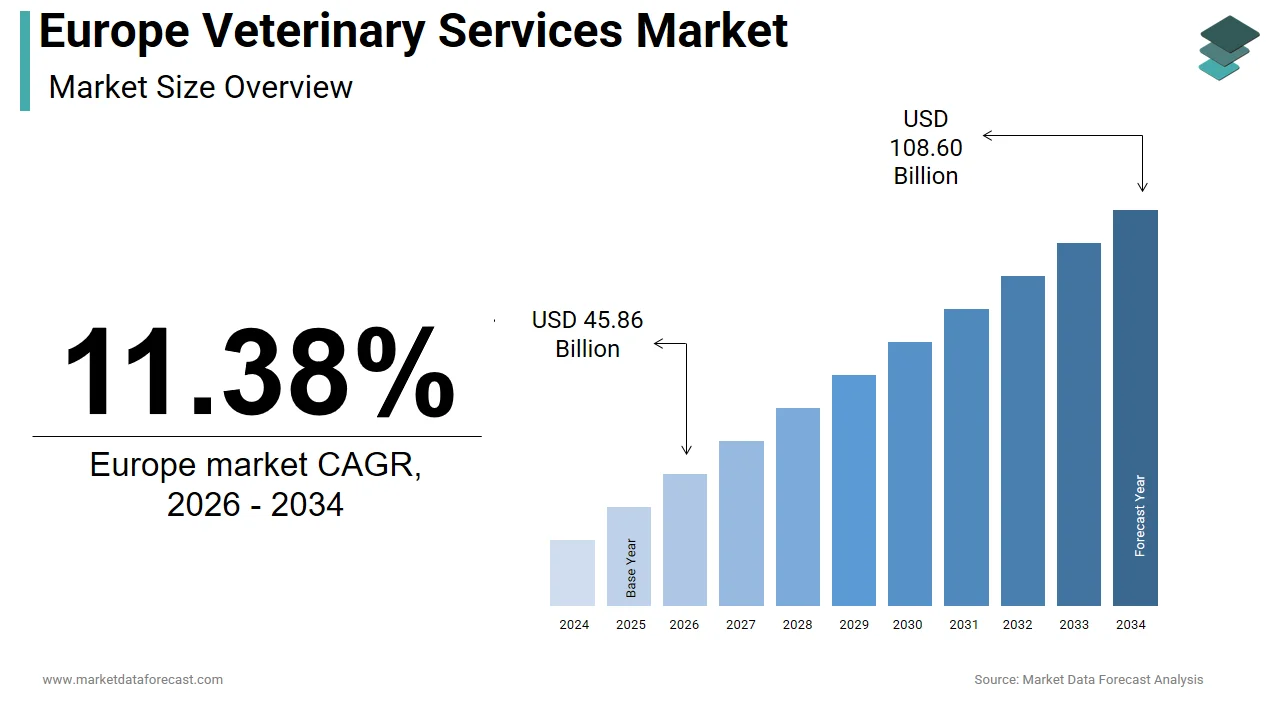
The Europe veterinary services market was valued at USD 41.17 billion in 2025. It is projected to reach USD 45.86 billion in 2026 and grow to USD 108.60 billion by 2034, registering a CAGR of 11.38% during 2026 to 2034.
Veterinary services include a comprehensive array of clinical and non-clinical offerings directed toward the health and well-being of companion and production animals. These services include preventive care, diagnostics, surgery, emergency interventions, and specialized treatments delivered through private clinics, corporate practices, mobile units, and referral hospitals. The sector operates within a tightly regulated environment shaped by the European Medicines Agency and national veterinary authorities to uphold animal welfare and public health standards. A distinctive feature of the European landscape is the integration of One Health principles, which recognize the interdependence of human, animal, and environmental health. Over half of households in Germany, France, and the United Kingdom own at least one pet, with dogs and cats constituting the majority. The region hosts a large number of licensed veterinarians, yet faces persistent imbalances in workforce distribution, particularly in rural zones. Zoonotic diseases account for around 60% of all human infectious diseases, which is emphasizing the critical role veterinary services play in early detection and containment. This foundational structure positions veterinary care not merely as a support function for animal owners but as an essential public health infrastructure across the continent.
MARKET DRIVERS
Market growth is driven by rising pet humanization, increasing demand for advanced diagnostics, and strong EU regulatory frameworks that mandate preventive care and veterinary oversight.
Expanding Pet Humanization Trends Fuel Service Demand
- European pet owners increasingly treat pets as family members, driving higher spending on advanced medical services such as diagnostics, dental care, and orthopedic procedures.
- Rising disposable incomes and urban lifestyles have increased wellness visits, with many owners in Sweden and the Netherlands scheduling two or more preventive check-ups per year.
Pet humanization has significantly elevated veterinary service usage across Europe. Owners now expect human-grade care, leading to growing demand for advanced diagnostics, dental prophylaxis, orthopedic surgeries, and chronic disease management. Increased spending, especially in France and Italy, and frequent wellness visits in Northern Europe reflect a strong shift toward preventive and premium care.
Strengthened Regulatory Frameworks for Animal Health and Welfare
- EU regulations require routine veterinary oversight, mandatory herd health plans, and surveillance for transmissible animal diseases.
- Antibiotic reduction policies are boosting demand for diagnostics, preventive care, and continuous veterinary involvement in livestock operations.
The EU’s stringent regulatory environment is a major driver of veterinary service growth. Laws such as Directive 2016/429 mandate comprehensive monitoring, vaccination, and health planning, ensuring ongoing veterinary engagement. Antimicrobial reduction initiatives have increased the need for diagnostic testing and preventive herd health programs, particularly in Germany, Denmark, and other leading livestock markets.
MARKET RESTRAINTS
The market faces major restraints due to rural veterinary workforce shortages and low insurance penetration that limits preventive care adoption across Europe.
Shortage of Rural Veterinary Workforce Limits Service Accessibility
- Rural regions in France, Spain, and Romania report fewer than one veterinarian per 10,000 animals, creating severe access gaps.
- Urban migration of veterinary graduates delays disease response times and weakens compliance with EU health monitoring mandates.
A widening shortage of veterinarians in rural Europe is restricting access to essential services, especially for livestock and equine sectors. Nearly 40% of rural municipalities have fewer than one veterinarian per 10,000 animals, resulting in care deserts and slower emergency response times. Urban migration trends among veterinary graduates and limited incentives for rural practice reduce compliance with EU health regulations and compromise animal welfare and disease surveillance capability.
Fragmented Reimbursement Mechanisms Deter Preventive Care Adoption
- Only ~12% of EU pet owners hold veterinary insurance, with large country disparities (Sweden ~40%, Italy and Portugal <5%).
- High out-of-pocket costs discourage preventive care and delay diagnostic or routine veterinary visits.
Europe’s heavy reliance on out-of-pocket payments and low insurance penetration limits preventive veterinary care. With only around 12% of pet owners insured, many households postpone wellness exams and diagnostics due to cost. Livestock producers in non-subsidized regions also delay seeking veterinary guidance until disease outbreaks occur, increasing long-term risks and economic losses. The lack of standardized reimbursement frameworks further hinders telemedicine, remote monitoring, and adoption of advanced care models, slowing overall market maturity.
MARKET OPPORTUNITIES
Digital transformation and One Health integration are creating major growth opportunities for Europe’s veterinary services market.
Digital Transformation Enables Scalable and Preventive Care
-
Over 35% of clinics in Germany, the Netherlands, and Finland now offer tele-triage and remote consultations.
-
Wearable devices and AI-based diagnostics are enabling continuous monitoring and early disease detection.
Digital health technologies are reshaping veterinary care across Europe. Teleconsultation platforms, wearable monitors, and AI-driven diagnostics are shifting the sector toward predictive and preventive care. More than 35% of companion animal practices in Northern Europe now provide remote triage, while over 200,000 smart collars were sold in 2023 to track vitals and behavior. In livestock systems, digital herd management has improved vaccination compliance and reduced calf mortality in Denmark by 15% since 2020. These tools are expanding service accessibility and creating new recurring revenue models through subscription-based digital services.
One Health Integration Opens New Collaboration Pathways
-
EU One Health policies fund cross-sector programs involving veterinarians, public health agencies, and environmental authorities.
-
Joint surveillance programs have reduced zoonotic risks, including a 20% drop in poultry Salmonella cases in Belgium.
The integration of One Health principles into EU policy is broadening the role of veterinarians beyond clinical care. Under the 2023 One Health Action Plan, veterinarians participate in antimicrobial resistance monitoring, zoonotic disease surveillance, and food safety programs. Collaborative initiatives have already shown impact, such as a 20% reduction in Salmonella prevalence in Belgian poultry. Funding through Horizon Europe supports veterinary-led research on climate-resilient livestock systems, while national chambers in Finland and Austria now manage EU-backed wildlife rabies programs. These initiatives create opportunities in consulting, epidemiology, and regulatory compliance.
MARKET CHALLENGES
Antimicrobial resistance and increasing workforce burnout pose significant challenges to veterinary service delivery across Europe.
Antimicrobial Resistance Complicates Clinical Decision-Making
-
EU regulations require stricter prescribing rules, increasing dependence on diagnostics before treatment.
-
Limited access to rapid antimicrobial testing delays therapy, especially in Southern and Eastern Europe.
The rise of antimicrobial resistance is creating major clinical and regulatory challenges. New EU regulations require veterinarians to prioritize diagnostics over empirical treatments, increasing operational complexity. Resistant pathogens in livestock have made common infections harder to manage, while many smaller clinics lack access to rapid antimicrobial sensitivity testing. This leads to treatment delays, higher costs, and ethical pressure on practitioners, ultimately affecting client trust and clinical outcomes.
Workforce Burnout and Mental Health Strain Affect Service Continuity
-
A 2024 Europe-wide study found that a majority of veterinarians exhibit signs of clinical burnout.
-
Over 30% of new UK veterinary graduates leave clinical practice within five years due to stress.
Burnout and mental health pressures are increasingly impacting the veterinary workforce. Emotional demands, financial constraints around treatment decisions, and frequent euthanasia contribute to high stress levels. A 2024 pan-European study showed widespread symptoms of burnout, while the suicide rate among veterinarians remains significantly higher than the general population. In the UK, more than 30% of new graduates exit clinical roles within five years, worsening shortages in emergency and rural care. Without better support systems and workforce policies, service capacity risks long-term decline.
REPORT COVERAGE
| REPORT METRIC | DETAILS |
| Market Size Available | 2025 to 2034 |
| Base Year | 2025 |
| Forecast Period | 2026 to 2034 |
| Segments Covered | By Service Type, Animal Type, and County. |
| Various Analyses Covered | Global, Regional, and Country-Level Analysis, Segment-Level Analysis, Drivers, Restraints, Opportunities, Challenges; PESTLE Analysis; Porter’s Five Forces Analysis, Competitive Landscape, Analyst Overview of Investment Opportunities |
| Countries Covered | UK, France, Spain, Germany, Italy, Russia, Sweden, Denmark, Switzerland, Netherlands, Turkey, Czech Republic, and the Rest of Europe. |
| Market Leaders Profiled | National Veterinary Associates Inc., Pets at Home Group PLC, Greencross Ltd., CVS Group PLC, Ethos Veterinary Health, VetCor Holdings LLC, Addison Biological Laboratory, Armor Animal Health, and PetIQ, LLC. |
SEGMENTAL ANALYSIS
By Service Type Insights
Diagnostic Tests & Imaging (37.7% Market Share in 2024)
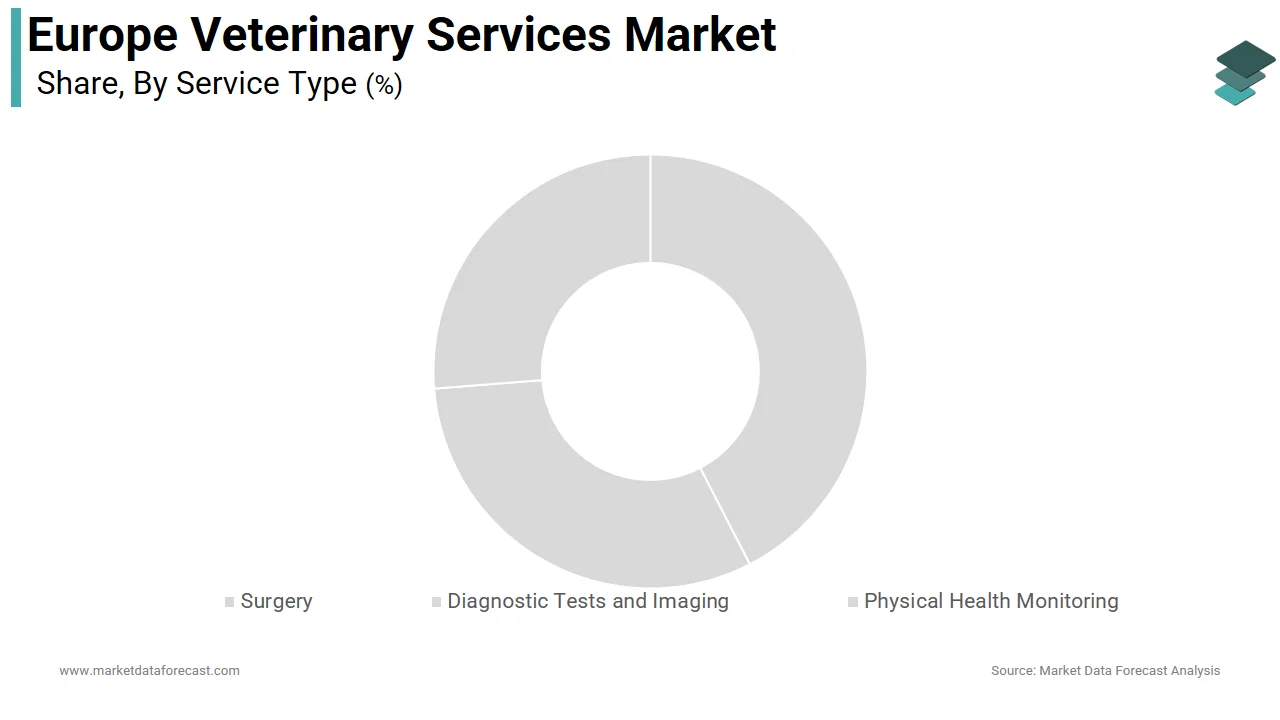
Diagnostic tests and imaging represented 37.7% of the Europe veterinary services market in 2024, making it the largest service category. Growth is driven by rising demand for early and accurate disease detection, EU mandates for livestock health screening, and rapid adoption of digital radiography, ultrasound, and MRI. Over 65% of first-tier companion animal clinics in Germany, France, and the Netherlands now operate in-house digital imaging systems for real-time assessment of musculoskeletal and abdominal conditions. Strong pet owner expectations for human-grade care and the European Medicines Agency’s push for non-invasive diagnostics have accelerated investment across the region. In the United Kingdom, more than 40% of clinics upgraded imaging equipment between 2021 and 2024, reinforcing the trend toward precision diagnostics.
Physical Health Monitoring (Fastest-Growing Segment; CAGR 9.7%)
Physical health monitoring is the fastest-growing service segment, expected to expand at a CAGR of 9.7%. Preventive care culture, wearable health technologies, and digital health records are driving this growth. More than 58% of clinics in Italy, Belgium, and the Netherlands now offer structured wellness programs that include quarterly weight checks, vital sign monitoring, and geriatric evaluations. Younger pet owners (ages 25–45) are particularly adopting long-term wellness plans. Insurance providers, such as Agria Pet Insurance in Sweden, incentivize regular health checks through premium discounts. The European Pet Health Charter (2023) recommends baseline exams twice yearly for all dogs and cats, helping shift veterinary care from episodic visits to continuous health monitoring.
By Animal Type Insights
Companion Animals (65.5% Market Share in 2024)
Companion animals accounted for 65.5% of the regional veterinary services market in 2024. High pet ownership rates, increasing humanization, and rising demand for advanced care are fueling segment growth. Over 82 million EU households own at least one pet, with dogs and cats forming more than 90% of the pet population. Many pet owners in France and the United Kingdom allocate more spending to their pets’ veterinary care than to their own medical checkups. This emotional and financial commitment supports strong demand for dental care, orthopedic surgeries, long-term disease management, and preventive programs. With rising insurance coverage and wellness-plan adoption, the companion animal segment generates recurring and stable service revenue.
Farm Animals (Fastest-Growing Animal Type; CAGR 8.12%)
Farm animals represent the fastest-growing animal type in Europe, expected to register a CAGR of 8.12% over the forecast period. Regulatory tightening, biosecurity initiatives, and export-driven health certification requirements are boosting veterinary service utilization. The EU exported over €24 billion in animal products in 2023, each shipment requiring veterinary-issued health attestations. Leading dairy exporters such as Germany and Denmark mandate quarterly herd health audits and digital veterinary record integration. In the Netherlands, most commercial pig and poultry farms undergo monthly veterinary inspections to maintain export eligibility. This compliance-focused environment positions veterinarians as essential contributors to Europe’s livestock trade and food safety system.
COUNTRY LEVEL ANALYSIS
Germany Market Insights
- Holds ~5% of Europe’s veterinary services market, the largest national share.
- Leads in digital veterinary health systems and advanced diagnostic adoption.
Germany accounted for approximately 19.5% of the European veterinary services market in 2024. High pet ownership, strict regulatory standards, and a dense network of specialized clinics fuel demand. Strong integration of veterinary care into public health and agricultural policy supports continuous service utilization, especially for livestock export certifications. Germany also leads in technology adoption, with widespread use of cloud-based medical records and advanced diagnostic devices, boosting clinical efficiency and revenue per patient.
United Kingdom Market Insights
- Among the highest pet insurance penetration rates in Europe.
- Strong presence of specialty referral centers and telemedicine adoption.
The United Kingdom holds a substantial share of the European veterinary services market, supported by high insurance uptake and a mature specialty-care ecosystem. Over half of UK households own pets, and strong insurance penetration enables greater access to advanced diagnostics and chronic disease management. Veterinary referral centers specializing in oncology, neurology, and cardiology attract patients from across Europe. Regulatory progress, such as the Animal Welfare Sentience Act 2022, and widespread telemedicine offerings further strengthen the UK market.
France Market Insights
- Major livestock producer with strong mixed animal practice presence.
- Regular veterinary herd health plans are mandatory for dairy export compliance.
France is projected to maintain a prominent share of the European market, driven by its dual strength in companion animals and livestock sectors. Millions of households own dogs and cats, while the country also hosts one of Europe’s largest cattle and poultry populations. A significant number of veterinarians operate mixed practices, serving both urban and rural needs. Compliance with EU export standards has institutionalized regular herd health planning, while urban clinics increasingly focus on wellness plans, dental care, and geriatric services.
Italy Market Insights
- Rapid growth in urban pet care demand.
- National regulations aligned with EU Animal Health Law.
Italy is expected to see strong growth in veterinary services due to increasing pet ownership and modernization of clinical standards. Pet adoption has surged, especially in northern cities such as Milan and Turin where disposable income supports premium veterinary care. The Italian Ministry of Health’s alignment with the EU Animal Health Law has expanded required veterinary contracts for commercial breeders. Rising partnerships with diagnostic laboratories and growing preventive care adoption are improving service quality and regional market penetration.
Spain Market Insights
- One of Europe’s largest livestock exporters.
- Growing demand for expatriate-focused veterinary services.
Spain holds a noteworthy share of the European veterinary services market, supported by its position as a major livestock producer and exporter. EU health certification rules require veterinary inspection for all export-ready animals, driving consistent service demand. Growing expatriate communities in cities like Barcelona and Valencia have increased the need for English-speaking and international pet services. Government investments under the 2023 National Strategy for Animal Health are improving rural veterinary infrastructure and narrowing service disparities, shifting Spain toward a more integrated veterinary care ecosystem.
COMPETITIVE LANDSCAPE
The Europe Veterinary Services Market features a dynamic competitive landscape characterized by the coexistence of large corporate groups, regional consolidators, and independent practitioners. Corporate players differentiate through technology-enabled service models, standardized protocols, and cross-border operational efficiencies, while independent clinics compete on personalized care, local reputation, and community trust. Regulatory harmonization under EU directives has raised service quality expectations across all segments, intensifying pressure to adopt diagnostic digital tools and preventive care frameworks. Competition is particularly acute in urban centers where clinic density is high, and client expectations for specialty services are elevated. Conversely, rural areas face limited competition due to workforce shortages, creating opportunities for mobile and telehealth innovators. Strategic alliances, public-private partnerships, and workforce development initiatives are increasingly shaping competitive advantage as the market evolves toward integrated value-based care.
KEY MARKET PLAYERS
The leading companies operating in the Europe veterinary services market include:
- National Veterinary Associates Inc.
- Pets at Home Group PLC
- Greencross Ltd.
- CVS Group PLC
- Ethos Veterinary Health
- VetCor Holdings LLC
- Addison Biological Laboratory
- Armor Animal Health
- PetIQ, LLC
TOP PLAYERS IN THE MARKET
Greencross Limited
Greencross Limited has established a strong presence in the Europe Veterinary Services Market through its focus on integrated pet health solutions and premium clinical standards. The company operates a network of advanced veterinary hospitals offering specialties in oncology, dentistry, and emergency care. In recent years, Greencross has invested heavily in digital health platforms, including teleconsultation services and electronic medical records, to enhance client engagement across European urban centers. Its strategic partnerships with European veterinary schools support continuous clinical training and innovation in evidence-based practice. These initiatives reinforce its reputation as a leader in high-quality companion animal care while aligning with Europe’s preventive health and One Health policy frameworks.
VetCor Holdings LLC
VetCor Holdings LLC has expanded its footprint in Europe by acquiring independent veterinary practices and consolidating them under a unified operational model that emphasizes clinical autonomy and administrative efficiency. The company supports its European clinics with centralized diagnostic coordination, continuing education programs, and client wellness plans. Recently, VetCor launched a continent-wide initiative to standardize antimicrobial stewardship protocols in alignment with European Medicines Agency guidelines. It also introduced a digital triage system now deployed across over two hundred partner clinics in Germany, France, and the Netherlands. These actions demonstrate VetCor’s commitment to scalable yet clinically responsible growth within Europe’s evolving veterinary landscape.
National Veterinary Associates Inc. (NVA)
National Veterinary Associates Inc has significantly strengthened its position in the Europe Veterinary Services Market by prioritizing ethical practice integration and community-centric care models. The company has formed joint ventures with local veterinary groups in Spain, Italy, and Sweden, ensuring cultural and regulatory alignment while preserving clinical independence. It recently rolled out a Europe-focused mental health support program for veterinary professionals in collaboration with national veterinary associations, addressing workforce retention challenges. Additionally, National Veterinary Associates has invested in mobile diagnostic units serving rural communities, thereby extending access to advanced care. These efforts underscore its dual focus on practitioner well-being and equitable service distribution across diverse European regions.
TOP STRATEGIES USED BY THE KEY MARKET PARTICIPANTS
Targeted Acquisitions
- Expanding regional presence by acquiring independent clinics while maintaining local brand identity.
Digital Transformation
- Investment in telemedicine platforms, wearable device integration, AI-driven diagnostics, and cloud-based medical records to improve continuity of care.
Regulatory Alignment
- Adopting EU-aligned clinical protocols, including antimicrobial reduction, animal welfare standards, and mandatory health planning.
Preventive & Subscription-Based Wellness Plans
- Creating recurring revenue models through structured wellness programs that increase client retention and promote preventive care.
One Health Collaboration
- Partnering with academic institutions, public health agencies, and environmental bodies to support One Health initiatives and expand non-clinical service roles.
MARKET SEGMENTATION
This Europe veterinary services market research report is segmented and sub-segmented into the following categories.
By Service Type
- Surgery
- Diagnostic Tests and Imaging
- Physical Health Monitoring
- Others
By Animal Type
- Companion Animals
- Farm Animals
By Country
- UK
- France
- Spain
- Germany
- Italy
- Russia
- Sweden
- Denmark
- Switzerland
- Netherlands
- Turkey
- Czech Republic
- Rest of Europe