- Product Description Description
- Table of Contents TOC
- List of Table & Figure LOT
- Get Free Sample PDF Sample PDF
Market Size, 2025
$1,015 MnMarket Estimate, 2026
$1,259.13 MnMarket Forecast, 2034
$3,988 MnCAGR, 2026–2034
24%Europe Virtual Assistant Market Report Summary
The Europe virtual assistant market was valued at USD 1,015 million in 2025, is estimated to reach USD 1,259.13 million in 2026, and is projected to reach USD 3,988 million by 2034, growing at a CAGR of 24% from 2026 to 2034. Market growth is driven by the rapid adoption of artificial intelligence, natural language processing, and voice recognition technologies across consumer and enterprise applications. Virtual assistants are increasingly used in customer service, smart devices, e-commerce platforms, and enterprise workflow automation. The growing popularity of voice-enabled devices, rising demand for automated customer interaction solutions, and increasing investments in AI-driven digital assistants are further supporting the expansion of the virtual assistant market across Europe.
Key Market Trends
- Increasing adoption of AI-powered voice assistants in smart devices and mobile applications.
- Rising use of virtual assistants for automated customer service and support operations.
- Growing integration of natural language processing and conversational AI technologies.
- Expansion of virtual assistants in retail, banking, and enterprise workflow automation.
- Increasing investment in multilingual and region-specific AI assistant technologies.
Segmental Insights
- Based on type, the spoken virtual assistant segment dominated the Europe virtual assistant market in 2025, supported by the growing popularity of voice-enabled technologies and smart devices.
- Based on end user, the retail segment held the largest share in 2025, driven by increasing use of virtual assistants in customer engagement, online shopping assistance, and personalized product recommendations.
Regional Insights
The Europe virtual assistant market is witnessing strong growth across major countries due to increasing digital transformation, AI innovation, and enterprise adoption of automation technologies.
- Germany led the regional market in 2025 with 21.8% share, supported by strong enterprise adoption of AI solutions and a well-developed digital infrastructure.
- The United Kingdom ranked second in the regional market in 2025, driven by strong consumer adoption of voice-enabled technologies and growing enterprise integration of AI-powered assistants.
- France is expected to hold a significant share during the forecast period due to strong government support for artificial intelligence development and innovations in language-specific AI technologies.
Competitive Landscape
The Europe virtual assistant market is characterized by intense competition among global technology companies and specialized AI solution providers. Market players are focusing on enhancing conversational AI capabilities, expanding multilingual support, and integrating virtual assistants into enterprise applications and smart devices. Strategic partnerships, continuous advancements in natural language processing, and investments in AI research are shaping competitive dynamics across the region.
Prominent companies operating in the Europe virtual assistant market include Amazon.com Inc., Anboto Europe SL Co., Apple Inc., Teneo AI, Baidu Inc., Creative Virtual Ltd., CSS Corp., CX Co., eGain Corp., GAVS Technologies NA Inc., Google LLC, IBM Corp., Inbenta Holdings Inc., Microsoft Corp., Oracle Corp., Synthetix Ltd., True Image Interactive Inc., and Verint Systems Inc.
Europe Virtual Assistant Market Size
The Europe virtual assistant market was valued at USD 1,015 million in 2025, is estimated to reach USD 1,259.13 million in 2026, and is projected to reach USD 3,988 million by 2034, growing at a CAGR of 24% from 2026 to 2034.
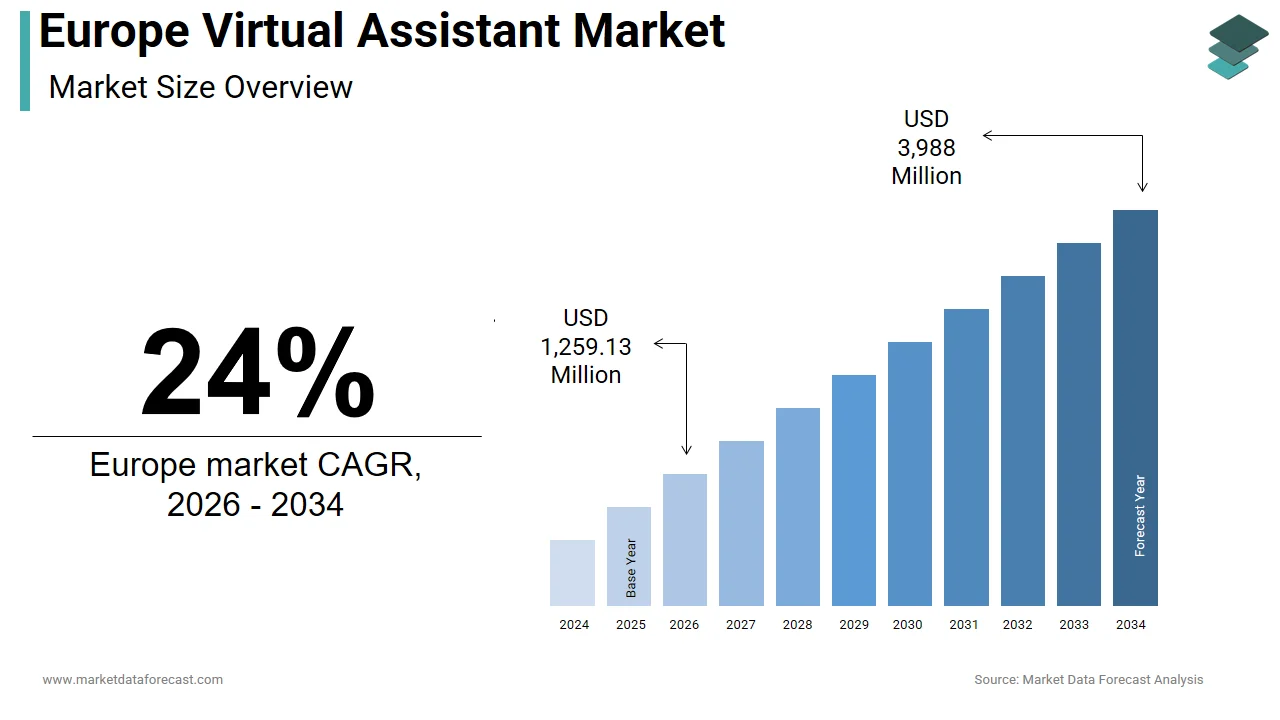
Virtual assistants encompass a sophisticated ecosystem of artificial intelligence-driven software agents designed to perform tasks, answer queries, and manage workflows through natural language processing. These digital entities operate across consumer smartphones, enterprise cloud platforms, and dedicated smart hardware to facilitate seamless human-machine interaction. For instance, the penetration of these technologies has become widespread, with smartphones in the region increasingly including integrated voice assistant capabilities. Furthermore, households are steadily adopting smart speaker devices, which serve as a primary interface for these virtual assistants. As per European Union demographic reports, the population provides a vast user base supporting this growth. Unlike generic definitions that focus solely on chatbots, the current European definition includes complex autonomous agents capable of executing multi-step transactions in compliance with strict regional data sovereignty laws. The integration of these tools into daily life reflects a shift from novelty utilities to essential productivity partners for both individual consumers and corporate entities.
MARKET DRIVERS
Escalating Enterprise Automation and Operational Efficiency Demands
Surging corporate adoption of AI-driven customer service automation is primarily driving the expansion of the European virtual assistant market. European enterprises are increasingly deploying virtual assistants to handle high-volume customer interactions and internal workflow management to reduce operational costs and improve response times. For instance, contact centers in the region are widely utilizing AI chatbots to manage initial customer inquiries effectively. This widespread implementation stems from the urgent need to maintain service quality while managing labor shortages and rising wage pressures across the continent. For instance, enterprises with more than ten employees have already integrated artificial intelligence into their core operations. The financial impact is substantial as the customer service automation segment in Europe reached a valuation of 7.2 billion United States dollars, representing a significant portion of the broader market. Companies in Germany, the United Kingdom, and France lead this transition by leveraging virtual agents to automate routine tasks such as appointment scheduling and order tracking. Organizations report measurable efficiency gains when virtual assistants resolve queries without human intervention. As per adoption studies, European companies are increasingly using AI, demonstrating accelerating momentum. This trend is not limited to large corporations, as small and medium-sized businesses in Nordic nations also exhibit high adoption rates to compete globally. The drive for automation is further fueled by the ability of modern virtual assistants to learn from interactions and continuously improve their accuracy without extensive reprogramming. Consequently, the demand for sophisticated enterprise-grade virtual assistant solutions continues to outpace supply in key industrial sectors.
Deepening Integration of Voice Interfaces in Consumer Smart Home Ecosystems
Rapid proliferation of smart speakers and connected home devices fuels unprecedented consumer demand for voice-activated assistants, which is further fuelling the growth of the European virtual assistant market. The consumer side of the market experiences vigorous growth driven by the increasing household penetration of smart speakers, which serve as the central hub for virtual assistant interactions. For instance, household penetration of smart speakers is anticipated to rise significantly in the coming years. This hardware expansion directly correlates with software usage as users rely on voice commands to control lighting, heating, and entertainment systems seamlessly. The Europe smart speakers market itself is poised for significant expansion with a compound annual growth rate of 18.2% from 2025 onwards. Consumers find value in the convenience of hands-free operation, which allows them to multitask while managing their domestic environment through natural speech. As per usage statistics, Google Assistant leads the user base in the region, followed closely by Apple Siri and Amazon Alexa. The ubiquity of these devices in living rooms and kitchens normalizes the use of virtual assistants for daily tasks such as setting timers or checking weather forecasts. Furthermore, as per smartphone shipment data, new devices increasingly include voice assistants, ensuring users can access these services both inside and outside the home. This dual presence creates a continuous engagement loop that reinforces dependency on virtual assistant technologies for information retrieval and task execution. Manufacturers are also introducing screens to these devices, which enhances the user experience by providing visual feedback alongside voice responses. As the cost of smart hardware decreases and functionality improves, the addressable market for consumer-focused virtual assistants expands into new demographic segments, including elderly users seeking accessibility features.
MARKET RESTRAINTS
Stringent Data Privacy Regulations and Compliance Complexities
Rigorous enforcement of the General Data Protection Regulation creates significant barriers to data collection and model training, which is a significant impediment to the European virtual assistant market growth. The regulatory landscape in Europe imposes strict constraints on how virtual assistant providers collect, store, and process voice data, which is classified as personally identifiable information. The General Data Protection Regulation considers voice recordings as sensitive data because they can reveal details about gender, ethnic origin, or potential health conditions. This classification mandates explicit user consent and robust data minimization practices, which limit the amount of audio data available for improving speech recognition algorithms. Recent actions against major technology firms in Germany highlight the suspension of human review processes for audio snippets due to privacy violations. Such regulatory scrutiny forces companies to invest heavily in compliance infrastructure and anonymization techniques, which increases operational costs and slows down innovation cycles. As per surveys, Europeans are highly concerned about their digital privacy and hesitate to embrace artificial intelligence without guaranteed protections. This consumer skepticism translates into lower adoption rates for features that require extensive data sharing, such as personalized recommendations or proactive assistance. The European Union Artificial Intelligence Act further categorizes many workplace uses of AI as high risk requiring rigorous assessment and transparency measures. Companies must navigate a fragmented legal environment where national supervisory authorities may interpret rules differently, leading to uncertainty in product deployment. The requirement for lawful basis processing means that providers cannot simply assume consent for data usage in all contexts. Consequently, the development of highly accurate multilingual models is hindered by the inability to aggregate diverse voice datasets freely. These compliance burdens act as a formidable restraint preventing faster market maturation and limiting the scope of services offered to end users.
Linguistic Fragmentation and Dialectal Variability Across the Region
Complex linguistic diversity and numerous dialects are further hampering the regional market expansion. Europe hosts a vast array of languages and regional dialects, which complicates the development of universal virtual assistant models capable of serving the entire population effectively. Challenges in the voice recognition market specifically involve accent variations that significantly reduce the accuracy of automated transcription and command interpretation. While major languages like English, German, and French have robust support, many smaller European languages suffer from inadequate training data, leading to poor performance for native speakers. As per research, the current state of the art open large language models inadequately support most European languages, posing a barrier for organizations operating in multilingual environments. This limitation forces providers to either restrict their services to dominant languages or incur prohibitive costs to develop specialized models for each linguistic group. The variability in pronunciation and grammar within single languages further exacerbates the issu,e as standard models often fail to understand strong regional accents. Collecting sufficient data from homogeneous samples of multilingual speakers remains a primary hurdle for researchers aiming to improve system inclusivity. Users who experience frequent misunderstandings or errors due to their accent are likely to abandon the technology, reducing overall market penetration in diverse regions. The lack of standardized datasets for low-resource languages means that virtual assistants often default to English, which alienates non-English-speaking demographics. This fragmentation prevents the realization of a truly unified European market where a single solution could serve all citizens equally. Until breakthroughs in few-shot learning or cross-lingual transfer occur, linguistic diversity will continue to restrain the universal applicability of virtual assistant technologies.
MARKET OPPORTUNITIES
Specialized Solutions for Aging Populations and Digital Health Management
Developing tailored virtual assistants for elderly care provides a massive opportunity in the European virtual assistant market. The aging population in Europe creates an urgent demand for advanced home-based healthcare technologies and digital companions that can assist with daily living and medical adherence. Virtual assistants equipped with health monitoring capabilities can help older adults manage medication schedules, detect falls, and connect with healthcare providers instantly. As per research, digital approaches hold huge potential to improve the health of the ageing population if tools are designed with their specific needs in mind. With the European Union population exceeding 450 million and a growing percentage of seniors, the addressable market for geriatric-focused AI solutions is expanding rapidly. These specialized agents can provide cognitive stimulation, remind users of appointments, and offer emotional support to combat loneliness among isolated elders. Telehealth integration allows virtual assistants to triage symptoms and facilitate remote consultations, which reduces the burden on physical healthcare facilities. As per studies, many older adults struggle with digital technology but are willing to adopt voice interfaces due to their natural interaction mode. The market for smart aging technologies is driven by the necessity to enable older adults to live longer and healthier lives independently at home. Governments and healthcare systems are increasingly promoting eHealth solutions that leverage communication technologies for disease prevention and diagnosis. Providers who can deliver accessible, intuitive, and trustworthy virtual health assistants stand to capture a significant share of this emerging sector. The convergence of demographic necessity and technological capability makes elderly care a prime avenue for future growth and innovation.
Expansion of Multilingual Capabilities to Serve Underserved Linguistic Groups
Enhancing support for minority and regional languages opens new market segments and fosters greater digital inclusion across Europe. There is a substantial opportunity for virtual assistant providers to differentiate themselves by offering high-quality support for languages that are currently underserved by major technology platforms. Addressing the gap in multilingual support can unlock millions of potential users who currently face barriers due to language limitations. As per multilingualism research, collecting sufficient data to achieve accurate recognition presents a clear roadmap for companies willing to invest in niche datasets. By developing proprietary bias mitigation algorithms and localized models, firms can cater to specific national markets with superior performance compared to generic global solutions. This strategy aligns with European values of cultural preservation and digital equity, making it attractive for public sector contracts and educational initiatives. Organizations operating in multilingual environments are actively seeking solutions that can switch seamlessly between languages to serve diverse workforces. The failure of current models to adequately support most European languages represents a competitive advantage for new entrants who prioritize linguistic breadth. Success in this area requires partnerships with local institutions to gather authentic speech samples and validate cultural nuances in responses. As the market matures, the ability to converse fluently in regional dialects will become a key differentiator for consumer loyalty and enterprise adoption. Expanding beyond the dominant languages allows providers to tap into rural and less digitized communities that have been overlooked thus far. This inclusive approach not only drives revenue growth but also strengthens the social license to operate within the diverse European landscape.
MARKET CHALLENGES
Overcoming Consumer Skepticism and Trust Deficits Regarding AI Autonomy
Building trust among consumers who remain sceptical about AI decision-making and data usage remains a critical hurdle, which is a major challenge to the growth of the European virtual assistant market. Despite technological advancements, a significant portion of the European population retains deep reservations about allowing artificial intelligence to make decisions or access personal information. As per surveys, Europeans believe that AI requires careful management to protect privacy and ensure ethical standards are met. This pervasive skepticism hinders the adoption of advanced features such as proactive suggestions or autonomous transaction execution, which require a high degree of user trust. As per reports, many Europeans feel less knowledgeable about artificial intelligence, which contributes to fear and misunderstanding of its capabilities and risks. The lack of transparency in how algorithms process data and reach conclusions exacerbates these concerns, leading to resistance in both consumer and enterprise sectors. Respondents in various studies cite privacy concerns and ethical issues as top challenges preventing wider acceptance of AI technologies. Companies face the difficult task of educating users while simultaneously proving the reliability and safety of their virtual assistant products. High-profile data breaches and misuse scandals have further eroded confidence, making it harder to convince users to grant necessary permissions. The challenge is compounded by the fact that knowledgeable consumers are often both more trusting and more sceptical, creating a complex dynamic for marketers to navigate. Overcoming this trust deficit requires demonstrable commitment to ethical AI principles and clear communication of benefits versus risks. Without addressing these psychological barriers, the market may struggle to move beyond basic command execution to more transformative applications.
Navigating Ethical Concerns and Potential Job Displacement Fears
Addressing societal fears regarding job displacement and the ethical implications of AI automation poses a significant socio-political challenge to the expansion of the European virtual assistant market. The rapid integration of virtual assistants into business processes has sparked intense debate regarding the potential loss of human jobs and the ethical ramifications of replacing workers with machines. As per European surveys, job displacement is identified as a primary concern associated with the rise of artificial intelligence. This anxiety influences public policy and corporate strategy as governments face pressure to regulate automation to protect employment levels. The perception that virtual assistants might render customer service representatives or administrative staff obsolete creates resistance from labor unions and workforce groups. For instance, ethical issues surrounding the deployment of AI are also cited as major challenges in the region. Companies must balance efficiency gains with social responsibility to avoid backlash and potential regulatory crackdowns. The narrative around AI often focuses on replacement rather than augmentation, which fuels negative sentiment among the working class. Ensuring that virtual assistants are positioned as tools that enhance human productivity rather than replace it is crucial for social acceptance. The European labor market is sensitive to these shifts, and any perception of unfair displacement can lead to strikes or legislative restrictions. Furthermore, ethical questions about bias in algorithmic decision-making add another layer of complexity to the deployment of these systems. Successfully managing these challenges requires transparent dialogue about the future of work and concrete plans for reskilling affected employees. Failure to address these socio-economic concerns could slow down the pace of adoption and limit the long-term potential of the virtual assistant market.
REPORT COVERAGE
| REPORT METRIC | DETAILS |
| Market Size Available | 2025 to 2034 |
| Base Year | 2025 |
| Forecast Period | 2026 to 2034 |
| Segments Covered | By Type, End-User, Product Type, and Country. |
| Various Analyses Covered | Global, Regional, and Country-Level Analysis, Segment-Level Analysis, Drivers, Restraints, Opportunities, Challenges; PESTLE Analysis; Porter’s Five Forces Analysis, Competitive Landscape, Analyst Overview of Investment Opportunities |
| Countries Covered | UK, France, Spain, Germany, Italy, Russia, Sweden, Denmark, Switzerland, Netherlands, Turkey, Czech Republic, and the Rest of Europe. |
| Market Leaders Profiled | Amazon.com Inc., Anboto Europe SL Co., Apple Inc., Teneo AI, Baidu Inc., Creative Virtual Ltd., CSS Corp., CX Co., eGain Corp., GAVS Technologies NA Inc., Google LLC, IBM Corp., Inbenta Holdings Inc., Microsoft Corp., Oracle Corp., Synthetix Ltd., True Image Interactive Inc., Verint Systems Inc., and Others. |
SEGMENTAL ANALYSIS
By Type Insights
The spoken segment dominated the market by commanding the highest share of the European virtual assistant market in 2025. The dominance of the spoken segment in the European virtual assistant market is majorly driven by the ubiquity of smart speakers and voice-activated mobile interfaces, the natural human preference for verbal interaction over typing, particularly in multitasking scenarios within the home or while driving. For instance, European households increasingly own smart speakers, which serve as dedicated hubs for voice commands. Furthermore, as per smartphone shipment reports, devices in the region are widely equipped with integrated voice assistant capabilities, ensuring spoken interaction is the default mode for daily queries. As per consumer behavior studies, users initiate most of their interactions with virtual assistants via voice rather than text, which indicates a clear behavioral shift towards hands-free operation. The automotive sector further amplifies this trend as modern vehicles increasingly integrate voice control systems to manage navigation and entertainment without distracting the driver. Safety regulations in Europe also favor voice interfaces in cars, pushing manufacturers to prioritize spoken command accuracy. The maturity of natural language processing models for major European languages has reduced error rates significantly, making spoken commands reliable for complex tasks like banking transactions or scheduling appointments. As hardware costs decrease and microphone arrays improve, the penetration of voice-first devices continues to expand into rural areas, solidifying the lead of spoken commands over text-based alternatives in the overall market volume.
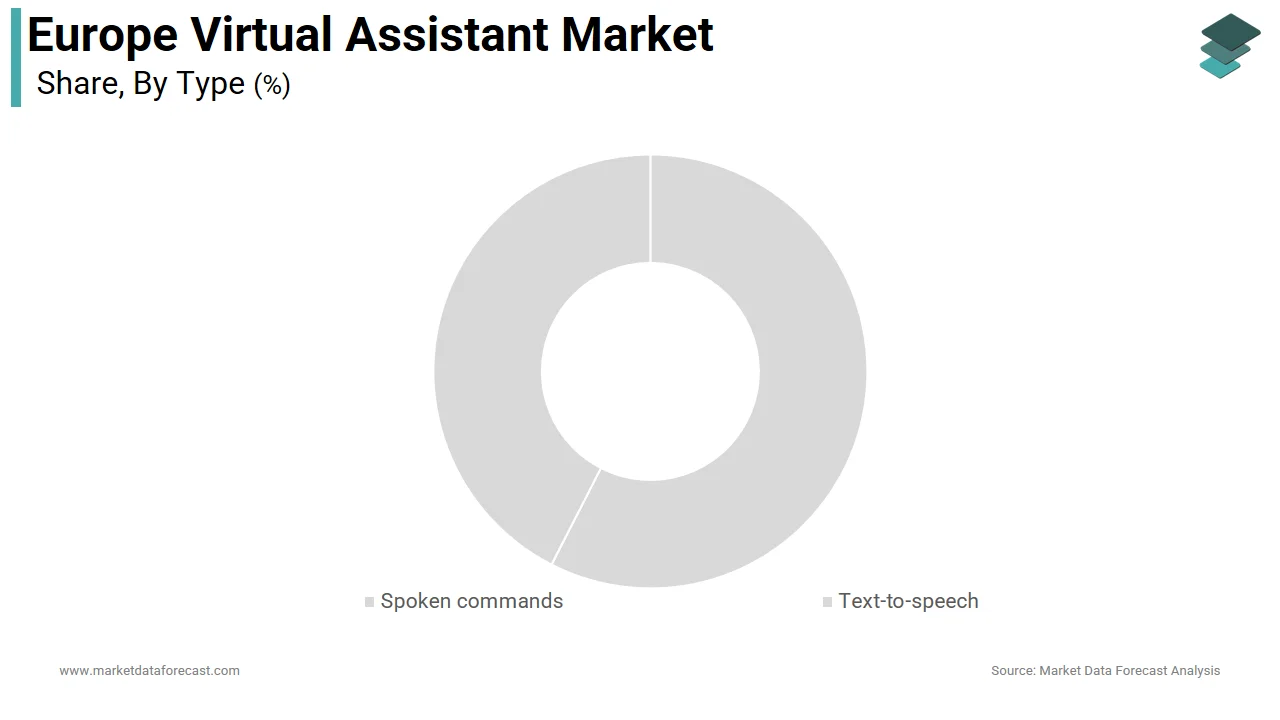
The text-to-speech segment is promising and is estimated to witness a CAGR of 20.5% over the forecast period, owing to the accessibility mandates, content consumption shifts, and stringent European Union regulations requiring digital services to be accessible to individuals with visual impairments or reading difficulties. The European Accessibility Act mandates that websites and mobile applications provided by public and private sectors must offer text-to-speech functionality, forcing a massive wave of compliance-driven upgrades across industries. Additionally, the rise of audio content consumption, including podcasts and audiobooks, has created a surge in demand for high-quality synthetic voices that can narrate digital text naturally. For instance, the audiobook market in Europe has shown strong growth with publishers increasingly relying on advanced text-to-speech engines to convert written content into audio formats cost-effectively. As per educational studies, schools in Nordic countries are adopting text-to-speech software to support diverse learning styles. The technology has evolved to produce near-human intonation and emotion, making it viable for customer service IVR systems and virtual companions. Companies are investing heavily in neural text-to-speech models that support multiple European dialects, which addresses previous limitations in voice quality. The ability to generate real-time voiceovers for dynamic content such as news feeds or stock updates further accelerates adoption in the media and finance sectors. As the cost of generating synthetic speech drops and quality improves, the text-to-speech segment is poised to outpace all other type categories in growth velocity.
By End-User Insights
The retail segment accounted for the major share of the European virtual assistant market in 2025. The growth of the retail segment in the European market can be credited to the urgent need for personalized customer engagement and automated support solutions. Retailers across Europe are aggressively deploying virtual assistants to handle the immense volume of customer inquiries related to order tracking, product recommendations, and return policies. For instance, contact centers in the European retail sector are widely utilizing AI chatbots to manage initial customer interactions, significantly reducing operational costs while maintaining service availability around the clock. The drive for personalization is another critical factor, as virtual assistants leverage purchase history and browsing behavior to offer tailored suggestions that increase conversion rates. As per retail studies, companies using AI-driven personalization see notable revenue increases compared to those relying on static interfaces. The integration of virtual assistants into popular messaging platforms like WhatsApp and Facebook Messenger has further expanded their reach, allowing brands to engage customers where they already spend their time. During peak shopping seasons such as Black Friday and Christmas, these automated agents prove indispensable in managing traffic spikes that would otherwise overwhelm human staff. The shift towards omnichannel retailing requires seamless interaction between online and offline channels, a capability that modern virtual assistants provide by syncing inventory data and store locations in real time. Small and medium-sized enterprises are also adopting these tools to compete with larger chains, democratizing access to advanced customer service technologies. The continuous improvement in natural language understanding allows these systems to resolve complex queries without human escalation, cementing the retail sector's position as the primary adopter of virtual assistant technologies.
The BFSI segment is anticipated to record a CAGR of 23.5% over the forecast period in the European market, Factors such as the imperative for secure, instant, compliant financial interactions, the increasing consumer demand for instant banking services and the need for financial institutions to reduce fraud and operational risks through AI verification are propelling the expansion of the BFSI segment in the European market. For instance, European banks are rapidly integrating virtual assistants to handle routine transactions such as balance inquiries, fund transfers, and bill payments. The implementation of Strong Customer Authentication regulations under the Revised Payment Services Directive has accelerated the adoption of AI-driven biometric verification within virtual assistant interfaces, enhancing security while simplifying the user experience. Fraud detection capabilities powered by machine learning allow these assistants to identify suspicious patterns in real time, saving the industry high costs annually. Insurance companies are also leveraging virtual assistants for claims processing, where AI can assess damage photos and automate payouts, reducing settlement times drastically. As per consumer surveys, Europeans are increasingly comfortable discussing financial matters with AI agents, provided security protocols are transparent. The shift towards open banking frameworks enables virtual assistants to aggregate data from multiple financial providers, offering users a holistic view of their finances and personalized advice. As regulatory sandboxes encourage innovation, fintech startups and traditional banks alike are racing to deploy sophisticated conversational AI solutions to capture market share and improve customer retention rates.
COUNTRY-LEVEL ANALYSIS
Germany Virtual Assistant Market Analysis
Germany accounted for 21.8% of the European virtual assistant market share in 2025 and emerged as the most dominating regional segment in the European market due to enterprise adoption and strong AI infrastructure. According to Bitkom, over 65% of German enterprises use AI‑powered assistants for customer service or workflow automation. Automotive giants such as BMW and Volkswagen deploy multilingual assistants for connected vehicles, while Deutsche Telekom integrates AI chatbots into telecom services. Berlin and Munich host more than 400 AI startups, many specializing in conversational AI. Regulatory clarity under GDPR ensures trust in enterprise deployments, while the Federal Ministry for Economic Affairs funds AI innovation hubs. With its combination of industrial demand, startup activity, and regulatory alignment, Germany remains the anchor of Europe’s enterprise‑driven virtual assistant ecosystem.
United Kingdom Virtual Assistant Market Analysis
The UK held the second largest share, which represents the second largest market, supported by strong consumer adoption and enterprise integration. According to Ofcom, over 50% of UK households use smart speakers, making voice assistants a mainstream consumer tool. Financial services firms such as Barclays and HSBC deploy AI assistants for fraud detection and customer support, while the NHS has piloted digital assistants for patient triage. The UK Biobank’s genomics initiative has also enabled AI‑driven personalization in healthcare assistants. Post‑Brexit regulatory autonomy has allowed faster approvals for AI pilots, with the Information Commissioner’s Office issuing guidelines for ethical chatbot use. With its blend of consumer penetration, enterprise demand, and regulatory flexibility, the UK remains a high‑value hub for both B2B and B2C virtual assistant applications.
France Virtual Assistant Market Analysis
France is expected to hold a prominent share of the European virtual assistant market during the forecast period due to strong government support and language‑specific innovation. According to France Digitale, over 40% of French SMEs have adopted AI assistants for customer engagement. Paris hosts major AI research centers, including INRIA and CNRS, which collaborate with startups on conversational AI. Telecom providers such as Orange integrate assistants into customer service, while Carrefour uses AI chatbots in retail. The France 2030 plan allocated €1.5 billion to AI development, boosting adoption in public services and enterprises. Consumer demand is also rising, with assistants integrated into banking and e‑commerce apps. With its combination of policy support, linguistic specialization, and enterprise adoption, France is expected to remain a stable and innovation‑driven market.
COMPETITIVE LANDSCAPE
The competition in the Europe virtual assistant market is intense and characterized by a fierce rivalry among global technology giants who constantly innovate to capture user attention and loyalty. Major competitors differentiate themselves through superior natural language understanding capabilities and the breadth of their integrated device ecosystems, which lock users into their respective platforms. Privacy compliance has emerged as a critical battleground where companies strive to demonstrate adherence to strict European regulations to gain consumer trust over rivals. The market sees frequent launches of new features powered by generative artificial intelligence that aim to make interactions more human-like and contextually relevant for users. Smaller niche players often focus on specific industries or languages to carve out sustainable positions against the dominance of large corporations. Strategic alliances with automotive manufacturers and smart home device producers are common tactics used to expand reach and ensure default placement of virtual assistants. This dynamic environment forces all participants to continuously evolve their technologies and business models to maintain relevance and market share.
KEY MARKET PLAYERS
The leading companies operating in the Europe virtual assistant market include:
- Amazon.com Inc.
- Anboto Europe SL Co.
- Apple Inc.
- Teneo AI
- Baidu Inc.
- Creative Virtual Ltd.
- CSS Corp.
- CX Co.
- eGain Corp.
- GAVS Technologies NA Inc.
- Google LLC
- IBM Corp.
- Inbenta Holdings Inc.
- Microsoft Corp.
- Oracle Corp.
- Synthetix Ltd.
- True Image Interactive Inc.
- Verint Systems Inc.
TOP PLAYERS IN THE MARKET
- Google maintains a dominant presence in the Europe virtual assistant market through its Google Assistant, which powers billions of devices ranging from smartphones to smart home speakers. The company recently intensified its focus on generative artificial intelligence by integrating large language models directly into its assistant capabilities to enable more natural and context-aware conversations. Google has established significant data centers across European nations to ensure compliance with local data sovereignty laws while reducing latency for users. Their recent initiatives include expanding support for additional European languages and dialects to serve diverse populations better. By partnering with major automotive manufacturers and consumer electronics brands, Google ensures its assistant remains embedded in the daily lives of Europeans. These strategic moves reinforce their commitment to providing seamless and intelligent user experiences across all touchpoints in the region.
- Apple contributes significantly to the global virtual assistant landscape through Siri, which serves as the primary interface for hundreds of millions of iPhone and iPad users across Europe. The company recently unveiled major upgrades to Siri, leveraging on-device processing to enhance privacy while delivering faster and more accurate responses to user queries. Apple has focused heavily on integrating Siri with its ecosystem of services, including Apple Music and HomeKit, to create a unified and intuitive user experience. Recent actions include rolling out advanced personalization features that allow the assistant to anticipate user needs based on habits and preferences without compromising data security. The firm continues to invest in European research facilities to improve natural language understanding for various regional accents. These efforts demonstrate Apple's dedication to maintaining high standards of privacy and functionality for its extensive European customer base.
- Amazon drives substantial innovation in the Europe virtual assistant market via Alexa, which has become a staple in millions of households and businesses throughout the continent. The company recently launched new generative AI features that enable Alexa to handle complex multi-step requests and engage in more fluid dialogues with users. Amazon has expanded its network of fulfillment centers and data infrastructure in Europe to support the growing demand for voice-enabled services and smart home devices. Strategic partnerships with local retailers and service providers have allowed Alexa to offer region-specific skills and information tailored to European consumers. The firm also introduced new hardware devices designed specifically for the European market to enhance voice recognition accuracy in noisy environments. These continuous improvements and expansions highlight Amazon's resolve to lead the voice technology sector across the diverse European landscape.
TOP STRATEGIES USED BY KEY MARKET PARTICIPANTS
Key players in the Europe virtual assistant market primarily employ strategies centered on deep integration with existing ecosystems and relentless advancement of artificial intelligence capabilities. Companies aggressively pursue partnerships with hardware manufacturers to embed their assistants into a wide array of devices, from cars to kitchen appliances, ensuring ubiquitous access for users. Another major strategy involves heavy investment in natural language processing research to support the vast linguistic diversity found across European nations, including rare dialects. Firms also prioritize strict adherence to data privacy regulations like the General Data Protection Regulation to build trust and avoid legal penalties while operating in the region. Acquisitions of specialized startups focusing on niche verticals such as healthcare or finance allow major players to rapidly expand their functional offerings. Furthermore, participants frequently launch developer programs to encourage the creation of third-party skills and applications that enrich the overall utility of their platforms. These combined approaches enable companies to solidify their positions and drive sustained growth in this competitive market.
MARKET SEGMENTATION
This research report on the Europe virtual assistant market has been segmented and sub-segmented into the following categories.
By Type
- Spoken commands
- Text-to-speech
By End-user
- Automotive
- BFSI
- Government
- Retail
- Others
By Product Type
- Chatbots
- Smart speakers
By Country
- United Kingdom
- France
- Spain
- Germany
- Italy
- Russia
- Sweden
- Denmark
- Switzerland
- Netherlands
- Rest of Europe