- Product Description Description
- Table of Contents TOC
- List of Table & Figure LOT
- Get Free Sample PDF Sample PDF
Market Size, 2025
$640.65 MnMarket Estimate, 2026
$752.12 MnMarket Forecast, 2034
$2714 MnCAGR, 2026–2034
17.4%Global Bionematicides Market Size, Growth, Trends & Forecast (2026–2034)
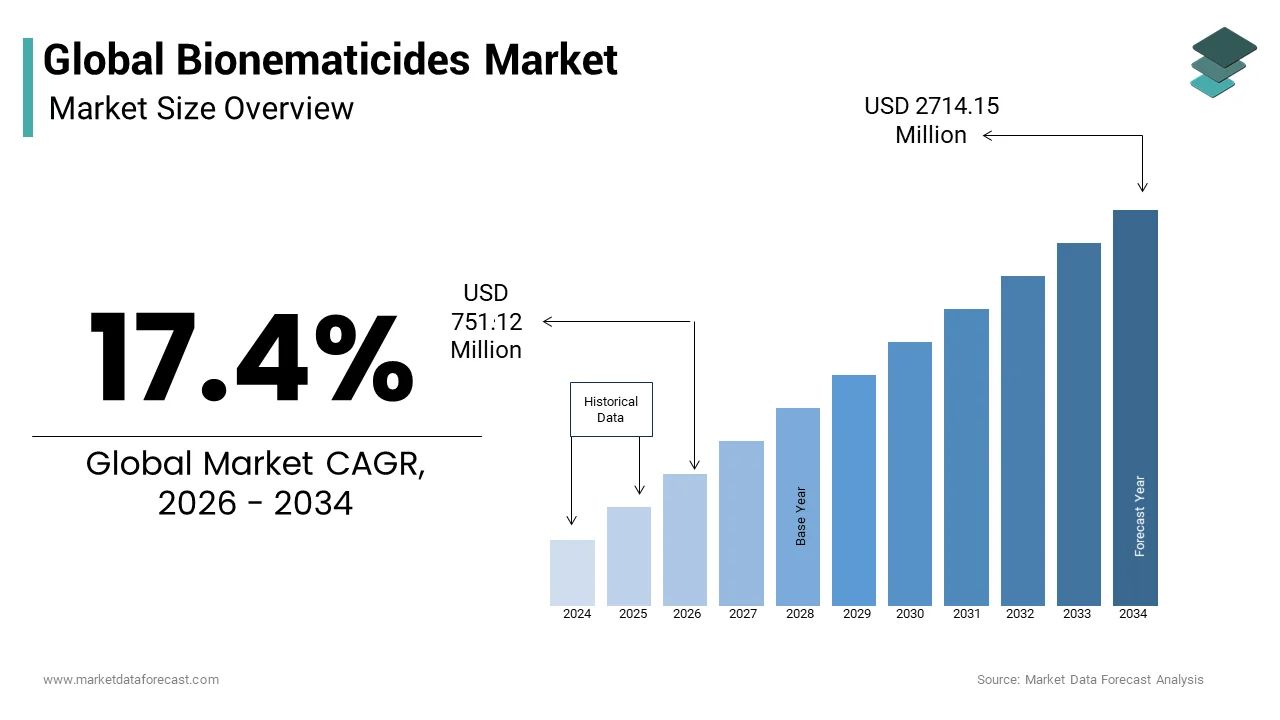
The global bionematicides market size was valued at USD 640.65 million in 2025, is anticipated to reach USD 752.12 million in 2026, and is projected to scale up to USD 2,714.15 million by 2034, registering a compound annual growth rate (CAGR) of 17.4% during the forecast period from 2026 to 2034. Driven by surging food demands, escalating preference for organic food items, and strict regulations against hazardous synthetic nematicides, the bionematicides sector is experiencing rapid expansion worldwide.
Key Executive Metrics (At-a-Glance)
- 2025 Base Valuation: USD 640.65 Million
- 2026 Current Valuation: USD 752.12 Million
- 2034 Forecast Valuation: USD 2,714.15 Million
- Compound Annual Growth Rate (CAGR): 17.4% (2026–2034)
- Dominant Product Type: Microbial Bionematicides (leading due to nutrient mineralization and biological control properties)
- Dominant Application/Crop Segment: Fruits & Vegetables (holding the highest market share owing to high vulnerability to nematode attacks and organic demand)
- Dominant Mode of Application: Soil Treatment (capturing the largest share for optimized root health and moisture retention)
- Dominant Infestation Segment: Root-Knot Nematodes (leading due to widespread attacks on diverse crops and high persistence)
- Regional Growth Leader: Europe (projected to record the highest regional CAGR driven by large-scale fruit and vegetable cultivation and organic mandates)
Core Market Drivers
- Surging Global Food Demand: Rapid population growth pressurizing farmers to improve both crop quality and quantity using sustainable agricultural biologicals.
- Shift Toward Organic Food & Safety: Growing consumer health awareness and strict environmental regulations favoring eco-friendly pest control alternatives over chemical nematicides.
- Soil Enrichment Properties: Beneficial microbes enhancing soil fertility, promoting nutrient mineralization, and protecting roots without toxic residues.
Primary Market Restraints & Challenges
- Awareness & Shelf-Life Constraints: Low technical awareness among smallholder farmers in developing nations combined with the limited shelf life of living microbial products.
Global Bionematicides Market Segmentation Breakdown
| Segment Category | Leading Sub-Segment (2025 Base) | Fastest-Growing Sub-Segment / Outlook |
|---|---|---|
| By Type | Microbial (dominates via soil nutrient mineralization and biological control actions) | Microbial Formulations (expanded use via genetic and strain enhancements) |
| By Form | Liquid Formulations (favored for safety and ease of field application) | Dry / Granular Form (gaining traction due to extended shelf-life and logistics ease) |
| By Crop Type | Fruits & Vegetables (leads due to high vulnerability in carrots, potatoes, and tomatoes) | Fruits & Vegetables (driven by surging organic retail demand) |
| By Mode of Application | Soil Treatment (largest share; promotes early seed germination and efficient nutrient uptake) | Seed Treatment & Soil Application (expanding as preventive measures) |
| By Infestation | Root-Knot Nematodes (dominant due to wide host range across vegetables and ornamentals) | Cyst & Lesion Nematodes (targeted solutions for specialized field crops) |
| By Region | North America (highest market adoption of advanced organic agriculture) | Europe (projected at the highest CAGR driven by widespread organic farm acreage) |
Major Industry Players Profiled
Key market leaders steering the competitive global bionematicides landscape include Bayer AG, Monsanto Company, Syngenta AG, BASF SE, Dow AgroSciences LLC, FMC Corporation, Valent BioSciences LLC, Marrone Bio Innovations (Certis), and T. Stanes & Company Limited.
Global Bionematicides Market Size
The global bio-nematicides market size was valued at USD 640.65 million in 2025 and is anticipated to reach USD 752.12 million in 2026 to reach USD 2714.15 million by 2034, growing at a CAGR of 17.4% from 2026 to 2034.
Bionematicide is a kind of Biopesticide that is used to treat nematode infestation in crops. The nematodes are pests that attack the roots of all kinds of crops, including fruit and vegetables, and cause damage to the crops. The bionematicides are used to eradicate the nematodes at all stages of their lifecycle. The bionematicides are eco-friendly in nature and do not cause any harm to the quality of crops, as well as the fertility of the soil. Bionematicides are produced either by plant sources or by different organisms such as bacteria, fungi, and other inert materials. Bionematicides are available in liquid or dry form. Bionematicides provide organic nutrients to crops and are becoming the most preferred solution for controlling nematodes. Owing to the benefits of bionematicides over synthetic nematicides, the growth of the bionematicides market is expected between 2022 and 2027.
MARKET DRIVERS
The driving force of the bio-natural market is the ever-increasing demand for food. The increasing demand for food due to the rapidly growing population is encouraging farmers to use biopesticides to improve the quality as well as the quantity of the yields.
The growing health concern and the increasing demand for organic food across the globe are encouraging farmers to use biopesticides to grow organic crops and meet the surging demand, which is driving the growth of the market. Additionally, bionematicides are safe for the environment and crops compared to synthetic nematicides; therefore, the demand for bionematicides is increasing in the market.
Moreover, some of the nematicides, such as microbes, help enhance the nutrient and fertility of the soil, help control harmful pests, and do not cause any harm to the crop and soil like chemical nematicides. Therefore, the demand for biopesticides is increasing, which, in turn, increases the growth of the bionematicide market in the forecast period.
MARKET RESTRAINTS
The low awareness among farmers in some of the developing nations and the low shelf life of the marerobes are restricting the growth of the bionematicide market in the forecast period.
COVID-19 Impact on the Global Bionematicides Market
The bio-nematicides market has been significantly impacted by the COVID-19 outbreak. During the pandemic, the lockdown imposed by legislative bodies around the globe and travel restrictions caused adverse effects in several industries, and the bionematicide industry is no exception. The biopesticide market has slowed down during this period due to disruption in transportation and logistics, which affects the supply chain and the demand for biopesticides. Furthermore, the travel restrictions around the globe also affect the global trade of bionematicides. However, with the pace of time, the demand for bionematicides is increasing due to the increasing demand for organic food improvement, which in turn fuels the market for bionematicides.
REPORT COVERAGE
| REPORT METRIC | DETAILS |
| Market Size Available | 2025 to 2034 |
| Base Year | 2025 |
| Forecast Period | 2026 to 2034 |
| CAGR | 17.4% |
| Segments Covered | By Type, Form, Crop, Mode Of Application, Infestation, and Region. |
| Various Analyses Covered | Global, Regional & Country Level Analysis, Segment-Level Analysis, DROC, PESTLE Analysis, Porter’s Five Forces Analysis, Competitive Landscape, Analyst Overview of Investment Opportunities |
| Regions Covered | North America, Europe, APAC, Latin America, Middle East & Africa |
| Market Leaders Profiled | Bayer AG, Monsanto Company, Syngenta AG, BASF SE, Dow AgroSciences LLC, FMC Corporation, Valent BioSciences LLC, Marrone Bio Innovations. Certis, T. STANES & COMPANY LIMITED and Others. |
SEGMENT ANALYSIS
By Type Insights
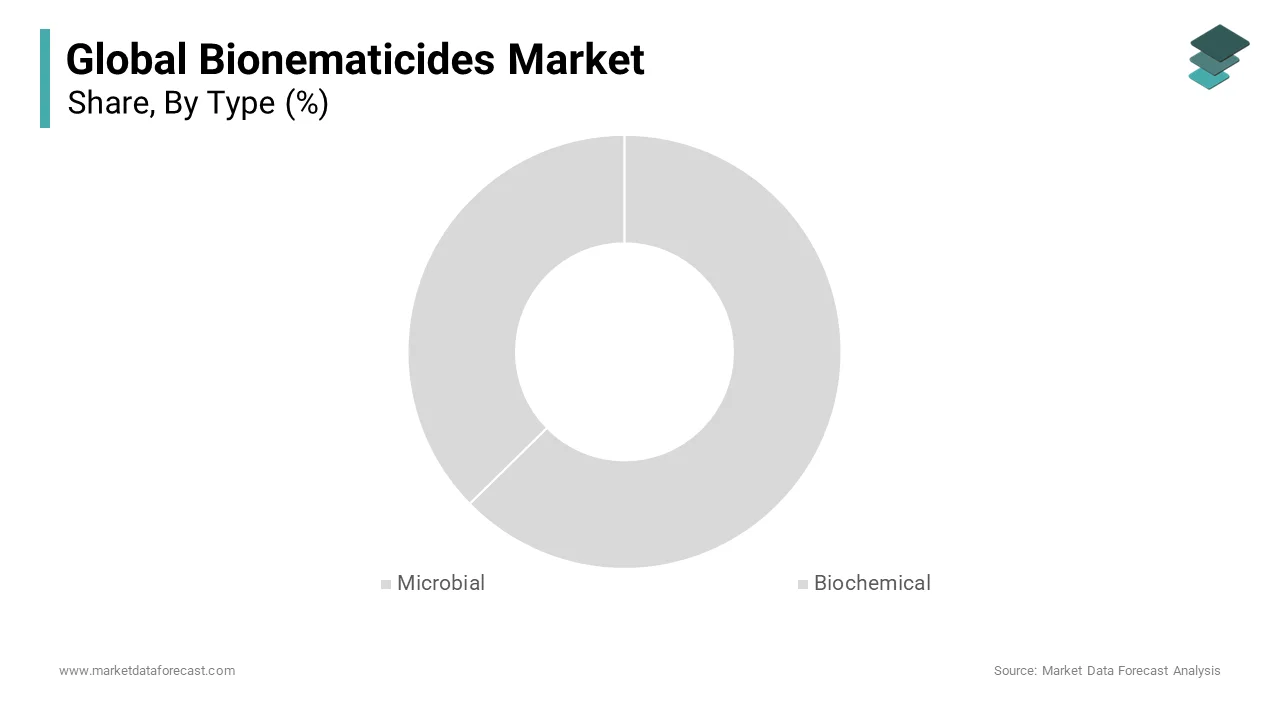
Based on type, the global bionematicides market is segmented into Microbial and Biochemical. The microbial bionematicides segment is dominating the market in the forecast period between 2024 and 2033, as the microbial form of bionematicides enhances nutrient mineralization and, therefore, increases the fertility of the soil and also acts as a biological control agent.
By Form Insights
Based on form, the Global Bionematicides Market is segmented into Liquid and Dry. The Liquid formulation of bionematicides is expected to register significant growth throughout the forecast period. The liquid form of bionematicide is safe and easily applicable. However, the demand for granular or dry forms of bionematicides is also gaining traction due to their long shelf life and ease of storage and transport.
By Crop Insights
Based on crop, the Global Bionematicides Market is segmented into Cereals & grains, Oilseeds & Pulses, Fruits & Vegetables, and Others. Because of the rising occurrence of nematode infestation in several vegetables such as carrots, potatoes, and tomatoes, the vegetable and fruit segment is predicted to hold the greatest market sharNemNematode-infectedbecome damaged and dist, which affects the quality and quantity of the crops. T,heref ore the growers are using bionematicides in fruits and vegetables. Also, the increasing worldwide demand for organic fruits and vegetables is fueling the demand for bionematicides in the market.
By Mode of Application Insights
Based on the mode of application, the Global Bionematicides Market is segmented into Seed Treatment, Soil Treatment, Foliar Sprays, and Others. Soil treatment accounts for the largest market as it promotes seed germination, enables faster growth of the plant, and provides more efficient use of moisture and nutrients, therefore helping in improving crop yields. Owing to the above factors, the soil treatment segment is going to boost the nematicides market in 2022 and 2027.
By Infestation Insights
Based on the infestation, the Global Bionematicides Market is segmented into Root Knot, Cyst Nematodes, Lesion Nematodes, and Others. The root-knot kind of infestation is going to dominate the market as root-knot nematodes attack a wide range of plants, including vegetables, fruit trees, and ornamentals. These kinds of nematodes are difficult to c, control and they can spread easily from garden to garden in soil.
REGIONAL ANALYSIS
The Global Bionematicides Market has been categorized into four regions: North America, Europe, Asia-Pacific, and RoW (Rest of the World).
North America dominates the biopesticides market due to the huge adoption of bio-based pesticides, including bioinsecticides to control the damage of the thAlsoop. Also, the high deployment of advanced and organic agriculture is driving the growth of the market during the forecast period.
The Bionematicides market in Europe is projected to grow at the highest CAGR during the forecas,t period owing to the presence of large agricultural lands for the production of fruits and vegetables on a large scale. Also, the increasing demand for organic products is driving the growth of the bionematicides market.
Asia-Pacific also projects significant growth during this period due to the growing acceptance of organic agriculture and biopesticides in developing countries. Moreover, the increasing awareness among farmers about the benefits of using bionematicides over chemical nematicides is driving the growth of the bionematicide market in this region.
COMPETITIVE LANDSCAPE
KEY MARKET PLAYERS
A few of the market players in the global
- Bayer AG
- Monsanto Company
- Syngenta AG
- BASF SE
- Dow AgroSciences LLC
- FMC Corporation
- Valent BioSciences LLC
- Marrone BioInnovation
- Certis
- T.STANES & COMPANY LIMITED.
RECENT MARKET NEWS
- In June 2021, the number of agricultural crop protection manufacturers supported Crop Lifescience's commitment to a closed transfer system (CTS) universally available. Crop protection manufacturers such as Belchim Crop Protection, FMC Corporation, and Ronseva Group join forces with ADAMA, BASF, Certis Europe, Corteva Agriscience, Nufarm, and Syngenta to introduce easy connections into the European Market. The connect system is developed for liquid crop protection products and consists of two components: a unique cap and a coupler.
- In April 2020, the Ministry of Agriculture of Zilhas adopted unprecedented biological pesticides. One pesticide is based on garlic extract and can be used to control nematodes, and the other is a mite that can be used to control the whitefly that attacks potatoes, tomatoes, and beansong other crops.
MARKET SEGMENTATION
This research report on the global bionematicides market is segmented and sub-segmented into the following categories.
By Type
- Microbial
- Biochemical
By Form
- Liquid
- Dry
By Crop
- Cereals & grains
- Oilseeds & Pulses
- Fruits & Vegetables
- Others
By Mode of Application
- Seed Treatment
- Soil Treatment
- Foliar Sprays
- Others
By Infestation
- Root Knot
- Cyst Nematodes
- Lesion Nematodes
- Others
By Region
- North America
- Europe
- Asia-Pacific
- South America
- Middle East and Africa