- Product Description Description
- Table of Contents TOC
- List of Table & Figure LOT
- Get Free Sample PDF Sample PDF
Market Size, 2025
$47.55 BnMarket Estimate, 2026
$49.45Market Forecast, 2034
$67.68 BnCAGR, 2026–2034
4%Global Flavored Syrups Market Size, Growth, Trends & Forecast (2026–2034)
The global flavored syrups market size was calculated to be USD 47.55 billion in 2025, is anticipated to be worth USD 49.45 billion in 2026, and is projected to scale up to USD 67.68 billion by 2034, registering a compound annual growth rate (CAGR) of 4.0% during the forecast period from 2026 to 2034. Driven by the proliferation of specialty coffee culture, expanding home mixology trends, and the demand for innovative functional and clean-label beverage additives, the market continues to experience steady global expansion.
Key Executive Metrics (At-a-Glance)
- 2025 Base Valuation: USD 47.55 Billion
- 2026 Current Valuation: USD 49.45 Billion
- 2034 Forecast Valuation: USD 67.68 Billion
- Compound Annual Growth Rate (CAGR): 4.0% (2026–2034)
- Dominant Flavor Segment: Vanilla (capturing 32.6% of total volume consumption in 2025)
- Fastest-Growing Flavor Segment: Fruit (projected at a CAGR of 10.6% from 2026 to 2034)
- Dominant Flavor Type Segment: Sweet (holding the largest market share due to foundational consumer preference)
- Fastest-Growing Flavor Type Segment: Salty (projected at a CAGR of 9.3% through 2034, driven by umami and savory beverage trends)
- Dominant Application Segment: Beverage (commanding 64.8% of total demand in 2025)
- Fastest-Growing Application Segment: Dairy & Frozen Desserts (expanding at a CAGR of 9.8% from 2026 to 2034)
- Regional Leader: North America (accounting for 39.5% of total revenue in 2025)
Core Market Drivers
- Specialty Coffee Culture: Global expansion of independent and chain cafes transforming syrups into essential sensory differentiators.
- At-Home DIY Experimentation: Rising consumer engagement in home mixology, cocktail customization, and gourmet retail syrup purchasing.
- Functional & Plant-Based Innovations: Shift toward adaptogen-infused wellness syrups and vegan-certified, allergen-friendly formulations.
Primary Market Restraints & Challenges
- Health & Sugar Concerns: Increased regulatory and consumer scrutiny over high sugar content and artificial additives, pushing brands toward reduced-sugar trade-offs.
- Supply Chain Vulnerabilities: Climate-driven instability and geographic concentration in natural flavoring agent production, particularly vanilla and luxury botanicals.
- Regulatory Inconsistencies: Fragmented global definitions of "natural flavor" and varying labeling standards complicating cross-border scalability.
Global Flavored Syrups Market Segmentation Breakdown
| Segment Category | Leading Sub-Segment (2025 Base) | Fastest-Growing Sub-Segment (2026–2034) |
|---|---|---|
| By Flavor | Vanilla (32.6% volume share in 2025; universal application versatility) | Fruit (10.6% CAGR driven by clean-label and refreshing profiles) |
| By Flavor Type | Sweet (dominant baseline share across core beverage and dessert systems) | Salty (9.3% CAGR driven by umami, salted caramel, and savory mixology) |
| By Application | Beverage (64.8% demand share in 2025; coffee, tea, and cocktail bases) | Dairy & Frozen Desserts (9.8% CAGR driven by premium artisanal treats) |
| By Region | North America (39.5% revenue share in 2025; mature café infrastructure) | Asia-Pacific (fastest transformation via urbanization and Western café expansion) |
Major Industry Players Profiled
Key market leaders shaping the global flavored syrups landscape include Hershey, Tate & Lyle, The Kraft Heinz Company, Monin Inc., Kerry Group Plc., Sonoma Syrup Co., Cedarvale Maple Syrup, and VSBO.
Global Flavored Syrups Market Size
The global flavored syrups market size was calculated to be USD 47.55 billion in 2025 and is anticipated to be worth USD 67.68 billion by 2034 from USD 49.45 billion in 2026, growing at a CAGR of 4% during the forecast period. The global syrup market is experiencing significant demand from the food and beverage industry.
Flavored Syrups refers to a category of concentrated, sweetened liquid solutions infused with natural or artificial flavorings, primarily used to enhance beverages, desserts, and culinary preparations. These syrups, ranging from classic vanilla and caramel to exotic options like lavender, yuzu, and hibiscus, are integral to specialty coffee, craft cocktails, dairy alternatives, and plant-based beverages. As per the U.S. Department of Agriculture, the average American consumes 17 teaspoons of added sugars daily, with flavored syrups contributing to both indulgent and functional beverage segments. With evolving consumer palates and the proliferation of café culture, flavored syrups have transitioned from niche additives to mainstream sensory enhancers.
MARKET DRIVERS
Proliferation of Specialty Coffee and Third-Wave Café Culture
The global expansion of specialty coffee shops has significantly amplified demand for premium flavored syrups, transforming them from simple sweeteners into curated flavor experiences. Also, the number of specialty coffee outlets worldwide surged in 2023. Independent cafes in cities like London, Melbourne, and Seoul are increasingly partnering with local syrup producers to offer region-specific flavors such as matcha, ube, and rose. This cultural shift toward experiential beverage consumption is making flavored syrups a strategic differentiator in competitive foodservice environments.
Rising Consumer Interest in Home Mixology and DIY Beverage Customization
The normalization of remote work and home-based entertainment has catalyzed a surge in at-home cocktail and beverage experimentation, significantly boosting retail flavored syrup sales. Moreover, global sales of cocktail syrups and mixers grew between 2020 and 2023, with consumers seeking bar-quality experiences without professional equipment. Retailers have expanded their gourmet syrup offerings by over 50% since 2021, responding to demand for premium, small-batch products. This trend underscores a lasting behavioral change in consumer engagement with flavor customization.
MARKET RESTRAINTS
Growing Health Concerns Over Sugar Content and Artificial Ingredients
Increasing consumer skepticism toward high sugar levels and synthetic additives, which are prevalent in many conventional products, is a primary restraint in the flavored syrups market. Like, excessive sugar intake contributes to millions of deaths annually, prompting regulatory scrutiny and consumer avoidance. As a result, major foodservice chains like Dunkin’ and Costa Coffee have reformulated their syrup lines to include reduced-sugar options, but the transition remains challenging due to taste and shelf-life trade-offs, slowing innovation in mass-market segments.
Supply Chain Vulnerability for Natural Flavoring Agents
The production of premium flavored syrups relies heavily on botanical extracts, essential oils, and exotic ingredients that are susceptible to climatic, geopolitical, and logistical disruptions. As per the Food and Agriculture Organization, vanilla bean production, used in about 42% of flavored syrups, has declined in Madagascar since 2020 due to cyclones and illegal deforestation. The U.S. Department of Agriculture points out that 70% of global vanilla supply originates from Madagascar and Indonesia, creating concentration risk. Similarly, saffron, used in luxury syrups, is affected by droughts in Iran, which produces 90% of the world’s supply, according to Iran’s Agricultural Ministry. These supply instabilities hinder consistent product formulation and pricing, particularly for small and mid-sized syrup producers dependent on single-source ingredients.
MARKET OPPORTUNITIES
Expansion into Functional and Wellness-Oriented Syrup Formulations
The flavored syrups market is witnessing a transformative shift toward functional beverages, where syrups serve as delivery vehicles for adaptogens, nootropics, and digestive aids. Brands like Monin and Small Hand Foods have launched syrups infused with turmeric, ashwagandha, and L-theanine, targeting cognitive health and stress reduction. In the U.S., 54% of consumers are willing to pay a premium for beverages with added health benefits, as per the International Food Information Council. This convergence of flavor and function is redefining syrups as active ingredients in holistic wellness regimens.
Adoption of Plant-Based and Vegan-Friendly Syrup Innovations
The rise of plant-based diets has spurred demand for syrups free from animal-derived processing agents and aligned with clean-label trends. As per the Plant Based Foods Association, sales of plant-based products in the U.S. reached $8.1 billion in 2023, with beverage customization emerging as a key growth vector. Traditional syrups often use bone char in sugar refining, rendering them non-vegan; in response, companies like DaVinci Gourmet and Jordan’s Skinny Syrups now certify their products as vegan and non-GMO. Additionally, dairy-free coffee shops in cities like San Francisco and Amsterdam are curating exclusive syrup menus using organic agave and birch xylitol bases. This alignment with ethical consumption is unlocking premiumization and brand loyalty in environmentally conscious markets.
MARKET CHALLENGES
Intense Product Differentiation Challenges in a Crowded Market
Despite high demand, the flavored syrups market faces saturation, making it difficult for new entrants to achieve brand recognition and consumer trust. Consumers often struggle to distinguish between similar flavor profiles, such as salted caramel or vanilla bean, due to inconsistent ingredient quality and naming conventions. This commoditization pressures manufacturers to invest heavily in packaging, storytelling, and influencer marketing, increasing operational costs without guaranteed returns, particularly for artisanal producers with limited distribution.
Regulatory and Labeling Inconsistencies Across Global Markets
The flavored syrups industry operates under a fragmented regulatory landscape, complicating international expansion and consumer transparency. As per the Codex Alimentarius Commission, definitions of "natural flavor" vary significantly, while the U.S. FDA allows certain synthetic solvents in natural extracts, the European Union prohibits them. In Japan, the Ministry of Health, Labour and Welfare requires full disclosure of allergens and processing aids, whereas regulations in Southeast Asia remain underdeveloped. Additionally, the absence of standardized serving size guidelines leads to consumer confusion. These disparities increase compliance costs and hinder global scalability, especially for small producers navigating complex import requirements.
REPORT COVERAGE
| REPORT METRIC | DETAILS |
| Market Size Available | 2025 to 2034 |
| Base Year | 2025 |
| Forecast Period | 2026 to 2034 |
| CAGR | 4.0% |
| Segments Covered | By Flavor, Flavor Type, Application, and Region |
| Various Analyses Covered | Global, Regional, & Country Level Analysis; Segment-Level Analysis; DROC; PESTLE Analysis; Porter’s Five Forces Analysis; Competitive Landscape; Analyst Overview of Investment Opportunities |
| Regions Covered | North America, Europe, APAC, Latin America, Middle East & Africa |
| Market Leaders Profiled | Hershey, Tate & Lyle, Kraft Heinz Company, Monin Inc., Kerry Group Plc., Sonoma Syrup, Cedarvale Maple Syrup, and VSBO, and others. |
SEGMENTAL ANALYSIS
By Flavor Insights
The vanilla segment dominated the flavored syrups market by capturing 32.6% of total volume consumption in 2025. This lead position is rooted in its universal appeal, sensory versatility, and foundational role in beverage and dessert formulation. Vanilla is the most widely used flavor in coffee-based drinks. The U.S. Department of Agriculture notes that Madagascar and Indonesia supply over 80% of global natural vanilla, though price volatility has prompted manufacturers to blend natural and nature-identical vanillin. Additionally, vanilla’s compatibility with dairy, plant-based milks, and alcohol makes it indispensable in product development, ensuring its entrenched position across foodservice, retail, and industrial applications.

The fruit flavor segment is growing at the fastest pace and is projected to expand at a CAGR of 10.6% from 2026 to 2034. This surge is driven by consumer demand for vibrant, refreshing, and perceived “natural” taste experiences, particularly in non-alcoholic and functional beverages. A significant share of consumers associate fruit flavors with lower sugar and higher healthfulness, even when sweetness levels are comparable. With clean-label trends favoring recognizable fruit names over abstract flavor descriptors, this segment is redefining consumer expectations in both home and commercial settings.
By Flavor Type Insights
The sweet flavor type segment held the largest share of the flavored syrups market in 2025. This dominance is due to the intrinsic role of syrups as sweetening agents in beverages and desserts, aligning with deeply ingrained consumer palates and formulation requirements. The World Health Organization acknowledges that sweetness is the most universally preferred taste, particularly in caffeinated and carbonated drinks where sugar or syrup masks bitterness. In the U.S., as per the Centers for Disease Control and Prevention, over 40% of adults consume at least one sugary beverage daily, with flavored syrups contributing significantly to added sugar intake. Also, sweetness perception directly influences purchase decisions. As a result, even sugar-reduced syrups maintain sweet profiles using non-nutritive sweeteners like stevia and sucralose, ensuring continuity in taste preference across health-conscious and indulgent segments.
The salty flavor type is emerging as the fastest-growing and is projected to grow at a CAGR of 9.3% through 2034. This growth is fueled by the rising popularity of umami-rich and savory beverage experiences, particularly in hybrid drinks and premium mixology. The trend is exemplified by the global success of salted caramel. In South Korea, the Ministry of Food and Drug Safety confirms that “salted fruit” syrups, such as salted plum and salted yuzu, are featured in a portion of seasonal café menus, appealing to consumers seeking complex taste profiles. Besides, the Japanese concept of kansha (balance) in taste has popularized salt-infused syrups in tea and milk-based drinks. As consumers move beyond simple sweetness, salty syrups are becoming key tools in flavor layering and sensory innovation.
By Application Insights
The beverage segment commanded the largest share of the flavored syrups market at 64.8% of total demand in 2025. This dominance is driven by the central role of syrups in coffee, tea, cocktails, and functional drinks, where flavor customization is a primary value proposition. As per the National Coffee Association, a notable portion of American coffee drinkers use flavored syrups. In the UK, flavored coffee sales increased between 2020 and 2023, driven by younger consumers. The rise of plant-based milks has further amplified syrup use to mask earthy notes. Besides, RTD beverage manufacturers like Coca-Cola and PepsiCo are incorporating syrup-based flavor systems into new product lines such as Topo Chico Hard Seltzer and Starbucks Refreshers. With beverages serving as the primary vehicle for flavor experimentation, this segment remains the core engine of syrup innovation and consumption.
The dairy & frozen desserts segment is expanding at the fastest rate and is projected to grow at a CAGR of 9.8% from 2026 to 2034. This acceleration is driven by the increasing use of flavored syrups in premium ice creams, soft-serve, yogurt parfaits, and artisanal gelato, where swirls and ripples enhance visual appeal and taste complexity. With indulgence and sensory experience becoming key purchase drivers, syrups are evolving from mere additives to central components in high-margin dessert innovation.
REGIONAL ANALYSIS
North America Flavored Syrups Market Insights
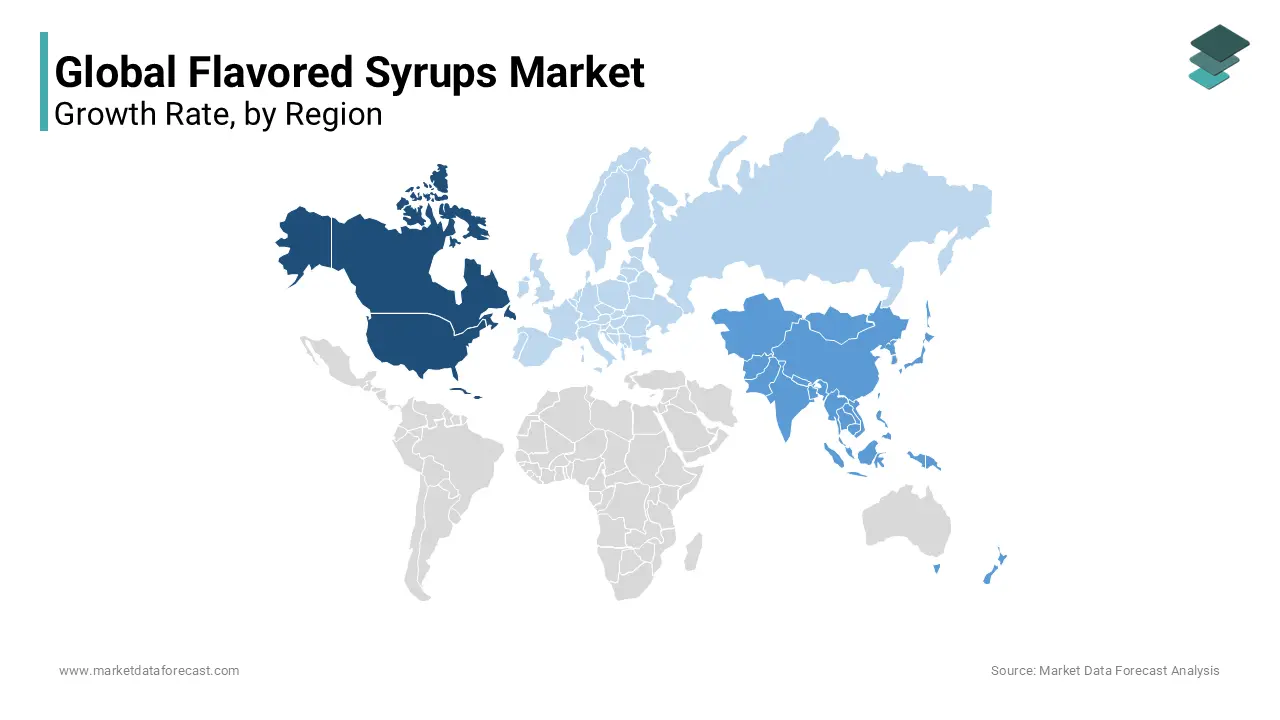
North America held the most influential position in the global flavored syrups market by accounting for 39.5% of total revenue in 2025. The region’s position is anchored in its deeply embedded café culture, high disposable income, and early adoption of beverage customization trends. Canada has seen an increase in flavored syrup usage in specialty tea and cold brew beverages since 2020. Major players are headquartered in the U.S., driving innovation in sugar-free, organic, and functional syrups. With Starbucks, Dunkin’, and independent cafés setting global flavor trends, North America remains the epicenter of product development and consumer preference shaping in the flavored syrups industry.
Europe Flavored Syrups Market Insights
Europe holds a significant share of the global flavored syrups market, with a strong emphasis on premiumization and artisanal quality. The region’s market is characterized by high demand for natural ingredients, regional flavor profiles, and sustainability. France has seen a rise in syrup-based cocktail sales in bistros since 2021, driven by the aperitivo culture. The UK’s Food Standards Agency has tightened labeling rules for “natural” claims, pushing brands like Monin and Jordan’s to reformulate with transparent sourcing. Besides, Germany’s clean-label movement has accelerated demand for syrups free from preservatives and artificial colors. With strong regulatory frameworks and discerning consumers, Europe remains a high-value, innovation-driven market.
Asia Pacific Flavored Syrups Market Insights
Asia Pacific accounts for a notable share of the global flavored syrups market, and is experiencing the most rapid transformation due to urbanization and Western-style café proliferation. China has large number of specialty coffee outlets, with Shanghai and Beijing leading in flavored beverage adoption. India’s café market is expanding at annually, with chains like CCD and Starbucks introducing localized syrups such as cardamom, mango, and rose. Japan confirms that seasonal syrup launches, such as sakura and yuzu, drive a notable share of quarterly café sales. Australia’s craft cocktail scene has embraced native botanical syrups like finger lime and lemon myrtle. With rising disposable incomes and digital influence, the region is becoming a testing ground for culturally adapted, premium flavor innovation.
Latin America Flavored Syrups Market Insights
Latin America contributes a descent share to the global flavored syrups market, with Brazil and Mexico leading demand. The region’s growth is fueled by expanding middle-class consumption and the popularity of sweet, fruit-forward flavor profiles. Colombia and Chile are witnessing rising adoption of specialty coffee. However, price sensitivity and limited access to imported syrups constrain premium segment growth. Despite this, local producers are innovating with native fruits like guava, tamarind, and soursop, creating a distinct regional flavor identity.
Middle East Flavored Syrups Market Insights
The Middle East is witnessing accelerated adoption due to urban luxury consumption and café culture expansion. The UAE, particularly Dubai and Abu Dhabi, hosts specialty cafes, many offering bespoke syrup menus with flavors like saffron, dates, and rosewater. Saudi Arabia’s Vision 2030 includes major investment in lifestyle and entertainment sectors, including café and dessert chains, driving syrup demand. Additionally, Ramadan-themed syrups, such as jallab and tamarind, see seasonal sales spikes, with volumes increasing. With high urbanization and youth-driven consumption, the Middle East is evolving into a niche but high-potential market for culturally resonant flavor innovation.
KEY MARKET PLAYERS AND COMPETITIVE LANDSCAPE
Hershey, Tate & Lyle, Kraft Heinz Company, Monin Inc., Kerry Group Plc., Sonoma Syrup, Cedarvale Maple Syrup, and VSBO are some of the notable companies in the global flavored syrups market.
The flavored syrups market features a competitive landscape where global leaders coexist with regional specialty producers, creating a dynamic environment shaped by flavor innovation and brand positioning. Competition is less price-driven and more focused on differentiation through ingredient quality, flavor authenticity, and application versatility. Monin, Torani, and DaVinci dominate through strong B2B relationships, culinary expertise, and global distribution, while local brands gain traction with culturally resonant profiles. The rise of private-label syrups and artisanal startups intensifies pressure on incumbents to innovate continuously. Success hinges on the ability to anticipate consumer trends, support foodservice professionals, and adapt to regulatory and health-related shifts. With flavor experience becoming a key purchase driver, the market rewards agility, storytelling, and technical excellence in product formulation and delivery.
TOP PLAYERS IN THE MARKET
Monin
Monin has established a dominant presence in the Asia Pacific flavored syrups market by positioning itself as a premium supplier for specialty coffee, mixology, and dessert applications. The company has expanded aggressively into China, Japan, India, and Australia, offering over 200 flavors, including region-specific innovations like lychee, matcha, and rose. It partnered with leading café chains in South Korea to co-develop seasonal menus featuring limited-edition syrups. The company also launched its "Clean Label" range in Australia, using cane sugar and natural extracts to meet clean-label demands. By emphasizing sensory expertise, culinary collaboration, and sustainability—such as recyclable packaging—Monin has become a trusted partner in high-end foodservice and retail channels across the region.
Torani
Torani has strengthened its footprint in the Asia Pacific market by leveraging its heritage in flavor innovation and its growing portfolio of non-dairy, sugar-free, and functional syrups. The company has focused on urban café hubs in India, Thailand, and the Philippines, where its vibrant, bold flavors align with local taste preferences for sweet and aromatic beverages. It collaborated with Starbucks Japan to supply exclusive syrup variants for seasonal sakura and yuzu beverages. Torani also launched a digital flavor configurator tool for café owners in Indonesia, enabling real-time customization of drink menus. With its emphasis on ease of integration, flavor consistency, and digital engagement, Torani is expanding beyond traditional coffee applications into RTD beverages and dessert manufacturing, reinforcing its relevance in dynamic consumer markets.
DaVinci Gourmet
DaVinci Gourmet has carved a niche in the Asia Pacific flavored syrups market by focusing on quality, versatility, and health-conscious innovation. The company’s presence has grown in Australia, New Zealand, and select Southeast Asian markets through partnerships with premium coffee roasters and boutique dessert studios. It expanded its distribution network in India by collaborating with urban café franchises to supply sugar-free and vegan-certified syrups aligned with wellness trends. The company also launched a sustainability initiative in 2023, transitioning to 100% recyclable bottles across its Asia Pacific supply chain. By combining technical performance with clean-label transparency and environmental responsibility, DaVinci Gourmet is positioning itself as a modern, reliable brand for both professional and retail consumers seeking consistency and integrity in flavor solutions.
TOP STRATEGIES USED BY KEY MARKET PLAYERS
Key players in the flavored syrups market are focusing on flavor innovation, regional customization, and strategic partnerships to capture emerging opportunities. Companies are investing in R&D to develop clean-label, sugar-free, and functional syrups infused with botanicals and adaptogens. Expansion into high-growth markets is being driven by localized flavor development, training programs for baristas, and collaborations with café chains and beverage brands. Digital engagement tools, e-commerce platforms, and sustainable packaging are enhancing brand loyalty. Firms are also strengthening supply chains and ensuring regulatory compliance across diverse markets. These strategies collectively aim to balance premium quality with cultural relevance, scalability, and evolving consumer expectations in a competitive, taste-driven industry.
RECENT HAPPENINGS IN THE MARKET
- In January 2022, Monin opened a barista training and innovation center in Singapore, offering hands-on workshops to café professionals across Southeast Asia and strengthening its brand presence in high-growth urban markets.
- In June 2022, Torani launched a plant-based syrup line in Thailand, specifically formulated to remain stable in oat and almond milk, addressing a critical formulation challenge in the region’s dairy-free beverage market.
- In September 2022, DaVinci Gourmet introduced its True White syrup series in Australia, preventing discoloration in non-dairy lattes and enhancing compatibility with plant-based milk systems.
- In March 2023, Monin collaborated with Starbucks Japan to co-develop exclusive seasonal syrups for sakura and yuzu beverages, increasing visibility in premium café menus.
- In November 2023, Torani launched a digital flavor configurator for café owners in Indonesia, enabling real-time menu customization and improving engagement with independent beverage operators.
MARKET SEGMENTATION
This research report on the global flavored syrups market has been segmented and sub-segmented based on flavor, flavor type, application, & region.
By Flavor
- Chocolate
- Coffee
- Herbs & Seasonings
- Vanilla
- Fruit
- Maple
- Malt
- Palm
- Others
By Flavor Type
- Salty
- Sour
- Mint
- Savoury
- Sweet
By Application
- Dairy & Frozen Desserts
- Bakery
- Confectionery
- Beverage
- Others
By Region
- North America
- Europe
- Asia Pacific
- Latin America
- Middle East and Africa