- Product Description Description
- Table of Contents TOC
- List of Table & Figure LOT
- Get Free Sample PDF Sample PDF
Market Size, 2025
$5587.60 MnMarket Estimate, 2026
$7289.58 MnMarket Forecast, 2034
$61,167.51 MnCAGR, 2026–2034
30.46%Executive Summary: 3D Printing Medical Devices Market
- Market Scope: Comprehensive global 3D printing medical devices industry analysis covering patient-specific implants, preoperative planning tools, material innovations (metals/alloys), regional leadership frameworks, strategic corporate developments, and competitive landscapes.
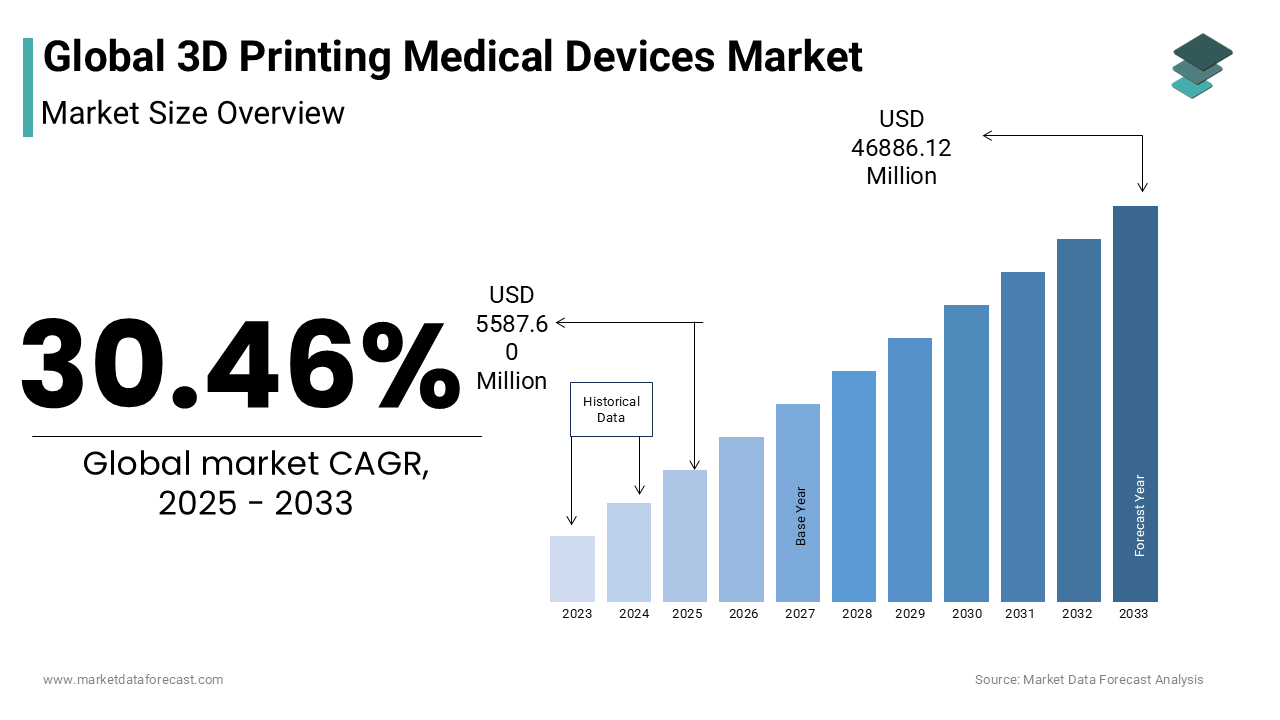
- Market Valuation: Valued at USD 5,587.60 million (2025), estimated at USD 7,289.58 million (2026), and projected to reach USD 61,167.61 million by 2034, registering an exceptional CAGR of 30.46% (2026–2034).
- Primary Growth Drivers: Patient-specific implants demand, preoperative planning anatomical models, FDA regulatory clearances (500+ devices), point-of-care manufacturing adoption, and bioprinting advancements. Restraints include stringent MDR compliance timelines, biocompatible material limits, and high capital costs.
Key Market Segment Metrics (2026–2034)
| Category | Leading Segment / Region (Position) | Fastest-Growing Segment |
|---|---|---|
| By Product Type & Materials | Medical implants (dominated with 37.8% share) & Metal and metal alloys (led materials with 34.5% share via titanium) | Tissue engineering (anticipated to witness 18.6% CAGR) & Electron beam melting technology |
| By Application & Technology | Orthopedic and dental load-bearing implant applications using electron beam melting | Regenerative medicine breakthroughs and pharmaceutical toxicity screening models |
| By Region | North America (dominated with 43.2% global share in 2024 via advanced healthcare infrastructure) & Europe (29.1% share) | Asia-Pacific clinical and hospital lab adoption corridors (driven by regional regulatory approvals and partnerships) |
Major Market Players & Market Structure
Market Structure: Highly collaborative global medical additive manufacturing ecosystem driven by international regulatory approvals (PMDA, NMPA, FDA), hospital partnerships (Apollo Hospitals, Asan Medical Center), and localized healthcare innovation centers.
Key Companies: 3D Systems Corporation, Stratasys Ltd., Renishaw plc, EOS GmbH Electro Optical Systems, EnvisionTEC GmbH, Materialise NV, Arcam AB, 3T RPD Ltd., Prodways, and Concept Laser GmbH.
 Download Free Sample Report
Global 3D Printing Medical Devices Market Size
The global 3D printing medical devices market size was valued at USD 5587.60 million in 2025 and is anticipated to reach USD 7289.58 million in 2026 from USD 61,167.61 million by 2034, growing at a CAGR of 30.46% during the forecast period from 2026 to 2034.
3D printing in medical devices refers to the additive manufacturing of patient-specific implants, surgical instruments, prosthetics, and anatomical models using biocompatible materials such as titanium, polymers, and bio-inks. This technology enables precise replication of complex anatomical structures derived from patient imaging data, transforming preoperative planning and surgical execution. As per the U.S. Food and Drug Administration, over 500 3D-printed medical devices have received regulatory clearance since 2010, including spinal implants, cranial plates, and dental prostheses. The integration of 3D printing into clinical settings has been further validated by institutions such as Mayo Clinic, where customized surgical models are routinely used in congenital heart defect repairs, reducing operative time by up to 25%.
MARKET DRIVERS
Surge in Demand for Patient-Specific Implants and Prosthetics
The growing demand for anatomically matched implants is a primary factor accelerating the growth of 3D printing in the medical devices market. Traditional off-the-shelf implants often fail to align with individual patient geometries, leading to complications such as implant loosening or misalignment. 3D printing enables the production of custom cranial, orthopedic, and maxillofacial implants tailored to a patient’s unique anatomy. As per the Journal of Neurosurgery, the use of 3D-printed cranial implants has reduced postoperative complications by 32% compared to standard prostheses, with a 98% fit accuracy rate in over 15,000 cases analyzed between 2018 and 2022. The ability to create porous, lattice-structured surfaces that mimic natural bone architecture enhances osseointegration, making 3D-printed implants particularly valuable in revision surgeries and complex reconstructions.
Expansion of Preoperative Planning and Surgical Simulation Tools
The integration of 3D-printed anatomical models into surgical planning has significantly improved procedural precision and reduced intraoperative risks is propelling the growth of the 3D Printing Medical Devices Market. Surgeons increasingly rely on patient-specific physical models derived from CT and MRI scans to simulate complex interventions before entering the operating room. According to a 2023 study published in The Lancet Digital Health, the use of 3D-printed cardiac models in pediatric congenital heart surgery reduced cross-clamp time by an average of 28 minutes per procedure. In liver resections, the University of Tokyo reported a 35% decrease in blood loss when 3D models were used for preoperative vascular mapping. Institutions such as Boston Children’s Hospital have incorporated 3D printing into over 70% of their high-risk cardiac and craniofacial surgeries.
MARKET RESTRAINTS
Stringent Regulatory and Quality Assurance Requirements
The regulatory scrutiny in the healthcare industry is hindering the growth of the 3D Printing Medical Devices Market. As per the European Medicines Agency, the average time to obtain CE marking for a 3D-printed implant has increased to 18 months post-MDR implementation in 2021, up from 10 months previously. Additionally, ensuring batch-to-batch consistency in additive manufacturing remains challenging due to variability in laser power, powder composition, and layer adhesion. A 2022 audit by the International Organization for Standardization found that 45% of 3D-printed orthopedic implants failed mechanical stress tests due to undetected micro-porosity.
Limited Availability of Biocompatible and Functional Printing Materials
The range of FDA-approved materials suitable for 3D printing remains constrained is limiting the scope of viable medical applications, which is restricting the growth of the 3D Printing Medical Devices Market. While titanium and PEEK (polyether ether ketone) are widely used for load-bearing implants, there is a critical shortage of biodegradable, flexible, or electrically conductive materials for soft tissue engineering and bio-integrated devices. According to the Biomaterials Science journal, fewer than 12 polymers are currently cleared by the FDA for implantable 3D-printed devices, restricting innovation in areas such as nerve regeneration scaffolds and cardiac patches. A 2023 study by the National Institute of Biomedical Imaging and Bioengineering revealed that 30% of 3D-printed polymer implants exhibited unexpected inflammatory responses in preclinical models. These material limitations hinder the translation of experimental bio-printing concepts into clinically approved therapies.
MARKET OPPORTUNITIES
Growth of Point-of-Care Manufacturing in Hospitals
The decentralization of device production through in-hospital 3D printing labs presents a transformative opportunity for real-time, on-demand medical solutions is creating new opportunities for the growth of the 3D Printing Medical Devices Market. Leading healthcare institutions are establishing centralized fabrication units to produce surgical guides, anatomical models, and even implants within hospital premises. As per the Radiological Society of North America, over 120 U.S. hospitals operated accredited 3D printing facilities as of 2023, with Mayo Clinic producing more than 4,000 patient-specific models annually. This shift reduces reliance on external vendors, shortens lead times from weeks to hours, and enhances surgical preparedness.
Advancement in Bioprinting for Tissue Engineering and Regenerative Medicine
The bioprinting using living cells and bio-inks holds immense potential for creating functional tissues and organoids for transplantation and drug testing, which is expected to fuel the growth of the 3D Printing Medical Devices Market. Researchers have successfully printed vascularized skin grafts, cartilage constructs, and beating cardiac patches using patient-derived stem cells. According to the Wake Forest Institute for Regenerative Medicine, a 3D-bioprinted ear implant was successfully transplanted in a human patient in 2022, marking a milestone in reconstructive surgery. In oncology, Organovo’s 3D-printed liver tissue models are being used by pharmaceutical companies to assess drug toxicity with 85% higher accuracy than traditional 2D cultures, as reported in Nature Biotechnology.
MARKET CHALLENGES
High Capital and Operational Costs of Industrial-Grade 3D Printing Systems
The financial burden associated with acquiring and maintaining medical-grade 3D printing infrastructure in mid-tier and public healthcare facilities hampers the growth of the 3D Printing Medical Devices Market. According to the Healthcare Financial Management Association, the total cost of ownership for a hospital-based metal 3D printing unit exceeds $2.1 million over five years, including staffing, maintenance, and quality control. Polymer systems, while less expensive, still require investments in sterilization protocols and regulatory documentation. These economic barriers limit scalability and delay the democratization of personalized medical devices across diverse healthcare economies.
Lack of Skilled Workforce and Standardized Training Programs
The effective deployment of 3D printing in medical settings demands a multidisciplinary team proficient in radiology, biomedical engineering, and regulatory compliance is significantly hindering the growth of the 3D Printing Medical Devices Market. This skills gap leads to suboptimal model design, inaccurate segmentation of imaging data, and non-compliance with clinical validation protocols. The European Society of Radiology reports that 60% of 3D-printed models in EU hospitals are created by technicians without clinical oversight, increasing the risk of anatomical inaccuracies.
REPORT COVERAGE
| REPORT METRIC | DETAILS |
| Market Size Available | 2025 to 2034 |
| Base Year | 2025 |
| Forecast Period | 2026 to 2034 |
| CAGR | 30.46% |
| Segments Covered | By Product, Material, Technology, and Region |
| Various Analyses Covered | Global, Regional & Country Level Analysis, Segment-Level Analysis; DROC, PESTLE Analysis, Porter's Five Forces Analysis, Competitive Landscape, Analyst Overview of Investment Opportunities |
| Regions Covered | North America, Europe, APAC, Latin America, Middle East & Africa |
| Market Leader Profiled | 3D Systems Corporation (U.S.), Stratasys Ltd., Renishaw plc (U.K.), EOS GmbH Electro Optical Systems (Germany), EnvisionTEC GmbH (Germany), Materialize NV (Belgium), Arcam AB (Sweden), 3T RPD, Ltd. (U.K.), Prodways (France) and Concept Laser GmbH (Germany) |
SEGMENTAL ANALYSIS
By Product Type Insights
The medical implants segment accounted in holding 37.8% of the 3D Printing Medical Devices Market share in 2024, owing to the increasing clinical demand for patient-specific orthopedic, cranial, and spinal implants. The precision of 3D printing allows for the creation of porous, trabecular structures that promote osseointegration, which improves long-term implant stability. According to the Journal of Arthroplasty, 3D-printed titanium acetabular cups used in hip replacements demonstrated a 42% higher bone ingrowth rate compared to traditionally manufactured implants in a 2022 multicenter study. Additionally, the U.S. Food and Drug Administration has cleared over 180 3D-printed implant designs since 2015, including Stryker’s Tritanium spinal cages and Zimmer Biomet’s Persona Knees, which are customized to patient anatomy.
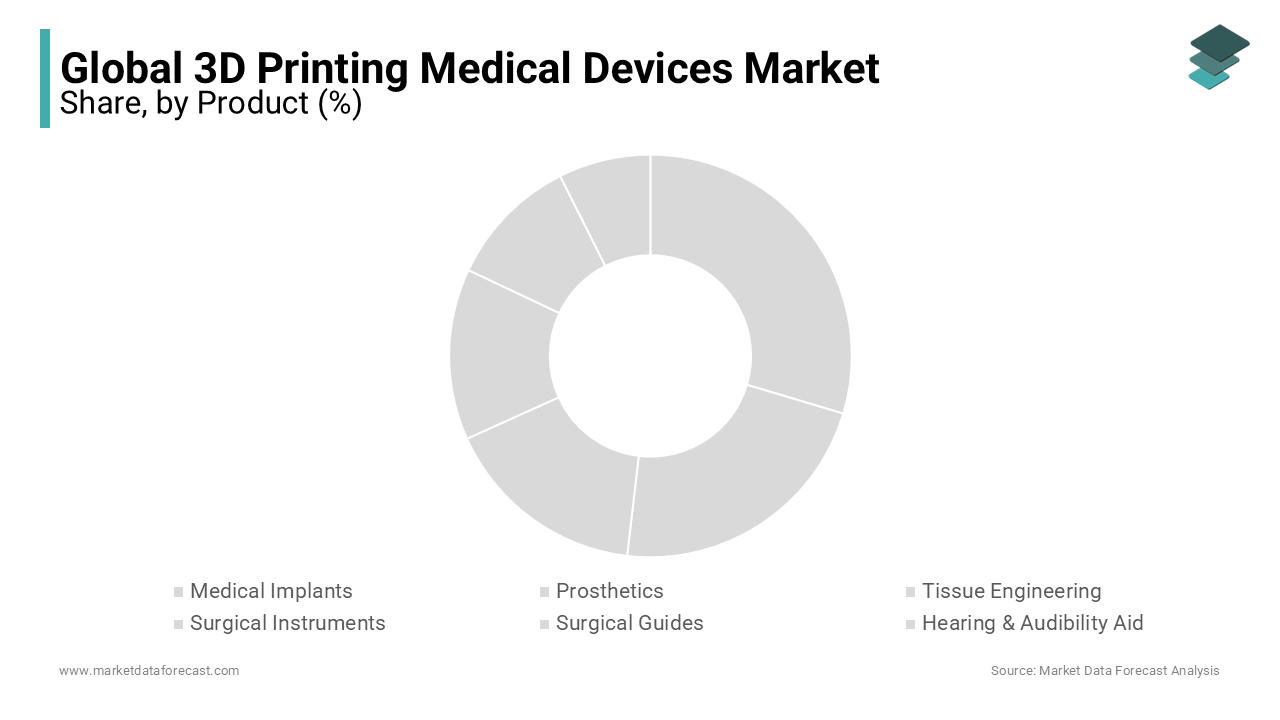
The tissue engineering segment is likely to witness an expected CAGR of 18.6% during the forecast period in bioprinting technologies capable of depositing living cells and bio-inks into functional tissue constructs. Researchers at the Wake Forest Institute for Regenerative Medicine successfully implanted a 3D-bioprinted ear in a pediatric patient with microtia in 2022, marking a pivotal clinical milestone. The National Institutes of Health reports that over 120,000 Americans are on the organ transplant waiting list, fueling investment in bioengineered tissues as a viable alternative. Furthermore, pharmaceutical companies are adopting 3D-printed tissue models for drug toxicity screening; a 2023 study in Nature Biotechnology found that 3D-bioprinted liver tissues predicted hepatotoxicity with 92% accuracy, far surpassing conventional 2D cell cultures.
By Material Type Insights
The metal and metal alloys segment was the largest and held 34.5% of the 3D Printing Medical Devices Market in 2024, with the widespread use of titanium and cobalt-chrome in load-bearing medical implants such as hip stems, dental fixtures, and spinal cages. Titanium’s biocompatibility, corrosion resistance, and mechanical strength make it ideal for long-term implantation. According to the American Society for Testing and Materials, over 85% of 3D-printed orthopedic implants utilize Ti-6Al-4V alloy due to its optimal strength-to-density ratio.
The biomaterials segment is anticipated to grow at a CAGR of 17.9% throughout the forecast period. These materials include hydrogels, decellularized extracellular matrices, and bio-inks composed of living cells, which are essential for creating functional tissue constructs. The National Institute of Biomedical Imaging and Bioengineering reports that over 40 bio-ink formulations are currently in preclinical or clinical testing for applications in skin, cartilage, and vascular grafts. Additionally, the European Commission’s Horizon Europe program has allocated €90 million to biomaterial innovation in tissue engineering between 2021 and 2025.
By Technology Insights
The electron beam melting (EBM) segment is estimated to register the highest share of the global market during the forecast period. The growing number of dental institutes and rising demand for dental crowns and bridges accelerate segmental growth. The EBM process is particularly suitable for small batch production of complex orthopedic implants through an electron beam, which is several times more potent than a laser, for producing perfectly dense and exact layer-by-layer melting of powder to produce parts, ultimately leading to faster print speeds.
The laser beam melting (LBM) segment is anticipated to hold a substantial share of the global market during the forecast period. Laser beam melting is an additive manufacturing process for digitally cutting 3D components into 2D layers. Due to its high-performance laser, it becomes Ideal for producing solid functional parts with complex geometries, exposing surfaces of the 2D layers. Saving printing and post-processing time without the requirement of support is the reason behind its high adoption.
REGIONAL ANALYSIS
North America 3D Printing Medical Devices Market Analysis
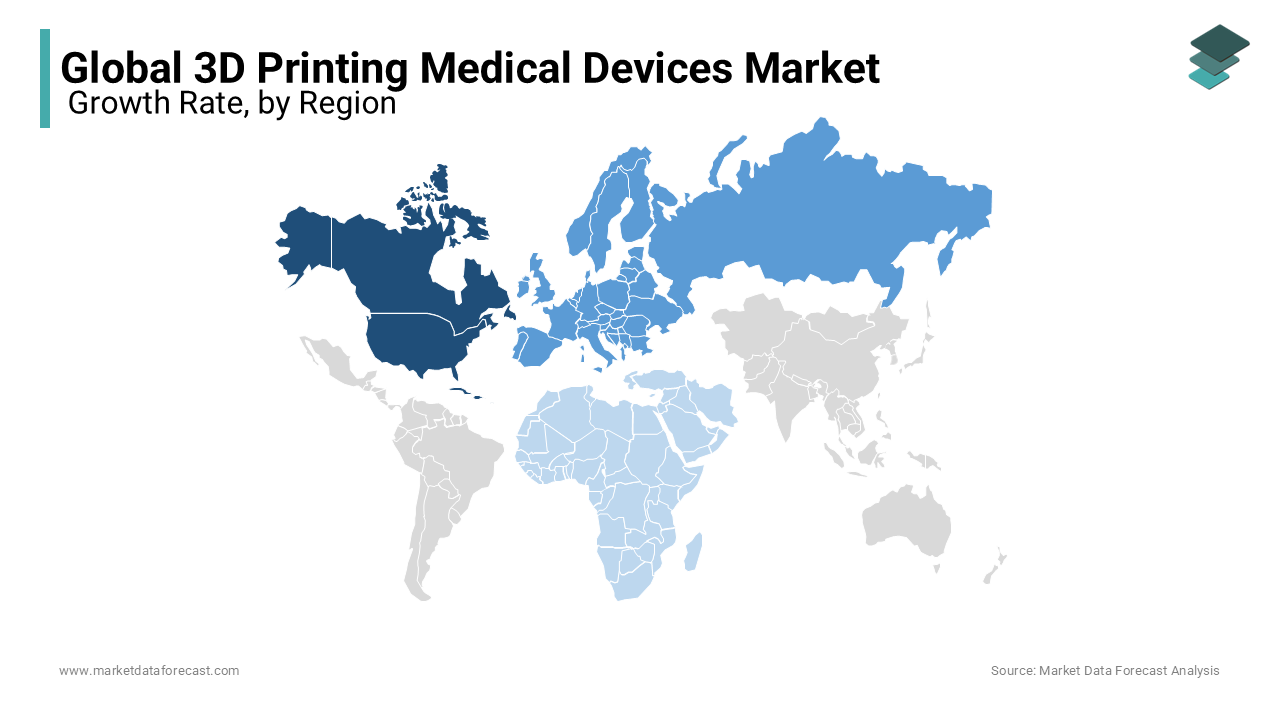
North America was the top performer of the 3D printing medical devices market by accounting for 43.2% of share in 2025 owing to the advanced healthcare infrastructure, strong regulatory frameworks, and early adoption of additive manufacturing in clinical settings. The U.S. Food and Drug Administration has established dedicated guidance for 3D-printed medical devices, facilitating over 500 clearances since 2010. Leading institutions such as Mayo Clinic, Cleveland Clinic, and Johns Hopkins operate in-house 3D printing labs, producing more than 10,000 patient-specific models and implants annually. The presence of major technology developers like 3D Systems, Stratasys, and HP further strengthens the innovation ecosystem. According to the Healthcare
Europe 3D Printing Medical Devices Market Analysis
Europe Information and Management Systems Society, over 130 U.S. hospitals are accredited by the Radiological Society of North America for 3D printing, reflecting institutional integration and clinical validation.
It was positioned second by holding 29.1% of the 3D Printing Medical Devices Market share in 2025. Countries such as Germany, the UK, and the Netherlands have integrated 3D printing into national healthcare strategies, with the UK’s National Health Service supporting over 40 hospital-based 3D labs. The implementation of the EU Medical Device Regulation (MDR) in 2021 has standardized quality and traceability requirements, ensuring consistent device performance. The European Society of Radiology notes that 3D-printed surgical guides are now routinely used in maxillofacial and orthopedic procedures across 18 member states. Academic collaborations, such as the EU-funded PERFORM project, are advancing patient-specific implants for trauma care.
Asia Pacific 3D Printing Medical Devices Market Analysis
The Asia Pacific 3D printing medical devices market is expected to grow with a significant CAGR during the forecast period. Japan and South Korea lead in regulatory approvals and clinical implementation; Japan’s Pharmaceuticals and Medical Devices Agency (PMDA) has cleared over 60 3D-printed medical devices since 2016, including spinal and dental implants. In India, the government’s National Digital Health Mission includes provisions for 3D-printed prosthetics and surgical models, with pilot programs launched in 12 major hospitals. The region faces a critical shortage of medical devices, with only 2 surgeons per 100,000 population in many countries, as per the World Health Organization, making customized solutions highly valuable.
Latin America 3D Printing Medical Devices Market Analysis
Latin America 3D Printing Medical Devices Market growth is likely to grow with the prominent growth opportunities in the next coming years. Brazil and Mexico are at the forefront, with public hospitals adopting 3D printing for craniofacial reconstruction and pediatric cardiac surgery. The Albert Einstein Israelite Hospital in São Paulo has utilized 3D-printed models in over 1,200 complex surgeries since 2020, reducing operative time by an average of 22%. However, limited access to high-end printers and regulatory delays hinder scalability. The Inter-American Development Bank notes that only 12% of Latin American hospitals have dedicated 3D printing units. Despite this, rising healthcare expenditure and increasing medical tourism are creating demand for advanced solutions.
Middle East & Africa 3D Printing Medical Devices Market Analysis
The Middle East and Africa 3D Printing Medical Devices Market is expected to have slow growth during the forecast period. Gulf Cooperation Council (GCC) nations such as the UAE and Saudi Arabia are investing heavily in smart healthcare; the UAE’s Ministry of Health and Prevention launched a national 3D printing strategy in 2022 by allocating $180 million for hospital-based fabrication centers. In Dubai, Rashid Hospital has implemented 3D printing for trauma and burn reconstruction, serving a diverse, high-volume patient base. Conversely, Sub-Saharan Africa faces severe limitations in equipment, expertise, and connectivity. The International Telecommunication Union reports that fewer than 8% of African hospitals have reliable internet for cloud-based 3D model sharing.
COMPETITIVE LANDSCAPE
The competition in the 3D printing medical devices market is characterized by a dynamic interplay between established industrial 3D printing firms and agile medtech innovators. While companies like 3D Systems and Stratasys dominate with comprehensive hardware and software ecosystems, specialized players are emerging with niche applications in bioprinting, surgical guides, and regenerative implants. Differentiation is increasingly driven by clinical validation, regulatory milestones, and integration with hospital IT systems rather than technological novelty alone. The rise of in-house hospital fabrication labs is shifting demand toward scalable, user-friendly platforms that support decentralized manufacturing. Intellectual property in bio-inks, AI segmentation, and implant design is becoming a critical competitive lever. In the Asia Pacific region, local regulatory strategies and partnerships with academic medical centers are defining market leadership.
KEY MARKET PLAYERS
Companies are currently leading the global 3D printing medical devices market include
- 3D Systems Corporation (U.S.)
- Stratasys Ltd. (Israel)
- Renishaw plc (U.K.)
- EOS GmbH Electro Optical Systems (Germany)
- EnvisionTEC GmbH (Germany)
- Materialise NV (Belgium)
- Arcam AB (Sweden)
- 3T RPD Ltd. (U.K.)
- Prodways (France)
- Concept Laser GmbH (Germany)
Top Players in the 3D Printing Medical Devices Market
3D Systems Corporation
3D Systems has established a significant presence in the Asia Pacific medical 3D printing sector by delivering integrated solutions for surgical planning, dental applications, and patient-specific implants. The company’s collaboration with Japan’s National Hospital Organization in 2023 enabled the deployment of its surgical planning platform and 3D-printed anatomical models for complex cardiovascular interventions. In South Korea, 3D Systems partnered with Seoul National University Hospital to enhance craniofacial reconstruction workflows using its On-Demand Implants service. The company has also expanded its materials portfolio with biocompatible resins cleared by the PMDA and TGA, supporting regulatory compliance across regional markets.
Stratasys Ltd.
Stratasys has intensified its footprint in the Asia Pacific market by advancing its PolyJet and FDM technologies for medical modeling and surgical simulation. In 2022, the company launched a dedicated healthcare innovation center in Singapore, designed to collaborate with regional hospitals on developing anatomical models for neurosurgery and congenital defect repair. It has supplied 3D-printed cardiac and liver models to institutions such as the Royal Melbourne Hospital and Apollo Children’s Hospital in Chennai, improving preoperative accuracy and team preparedness. Stratasys also introduced bio-replicating materials that mimic the mechanical properties of human tissues, enhancing realism in surgical training. The company’s partnership with Australia’s Therapeutic Goods Administration to validate material biocompatibility has accelerated clinical adoption.
Materialise NV
Materialise has emerged as a critical technology partner in the Asia Pacific 3D printing medical devices landscape through its FDA-cleared software platforms and patient-specific solutions. The company’s Mimics Innovation Suite is widely used in Japanese and Chinese hospitals for converting CT and MRI data into printable 3D models, supporting interventions in orthopedics and cardiovascular surgery. In 2023, Materialise collaborated with Taiwan’s Chang Gung Memorial Hospital to optimize 3D-printed surgical guides for mandibular reconstruction, reducing operative time by 30%. Its partnership with India’s Narayana Health expanded access to affordable cardiac models for pediatric surgeries. Materialise has also established regulatory alignment with China’s NMPA and Japan’s PMDA, enabling smoother commercialization.
Top Strategies Used by the Key Market Participants
Key players in the 3D printing medical devices market are deploying advanced strategies to consolidate their influence and accelerate clinical adoption. Strategic partnerships with leading hospitals and research institutions enable real-world validation and workflow integration. Companies are investing heavily in software development, particularly in AI-powered segmentation and simulation tools, to enhance precision and reduce manual input. Regulatory alignment across geographies is a priority, with firms pursuing simultaneous clearances from the FDA, CE-IVD, PMDA, and NMPA. Mergers and acquisitions are being leveraged to expand material science capabilities and digital health platforms. Geographic expansion, especially in emerging markets, is supported by localized training programs and point-of-care manufacturing models. Additionally, vendors are focusing on end-to-end solutions that combine hardware, software, and consumables by ensuring seamless integration into clinical environments and long-term customer retention.
RECENT MARKET HAPPENINGS
- In February 2022, 3D Systems launched its On Demand Implants service in Japan, offering patient-specific cranial and spinal implants with PMDA clearance by enabling faster adoption in high-precision surgical applications across the Asia Pacific region.
- In July 2022, Stratasys inaugurated its Healthcare Innovation Center in Singapore, a dedicated facility to co-develop anatomical models and surgical tools with regional hospitals, which is enhancing clinical relevance and market penetration in Southeast Asia.
- In May 2023, Materialise NV received NMPA approval in China for its Mimics software, allowing Chinese hospitals to use its image-processing platform for creating 3D-printed surgical models and guides within regulatory compliance.
- In October 2023, HP Inc. partnered with India’s Apollo Hospitals to deploy its Multi Jet Fusion 3D printing technology for producing surgical instruments and prosthetics by aiming to improve access to customized care in tier-2 and tier-3 cities.
- In January 2024, EOS GmbH collaborated with South Korea’s Asan Medical Center to develop metal 3D-printed orthopedic implants using biocompatible titanium, which
MARKET SEGMENTATION
This research report on the global 3d printing medical devices market has been segmented & sub-segmented based on the product, material, technology, and Region.
By Product
- Medical Implants
- Orthopedic Implants
- Dental Implants
- Craniomaxillofacial Implants
- Prosthetics
- Tissue Engineering
- Surgical Instruments
- Surgical Guides
- Hearing & Audibility Aid
By Material
- Plastics
- Biomaterials
- Metal & Metal Alloys
- Ceramics
- Nylon
- Wax
By Technology
- Laser Beam Melting (LBM)
- Electron Beam Melting (EBM)
- Droplet Deposition
- Photopolymerization
- Wax deposition Modelling
- Bio Printing
By Region
- North America
- Europe
- Asia-Pacific
- Latin America
- Middle East and Africa