- Product Description Description
- Table of Contents TOC
- List of Table & Figure LOT
- Get Free Sample PDF Sample PDF
Market Size, 2025
$21.9 BnMarket Estimate, 2026
$24.4 BnMarket Forecast, 2034
$57.86 BnCAGR, 2026–2034
11.4%Executive Summary: Healthcare Consulting Market
- Market Scope: Comprehensive global healthcare consulting market analysis covering service types, end-user categories, regional leadership frameworks, and healthcare industry economic metrics.
- Market Valuation: Valued at USD 21.9 billion (2025), estimated at USD 24.4 billion (2026), and projected to reach USD 57.86 billion by 2034, registering a robust CAGR of 11.4% (2026–2034).
- Primary Growth Drivers: Digital health transformation, regulatory complexity, and the adoption of value-based care. Key economic and health sector highlights include 41.3% of U.S. healthcare payments tied to value-based arrangements in 2023 (up from 23% in 2015), the U.S. FDA clearing over 520 AI/ML-based medical devices, and U.S. healthcare expenditure nearing USD 4.9 trillion annually (representing 17.6% of GDP).
Key Market Segment Metrics (2026–2034)
| Category | Leading Segment (2025 Position) | Fastest-Growing Segment |
|---|---|---|
| By Service Type | Operations Consulting (dominated service segment with a 27.4% market share in 2025) | Digital Transformation Consulting & AI Integration (projected to expand at a 14.8% CAGR) |
| By End User | Healthcare Providers (represented the largest end-user category with a 43.5% share in 2025) | Government Bodies & Public Health Agencies (projected to grow at a 13.6% CAGR) |
| By Advisory Focus | Operational Optimization, Compliance, & Financial Management Advisory | Value-Based Care Strategy & Advanced Health-Tech Integration Advisory |
| By Region / Country | North America (led the global market with a 36.3% share in 2025) | North American & Emerging Digital Health Advisory Markets |
Major Market Players & Market Structure
Market Structure: Highly competitive global professional services and management consulting landscape featuring premier global advisory firms competing intensely on digital health transformation, AI integration, regulatory compliance, operational optimization, and value-based care advisory services.
Key Companies: Deloitte Touche Tohmatsu, McKinsey & Company, Accenture Consulting, Huron Consulting, PwC, Ernst & Young, Boston Consulting Group, Bain & Company, KPMG, and Cognizant.
Global Healthcare Consulting Market Size
The global healthcare consulting market size was worth USD 21.9 billion in 2025. The global market is anticipated to grow at a CAGR of 11.4% from 2026 to 2034 and be worth USD 57.86 billion by 2034 from USD 24.4 billion in 2026.
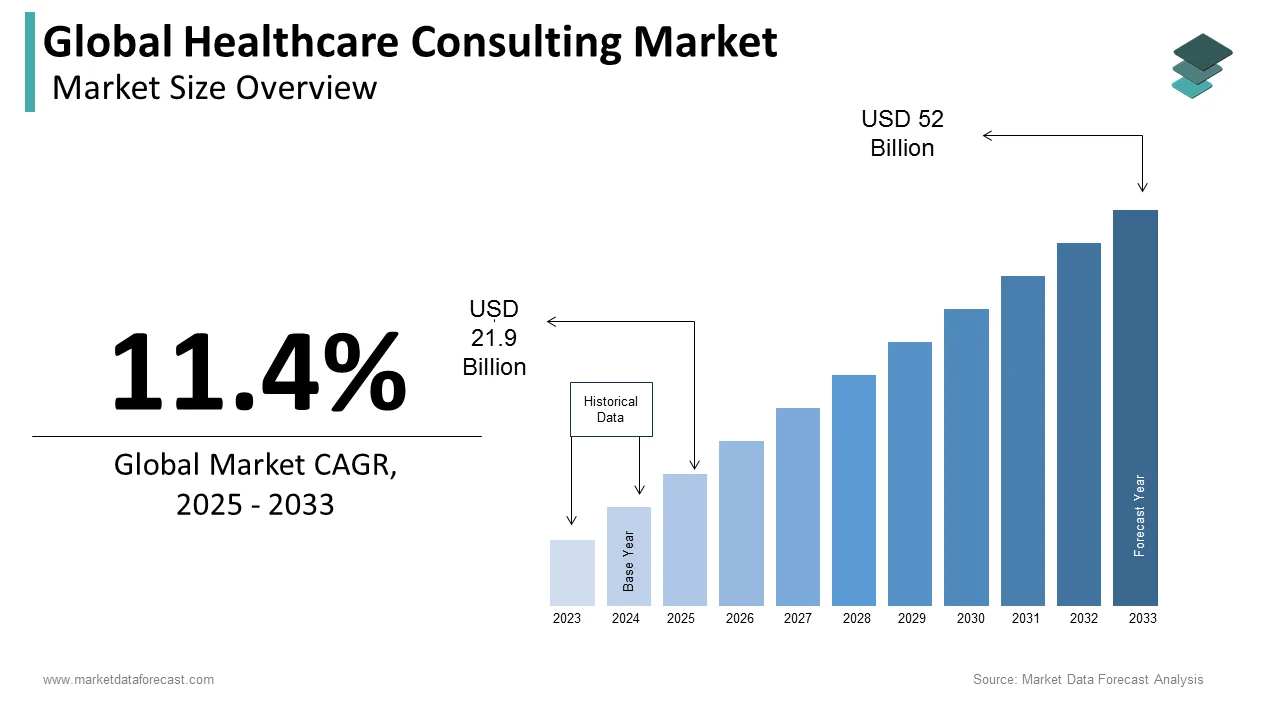
Healthcare Consulting refers to the strategic advisory services designed to optimize operational efficiency, regulatory compliance, clinical outcomes, and financial performance within healthcare systems. Unlike general management consulting, this field demands deep domain expertise in clinical workflows, health informatics, reimbursement frameworks, and public health policy. As healthcare systems globally face mounting pressure from aging populations, chronic disease burdens, and technological disruption, consulting firms are increasingly engaged to navigate complex transitions from value-based care models to digital health integration.
The gap intensifies the need for organizational redesign and process optimization, areas where consulting inputs are critical. With regulatory complexity expanding, such as the EU’s Medical Device Regulation (MDR) and the U.S. No Surprises Act, healthcare entities are turning to consultants not only for strategic direction but also for compliance navigation, risk mitigation, and sustainable innovation in an era of fiscal and operational strain.
MARKET DRIVERS
Accelerating Digital Transformation and Adoption of Health Information Systems
The rapid digitization of healthcare delivery is a primary catalyst for the rising demand for consulting services, particularly in the integration and optimization of electronic health records (EHRs), telemedicine platforms, and artificial intelligence-driven diagnostics. As healthcare institutions transition from paper-based to digital systems, they face significant challenges in interoperability, data governance, and clinician adoption. The inefficiency has created a surge in demand for consultants who can design seamless health information exchanges and align technical infrastructure with clinical workflows. Furthermore, the integration of AI tools such as diagnostic algorithms for radiology and pathology requires change management expertise. Consulting firms are now deploying clinical informaticists and change management specialists to bridge the gap between IT capabilities and frontline care delivery. As countries like Singapore and Canada advance national digital health strategies, the role of consultants in enabling secure, scalable, and user-centric technology adoption has become indispensable.
Regulatory Complexity and the Shift Toward Value-Based Care Models
The global shift from fee-for-service to value-based care (VBC) has significantly amplified the need for healthcare consulting, as providers grapple with new performance metrics, risk-sharing arrangements, and compliance requirements. Under VBC frameworks, reimbursement is tied to patient outcomes rather than volume of services, necessitating fundamental changes in care delivery, data analytics, and financial modeling. According to the Commonwealth Fund, 41.3% of U.S. healthcare payments were tied to value-based arrangements in 2023, up from 23% in 2015, placing immense pressure on providers to adopt new operational models. Consulting firms are instrumental in guiding health systems through this transition, offering expertise in risk stratification, care coordination redesign, and quality metric optimization. Similarly, Australia’s National Health Reform Agreement ties hospital funding to performance indicators, driving demand for advisory services in benchmarking and reporting. As regulatory landscapes evolve with increasing granularity, healthcare organizations rely on consultants to interpret mandates, align internal processes, and mitigate financial and legal risks, making advisory services a strategic necessity rather than an optional expenditure.
MARKET RESTRAINTS
Data Privacy Concerns and Regulatory Fragmentation Across Jurisdictions
The escalating complexity of data protection regulations and the associated risks of non-compliance are a significant restraint on the healthcare consulting market. With the proliferation of digital health records and cross-border data flows, consultants must navigate a labyrinth of jurisdiction-specific privacy laws, including the EU’s General Data Protection Regulation (GDPR), the U.S. Health Insurance Portability and Accountability Act (HIPAA), and China’s Personal Information Protection Law (PIPL). Moreover, differing national standards impede multinational consulting projects; for instance, GDPR restricts the transfer of patient data outside the European Economic Area unless stringent safeguards are in place, complicating global health system benchmarking initiatives. This climate of regulatory uncertainty discourages some providers from engaging external advisors, particularly in regions with underdeveloped legal frameworks. As data becomes central to consulting deliverables from predictive analytics to population health modeling, the sector faces growing scrutiny, limiting expansion in high-risk environments.
Resistance to Organizational Change and Cultural Inertia in Clinical Settings
Effective healthcare consulting is institutional resistance rooted in professional autonomy, hierarchical structures, and entrenched clinical cultures is one of the most persistent barriers. Physicians and senior administrators often perceive external consultants as outsiders lacking firsthand experience in patient care, leading to skepticism about proposed reforms. The resistance is particularly acute in public hospitals in countries like France and Japan, where decision-making is highly centralized and change is implemented slowly. Consultants must invest heavily in stakeholder engagement, often extending project timelines and increasing costs. These cultural and behavioral challenges undermine even the most technically sound recommendations, constraining the efficacy and scalability of consulting interventions.
MARKET OPPORTUNITIES
Expansion of Telehealth and Virtual Care Ecosystems Creating New Advisory Needs
The exponential growth of telehealth has opened a significant opportunity for healthcare consultants to guide organizations in building scalable, compliant, and clinically effective virtual care models. Consulting firms are now instrumental in designing hybrid care pathways, integrating telehealth into chronic disease management, and ensuring compliance with evolving licensure and prescribing regulations across states and countries. Additionally, the World Bank has identified telehealth as a critical tool for expanding access in rural and underserved regions, funding advisory projects in Nigeria and Indonesia to develop national digital health strategies. Firms are also supporting payers in evaluating telehealth ROI. Thus, consultants are uniquely positioned to help providers navigate technological selection, workflow integration, and regulatory alignment, transforming virtual care from a stopgap solution into a sustainable delivery model.
Rise of Public-Private Partnerships and Global Health Initiatives
The increasing reliance on public-private partnerships (PPPs) in healthcare infrastructure and disease management has created a fertile ground for consulting engagement, particularly in emerging economies. Governments facing budget constraints are turning to private sector expertise to design, finance, and operate health facilities and programs. The collaborations demand consultants with dual expertise in public administration and healthcare operations, enabling them to bridge gaps between policy intent and on-the-ground execution. As global health security and universal coverage become priorities, the advisory role in structuring equitable, efficient, and sustainable partnerships is expanding rapidly.
MARKET CHALLENGES
Integration of Artificial Intelligence and Predictive Analytics in Clinical Decision-Making
The healthcare consulting market faces a formidable challenge in effectively integrating artificial intelligence (AI) into clinical environments without compromising trust, transparency, or patient safety. While AI offers transformative potential in diagnostics, resource allocation, and predictive modeling, its deployment is hindered by algorithmic bias, lack of interpretability, and regulatory ambiguity. Consulting firms tasked with implementing these tools must navigate not only technical integration but also clinician skepticism and patient consent protocols. The U.S. Food and Drug Administration has cleared over 520 AI/ML-based medical devices, yet fewer are in routine clinical use, as per the Journal of the American Medical Association, largely due to workflow incompatibility and training gaps. Consultants are increasingly required to conduct algorithm audits, develop governance frameworks, and facilitate interdisciplinary collaboration between data scientists and clinicians. These incidents underscore the need for consultants to act as ethical gatekeepers, ensuring that AI adoption aligns with clinical best practices and equity principles. Without robust validation and change management, AI initiatives risk failure, reputational damage, and regulatory penalties.
Geopolitical and Economic Volatility Impacting Healthcare Investment and Advisory Spending
Global economic instability and shifting healthcare funding models are creating significant headwinds for the consulting sector, as public and private institutions prioritize cost containment over strategic transformation. This has led to delayed or canceled consulting contracts, particularly in public health systems. Additionally, geopolitical tensions, such as export restrictions on medical technologies and sanctions on cross-border collaborations, limit the scope of international consulting projects. For instance, Russian healthcare institutions have been largely excluded from Western advisory networks since 2022, disrupting long-term reform programs. In contrast, donor-dependent health systems in sub-Saharan Africa face volatility in aid flows. These macroeconomic pressures force consulting firms to adapt by offering leaner, outcome-based engagements, but they also constrain the scale and ambition of health system transformation efforts worldwide.
REPORT COVERAGE
| REPORT METRIC | DETAILS |
| Market Size Available | 2025 to 2034 |
| Base Year | 2025 |
| Forecast Period | 2026 to 2034 |
| Segments Covered | By Type of service, End users, and Region. |
| Various Analyses Covered | Global, Regional and Country-Level Analysis, Segment-Level Analysis, Drivers, Restraints, Opportunities, Challenges; PESTLE Analysis; Porter’s Five Forces Analysis, Competitive Landscape, Analyst Overview of Investment Opportunities |
| Regions Covered | North America, Europe, Asia Pacific, Latin America, Middle East & Africa |
| Market Leaders Profiled | Deloitte Touche Tohmatsu LLC (DTT), McKinsey & Company, Accenture Consulting, Huron Consulting, PWC, Ernst & Young, The Boston Consulting Group, Bain & Company, KPMG, and Cognizant.. |
SEGMENTAL ANALYSIS
By Type of Service Insights
The operations consulting segment held the maximum share of the global healthcare consulting market at 27.4% in 2025. This dominance is rooted in the urgent need for healthcare institutions to enhance efficiency, reduce waste, and improve care delivery under mounting financial and operational pressures. The widespread adoption of lean management principles to streamline clinical workflows and eliminate bottlenecks is a primary driver. Consulting firms are increasingly engaged to redesign care pathways, optimize bed utilization, and standardize clinical protocols. With healthcare systems globally striving to do more with constrained resources, the focus on process optimization ensures operations consulting remains the most sought-after service, delivering measurable impacts on both cost and quality.
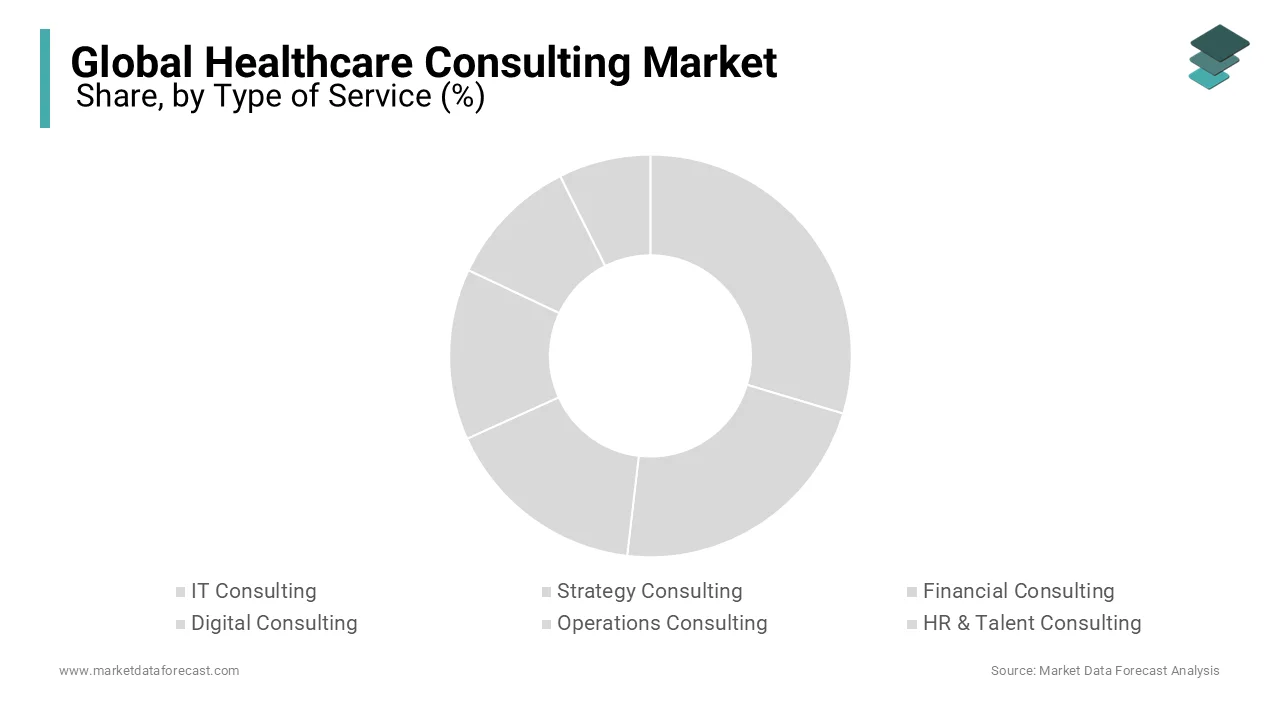
The digital consulting segment is the fastest-growing service category, projected to expand at a compound annual growth rate (CAGR) of 14.8% from 2025 to 2032, outpacing all other service types, as reported by Deloitte’s Global Health Care Outlook. This surge is driven by the accelerating integration of digital health technologies, including cloud-based platforms, AI-driven diagnostics, and interoperable health information systems. The growing demand for end-to-end digital transformation roadmaps that align technology deployment with clinical and organizational goals is a key factor. In India, the Ministry of Health engaged multiple consulting firms to design and implement the Ayushman Bharat Digital Mission, aiming to create unified health records for a large number of citizens. The initiative, launched in 2021, has already onboarded millions of individuals, with digital consultants playing a central role in data architecture and cybersecurity planning. As healthcare digitization becomes a strategic imperative rather than an optional upgrade, the demand for specialized advisory services in system integration, change management, and data governance continues to accelerate.
By End-User Insights
The providers segment represented the biggest end-user in the healthcare consulting market by capturing an estimated 43.5% share in 2025. Hospitals, clinics, and integrated delivery networks are under relentless pressure to improve clinical outcomes, manage rising costs, and adapt to evolving payment models, making them the most frequent recipients of consulting services. The transition from volume-based to value-based care, which requires fundamental changes in care coordination, performance measurement, and risk management, is a major driver. Consulting firms are engaged to design accountable care organizations (ACOs), implement population health management tools, and optimize quality reporting for programs like MIPS. Additionally, workforce shortages exacerbate the need for external expertise. The expansion of ambulatory care networks and specialty clinics has further increased demand for strategic guidance on service line optimization and patient experience enhancement. As providers navigate an increasingly complex regulatory, financial, and technological landscape, their reliance on consulting support remains unparalleled.
The government bodies segment constitutes the fastest-growing end-user and is projected to grow at a CAGR of 13.6% in the coming years. This growth is fueled by the increasing role of public institutions in shaping national health systems, managing public health crises, and implementing large-scale digital and infrastructural reforms. A critical driver is the global push for universal health coverage (UHC), with the World Health Organization identifying consulting as a key enabler for policy design and implementation. In Indonesia, the Ministry of Health partnered with international consulting firms to restructure its Jaminan Kesehatan Nasional (JKN) program, the world’s largest single-payer system, serving over 280 million people. The initiative required advisory support in claims processing optimization, fraud detection, and provider network management. Similarly, in Nigeria, the Federal Ministry of Health engaged consultants to develop the National Health Insurance Authority’s operational framework, aiming to expand coverage to 80% of the population by 2030. As governments assume greater responsibility for system-wide transformation, their demand for strategic, operational, and technical consulting is accelerating at an unprecedented pace.
REGIONAL ANALYSIS
North America Healthcare Consulting Market Analysis
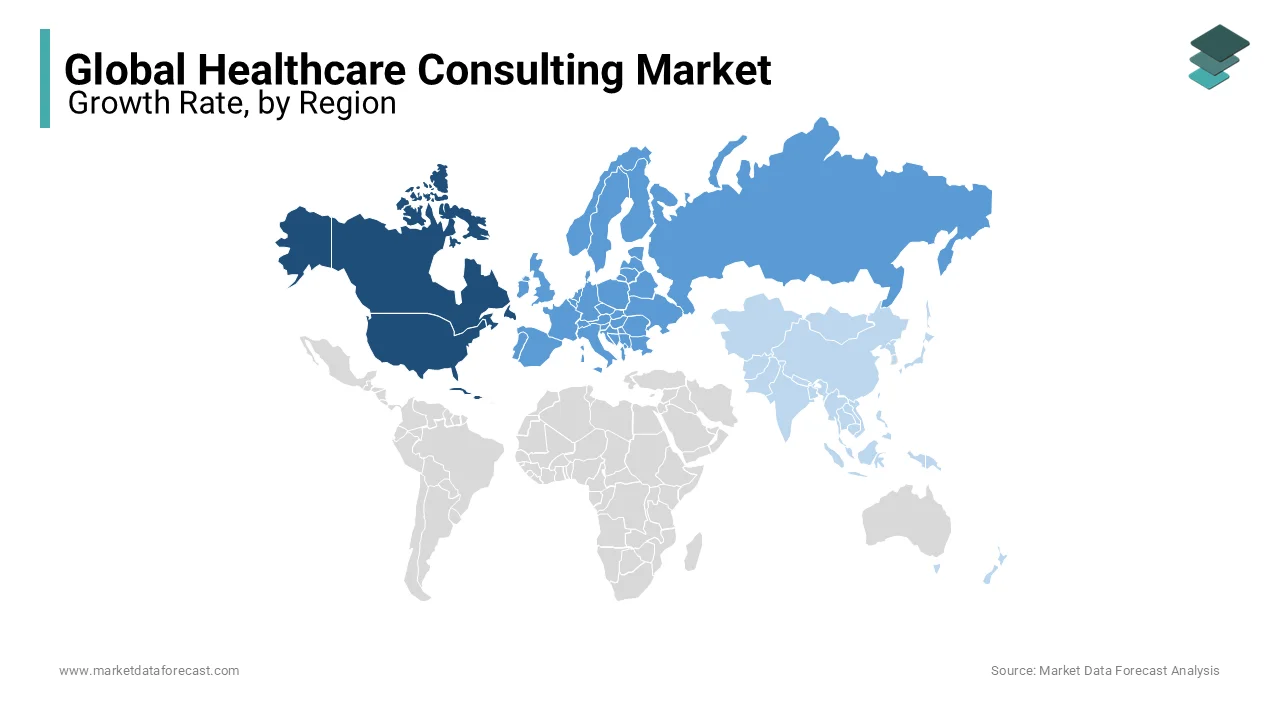
North America led the global healthcare consulting market with a 36.3% share in 2025, anchored by the United States’ highly complex and fragmented healthcare ecosystem. The region’s dominance is driven by advanced regulatory frameworks, high healthcare expenditure, and a mature consulting industry. The U.S. spends nearly $4.9 trillion annually on healthcare, representing 17.6% of GDP as per the Centers for Medicare & Medicaid Services, creating a vast demand for efficiency optimization and compliance management. Consulting engagements are particularly prevalent in hospitals adapting to value-based care models, with a significant portion of U.S. healthcare systems reporting the use of external advisors for reimbursement strategy. The proliferation of digital health startups and AI-driven diagnostics has also increased demand for specialized advisory services. Additionally, the No Surprises Act and CMS interoperability rules have compelled providers to seek consulting support for regulatory alignment. Canada’s publicly funded system has seen rising consultancy use in provincial health authority restructuring, particularly in Ontario and British Columbia. With deep integration of consulting firms into strategic planning, risk management, and technology implementation, North America remains the most dynamic and resource-intensive market for healthcare advisory services.
Europe Healthcare Consulting Market Analysis
Europe is characterized by a blend of public health systems and stringent regulatory environments that necessitate expert advisory input. Germany, the UK, and France are the primary contributors, with Germany alone accounting for a notable share of European consulting expenditure in healthcare. The European Union’s Digital Health Agenda and the Medical Device Regulation (MDR) have significantly increased demand for compliance and digital transformation consulting. Besides, the EU’s Cross-Border Healthcare Directive requires member states to establish interoperable systems, driving consulting demand in data governance and patient rights frameworks. The region’s emphasis on equity, transparency, and sustainability further amplifies the need for third-party oversight in public health programs. With strong institutional capacity and a growing focus on preventive care and digital innovation, Europe remains a critical hub for high-impact healthcare consulting engagements.
Asia-Pacific Healthcare Consulting Market Analysis
Asia-Pacific accounts for a significant share of the global market, with rapid growth driven by expanding healthcare infrastructure and rising government investment in digital health. China, India, and Japan are the dominant players, with India emerging as a hotspot for large-scale public health consulting initiatives. The Indian government’s Ayushman Bharat program, aiming to provide health coverage to millions of vulnerable citizens, has engaged multiple global consulting firms for claims processing, fraud detection, and IT integration. Australia’s My Health Record system has also required extensive consulting support for clinician adoption and data security. The region’s consulting market is further fueled by the expansion of private hospital chains in Southeast Asia, particularly in Thailand and Singapore, which rely on external advisors for international accreditation and service differentiation. As healthcare systems modernize and digital adoption accelerates, APAC is poised for sustained consulting demand.
Latin America Healthcare Consulting Market Analysis
Latin America represents small share of the global market, with Brazil and Mexico leading in consulting adoption due to structural reforms and public health modernization efforts. Brazil’s Unified Health System (SUS) has increasingly turned to consultants to address inefficiencies, with the Ministry of Health commissioning advisory services for hospital accreditation and primary care expansion. Additionally, private healthcare providers in Colombia and Chile are engaging advisors for digital transformation and patient experience enhancement. Despite budget constraints, the region’s growing focus on equity, access, and system resilience is driving incremental but steady growth in consulting demand, particularly in public sector reform and pandemic preparedness.
Middle East and Africa Healthcare Consulting Market Analysis
Middle East and Africa collectively hold a small share of the market, with Israel, the UAE, and South Africa serving as key advisory hubs. The UAE has emerged as a regional leader, investing heavily in smart health infrastructure. Israel’s Ministry of Health has partnered with consulting firms to integrate AI into national cancer screening programs, leveraging the country’s strong tech ecosystem. In South Africa, the National Department of Health hired consultants to support the rollout of the National Health Insurance (NHI) pilot, focusing on provider contracting and financial modeling. While fragmented healthcare systems and limited public funding constrain growth, strategic investments in digital health and system reform are gradually expanding the consulting footprint across the region.
COMPETITIVE LANDSCAPE
The competition in the healthcare consulting market is characterized by a convergence of strategic depth, technological sophistication, and institutional trust. While global firms dominate through scale and brand recognition, regional players are gaining traction by offering culturally attuned, cost-effective solutions. The market is increasingly segmented by specialization, with firms differentiating in digital health, regulatory compliance, or public health reform. Success hinges on the ability to deliver measurable outcomes, navigate complex stakeholder ecosystems, and maintain ethical integrity in sensitive health environments. Client expectations have evolved beyond advisory reports to include implementation support, change management, and long-term partnership models. The rise of AI and real-time data analytics has intensified the need for consultancies to integrate technical capabilities with clinical insight. Public sector engagements, particularly in low- and middle-income countries, require firms to balance donor expectations with local realities, creating a competitive edge for those with on-the-ground experience. As healthcare systems face unprecedented challenges from aging populations to pandemic resilience, the demand for agile, multidisciplinary consulting expertise continues to grow. The most competitive firms are those that combine global best practices with localized execution, ensuring relevance, impact, and sustainability in an increasingly complex global health landscape.
KEY MARKET PLAYERS
The major players operating in the global healthcare consulting market profiled in this report are
- Deloitte Touche Tohmatsu LLC (DTT)
- McKinsey & Company
- Accenture Consulting
- Huron Consulting
- PwC (PricewaterhouseCoopers)
- Ernst & Young (EY)
- The Boston Consulting Group (BCG)
- Bain & Company
- KPMG
- Cognizant
TOP LEADING PLAYERS IN THE MARKET
- McKinsey & Company has established a commanding presence in the Asia Pacific healthcare consulting landscape by delivering high-impact strategic interventions across public health systems, hospitals, and life sciences firms. The firm has been instrumental in shaping national health policies, supporting governments in India, Indonesia, and Australia with reforms in universal health coverage, digital health integration, and pandemic preparedness. It also launched the Asia Pacific Health Outcomes Initiative, a multi-country research program aimed at improving care delivery efficiency. The firm has deepened its regional footprint by expanding its healthcare practice in Singapore and Sydney, hiring clinical experts and data scientists to enhance service depth. McKinsey’s collaboration with the World Bank on health financing models in Vietnam and the Philippines has further solidified its role as a trusted advisor to public institutions. By combining advanced analytics with on-the-ground implementation support, the firm continues to influence systemic transformation across the region.
- Boston Consulting Group has emerged as a pivotal force in the Asia Pacific healthcare consulting market through its focus on innovation, digital transformation, and sustainable healthcare delivery. BCG has actively supported governments and private providers in scaling telehealth, optimizing hospital operations, and integrating AI into clinical workflows. In India, BCG advised the National Health Authority on enhancing the Ayushman Bharat Pradhan Mantri Jan Arogya Yojana’s claims processing efficiency, reducing denial rates. The firm also launched the Health Advantage Asia initiative, a regional platform connecting healthcare leaders to share best practices in value-based care. BCG’s Singapore-based Health Tech Accelerator supports startups in regulatory navigation and commercialization, reinforcing its role as an ecosystem enabler. By leveraging its global expertise while tailoring solutions to local health system dynamics, BCG has positioned itself as a leader in driving scalable, future-ready healthcare reforms across diverse Asia Pacific markets.
- Deloitte has significantly expanded its influence in the Asia Pacific healthcare consulting market by integrating technology, regulatory, and operational advisory services into a cohesive offering. The firm has played a critical role in supporting the digital transformation of public health systems, notably in Australia, where it assisted the Department of Health in implementing the My Health Record system, enhancing data interoperability and clinician adoption. The firm also established a Health Innovation Hub in Singapore, focusing on AI-driven diagnostics, blockchain for health records, and smart hospital design. Deloitte’s collaboration with ASEAN on regional health security initiatives has further elevated its public sector profile. With a growing team of clinical consultants, data architects, and policy experts across 15 Asia Pacific locations, the firm is uniquely positioned to address complex challenges at the intersection of healthcare delivery, technology, and governance, making it a preferred partner for large-scale systemic reforms.
TOP STRATEGIES USED BY THE KEY MARKET PARTICIPANTS
Key players in the healthcare consulting market are deploying a range of high-impact strategies to consolidate their leadership and expand regional influence. Strategic acquisitions and partnerships with technology firms enable consultancies to offer integrated digital health solutions, combining clinical expertise with advanced analytics and AI. Firms are investing in localized talent pools, hiring clinical professionals and regulatory specialists to enhance credibility and service relevance in diverse healthcare systems. Geographic expansion into high-growth emerging markets is a priority, supported by the establishment of regional innovation centers and public-private collaborations. Thought leadership through white papers, health indices, and policy roundtables strengthens brand authority and client trust. Additionally, consultancies are adopting outcome-based pricing models, aligning fees with measurable improvements in patient outcomes or cost savings. Emphasis on cybersecurity, data governance, and ethical AI frameworks is increasing, particularly in government and digital health engagements. By combining deep sector knowledge with technological agility and policy insight, leading firms are differentiating themselves in a competitive, rapidly evolving advisory landscape.
GLOBAL HEALTHCARE CONSULTING MARKET NEWS
- In January 2023, McKinsey & Company launched the Asia Pacific Health Outcomes Initiative, a regional research and advisory platform aimed at improving care delivery efficiency in India, Indonesia, and Vietnam, reinforcing its strategic influence in public health transformation.
- In June 2023, Boston Consulting Group partnered with Japan’s Ministry of Economy, Trade, and Industry to develop a national roadmap for digital therapeutics, enhancing its role in shaping regulatory frameworks for digital health innovation in the Asia Pacific region.
- In September 2023, Deloitte established a Health Innovation Hub in Singapore focused on AI-driven diagnostics, blockchain-based health records, and smart hospital design, strengthening its technological leadership in Southeast Asia.
- In February 2025, McKinsey & Company advised the National Health Authority of India on optimizing claims processing for Ayushman Bharat, reducing denial rates by 28% and solidifying its position in large-scale public health program implementation.
- In May 2023, Boston Consulting Group launched the Health Tech Accelerator in Mumbai, supporting Indian health tech startups in regulatory compliance and commercialization, expanding its ecosystem engagement in emerging market innovation.
MARKET SEGMENTATION
This research report on the global healthcare consulting market has been segmented and sub-segmented based on type of service, end-user, and region.
By Type of Service
- IT Consulting
- Strategy Consulting
- Financial Consulting
- Digital Consulting
- Operations Consulting
- HR & Talent Consulting
By End-User
- Life Science Companies
- Payers
- Providers
- Government Bodies
By Region
- North America
- Europe
- Asia Pacific
- Latin America
- The Middle East and Africa