- Product Description Description
- Table of Contents TOC
- List of Table & Figure LOT
- Get Free Sample PDF Sample PDF
Market Size, 2025
$59 MnMarket Estimate, 2026
$61.07 MnMarket Forecast, 2034
$80 MnCAGR, 2026–2034
3.5%Global Human Platelet Lysate Market Size
The size of the global human platelet lysate market was worth USD 59 million in 2025. The global market is anticipated to grow at a CAGR of 3.5% from 2026 to 2034 and be worth USD 80 million by 2034, up from USD 61.07 million in 2026.

Human platelet lysate (HPL) is a cell culture growth supplement derived from human blood platelets after they are frozen and thawed. HPL is a non-animal supplement for cell growth with cell growth factors like cytokinesis which help in the proliferation of cells. HPL can help in the clinical production of functional mesenchymal stromal cells. This function of HPL can help replace the bovine serum, eliminating the possibilities of xenogeneic immune reactions and transmission of bovine prion and viral pathogens. In addition, HPL reduces the risk involved with the production of mesenchymal stromal cells by increasing their genetic stability.
The Human Platelet Lysate is collected from human donors and stored in batches. The batches are then processed to produce a consistent product. Human platelet lysate can be prepared through repeated cycles of freezing and thawing. The platelet is activated through signification, calcium chloride, or detergent.
Cell growth culture is a very sensitive process and needs time and attention. HPL makes it easier by speeding it up and reducing the risks. The mesenchymal stem cells produced using HPL can be used to treat various neurodegenerative diseases. The mesenchymal stem cells are in clinical trials to treat problems like myocardial infarction, stroke, meniscus injury, limb ischemia, etc. The human platelet lysates have high wound-healing capabilities, as platelets' basic function is the coagulation of blood. HPL can be used to treat diseases like osteoarthritis, Parkinson's disease, tendon regeneration, infertility, androgenetic alopecia, nerve repair, and regenerative tissue.
MARKET DRIVERS
The high disease treatment and prevention ability of human platelet lysates is majorly promoting the market's growth rate.
HPL can replace Bovine serum and completely eradicate the risk posed by xenogeneic immune reactions. The transfer of viral pathogens and bovine prion makes it an attractive alternative for researchers. The research and developments in the field, along with the production of biotechnologies and pharmaceutical drug breakthroughs, are predicted to be responsible for the rise in the market. In addition, increased funding from the government for life science projects and propelling numbers of research institutes will boost the market's reach. Furthermore, the rise in opposition to animal-derived cells is also expected to fuel the growth in the market.
Collaborations between research institutes and biotech companies in attempts to raise the number of clinical trials will also benefit the market. An example of such collaboration would be the Massachusetts eye and ear infirmary, Oregon Health and Science University, University of Michigan, and Duke University collaborating with Cambium Medical Technologies LLC to develop a clinical trial for a tropical-depleted human platelet lysate in patients with dry eye secondary to graft vs. host disease.
The recent escalation in the number of bacterial and viral infections has led to a demand for development in the biopharmaceutical market. This demand is also responsible for shooting up the human platelet lysate market.
MARKET RESTRAINTS
Even though there is an increased demand for human platelet lysate due to its efficiency, there are also multiple safety concerns. The risk of spreading transmittable and infectious sicknesses is a major hindrance to the growth rate of the global human platelet lysate market. Additionally, the high cost of stem cell research and budget can also push back the growth of the market.
REPORT COVERAGE
| REPORT METRIC | DETAILS |
| Market Size Available | 2025 to 2034 |
| Base Year | 2025 |
| Forecast Period | 2026 to 2034 |
| Segments Covered | By Product Type, Application, End-User, and Region. |
| Various Analyses Covered | Global, Regional, and Country-Level Analysis, Segment-Level Analysis, Drivers, Restraints, Opportunities, Challenges; PESTLE Analysis; Porter’s Five Forces Analysis, Competitive Landscape, Analyst Overview of Investment Opportunities |
| Regions Covered | North America, Europe, Asia Pacific, Latin America, Middle East & Africa |
| Market Leaders Profiled | COOK, Merck KGaA, STEMCELL Technologies Inc., Regenexx, Life Science Group Ltd., Macropharma, BBI Solutions, Compass Biomedical, Inc., Trinova Biochem GmbH, PL BioScience GmbH, AventaCell BioMedical Corp, Mill Creek Life Sciences and Zen-Bio, Inc., and Others. |
SEGMENTAL ANALYSIS
By Product Type Insights
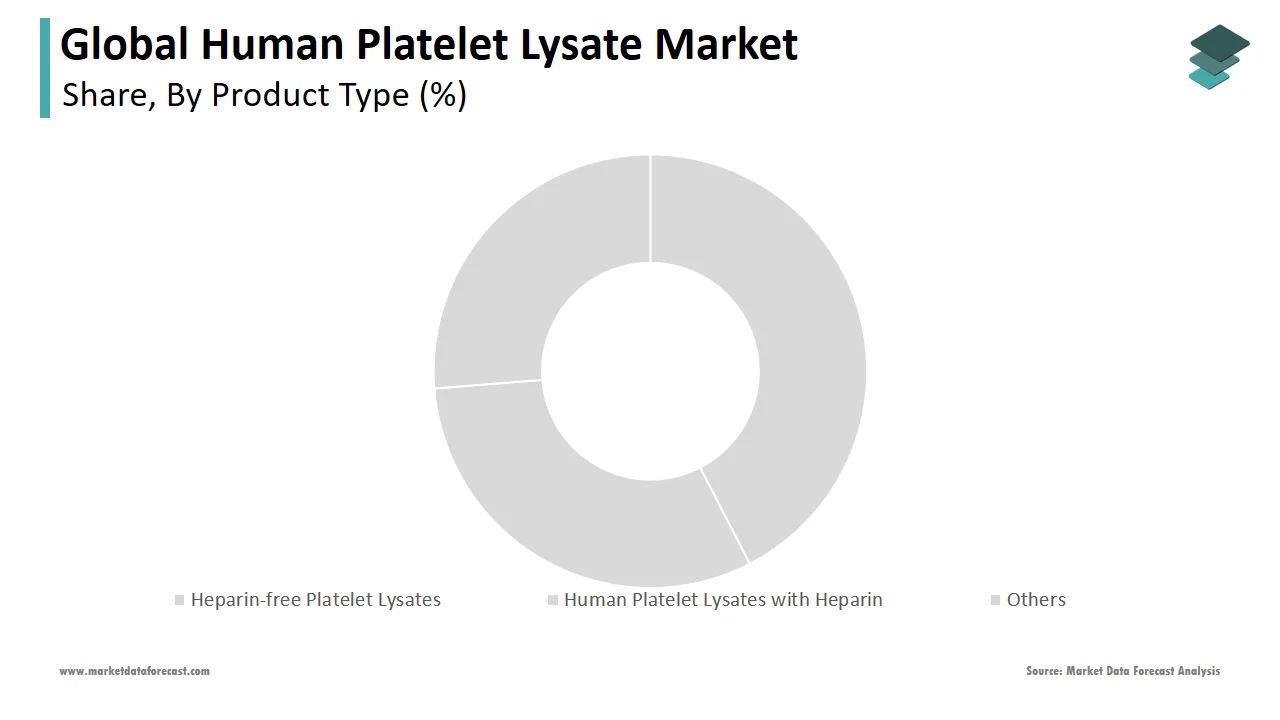
Among the types of Human Platelet Lysates categorized based on product type, both Heparin-free Lysates and Human Platelet Lysates with heparin seem to receive equal attention and revenue. The heparin-free platelet lysate is expected to rise to just a little higher during the forecast period.
By Application Insights
The human platelet lysate is mainly applicable to research and development. Therefore, the market is primarily run-on funding and investments in research and development.
By End-User Insights
As the application of HPL is mainly required in the research and development segment, they are also the end-users who contribute the most to the market. However, in recent times, due to an increase in the number of bacterial and viral diseases globally, biopharmaceutical companies are expected to contribute more to the market during the forecast period.
REGIONAL ANALYSIS
North America will lead the human platelet lysate market during the forecast period. Countries like the U.S. and Canada have a rising application of Human Platelets Lysate in research and development. The region is also receiving favor and support from regulatory authorities, leading to an advancement in the market.
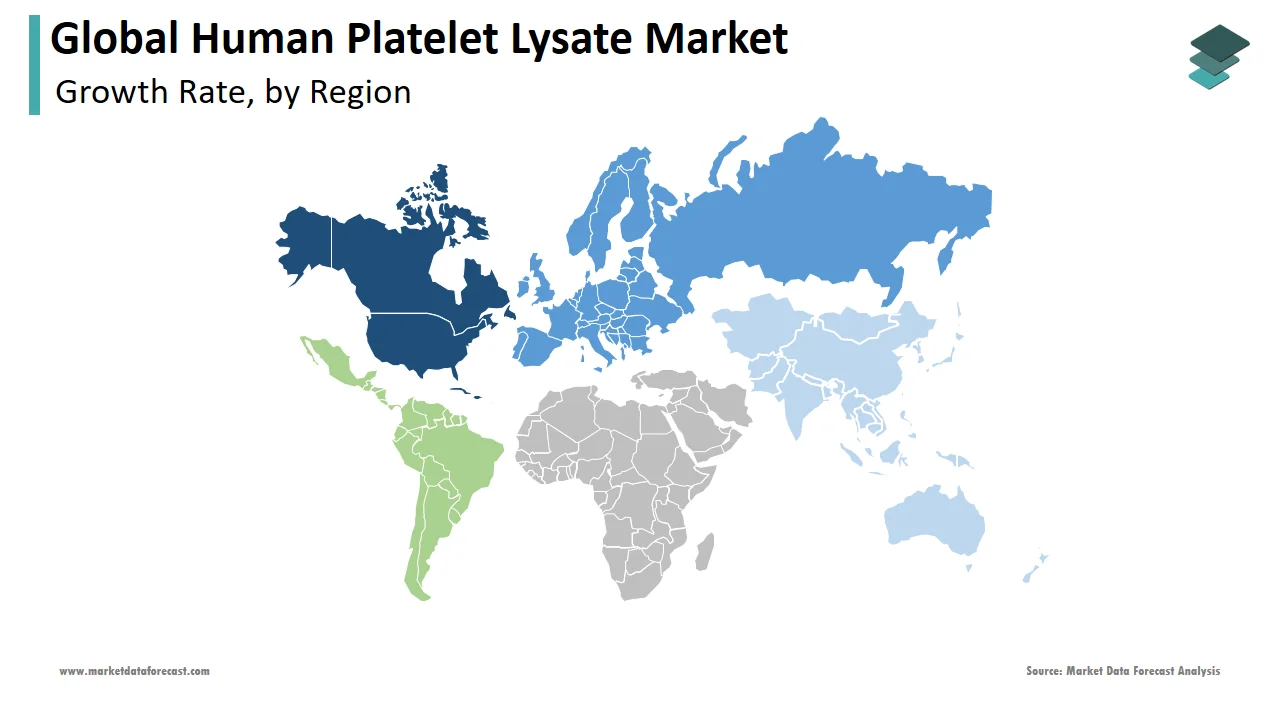
Europe is also expected to show progress in the human platelet lysate market. This growth is attributed to the improved acceptance rate for HPL and new healthcare developments in countries like the U.K., Germany, Italy, France, etc. So, owing to these reasons, the human platelet lysate market is predicted to grow in the region during the forecast period.
The Asia Pacific region is expected to have the most progressive CAGR during the forecast period. The region's countries like India, Japan, and South Korea are expected to see a fast rise in the market due to the augmentation of opposition to animal-based blood products. In addition, the region is receiving a surge in awareness relating to HPL usage.
Aside from these regions, Latin America with countries like Brazil and Columbia, the Middle East with countries like the UAE, and Africa with countries like South Africa are also expected to grow lucratively in the human platelet lysate market due to the increased demand for better healthcare services.
KEY MARKET PLAYERS
Some of the companies that are playing a dominating role in the global human platelet lysate market include
- COOK
- Merck KGaA
- STEMCELL Technologies Inc.
- Regenexx
- Life Science Group Ltd.
- Macropharma
- BBI Solutions
- Compass Biomedical, Inc.
- Trinova Biochem GmbH
- PL BioScience GmbH
- AventaCell BioMedical Corp
- Mill Creek Life Sciences
- Zen-Bio, Inc.
GLOBAL HUMAN PLATELET LYSATE MARKET NEWS
- PL BioScience has signed an exclusive distribution agreement with Captive Bio across the North American region. Their goal is to support innovative scientists in developing innovative medicine. The partnership will make HPL a more affordable project for Captive Bio. It will also increase sales and introduce new markets to the company.
- Captive Bio expands cell culture media focus and small molecule kits for stem cell research and emerging markets. The company will enhance its portfolio by including new classic media and custom media manufacturing services. In addition, the company is working to improve the development of the human pluripotent stem cell (hPSC) workflow.
- More platelet-based treatment research and development is coming forward. The platelet-derived growth factor-BB is useful in regenerating the periodontal ligament in the tooth replantation process. The pathological condition called tooth ankylosis of periodontal ligament, which occurs after tooth replantation, can be prevented using this platelet.
MARKET SEGMENTATION
This global human platelet lysate market research report is segmented and sub-segmented into the following categories.
By Product Type
- Heparin-free Platelet Lysates
- Human Platelet Lysates with Heparin
- Others
By Application
- Research And Development Use
- Clinical Use
By End-User
- Academic and research institutes
- Biopharmaceutical companies
- others
By Region
- North America
- Europe
- Asia Pacific
- Latin America
- Middle East and Africa