- Product Description Description
- Table of Contents TOC
- List of Table & Figure LOT
- Get Free Sample PDF Sample PDF
Market Size, 2025
$8.9 BnMarket Estimate, 2026
$9.63 BnMarket Forecast, 2034
$18.09 BnCAGR, 2026–2034
8.2%Executive Summary: Global Lateral Flow Assay Market
- Market Scope: Comprehensive global lateral flow assay market analysis covering products, techniques, end-user settings, regional leadership frameworks, and infectious disease diagnostic trends.
- Market Valuation: Valued at USD 8.9 billion (2025), estimated at USD 9.63 billion (2026), and projected to reach USD 18.09 billion by 2034, registering a solid CAGR of 8.2% (2026–2034).
- Primary Growth Drivers: Expanding use in infectious disease surveillance across low- and middle-income countries, integration of LFAs into home-based testing models following widespread regulatory authorizations, and development of multiplexed and quantitative platforms enabling simultaneous pathogen detection with digital readouts.
Key Market Segment Metrics (2026–2034)
| Category | Leading Segment (2025 Position) | Fastest-Growing Segment |
|---|---|---|
| By Product | Kits and Reagents (dominated revenue due to their consumable nature and mass testing volumes) | Lateral Flow Readers (projected to expand at a CAGR of 12.8%) |
| By Technique | Sandwich Assays (accounted for 63.7% of technique share in 2025) | Multiplex Detection Assays (expected to grow at a CAGR of 14.3%) |
| By End User | Hospitals and Clinics (represented 44.6% of end-user share in 2025) | Home Care (anticipated to register a CAGR of 13.6% driven by self-testing normalization and smartphone-integrated digital platforms) |
| By Region / Country | North America (led the global market with a 32.1% share in 2025, supported by advanced healthcare infrastructure) | Asia-Pacific (expanding rapidly through strategic supply hubs and regional healthcare digitization) |
Major Market Players & Market Structure
Market Structure: Highly competitive global diagnostics landscape featuring major industry leaders focusing on supply chain localization, smartphone-integrated digital readers, and multiplex kit expansions to address infectious disease testing demands.
Key Companies: Alere Inc., F. Hoffmann-La Roche AG, Danaher Corporation, Siemens AG, Becton Dickinson and Company, bioMérieux SA, Johnson & Johnson, Bio-Rad Laboratories Inc., Thermo Fisher Scientific Inc., QIAGEN N.V., PerkinElmer Inc., Abbott Laboratories, and SD BIOSENSOR.
Global Lateral Flow Assay Market Size
The global lateral flow assay market size was valued at USD 8.9 billion in 2025 and is anticipated to reach USD 9.63 billion in 2026 from USD 18.09 billion by 2034, growing at a CAGR of 8.2%. during the forecast period from 2026 to 2034
Lateral Flow Assay (LFA) refers to the diagnostic technology that enables rapid, point-of-care detection of analytes such as antigens, antibodies, or nucleic acid fragments using a simple, membrane-based platform. These assays operate on capillary action, where a liquid sample migrates along a porous strip, interacting with immobilized reagents to produce a visual signal, typically lines on a test strip, indicating the presence or absence of a target substance. Moreover, billions of rapid diagnostic tests were deployed globally during the COVID-19 pandemic, and LFAs were widely used. The U.S. Centers for Disease Control and Prevention emphasizes that LFAs require no specialized training or equipment, making them indispensable in low-resource settings. Their application extends beyond infectious diseases to include pregnancy, cardiac markers, and drug screening, reinforcing their status as a cornerstone of decentralized diagnostics.
MARKET DRIVERS
Expanding Use in Infectious Disease Surveillance in Low- and Middle-Income Countries (LMICs) is a principal driver of demand for lateral flow assays. According to the World Health Organization, a significant proportion of diagnostic testing in sub-Saharan Africa is conducted at the point of care, where infrastructure limitations preclude centralized laboratory access. LFAs are instrumental in combating diseases such as malaria, HIV, and tuberculosis, which remain highly prevalent in LMICs. LFAs constitute the majority of malaria RDTs in endemic regions, preventing unnecessary antimalarial use and improving treatment accuracy. Similarly, The Global Fund distributes millions of HIV self-testing kits annually, many of which are lateral flow-based, enabling community-led screening. Their stability at ambient temperatures, minimal training requirements, and cost-effectiveness make LFAs a vital tool in achieving universal health coverage and pandemic preparedness in resource-constrained environments.
Integration into Home-Based Testing and Consumer Health Models is accelerating the adoption of lateral flow assays beyond clinical settings. The FDA authorized numerous antigen-based LFA kits for home use during COVID-19, catalyzing a shift toward self-diagnosis. A majority of American adults used at-home COVID-19 tests and most were confident in their accuracy, though the exact percentages differ. This behavioral shift has extended to other applications: companies like iHealth and BTNX have launched at-home tests for respiratory syncytial virus (RSV), influenza, and sexually transmitted infections. Self-testing generally improves patient adherence to screening programs. With rising digital health integration, such as smartphone apps that scan and interpret test results, LFAs are becoming central to telemedicine and preventive care frameworks, particularly in urban, tech-savvy populations seeking autonomy over personal health monitoring.
MARKET RESTRAINTS
Variable Sensitivity and Risk of False-Negative Results remain a critical restraint, particularly in early-stage or low-burden infections. Antigen-based LFAs generally have lower sensitivity than RT-PCR, especially in asymptomatic individuals. The U.S. Centers for Disease Control and Prevention warns that such limitations can lead to missed diagnoses and continued transmission, especially in outbreak scenarios. For diseases like syphilis and hepatitis C, false negatives in early infection stages undermine elimination efforts. Additionally, user error, such as improper sample collection or timing, further compromises reliability. Misinterpretation of faint lines is a known source of user error in at-home LFAs. These performance gaps necessitate confirmatory testing, reducing the autonomy and cost-efficiency that LFAs are designed to provide.
Supply Chain Fragility and Raw Material Shortages hinder consistent production and global distribution of lateral flow assays. The assays rely on specialized components such as nitrocellulose membranes, gold nanoparticles, and conjugated antibodies, many of which are produced by a limited number of suppliers. A limited number of suppliers dominate high-grade nitrocellulose production, creating potential bottlenecks. Also, lead times for gold colloids increased during supply chain disruptions. During the pandemic, shortages of swabs and extraction buffers further delayed test deployment. Additionally, geopolitical disruptions and export controls, such as Geopolitical and export controls can disrupt raw material availability for LFA production. These vulnerabilities expose manufacturers to price volatility and production halts, undermining the scalability and reliability of LFA-based diagnostics, especially in emergency response scenarios.
MARKET OPPORTUNITIES
Development of Multiplexed and Quantitative Lateral Flow Platforms presents a transformative opportunity for advanced diagnostics. Traditional LFAs are qualitative and single-target, but emerging technologies enable the simultaneous detection of multiple analytes with digital quantification. Multiplex LFAs are emerging and can detect multiple respiratory pathogens simultaneously. Companies like Qorvo Biotechnologies and LumiraDx have introduced handheld readers that convert visual signals into quantitative data, improving accuracy and enabling trend monitoring. The FDA has recognized advanced multiplex LFA platforms for critical diagnostic applications. With applications in chronic disease management and antimicrobial stewardship, these enhanced assays bridge the gap between rapid testing and lab-grade diagnostics, unlocking new use cases in primary care, emergency medicine, and home health.
Expansion into Veterinary and Food Safety Applications offers significant growth potential beyond human healthcare. The Food and Agriculture Organization estimates that over 600 million cases of foodborne illness occur annually, many linked to pathogens like Salmonella, E. coli, and Listeria. Lateral flow assays are increasingly deployed in agri-food supply chains to detect contamination in meat, dairy, and produce. Like, LFAs are increasingly used for pathogen screening in U.S. meat processing facilities. In veterinary medicine, portable LFAs enable rapid diagnosis of diseases such as canine parvovirus, feline leukemia, and avian influenza. Many countries globally employ LFA-based kits in veterinary surveillance to prevent zoonotic spillover. With minimal infrastructure requirements and rapid turnaround, these assays are becoming essential tools in One Health frameworks, integrating human, animal, and environmental health monitoring across global value chains.
MARKET CHALLENGES
Regulatory Heterogeneity Across Jurisdictions poses a persistent challenge for global LFA commercialization. While the U.S. FDA, European Union’s IVDR, and Health Canada have established pathways for rapid test approval, their requirements for clinical validation, manufacturing quality, and post-market surveillance vary significantly. Compliance with multiple regulatory frameworks simultaneously is limited among LFA manufacturers. In 2023, the European Commission delayed the full implementation of IVDR due to industry unpreparedness, creating uncertainty for market entry. Besides, low- and middle-income countries often lack robust regulatory bodies, leading to the circulation of substandard or unverified tests. The WHO EUL program evaluates hundreds of diagnostic products, and not all meet minimum performance criteria. This fragmented landscape increases time-to-market and compliance costs, particularly for small and mid-sized developers aiming for international reach.
Emergence of Counterfeit and Substandard Tests threatens the credibility and safety of the lateral flow assay ecosystem. Interpol operations have seized large quantities of counterfeit or non-compliant diagnostic kits across multiple countries, many falsely labeled as WHO-approved. Reports of counterfeit lateral flow tests increased significantly in the UK, including tests with inactive reagents or misleading packaging. In low-resource settings, where verification infrastructure is weak, the proliferation of unreliable kits undermines public trust and disease control efforts. A notable proportion of medical products in LMICs are substandard, and diagnostics are vulnerable due to complex supply chains. These fraudulent products not only endanger health but also distort market dynamics, penalizing legitimate manufacturers who invest in rigorous R&D and quality control, thereby threatening the long-term integrity of decentralized testing systems.
REPORT COVERAGE
| REPORT METRIC | DETAILS |
| Market Size Available | 2025 to 2034 |
| Base Year | 2025 |
| Forecast Period | 2026 to 2034 |
| Segments Covered | By Product, Technique, Application, End-User, and Region |
| Various Analyses Covered | Global, Regional & Country Level Analysis, Segment-Level Analysis; DROC, PESTLE Analysis, Porter's Five Forces Analysis, Competitive Landscape, Analyst Overview of Investment Opportunities |
| Regions Covered | North America, Europe, APAC, Latin America, Middle East & Africa |
| Market Leader Profiled | Alere Inc., F. Hoffmann-La Roche AG, Danaher Corporation, Siemens AG, Becton, Dickinson and Company, bioMérieux SA, Johnson & Johnson, Bio-Rad Laboratories Inc., Thermo Fisher Scientific Inc., QIAGEN N.V., and PerkinElmer Inc. |
SEGMENTAL ANALYSIS
By Product Insights
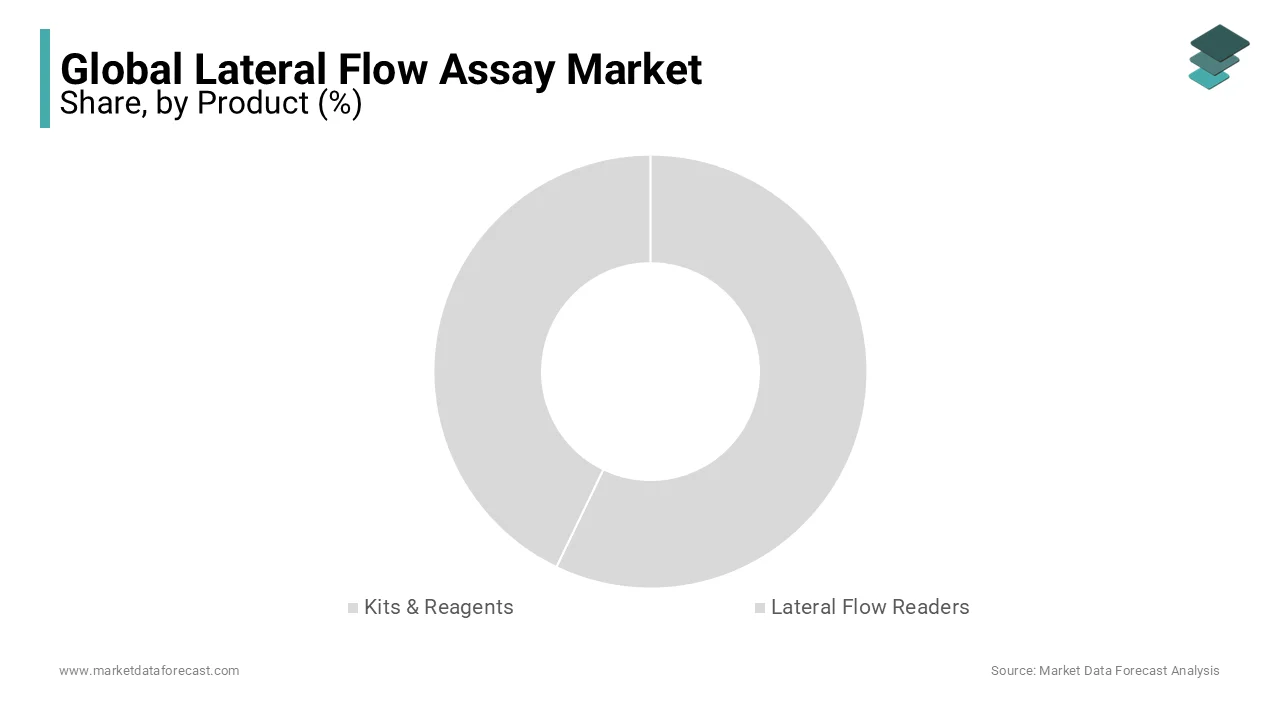
The kits and reagents segment remained the largest revenue-generating part of the lateral flow assay market by capturing a substantial share of total revenue in 2024. This dominance is driven by the consumable nature of test components and the high volume of single-use diagnostics deployed globally. Each lateral flow test requires a new kit containing the membrane strip, conjugate pad, sample pad, and desiccant, making reagents the primary cost driver in large-scale screening programs. Billions of antigen tests were procured globally during the COVID-19 pandemic, mostly as disposable kits. The U.S. Department of Health and Human Services notes that public health initiatives often prioritize low-cost, scalable solutions, favoring standalone kits over instrument-based systems. Additionally, home testing models rely entirely on self-contained kits, with hundreds of millions of at-home tests distributed in the U.S. during 2021–2023. Their ease of deployment, minimal infrastructure needs, and compatibility with mass testing solidify kits and reagents as the backbone of the LFA ecosystem.
The lateral flow readers segment is the fastest-growing and is projected to expand at a notable CAGR of 12.8% from 2025 to 2033. This growth is fueled by the increasing demand for quantitative, objective, and digitally integrated diagnostic results. Traditional visual interpretation of test lines is prone to human error, particularly with faint or ambiguous signals. Moreover, digital readers enhance result accuracy over manual interpretation, especially for faint signals. Devices like the Acon Laboratories’ iChroma and Quidel’s Sofia 2 use optical sensors and AI algorithms to quantify signal intensity, enabling trend monitoring and electronic health record integration. The FDA has cleared multiple reader-based LFA platforms for point-of-care use, including emergency departments and primary care clinics. With rising adoption in telemedicine and chronic disease management, these instruments are transforming LFAs from qualitative tools into data-generating components of digital health ecosystems.
By Technique Insights
The sandwich assay technique segment was the dominant technique in the market by accounting for 63.7% of global LFA applications in 2025. This dominance is because of its high sensitivity and specificity in detecting large, multi-epitope antigens such as proteins from pathogens like SARS-CoV-2, Streptococcus, and Plasmodium falciparum. The technique relies on two antibodies, one immobilized on the test line and one conjugated to a detection particle, that “sandwich” the target antigen, producing a visible signal. Most rapid antigen tests for respiratory viruses use the sandwich format due to its reliability in high-burden infections. The Global Fund distributes hundreds of millions of malaria RDTs annually, the majority based on sandwich assays, preventing misdiagnosis and inappropriate treatment. Its compatibility with both qualitative and semi-quantitative outputs makes it the preferred method in clinical, home, and field settings, reinforcing its centrality in infectious disease control.
The multiplex detection assays segment is the fastest-growing and is likely expanding at a CAGR of 14.3% from 2026 to 2034. This surge is driven by the need for differential diagnosis in syndromic conditions such as fever and respiratory illness, where multiple pathogens present similar symptoms. Traditional single-target LFAs cannot distinguish between influenza, RSV, and SARS-CoV-2, leading to diagnostic uncertainty. Co-circulation of respiratory viruses in the U.S. annually affects millions of people, necessitating multi-pathogen testing. Multiplex platforms can detect multiple analytes simultaneously. The European Commission’s Horizon Europe program has funded several multiplex LFA projects under its pandemic preparedness initiative. With enhanced clinical utility and growing regulatory support, multiplex assays are redefining the scope of rapid diagnostics, enabling smarter, faster, and more comprehensive patient management.
By End User Insights
The hospitals and clinics segment represented the largest end-user by accounting for 44.6% of the market in 2025. This lead position is rooted in their role as primary points of acute care and triage, where rapid diagnostic decisions are critical. Emergency departments, intensive care units, and outpatient clinics rely on LFAs for immediate detection of infections, cardiac markers, and sepsis indicators. Point-of-care testing, including LFAs, informs a big share of emergency clinical decisions. Rapid LFA-based strep and influenza tests reduce inappropriate antibiotic prescriptions. Further, hospitals integrate LFAs into infection control protocols, particularly for nosocomial pathogens like MRSA. Their access to trained personnel, procurement systems, and regulatory compliance frameworks makes hospitals and clinics the dominant institutional users of lateral flow technology.
The home care segment is the quickest-growing and is projected to expand at a CAGR of 13.6% during the forecast period. This growth is driven by the normalization of self-testing following the SARS-CoV-2 pandemic and rising consumer demand for health autonomy. Like, majority of U.S. adults used at-home antigen tests during the pandemic, and many expressed willingness to continue. The FDA has authorized numerous LFA kits for home use across various conditions. Home-based testing improves STI screening rates compared to clinic-only models. Companies like iHealth, FlowFlex, and BTNX have expanded into non-infectious applications such as vitamin deficiency and cardiac risk markers. With smartphone integration and telehealth linkage, home care is evolving into a data-rich, preventive health domain, redefining the boundaries of decentralized diagnostics.
REGIONAL ANALYSIS
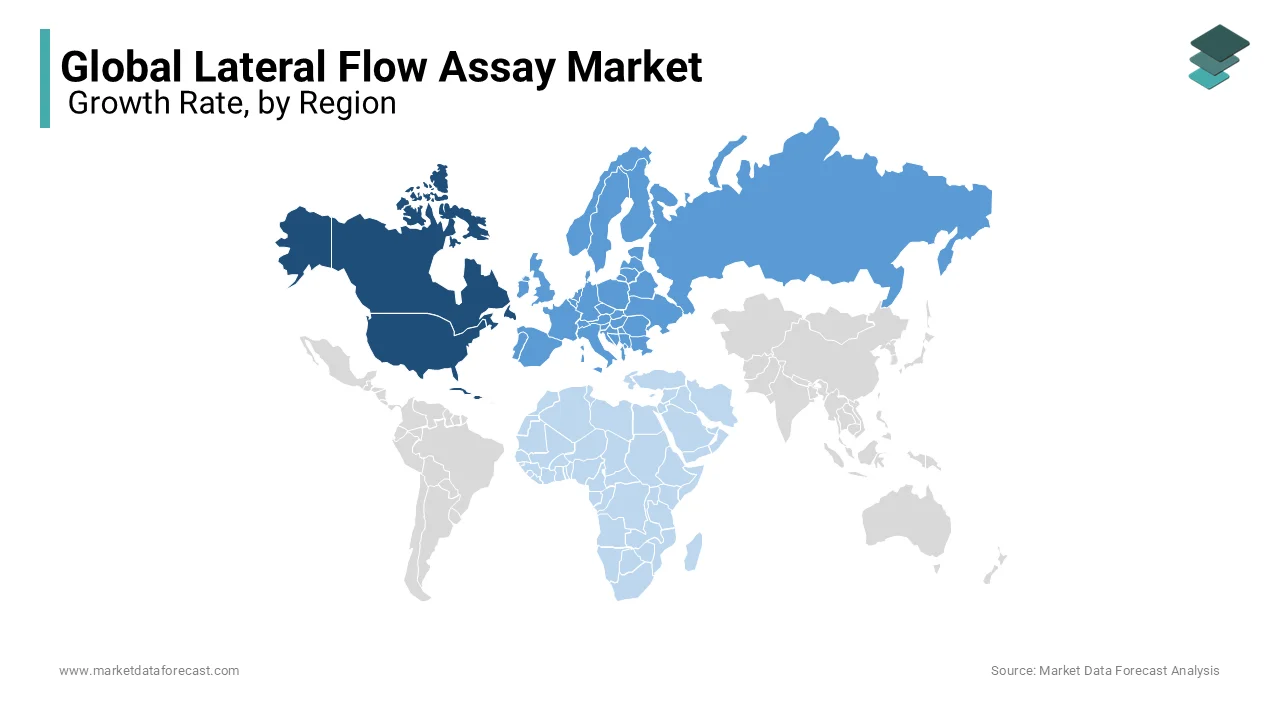
North America leads the global lateral flow assay market with a 32.1% share in 2025. The region’s dominance is anchored in its advanced healthcare infrastructure, robust regulatory framework, and early adoption of rapid diagnostics. U.S. federal agencies procured billions of rapid tests during COVID-19. The U.S. Food and Drug Administration’s Emergency Use Authorization (EUA) allowed numerous LFA/antigen test manufacturers during COVID-19. The Centers for Medicare & Medicaid Services provides reimbursement for certain point-of-care diagnostic tests, enhancing provider adoption. Canada has followed suit with the national stockpiling of rapid tests for pandemic preparedness. With strong R&D investment, digital health integration, and public-private partnerships, North America remains the innovation and deployment epicenter for next-generation lateral flow technologies.
Europe holds a significant market share, with Germany, the UK, and France driving demand. The region benefits from a well-established network of primary care clinics and public health programs that prioritize early diagnosis and infection control. The European Centre for Disease Prevention and Control (ECDC) acknowledges the role of rapid diagnostics in infectious disease control. The UK’s National Health Service distributed hundreds of millions of lateral flow tests for COVID-19, establishing a precedent for mass screening. The In Vitro Diagnostic Regulation (IVDR) has raised performance standards, encouraging innovation in accuracy and traceability. With strong emphasis on quality, data privacy, and equitable access, Europe maintains a balanced approach between regulatory rigor and public health responsiveness.
Asia Pacific is another key player in the market which is propelled by rising healthcare expenditure and infectious disease burden. India, China, and Japan are key markets, with governments investing in decentralized diagnostics to improve rural access. The Indian Council of Medical Research has scaled up rapid malaria and dengue testing significantly in recent years, primarily in remote regions. China’s National Medical Products Administration has fast-tracked approvals for domestic LFA manufacturers, supporting self-reliance in diagnostics. Japan’s Ministry of Health promotes rapid testing in schools and elderly care facilities to manage seasonal influenza. With expanding biotech sectors and digital health adoption, Asia Pacific is emerging as a hub for both production and innovation in lateral flow technologies.
Latin America accounts for a notable portion of the market, with Brazil and Mexico leading regional adoption. Brazil’s Unified Health System (SUS) has integrated LFAs into primary care networks, particularly in the Amazon region where laboratory access is limited. The Oswaldo Cruz Foundation (Fiocruz) has developed locally manufactured diagnostic kits, including for arboviruses. To address this, countries like Colombia and Chile have established regional diagnostic hubs. With rising urbanization and infectious disease threats, Latin America is increasingly relying on lateral flow assays to strengthen surveillance and response capabilities, particularly in hard-to-reach populations.
Middle East and Africa collectively hold a smaller share of the global market, with South Africa, Kenya, and the UAE leading development. South Africa has one of the most advanced diagnostic infrastructures in Africa, with the National Institute for Communicable Diseases deploying LFAs for HIV, TB, and hepatitis screening. The World Health Organization and partners distributed large volumes of rapid diagnostic tests across Africa. The UAE has advanced digital health initiatives, including remote diagnostics. Egypt and Nigeria are scaling up local production of malaria and pregnancy tests to reduce import reliance. Despite challenges in cold-chain logistics and regulatory harmonization, the region is leveraging LFAs as a cornerstone of universal health coverage, particularly in mobile clinics and community health worker programs, positioning them as vital tools in equitable healthcare delivery.
COMPETITIVE LANDSCAPE
The competition in the Lateral Flow Assay Market is intensifying as global diagnostics giants, regional manufacturers, and emerging biotech firms vie for dominance in a high-stakes, rapidly evolving landscape. Established players leverage brand trust, regulatory expertise, and global distribution to maintain leadership, while agile entrants differentiate through cost efficiency, multiplex capabilities, and digital integration. The post-pandemic shift toward preparedness has increased demand for versatile, scalable solutions, favoring companies with robust R&D pipelines. Intellectual property control over novel conjugates, membranes, and reader algorithms is a key differentiator. Regulatory fragmentation, counterfeit risks, and pricing pressures in low-income markets add complexity. As the focus shifts from emergency response to integrated health systems, companies must balance innovation, accessibility, and compliance to sustain long-term competitiveness in a market defined by speed, accuracy, and equity.
KEY MARKET PLAYERS
Noteworthy companies dominating the global lateral flow assay market profiled in this report are
- Alere Inc.
- F. Hoffmann-La Roche AG
- Danaher Corporation
- Siemens AG, Becton
- Dickinson and Company
- bioMérieux SA
- Johnson & Johnson
- Bio-Rad Laboratories Inc.
- Thermo Fisher Scientific Inc.
- QIAGEN N.V.,
- PerkinElmer Inc.
Top Players in the Lateral Flow Assay Market
Abbott Laboratories has significantly strengthened its presence in the Asia Pacific lateral flow assay market through localized manufacturing and public health partnerships. The company’s BinaxNOW and SD BIOSENSOR-branded antigen tests have been widely adopted in Japan, South Korea, and Australia for respiratory disease screening. The company also established a regional distribution hub in Singapore to enhance supply chain resilience across Southeast Asia. By aligning with national health programs and investing in cold-chain logistics, Abbott has ensured consistent access to high-quality assays. Additionally, its integration of smartphone-compatible test readers in telemedicine pilots in Thailand and Malaysia demonstrates a forward-looking approach to digital diagnostics, reinforcing its leadership in decentralized testing solutions.
Roche Diagnostics has expanded its footprint in the Asia Pacific region by focusing on high-sensitivity lateral flow platforms for infectious and chronic diseases. The company introduced its SARS-CoV-2 Antigen Rapid Test in Japan, China, and Taiwan, receiving regulatory approval under emergency pathways. The company also launched educational initiatives with hospitals in Indonesia and Vietnam to train healthcare workers on rapid testing protocols. Roche’s emphasis on analytical precision and compliance with ISO 13485 standards has earned trust among clinical users. By leveraging its global R&D infrastructure and collaborating with regional governments on disease surveillance, Roche has positioned itself as a provider of reliable, science-driven diagnostic solutions tailored to diverse healthcare environments across the region.
SD BIOSENSOR (a subsidiary of Standard BioTools) has emerged as a key player in the Asia Pacific lateral flow assay market by combining South Korean innovation with scalable production. The company’s AllTest and iCHROMA platforms are widely used in point-of-care settings across India, the Philippines, and Malaysia. The company also launched a multiplex respiratory panel capable of detecting influenza, RSV, and SARS-CoV-2 simultaneously, receiving CE and PMDA approvals. Its investment in automated manufacturing lines in South Korea ensures high output and cost efficiency. By focusing on affordability, regulatory agility, and multi-pathogen detection, SD BIOSENSOR has become a preferred partner for public health agencies and private clinics seeking reliable, next-generation lateral flow solutions.
Top Strategies Used by Key Market Participants
Key players in the Lateral Flow Assay Market are deploying vertical integration, strategic public-private partnerships, digital integration, regulatory acceleration, and localization of production to consolidate their positions. Companies are securing control over critical raw materials such as nitrocellulose and conjugated antibodies to mitigate supply chain risks. Expansion into multiplex and quantitative platforms enables differentiation in a crowded market. Strategic collaborations with national health systems enhance distribution and credibility. Investment in smartphone-linked readers and cloud-based data reporting supports telemedicine integration. Additionally, firms are establishing regional manufacturing and distribution hubs in Asia and Africa to reduce lead times and comply with local content requirements. Emphasis on rapid regulatory submissions, especially under emergency use pathways, allows faster market entry during health crises, ensuring sustained relevance and scalability.
RECENT MARKET HAPPENINGS
- In January 2023, Abbott Laboratories launched a regional supply hub in Singapore to accelerate the distribution of its BinaxNOW antigen tests across Southeast Asia in the Lateral Flow Assay Market.
- In March 2023, Roche Diagnostics partnered with Australia’s national health agency to include its SARS-CoV-2 rapid test in the country’s pandemic preparedness stockpile in the Lateral Flow Assay Market.
- In July 2023, SD BIOSENSOR supplied 10 million multiplex respiratory antigen kits to Indonesia’s Ministry of Health for primary care deployment in the Lateral Flow Assay Market.
- In November 2023, Becton Dickinson introduced a smartphone-integrated lateral flow reader in India, enabling digital result capture and teleconsultation linkage in the Lateral Flow Assay Market.
- In February 2024, Bio-Rad Laboratories launched a new line of veterinary lateral flow assays for bovine diseases in collaboration with Thai agricultural authorities in the Lateral Flow Assay Market.
MARKET SEGMENTATION
This market research report on the global lateral flow assay market has been segmented and sub-segmented based on the product, technique, application, end-user, and region.
By Product
- Kits & Reagents
- Lateral Flow Readers
- Digital/Mobile Readers
- Benchtop Readers
By Technique
- Sandwich Assays
- Competitive Assays
- Multiplex Detection Assays
By Application
- Clinical/Point-of-Care Testing
- Infectious Disease Testing
- Mosquito-Borne Disease Testing
- Influenza Testing
- Sexually Transmitted Infections
- Hepatitis
- Tuberculosis
- Other Infectious Diseases
- Cardiac Marker Testing
- Pregnancy & Fertility Testing
- Pregnancy Testing
- Fertility Testing
- Cholesterol/Lipid Testing
- Drugs-of-Abuse Testing
- Other Tests
- Infectious Disease Testing
- Veterinary Diagnostics
- Food Safety & Environment Testing
- Drug Development & Quality Testing
- Other Applications
By End User
- Hospitals and Clinics
- Home Care
- Diagnostic Laboratories
- Pharmaceutical
- Biotechnology Companies
By Region
- North America
- Europe
- Asia Pacific
- Latin America
- Middle East and Africa