- Product Description Description
- Table of Contents TOC
- List of Table & Figure LOT
- Get Free Sample PDF Sample PDF
Market Size, 2025
$0.29 BnMarket Estimate, 2026
$0.31 BnMarket Forecast, 2034
$0.54 BnCAGR, 2026–2034
7.25%Executive Summary: Latin America Hospital Beds Market
- Market Scope: Comprehensive regional market evaluation of hospital beds in Latin America covering usage types, power mechanisms, end-user settings, and country-level distribution frameworks.
- Market Valuation: Valued at USD 0.29 billion (2025), estimated at USD 0.31 billion (2026), and projected to reach USD 0.54 billion by 2034, registering a solid CAGR of 7.25% (2026–2034).
- Primary Growth Drivers: Rising prevalence of chronic diseases, increasing accidental injuries, and growing healthcare investments and budget allocations. Key operational factors include a rapidly expanding geriatric population (projected to more than double from 48 million in 2018 to over 101 million by 2050), modernization of healthcare facilities, and the proliferation of private hospitals.
Key Market Segment Metrics (2026–2034)
| Category | Leading Segment (2025 Position) | Fastest-Growing Segment |
|---|---|---|
| By Usage | Acute Care Beds (led regional demand driven by high hospitalization and emergency treatment volumes) | Long-Term Care and Psychiatric Care Beds |
| By Power | Electric and Semi-Electric Beds (favored for advanced patient positioning and comfort) | Electric Beds driven by smart healthcare infrastructure upgrades |
| By End-User | Hospitals (captured the largest share due to widespread inpatient admissions and private facility growth) | Ambulatory Surgical Centers and Specialized Clinics |
| By Country | Brazil (led the regional market with the highest number of beds and operating rooms) | Mexico, Colombia, and emerging healthcare hubs like Chile and Uruguay |
Major Market Players & Market Structure
Market Structure: Highly competitive regional medical furniture and equipment landscape featuring global health-tech leaders competing against local manufacturers on pricing, automated functionalities, durability, and patient safety features.
Key Companies: Invacare Corporation, Paramount Bed Holdings Co. Ltd., Gendron Inc., Medline Industries Inc., LINET spol. s r.o., Savaria Corporation, Savion Industries, Hill-Rom Holdings Inc., Stryker Corporation, and Getinge Group.
 Download Free Sample Report
Latin America Hospital Beds Market Size
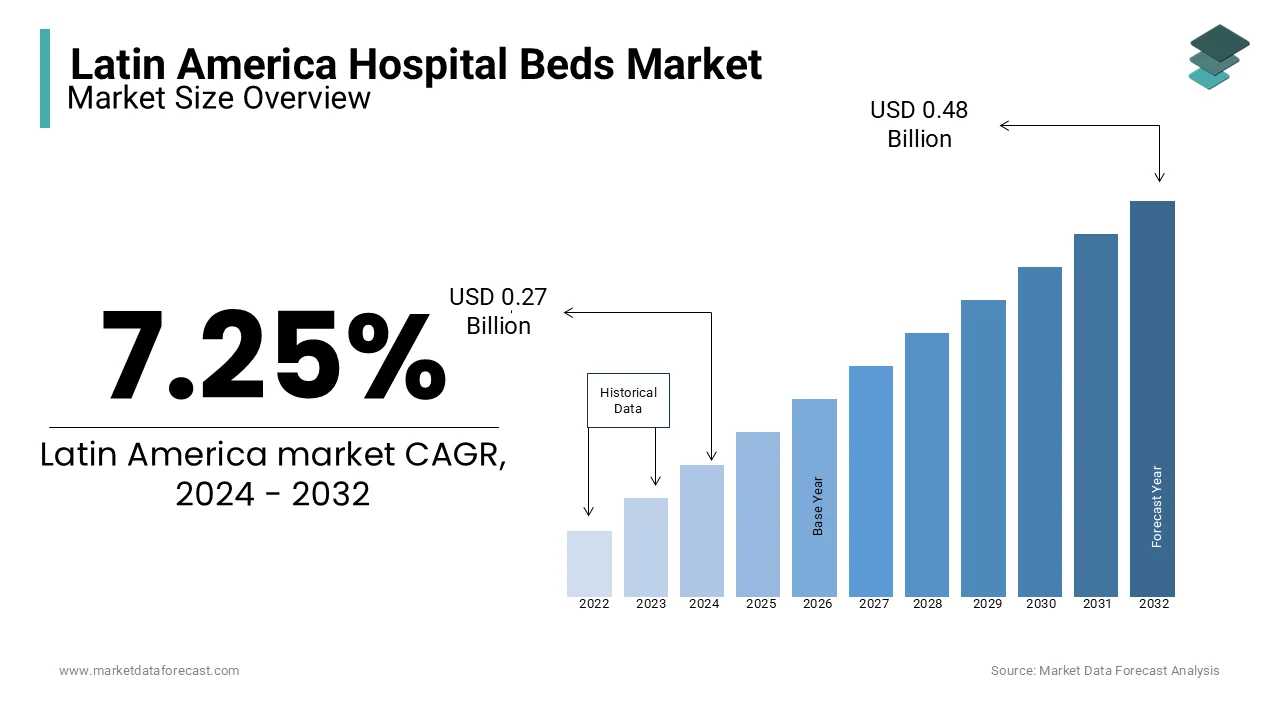
The size of the Latin America hospital beds market was valued at USD 0.29 billion in 2025. This market is expected to grow at a CAGR of 7.25% from 2026 to 2034 and be worth USD 0.54 billion by 2034 from USD 0.31 billion in 2026.
Hospital beds are manual, electric, and specialized medical beds designed for patient care in acute, long-term, and home healthcare settings. These essential infrastructure components serve as the foundation for modern medical treatment, ensuring patient comfort, safety, and efficient clinical workflows. According to the Pan American Health Organization, the region faces a significant deficit in hospital infrastructure, with many countries having fewer than 2 beds per 1000 inhabitants, which is well below the global average. This scarcity drives urgent government initiatives to expand healthcare capacity and modernize existing facilities. Manufacturers focus on durability, ease of cleaning, and ergonomic design to meet stringent hygiene standards. Regulatory frameworks vary across countries, requiring manufacturers to adapt to local certification requirements.
MARKET DRIVERS
Rising Prevalence of Chronic Diseases
The rising prevalence of chronic diseases is increasing the demand for long-term care and specialized medical infrastructure, accelerating the growth of the Latin America hospital beds market. Conditions such as diabetes, cardiovascular diseases, and respiratory disorders require extended hospital stays and frequent monitoring, which require adequate bed capacity and advanced patient support systems. The epidemiological shift drives hospitals to invest in high-acuity beds equipped with features like lateral rotation and integrated weighing scales to manage immobile patients effectively. As per the World Health Organization, the number of people aged 60 and above in Latin America is projected to double by 2050, leading to higher rates of age-related complications that require specialized geriatric care units. These demographic changes compel healthcare providers to upgrade from basic manual beds to electric models that reduce caregiver strain and improve patient outcomes. Government health programs prioritize the expansion of chronic care centers, further boosting procurement volumes. The integration of smart beds with electronic health records allows for real-time data tracking, enhancing clinical decision-making.
Expansion of Healthcare Infrastructure
The ongoing expansion of healthcare infrastructure, as governments and private investors commit to building new hospitals and upgrading existing facilities to improve access to care, is additionally leveraging the growth of the Latin America hospital beds market. Rapid urbanization and population growth have exposed gaps in medical coverage, prompting large-scale construction projects across major economies in the region. The financial commitment translates into direct procurement opportunities for bed manufacturers supplying both public and private institutions. Several countries have launched national health plans aiming to increase the ratio of hospital beds to population levels, aligning with international standards. Private hospital chains are also expanding their networks to cater to the growing middle class seeking premium healthcare services. These expansions often include state-of-the-art intensive care units and surgical wards that require specialized high-end beds. Standardization of medical equipment across new facilities creates bulk purchasing opportunities for established suppliers.
MARKET RESTRAINTS
Budget Constraints and Economic Volatility
Budget constraints and economic volatility limit the financial capacity of public healthcare systems to procure new equipment, which is hindering the growth of the Latin America hospital beds market. Many countries in the region face fluctuating currency values and high inflation rates, which erode purchasing power and delay capital expenditure projects. Several Latin American countries have experienced contraction or slow growth in recent years, forcing governments to prioritize essential spending over infrastructure upgrades. This fiscal pressure leads to deferred maintenance and postponed replacement of aging hospital beds, resulting in a slower adoption rate for new technologies. The public debt levels in the region have risen, significantly reducing the fiscal space available for health investments without external financing. Hospitals often resort to repairing old equipment rather than buying new units, extending the lifecycle of outdated products. Private institutions may also tighten budgets in response to economic uncertainty affecting their expansion plans. Import tariffs and taxes on medical devices further increase costs, making advanced beds less affordable for smaller clinics. Currency devaluation makes imported beds from Europe or North America prohibitively expensive.
Complex Regulatory Frameworks
The complex regulatory frameworks are creating barriers to entry and delaying the approval process for new medical devices, which is additionally slowing the growth of the Latin America hospital beds market. Each country in the region maintains distinct registration requirements, safety standards, and certification processes, which manufacturers must navigate individually. This regulatory fragmentation forces companies to invest heavily in local legal and technical resources to ensure adherence to varying national laws. The lack of unified regional guidelines results in duplication of efforts and inconsistent enforcement of quality controls across borders. Delays in obtaining sanitary registrations can postpone product launches by months or even years, affecting revenue projections. Small and medium-sized manufacturers often struggle to meet these rigorous documentation and testing requirements, limiting competition. Changes in regulatory policies without prior notice create additional uncertainty for importers and distributors.
MARKET OPPORTUNITIES
Adoption of Smart and Connected Hospital Beds
The adoption of smart and connected hospital beds is enabling advanced patient monitoring and improving operational efficiency in healthcare facilities, which is substantially promoting the growth of the Latin America hospital beds market. These intelligent beds integrate sensors and connectivity features that track patient movement, vital signs, and bed occupancy, providing real-time data to nursing staff. This technological shift allows for early detection of pressure ulcers and falls, reducing liability and improving patient safety outcomes. Healthcare providers are increasingly interested in these value-added features to enhance quality of care and optimize staffing resources. Government initiatives promoting digital health infrastructure support the uptake of connected medical devices. Manufacturers can differentiate their offerings by providing software platforms that analyze bed usage patterns for better resource management. Partnerships with technology firms facilitate the development of interoperable systems.
Growth in Home Healthcare Services
The growth in home healthcare services, as patients increasingly prefer receiving treatment in the comfort of their homes. This factor is attributed to the growth of the Latin America hospital beds market. Rising healthcare costs and hospital bed shortages have accelerated the shift toward home-based care for chronic conditions, post-operative recovery, and palliative care. This trend creates demand for lightweight, adjustable, and easy-to-maintain hospital beds suitable for residential use. The aging population in Latin America is a key driver for home care adoption, as families seek convenient solutions for elderly relatives. Manufacturers can capitalize on this opportunity by designing aesthetically pleasing and compact beds that blend with home décor, while offering medical functionality. Distribution channels are evolving to include online retailers and medical equipment rental services that cater to individual consumers. Insurance coverage for home medical equipment is expanding in some countries, making these products more accessible. Training programs for caregivers on bed operation and safety enhance user confidence.
MARKET CHALLENGES
Shortage of Skilled Healthcare Personnel
The shortage of skilled healthcare personnel are limiting the effective utilization of advanced medical equipment and affecting patient care quality that is to act as a major barrier for the expansion of the Latin America hospital beds market. Many hospitals struggle to recruit and retain trained nurses and technicians, who can operate sophisticated electric and smart beds safely and efficiently. According to the Pan American Health Organization, the region faces a deficit of over 1 million health workers, with rural areas being disproportionately affected by this brain drain. This staffing crisis means that even when new beds are installed, they may not be used to their full potential due to lack of expertise. The high turnover rates in the healthcare sector lead to continuous training needs, which strain hospital resources and budgets. Complex beds with multiple functions require specific knowledge to prevent patient injury and equipment damage. The reliance on informal caregivers in home settings further complicates the safe operation of medical beds.
Maintenance and After-Sales Service Issues
Maintenance and after-sales service issues are affecting the longevity and reliability of medical equipment in regions with limited technical support infrastructure, which is an additional factor contributing to the decline in the growth of the Latin American hospital beds market. Hospital beds are subject to heavy daily use and require regular maintenance to ensure safety and functionality, yet many facilities lack access to timely repair services. According to the World Health Organization, medical equipment in developing countries is out of service at any given time due to lack of maintenance and spare parts. This high downtime rate reduces the return on investment for hospitals and discourages the purchase of new equipment. The lack of standardized technical training for biomedical engineers in the region exacerbates the problem, leading to improper repairs and further damage. Manufacturers often struggle to establish comprehensive service networks in remote areas due to logistical costs and sparse demand. Spare parts availability is another critical issue, with long lead times for imports causing prolonged equipment idle periods. Hospitals may opt for cheaper, lower-quality beds that are easier to repair locally but offer fewer features.
REPORT COVERAGE
| REPORT METRIC | DETAILS |
| Market Size Available | 2025 to 2034 |
| Base Year | 2025 |
| Forecast Period | 2026 to 2034 |
| Segments Covered | By Usage, Power, End-Users, and Country. |
| Various Analyses Covered | Global, Regional, and Country-Level Analysis, Segment-Level Analysis, Drivers, Restraints, Opportunities, Challenges; PESTLE Analysis; Porter’s Five Forces Analysis, Competitive Landscape, Analyst Overview of Investment Opportunities |
| Countries Covered | Brazil, Mexico, Argentina, Chile & Rest of Latin America |
| Market Leaders Profiled | Invacare Corporation, Lincoln Medical Group, Paramount Bed Holdings Co. Ltd., Gendron Inc., Medline Industries Inc., LINET spol. S r.o., Savaria Corporation, Savion Industries, Hill-Rom Holdings Inc., Stryker Corporation, and Getinge Group. |
SEGMENTAL ANALYSIS
By Usage Insights
The acute care beds segment held a prominent share of the Latin America Hospital Beds Market in 2025 due to its role in emergency rooms, surgical units, and intensive care departments, where immediate medical intervention is required. These beds are designed for short-term stays and feature advanced functionalities to support complex clinical procedures. The high turnover rate drives consistent demand for durable and hygienic bed models that can withstand frequent cleaning and heavy usage. Hospitals prioritize these beds to ensure rapid patient stabilization and efficient workflow management during crucial care scenarios. The prevalence of road traffic accidents and industrial injuries in developing economies further amplifies the need for robust acute care solutions. Manufacturers focus on ergonomic designs that facilitate easy access for medical staff during emergencies. Regulatory standards for infection control in acute settings also drive the adoption of beds with antimicrobial surfaces.

The long-term care beds segment is anticipated to witness the fastest CAGR of 10.9% from 2026 to 2034 with the rapidly aging population and the increasing burden of chronic degenerative diseases. These beds are specifically engineered for extended stays, featuring pressure redistribution mattresses and adjustable positions to prevent bedsores and enhance patient comfort over prolonged periods. The demographic shift compels healthcare providers to invest in specialized long-term care infrastructure that supports mobility-impaired patients. Families and institutions seek beds that reduce caregiver burden through electric adjustments and safety rails. Government initiatives to expand palliative care and rehabilitation centers further boost this segment. The rise of private nursing homes catering to the affluent elderly population also contributes to growth.
By Power Insights
The manual beds segment held a significant share of the Latin America Hospital Beds Market in 2025 by owing to their affordability, simplicity, and widespread availability in public healthcare facilities and smaller clinics. These beds rely on mechanical cranks for adjustment, making them cost-effective to purchase and maintain, which is crucial for budget-constrained healthcare systems. The financial reality ensures that manual beds remain the standard choice for general wards and rural health centers. As per the study, over 60% of primary care facilities in remote areas lack a reliable electricity supply, making manual beds the only viable option for patient care. Their robust construction requires minimal technical expertise for operation and repair, reducing dependency on specialized biomedical engineers. Distributors favor manual beds due to lower logistics costs and easier storage requirements. The large volume of government tenders for basic hospital furniture further sustains this segment leadership.
The electric beds segment is swiftly emerging at a fastest CAGR of 7.2% during the forecast period with the modernization of private hospitals and the increasing demand for enhanced patient comfort and caregiver efficiency. These beds offer seamless adjustment of head, foot, and height positions via remote controls, reducing physical strain on nursing staff and improving patient autonomy. The integration of electric beds with smart hospital systems allows for data collection on patient movement and sleep patterns. Aging populations prefer electric beds for their ease of use in home care settings as well. Regulatory incentives for workplace safety encourage facilities to replace manual beds with electric versions. Technological advancements have lowered the cost of electric motors, making them more accessible.
By End User Insights
The hospitals segment was the largest, accounting for 44.3% of the Latin America hospital beds market share in 2025 due to their central role in providing comprehensive medical services ranging from emergency care to surgery and inpatient treatment. These institutions require large volumes of beds across various departments, including intensive care units, operating theaters, and general wards, driving substantial procurement activity. The extensive network ensures consistent demand for both replacement and new capacity expansion. Hospital bed density varies significantly across the region but remains the primary metric for healthcare capacity planning, prompting governments to prioritize hospital infrastructure projects. Public hospitals drive volume through bulk tenders, while private hospitals focus on premium features and aesthetics. The concentration of specialized medical equipment in hospitals necessitates compatible bed designs that support diagnostic and therapeutic devices. Training programs for hospital staff on bed usage and maintenance are well established, ensuring optimal utilization.
The ambulatory services segment is expected to register the fastest CAGR of 8.2% from 2026 to 2034 with the shift toward outpatient care and same-day surgical procedures. These facilities include surgical centers, diagnostic clinics, and rehabilitation units that require specialized beds for short-term observation and recovery without overnight stays. The burden on inpatient facilities, while creating demand for compact and versatile bed solutions. These beds need to be easily convertible and space-efficient to maximize throughput in high-volume clinics. The rise of specialized centers for ophthalmology, dentistry, and minor surgeries further boosts this segment. Investors are funding the expansion of ambulatory networks to capture the growing middle-class population.
COUNTRY-LEVEL ANALYSIS
Brazil Hospital Beds Market Analysis
Brazil was the largest contributor in the Latin America Hospital Beds Market by capturing 39.2% of the share in 2025 with its massive population, extensive public healthcare system, and robust domestic manufacturing base. The country serves as the regional hub for medical device production and distribution by leveraging its industrial capacity to supply both local and neighboring areas. The vast infrastructure ensures steady procurement volumes from both public and private sectors. The government focuses on reducing waiting times for surgeries, which requires expanding intensive care and surgical bed capacity. Private hospital chains are investing in modernization to attract medical tourism. Regulatory agency ANVISA enforces strict quality controls, ensuring high standards for imported and local products. Economic fluctuations impact purchasing power, but essential health spending remains prioritized. The presence of major global and local players fosters competition and innovation.

Mexico Hospital Beds Market Analysis
Mexico hospital beds market was ranked second, accounting for a 21.2% share in 2025, with its strong trade ties with North America and growing private healthcare sector. The country benefits from proximity to the United States, which facilitates the import of advanced medical technologies and export of manufactured components. The transformation of the public health system has led to the construction of new general hospitals, requiring thousands of new beds to improve access in underserved regions. This government initiative drives substantial demand for standardized and durable bed models. Private hospitals prefer high-end electric beds with smart features to differentiate their offerings. Manufacturing hubs in northern Mexico support the assembly of medical equipment, reducing costs. Regulatory harmonization with international standards simplifies market entry for global brands. The tourism industry in coastal areas boosts demand for medical facilities equipped with modern beds.
Argentina Hospital Beds Market Analysis
Argentina hospital beds market growth is expected to grow at a fastest CAGR during the forecast period with its highly educated medical workforce and strong tradition of universal healthcare coverage. The country has a dense network of hospitals and clinics, particularly in Buenos Aires, which drives consistent demand for medical infrastructure. Hospitals serve over 60% of the population, necessitating regular updates to equipment to maintain service quality, despite economic challenges. This high utilization rate leads to frequent replacement cycles for worn-out beds. Imports of medical devices have stabilized as local manufacturers improve their competitiveness through technological upgrades. Economic volatility affects pricing, but government subsidies for essential health equipment help mitigate impacts. The private sector focuses on niche segments such as bariatric and pediatric beds. Professional associations advocate for better working conditions, including ergonomic beds for staff. Local distributors play a crucial role in navigating complex import regulations.
Chile Hospital Beds Market Analysis
Chile hospital beds market growth is expected to grow with the rising focus on high-quality standards and integration with digital health systems. The country leads in regulatory compliance and healthcare outcomes, driving demand for premium and smart hospital beds. The national strategy for healthcare modernization includes the digitization of hospital services, which requires compatible smart beds for data integration. This technological push favors advanced electric models with connectivity features. The high per capita health expenditure allows private insurers to cover sophisticated treatments in facilities equipped with state-of-the-art beds. The aging population increases demand for long-term care beds in specialized residences. Public-private partnerships facilitate the renovation of older hospitals with modern equipment. Regulatory agency ISP ensures strict adherence to international safety standards. Consumers prioritize brand reputation and reliability over cost.
Rest of Latin America
The Rest of Latin America hospital beds market growth is driven by ongoing healthcare reforms and infrastructure development in countries like Colombia, Peru, and Ecuador. These nations are investing in expanding primary and secondary care networks to improve access for rural populations. The regional health initiatives aim to standardize medical equipment procurement, allowing for bulk purchases and better pricing for member states. This cooperation facilitates the entry of international suppliers into smaller markets. The infrastructure loans targeted at health sector improvements have enabled the construction of new regional hospitals, requiring complete bed fittings. Local distributors adapt global products to meet specific climatic and logistical conditions. Political stability in some countries encourages foreign direct investment in healthcare facilities. The rise of medical tourism in countries like Costa Rica drives demand for high-end hospitality-style hospital beds. Challenges include fragmented regulatory landscapes and limited technical support in remote areas.
COMPETITIVE LANDSCAPE
The competitive landscape of the Latin America Hospital Beds Market features a mix of global multinational corporations and strong regional manufacturers striving to capture demand across diverse healthcare settings. Major players differentiate themselves through technological innovation, brand reputation, and comprehensive after-sales support, while local competitors leverage cost advantages and proximity to customers. Competition intensifies as companies invest in research and development to create smart beds with integrated sensors and connectivity features that appeal to modernizing hospitals. Established medical device firms often bundle beds with other equipment to offer holistic room solutions, creating high barriers to entry for standalone manufacturers. Strategic collaborations with local distributors and service providers accelerate market penetration by ensuring timely maintenance and spare parts availability. Regulatory compliance remains a critical factor influencing competitive dynamics as countries implement stricter safety and quality standards for medical devices. Price sensitivity in public sector procurement prompts firms to adopt tiered pricing strategies and local assembly options to maintain affordability.
KEY MARKET PLAYERS
The leading companies operating in the Latin America hospital beds market include:
- Invacare Corporation
- Lincoln Medical Group
- Paramount Bed Holdings Co. Ltd.
- Gendron Inc.
- Medline Industries Inc.
- LINET spol. S r.o.
- Savaria Corporation
- Savion Industries
- Hill-Rom Holdings Inc.
- Stryker Corporation
- Getinge Group
TOP PLAYERS IN THE MARKET
- Hill-Rom Holdings Inc. maintains a robust presence in the Latin America Hospital Beds Market through its comprehensive portfolio of advanced patient care solutions. The company leverages its global reputation for innovation to deliver smart beds that integrate with hospital information systems for improved clinical outcomes. Recent initiatives focus on expanding distribution partnerships in Brazil and Mexico to enhance local support and service capabilities. Hill-Rom actively collaborates with healthcare providers to demonstrate the value of pressure injury prevention technologies embedded in their mattresses. Their commitment to sustainability drives the development of eco-friendly materials and energy-efficient designs. The company provides extensive training programs for biomedical engineers, ensuring proper maintenance and optimal usage of equipment. Strategic investments in digital health platforms enable remote monitoring of bed status and patient movement.
- Stryker Corporation serves as a pivotal contributor to the Latin America Hospital Beds Market by offering high durability and ergonomic medical beds designed for demanding clinical environments. The company focuses on delivering products that reduce caregiver strain and enhance patient safety through innovative mechanical and electrical features. Recent expansions include strengthening manufacturing and assembly operations in key regions to reduce lead times and import costs. Stryker prioritizes education by hosting workshops on safe patient handling and mobility best practices for nursing staff. The firm actively engages with regulatory bodies to ensure compliance with evolving safety standards across different countries. Their technical teams work closely with hospital administrators to optimize fleet management and lifecycle costs. Stryker also invests in research to develop beds with integrated weighing and diagnostic capabilities.
- Lincoln Medical Group plays a significant role in the Latin America Hospital Beds Market by providing cost-effective and reliable bed solutions tailored to the needs of public and private healthcare facilities. The company integrates local manufacturing capabilities with international quality standards to deliver affordable, yet durable products. Recent actions involve upgrading production facilities in Argentina and Chile to increase capacity for electric and manual bed models. Lincoln Medical emphasizes after-sales service by establishing regional spare parts centers to minimize equipment downtime. The firm is committed to supporting healthcare accessibility by offering flexible financing options for smaller clinics and hospitals. Their focus on modular design allows for easy customization and repair, extending product lifespan. Lincoln Medical actively participates in government tenders, supplying bulk orders for public health infrastructure projects.
MARKET SEGMENTATION
This Latin America hospital beds market research report is segmented and sub-segmented into the following categories.
By Usage
- Acute care beds
- Long term care beds
- Psychiatric care beds
- Others (maternity, etc.)
By Power
- Electric Bed
- Semi-Electric Bed
- Manual Bed
By End-User
- Hospitals
- Clinics
- Ambulatory services
- Others
By Country
- Brazil
- Mexico
- Argentina
- Chile
- Rest of Latin America