- Product Description Description
- Table of Contents TOC
- List of Table & Figure LOT
- Get Free Sample PDF Sample PDF
Market Size, 2025
$1.73 BnMarket Estimate, 2026
$2.06 BnMarket Forecast, 2034
$8.47 BnCAGR, 2026–2034
19.31%Executive Summary: Global LiDAR Market
- Market Scope: Comprehensive global LiDAR market analysis covering installation modes, application verticals, component categories, regional frameworks, and competitive dynamics.
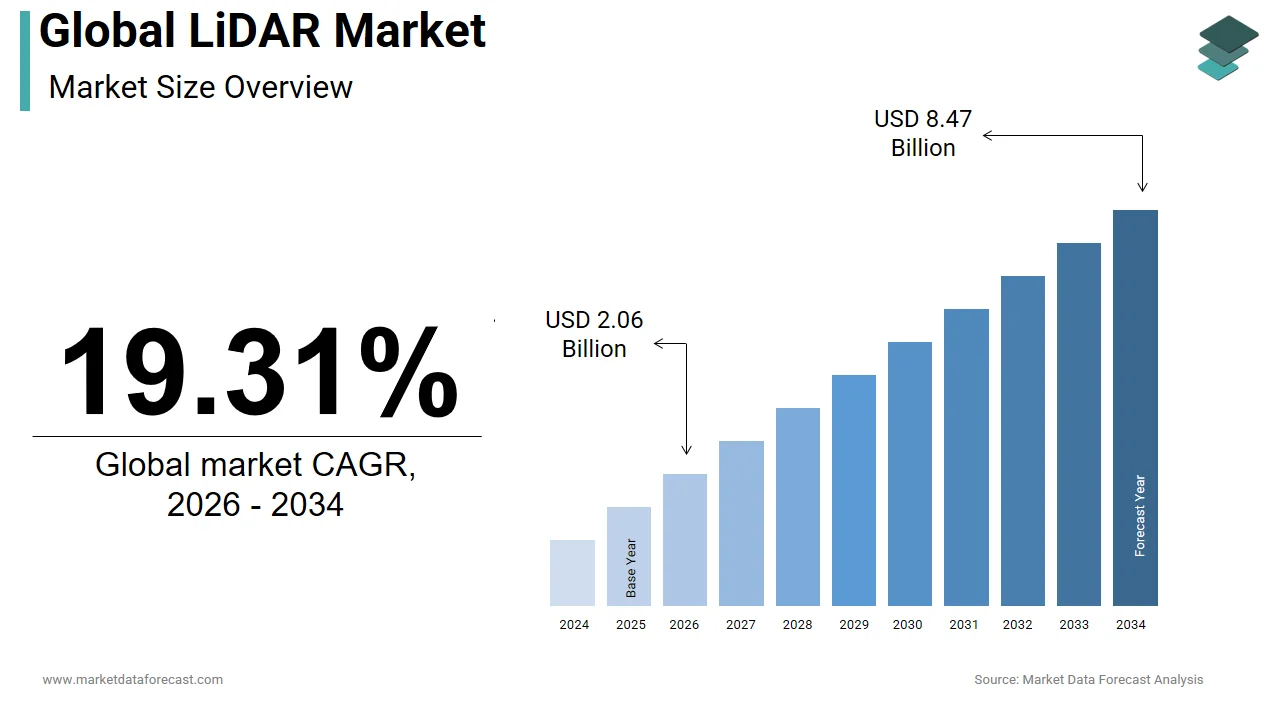
- Market Valuation: Valued at USD 1.73 billion (2025), estimated at USD 2.06 billion (2026), and projected to reach USD 8.47 billion by 2034, registering a strong CAGR of 19.31% (2026–2034).
- Primary Growth Drivers: LiDAR adoption in smart cities, urban planning, robotics, manufacturing automation, warehouse automation, and 5G infrastructure. Opportunities include autonomous vehicles, ADAS applications, precision mapping, and telecommunications expansion.
Key Market Segment Metrics (2026–2034)
| Category | Leading Segment (2025 Position) | Fastest-Growing Segment |
|---|---|---|
| By Type, Installation, Application & Component | Ground-Based (largest installation); Corridor Mapping (largest application); Laser Scanners (largest component segment; largest type not explicitly stated) | Solid-State LiDAR (fastest-growing type); ADAS & Driverless Car (fastest-growing application); Ground-Based Surveying (fastest-growing service); Laser Scanners (fastest-growing component) |
| By Region | North America (largest regional market) | Not explicitly stated in the uploaded report |
Major Market Players & Strategic Developments
Market Structure: Highly innovation-driven global laser sensing and geospatial intelligence ecosystem featuring leading companies competing on advanced solid-state sensors, autonomous vehicle solutions, precision surveying, and industrial automation.
Key Companies: Teledyne Technologies Inc., Geodigital, Optech, BLOM, Faro Technologies, Leica Geosystems, Michael Baker International, Topcon Positioning Systems, Trimble, Hexagon AB, Beike Tianhui Technology Co., Ltd., Quantum Spatial, YellowScan, Velodyne LiDAR, Merrick & Co., Riegl Laser Measurement Systems, Beijing Surestar Technology, Geokno, and Sick AG.
Recent Strategic Developments: Innoviz Technologies focused on developing high-performance solid-state LiDAR sensors tailored for autonomous vehicles.
Global LiDAR Market Size
The global LiDAR market size was worth USD 1.73 billion in 2025. The global market is expected to grow at a CAGR of 19.31% from 2026 to 2034 and be worth USD 2.06 billion in 2026 and USD 8.47 billion by 2034.
LiDAR is a remote sensing technology that uses laser beams to measure distances and create 3D maps. It emits laser pulses, measuring the time taken for light to return, enabling precise distance calculations. It is essential in geographic mapping, autonomous vehicles, forestry, and environmental monitoring, LiDAR also provides high-resolution spatial information. Its applications range across industries and research fields, offering a powerful tool for accurately mapping and understanding the intricacies of the physical world.
MARKET DRIVERS
Smart Cities and Infrastructure Development play a pivotal role in the growth of the LiDAR market. It enables the creation of highly detailed 3D maps, providing urban planners and policymakers with crucial insights for efficient city management.
However, its application extends to monitoring changes in the urban landscape and the development of sustainable infrastructure. As cities strive for enhanced connectivity, resource optimization, and environmental sustainability, LiDAR's capacity to deliver accurate spatial data. As a result, the LiDAR market experiences heightened demand as smart city projects increase, emphasizing the significance of technology in shaping the future of urban living through innovative, technology-driven solutions for intelligent infrastructure development and management.
The LiDAR Market is also experiencing another notable surge driven by the rising industrial realms, emerging as a catalyst for innovation in robotics, manufacturing, and warehouse automation. Its application offers real-time spatial data that enhances automation processes to high levels of efficiency. In robotics, LiDAR eventually facilitates precise navigation and obstacle avoidance. However, warehouse automation also benefits from LiDAR's capacity to optimize inventory management and streamline logistics through accurate spatial awareness. As industries increasingly prioritize automation for productivity gains, the LiDAR market experiences a surge in demand, becoming an integral component in the industrial landscape, driving advancements that redefine the possibilities of automated processes in manufacturing and logistics.
The LiDAR market stands at the forefront of telecommunications evolution, offering significant growth opportunities through its pivotal role in planning and optimizing 5G infrastructure. LiDAR's precision in mapping and assessing urban landscapes proves instrumental in the efficient deployment of network equipment for advanced telecommunications networks. However, this technology facilitates the strategic placement of antennas and ensures optimal coverage, addressing the unique challenges of urban environments. Moreover, the relationship between LiDAR and 5G infrastructure positions the market as a key player in shaping the future of telecommunications, offering solutions that enable seamless connectivity and contribute to the realization of the 5G revolution.
MARKET RESTRAINTS
The rising LiDAR market encounters a significant restraint in the form of cost and affordability.
The expense associated with receiving and implementing LiDAR technology serves as a substantial barrier, particularly for smaller businesses and applications struggling with budget constraints. As industries seek to tackle the transformative potential of LiDAR for applications like autonomous vehicles, precision agriculture, and industrial automation, the financial burden still remains a main consideration. However, the market's challenge lies in addressing these cost barriers, whether through technological innovations that drive down manufacturing costs, strategic partnerships, or the development of more cost-effective LiDAR solutions.
The market growth faces a critical challenge as the environmental impact. As the demand for LiDAR technology rises across various industries, there is also a need to adopt sustainable practices in manufacturing and disposal. Also, the extraction and processing of materials for LiDAR systems and electronic waste concerns underscore the imperative for environmentally conscious strategies. Industry stakeholders must prioritize the development of eco-friendly manufacturing processes, recyclable materials, and responsible disposal methods.
REPORT COVERAGE
| REPORT METRIC | DETAILS |
| Market Size Available | 2025 to 2034 |
| Base Year | 2025 |
| Forecast Period | 2026 to 2034 |
| CAGR | 19.31% |
| Segments Covered | By Type, Installation, Application, Service, Component, Geography and Region |
|
Various Analyses Covered | Global, Regional & Country Level Analysis, Segment-Level Analysis, DROC, PESTLE Analysis, Porter’s Five Forces Analysis, Competitive Landscape, Analyst Overview on Investment Opportunities |
| Regions Covered | North America, Europe, APAC, Latin America, Middle East & Africa |
|
Market Leaders Profiled | Teledyne Technologies Inc. (US), Geodigital (Canada), Optech (Canada), BLOM (Norway), Faro Technologies (US), Leica Geosystems (Switzerland), Michael Baker International (U.S.), Topcon Positioning Systems, Inc. (U.S.), Trimble (US), Hexagon AB (Sweden), Beike Tianhui Technology Co., Ltd. (China), Quantum Spatial (US), YellowScan (France), Velodyne LiDAR (US), Merrick & Co. (US), Reigl Laser Measurement Systems (Austria), Beijing Surestar Technology (China), Geokno (India), and Sick AG (Germany) and Others. |
SEGMENTAL ANALYSIS
By Type Insights
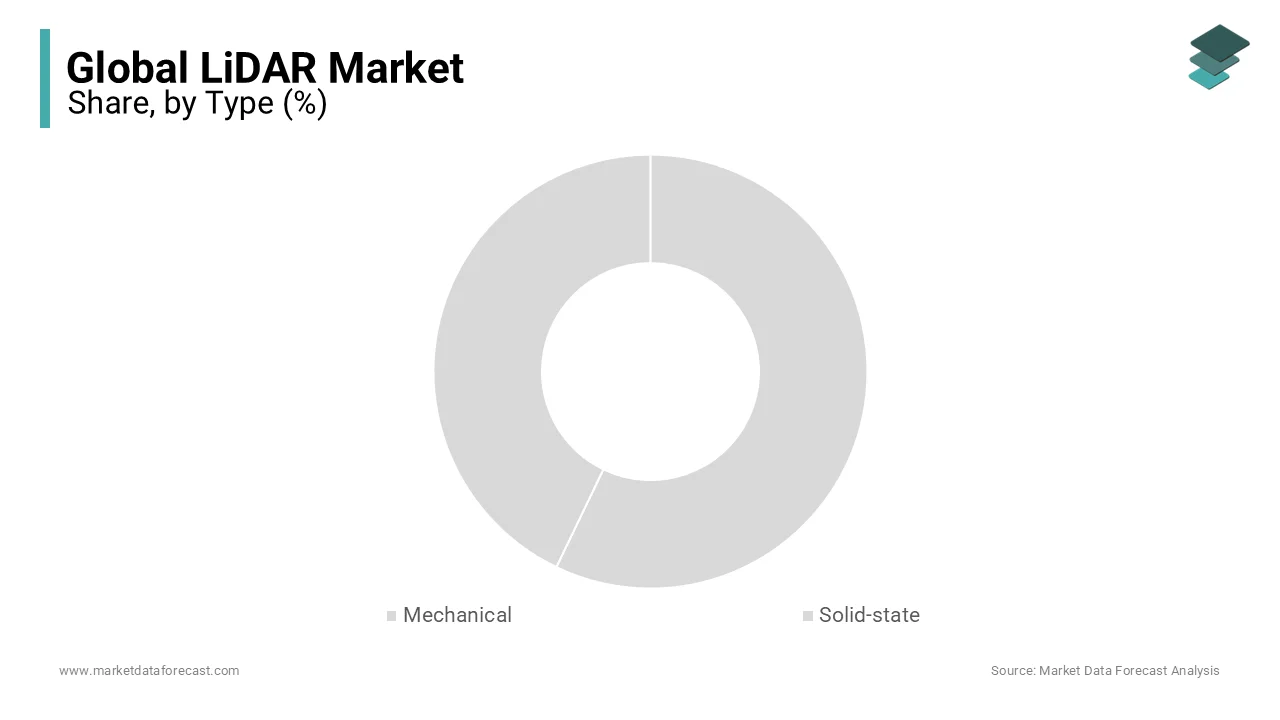
The solid-state segment is anticipated to be the fastest growing segment in the global LiDAR market during the forecast period, owing to its increasing application in the automotive and robotics industries.
By Installation Insights
The ground-based segment is expected to lead the market in the forecast period mainly due to its use in SUVs and ATVs. Tripods help them map uneven terrain.
By Application Insights
The ADAS and Driverless car segment is anticipated to have the highest CAGR in the forecast period due to the advancements made by significant companies like Honda, BMW, and AUDI.
The corridor mapping segment is estimated to account for a substantial share of the global market during the forecast period. Corridor Mapping stands out as a widely adopted application. It also involves the use of LiDAR for surveying and mapping linear features like roads, railways, pipelines, and power lines. The dominance of Corridor Mapping is attributed to its critical role in infrastructure development, urban planning, and transportation projects. LiDAR's ability to provide detailed and accurate 3D mapping of linear structures enhances efficiency in design, construction, and maintenance.
By Service Insights
The ground-based surveying segment is expected to be the fastest-growing due to the increase in the use of LiDAR technology in SUVs and ATVs for surveillance purposes, especially in defense applications.
By Component Insights
The laser scanners segment held the major share of the worldwide market in 2025 and is projected to have the fastest growth rate in the proposed forecast period.
REGIONAL ANALYSIS
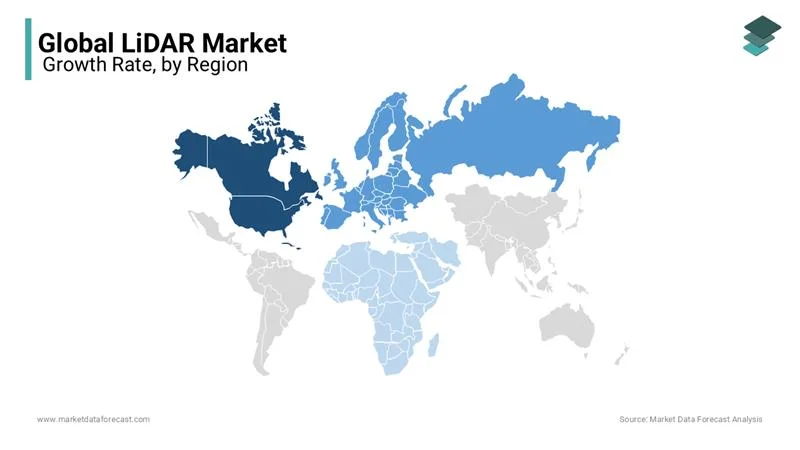
North America is the most dominant region in the LiDAR market, driven by a robust demand for LiDAR technology in applications such as autonomous vehicles, smart cities, and infrastructure development. Strong technological advancements, significant investments in research and development, and a well-established automotive sector contribute to the dominance of LiDAR technology in North America.
Europe is a second significant player in the LiDAR market, with widespread adoption across industries like forestry, agriculture, and environmental monitoring. Stringent environmental regulations, emphasis on sustainable practices, and advancements in precision agriculture contribute to the growing utilization of LiDAR technology in Europe.
The Asia-Pacific region is also experiencing a growing influence in the LiDAR market, fuelled by increasing applications in industries like mining, urban planning, and agriculture. Rapid urbanization, infrastructure development, and a surge in demand for autonomous technologies contribute to the expanding footprint of LiDAR in the Asia-Pacific region.
Latin America is an emerging market for LiDAR, with applications primarily in agriculture, forestry, and environmental monitoring. Increasing awareness of LiDAR technology benefits and growing investments in agriculture and environmental preservation contribute to its gradual adoption in Latin America.
The Middle East and Africa are in the early stages of LiDAR adoption, primarily driven by applications in topographic mapping, infrastructure planning, and mining. Infrastructure development projects, natural resource exploration, and a focus on enhancing surveying capabilities contribute to the nascent adoption of LiDAR in the Middle East and Africa.
KEY MARKET PLAYERS
Teledyne Technologies Inc. (US), Geodigital (Canada), Optech (Canada), BLOM (Norway), Faro Technologies (US), Leica Geosystems (Switzerland), Michael Baker International (U.S.), Topcon Positioning Systems, Inc. (U.S.), Trimble (US), Hexagon AB (Sweden), Beike Tianhui Technology Co., Ltd. (China), Quantum Spatial (US), YellowScan (France), Velodyne LiDAR (US), Merrick & Co. (US), Reigl Laser Measurement Systems (Austria), Beijing Surestar Technology (China), Geokno (India), and Sick AG (Germany) are playing a leading role in the global LiDAR market.
RECENT MARKET HAPPENINGS
- In 2023, Innoviz Technologies focused on developing high-performance, solid-state LiDAR sensors for autonomous vehicles. The company made strides in reducing the size and cost of its LiDAR sensors while maintaining or improving their performance.
- In 2023, Luminar Technologies concentrated on improving the performance and capabilities of its LiDAR sensors, with a particular emphasis on long-range perception. The company aimed to reduce the cost of its LiDAR sensors through technological advancements and increased production scale.
MARKET SEGMENTATION
This research report on the global LiDAR market has been segmented and sub-segmented based on type, installation, application, service, component, geography, and region.
By Type
- Mechanical
- Solid-state
By Installation
- Airborne
- Ground-Based
By Application
-
Corridor Mapping
- ADAS & Driverless Car
- Engineering
By Service
-
Aerial Surveying
- GIS Services
- Ground-Based Surveying
- Asset Management
- Others
By Component
-
Navigation
- Laser Scanners
- Positioning Systems
By Region
- North America
- Europe
- Asia Pacific
- Latin America
- Middle East & Africa