- Product Description Description
- Table of Contents TOC
- List of Table & Figure LOT
- Get Free Sample PDF Sample PDF
Market Size, 2025
$226 MnMarket Estimate, 2026
$247.02 MnMarket Forecast, 2034
$503 MnCAGR, 2026–2034
9.3%Executive Summary: Middle East & Africa Industrial Hemp Market
- Market Scope: Comprehensive market assessment of the Middle East and Africa industrial hemp industry covering core product types (hemp seed, hemp seed oil, CBD hemp oil, hemp fiber), multifaceted applications (food & beverages, personal care, textiles, pharmaceuticals, automotive, construction), and key country-level landscapes across GCC nations, South Africa, and greater MEA territories.
- Market Valuation: Valued at USD 226 million in 2025, estimated at USD 247.02 million in 2026, and projected to reach USD 503 million by 2034, registering a strong CAGR of 9.3% (2026–2034).
- Primary Growth Drivers: Rising demand for plant-based nutrition and vegan-friendly hemp seeds, expanding incorporation of hemp oil in personal care and wellness items, increasing chronic disease prevalence driving medical cannabis/hemp research, and the rising industrial transition toward lightweight automotive and sustainable materials.
Key Market Segment Metrics (2026–2034)
| Category | Leading Segment / Position | Growth Dynamics |
|---|---|---|
| By Type | Hemp Seeds & Hemp Seed Oil (dominant due to extensive incorporation into functional foods, dietary supplements, and healthy vegan diets) | CBD Hemp Oil & Hemp Fiber (accelerating due to pharmaceutical and eco-friendly textile/automotive demands) |
| By Application | Food & Beverages and Pharmaceuticals (led by snacks, cereals, dairy alternatives, and therapeutic formulations) | Personal care products, textiles, and green construction materials |
| By Region / Country | South Africa (holds the top position and rules the largest regional market share backed by regulatory acceptance for medical crop cultivation) | Expanding footprints across Israel, the UAE, and broader North/East African cultivating zones. |
Major Market Players & Market Structure
Market Structure: Emerging and increasingly competitive landscape featuring international hemp processors, agricultural enterprises, and specialized biotechnology firms scaling cultivation licenses and navigating complex regional regulatory environments.
Key Companies: Hempco, Ecofibre, Hemp Inc., Gencanna, Hempflax BV, Konoplex Group, Hemp Oil Canada, BAFA, Hemp Poland, Dun Agro, Colorado Hemp Works, and Canah International.
Middle East & Africa Industrial Hemp Market Size
The size of the Middle East and Africa industrial hemp market was worth USD 226 million in 2025. The market is anticipated to grow at a CAGR of 9.3% from 2026 to 2034 and be worth USD 503 million by 2034, from USD 247.02 million in 2026.
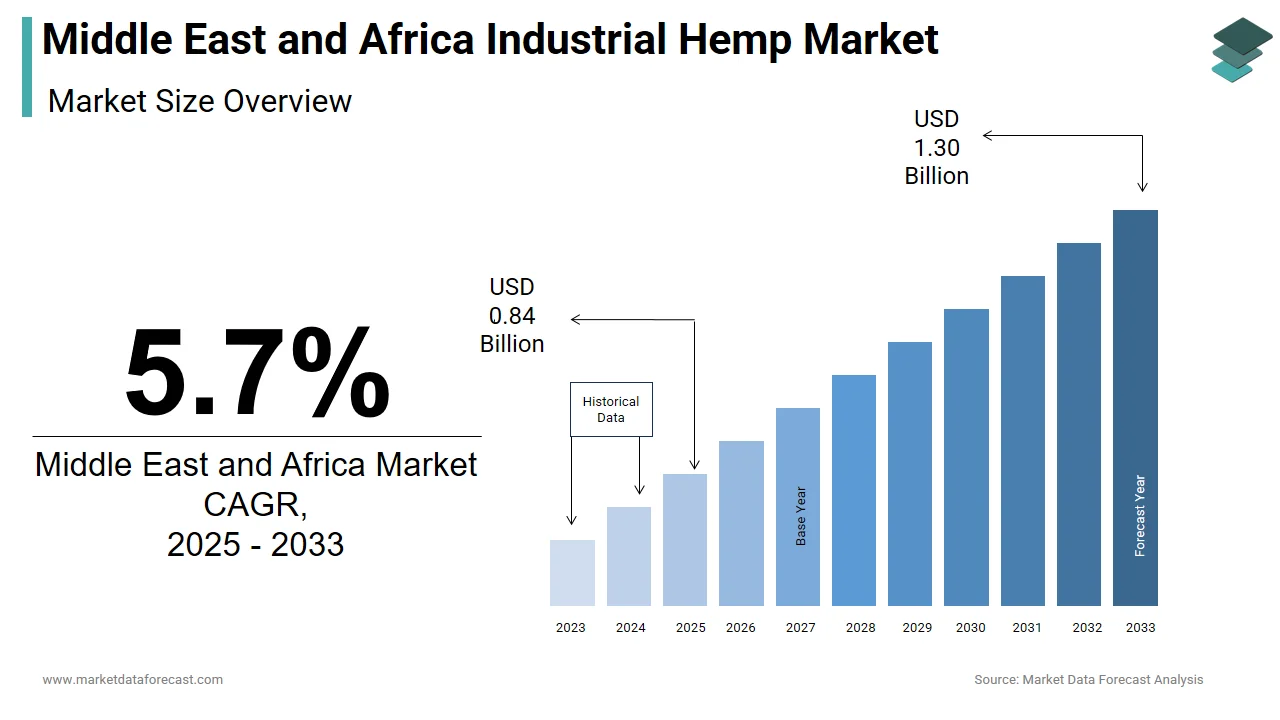
Industrial hemp is a specialized Cannabis sativa plant variety containing minimal psychoactive properties, which are utilized extensively across textiles, pharmaceuticals, construction, paper, and wellness sectors. Additionally, cross-border commercial partnerships for sustainable bio-materials have surged by reflecting a broader economic commitment to integrating environmentally resilient crops into traditional farming systems and positioning the territory as an emerging participant in the global bio-economy.
MARKET DRIVERS
Surging Prevalence of Chronic Health Conditions and Preventive Wellness Demands
The growing prevalence of chronic health conditions and preventive wellness is driving the growth of the Middle East and Africa industrial hemp market. The regional valuation, reaching 503 million dollars by 2034, is heavily underpinned by the rising consumer inclination toward preventative wellness, organic nutrition, and natural pharmaceutical remedies. The daily consumption of cannabidiol oils, tinctures, and omega-rich hemp seeds is designed to combat immune deficiencies, cardiovascular stress, and chronic inflammation. As local populations increasingly prioritize organic therapeutic interventions over synthetic pharmaceuticals, regional manufacturers are scaling up advanced extraction capacities to satisfy expanding pharmaceutical pipelines. Furthermore, retail sales of natural health supplements have expanded by 21% across key urban centers by creating a sustained commercial pull that incentivizes agricultural producers to transition traditional acreage toward high-yield industrial hemp cultivation to capture growing market share.
Expanding Automotive and Construction Sector Investments in Sustainable Bio-Composites
The expanding automotive and construction sector investments in sustainable bio-composites is additionally fuelling the growth of the Middle East and Africa industrial hemp market. This regulatory and architectural shift directly stimulates the commercial utilization of robust hemp fibers and shives for lightweight automotive interior components and zero-carbon construction blocks. Consequently, industrial stakeholders and heavy manufacturing firms are aggressively forging cross-border supply agreements to secure reliable raw bast fiber inputs for heavy engineering applications. Moreover, urban real estate investments have grown by 14% over the past three years, providing a steady stream of capital projects that increasingly specify sustainable bio-composites to meet stringent international environmental compliance benchmarks.
MARKET RESTRAINTS
Complex Regulatory Frameworks and Strict Cultivation Licensing Prohibitions
The complex regulatory frameworks and strict cultivation licensing prohibitions are hindering the growth of the Middle East and Africa industrial hemp market. As per the study, stringent governmental oversight and protracted approval procedures continue to encumber rapid commercial expansion across several jurisdictions within the territory. According to the study, over 65% of developing nations maintain rigid legislative barriers separating industrial crop cultivation from controlled narcotic varieties, lengthening administrative licensing wait times to upwards of 24 months. The discouraging private venture capital inflows and stalls large-scale agricultural sowing initiatives before they can achieve commercial viability. Consequently, operational expansion remains heavily bottlenecked in localized administrative zones, preventing commercial entities from achieving economies of scale and slowing down broader distribution networks across borders. Furthermore, according to the International Monetary Fund, compliance-related administrative expenditures add to the estimated initial startup costs for agricultural enterprises, deterring smallholder farmers from entering the sector and concentrating market power among a few well-capitalized corporations.
Prohibitive Initial Processing Equipment Costs and Dearth of Technical Expertise
The prohibitive initial processing equipment costs and dearth of technical expertise are limiting the growth of the Middle East and Africa industrial hemp market. According to research, capital expenditure hurdles associated with specialized decortication machinery and harvesting technology create severe operational friction for emerging agricultural enterprises. According to the International Labour Organization, localized agricultural sectors face a 30% deficit in trained agronomists and mechanical operators capable of managing precision harvesting and post-harvest fiber processing for non-traditional crops. This technical shortfall directly impacts the Middle East and Africa Industrial Hemp Market by yielding inconsistent raw material quality and elevating production overheads for local processors trying to meet international export standards. Lacking widespread access to affordable advanced agricultural technology and skilled human capital, smaller market participants struggle to maintain competitive pricing margins against established global competitors in Europe and North America.
MARKET OPPORTUNITIES
Favorable Agricultural Policy Revisions and Cross-Border Trade Agreements
The favorable agricultural policy revisions and cross-border trade agreements are also to promote new opportunities for the growth of the Middle East and Africa industrial hemp market. The progressive legislative amendments in select developing economies are creating lucrative avenues for legal cannabis and hemp crop cultivation. According to the research, regional agricultural modernization grants have grown by 12% year-over-year, prioritizing sustainable crop diversification in arid and semi-arid zones to combat environmental degradation. The unlocking previously restricted arable land for high-yield fiber and seed production by reducing reliance on expensive foreign agricultural imports. By integrating hemp into national export diversification strategies, emerging economies are positioning themselves as competitive future suppliers within the global bio-economy.
Rising Consumer Demand for Plant-Based Proteins and Functional Foods
The global shift toward plant-forward diets is significantly boosting the growth of the Middle East and Africa industrial hemp market. This dietary evolution directly benefits the Middle East and Africa Industrial Hemp Market by accelerating the commercial incorporation of hemp seeds, cold-pressed oils, and protein powders into everyday consumer packaged goods. As urban demographics grow increasingly health-conscious and disposable incomes rise among middle-class households, food manufacturers are continuously introducing hemp-infused functional beverages and nutritional snacks, cementing the crop's long-term commercial viability.
REPORT COVERAGE
| REPORT METRIC | DETAILS |
| Market Size Available | 2025 to 2034 |
| Base Year | 2025 |
| Forecast Period | 2026 to 2034 |
| Segments Covered | By Type, Application, and Country. |
| Various Analyses Covered | Global, Regional, and Country-Level Analysis, Segment-Level Analysis, Drivers, Restraints, Opportunities, Challenges; PESTLE Analysis; Porter’s Five Forces Analysis, Competitive Landscape, Analyst Overview of Investment Opportunities |
| Countries Covered | KSA, UAE, Israel, Rest of GCC, South Africa, Ethiopia, Kenya, Egypt, Sudan, Rest of MEA |
| Market Leaders Profiled | Hempco, Ecofibre, Hemp Inc., Gencanna, Hempflax BV, Konoplex Group, Hemp Oil Canada, BAFA, Hemp Poland, Dun Agro, Colorado Hemp Works, Medical Marijuana Inc., and Canah International. |
SEGMENTAL ANALYSIS
By Type Insights
The hemo segment held 44.7% of the Middle East and Africa industrial hemp market share in 2025. According to the Food and Agriculture Organization, regional household consumption of protein-dense oilseeds has grown by 14% over recent years as families actively seek affordable plant-based nutritional alternatives to combat malnutrition and lifestyle diseases. This dietary trend directly bolsters the hemp seed category within the expanding commercial distribution across retail supermarkets and health food stores.
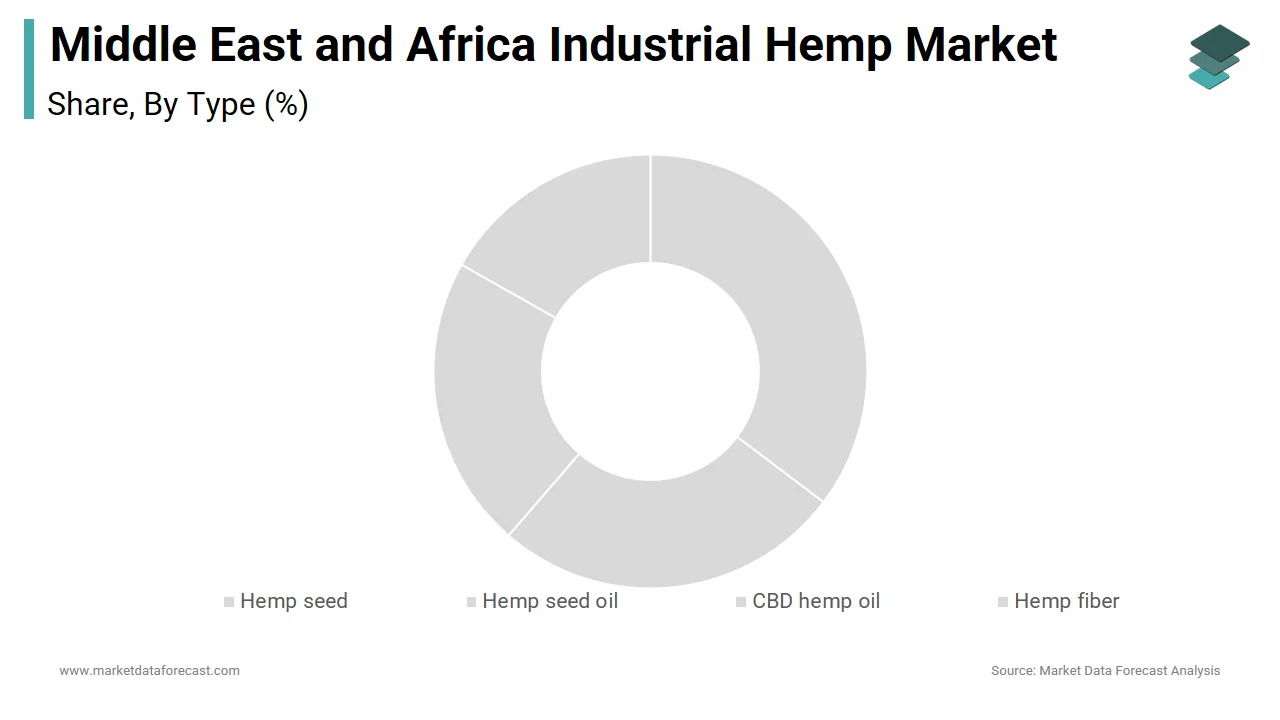
The CBD hemp oil category segment is likely to grow at an anticipated CAGR of 9.3% over the forecast period. According to the World Health Organization, therapeutic applications of non-psychoactive cannabinoids have gained clinical validation across 30% of emerging medical research centers in the region, triggering a surge in prescription-based wellness products. Additionally, consumer spending on alternative skin care therapeutics infused with natural botanical oils has risen, establishing a lucrative commercial pipeline that continuously fuels rapid segment expansion.
By Application Insights
The food applications segment held a significant share of the Middle East and Africa industrial hemp market share in 2025. The food application sector secures the dominant revenue share within the Middle East and Africa Industrial Hemp Market, driven by increasing public awareness regarding organic nutrition and functional food benefits. According to the study, public health campaigns promoting balanced dietary habits have driven a 19% increase in consumer spending on plant-based protein alternatives across urban households. This nutritional shift directly elevates the food application by encouraging local bakeries, snack producers, and beverage manufacturers to incorporate hemp derivatives into mainstream grocery items.
The textiles and pharmaceuticals segment is expected to grow at the fastest CAGR of 9.4% during the forecast period. According to the study, manufacturing investments targeting sustainable apparel production have increased by 16%, as regional economies seek eco-friendly substitutes for synthetic fibers. This industrial evolution directly influences the Middle East and Africa Industrial Hemp Market by creating massive commercial demand for durable hemp bast fibers within commercial weaving and apparel production lines. Furthermore, pharmaceutical processing plant modernizations have grown by 13%, facilitating the large-scale conversion of raw crop extracts into regulated medicinal tinctures and therapeutic ointments.
COUNTRY LEVEL ANALYSIS
South Africa Industrial Hemp Market Analysis
South Africa was the top performer in the Middle East and Africa Industrial Hemp Market by capturing a 23.1% share in 2025, with progressive agricultural legislation and established processing infrastructure. Land Reform and Rural Development in South Africa: commercial permits issued for hemp cultivation have expanded by 28% over the past 3 years to support rural economic revitalization. This regulatory advancement directly stimulates the Middle East and Africa Industrial Hemp Market by attracting foreign direct investments into local decortication facilities and seed processing plants.
United Arab Emirates Industrial Hemp Market Analysis
The United Arab Emirates industrial hemp market growth was ranked second by capturing a 19.2% share in 2025, with the high disposable incomes and a flourishing luxury wellness sector. According to the study, retail imports of premium organic health supplements and natural cosmetics have surged by 22% across major commercial emirates. This consumer demand directly impacts the Middle East and Africa Industrial Hemp Market by positioning local retail markets as lucrative destinations for high-end CBD oils and specialized hemp-infused personal care products. In addition, trade logistics efficiency enhancements have reduced import clearance times for specialized agricultural commodities by encouraging international wellness brands to establish regional distribution headquarters.
Kingdom of Saudi Arabia Industrial Hemp Market Analysis
The Kingdom of Saudi Arabia industrial hemp market growth is attributed to significant opportunities throughout the forecast period, with sweeping agricultural reforms under national transformation blueprints. According to the study, government-backed initiatives supporting sustainable arid farming technologies and crop diversification have grown annually. This strategic policy focus directly benefits the Middle East and Africa Industrial Hemp Market by unlocking non-traditional arable tracts for resilient industrial crop trials designed to combat desertification.
Israel Industrial Hemp Market Analysis
Israel industrial hemp market is likely to grow with advanced agricultural biotechnology and rigorous pharmaceutical extraction research. According to the Central Bureau of Statistics in Israel, private venture capital funding allocated to agricultural technology and medical botany research has increased by 24% over the past 3 years. This technological leadership directly drives the Middle East and Africa Industrial Hemp Market by developing high-yielding seed variants and precision drip irrigation systems customized for arid climates. Moreover, according to the study, specialized life science technology exports have grown by 17%, establishing crucial commercial corridors for transferring advanced hemp processing know-how across neighboring developing territories.
Kenya Industrial Hemp Market Analysis
Kenya industrial hemp market growth is driven by the favorable tropical highlands and active community-based farming cooperatives to scale production. According to the study, agricultural sector productivity grants directed toward non-traditional cash crops have grown by 19% over the review period. This institutional backing directly accelerates the Middle East and Africa Industrial Hemp Market by enabling smallholder farming communities to transition marginal lands into profitable hemp cultivation zones.
COMPETITIVE LANDSCAPE
The competitive landscape of the Middle East and Africa industrial hemp market is characterized by intense rivalry among a mix of established international corporations and emerging regional agribusiness startups. While well-funded multinational entities leverage superior technological capabilities and extensive distribution networks, local enterprises maintain a competitive advantage through deep familiarity with regional regulatory environments and established relationships with domestic farming communities. Strategic acquisitions, collaborative distribution partnerships, and continuous portfolio expansion remain primary tactics deployed by industry leaders seeking to capture long-term growth opportunities across diverse national jurisdictions within the territory.
KEY MARKET PLAYERS
The leading companies operating in the Middle East and Africa industrial hemp market include:
- Hempco
- Ecofibre
- Hemp Inc.
- GenCanna
- HempFlax BV
- Konoplex Group
- Hemp Oil Canada
- BAFA
- Hemp Poland
- Dun Agro
- Colorado Hemp Works
- Medical Marijuana Inc.
- Canah International
TOP PLAYERS IN THE MARKET
- Ecofibre Limited engages actively in the Middle East and Africa Industrial Hemp Market by supplying high-quality therapeutic cannabinoid extracts and specialized seed genetics to international distributors and agricultural partners. The enterprise focuses on optimizing vertically integrated production lines to ensure consistent product purity across commercial health and wellness sectors. Furthermore, the company upgraded its digital supply chain tracking infrastructure to streamline cross-border distribution logistics and enhance transparency for commercial clients operating throughout developing territories.
- Medical Marijuana Incorporated participates dynamically in the Middle East and Africa Industrial Hemp Market through the extensive commercialization of plant-based consumer goods, dietary supplements, and pharmaceutical formulations. The organization leverages comprehensive distribution networks to supply premium cannabidiol oils and wellness merchandise to emerging retail pharmacies and specialized health food stores. For the purpose of strengthening its standing in the regional market, Medical Marijuana Incorporated recently entered into strategic distribution agreements with local health product retail chains. Additionally, the firm launched targeted educational campaigns directed at regional medical professionals to promote the clinical efficacy of standardized non-psychoactive botanical extracts.
TOP STRATEGIES USED BY KEY MARKET PARTICIPANTS
Major enterprises operating within the Middle East and Africa Industrial Hemp Market predominantly implement targeted agricultural collaborations and localized supply chain integration to secure raw material access and distribution channels. Companies frequently establish joint ventures with regional farming cooperatives to overcome complex cross-border trade barriers and ensure a steady volume of high-yield biomass. Furthermore, key industry participants allocate substantial financial resources toward advanced research and development initiatives aimed at refining extraction technologies and diversifying product portfolios for pharmaceutical and textile applications. Players also focus heavily on acquiring compliance certifications to navigate strict regulatory frameworks successfully across developing nations.
MARKET SEGMENTATION
This Middle East and Africa industrial hemp market research report is segmented and sub-segmented into the following categories.
By Type
- Hemp seed
- Hemp seed oil
- CBD hemp oil
- Hemp fiber
By Application
- Food
- Snacks & cereals
- Soup, sauces, and seasonings
- Bakery
- Dairy & frozen desserts
- Others (cold cereals, pasta, chocolate spreads, and pet food)
- Beverages
- Hot beverages
- Sports & energy drinks
- Ready to drink
- Others (meal replacement drinks, beverage mixes, beverage concentrates, and juice drinks)
- Personal care products
- Textiles
- Pharmaceuticals
- Others (paper, automobiles, construction & materials, furniture, and pet food)
By Country
- KSA
- UAE
- Israel
- Rest of the GCC countries
- South Africa
- Ethiopia
- Kenya
- Egypt
- Sudan
- Rest of MEA