- Product Description Description
- Table of Contents TOC
- List of Table & Figure LOT
- Get Free Sample PDF Sample PDF
Market Size, 2025
$19.85 BnMarket Estimate, 2026
$22.78 BnMarket Forecast, 2034
$68.48 BnCAGR, 2026–2034
14.75%Executive Summary: North America Industrial Hemp Market
- Market Scope: Comprehensive market analysis of the North American industrial hemp industry covering product types (hemp seed, hemp seed oil, CBD hemp oil, hemp fiber), diverse application verticals (food, beverages, personal care, textiles, pharmaceuticals, automotive, and construction), and country-level dynamics across the United States, Canada, and Mexico.
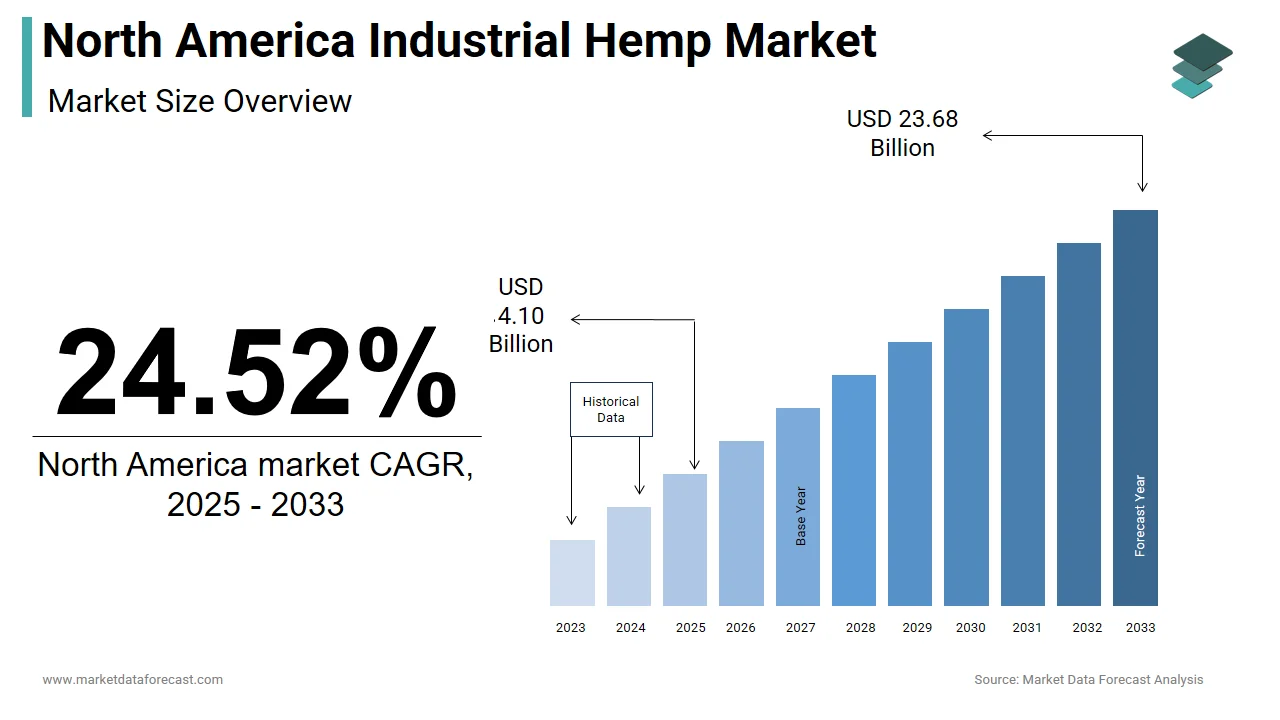
- Market Valuation: Valued at USD 4.10 billion in 2025, estimated at USD 22.78 billion in 2026, and projected to reach USD 68.48 billion by 2034, registering a phenomenal CAGR of 24.52% (2026–2034).
- Primary Growth Drivers: Progressive government support and legalization of hemp crop cultivation; rising industrial adoption in textiles, automotive, and personal care; growing integration of protein-rich hemp seed oil into vegan diets; and expanding medical applications for managing chronic conditions, epilepsy, and sleep disorders.
Key Market Segment Metrics (2026–2034)
| Category | Leading Segment / Position | Growth Dynamics |
|---|---|---|
| By Type | Hemp Seed, Hemp Seed Oil, CBD Hemp Oil, & Hemp Fiber (Hemp seed and oil derivatives command leading volume share across functional food and supplement sectors) | Accelerating demand for fiber and CBD oils in industrial and therapeutic applications |
| By Application | Food & Beverages, Textiles, and Pharmaceuticals (Food and textile sectors lead commercial consumption) | Rapid expansion in personal care and eco-friendly automotive/construction materials |
| By Country | United States (dominates the regional market share driven by rising chronic disease incidence and strong textile consumption) | Canada follows closely as a major agricultural cultivator, accounting for significant acreage dedicated to industrial hemp. |
Major Market Players & Market Structure
Market Structure: Highly scalable and rapidly expanding marketplace featuring international hemp processors, agricultural producers, and specialized product developers leveraging favorable regulatory shifts.
Key Companies: Hempco, Ecofibre, Hemp Inc., Gencanna, Hempflax BV, Konoplex Group, Hemp Oil Canada, BAFA, Hemp Poland, Dun Agro, Colorado Hemp Works, and Canah International.
North America Industrial Hemp Market Size
The size of the North American industrial hemp market was worth USD 4.10 billion in 2025. The North American market is anticipated to grow at a CAGR of 24.52% from 2026 to 2034 and be worth USD 68.48 billion by 2034, up from USD 22.78 billion in 2026.
Industrial hemp is the large-scale agricultural production, processing, and commercialization of Cannabis sativa plant derivatives featuring controlled tetrahydrocannabinol thresholds, serving diverse end-use sectors including textiles, bioplastics, wellness goods, and sustainable construction materials. As per the United States Department of Agriculture, consumer product launches featuring sustainable botanical inputs have expanded by 24% over recent commercial cycles, reflecting a deep structural shift toward eco-friendly manufacturing. Furthermore, architectural adoption of bio-composite building materials across North American metropolitan zones has increased, providing a robust foundational framework that accelerates the long term expansion of the domestic industrial hemp supply chain.
MARKET DRIVERS
Legislative Modernization and Favorable Federal Agricultural Frameworks
The legislative modernization and favorable federal agricultural frameworks are fuelling the growth of the North American industrial hemp market. According to the study, federally authorized acreage and legal farming allowances have stimulated a 28% increase in commercial grower registrations over the past 3 consecutive years as farming syndicates diversify away from traditional row crops. This regulatory evolution directly expands the North American Industrial Hemp Market by offering legal security to institutional investors and lowering barriers for commercial-scale cultivation. Consequently, major agricultural cooperatives are redirecting substantial land assets toward high-yielding fiber and grain varieties to feed expanding domestic processing hubs. This enhanced capital injection directly mitigates the historical financial hesitation that previously plagued alternative crop adoption by allowing regional operators to invest heavily in advanced mechanical seed drills, automated irrigation systems, and specialized harvesting equipment designed explicitly for high-density fiber production.
Surging Consumer Preference for Plant-Based Wellness and Functional Nutrition
The surging consumer preference for plant-based wellness and functional nutrition is also elevating the growth of the North America industrial hemp market. As per research, the rapid consumer pivot toward preventative health routines and organic nutrition is a primary factor driving record-breaking sales volumes across retail wellness channels. This dietary shift directly influences the North America Industrial Hemp Market by intensifying the commercial demand for cold-pressed hemp seed oils, protein powders, and standardized cannabinoid extracts. Food and beverage manufacturers are continuously reformulating legacy product lines to incorporate nutrient-dense hemp ingredients, satisfying the dietary demands of health-conscious demographics. Additionally, mainstream supermarket distribution footprints for hemp-infused food items have grown by anchoring long-term commercial integration within grocery retail networks.
MARKET RESTRAINTS
Complex Regulatory Fragmentation and Stringent Compliance Burdens
The growing concern over the stringent compliance burdens is largely attributed to hindering the growth of the North American industrial hemp market. The regulatory inconsistencies across state and provincial jurisdictions impose a negative drag on the overall expansion velocity of the regional trade ecosystem. According to the study, conflicting testing mandates and variable cannabinoid concentration thresholds across neighboring state lines add an estimated administrative compliance overhead for interstate distributors. This regulatory friction directly restricts the North American Industrial Hemp Market by stalling seamless product distribution and preventing emerging brands from achieving multi-state economies of scale. Small and medium-sized enterprises frequently struggle to absorb the recurring legal expenses required to verify compliance with overlapping federal and local oversight mandates. Consequently, capital deployment into cross-border supply chain ventures remains constrained, slowing down the maturation of a unified continental marketplace.
Underdeveloped Processing Infrastructure and Raw Material Supply Bottlenecks
The underdeveloped processing infrastructure and raw material supply disruptions are also limiting the growth of the North American industrial hemp market. The persistent gaps in primary decortication and fiber refinement infrastructure create severe operational disruptions that limit throughput for agricultural producers. The infrastructural deficit causes raw material price volatility and discourages new growers from entering long-term supply contracts. Without immediate capital infusions into advanced cleaning, decortication, and shive separation machinery, manufacturers face chronic difficulties in securing consistent volumes of high-grade textile fibers. Furthermore, engineering shortages and specialized equipment import delays have extended facility commissioning timelines by an average of 8 months.
REPORT COVERAGE
| REPORT METRIC | DETAILS |
| Market Size Available | 2025 to 2034 |
| Base Year | 2025 |
| Forecast Period | 2026 to 2034 |
| Segments Covered | By Type, Application, and Region. |
| Various Analyses Covered | Global, Regional, and Country-Level Analysis, Segment-Level Analysis, Drivers, Restraints, Opportunities, Challenges; PESTLE Analysis; Porter’s Five Forces Analysis, Competitive Landscape, Analyst Overview of Investment Opportunities |
| Countries Covered | United States, Canada, Mexico, and the Rest of North America. |
| Market Leaders Profiled | Hempco, Ecofibre, Hemp Inc., Gencanna, Hempflax BV, Konoplex Group, Hemp Oil Canada, BAFA, Curaleaf Holdings, Hemp Poland, Dun Agro, Canopy Growth Corporation, Colorado Hemp Works, and Canah International. |
SEGMENTAL ANALYSIS
By Type Insights
The hemp seed segment was the largest, holding a prominent share of the North American industrial hemp market in 2025. This dietary trend directly bolsters the hemp seed category by expanding commercial distribution across retail supermarkets and health food stores. Furthermore, imports of raw edible seeds into North American trade blocks have expanded by 17% by providing food processing enterprises with a steady volume of inputs required for mass production.
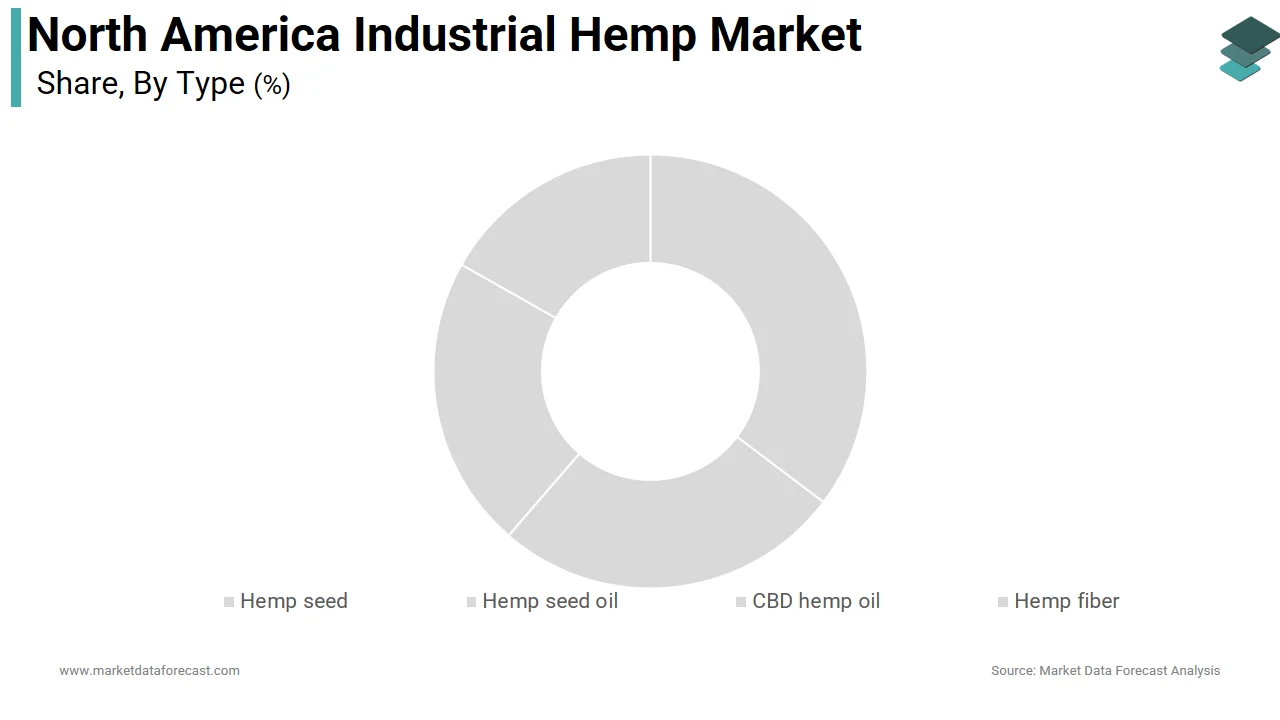
The hemp segment is likely to grow at an anticipated CAGR of 21.3% from 2026 to 2034. According to the study, technical applications of sustainable natural fibers have gained industrial validation across 30% of emerging manufacturing sectors in the region, triggering a surge in eco-friendly textiles and automotive components. This industrial momentum directly accelerates the growth of the hemp fiber segment within North America, as automotive and construction firms invest heavily in advanced processing technologies. Additionally, consumer spending on alternative green building materials infused with natural plant fibers has risen by 25% by establishing a lucrative commercial pipeline that continuously fuels rapid segment expansion.
By Application Insights
The food and beverage applications segment was the largest, holding 32.6% of the North America Industrial Hemp Market share in 2025, with increasing public awareness regarding organic nutrition and functional food benefits. According to the study, public health campaigns promoting balanced dietary habits have driven a 19% increase in consumer spending on plant-based protein alternatives across North American households. This nutritional shift directly elevates the food and beverage application segment inside the North America Industrial Hemp Market by encouraging local bakeries, snack producers, and beverage manufacturers to incorporate hemp derivatives into mainstream grocery items. Moreover, urban retail demand for organic superfoods has surged by 22% in major metropolitan centers, providing a consistent commercial foundation for widespread culinary adoption, as per reports.
The textiles segment is likely to grow at the fastest CAGR of 20.9% during the forecast period. According to the study, manufacturing investments targeting sustainable apparel production have increased by 16%, as regional economies seek eco-friendly substitutes for synthetic fibers. This industrial evolution directly influences the North America Industrial Hemp Market by creating massive commercial demand for durable hemp bast fibers within commercial weaving and apparel production lines. Furthermore, textile processing plant modernizations have grown by 13%, facilitating the large-scale conversion of raw crop fibers into regulated commercial garments and technical fabrics.
COUNTRY LEVEL ANALYSIS
U.S. Industrial Hemp Market Analysis
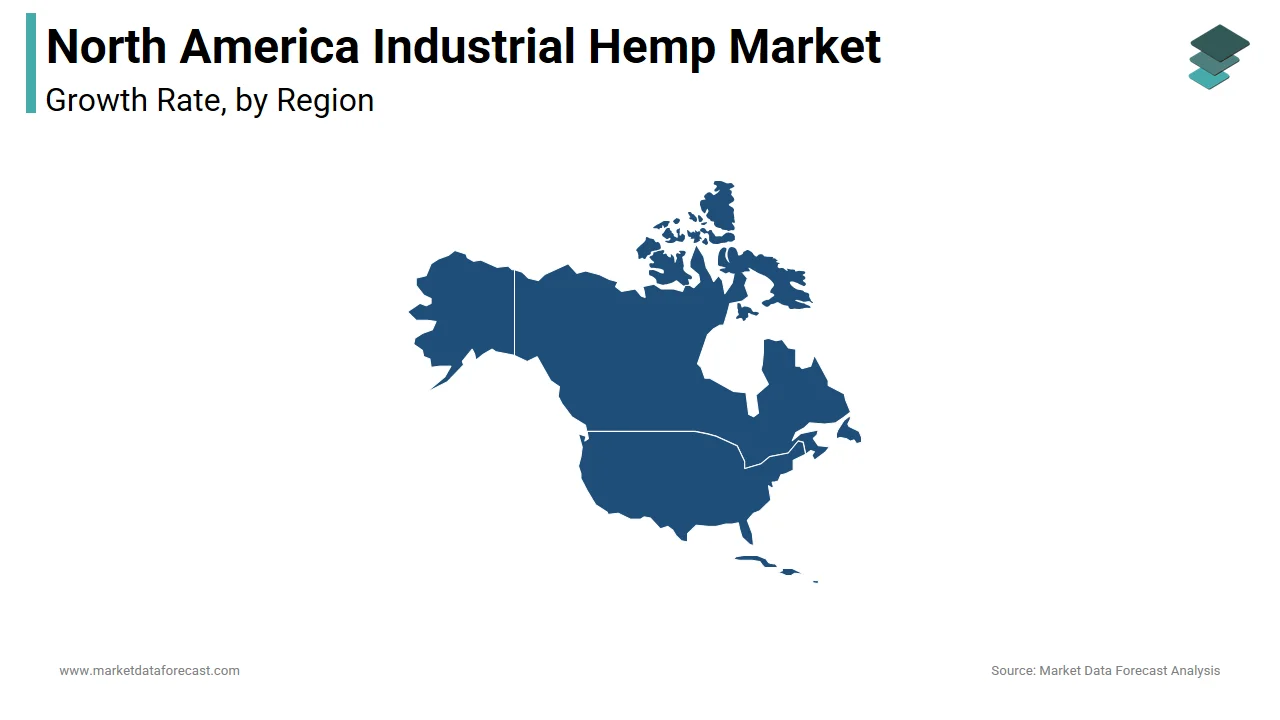
The United States industrial hemp market was the largest contributor in the North America industrial hemp market, holding an 89.1% share in 2025 with progressive federal agricultural legislation and established processing infrastructure. According to the study, commercial permits issued for hemp cultivation have expanded by 28% over the past 3 consecutive years to support rural economic revitalization. This regulatory advancement directly accelerates the North American Industrial Hemp Market growth by attracting foreign direct investments into local decortication facilities and seed processing plants. Furthermore, United States agricultural exports of value-added botanical commodities have risen by 15%, as per studies.
Canada Industrial Hemp Market Analysis
Canada industrial hemp market was next, holding a 10.2% share in 2025, with a mature regulatory framework and a strong agricultural base. The growing local farming enterprises as lucrative suppliers for high-end food processors and wellness manufacturers are also accelerating the growth of the North America industrial hemp market. In addition, trade logistics efficiency enhancements have reduced import clearance times for specialized agricultural commodities by encouraging international agribusiness brands to establish regional distribution headquarters.
COMPETITIVE LANDSCAPE
The competition in the North American industrial hemp market is characterized by intense rivalry among a diverse mix of established multinational corporations and agile regional agribusiness startups. Market participants constantly strive to differentiate their product offerings through rigorous quality control standards, innovative extraction techniques, and competitive pricing models tailored to evolving consumer expectations. While well-funded corporate entities leverage superior technological capabilities and extensive distribution networks, smaller enterprises maintain competitive advantages through deep familiarity with local agricultural conditions and established relationships with domestic farming communities.
KEY MARKET PLAYERS
The leading companies operating in the North American industrial hemp market include:
- Hempco
- Ecofibre
- Hemp Inc.
- GenCanna
- HempFlax BV
- Konoplex Group
- Hemp Oil Canada
- BAFA
- Curaleaf Holdings
- Hemp Poland
- Dun Agro
- Canopy Growth Corporation
- Colorado Hemp Works
- Canah International
TOP PLAYERS IN THE MARKET
- Curaleaf Holdings Incorporated operates extensively within the North American industrial hemp market by supplying high-purity botanical extracts, wellness merchandise, and standardized consumer goods. The enterprise utilizes sophisticated extraction facilities and robust distribution frameworks to serve expanding retail networks across multiple states. Additionally, the company upgraded its internal compliance tracking software to streamline multi-state distribution logistics and ensure absolute adherence to evolving federal agricultural guidelines.
- Canopy Growth Corporation maintains a prominent presence in the North American Industrial Hemp Market through the large-scale production of specialized cannabinoid derivatives, infused beverages, and functional food ingredients. The organization leverages advanced agricultural research and state-of-the-art processing infrastructure to deliver consistent, high-grade products to commercial buyers. For the purpose of reinforcing its market position, Canopy Growth recently streamlined its brand portfolio to concentrate resources on high-margin hemp consumable goods. Furthermore, the corporation invested heavily in advanced extraction technology to minimize operational wastage and lower unit production expenses across its continental processing facilities.
- Ecofibre Limited contributes significantly to the North American Industrial Hemp Market by specializing in proprietary hemp seed genetics, advanced biopolymers, and natural healthcare formulations. The firm operates vertically integrated supply chains that bridge primary agricultural cultivation with specialized industrial manufacturing requirements. Moreover, the enterprise optimized its digital supply chain architecture to enhance inventory visibility and accelerate delivery speeds for commercial textile and construction partners throughout the continent.
TOP STRATEGIES USED BY KEY MARKET PARTICIPANTS
Major enterprises operating within the North America industrial hemp market predominantly deploy targeted vertical integration and strategic agricultural partnerships to secure reliable biomass supply chains. Companies frequently establish joint ventures with regional farming syndicates to mitigate raw material price volatility and overcome complex interstate trade hurdles. Furthermore, key industry participants allocate substantial capital budgets toward advanced research and development initiatives aimed at refining extraction technologies and diversifying product portfolios for pharmaceutical and industrial applications. Strategic retail alliances and direct-to-consumer digital expansion further enable major firms to capture rising consumer demand for organic dietary supplements and sustainable biopolymers.
MARKET SEGMENTATION
This research report on the North America industrial hemp market is segmented and sub-segmented into the following categories.
By Type
- Hemp seed
- Hemp seed oil
- CBD hemp oil
- Hemp fiber
By Application
-
Food
- Snacks & cereals
- Soup, sauces, and seasonings
- Bakery
- Dairy & frozen desserts
- Others (cold cereals, pasta, chocolate spreads, and pet food)
- Beverages
- Hot beverages
- Sports & energy drinks
- Ready to drink
- Others (meal replacement drinks, beverage mixes, beverage concentrates, and juice drinks)
- Personal care products
- Textiles
- Pharmaceuticals
- Others (paper, automobiles, construction & materials, furniture, and pet food)
By Country
- United States
- Canada
- Mexico
- Rest of North America