- Product Description Description
- Table of Contents TOC
- List of Table & Figure LOT
- Get Free Sample PDF Sample PDF
Market Size, 2025
$245.90 MnMarket Estimate, 2026
$283.43 MnMarket Forecast, 2034
$883.01 MnCAGR, 2026–2034
15.26%Middle East and Africa Center Pivot Irrigation Systems Market Size
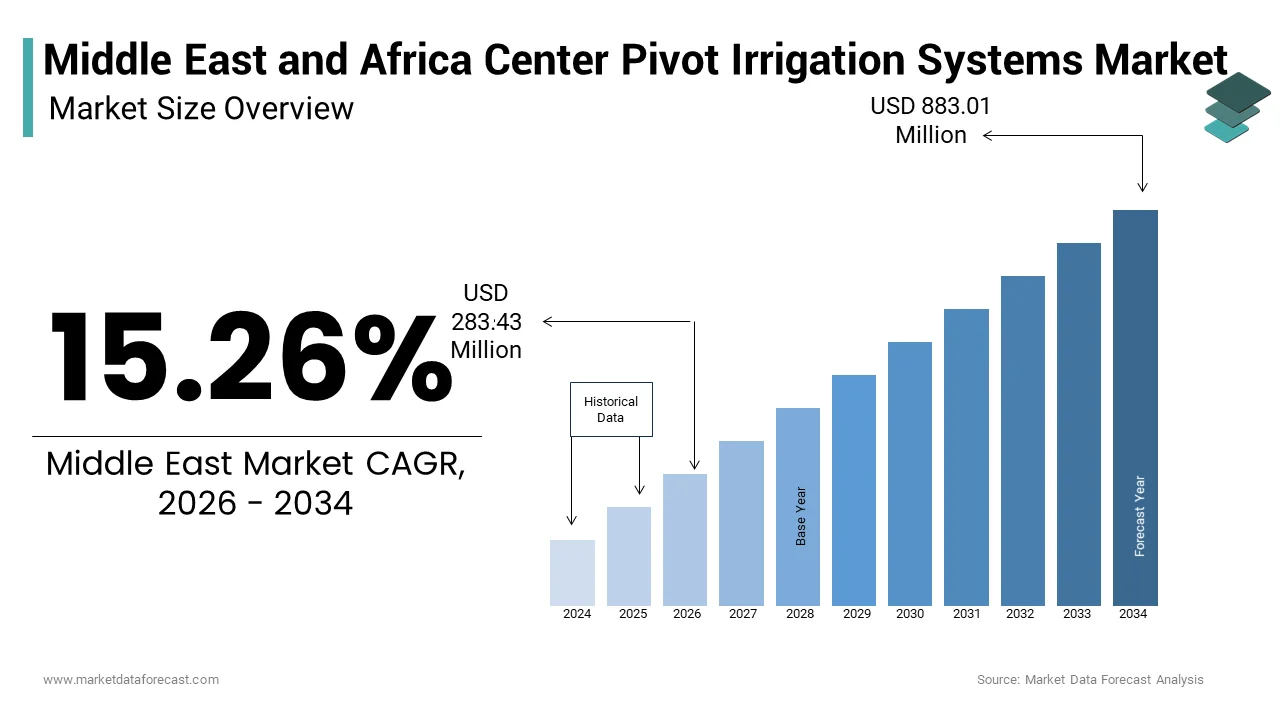
The Middle East and Africa center pivot irrigation systems market size was valued at USD 245.90 million in 2025 and is anticipated to reach USD 283.43 million in 2026 to reach USD 883.01 million by 2034, growing at a CAGR of 15.263% from 2026 to 2034.
MARKET OVERVIEW
The center pivot irigation systems are technological intervention in regions characterized by extreme aridity and scarce water resources. These automated circular irrigation systems are increasingly vital for transforming desert into productive agricultural zones in Gulf Cooperation Council countries and North African nations. The adoption of such machinery is driven by the urgent need to enhance food security and reduce dependency on volatile global food imports. According to the Food and Agriculture Organization of the United Nations, the Middle East and North Africa region holds only 1% of the world’s renewable water resources yet faces some of the highest rates of water stress globally. This disparity necessitates the deployment of high efficiency irrigation technologies that minimize evaporation and runoff. As per the World Bank, agriculture consumes approximately 85% of total water withdrawals in the region, making efficient usage a national priority for many governments. The shift toward mechanized irrigation is further supported by national visions such as Saudi Vision 2030 and Egypt’s Sustainable Agricultural Development Strategy, which prioritize modernizing farming practices. The vast expanses of flat terrain in countries like Sudan and Saudi Arabia provide ideal geographical conditions for the installation of large scale center pivot systems. Furthermore, the integration of solar powered solutions is gaining traction, addressing energy constraints in remote agricultural areas. As per the International Renewable Energy Agency, the potential for solar irrigation in the region is immense, offering a sustainable pathway to expand cultivated land without exacerbating carbon emissions or depleting fossil fuel reserves.
MARKET DRIVERS
Severe Water Scarcity And Government Mandates For Efficient Usage
The severe water scarcity coupled with stringent government mandates for efficient water usage is propelling the growth of the Middle East and Africa center pivot irrigation systems market. The region is home to twelve of the seventeen most water stressed countries in the world, creating an imperative for technologies that maximize every drop of water. Center pivot systems, by contrast, achieve efficiency levels of up to 90% by making them compliant with new regulatory frameworks. As per the Ministry of Environment, Water and Agriculture in Saudi Arabia, the kingdom has banned the cultivation of water intensive crops like alfalfa using groundwater by forcing farmers to switch to more efficient irrigation methods or import feed. Similarly, in Egypt, the government has launched initiatives to replace old irrigation systems with modern ones across millions of feddans of agricultural land. These efforts aim to save billions of cubic meters of water annually. The enforcement of such regulations creates a compelled market for center pivot systems, as farmers must adopt these technologies to continue operations legally and sustainably. This regulatory pressure, combined with the physical reality of water depletion that ensures steady demand for advanced irrigation infrastructure across the region.
Strategic National Initiatives To Enhance Food Security And Self Sufficiency
The strategic national initiatives aimed at enhancing food security and achieving self-sufficiency are significantly driving the growth of the Middle East and Africa center pivot irrigation systems. Many countries in the region rely heavily on food imports by making them vulnerable to global supply chain disruptions and price volatility. According to the United States Department of Agriculture, the Gulf Cooperation Council countries import approximately 85% of their food needs, prompting aggressive strategies to increase local output. Saudi Arabia’s Vision 2030 includes specific targets to increase the contribution of the agricultural sector to the gross domestic product, supported by subsidies for modern irrigation equipment. The investments in overseas and domestic agricultural projects have surged, with a focus on technologies that enable year round production. In the United Arab Emirates, the National Food Security Strategy 2051 aims to establish a sustainable food system through innovation and technology adoption. Center pivot systems are central to these plans, as they allow for the cultivation of staple crops in arid environments with minimal water waste. Furthermore, in Africa, countries like Sudan and Ethiopia are expanding irrigated agriculture to support growing populations.
MARKET RESTRAINTS
High Initial Capital Costs And Limited Access To Financing For Smallholders
The high initial capital costs and limited access to financing for smallholder farmers is hindering the growth of the Middle East and Africa center pivot irrigation systems market. In the Middle East, while large agribusinesses benefit from government subsidies, smaller operators struggle to secure affordable credit due to high interest rates and stringent collateral requirements. As per the World Bank, only 35% of adults in the Middle East and North Africa have access to formal financial services, limiting the ability of farmers to finance large capital expenditures. Additionally, the perceived risk of agricultural lending in arid regions, where crop failure due to extreme weather is a possibility, makes banks hesitant to provide loans for irrigation equipment. This financial barrier restricts to wealthy corporate entities and state backed projects by leaving a significant portion of the agricultural sector unable to modernize. The lack of flexible leasing options or pay as you go models further exacerbates this issue by slowing the overall penetration of center pivot technology among the broader farming community in the region.
Complex Maintenance Requirements And Shortage Of Skilled Technical Labor
The complex maintenance requirements and a shortage of skilled technical labor is degrading the growth of the Middle East and Africa center pivot irrigation systems market. These systems comprise sophisticated mechanical and electronic components, including motors, gearboxes, and control panels, which require regular maintenance and specialized knowledge for repair. According to the International Labour Organization, there is a significant skills gap in the agricultural sector across many African and Middle Eastern countries, with a lack of trained technicians capable of servicing advanced irrigation machinery. In remote rural areas, the absence of local service providers means that farmers must wait days or weeks for experts to travel from urban centers, leading to prolonged downtime during critical growing periods. As per the African Development Bank, inadequate vocational training programs in agricultural engineering contribute to this workforce deficiency, leaving farmers ill equipped to handle minor repairs or troubleshooting. Furthermore, the harsh environmental conditions, including high temperatures, dust storms, and saline water, accelerate wear and tear on equipment, increasing the frequency of maintenance needs. The high cost of imported spare parts and logistical delays in customs clearance further complicate maintenance efforts. As per the World Customs Organization, inefficient border procedures in some regions can delay the import of essential components by several weeks. These operational hurdles discourage potential buyers who fear that the long term costs and complexities of maintaining center pivot systems will outweigh the benefits, thereby restraining market growth.
MARKET OPPORTUNITIES
Integration of Solar-Powered Irrigation Systems To Reduce Energy Dependence
The integration of solar powered irrigation systems, where energy costs and availability are significant concerns is specifically to create new opportunities for the growth of the Middle East and Africa center pivot irrigation systems market. Traditional center pivot systems rely on electricity or diesel generators, which can be expensive and unreliable in remote agricultural areas. Solar power offers a sustainable and cost effective alternative by leveraging the abundant sunlight available in the region. According to the International Renewable Energy Agency, the Middle East and North Africa have the highest solar potential in the world, with average daily solar irradiation exceeding 6 kilowatt hours per square meter. As per the United Nations Industrial Development Organization, several pilot projects in Egypt and Morocco have demonstrated that solar powered irrigation can reduce energy costs by up to 70% compared to diesel systems. Governments are increasingly supporting this transition through subsidies and incentives for renewable energy adoption in agriculture. For instance, the Saudi Arabian government has launched initiatives to promote solar irrigation as part of its broader sustainability goals. The modular nature of solar panels allows for scalable installations that can be expanded as farming operations grow. This synergy between renewable energy and efficient irrigation technology not only enhances economic viability for farmers but also aligns with global climate goals by creating a compelling value proposition that drives market opportunities in the region.
Expansion Of Cultivated Land Through Desert Reclamation Projects
The expansion of cultivated land through ambitious desert reclamation projects is also to emnhance the growth of the Middle East And Africa Center Pivot Irrigation Systems Market in coming years. Governments in the region are actively converting barren desert areas into productive agricultural zones to meet rising food demands and create employment opportunities. These large-scale projects require efficient irrigation systems that can cover vast areas uniformly by making center pivots the ideal choice. According to the Egyptian Ministry of Agriculture, the country aims to reclaim 1.5 million acres of desert land for agricultural use by 2030, primarily in the Western Desert and Sinai Peninsula. Similarly, Saudi Arabia is investing heavily in the Neom project and other agricultural initiatives that involve cultivating previously unused land. These reclamation efforts are supported by advanced infrastructure development, including water transmission networks and power supply systems. Center pivot systems are essential for these projects due to their ability to operate in sandy soils and cover large circular plots efficiently. The standardization of these systems allows for rapid deployment across extensive tracts of land, accelerating the timeline for bringing new areas into production. Furthermore, the use of treated wastewater for irrigation in these reclaimed areas is becoming more common, requiring robust systems that can handle varying water qualities.
MARKET CHALLENGES
Groundwater Depletion And Salinization Threatening Long Term Sustainability
The groundwater depletion and salinization to the long term sustainability of center pivot irrigation systems is to act as a major challenge for the growth of Middle East and Africa center pivot irrigation systems market. While these systems improve water use efficiency, they do not create new water sources, and excessive extraction from aquifers continues to outpace natural recharge rates. According to the United Nations Educational, Scientific and Cultural Organization, the Middle East and North Africa region is experiencing the fastest rate of groundwater depletion in the world, with some aquifers losing up to 5% of their storage annually. In countries like Yemen and Saudi Arabia, non-renewable fossil aquifers are being mined for agriculture, leading to declining water tables and increased pumping costs. As per the Food and Agriculture Organization of the United Nations, over-extraction of groundwater has led to severe salinization in many areas, rendering soil less productive and damaging irrigation equipment. Saline water can corrode metal components of center pivot systems, increasing maintenance costs and reducing lifespan. Furthermore, the accumulation of salts in the soil requires additional water for leaching, which contradicts the goal of water conservation. This environmental degradation threatens the viability of agricultural projects that rely on center pivots, forcing farmers to abandon fields or invest in expensive soil remediation techniques.
Geopolitical Instability And Supply Chain Disruptions Impacting Equipment Availability
The geopolitical instability and supply chain disruptions pose significant challenges to the consistent availability and installation is also likely to impede the growth of the Middle East and Africa center pivot irrigation systems market. The region is prone to political conflicts, civil unrest, and trade restrictions that can interrupt the flow of goods and services. The political instability in certain African and Middle Eastern countries has led to frequent closures of borders and ports by delaying the import of heavy machinery and spare parts. The agricultural infrastructure is often targeted or neglected, discouraging investment in long term assets like center pivot systems. The uncertainty makes it difficult for farmers and investors to plan projects and secure timely delivery of irrigation systems. Additionally, currency fluctuations and inflation in unstable economies increase the cost of imported equipment, making it less affordable for local buyers. The lack of standardized regulations across different countries also complicates cross border trade and installation processes. As per the International Chamber of Commerce, inconsistent customs procedures and bureaucratic hurdles further delay the clearance of irrigation components. These geopolitical and logistical challenges create an unpredictable operating environment by hindering the seamless expansion of the center pivot irrigation market and affecting the reliability of supply chains essential for agricultural modernization in the region.
REPORT COVERAGE
| REPORT METRIC | DETAILS |
| Market Size Available | 2025 to 2034 |
| Base Year | 2025 |
| Forecast Period | 2026 to 2034 |
| CAGR | 15.26% |
| Segments Covered | By Field Type, Crop, Mobility, Component, and Region. |
| Various Analyses Covered | Global, Regional & Country Level Analysis, Segment-Level Analysis, DROC, PESTLE Analysis, Porter’s Five Forces Analysis, Competitive Landscape, Analyst Overview of Investment Opportunities |
| Regions Covered | KSA, UAE, Israel, rest of GCC countries, South Africa, Ethiopia, Kenya, Egypt, Sudan, rest of MEA |
| Market Leaders Profiled | T-L Irrigation Company, Netafim Limited, Roehren- Und Pumpenwerk, Lindsay Corporation, Valmont Industries, Alkhorayef Group, Reinke Manufacturing Company Inc., Grupo Fockink, Vodar (Tianjin) Co., Ltd, Pierce Corporation Ltd., Bauer GmbH, Rainfine (Dalian) Irrigation Co. |
SEGMENTAL ANALYSIS
By Field Insights
The large fields segment was the largest by holding 44.3% of the Middle East And Africa Center Pivot Irrigation Systems Market, primarily driven by state sponsored mega agricultural projects designed to achieve food self sufficiency in arid zones. Governments in countries like Saudi Arabia, Egypt, and Sudan are investing billions in reclaiming desert lands for large scale commercial farming, which necessitates the use of extensive center pivot systems. In Saudi Arabia, the Ministry of Environment Water and Agriculture has allocated significant resources to develop new agricultural cities in remote desert regions, relying on center pivot technology to cultivate wheat and fodder crops. The Toshka Project and other initiatives in the Western Desert involve the installation of hundreds of large span pivots to transform sandy soils into productive farmland. These projects benefit from economies of scale, reducing the per hectare cost of irrigation infrastructure. The flat topography of these reclaimed lands is ideal for the circular movement of large pivots, minimizing technical complications.
The medium fields segment is likely to grow at an anticipated CAGR of 7.5% from 2026 to 2034 owing to the emergence of commercial mid-sized farms in Sub Saharan Africa. Countries like Kenya, Ethiopia, and South Africa are witnessing a rise in professional farming enterprises that operate on land holdings between 50 and 500 hectares. These farmers are adopting center pivot systems to improve competitiveness and meet the quality standards of domestic and export markets. These operators seek to balance investment costs with productivity gains, finding medium sized pivots to be the optimal solution. Government initiatives supporting agricultural modernization in East Africa have provided access to credit and technical assistance for mid sized farmers, facilitating the adoption of mechanized irrigation. The desire to diversify into high value crops such as horticulture and maize for commercial sale drives the need for precise water management. Medium fields allow for flexible crop rotation and efficient land use, appealing to farmers who aim to maximize revenue per hectare. This trend toward professionalization and commercialization in Sub Saharan Africa is creating a dynamic and rapidly growing market segment for center pivot irrigation systems.
By Crop Insights
The cereals and grains segment was the largest by holding 60.1% of the Middle East And Africa Center Pivot Irrigation Systems Market share in 2025 with the strategic focus on wheat and maize production to ensure national food security. These staple crops are essential for the dietary needs of the growing population in the region, prompting governments to prioritize their domestic cultivation. According to the United States Department of Agriculture, the Middle East and North Africa region imports over 50% of its wheat consumption, creating a strong incentive to increase local production through efficient irrigation. Center pivot systems are widely used in the cultivation of wheat in Saudi Arabia and Egypt, where water scarcity necessitates high efficiency methods. The country aims to reduce wheat imports by expanding irrigated acreage in newly reclaimed lands by relying heavily on center pivot technology. Maize production in Sub Saharan Africa, particularly in Kenya and South Africa, also benefits from mechanized irrigation to mitigate the risks of drought. The large-scale nature of cereal farming aligns well with the coverage capabilities of center pivots by allowing for uniform growth and easy mechanization of harvesting. Government subsidies for staple crop production further encourage the adoption of these irrigation systems. The consistent demand for cereals ensures a stable market for center pivot manufacturers, as farmers seek to maximize yields and minimize losses due to water stress.
The oilseeds and pulses segment is swiftly emerging at a fastest CAGR of 8.2% during the forecast period with the rising demand for plant based proteins and lucrative export opportunities. Global shifts toward healthier diets and sustainable food sources are increasing the consumption of crops like soybeans, sunflowers, and lentils. According to the United States Department of Agriculture, global demand for oilseeds is expected to grow by 3% annually, creating incentives for producers in the Middle East and Africa to expand cultivation. In South Africa, soybean production has increased significantly, supported by irrigation infrastructure that ensures consistent yields. The high value nature of these crops justifies the cost of center pivot systems, as even modest yield improvements can lead to substantial profit increases. Additionally, pulses such as chickpeas and lentils are gaining popularity in the Middle East due to their nutritional benefits and water efficient characteristics. The ability of center pivots to provide precise water management enhances the quality and size of these crops, meeting strict export standards.
By Component Insights
The spans segment was accounted in holding 44.3% of the Middle East And Africa Center Pivot Irrigation Systems Market share in 2025 due to its structural importance and the significant volume of materials required for system construction. Spans form the main framework of the pivot, supporting the water pipes and sprinkler packages, across the field. According to the American Society of Agricultural and Biological Engineers, spans account for approximately 40% of the total weight and cost of a center pivot system, reflecting their critical role in the overall infrastructure. In the Middle East and Africa, where large field applications are common, long spans are necessary to cover extensive areas efficiently, driving high demand for this component. As per the International Irrigation Equipment Manufacturers Association, the durability of spans is paramount in harsh climatic conditions, leading to the use of high strength galvanized steel and aluminum alloys. The need for replacement and maintenance of spans in older systems also contributes to the segment’s dominance, as exposure to extreme heat and dust can cause wear over time. Manufacturers focus on producing corrosion resistant spans to withstand saline water and humid conditions in coastal agricultural zones. The standardized production of spans allows for economies of scale, making them a consistent revenue stream for suppliers. The continuous expansion of irrigated land in the region ensures a steady demand for new spans, while the maintenance of existing installations supports aftermarket sales.
The control panels segment is projected to register a fastest CAGR of 9.0% during the forecast period with the integration of smart farming technologies and remote monitoring capabilities. Modern control panels enable farmers to automate irrigation schedules, monitor system performance, and adjust water application based on real time data. The mobile broadband penetration in Africa and the Middle East has reached 50%, facilitating the adoption of connected irrigation devices. This connectivity allows farmers to manage their systems via smartphones, improving responsiveness to weather changes and crop needs. The Internet of Things in agriculture is gaining traction, with control panels serving as the central hub for data collection and decision making. The ability to detect leaks, pressure changes, and mechanical issues remotely reduces labor requirements and prevents crop loss. In water scarce regions, precision control is essential for optimizing resource use, making smart panels a valuable investment. Governments and development agencies are promoting digital agriculture initiatives that include the deployment of intelligent irrigation controls.
COUNTRY ANALYSIS
Saudi Arabia Center Pivot Irrigation Systems Market Analysis
The Kingdom Of Saudi Arabia was the out performer of the Middle East And Africa Center Pivot Irrigation Systems Market by capturing 30.3% of the share in 2025 with its ambitious national food security strategies and extensive desert reclamation projects. The country’s Vision 2030 initiative prioritizes the development of sustainable agricultural practices by leading to significant investments in modern irrigation infrastructure. According to the Ministry of Environment Water and Agriculture, Saudi Arabia has invested billions of riyals in developing new agricultural zones in remote desert areas, relying heavily on center pivot systems to cultivate wheat, barley, and fodder crops. The government provides subsidies and financial support to farmers who adopt water efficient technologies, encouraging the widespread use of center pivots. As per the General Authority for Statistics, the area under irrigated agriculture has expanded steadily, with center pivots covering a significant portion of this land. The presence of major international irrigation manufacturers in the kingdom ensures a robust supply chain and technical support network. Additionally, the shift toward solar powered irrigation systems is gaining momentum, aligning with the country’s renewable energy goals. The combination of government support, technological adoption, and strategic necessity solidifies Saudi Arabia’s leading position in the regional market.
United Arab Emirates Center Pivot Irrigation Systems Market Analysis
The United Arab Emirates pivot irrigation systems market held second position by holding 10.3% of share in 2025 with its focus on high tech agricultural solutions and food security initiatives. The country’s National Food Security Strategy 2051 aims to enhance local production through innovation and technology, driving the adoption of advanced irrigation systems. According to the Ministry of Climate Change and Environment, the UAE is investing in smart farming technologies, including automated center pivot systems equipped with sensors and remote monitoring capabilities. The limited availability of arable land and water resources necessitates highly efficient irrigation methods, making center pivots an ideal choice for commercial farms. As per the Dubai Electricity and Water Authority, initiatives to integrate solar power with irrigation systems are promoting sustainable agricultural practices. The presence of research institutions and agricultural technology hubs in the UAE fosters innovation and collaboration in the sector. Furthermore, the government’s support for vertical farming and controlled environment agriculture complements the use of field based irrigation systems.
Israel Center Pivot Irrigation Systems Market Analysis
Israel Center Pivot Irrigation Systems Market growth is likely to grow with the agricultural innovation and water management technologies. Israel is a global pioneer in irrigation efficiency, with a high adoption rate of advanced center pivot systems integrated with smart controls. According to the Israeli Ministry of Agriculture and Rural Development, the country achieves some of the highest water use efficiency rates in the world, largely due to the widespread use of precision irrigation technologies. Israeli companies are at the forefront of developing innovative pivot components, such as smart control panels and variable rate irrigation systems, which are exported globally and used domestically. The agricultural sector in Israel continues to invest in research and development to enhance productivity and sustainability.
South Africa Center Pivot Irrigation Systems Market Analysis
South Africa center pivot irrigation systems market growth is expected to grow in coming years with a major producer of maize, soybeans, and other field crops by relying extensively on mechanized irrigation to ensure consistent yields. According to the Agricultural Research Council, South Africa has one of the highest densities of center pivot systems in Africa, particularly in the Free State and Mpumalanga provinces. The established infrastructure and availability of skilled technicians facilitate the efficient operation and maintenance of these systems. As per the Department of Agriculture, Land Reform and Rural Development, government programs support the modernization of irrigation infrastructure to improve water use efficiency and productivity. The presence of local manufacturing and distribution networks for irrigation equipment ensures competitive pricing and timely service. Additionally, the adoption of solar powered pivots is increasing, driven by energy cost concerns and sustainability goals.
Ethiopia Center Pivot Irrigation Systems Market Analysis
Ethiopia center pivot irrigation systems market growth is driven by government initiatives to expand irrigated agriculture and enhance food security. The country has vast agricultural potential, with large areas of arable land suitable for mechanized farming. Ethiopia is investing in large scale irrigation projects, such as the Koga and Megech dams to support commercial agriculture. The government encourages the adoption of modern irrigation technologies to reduce dependency on rain fed farming and mitigate the impacts of climate change. Partnerships with international organizations and private sector players are facilitating the introduction of center pivot systems to medium and large scale farms. The cultivation of high value crops for export, such as flowers and vegetables, is also driving demand for efficient irrigation solutions.
COMPETITIVE LANDSCAPE
The competition in the Middle East And Africa Center Pivot Irrigation Systems Market is characterized by the presence of established global manufacturers and emerging regional players who strive to capture market share through technological differentiation and strategic localization. Leading companies differentiate themselves by offering advanced features such as solar powered drives and smart control systems that address the specific challenges of water scarcity and energy availability in the region. The market sees intense rivalry in terms of product durability and after sales support, as farmers prioritize reliability in harsh climatic conditions. Local distributors and service providers play a crucial role in this competitive landscape by offering localized expertise and faster response times for maintenance issues. Price competition is significant for government tendered projects where cost efficiency is a primary criterion. The competitive dynamics are further influenced by government policies promoting food security and sustainable agriculture. Overall, the market remains dynamic with companies adapting their strategies to meet the evolving needs of agricultural modernization in the Middle East and Africa.
KEY MARKET PLAYERS
Some of the market leaders of the CPI systems market include
- T-L Irrigation Company
- Netafim Limited
- RoEhren- Und Pumpenwerk
- Lindsay Corporation
- Valmont Industries
- Alkhorayef Group,
- Reinke Manufacturing Company Inc
- Grupo Fockink
- Vodar (Tianjin) Co. Ltd
- Pierce Corporation Ltd.
- Bauer GmbH
- Rainfine (Dalian) Irrigation Co.
Top Players In The Market
- Lindsay Corporation maintains a significant presence in the Middle East And Africa market through its Zimmatic brand, focusing on durable and efficient irrigation solutions for arid environments. The company actively engages with large scale agricultural projects in Saudi Arabia and Egypt, providing customized center pivot systems that withstand harsh climatic conditions. Lindsay recently expanded its digital capabilities by enhancing the FieldNET remote management platform, allowing farmers in the region to monitor and control irrigation operations via mobile devices. This technological integration supports water conservation efforts, aligning with national sustainability goals. The company also strengthens its position by collaborating with local distributors to ensure timely maintenance and technical support. Their commitment to innovation and customer service reinforces their reputation as a leading provider of irrigation infrastructure in the Middle East and Africa.
- Valmont Industries contributes substantially to the Middle East And Africa market through its Valley Irrigation brand, known for high performance center pivot systems. The company focuses on delivering energy efficient solutions, including solar powered drive units, which are increasingly popular in off grid agricultural areas. Valmont has strengthened its market position by establishing strategic partnerships with regional engineering firms to facilitate the installation and commissioning of large scale irrigation projects. Recent initiatives include the launch of specialized corrosion resistant materials designed to handle saline water sources common in the Gulf region. The company also invests in training programs for local technicians, ensuring optimal system performance and longevity. Their proactive approach to product adaptation and local capacity building enhances their competitive edge and supports the growth of modern agriculture in the Middle East and Africa.
- Reinke Manufacturing Company plays a vital role in the Middle East And Africa market by offering customizable and robust center pivot irrigation systems. The company emphasizes strong relationships with local dealers and agricultural consultants to provide tailored solutions for diverse crop types and field conditions. Reinke recently introduced advanced control panels with enhanced connectivity features, enabling seamless integration with precision agriculture tools used in the region. This development addresses the growing demand for real time data access among modern farmers in countries like South Africa and Kenya. The company also participates in regional agricultural exhibitions to showcase its latest technologies and engage with potential clients.
Top Strategies Used by Key Market Participants
Key players in the Middle East And Africa Center Pivot Irrigation Systems Market primarily employ strategies focused on technological innovation and localized service expansion to strengthen their competitive position. Companies are increasingly integrating solar power solutions with center pivot systems to address energy scarcity and reduce operational costs in remote areas. This adaptation aligns with regional sustainability goals and appeals to cost conscious farmers. Additionally, manufacturers are enhancing their digital offerings by incorporating Internet of Things sensors and remote monitoring platforms, allowing for precise water management and predictive maintenance. Strategic partnerships with local distributors and government entities are crucial for navigating regulations and securing contracts for large scale reclamation projects. Companies also invest in training programs for local technicians to ensure reliable after sales support, which is vital in regions with limited skilled labor. Product customization to withstand harsh environmental conditions such as high temperatures and saline water is another key strategy. These combined efforts enable key participants to address the unique challenges of the Middle East and Africa market while driving adoption of efficient irrigation technologies.
MARKET SEGMENTATION
This research report on the Middle Eastern and African silage additives market is segmented and sub-segmented into the following categories.
By Field Type
- Large Fields
- Medium Field
- Small Fields
By Crop Type
- Cereals & Grains
- Oilseeds & Pulses
- Other Crop Types
By Mobility
- Stationary
- Mobile Center Pivot Irrigation Systems
By Component
- Spans
- Pivot Points
- Drive Trains
- Control Panels
- Sprinkler Drops
By Country
- KSA
- UAE
- IsraelThe
- rest of the GCC countries
- South Africa
- Ethiopia
- Kenya
- Egypt
- Sudan
- rest of MEA