Middle East Cyber Security Market Size, Share, Trends & Growth Forecast Report By Solution Type (IAM, Firewall & VPN, SIEM, Antivirus), Service (Professional, Managed), Security Type (Cloud, Application), and Country (KSA, UAE, Israel, Rest of GCC, Rest of Middle East) – Industry Analysis, 2026 to 2034
Market Size, 2025
$16.72 BnMarket Estimate, 2026
$18.27 BnMarket Forecast, 2034
$37.22 BnCAGR, 2026–2034
9.3%Middle East Cyber Security Market Size
The size of the Middle East cybersecurity market was valued at USD 16.72 billion in 2025. This market is expected to grow at a CAGR of 9.3% from 2026 to 2034 and be worth USD 37.22 billion by 2034 from USD 18.27 billion in 2026.
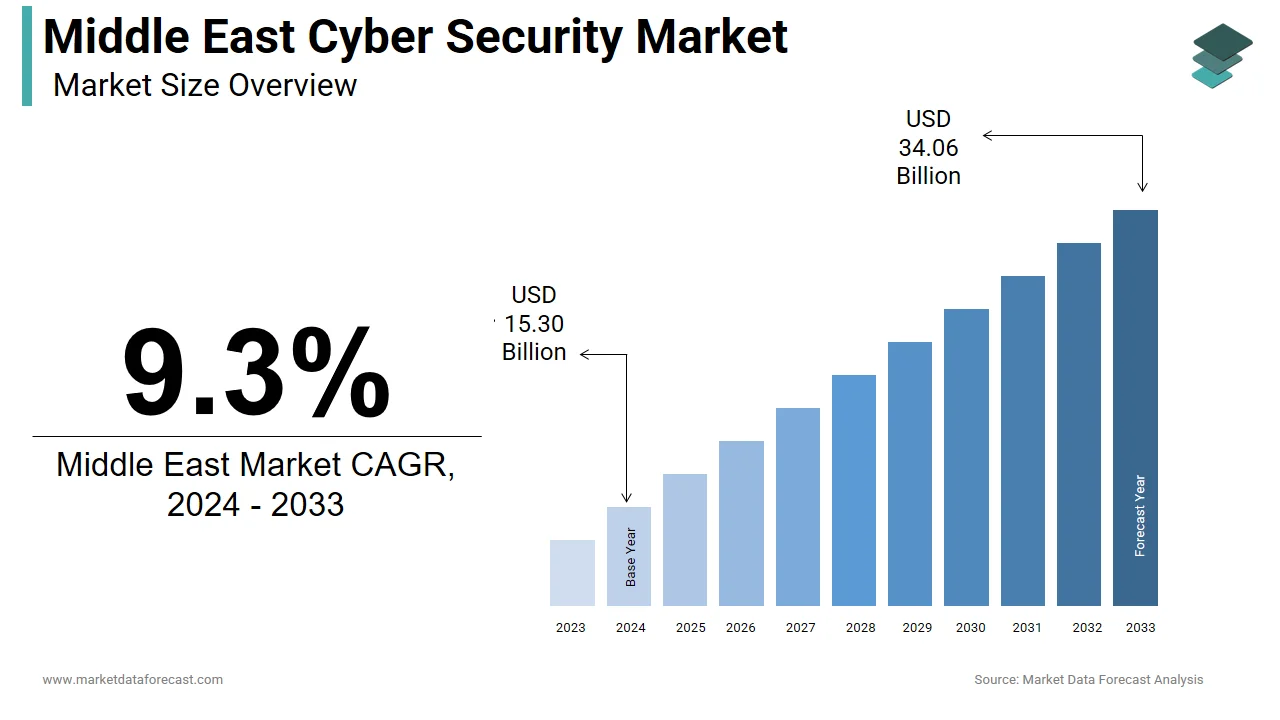
Cybersecurity is an ecosystem of technologies, services, and solutions designed to safeguard digital infrastructure, networks, and data from unauthorized access, breaches, and cyber threats. The increasing frequency of sophisticated cyberattacks, coupled with the adoption of emerging technologies like cloud computing, IoT, and AI, has intensified the need for advanced security protocols.
MARKET DRIVERS
Rapid Digital Transformation Across Key Sectors
The widespread digital transformation occurring across industries such as finance, healthcare, energy, and government is a major factor accelerating the growth of the Middle East cyber security market. Governments and enterprises are investing heavily in digitizing operations, implementing smart city initiatives, and adopting cloud-based infrastructure to improve efficiency and service delivery. For instance, Saudi Arabia’s Vision 2030 initiative includes a strong emphasis on digital transformation, aiming to modernize public services through e-government platforms and data-driven decision-making systems. Moreover, the proliferation of Internet of Things (IoT) devices and the deployment of 5G networks have expanded the attack surface, making traditional security architectures insufficient. Consequently, organizations are increasingly adopting endpoint protection, zero-trust security models, and AI-driven threat detection systems. The rise in remote work culture post-pandemic has further accelerated the demand for secure access service edge (SASE) solutions and multi-factor authentication tools by contributing significantly to the growth of the cyber security market in the region.
Increasing Government Investments and Regulatory Mandates
Government-led initiatives and regulatory mandates play a pivotal role in driving the Middle East cyber security market. Several governments in the region have recognized the strategic importance of cyber resilience and have introduced comprehensive policies and national cyber strategies to safeguard digital infrastructure. The UAE, for example, established the National Cyber Security Authority (NCSA) in 2019 under the Telecommunications and Digital Infrastructure Regulatory Authority (TDRA), which aims to coordinate cybersecurity efforts across federal entities and private sectors. According to the Organization of Islamic Cooperation (OIC) Cybersecurity Strategy 2025, member states including Egypt, Morocco, and Jordan have committed to allocating at least 3% of their annual IT budgets toward cybersecurity enhancements. Furthermore, the implementation of mandatory data protection laws, such as the UAE’s Federal Decree-Law No. 45/2021 on Personal Data Protection and Saudi Arabia’s Personal Data Protection Law (PDPL), has compelled businesses to adopt compliance-ready security frameworks.
MARKET RESTRAINTS
Shortage of Skilled Cybersecurity Professionals
The acute shortage of skilled professionals capable of managing complex cyber threats is hindering the growth of the Middle East cyber security market. The region faces a severe talent gap in cybersecurity expertise. According to the International Information System Security Certification Consortium (ISC)², the global cybersecurity workforce shortage stood at approximately 3.4 million professionals in 2023, with the Middle East accounting for nearly 12% of this deficit.
In countries like Oman and Bahrain, less than 15% of cybersecurity roles are filled due to limited educational programs and professional certification opportunities. Even in more developed markets such as the UAE and Saudi Arabia, organizations struggle to retain qualified personnel, leading to operational inefficiencies and delayed incident response times. According to the IDC Middle East in 2023, 64% of enterprises in the region cited skill shortages as a major barrier to implementing advanced security solutions like extended detection and response (XDR) and zero trust architecture. Moreover, the lack of standardized training frameworks and industry-academia collaboration hampers the development of a sustainable talent pipeline.
Fragmented Regulatory Frameworks Across Countries
The lack of harmonized regulatory frameworks across the region is also impeding the growth of the Middle East cyber security market. While some countries like the UAE and Saudi Arabia have well-defined cybersecurity laws and enforcement agencies, others lag in establishing comprehensive legal structures to address cybercrime and data protection. According to the United Nations Conference on Trade and Development (UNCTAD), only six out of the 17 countries in the Middle East have enacted dedicated cybersecurity legislation with enforceable penalties for non-compliance. In contrast, nations such as Yemen and Syria continue to rely on outdated telecom or criminal codes that do not adequately cover modern cyber threats. Additionally, varying definitions of cyber offenses and inconsistent prosecution procedures hinder the ability to track and respond to transnational cyberattacks. The Arab League’s Arab Convention on Cybercrime, adopted in 2021, aims to foster regional cooperation, but implementation remains uneven. As per the International Telecommunication Union (ITU), less than 40% of Middle Eastern countries participate in joint cybercrime investigations by limiting intelligence sharing and coordinated defense mechanisms.
MARKET OPPORTUNITIES
Expansion of Smart City Initiatives Driving Demand for Secure Infrastructure
Smart city development is emerging as a major opportunity for the Middle East cyber security market in countries like the UAE, Saudi Arabia, and Qatar. Governments in the region are investing heavily in urban digitization projects aimed at enhancing public services, optimizing resource management, and improving quality of life. These smart city ecosystems integrate vast networks of connected devices, including surveillance cameras, traffic sensors, and automated utility systems, all of which require robust cybersecurity protections. For instance, Dubai’s Smart City initiative involves deploying millions of IoT-enabled devices to manage transportation, utilities, and emergency response systems. Moreover, the rise of intelligent transport systems, smart grids, and digital identity platforms further amplifies the need for real-time threat monitoring and secure data exchange.
Growth of Financial Technology (FinTech) and Digital Banking
The rapid expansion of financial technology (FinTech) and digital banking in the Middle East is also creating opportunities for cybersecurity market growth. As consumers and businesses increasingly shift toward mobile payments, blockchain transactions, and online banking platforms, financial institutions face heightened risks from fraud, phishing attacks, and ransomware. According to the Central Bank of the UAE, digital payment transactions in the country surged by 43% in 2023 compared to the previous year. Governments across the region are actively supporting FinTech innovation while simultaneously enforcing stringent security regulations. For example, the Saudi Arabian Monetary Authority (SAMA) launched the “FinTech Saudi” initiative in 2020 to promote secure digital financial services and attract investment in FinTech startups.
Banks and financial service providers are increasingly adopting biometric authentication, behavioral analytics, and secure API gateways to mitigate risks associated with digital transactions. According to Deloitte Middle East, financial institutions in the region plan to increase their cybersecurity budgets by an average of 22% annually over the next five years. This growing emphasis on secure digital banking solutions presents a compelling opportunity for cybersecurity firms to develop tailored products that align with the evolving needs of the financial sector.
MARKET CHALLENGES
Sophisticated State-Sponsored Cyberattacks Targeting Advanced Infrastructure
The escalating threat of state-sponsored cyberattacks targeting advanced infrastructure is a major challenging factor for the Middle East cyber security market. Over the past decade, the region has become a focal point for advanced persistent threat (APT) groups linked to nation-states, aiming to disrupt energy facilities, financial institutions, and government networks. According to Kaspersky’s Threat Landscape Report 2023, the Middle East accounted for 18% of all targeted cyber espionage campaigns globally, with Iran, Israel, and Gulf states frequently implicated in cyber conflict activities. The complexity of these attacks often surpasses the capabilities of conventional security defenses, requiring advanced threat intelligence, deception technologies, and machine learning-based anomaly detection systems. However, many organizations in the region still rely on legacy security infrastructures, which is making them susceptible to zero-day exploits and supply chain compromises. Moreover, the geopolitical tensions in the region exacerbate the risk environment, as cyber warfare becomes an integral component of broader strategic conflicts.
Lack of Public Awareness and Organizational Cyber Hygiene Practices
Despite growing investments in cybersecurity technologies, a major challenge hindering the effectiveness of security measures in the Middle East is the lack of public awareness and poor organizational cyber hygiene practices. Many businesses and individuals remain unaware of fundamental security best practices, such as password management, phishing recognition, and software patching, leaving them vulnerable to common yet damaging cyber threats. According to a 2023 survey conducted by the National Cybersecurity Authority of Saudi Arabia, only 38% of employees in medium-to-large enterprises received regular cybersecurity training, and less than half were able to identify basic signs of a phishing attempt. This knowledge gap is further exacerbated by the absence of mandatory cybersecurity education in many school curricula across the region. As per UNESCO’s Digital Literacy and Cyber Education Report 2023, only three Middle Eastern countries UAE, Kuwait, and Lebanon have integrated formal cyber safety modules into their national education systems. Addressing this challenge requires a concerted effort from governments, academic institutions, and private enterprises to promote cyber literacy and embed security awareness into everyday digital interactions.
REPORT COVERAGE
| REPORT METRIC | DETAILS |
| Market Size Available | 2025 to 2034 |
| Base Year | 2025 |
| Forecast Period | 2026 to 2034 |
| Segments Covered | By Solution Type, Service, Security Type, and Region. |
| Various Analyses Covered | Global, Regional and Country-Level Analysis, Segment-Level Analysis, Drivers, Restraints, Opportunities, Challenges; PESTLE Analysis; Porter’s Five Forces Analysis, Competitive Landscape, Analyst Overview of Investment Opportunities |
| Countries Covered | KSA, UAE, Israel, Rest of GCC, Rest of Middle East |
| Market Leaders Profiled | Palo Alto Networks (US), IBM (US), Check Point (US), Cisco (US), Fortinet (US), Trend Micro (Japan), CrowdStrike (US), CPX (UAE), sirar by stc (Saudi Arabia), SITE (Saudi Arabia), Help AG (UAE), Mandiant (US), Eviden (Atos) (France), Trellix (US), and SOCRadar (US) |
SEGMENTAL ANALYSIS
By Solution Type Insights
The firewall and virtual private network (VPN) segment accounted in holding 28.3% of the Middle East cyber security market share in 2024. The growing reliance on cloud infrastructure and hybrid work models has further amplified the demand for secure connectivity tools such as SSL/TLS-based VPNs and zero-trust network access (ZTNA). Moreover, regulatory mandates such as the UAE’s Federal Decree-Law No. 45/2021 on Personal Data Protection and Saudi Arabia’s PDPL have compelled organizations to enhance their data encryption and secure tunneling capabilities. According to PwC Middle East, compliance with these regulations has led to a 27% increase in firewall-related investments among financial institutions in the past two years.

The Identity and Access Management (IAM) segment is lucratively to grow with a CAGR of 19.2% in the coming years. Governments are also playing a pivotal role in Saudi Arabia’s National Identification and Authentication Strategy, launched under Vision 2030, which aims to establish a unified digital identity framework that mandates strong authentication for all public services. Additionally, the rise of decentralized applications (dApps) and blockchain-based transactions in countries like the UAE has heightened the importance of IAM solutions.
By Service Type Insights
The managed services segment was the largest, holding 52.3% of the Middle East cyber security market share in 2024. over 60% of medium-to-large enterprises in the UAE and Saudi Arabia rely on managed security service providers (MSSPs) to monitor, detect, and respond to cyber incidents in real-time. The growing sophistication of ransomware, phishing, and supply chain attacks has made it imperative for organizations to deploy continuous threat monitoring and incident response support, which MSSPs offer at a lower cost compared to building internal Security Operations Centers (SOCs). Furthermore, regulatory mandates such as the UAE Central Bank's Cyber Risk Management Framework and the Saudi Arabian Monetary Authority (SAMA) guidelines have pushed financial institutions to adopt managed detection and response (MDR) services.
The professional services segment is expected to grow with an expected CAGR of 18.7% throughout the forecast period. Governments across the Middle East are mandating comprehensive risk assessments before approving digital transformation projects, particularly in sectors such as energy, healthcare, and defense. According to the National Cybersecurity Authority of Saudi Arabia (NCA), over 800 cybersecurity audits were conducted in 2023, a 38% increase from the previous year. In addition, the growing awareness of cyber hygiene practices among employees has led to an uptick in customized training programs. As per PwC Middle East, corporate cybersecurity training engagements rose by 41% in 2023, with organizations investing in simulated phishing exercises and incident response drills. Moreover, the implementation of new data protection laws such as Egypt’s Personal Data Protection Law (PDPL) has prompted businesses to seek expert advisory services for compliance readiness.
By Security Type Insights
The cloud security segment was the largest and held 58.2% of the Middle East cyber security market share in 2024. According to IDC Middle East, over 70% of enterprises in the GCC region have adopted either a hybrid or multi-cloud strategy, significantly expanding the attack surface for potential breaches. Moreover, the introduction of stringent data localization policies in countries like Saudi Arabia and the UAE has heightened the demand for cloud encryption and data residency compliance tools. Spending on cloud security solutions in the Middle East is expected to surpass USD 2.3 billion by 2027, growing at a CAGR of 17.4%. Government initiatives such as Dubai’s Cloud-First Policy and Saudi Arabia’s National Cloud Program are further accelerating cloud adoption, reinforcing the necessity for robust security frameworks.
The application security segment is deemed to grow with an anticipated CAGR of 20.1% from 2025 to 2033. According to Gartner, application-layer attacks accounted for nearly 43% of all cyber incidents in the Middle East in 2023, with SQL injection, cross-site scripting (XSS), and API vulnerabilities being the most common exploitation vectors. Additionally, the enforcement of secure software development lifecycle (SDLC) practices by regulatory bodies is contributing to this trend. For instance, the Saudi Arabian Monetary Authority (SAMA) mandates application security assessments for all licensed digital banks. Similarly, the UAE’s Smart Dubai initiative requires developers to integrate security checks into all smart city applications.
COUNTRY-LEVEL ANALYSIS
United Arab Emirates Cyber Security Market Insights
The United Arab Emirates was the top performer in the Middle East and Africa (MEA) cyber security market with a 28.3% of share in 2024, with its aggressive digital transformation agenda and proactive national cyber strategy. The country has positioned itself as a regional technology hub, hosting global cybersecurity firms and establishing dedicated regulatory bodies such as the Telecommunications and Digital Infrastructure Regulatory Authority (TDRA) and the National Cybersecurity Authority (NCSA). The Abu Dhabi Investment Office (ADIO) allocated USD 1.3 billion in incentives to attract cybersecurity startups, fostering a vibrant ecosystem of innovation.
Saudi Arabia Cyber Security Market Insights
Saudi Arabia MEA cyber security market held 24.2% of share in 2024 with the emphasis on digital governance, economic diversification, and national cyber resilience. The Kingdom has institutionalized cybersecurity through the establishment of the National Cybersecurity Authority (NCA) and the implementation of the Personal Data Protection Law (PDPL) in 2023. The Saudi government has also launched several strategic initiatives, including the National Cybersecurity Strategy 2025, aimed at enhancing digital trust and securing national assets. As per PwC Middle East, over 75% of Saudi enterprises have increased their cybersecurity budgets since 2022, aligning with regulatory requirements and international best practices.
Israel Cyber Security Market Insights
Israel cyber security market growth is anticipated to grow with its globally recognized cyber innovation ecosystem and military-grade cyber capabilities. According to Start-Up Nation Central, Israel’s cybersecurity sector comprises over 500 active companies, generating more than USD 10 billion in annual revenue, with a significant portion exported to global markets. The Israeli National Cyber Directorate (INCD) has implemented stringent cybersecurity standards for infrastructure, mandating real-time threat monitoring and incident reporting. Additionally, academic institutions like Ben-Gurion University and Technion play a vital role in producing elite cybersecurity talent, which is feeding both domestic and international markets.
Egypt Cyber Security Market Insights
Egypt cyber security market growth is driven by its growing digital economy, expanding internet penetration, and government-led cybersecurity reforms. According to the Egyptian National Telecom Regulatory Authority (NTRA), the number of internet users in Egypt reached over 120 million in 2023, up from 80 million in 2020.
South Africa Cyber Security Market Insights
South Africa cyber security market growth is likely to grow with a high incidence of cybercrime, particularly in the financial and retail sectors, prompting increased investment in threat intelligence, data protection, and compliance-driven security measures. According to the South African Banking Risk Information Centre (SABRIC), cyberattacks targeting financial institutions in the country increased by 39% in 2023, with ransomware and business email compromise (BEC) scams being the most prevalent threats.
COMPETITIVE LANDSCAPE
The competition in the Middle East cybersecurity market is intensifying as both global leaders and regional players strive to capture a larger share of the expanding digital defense landscape. Multinational vendors such as Cisco, Palo Alto Networks, and Fortinet maintain a dominant presence due to their advanced technology portfolios and extensive experience in handling complex cyber threats. However, they face growing competition from emerging regional firms that offer cost-effective, locally adapted solutions tailored to specific regulatory and operational requirements. Governments in the Gulf Cooperation Council (GCC) and beyond are increasingly encouraging domestic cybersecurity capabilities, fostering the growth of indigenous companies that can support national cyber resilience initiatives. Additionally, the entry of new startups and the expansion of managed security service providers are further diversifying the competitive environment.
KEY MARKET PLAYERS
Some of the noteworthy companies in the Middle East cyber security market profiled in this report are
- Palo Alto Networks
- IBM
- Check Point
- Cisco
- Fortinet
- Trend Micro
- CrowdStrike
- CPX
- sirar by stc
- SITE
- Help AG
- Mandiant
- Eviden (Atos)
- Trellix
- SOCRadar
TOP LEADING PLAYERS IN THE MARKET
- Cisco Systems plays a pivotal role in the Middle East cyber security market by offering a comprehensive portfolio of network and cloud security solutions tailored for enterprises, government agencies, and service providers. The company has been instrumental in supporting regional digital transformation initiatives by integrating advanced threat intelligence, secure access services, and zero-trust architectures. Cisco collaborates closely with local governments and telecom operators to enhance national cybersecurity frameworks. Its global expertise combined with localized support enables it to address evolving threats effectively by making it a trusted partner across infrastructure sectors.
- Palo Alto Networks is a leading force in the Middle East cyber security landscape known for its next-generation firewalls, cloud security, and AI-driven threat detection platforms. The company has established strong partnerships with regional entities to bolster defenses against sophisticated cyberattacks. Palo Alto Networks actively engages in capacity-building programs, including training initiatives and joint innovation labs, to strengthen cyber resilience. Its presence in the region supports major smart city and financial sector modernization projects. Palo Alto Networks continues to expand its influence and customer base across the Middle East by aligning with regulatory mandates and offering customized security solutions.
- Check Point Software Technologies has a significant footprint in the Middle East, delivering enterprise-grade security solutions that protect networks, endpoints, and cloud environments. The company's proactive approach includes continuous threat prevention and real-time monitoring capabilities that cater to both public and private sector organizations. In the Middle East, Check Point works closely with national cybersecurity authorities to implement robust defense mechanisms. It also invests in local talent development through cybersecurity awareness campaigns and academic collaborations. Check Point remains a key player shaping the security ecosystem in the Middle East with its innovative product suite and deep understanding of regional cyber risks.
TOP STRATEGIES USED BY KEY MARKET PARTICIPANTS
One of the primary strategies employed by key players in the Middle East cyber security market is expanding strategic partnerships and alliances. Companies are increasingly collaborating with regional governments, telecom providers, and system integrators to co-develop tailored security solutions that align with national cybersecurity policies and infrastructural needs.
Another widely adopted strategy is investing in localized research and development (R&D) centers. Major vendors are establishing innovation hubs in countries like the UAE and Saudi Arabia to better understand regional threat landscapes, develop context-specific security tools, and accelerate product localization for faster market adoption. Leading firms offer customized cybersecurity consulting, risk assessments, and workforce upskilling initiatives to bridge the skills gap and ensure effective deployment of security technologies across finance, energy, and healthcare sectors.
RECENT MARKET DEVELOPMENTS
- In January 2024, Palo Alto Networks announced a strategic collaboration with the National Cybersecurity Authority of Saudi Arabia to support the implementation of the country’s National Cybersecurity Strategy 2025. The partnership aimed at enhancing threat intelligence sharing and strengthening cyber defenses across infrastructure sectors.
- In March 2024, Cisco Systems launched its first dedicated cybersecurity operations center in the UAE, designed to provide real-time monitoring, incident response, and advisory services to regional clients. This initiative was part of Cisco’s broader effort to deepen its presence in the Gulf and support digital transformation securely.
- In June 2024, Check Point Software Technologies introduced a new cybersecurity training program in collaboration with leading universities in Egypt and Jordan. The initiative was aimed at addressing the skills shortage in the region by equipping students and professionals with practical cybersecurity knowledge.
- In September 2024, DarkMatter, a prominent regional cybersecurity firm based in the UAE, expanded its threat intelligence capabilities by acquiring a local data analytics startup. This move strengthened DarkMatter’s ability to detect and respond to advanced cyber threats targeting enterprises and government agencies.
- In November 2024, Fortinet partnered with the Dubai Electronic Security Center to deploy an advanced security operations platform across key government departments. The initiative supported Dubai’s Smart City vision by ensuring secure and resilient digital infrastructure for public services.
MARKET SEGMENTATION
This Middle East cyber security market research report is segmented and sub-segmented into the following categories.
By Solution Type
- Identity and Access Management (IAM)
- Firewall & VPN
- Log Management & SIEM
- Antivirus / Antimalware
By Service
- Professional Services
- Risk & Threat Assessment
- Training & Education
- Managed Services
By Security Type
- Cloud Security
- Application Security
By Country
- KSA
- UAE
- Israel
- Rest of GCC countries
- Rest of Middle East
Frequently Asked Questions
Which countries lead the Middle East Cyber Security Market?
Saudi Arabia, UAE, and Israel are key markets, driven by advanced digital infrastructure and significant cyber security investments
What are the main segments in the Middle East Cyber Security Market?
Key segments include cloud security, network security, endpoint security, identity and access management (IAM), and managed security services
Which industries drive the Middle East Cyber Security Market?
Banking, government, oil & gas, telecom, and healthcare are major drivers due to critical infrastructure and sensitive data needs
What are the key trends in the Middle East Cyber Security Market?
Trends include cloud adoption, AI-driven threat detection, IoT security, stricter regulations, and managed security services growth
Who are the top players in the Middle East Cyber Security Market?
Leading players include Palo Alto Networks, IBM, Check Point, Cisco, Fortinet, Trend Micro, CPX (UAE), and sirar by stc (Saudi Arabia)
How do regulations impact the Middle East Cyber Security Market?
Stricter data protection laws and national cyber security strategies are increasing compliance requirements and investment in security solutions
How does digital transformation affect the Middle East Cyber Security Market?
Digital transformation accelerates demand for advanced cyber security, especially for cloud and mobile environments in the Middle East
What is the role of managed security services in the Middle East Cyber Security Market?
Managed security services are rapidly growing, helping organizations address skills shortages and complex threats
How significant are cyberattacks in the Middle East Cyber Security Market?
Cyberattacks are a major concern, with rising incidents targeting critical infrastructure, government, and financial sectors
What opportunities exist in the Middle East Cyber Security Market?
Opportunities include AI-driven solutions, cloud security, compliance services, and specialized offerings for SMEs and critical industries
Related Reports
Access the study in MULTIPLE FORMATS
Purchase options starting from
$ 1600
Didn’t find what you’re looking for?
TALK TO OUR ANALYST TEAM
Need something within your budget?
NO WORRIES! WE GOT YOU COVERED!
Call us on: +1 888 702 9696 (U.S Toll Free)
Write to us: sales@marketdataforecast.com