- Product Description Description
- Table of Contents TOC
- List of Table & Figure LOT
- Get Free Sample PDF Sample PDF
Market Size, 2025
$2.55 BnMarket Estimate, 2026
$2.79 BnMarket Forecast, 2034
$5.68 BnCAGR, 2026–2034
9.3%Global Nematocide Market Size, Growth, Trends & Forecast (2026–2034)
The global nematocide market size was valued at USD 2.55 billion in 2025, is anticipated to reach USD 2.79 billion in 2026, and is projected to scale up to USD 5.68 billion by 2034, registering a compound annual growth rate (CAGR) of 9.3% during the forecast period from 2026 to 2034. Driven by shrinking arable land due to industrialization, surging food demand from a growing population, and the critical need for high-yielding crop protection, the market continues to expand robustly.
Key Executive Metrics (At-a-Glance)
- 2025 Base Valuation: USD 2.55 Billion
- 2026 Current Valuation: USD 2.79 Billion
- 2034 Forecast Valuation: USD 5.68 Billion
- Compound Annual Growth Rate (CAGR): 9.3% (2026–2034)
- Dominant Product Segment: Fumigants & Organophosphates (leading traditional chemical control volume share)
- Fastest-Growing Product Segment: Bio-Based Nematocides (accelerating via eco-friendly regulations and sustainable farming demands)
- Dominant End-User Segment: Potato, Soy & Canola (holding major volume share across key agricultural economies)
- Regional Leaders: North America (dominant historical regional market share) and Asia-Pacific (fastest-growing regional hub fueled by high-yield crop cultivation)
Core Market Drivers
- Population Growth & Food Demand: Increasing global requirements for agricultural productivity and high-yielding crops.
- Arable Land Reduction: Urbanization and industrial expansion shrinking available farmland, necessitating intensive crop protection.
- Rising Awareness: Growing adoption of specialized pest management to eliminate plant-parasitic nematodes and protect root health.
Primary Market Restraints & Challenges
- Environmental & Regulatory Restrictions: Stringent government policies limiting the usage of volatile, high-toxicity chemical pesticides.
- Ecosystem Impact: High volatility and soil migration characteristics prompting a shift toward safer bio-based alternatives.
Global Nematocide Market Segmentation Breakdown
| Segment Category | Leading Sub-Segment (2025 Base) | Fastest-Growing Sub-Segment (2026–2034) |
|---|---|---|
| By Product | Fumigants & Organophosphates (dominant traditional chemical control methods) | Bio-Based Nematocides (fastest-growing due to environmental safety compliance) |
| By End Users | Potato, Soy & Canola (leading volume share across major staple crop regions) | Wheat & Specialized Produce (expanding via targeted nematode protection programs) |
| By Region | North America (leading established regional market share) | Asia-Pacific (fastest-growing regional market driven by intensive farming demands) |
Major Industry Players Profiled
Key enterprises shaping the competitive landscape of the global nematocide market include BASF SE, Bayer CropScience AG, Adama Agricultural Solutions Ltd, FMC Corporation, Monsanto, Syngenta AG, Dow AgroSciences, E.I. du Pont de Nemours and Company, and Valent.
Global Nematocide Market Size
The global nematocide market size was valued at USD 2.55 billion in 2025 and is anticipated to reach a valuation of USD 2.79 billion in 2026 and USD 5.68 billion by 2034, growing at a CAGR of 9.3%, from 2026 to 2034.
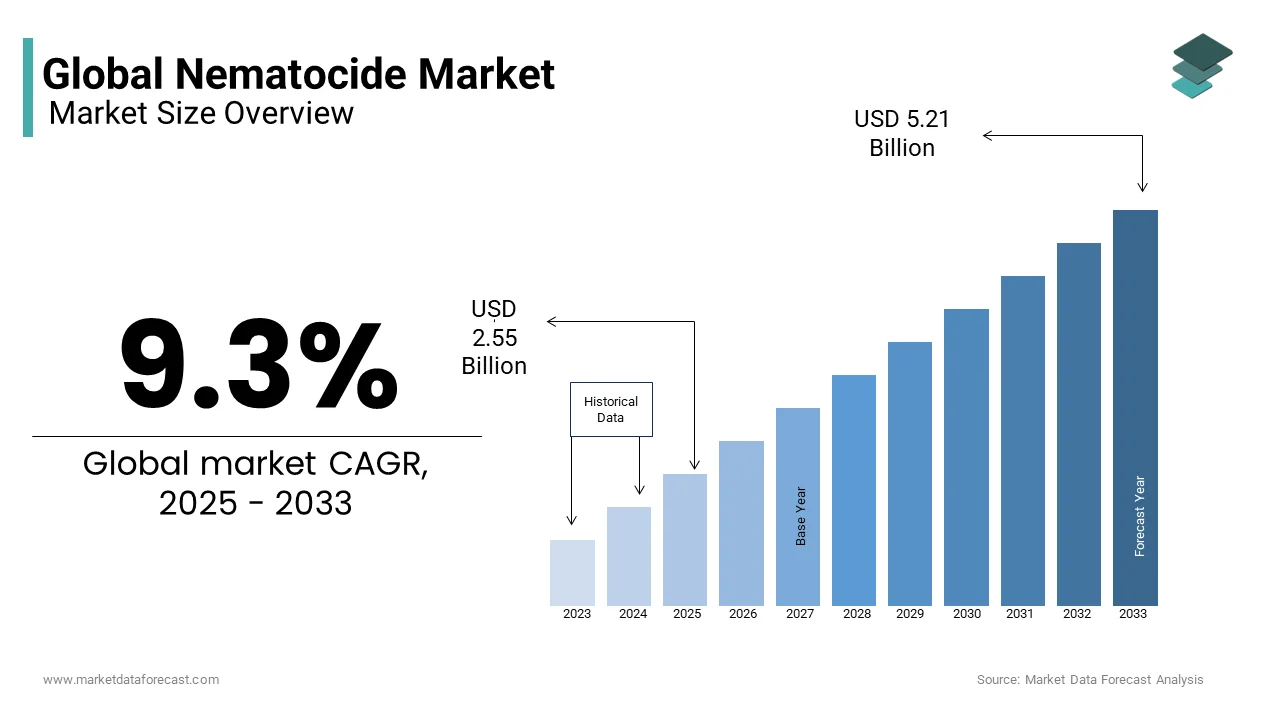
The market is showcasing evident potential in the mentioned forecasting period. The market continues to gain momentum with the rapid development in the fertilizer industry. Nematocide is a chemical pesticide that is used to get rid of plant-parasitic nematodes. Nematocides are known to be broad-spectrum toxic substances that have high volatility and other features that promote migration through the soil.
Increasing industrialization that has resulted in a decrease in arable land is predicted to propel the market for nematocides. Hence, the demand for high-yielding crops has risen, too. Also, the rising population leading to greater food demand is estimated to drive market growth. Moreover, the awareness of the benefits of nematicides is also responsible for the prospering market. However, environmental restrictions are predicted to hinder market growth.
REPORT COVERAGE
| REPORT METRIC | DETAILS |
| Market Size Available | 2025 to 2034 |
| Base Year | 2025 |
| Forecast Period | 2026 to 2034 |
| CAGR | 9.3% |
| Segments Covered | By Product, End Users, and Region. |
| Various Analyses Covered | Global, Regional, & Country Level Analysis; Segment-Level Analysis, DROC, PESTLE Analysis, Porter’s Five Forces Analysis, Competitive Landscape, Analyst Overview of Investment Opportunities |
| Regions Covered | North America, Europe, APAC, Latin America, Middle East & Africa |
| Market Leaders Profiled | ASF SE, Bayer CropScience AG, Adama Agricultural Solutions Ltd, FMC Corporation, Monsanto, Syngenta AG, Dow AgroSciences, E.I. DU Pont De Nemours, and Company, Valent, among Others. |
KEY MARKET PLAYERS
ASF SE, Bayer CropScience AG, Adama Agricultural Solutions Ltd, FMC Corporation, Monsanto, Syngenta AG, Dow AgroSciences, E.I. DU Pont De Nemours and Company, Valent, among others. Are some of the market players dominating the global nematocide market.
MARKET SEGMENTATION
This research report on the nematocide market is segmented and sub-segmented into the following categories:
By Product
- Fumigants
- Organophosphates
- Carbamates
- Bio-Based Nematocides
- Others
By End Users
- Canola
- Potato
- Wheat
- Soy
- Others
By Region
- North America
- Europe
- Asia-Pacific
- Middle East and Africa
- Latin America
The global nematocide market was dominated by North America. Asia Pacific is expected to show the highest CAGR during the forecast period.