- Product Description Description
- Table of Contents TOC
- List of Table & Figure LOT
- Get Free Sample PDF Sample PDF
Market Size, 2025
$8.52 BnMarket Estimate, 2026
$11.59 BnMarket Forecast, 2034
$136.06 BnCAGR, 2026–2034
36.05%North America IoT Sensor Market Summary
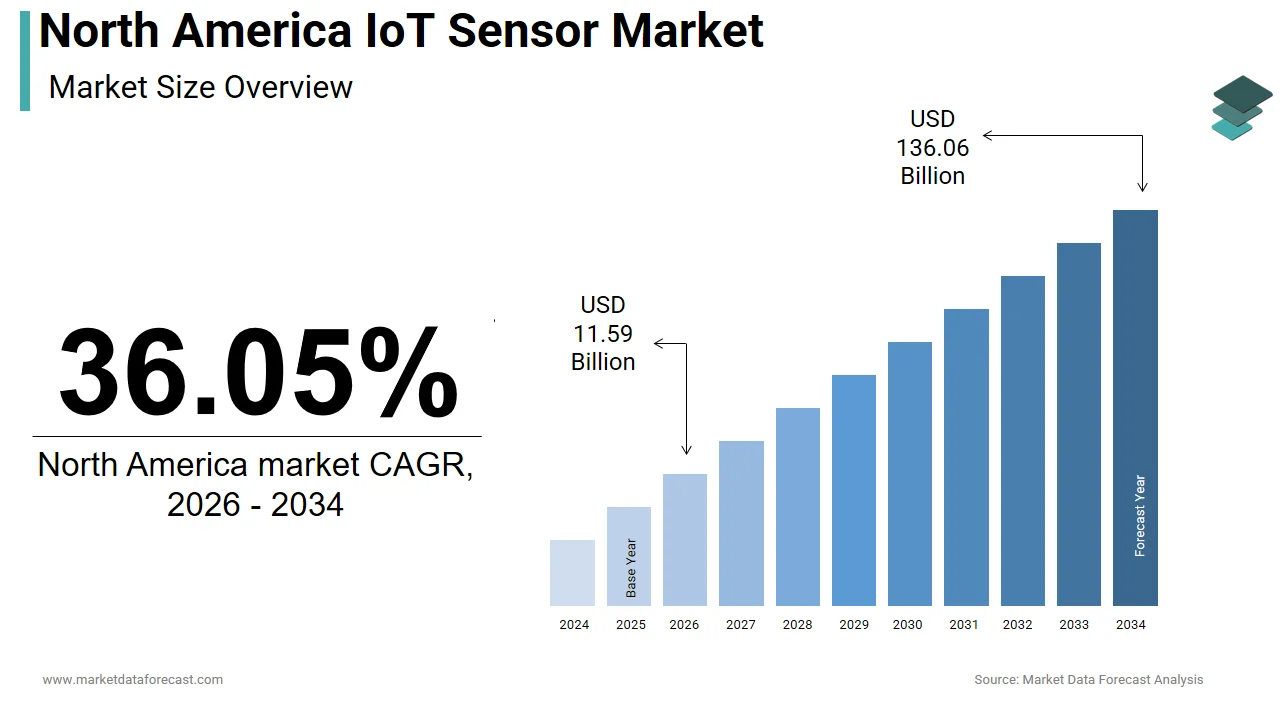
The North America IoT sensor market was valued at USD 8.52 billion in 2025 and is projected to reach USD 136.06 billion by 2034, growing at a CAGR of 36.05% from 2026 to 2034. Growth is driven by industrial automation, smart city development, and rising demand for real-time data from healthcare, automotive, and energy sectors.
Key Market Trends & Insights
- United States led the North America IoT sensor market in 2025.
- Canada is expected to witness significant growth through government-backed smart infrastructure projects.
- Based on type, the temperature sensors segment held the dominant market share in 2025.
- Based on end-use, automotive and transportation was the top segment in 2025.
- Healthcare is the fastest-growing end-use sector through 2033.
Market Size & Forecast
- 2025 Market Size: USD 8.52 Billion
- 2026 Market Size: USD 11.59 Billion
- 2034 Projected Market Size: USD 136.06 Billion
- CAGR (2026 to 2034): 36.05%
- United States: Largest market in 2025
- Canada: Key growth region
North America IoT Sensor Market Size
The size of the North America IoT sensor market was worth USD 8.52 billion in 2025. The regional market is anticipated to grow at a CAGR of 36.05% from 2026 to 2034 and be worth USD 136.06 billion by 2034 from USD 11.59 billion in 2026.
IoT sensor is a segment within the broader industrial digitization landscape, driven by an increasing reliance on real-time data acquisition across smart infrastructure, manufacturing, healthcare, and logistics. These sensors form the foundational layer of interconnected systems that enable automation, predictive analytics, and operational intelligence. Within this region, industries such as oil & gas, automotive, and utilities are increasingly embedding sensing technologies to monitor equipment performance, environmental conditions, and asset location. The proliferation of 5G networks and edge computing capabilities further amplifies the potential for high-frequency, low-latency sensor data processing. This evolving digital infrastructure underscores the criticality of IoT sensors in shaping resilient and responsive operational models across North American industries.
MARKET DRIVERS
Industrial Automation and Smart Manufacturing Adoption
Industrial automation has emerged as a primary catalyst propelling the North America IoT sensor market forward. As manufacturers strive to enhance productivity, reduce downtime, and optimize resource utilization, the integration of IoT-enabled sensors into production lines and machinery has become essential. These sensors facilitate condition monitoring, fault detection, and process optimization through continuous data collection. This surge aligns with Industry 4.0 initiatives that emphasize real-time visibility and autonomous decision-making. The rise in programmable logic controllers (PLCs) and supervisory control and data acquisition (SCADA) systems also fuels demand, as these platforms require sensor inputs for effective operation. Besides, predictive maintenance strategies, enabled by vibration, temperature, and pressure sensors, can reduce unplanned downtime and extend equipment life. Consequently, North American manufacturers are investing heavily in sensor-rich environments to meet global competitiveness standards and adapt to evolving supply chain dynamics.
Expansion of Smart City Infrastructure Projects
The rapid urbanization trends in North America have accelerated investments in smart city infrastructure, significantly boosting the demand for IoT sensors. Municipalities across the U.S. and Canada are deploying sensor networks for traffic management, waste optimization, air quality monitoring, and energy-efficient lighting systems. For instance, cities like Toronto and Chicago have launched pilot programs integrating environmental sensors into public transit hubs and streetlights to gather actionable insights on urban mobility patterns and pollution levels. Furthermore, federal funding through programs like the Smart City Challenge has allocated a substantial amount toward enhancing urban resilience via digital twin modeling and real-time data analytics. These developments underscore how governmental and civic bodies are leveraging IoT sensors to create responsive, sustainable, and citizen-centric urban ecosystems.
MARKET RESTRAINTS
Data Privacy and Security Concerns
Data privacy and cybersecurity vulnerabilities pose significant constraints on market growth in North America. With billions of sensor nodes transmitting sensitive operational and personal data, concerns around unauthorized access, data breaches, and compliance with privacy regulations continue to hinder widespread adoption. The complexity of securing heterogeneous sensor networks, often comprising legacy devices with outdated firmware, amplifies exposure risks. Moreover, the lack of standardized encryption protocols and inconsistent authentication mechanisms across vendors complicates unified security frameworks. The European Union’s General Data Protection Regulation (GDPR) and similar North American legislative efforts, such as California’s CCPA, impose stringent requirements on data handling, prompting companies to delay or scale back sensor implementations until robust compliance infrastructures are established.
High Initial Deployment and Maintenance Costs
Cost remains a persistent challenge constraining the scalability of IoT sensor networks in North America, particularly among small and medium-sized enterprises (SMEs). The upfront capital expenditure associated with procuring, installing, and configuring sensor systems, combined with ongoing maintenance and software licensing fees often outweighs perceived short-term returns. Beyond acquisition, the lifecycle costs of sensor management, including calibration, firmware updates, and replacement, add to the financial burden. Industrial-grade sensors, especially those designed for harsh environments such as oil refineries or mining operations, command premium pricing. Additionally, the fragmented vendor landscape results in interoperability challenges, increasing integration expenses. Consequently, while large corporations may absorb these expenditures, SMEs often defer investments, limiting overall market penetration despite the evident benefits of enhanced operational efficiency and risk mitigation.
MARKET OPPORTUNITIES
Growth in Edge Computing Integration
The convergence of IoT sensors with edge computing presents a transformative opportunity within the North America IoT sensor market. Edge computing enables localized data processing, reducing latency and bandwidth consumption while enhancing system responsiveness an ideal complement to time-sensitive applications such as autonomous vehicles, smart grids, and industrial robotics. This trend is further supported by semiconductor advancements, with companies like NVIDIA and Intel introducing compact, power-efficient processors tailored for edge deployment. In parallel, telecom providers are expanding 5G mmWave coverage, enabling seamless communication between distributed sensor nodes and edge gateways. The integration of machine learning algorithms directly into sensor hardware, known as TinyML, is also gaining traction, allowing for real-time anomaly detection without cloud dependency. These developments not only improve operational agility but also reduce reliance on centralized data centers, opening new revenue streams for sensor manufacturers and solution integrators alike.
Surge in Renewable Energy and Grid Modernization Initiatives
The transition toward renewable energy sources and the modernization of electrical grids in North America offer substantial growth prospects for the IoT sensor market. Sensors play a crucial role in monitoring solar irradiance, wind speed, battery health, and grid stability, enabling efficient energy generation, storage, and distribution. Like Canada’s Net-Zero Electricity Plan emphasizes smart grid infrastructure, requiring millions of intelligent sensors to manage bidirectional energy flows and integrate distributed energy resources. Furthermore, the Biden administration’s Infrastructure Investment and Jobs Act allocates significant funds toward grid resilience and clean energy initiatives, much of which hinges on sensor-enabled monitoring systems. These policy-driven investments, coupled with declining sensor costs and improved wireless connectivity, position the North America IoT sensor market for sustained expansion in the energy sector.
MARKET CHALLENGES
Interoperability and Standardization Gaps
The absence of universal interoperability standards is one of the most pressing challenges facing the North America IoT sensor market. The diversity of communication protocols, data formats, and vendor-specific architectures creates fragmentation, limiting seamless integration across multi-vendor environments. This lack of cohesion increases complexity for end-users seeking scalable and future-proof sensor deployments. Popular protocols such as Zigbee, LoRaWAN, Modbus, and MQTT coexist without unified middleware, resulting in siloed data and inefficient system management. The absence of standardized APIs and metadata schemas further complicates analytics integration, forcing enterprises to invest in custom middleware solutions. The Open Connectivity Foundation (OCF) has made strides in promoting interoperability, yet adoption remains uneven, particularly among legacy infrastructure operators. Until a consensus emerges on universal communication standards, the scalability and flexibility of IoT sensor networks will remain constrained, inhibiting broader market penetration and cross-industry collaboration.
Skilled Workforce Shortage for Sensor Deployment and Management
The North America IoT sensor market faces a critical human capital bottleneck due to the shortage of skilled professionals capable of designing, deploying, and maintaining complex sensor networks. As sensor technology becomes more sophisticated, encompassing wireless protocols, embedded analytics, and cybersecurity features, the demand for specialized expertise has surged beyond the current supply. Educational institutions have struggled to keep pace with industry needs. Compounding the issue, the existing workforce often lacks cross-functional competencies spanning hardware, software, and networking domains. This talent gap not only delays project timelines but also elevates operational risks, as suboptimal configurations can compromise system reliability and return on investment. Addressing this shortfall requires collaborative efforts between academia, industry, and certification bodies to develop targeted training programs and upskilling pathways.
REPORT COVERAGE
| REPORT METRIC | DETAILS |
| Market Size Available | 2025 to 2034 |
| Base Year | 2025 |
| Forecast Period | 2026 to 2034 |
| Segments Covered | By Type, End Use, and Country. |
| Various Analyses Covered | Global, Regional and Country-Level Analysis, Segment-Level Analysis, Drivers, Restraints, Opportunities, Challenges; PESTLE Analysis; Porter’s Five Forces Analysis, Competitive Landscape, Analyst Overview of Investment Opportunities |
| Countries Covered | United States, Canada, Mexico, Rest of North America |
| Market Leaders Profiled | Texas Instruments, TE Connectivity Corporation, STMicroelectronics International N.V., NXP Semiconductor N.V., Honeywell International Inc., Siemens AG, General Electric, OMRON Corporation, Murata Manufacturing Co., Ltd., Analog Devices, Inc., Robert Bosch GmbH, Infineon Technologies AG, and Sensirion AG. |
SEGMENTAL ANALYSIS
By Type Insights
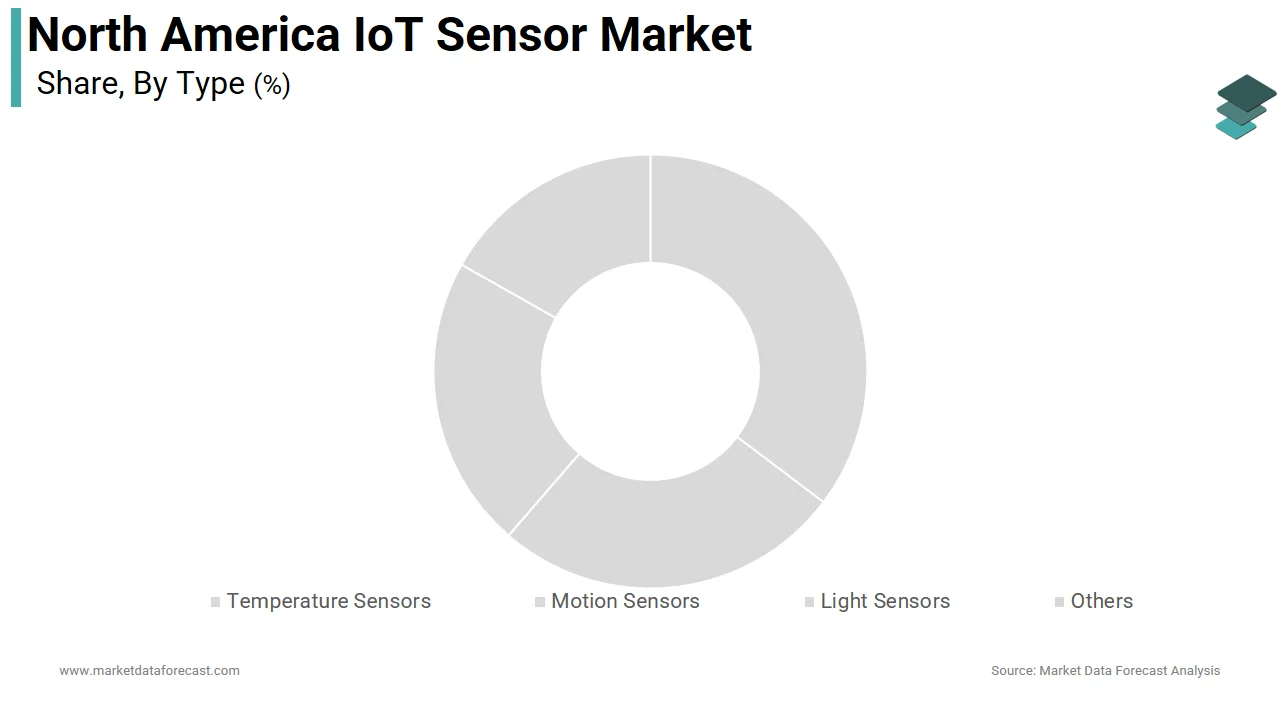
The temperature sensors segment represented the dominant force in the North America IoT sensor market by commanding a 34.7% of the total share in 2024. This supremacy stems from their fundamental role across diverse industrial applications where precise thermal monitoring is critical for operational safety and efficiency. The widespread adoption spans manufacturing processes, HVAC systems, food processing, pharmaceutical storage, and energy management infrastructure.
Industrial process industries heavily depend on temperature sensors for maintaining optimal operating conditions and preventing catastrophic failures. Temperature variations beyond specified thresholds can result in product degradation, equipment damage, or hazardous conditions, making continuous monitoring non-negotiable
The integration of temperature sensors into building automation systems represents a significant growth driver, fueled by stringent energy efficiency regulations and sustainability initiatives. Like, commercial buildings equipped with IoT-based HVAC control systems achieve a reduction in energy consumption through intelligent temperature regulation.
The motion sensors segment is experiencing the most rapid expansion within the North America IoT sensor market and is demonstrating a remarkable CAGR of 15.8% from 2026 to 2034. This accelerated growth trajectory reflects their expanding application scope beyond traditional security systems into smart lighting, occupancy analytics, automated doors, and elderly care monitoring solutions.
The evolution of workplace strategies following hybrid work models has intensified demand for motion sensors to optimize space utilization and reduce operational costs. Corporate real estate managers are increasingly deploying occupancy sensing networks to understand usage patterns and right-size office spaces. The rise of hot-desking and flexible work arrangements has amplified the need for real-time occupancy data, with motion sensors providing anonymous headcount information without privacy concerns. Corporate sustainability initiatives further drive adoption, as motion-activated lighting and HVAC systems contribute significantly to LEED certification scores and carbon footprint reduction targets.
The healthcare sector's embrace of motion sensors for patient monitoring and fall detection represents a transformative growth catalyst, particularly given North America's aging demographic trends. Motion sensing technology enables continuous patient activity monitoring without requiring wearable devices, making it ideal for dementia care, post-surgical recovery, and independent living applications. Senior living communities are rapidly adopting motion-based wandering detection systems. Insurance providers are beginning to reimburse motion sensor installations in senior care settings, with Medicare Advantage plans covering up to $1,200 annually for fall prevention technologies in high-risk patient populations.
By End Use Insights
The automotive and transportation sector dominated the North America IoT sensor market by representing 26.2% of the total share in 2024. The mandatory implementation of advanced driver assistance systems in new vehicles has created unprecedented demand for automotive-grade IoT sensors across North America. Furthermore, federal safety regulations mandate blind-spot detection and lane departure warning systems in commercial vehicles, driving fleet-wide sensor deployments across trucking and delivery companies.
The rapid electrification of North America's automotive fleet has intensified demand for specialized sensors to monitor battery health, thermal management, and charging infrastructure operations. Electric vehicle battery packs require continuous monitoring of cell temperature, voltage, and current to ensure safety and optimize performance throughout their lifecycle. Public charging infrastructure expansion has created additional sensor demand. Battery manufacturers such as LG Energy Solution and Panasonic report that sensor-related components now represent 12% of total battery production costs, reflecting their critical importance in ensuring safe and efficient electric vehicle operations.
The healthcare sector is experiencing the most rapid growth within the North America IoT sensor market, projected to achieve a compound annual growth rate of 19.2% from 2023 to 2030. This extraordinary expansion stems from digital health transformation, remote patient monitoring initiatives, and the integration of sensor technology into medical devices and hospital infrastructure.
The shift toward remote patient monitoring has revolutionized healthcare delivery models, creating massive demand for medical-grade IoT sensors that enable continuous health parameter tracking outside traditional clinical settings. Chronic disease management represents the primary use case, as continuous glucose monitors, blood pressure sensors, and cardiac rhythm detectors reduce hospital readmissions. Remote monitoring sensor deployments reduce emergency department visits while improving medication adherence rates among elderly patients with multiple comorbidities.
Healthcare facility modernization initiatives are driving extensive sensor deployments for asset tracking, environmental monitoring, and workflow optimization throughout North American hospitals and medical centers. Operating room efficiency improvements through sensor-enabled surgical instrument tracking have reduced procedure delays. Temperature and humidity sensors are mandatory for pharmaceutical storage compliance. Asset tracking sensors have reduced medical equipment procurement costs as hospitals gain visibility into existing inventory utilization patterns, eliminating unnecessary duplicate purchases while ensuring critical equipment availability during emergencies.
COUNTRY-LEVEL ANALYSIS
United States IoT Sensor Market Insights
The United States maintained an overwhelming leadership position in the North America IoT sensor market by commanding 89.5% of the regional share in 2024. This dominant status reflects the country's advanced technological infrastructure, robust industrial base, and aggressive adoption of digital transformation initiatives across multiple sectors.
The convergence of industrial automation, smart city initiatives, and healthcare digitization has positioned the United States as the epicenter of IoT sensor innovation and deployment. Manufacturing hubs such as Detroit, Chicago, and Houston have embraced sensor-rich environments to optimize production processes and enhance operational efficiency. The automotive industry's transformation toward electric and autonomous vehicles has created unprecedented demand for sophisticated sensing solutions, while the healthcare sector's shift toward remote monitoring and telemedicine has accelerated medical sensor adoption. Federal initiatives supporting smart infrastructure development, coupled with substantial private sector investments in Industry 4.0 technologies, have established the United States as the primary growth engine for the North American IoT sensor market. The country's mature venture capital ecosystem and concentration of technology talent further reinforce its market leadership position.
Canada IoT Sensor Market Insights
Canada occupied a significant position in the North America IoT sensor market. This significant market presence stems from the country's strategic focus on smart city development, mining automation, and healthcare technology advancement.
Canadian provinces have demonstrated remarkable commitment to IoT sensor deployment through comprehensive smart city initiatives and environmental monitoring programs. Ontario's manufacturing sector has extensively integrated sensor networks to enhance productivity and reduce environmental impact, while British Columbia's forestry and mining industries utilize ruggedized sensors for remote asset monitoring and safety management. The Canadian government's Digital Charter and Smart Cities Challenge have allocated substantial funding toward sensor-enabled urban infrastructure projects, creating sustained demand across municipal applications. Healthcare systems across Canadian provinces have prioritized remote patient monitoring and hospital automation, driving medical sensor adoption rates that exceed many comparable developed nations. Natural resource industries, including oil and gas exploration, have embraced IoT sensors for pipeline monitoring and environmental compliance, supported by stringent regulatory requirements that mandate continuous operational oversight.
Mexico IoT Sensor Market Insights
Mexico represents a growing participant in the North America IoT sensor market with increasing deployment across automotive manufacturing and industrial automation sectors. The country's strategic positioning as a manufacturing hub has driven significant sensor adoption for quality control and process optimization.
The maquiladora industry along the U.S.-Mexico border has increasingly integrated IoT sensors to meet international quality standards and enhance production efficiency. Mexican automotive manufacturers, including major facilities for Ford, General Motors, and Volkswagen, have deployed extensive sensor networks to support just-in-time manufacturing processes and predictive maintenance initiatives. Energy sector modernization efforts, particularly in renewable energy projects, have created new opportunities for environmental monitoring sensors and grid management solutions. Government initiatives supporting Industry 4.0 adoption through programs like ProMéxico have facilitated technology transfer and sensor deployment across medium and large enterprises, positioning Mexico for accelerated market growth in the coming years.
Rest of North America IoT Sensor Market Insights
The remaining North American countries, including Central American nations and Caribbean territories, collectively represent a modest but growing segment of the regional IoT sensor market. This emerging market segment is primarily driven by tourism infrastructure development and agricultural modernization initiatives.
Tourism-dependent economies such as Costa Rica and Jamaica have begun implementing sensor networks for smart hotel management and environmental monitoring to enhance visitor experiences while preserving natural resources. Agricultural sectors across Central America are adopting soil moisture and weather sensors to optimize crop yields and water usage, supported by international development funding and climate adaptation programs. Limited industrial bases in these countries restrict large-scale sensor deployments, but government digitization initiatives and private sector investments in logistics and transportation are creating gradual market expansion opportunities. The region's vulnerability to climate change has accelerated the adoption of environmental monitoring sensors for disaster preparedness and resource management applications.
COMPETITIVE LANDSCAPE
The North America IoT sensor market exhibits intense competitive dynamics characterized by the presence of established multinational corporations alongside innovative startups and specialized technology providers. Market participants compete primarily on technological innovation, product differentiation, and comprehensive solution offerings rather than solely on price. The competitive landscape is marked by continuous research and development investments aimed at developing next-generation sensing technologies with enhanced capabilities. Strategic collaborations between sensor manufacturers and system integrators have become increasingly common to deliver end-to-end IoT solutions. Intellectual property protection and patent portfolios play crucial roles in maintaining competitive advantages and preventing technology replication. Market consolidation through mergers and acquisitions has intensified as companies seek to expand their technological capabilities and geographic reach. The emergence of platform-based business models has transformed traditional sensor manufacturing into integrated ecosystem solutions. Customer relationships and after-sales support services have become critical differentiators in winning long-term contracts. Regional specialization and industry vertical focus strategies enable smaller players to compete effectively against larger corporations. The competitive environment is further complicated by rapidly evolving technology standards and changing customer preferences that require continuous adaptation and innovation.
KEY MARKET PLAYERS
Noteworthy Companies dominating the North America IoT sensor market profiled in the report are
- Texas Instruments
- TE Connectivity Corporation
- STMicroelectronics International N.V.
- NXP Semiconductor N.V.
- Honeywell International Inc.
- Siemens AG
- General Electric
- OMRON Corporation
- Murata Manufacturing Co., Ltd.
- Analog Devices, Inc.
- Robert Bosch GmbH
- Infineon Technologies AG
- Sensirion AG
TOP LEADING PLAYERS IN THE MARKET
- Texas Instruments stands as a semiconductor powerhouse in the North America IoT sensor market, renowned for its comprehensive portfolio of analog and embedded processing solutions. The company's extensive sensor offerings encompass temperature, pressure, humidity, and motion sensing technologies that cater to diverse industrial applications. Their innovation focus centers on developing low-power, high-precision sensors specifically designed for battery-operated IoT devices. Texas Instruments has consistently invested in research and development to miniaturize sensor components while enhancing their performance capabilities. The company's strategic partnerships with major electronics manufacturers have facilitated widespread adoption of their sensing solutions across automotive, industrial, and consumer markets. Their commitment to providing complete sensor system solutions, including signal conditioning and wireless connectivity integration, has solidified their leadership position in the competitive landscape.
- Honeywell represents a formidable force in the North America IoT sensor market through its advanced sensing technologies and automation solutions. The company's sensor division specializes in developing robust industrial-grade sensors for harsh environment applications, particularly in aerospace, automotive, and building technologies sectors. Their expertise spans pressure, flow, temperature, and gas sensing technologies that meet stringent safety and performance standards. Honeywell's innovation pipeline focuses on integrating artificial intelligence capabilities into sensor systems to enable predictive analytics and autonomous decision-making. The company's extensive global manufacturing footprint and strong distribution network have enabled rapid market penetration across North American industries. Their commitment to cybersecurity in sensor communications has positioned them as a trusted partner for critical infrastructure applications requiring reliable and secure data transmission.
- STMicroelectronics has established itself as a key player in the North America IoT sensor market through its MEMS (Micro-Electro-Mechanical Systems) technology leadership and comprehensive sensor portfolio. The company's expertise in motion, environmental, and audio sensors has made them a preferred supplier for consumer electronics, automotive, and industrial applications. Their innovation strategy emphasizes developing ultra-low-power sensors with enhanced accuracy and miniaturized form factors suitable for wearable and portable devices. STMicroelectronics' strong presence in the automotive sector has been bolstered by their MEMS inertial measurement units and pressure sensors that meet automotive-grade reliability standards. The company's focus on edge computing integration within sensor modules has enabled real-time data processing capabilities that reduce latency and bandwidth requirements. Their collaborative approach with ecosystem partners has facilitated rapid prototyping and time-to-market advantages for customers across various industry segments.
TOP STRATEGIES USED BY KEY MARKET PARTICIPANTS
Strategic Acquisitions and Partnerships Leading players in the North America IoT sensor market actively pursue acquisition strategies to expand their technological capabilities and market reach. These companies target specialized sensor manufacturers, software developers, and system integrators to create comprehensive solution portfolios. Strategic partnerships with cloud service providers, telecommunications companies, and industrial equipment manufacturers enable seamless integration of sensor data into broader digital transformation initiatives. Collaborative research agreements with academic institutions and technology incubators foster innovation in emerging sensor technologies. Joint ventures with regional players facilitate market entry into specific geographic segments while leveraging local expertise and distribution networks.
Research and Development Innovation Focus Market participants heavily invest in research and development activities to maintain technological superiority and address evolving customer requirements. Companies focus on developing next-generation sensors with enhanced accuracy, lower power consumption, and improved environmental resilience. Innovation efforts encompass artificial intelligence integration, edge computing capabilities, and wireless connectivity optimization to create intelligent sensing solutions. Development of standardized sensor platforms enables faster customization for specific applications while reducing time-to-market. Investment in advanced manufacturing processes and materials science research drives miniaturization efforts and cost reduction initiatives. Companies also prioritize cybersecurity research to ensure secure data transmission and protect against potential threats in connected sensor networks.
Vertical Market Specialization and Customization Key players adopt focused strategies to penetrate specific industry verticals by developing specialized sensor solutions tailored to unique requirements. This approach involves deep understanding of vertical-specific challenges, regulatory compliance requirements, and operational environments. Companies invest in domain expertise and industry partnerships to create application-specific sensor configurations that deliver optimal performance. Customization strategies encompass hardware modifications, software adaptations, and integration services that address particular use cases. Development of industry-specific certification programs and compliance frameworks establishes credibility and trust among target customers. Regional specialization strategies enable companies to address local market dynamics, regulatory environments, and cultural preferences while maintaining global scalability.
RECENT MARKET DEVELOPMENTS
- In March 2024, Texas Instruments announced the launch of its new ultra-low-power temperature sensor family specifically designed for battery-operated IoT applications, featuring enhanced accuracy and extended operational lifetime.
- In June 2024, Honeywell International completed the acquisition of Sensata Technologies' industrial sensor division, expanding its portfolio of pressure and flow sensing solutions for harsh environment applications.
- In September 2024, STMicroelectronics partnered with Microsoft Azure to develop integrated sensor-to-cloud solutions that enable seamless data transmission and analytics capabilities for industrial IoT applications.
- In January 2024, Bosch Sensortec introduced its next-generation MEMS inertial measurement unit with embedded AI processing capabilities, designed specifically for automotive and consumer electronics applications.
- In August 2024, Analog Devices acquired Maxim Integrated's sensor business unit, strengthening its position in precision sensing technologies and expanding its industrial automation sensor portfolio.
- In April 2024, DynaTouch, a kiosk solutions provider, acquired KioWare, a kiosk management software company. This acquisition is anticipated to allow DynaTouch to offer more comprehensive kiosk solutions and strengthen its market presence.
- In February 2024, TE Connectivity announced the expansion of its sensor manufacturing facility in Mexico, increasing production capacity for industrial and automotive sensors to meet growing North American demand.
- In July 2024, Infineon Technologies launched its new radar sensor portfolio specifically designed for industrial automation and smart building applications, featuring enhanced detection accuracy and reduced power consumption.
- In May 2024, NXP Semiconductors partnered with Amazon Web Services to develop integrated sensor solutions for smart city infrastructure projects across North American municipalities.
- In November 2024, Omron Corporation established a joint venture with a Canadian technology company to develop specialized sensors for harsh environment monitoring in mining and oil & gas applications.
MARKET SEGMENTATION
This North America IoT sensor market research report is segmented and sub-segmented into the following categories.
By Type
- Temperature Sensors
- Motion Sensors
- Light Sensors
- Others
By End Use
- Consumer Electronics
- Wearable Devices
- Automotive & Transportation
- BFSI
- Healthcare
- Retail
- Building Automation
- Oil & Gas
- Agriculture
- Aerospace & Defense
- Others
By Country
- United States
- Canada
- Mexico
- Rest of North America