- Product Description Description
- Table of Contents TOC
- List of Table & Figure LOT
- Get Free Sample PDF Sample PDF
Market Size, 2025
$4.75 BnMarket Estimate, 2026
$5.12 BnMarket Forecast, 2034
$9.28 BnCAGR, 2026–2034
7.73%North America Machine Vision Systems Market Summary
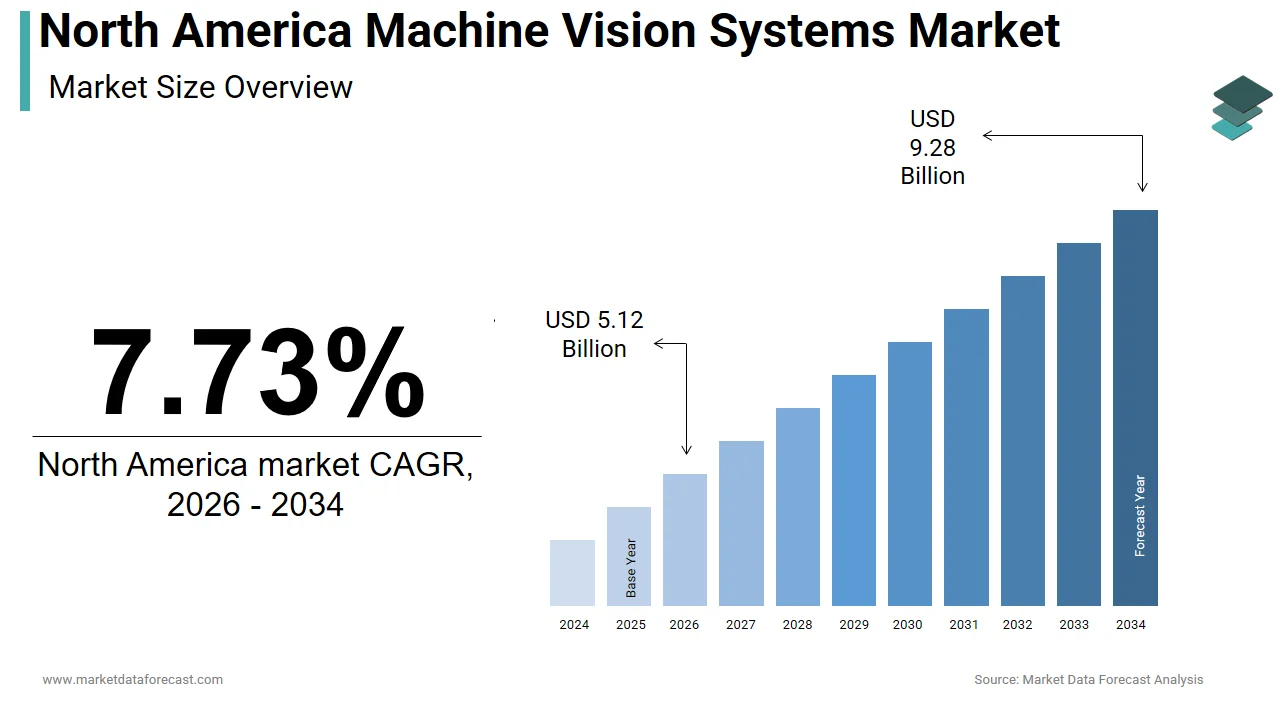
The North America machine vision systems market was valued at USD 4.75 billion in 2025, is estimated to reach USD 5.12 billion in 2026, and is projected to reach USD 9.28 billion by 2033, growing at a CAGR of 7.73% from 2026 to 2034. Machine vision systems are a sophisticated technology ecosystem driving automation across inspection, guidance, and identification applications in manufacturing and logistics.
Key Market Trends & Insights
- The United States dominated the North America machine vision systems market in 2025.
- Canada maintained a significant share owing to its sustainable manufacturing specialization.
- Based on component, the hardware segment held the dominant share with 65.7% in 2024.
- Based on product, the PC-based segment led the market in 2025.
- Based on end-user, the automotive industry was the leading segment in 2025.
Market Size & Forecast
- 2025 Market Size: USD 4.75 Billion
- 202 Market Size: USD 5.12 Billion
- 2034 Projected Market Size: USD 9.28 Billion
- CAGR (2026 to 2034): 7.73%
- United States: Largest market in 2025
- Canada: Significant contributor with sustainable system development
North America Machine Vision Systems Market Size
The size of the North America machine vision systems market was worth USD 4.75 billion in 2025. The regional market is anticipated to grow at a CAGR of 7.73% from 2026 to 2034 and be worth USD 9.28 billion by 2034 from USD 5.12 billion in 2026.
Machine vision systems are a sophisticated technological ecosystem encompassing imaging hardware, processing software, and integrated solutions designed to automate inspection, guidance, and identification processes across manufacturing and logistics environments. This market encompasses diverse technologies, including industrial cameras, lighting systems, lenses, image processing software, and artificial intelligence algorithms that enable automated quality control, robotic guidance, and production monitoring capabilities. The industry's evolution reflects advancement toward deep learning integration, three-dimensional imaging technologies, and edge computing solutions that enhance system performance while reducing implementation complexity. According to the Association for Advancing Automation, North American machine vision installations require comprehensive integration expertise and specialized technical knowledge that differentiates the market from consumer imaging applications. The market's complexity stems from its integration with industrial automation protocols, factory communication networks, and enterprise resource planning systems that create interdependent operational requirements.
MARKET DRIVERS
Industrial Automation and Smart Manufacturing Adoption
Industrial automation initiatives across North American manufacturing sectors constitute a fundamental demand catalyst for machine vision systems, driven by productivity enhancement requirements and competitive manufacturing imperatives. Automotive manufacturing facilities implement machine vision systems for component inspection, robotic guidance, and assembly verification processes, with major original equipment manufacturers deploying vision-guided robotics for a notable share of welding and painting operations. Electronics manufacturing companies utilize machine vision for component placement verification, solder joint inspection, and barcode reading applications, with semiconductor fabrication facilities requiring sub-micron inspection accuracy for 90% of quality control processes. Pharmaceutical manufacturers implement vision systems for tablet counting, packaging inspection, and serialization requirements encouraged by FDA regulations, with a large number of pharmaceutical manufacturing facilities requiring automated inspection capabilities. Food and beverage processing companies deploy machine vision for product sorting, quality grading, and contamination detection applications. These automation requirements create consistent demand opportunities that enable machine vision system providers to develop standardized solutions while maintaining premium pricing structures for specialized applications.
Quality Control and Defect Detection Requirements
Stringent quality control standards and defect detection requirements across regulated industries accelerate demand for advanced machine vision systems that provide consistent inspection capabilities exceeding human performance limitations. The International Organization for Standardization establishes quality management system requirements that mandate objective measurement and documentation of product conformity, creating demand for automated inspection systems that eliminate human subjectivity and fatigue-related errors. Aerospace manufacturers implement machine vision systems for composite material inspection, fastener verification, and surface finish measurement applications. Medical device manufacturers utilize vision systems for component dimension measurement, surface defect detection, and packaging integrity verification. Consumer goods companies deploy machine vision for label inspection, fill level monitoring, and package integrity verification, with major retailers requiring zero-defect delivery standards that mandate automated quality control systems for supplier compliance. Electronics assembly manufacturers implement vision-guided inspection for solder joint analysis, component orientation verification, and electrical connection validation, with IPC standards requiring sub-millimeter inspection accuracy for high-reliability applications. These quality assurance requirements create premium pricing opportunities for advanced vision systems while establishing long-term customer relationships through comprehensive quality management integration.
MARKET RESTRAINTS
High Implementation Costs and Technical Complexity
Significant capital investment requirements and technical implementation complexity create substantial barriers to machine vision system adoption, particularly for small and medium-sized manufacturing enterprises that lack specialized technical resources and financial capacity. Technical complexity challenges emerge from integration requirements with existing factory automation systems, communication protocol compatibility issues, and specialized programming expertise needed for custom application development. Lighting system optimization requires extensive testing and adjustment to achieve consistent image quality across varying production conditions. Integration with enterprise resource planning systems and quality management databases requires specialized middleware development and data mapping expertise. These cost and complexity barriers limit market penetration among smaller manufacturers while creating premium pricing opportunities for system integrators serving large enterprise customers with substantial technical resources.
Skilled Workforce Shortage and Training Requirements
Critical shortage of qualified machine vision system engineers and technical specialists constrains market capacity expansion while increasing project costs and implementation timelines across North American industrial sectors. Educational institution training programs produce fewer qualified machine vision engineers annually, insufficient to replace retiring technical staff and support market growth requirements for new professionals. Professional certification programs for machine vision system design and implementation require several months of specialized training, with high certification costs per participant. Geographic distribution challenges emerge as machine vision demand concentrates in metropolitan manufacturing hubs while qualified technical specialists remain dispersed across regions, increasing travel costs and project completion times. Language and cultural barriers affect training program effectiveness for immigrant workers comprising of manufacturing workforce, requiring specialized instruction methods that extend training duration while increasing program costs. These human capital constraints limit market capacity expansion while creating wage inflation pressures that increase system implementation costs annually.
MARKET OPPORTUNITIES
Artificial Intelligence and Deep Learning Integration
Advanced artificial intelligence algorithms and deep learning capabilities create premium market opportunities for machine vision system providers targeting complex inspection applications that require adaptive pattern recognition and anomaly detection capabilities. Deep learning-based vision systems can recognize complex defect patterns and product variations that traditional rule-based algorithms cannot detect, with convolutional neural networks achieving 99.5% accuracy in defect classification. Pharmaceutical manufacturers implement AI-powered vision systems for pill identification, coating inspection, and serialization applications that require recognition of subtle variations in product appearance and packaging characteristics. Food processing companies utilize deep learning vision systems for product grading, contamination detection, and quality classification applications, with the Food and Drug Administration recognizing AI-based inspection systems for enhanced food safety monitoring capabilities. Electronics assembly manufacturers deploy AI-powered vision systems for component inspection, solder joint analysis, and quality verification applications that require recognition of complex geometric patterns and surface characteristics. Automotive manufacturers implement deep learning vision systems for paint inspection, surface defect detection, and assembly verification applications that require adaptive learning capabilities for new vehicle models and design variations.
Edge Computing and Real-Time Processing Technologies
Edge computing integration and real-time processing capabilities create operational efficiency opportunities that reduce latency, improve system reliability, and enhance decision-making speed across industrial automation applications. Edge-based vision processing eliminates network communication delays and bandwidth limitations that constrain traditional centralized processing architectures. Manufacturing facilities implement edge vision systems for real-time quality control and process optimization applications, with automotive assembly lines utilizing edge processing for robotic guidance and assembly verification that requires sub-millisecond response times. Food and beverage processing companies deploy edge vision systems for high-speed sorting and quality grading applications, with packaging lines achieving 99.9% uptime through local processing that eliminates network dependency and reduces maintenance complexity. Pharmaceutical manufacturers utilize edge vision systems for real-time serialization and track-and-trace applications that require immediate data processing and regulatory compliance reporting capabilities. Electronics assembly facilities implement edge vision systems for high-speed component placement verification and solder joint inspection applications that require real-time feedback for process control and quality assurance. These edge computing advantages create new revenue streams for vision system providers while establishing competitive differentiation through enhanced performance and reliability improvements that support critical industrial applications.
MARKET CHALLENGES
Cybersecurity Vulnerabilities and Data Protection Requirements
Industrial cybersecurity threats and data protection requirements create operational risk management challenges that increase system complexity and implementation costs while affecting customer confidence in machine vision technology adoption. Data protection regulations, including GDPR and state-level privacy laws, require machine vision systems to implement comprehensive data encryption, access control, and audit trail capabilities that increase system complexity and operational costs. Network segmentation requirements mandate isolation of vision systems from corporate networks, requiring specialized firewall configurations and communication protocol implementations that increase project costs. Supply chain security concerns emerge from international component sourcing and software licensing arrangements, requiring comprehensive vendor security assessments and third-party risk management programs. Intellectual property protection requirements for proprietary vision algorithms and custom inspection criteria necessitate specialized security measures, including code obfuscation, hardware security modules, and secure boot processes that increase development costs.
Standardization and Interoperability Requirements
Lack of comprehensive industry standards and interoperability protocols creates integration complexity that increases implementation costs and reduces system flexibility across diverse industrial applications and customer requirements. Like, facilities utilizing multiple incompatible protocols including Ethernet/IP, PROFINET, and Modbus TCP that require specialized interface development. Image format standardization challenges emerge from diverse camera manufacturers utilizing proprietary file formats and compression algorithms that complicate data exchange and system integration requirements. Hardware component compatibility challenges arise from varying power requirements, mounting configurations, and environmental specifications that increase inventory complexity and reduce standardization benefits. Calibration and validation standardization requirements create additional complexity as customers demand traceable measurement accuracy and documented performance verification according to ISO 9001 and ISO 17025 quality standards. These standardization gaps require system integrators to maintain diverse component inventories and specialized technical expertise while accepting reduced operational efficiency compared to standardized market conditions that would enable economies of scale and simplified implementation processes.
REPORT COVERAGE
| REPORT METRIC | DETAILS |
| Market Size Available | 2025 to 2034 |
| Base Year | 2025 |
| Forecast Period | 2026 to 2034 |
| Segments Covered | By Component, Product, End-User Industry, and Region. |
| Various Analyses Covered | Global, Regional and Country-Level Analysis, Segment-Level Analysis, Drivers, Restraints, Opportunities, Challenges; PESTLE Analysis; Porter’s Five Forces Analysis, Competitive Landscape, Analyst Overview of Investment Opportunities |
| Countries Covered | United States, Canada, Mexico, Rest of North America |
| Market Leaders Profiled | Cognex Corporation, Keyence Corporation, Basler AG, National Instruments Corporation, Teledyne DALSA, and Others. |
SEGMENT ANALYSIS
By Component Insights
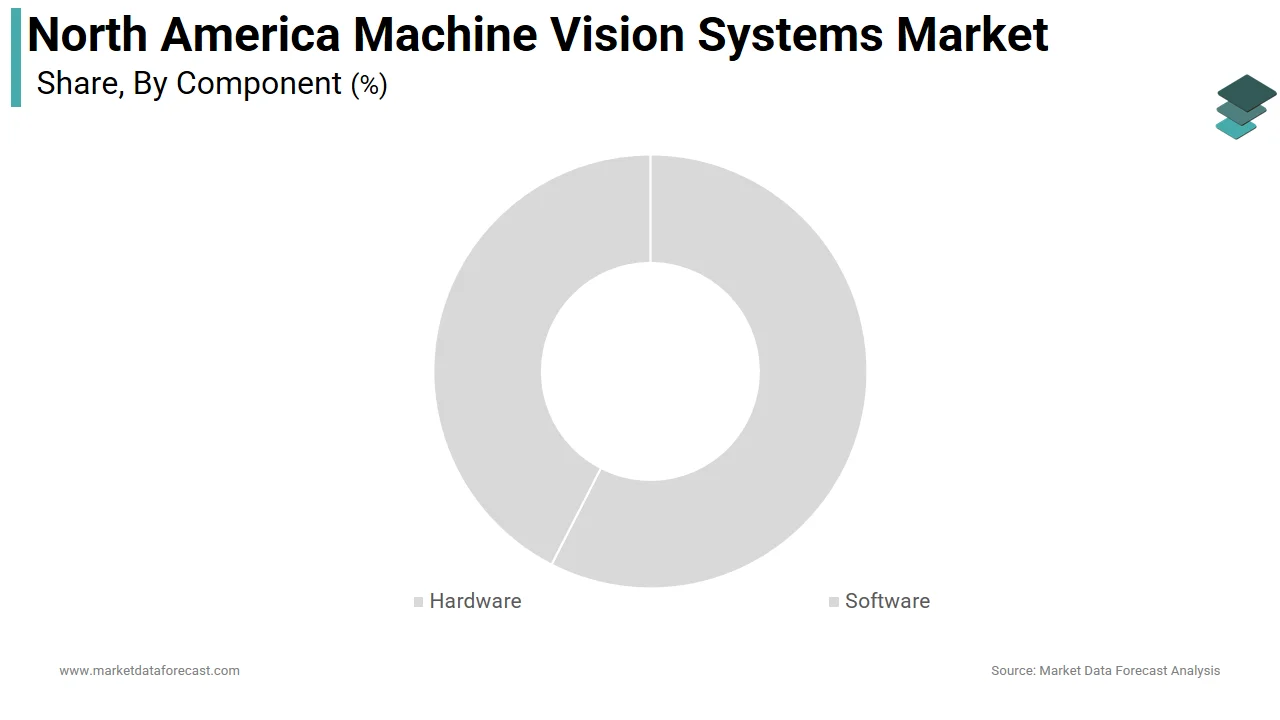
The hardware components segment dominated North America's machine vision systems market by commanding a 65.7% of the total share in 2024. The fundamental driver behind hardware component dominance is the substantial capital investment requirements for industrial machine vision implementations that prioritize high-quality imaging equipment and robust mechanical components over software development costs. Industrial camera systems represent the largest hardware expenditure category. Lens systems for precision measurement in high-cost applications cost, with telecentric lenses for sub-millimeter accuracy commanding premium pricing structures. Housing and mounting systems for harsh environment applications require specialized enclosures and protective components that add to total hardware costs, with IP67-rated systems costing more than standard components according to industrial equipment supplier catalogs. These capital-intensive hardware requirements create consistent demand opportunities that enable component manufacturers to achieve economies of scale while maintaining premium pricing structures for specialized applications.
Continuous hardware technology advancement and performance enhancement capabilities create additional market opportunities that expand beyond basic imaging requirements while supporting premium pricing structures for advanced components. High-resolution camera systems achieving 50-megapixel imaging capabilities command price premiums compared to standard 5-megapixel systems. Three-dimensional imaging systems utilizing structured light and laser triangulation technologies require specialized hardware components, including pattern projectors and high-speed cameras that cost high per installation according to industrial automation technology supplier pricing surveys. Hyperspectral imaging systems for food safety and pharmaceutical applications require specialized spectroscopic components and cooling systems that increase hardware costs compared to conventional imaging systems. Embedded processing hardware for edge computing applications requires specialized graphics processing units and field-programmable gate arrays. These advanced hardware capabilities enable system providers to command premium pricing while establishing sustainable competitive advantages through technological differentiation and performance enhancement capabilities.
The software components segment emerges as the fastest-growing in North America's machine vision systems market and is projected to achieve a CAGR of 12.4% through 2033. The primary catalyst driving software component growth is the automotive and electronics manufacturing industries' intensified demand for artificial intelligence algorithms that provide adaptive pattern recognition and anomaly detection capabilities exceeding traditional rule-based approaches. Deep learning-based vision algorithms can recognize complex defect patterns and product variations that conventional algorithms cannot detect, with convolutional neural networks achieving high accuracy in defect classification. Pharmaceutical manufacturers implement AI-powered vision software for pill identification, coating inspection, and serialization applications that require recognition of subtle variations in product appearance and packaging characteristics. Food processing companies utilize deep learning vision software for product grading, contamination detection, and quality classification applications, with the Food and Drug Administration recognizing AI-based inspection systems for enhanced food safety monitoring capabilities. Electronics assembly manufacturers deploy AI-powered vision software for component inspection, solder joint analysis, and quality verification applications that require recognition of complex geometric patterns and surface characteristics.
Machine vision software development tools increasingly emphasize user-friendly interfaces and simplified programming environments that reduce implementation complexity and enable broader customer adoption across diverse industrial applications. Graphical programming interfaces eliminate traditional text-based coding requirements, enabling manufacturing engineers to develop custom vision applications without specialized software development expertise. Drag-and-drop configuration tools enable rapid application development for standard inspection tasks, including measurement, counting, and presence detection, with implementation times reduced from weeks to days according to industrial automation consulting firm case studies. Cloud-based software platforms provide remote monitoring and system management capabilities that enhance operational efficiency while reducing maintenance costs for distributed manufacturing facilities. Mobile application integration enables factory floor personnel to monitor vision system performance and adjust parameters through smartphone interfaces, improving operational flexibility and reducing reliance on specialized technical support personnel. These user-friendly software capabilities expand market penetration among small and medium-sized manufacturers while creating recurring revenue opportunities through software licensing and subscription models.
By Product Insights
The PC-based machine vision systems segment maintained a dominant position in North America's market by representing a substantial portion of total product volume in 2025. The fundamental driver behind PC-based system dominance is their exceptional scalability and processing power advantages that enable complex image analysis and multi-camera applications exceeding smart camera capabilities. High-performance computing platforms utilizing multi-core processors and graphics processing units can process images from 8-16 cameras simultaneously while executing complex algorithms, including artificial intelligence and deep learning models. Industrial automation facilities implement PC-based vision systems for comprehensive quality control applications requiring real-time analysis of multiple product characteristics, including dimensions, color, and surface finish properties. Automotive manufacturing plants utilize PC-based systems for assembly line monitoring and robotic guidance applications that require processing data from dozens of sensors and cameras simultaneously. Electronics assembly facilities deploy PC-based vision systems for high-speed component placement verification and solder joint inspection applications that require massive parallel processing capabilities. Pharmaceutical manufacturers implement PC-based systems for serialization and track-and-trace applications that require database integration and complex data processing capabilities exceeding smart camera limitations. These scalability advantages enable PC-based system providers to command premium pricing while maintaining competitive positioning through technological superiority and application flexibility.
PC-based vision systems provide exceptional customization and integration capabilities that enable seamless connection with diverse factory automation systems and enterprise software platforms. Custom software development enables implementation of proprietary algorithms and specialized inspection criteria that differentiate customer applications and create sustainable competitive advantages. Communication protocol flexibility enables connection with diverse industrial networks, including Ethernet/IP, PROFINET, and Modbus TC, P, without requiring specialized interface hardware or software modifications. These integration capabilities enable PC-based system providers to develop comprehensive solutions that address customer operational requirements while maintaining premium pricing structures for specialized applications and services.
The smart camera-based systems segment emerges as the fastest-growing product in North America's machine vision systems market and is projected to achieve a CAGR of 9.8% through 2033. The main catalyst propelling smart camera growth is small and medium-sized manufacturing enterprises' intensified focus on simplified implementation and reduced technical complexity, which enables faster deployment and lower operational costs. Smart cameras integrate image processing capabilities directly into the camera housing, eliminating the need for separate processing units and reducing system complexity. Installation time for smart camera systems averages 2-3 days compared to 2-3 weeks for traditional PC-based systems, with reduced integration requirements enabling manufacturing facilities to implement vision systems without specialized technical personnel. Plug-and-play connectivity eliminates complex wiring and network configuration requirements. Pre-programmed inspection algorithms enable immediate deployment for standard applications, including presence detection, measurement, and barcode reading without requiring custom software development or specialized programming expertise. These simplification advantages enable smart camera providers to access market segments previously underserved by traditional machine vision solutions while maintaining competitive pricing structures that support broad market penetration.
Smart camera systems provide exceptional space efficiency and compact form factors that enable deployment in space-constrained industrial environments where traditional PC-based systems cannot be accommodated. Miniaturized processing units integrated directly into camera housings reduce system footprint compared to traditional machine vision implementations. Food processing facilities utilize compact smart cameras for inspection applications in confined spaces, including conveyor systems and packaging lines, where traditional vision systems would require extensive mounting infrastructure. Electronics assembly plants deploy smart cameras for component inspection applications in clean room environments where space limitations and contamination control requirements restrict traditional system deployment. Pharmaceutical manufacturing facilities implement smart cameras for tablet counting and packaging inspection applications in space-constrained production areas where floor space optimization is critical for operational efficiency. Retail and logistics companies utilize compact smart cameras for barcode reading and package inspection applications in distribution centers where space efficiency directly impacts operational throughput and facility utilization. These space efficiency advantages enable smart camera providers to access specialized market segments while commanding premium pricing for applications requiring compact form factors and simplified deployment in challenging environments.
By End-User Industry Insights
The Automotive manufacturing segment was the commanding end-user industry in North America's machine vision systems market in 2025. The fundamental driver behind automotive industry dominance is the sector's stringent quality control standards and defect detection requirements that mandate comprehensive inspection capabilities for safety-critical components and assemblies. Automotive original equipment manufacturers implement machine vision systems for 100% inspection of engine components, transmission parts, and braking systems. Body panel inspection applications utilize high-resolution vision systems for surface defect detection and dimensional measurement, with major automakers requiring sub-millimeter accuracy for panel alignment and gap measurement applications. Paint inspection systems monitor coating thickness, color consistency, and surface finish quality, with vision-guided robotic systems achieving high inspection coverage for exterior vehicle surfaces. Welding quality verification applications utilize vision systems for seam tracking and defect detection, with laser triangulation systems providing real-time feedback for robotic welding processes that require consistent joint quality. Assembly verification applications monitor component installation and torque application, with vision-guided systems ensuring proper installation of safety-critical components including airbag modules and seat belt assemblies. These quality assurance requirements create consistent demand opportunities that enable vision system providers to develop specialized automotive solutions while maintaining premium pricing structures for safety-critical applications.
Automotive manufacturing facilities increasingly rely on vision-guided robotics for assembly, welding, and material handling applications that require precise positioning and adaptive control capabilities exceeding traditional automation approaches. Pick-and-place applications utilize vision systems for component recognition and orientation correction, enabling robotic systems to handle diverse part geometries and presentation angles without requiring specialized fixtures or tooling. Material handling applications deploy vision-guided robots for bin picking and palletizing operations, with three-dimensional vision systems providing component location and orientation data for automated material transport systems. Quality sorting applications utilize vision systems for component classification and defect detection. These automation integration requirements create premium pricing opportunities for advanced vision systems while establishing long-term customer relationships through comprehensive manufacturing process optimization and quality assurance integration.
The healthcare and pharmaceutical industries segment emerges as the fastest-growing end-user segment in North America's machine vision systems market and is projected to achieve a CAGR of 14.2% through 2033. The key catalyst driving healthcare and pharmaceutical growth is intensified regulatory compliance requirements and quality assurance mandates that necessitate objective measurement and documentation of product conformity exceeding human inspection capabilities. Serialization and track-and-trace requirements encourage unique product identification and database integration capabilities that enable comprehensive supply chain monitoring and counterfeit prevention. Medical device manufacturers utilize vision systems for component dimension measurement, surface defect detection, and packaging integrity verification. Hospital automation applications deploy vision systems for medication dispensing verification and surgical instrument tracking. Laboratory automation applications utilize vision systems for sample identification, quality control testing, and result documentation. These regulatory compliance requirements create premium pricing opportunities for advanced vision systems while establishing long-term customer relationships through comprehensive quality management integration.
Pharmaceutical and healthcare product packaging requires comprehensive verification of labeling accuracy, barcode readability, and tamper-evident features that mandate automated inspection systems for regulatory compliance and patient safety protection. Machine vision systems verify label content accuracy including drug names, dosages, expiration dates, and usage instructions. Barcode and QR code verification applications ensure accurate product identification and tracking throughout supply chain operations. Tamper-evident feature verification applications monitor packaging integrity and security features, with vision systems detecting subtle package modifications that indicate potential contamination or counterfeiting activities. Child-resistant packaging verification ensures proper closure mechanisms and safety features function correctly, with automated systems providing 100% verification coverage that exceeds manual inspection capabilities. Multi-language labeling verification applications ensure accurate translation and formatting across diverse market requirements, with vision systems supporting 20+ languages and character sets for global pharmaceutical distribution networks. These packaging verification requirements create consistent demand opportunities that enable vision system providers to develop specialized healthcare solutions while maintaining premium pricing structures for regulatory compliance applications.
COUNTRY-LEVEL ANALYSIS
United States Machine Vision Systems Market Insights
The United States maintains absolute dominance in North America's machine vision systems market, commanding approximately 92-95% of total regional production with an estimated market value exceeding $2.5 billion in 2023. This overwhelming market position reflects the country's status as North America's primary manufacturing hub and its extensive integrated automation infrastructure.
The United States machine vision systems market dominance originates from the country's unparalleled concentration of automotive, electronics, and pharmaceutical manufacturing facilities that create comprehensive demand ecosystems supporting diverse application requirements. Michigan, Ohio, and Indiana form the core of America's automotive automation heartland, hosting major OEM facilities including General Motors' Arlington Assembly, Ford's Dearborn Truck Plant, and Stellantis' Jefferson North Assembly that require extensive vision system implementations. This industrial concentration creates demand a large number of machine vision system installations annually, encompassing automotive quality control, electronics assembly verification, and pharmaceutical inspection applications that require specialized capabilities and quality assurance systems.
American prowess in machine vision systems extends beyond production volume to encompass technological innovation and advanced manufacturing capabilities that support next-generation automation requirements. The United States leads North America in the adoption of artificial intelligence algorithms, three-dimensional imaging technologies, and edge computing solutions that produce components with enhanced performance characteristics and reduced implementation complexity. These innovations position American system providers at the forefront of producing complex components for autonomous vehicle manufacturing and Industry 4.0 applications, where precision requirements exceed traditional automation standards.
Canada Machine Vision Systems Market Insights
Canada maintains a significant position in North America's machine vision systems market. This market share reflects Canada's strategic role as a specialized supplier of environmentally compliant vision systems and its integration within North America's broader manufacturing ecosystem.
Canada's machine vision systems market strength lies in its specialization in environmentally compliant system components and sustainable manufacturing practices that align with global sustainability trends and regulatory requirements across North American jurisdictions. Ontario's automation cluster, centered in Windsor and Waterloo, focuses heavily on energy-efficient vision system components and recyclable materials that meet stringent environmental regulations established by Environment and Climate Change Canada. Quebec's manufacturing facilities specialize in low-power vision processing units and renewable energy-compatible systems that reduce operational energy consumption. These environmental specialization advantages enable Canadian system providers to access premium market segments while maintaining competitive positioning against larger U.S. competitors through technological differentiation and regulatory compliance expertise.
Canada's machine vision systems market success depends heavily on seamless integration with U.S. automation supply chains and a strong export orientation that leverages North American trade relationships and international market access opportunities. Canadian system providers supply specialized components to major U.S. automation distributors, including Rockwell Automation and Schneider Electric, often operating as strategic suppliers within integrated manufacturing networks that require specialized product capabilities and quality assurance systems. This trade integration extends beyond North America through Canada's participation in the Comprehensive and Progressive Agreement for Trans-Pacific Partnership, which facilitates automation exports to Japan, Australia, and Vietnam with reduced tariff structures that enhance international competitiveness. These export advantages enable Canadian system providers to achieve economies of scale that reduce production costs while maintaining premium pricing structures that support continued research and development investment in advanced automation technologies.
COMPETITIVE LANDSCAPE
The North American machine vision systems market exhibits intense competitive dynamics characterized by established technology leaders maintaining dominant positions through comprehensive product portfolios and extensive customer support networks. Competition intensifies across premium segments where technological innovation and artificial intelligence capabilities create differentiation opportunities among specialized application providers. Regional system integrators compete effectively in local markets through customer relationships and customized solution expertise that challenge national players' market share positions. Price competition remains significant in commodity vision system segments where product differentiation opportunities are limited and customer purchasing decisions primarily focus on cost considerations and basic functionality requirements. Strategic consolidation activities continue as larger providers acquire specialized vision technology companies to expand capabilities and eliminate competitive threats while achieving operational synergies and enhanced market reach. Market participants increasingly focus on value-added services and comprehensive technical support capabilities to differentiate offerings and strengthen customer relationships through dedicated application engineering and training programs. Digital transformation initiatives create new competitive dimensions where technology adoption rates influence market positioning and customer engagement effectiveness through cloud-based solutions and mobile application integration. Sustainability compliance requirements favor established providers with comprehensive environmental expertise and energy-efficient product offerings that can efficiently navigate complex regulatory requirements while maintaining competitive pricing structures.
KEY MARKET PLAYERS
Noteworthy Companies dominating the North America Machine vision systems market profiled in the report are
- Cognex Corporation
- Keyence Corporation
- Basler AG
- National Instruments Corporation
- Teledyne DALSA
TOP LEADING PLAYERS IN THE MARKET
- Cognex Corporation maintains a leadership position in North America's machine vision systems market through comprehensive product portfolios encompassing industrial cameras, lighting systems, and advanced vision software solutions. The company's expertise in barcode reading, inspection, and guidance applications serves diverse industries, including automotive, electronics, and pharmaceutical sectors. Cognex's commitment to innovation in deep learning algorithms and three-dimensional vision technologies establishes market differentiation through superior performance capabilities. Strategic acquisitions and research partnerships have strengthened the company's position in emerging vision applications, including autonomous vehicle guidance and smart manufacturing solutions. The organization's focus on user-friendly software interfaces and comprehensive technical support services creates sustainable competitive advantages in premium market segments. Global expansion initiatives enable Cognex to leverage North American technological excellence while serving international markets with locally adapted solutions and regional support capabilities.
- Keyence Corporation represents a significant presence in North America's machine vision systems market through specialized industrial automation solutions and advanced sensing technologies that require sophisticated technical expertise and application knowledge. The company's global research capabilities and innovative product development focus differentiate its offerings in premium market segments requiring specialized performance properties and reliability standards. Keyence's expertise in compact vision sensors and programmable logic controllers creates a strong market position in manufacturing automation and quality control applications. The organization's commitment to customer service excellence and comprehensive technical support establishes long-term customer relationships through dedicated application engineering and training programs. Strategic partnerships with major industrial customers and system integrators have established sustainable market presence in the automotive and electronics manufacturing sectors. The company's focus on miniaturized sensing technologies and wireless communication capabilities aligns with evolving industrial automation requirements and smart factory implementation trends.
- Basler AG maintains a strong market position in North America through specialized industrial camera systems and imaging components that serve diverse machine vision applications requiring high-performance imaging capabilities and technical precision. The company's expertise in area scan and line scan camera technologies creates market differentiation through superior image quality and reliability in demanding industrial environments. Basler's commitment to open architecture solutions and standardized interfaces enables seamless integration with diverse automation systems and third-party software platforms. Research initiatives focusing on complementary metal-oxide-semiconductor sensor technologies and advanced image processing capabilities position the company favorably for future market opportunities in artificial intelligence and deep learning applications. Strategic partnerships with system integrators and automation suppliers have established sustainable market presence in automotive quality control and electronics inspection applications. The organization's focus on compact form factors and energy-efficient designs supports emerging requirements for space-constrained installations and sustainable manufacturing practices.
TOP STRATEGIES USED BY KEY MARKET PARTICIPANTS
Strategic Acquisitions and Technology Partnerships Leading machine vision system providers actively pursue acquisition strategies to expand technological capabilities, enhance product portfolios, and strengthen market presence across specialized application segments. These strategic initiatives enable companies to access new customer bases, acquire proprietary algorithms, and eliminate competitive threats while achieving operational synergies. Partnership arrangements with artificial intelligence developers and software companies provide access to innovative algorithms and cloud-based solutions that differentiate market positioning. Joint venture structures facilitate entry into emerging market segments and geographic regions while sharing investment risks and development costs. These collaborative approaches enable vision system providers to accelerate innovation cycles while maintaining competitive cost structures and expanding market reach through complementary business relationships and technology integration capabilities.
Research and Development Investment in Emerging Technologies Machine vision system providers prioritize the development of advanced artificial intelligence algorithms, three-dimensional imaging technologies, and edge computing solutions that meet evolving customer requirements while maintaining superior performance characteristics across diverse applications. Investment in deep learning capabilities and neural network architectures addresses customer demands for adaptive pattern recognition and anomaly detection, exceeding traditional rule-based approaches. Research initiatives focus on reducing system complexity, improving user interfaces, and developing standardized solutions that support rapid deployment and simplified implementation. Life cycle assessment methodologies guide product development decisions to minimize environmental impact throughout system deployment and service life cycles. These innovation initiatives create premium pricing opportunities while establishing long-term competitive advantages through technological leadership and customer preference alignment.
Global Expansion and Regional Adaptation Leading machine vision system providers implement comprehensive global expansion strategies to access international markets while adapting solutions for regional requirements and customer preferences. Local manufacturing and support capabilities enable rapid response to customer requirements while reducing delivery times and implementation costs. Regional adaptation strategies include language localization, regulatory compliance modifications, and application-specific customization that addresses local market requirements and cultural preferences. Strategic partnerships with regional distributors and system integrators provide market access while leveraging local expertise and customer relationships. Training and certification programs develop regional technical expertise while ensuring consistent service quality and support capabilities across diverse geographic markets. These expansion initiatives create new revenue streams while establishing sustainable competitive advantages through comprehensive global presence and localized customer support capabilities.
RECENT MARKET DEVELOPMENTS
- In February 2024, Cognex Corporation acquired Deep Learning Systems LLC, a specialized artificial intelligence algorithm developer for industrial vision applications. This acquisition is anticipated to strengthen Cognex's position in the deep learning vision systems segment and expand its advanced inspection capabilities.
- In December 2023, Keyence Corporation partnered with Microsoft Corporation to implement cloud-based vision system management platforms and predictive maintenance solutions. This partnership is expected to enhance Keyence's competitive position in the smart factory automation market through advanced data analytics and remote monitoring capabilities.
- In October 2023, Basler AG completed the acquisition of Imaging Solutions Group Ltd., a European industrial camera distributor with significant North American operations. This acquisition is anticipated to expand Basler's market reach and strengthen its distribution network across North American manufacturing sectors.
- In July 2023, Cognex Corporation launched its new VisionPro AI software platform, integrating advanced deep learning algorithms and three-dimensional vision processing capabilities. This product launch is expected to strengthen Cognex's competitive position in the industrial automation market through enhanced inspection and guidance capabilities.
- In May 2023, Keyence Corporation announced a strategic partnership with Siemens AG to develop integrated vision-guided robotics solutions for automotive manufacturing applications. This partnership is anticipated to strengthen both companies' market positions in the automotive automation segment through comprehensive system integration capabilities.
- In March 2024, Teledyne Technologies Incorporated acquired FLIR Systems, a thermal imaging and machine vision technology company. This acquisition is anticipated to allow Teledyne to offer more comprehensive machine vision solutions and strengthen their market presence in the industrial automation sector.
MARKET SEGMENTATION
This North America Machine vision systems market research report is segmented and sub-segmented into the following categories.
By Component
- Hardware
- Vision Systems
- Cameras
- Optics and Illumination Systems
- Frame Grabber
- Other Types of Hardware
- Software
By Product
- PC-based
- Smart Camera-based
By End-User Industry
- Food and Beverage
- Healthcare and Pharmaceutical
- Logistic and Retail
- Automotive
- Electronics and Semiconductors
- Other End-User Industries
By Country
- United States
- Canada
- Mexico
- Rest of North America