North America Solid State Drive Market Size, Share, Trends & Growth Forecast Report By Form Factor (2.5-inch, M.2, U.2, Others), Application (Enterprise / Data-Center, Client / Consumer Devices, Industrial and Automotive, Others), Storage Capacity (Less than 1 TB, 1 - 2 TB, Others), End-user Industry (Cloud Service Providers, Gaming and Esports, Financial Services, Government and Defense, Others), and Country (United States, Canada, Mexico, Rest of North America) – Industry Analysis, 2026 to 2034
Market Size, 2025
$20.96 BnMarket Estimate, 2026
$24.22 BnMarket Forecast, 2034
$76.85 BnCAGR, 2026–2034
15.53%North America Solid State Drive Market Size
The size of the North America solid state drive market was worth USD 20.96 billion in 2025. The market is anticipated to grow at a CAGR of 15.53% from 2026 to 2034 and be worth USD 76.85 billion by 2034 from USD 24.22 billion in 2026.

A solid state drive (SSD) is a storage device that uses integrated circuit assemblies to store data persistently, typically using flash memory. SSDs offer faster read/write speeds, greater durability, lower latency, and reduced power consumption, which makes them ideal for modern computing applications ranging from consumer laptops to enterprise servers. In North America, the adoption of SSDs has accelerated significantly due to increasing demand for high-performance computing, growing reliance on cloud infrastructure, and widespread digitization across industries. As per the Pew Research Center, over 75% of American adults use personal computers daily, with a rising preference for SSD-equipped machines due to their speed and reliability. Additionally, Canadian businesses have increasingly migrated toward SSD-based storage solutions as part of broader IT modernization initiatives aimed at improving operational efficiency and data security. Moreover, government agencies and educational institutions are integrating SSDs into their systems to support advanced applications such as AI-driven analytics, video surveillance, and virtual learning environments.
MARKET DRIVERS
Increasing Adoption of High-Performance Computing and Data Centers
The rapid expansion of high-performance computing (HPC) and large-scale data centers is escalating the growth of the North America solid state drive market. Enterprises across sectors such as finance, healthcare, and artificial intelligence research are increasingly relying on SSDs to handle vast volumes of data with minimal latency and maximum throughput. According to the Uptime Institute, the United States alone hosts over 2,700 data centers, many of which are upgrading to all-flash or hybrid SSD storage architectures to meet rising demands for real-time analytics, machine learning, and cloud-based services. Additionally, hyperscale cloud providers such as Amazon Web Services, Microsoft Azure, and Google Cloud have been investing heavily in expanding their data center footprints across North America.
Rising Demand for SSDs in Consumer Electronics and Gaming Devices
The increasing integration of SSDs into consumer electronics like gaming consoles, laptops, and desktop PCs will additionally propel the growth of the North America solid state drive market. Consumers are shifting away from traditional hard drives in favor of SSDs due to their faster boot times, quicker file transfers, and enhanced overall system responsiveness. As per the Consumer Technology Association, over 65 million PCs were sold in the United States in 2023, with more than 80% of new laptops featuring built-in SSD storage, up from just 30% five years ago. This shift is largely attributed to improvements in NAND flash affordability and performance by allowing manufacturers like Apple, Dell, and HP to offer SSD-equipped models at competitive price points.
Gaming platforms have also played a crucial role in accelerating SSD adoption. Sony's PlayStation 5 and Microsoft’s Xbox Series X/S utilize custom NVMe SSDs to enable near-instant load times and seamless game streaming, setting a new standard for next-generation entertainment systems. Furthermore, the growing trend of content creation among consumers, such as video editing, 3D rendering, and live streaming, has increased the need for fast and reliable storage solutions.
MARKET RESTRAINTS
Price Sensitivity in Budget-Conscious Markets
The persistent price sensitivity among budget-conscious consumers and small-to-medium-sized enterprises (SMEs) is impeding the growth of the North America solid state drive market. While SSD prices have declined significantly over the past decade, they still remain higher than traditional hard disk drives (HDDs) on a per-gigabyte basis, which is limiting widespread adoption in cost-sensitive applications. According to a 2024 report by TechInsights, the average price per terabyte for SATA SSDs was approximately $25, whereas HDDs remained significantly cheaper at around $15 per terabyte. Additionally, economic fluctuations and inflationary pressures have made consumers and businesses more cautious about discretionary spending.
Supply Chain Constraints and Component Shortages
The ongoing volatility in global supply chains and periodic shortages of critical components such as NAND flash memory and controller chips are also hindering the growth of the North America solid state drive market. The semiconductor industry has faced multiple disruptions in recent years due to geopolitical tensions, trade restrictions, and manufacturing bottlenecks, affecting the availability and pricing of SSDs. According to the Semiconductor Industry Association, global chip shipments experienced a 7% decline in Q1 2023, primarily due to production slowdowns in major fabrication hubs such as South Korea, Taiwan, and Japan. These supply-side challenges have forced manufacturers to reassess procurement strategies, seek alternative sourcing options, and, in some cases, limit product offerings.
MARKET OPPORTUNITIES
Expansion of Edge Computing and IoT Applications
The growing deployment of edge computing and Internet of Things (IoT) applications, which require high-speed, durable, and compact storage solutions is prompting the growth of the North America solid state drive market. According to IDC, the global volume of data processed at the edge is expected to surpass 50% of total enterprise-generated data by 2025, with North America leading in early adoption across manufacturing, logistics, healthcare, and smart city initiatives. These applications often rely on embedded SSDs to store and analyze real-time sensor data without depending on centralized cloud infrastructures. For instance, autonomous vehicles, industrial automation systems, and remote monitoring equipment increasingly integrate SSDs to ensure fast data retrieval and decision-making in mission-critical scenarios. Moreover, the military and aerospace sectors are leveraging SSDs for onboard data logging and navigation systems where mechanical failure resistance and shock tolerance are paramount.
Integration of SSDs in Artificial Intelligence and Big Data Analytics Systems
The integration within artificial intelligence (AI) and big data analytics ecosystems is leveraging the growth of the North America solid state drive market. According to a 2024 report by Deloitte, over 70% of Fortune 500 companies in North America are actively investing in AI-driven analytics tools, many of which depend on SSD-backed storage clusters to accelerate model training and inference processes. Traditional HDDs are unable to keep pace with the intense I/O requirements of AI algorithms, making SSDs the preferred choice for high-throughput environments. Furthermore, AI-powered applications such as natural language processing, image recognition, and financial fraud detection generate and process petabytes of structured and unstructured data daily. To support these functions, tech firms and research institutions are deploying all-flash arrays and NVMe-based SSDs in their data centers. In addition to enterprise applications, academic institutions and government agencies are also adopting SSD-enhanced storage infrastructures to support large-scale scientific simulations, genomic research, and national security analytics.
MARKET CHALLENGES
Technological Obsolescence and Rapid Innovation Cycles
The rapid pace of technological innovation, which can render existing SSD models obsolete within a short period, is challenging the growth of the North America solid state drive market. According to a 2024 analysis by Gartner, the average lifecycle of an enterprise-grade SSD has dropped to less than three years, down from nearly five years a decade ago. This shortened lifespan creates pressure on vendors to invest heavily in R&D to stay ahead of evolving standards such as PCIe Gen 5, NVMe-oF, and computational storage, which promise higher throughput but require significant infrastructure changes. Moreover, the transition to newer storage interfaces and protocols introduces compatibility issues, particularly in legacy systems that cannot easily accommodate cutting-edge SSDs. Many organizations face challenges in integrating next-gen SSDs into older server racks and storage arrays, which is leading to fragmented deployments and increased complexity in IT planning. For smaller vendors lacking extensive R&D budgets, keeping pace with innovation cycles presents a formidable barrier, which is forcing them to either specialize in niche applications or risk being overtaken by larger competitors.
Environmental and Regulatory Compliance Pressures
The increasing scrutiny surrounding environmental sustainability and regulatory compliance is acting as a barrier for the growth of the North America solid state drive market. Governments and industry bodies are imposing stricter guidelines on electronic waste management, energy efficiency, and responsible sourcing of raw materials by compelling manufacturers to rethink product design and supply chain practices. According to the U.S. Environmental Protection Agency, only about 15% of electronic waste generated in North America is formally recycled, with SSDs contributing to this growing e-waste stream. Unlike HDDs, which contain recyclable metals, SSDs incorporate complex layers of silicon, rare earth elements, and proprietary controller chips, making disassembly and material recovery more challenging. Regulations such as the European Union’s Restriction of Hazardous Substances (RoHS) directive and California’s Electronic Waste Recycling Act have pushed manufacturers to develop eco-friendly alternatives, including halogen-free PCBs, recyclable casings, and energy-efficient firmware. Additionally, the push for corporate sustainability disclosures under frameworks like the Securities and Exchange Commission’s climate reporting rules has heightened pressure on SSD vendors to demonstrate environmental responsibility.
REPORT COVERAGE
| REPORT METRIC | DETAILS |
| Market Size Available | 2025 to 2034 |
| Base Year | 2025 |
| Forecast Period | 2026 to 2034 |
| Segments Covered | By Form Factor, Application, End-User Industry, and Region. |
| Various Analyses Covered | Global, Regional and Country-Level Analysis, Segment-Level Analysis, Drivers, Restraints, Opportunities, Challenges; PESTLE Analysis; Porter’s Five Forces Analysis, Competitive Landscape, Analyst Overview of Investment Opportunities |
| Countries Covered | United States, Canada, Mexico, Rest of North America |
| Market Leaders Profiled | Intel Corporation, Samsung Group, Western Digital Corporation, Kingston Technology Corporation, Micron Technology Inc., and others. |
SEGMENTAL ANALYSIS
By Form Factor Insights
The 2.5-inch SSD segment was the largest and held 48.3% of the North America solid state drive market in 2024, with its widespread adoption across enterprise storage systems, legacy infrastructure upgrades, and traditional laptop replacements. Their compatibility with existing SATA-based hardware, including servers, NAS devices, and older-generation notebooks, is accelerating the growth of the segment. According to IDC, over 60% of data centers in North America still rely on SATA-based storage arrays, where 2.5-inch SSDs serve as a direct replacement for HDDs without requiring major system redesigns. Additionally, this form factor remains popular among small-to-medium enterprises (SMEs) that operate budget-constrained IT environments. Moreover, the continued use of 2.5-inch SSDs in industrial PCs, medical imaging equipment, and transportation control systems further sustains demand.
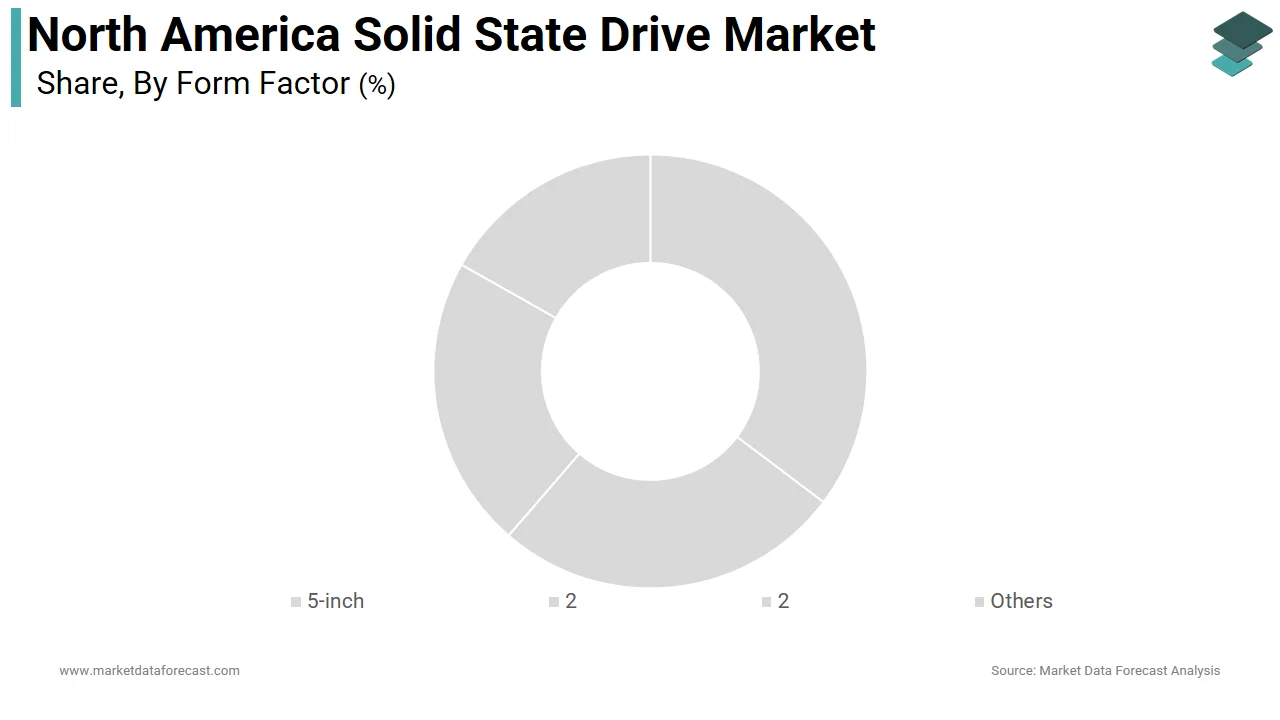
The M.2 SSD segment is lucratively to grow lucratively with a CAGR of 19.6% from 2026 to 2034 with the adoption of PCIe NVMe technology, which allows M.2 SSDs to deliver significantly faster read/write speeds compared to traditional SATA drives. Furthermore, the miniaturization of computing devices has increased the preference for M.2 drives due to their slim profile and lack of external cabling. Devices such as Microsoft Surface tablets, Apple MacBook Airs, and Razer Blade gaming laptops have set a precedent for ultra-thin designs that prioritize M.2-based storage. In addition to consumer applications, enterprise-grade M.2 SSDs are gaining traction in AI servers and edge computing appliances, where fast boot times and low latency are crucial.
By Application Insights
The enterprise and data center application segment dominated the North America solid state drive market by capturing 54.3% of share in 2024, with the massive investment in hyperscale data centers operated by companies such as Amazon Web Services, Microsoft Azure, and Google Cloud. Additionally, financial institutions, healthcare providers, and government agencies are adopting all-flash storage arrays to support mission-critical operations such as transaction processing, patient record management, and cybersecurity analytics. Moreover, the migration from legacy HDD-based storage to SSD-centric architectures continues to accelerate, particularly in sectors requiring high IOPS (Input/Output Operations Per Second). Enterprises are increasingly deploying tiered storage models where SSDs handle frequently accessed data while HDDs manage archival storage.
The client and consumer device application segment is expected to grow with a CAGR of 18.4% in the coming years with the growing consumer preference for faster boot times, improved multitasking performance, and enhanced user experience. According to the Consumer Technology Association, over 65 million PCs were sold in the U.S. in 2023, with more than 80% featuring built-in SSD storage, up from just 30% five years ago. This shift is largely attributed to declining SSD costs and increasing manufacturer emphasis on performance-driven design. Additionally, the rise of gaming and content creation among mainstream users is boosting demand for high-speed storage. The PlayStation 5 and Xbox Series X/S utilize custom NVMe SSDs to enable near-instant load times and seamless game streaming, setting a new standard for entertainment systems. Moreover, digital creators involved in video editing, 3D rendering, and live streaming are opting for SSD-equipped machines to handle large media files efficiently.
By End-User Industry Insights
The cloud service provider industry was accounted in holding 46.5% of the North America solid state drive market share in 2024 with the aggressive infrastructure investments made by major cloud providers such as Amazon Web Services, Microsoft Azure, and Google Cloud. According to Synergy Research Group, these companies spent over $45 billion on new data center construction and expansion projects in North America in 2023 alone, many of which incorporated all-flash storage arrays to improve data access speeds and reduce energy consumption. Additionally, the evolving demands of artificial intelligence and machine learning applications have intensified the need for high-performance storage. AI training models require rapid access to vast datasets, prompting cloud operators to deploy NVMe-based SSDs that offer superior throughput and lower latency. Moreover, data-intensive verticals such as finance, healthcare, and logistics are increasingly relying on cloud-hosted SSD storage for real-time analytics, fraud detection, and supply chain optimization.
The gaming and esports industry is anticipated to grow with a CAGR of 21.3% from 2026 to 2034. This rapid growth is primarily attributed to the increasing integration of high-speed SSDs in next-generation gaming consoles, high-performance PCs, and cloud gaming platforms. The shift toward faster storage solutions in gaming hardware with the launch of the PlayStation 5 and Xbox Series X/S, both of which feature custom NVMe SSDs is fuelling the growth of the segment. According to Sony Interactive Entertainment, the PS5’s SSD enables near-instant load times and seamless world transitions, enhancing gameplay immersion. Additionally, the rise of competitive esports and live-streaming platforms like Twitch and YouTube Gaming has heightened demand for SSD-equipped PCs capable of handling intensive multitasking such as gameplay recording, streaming, and real-time editing. Moreover, cloud gaming services offered by NVIDIA GeForce Now, Xbox Cloud Gaming, and Amazon Luna are leveraging SSD-backed server infrastructures to deliver low-latency experiences to users.
COUNTRY-LEVEL ANALYSIS
United States Solid State Drive Market Insights
The United States was the largest contributor in the North America solid state drive market with 78.3% of the share in 2024, with the massive investment in data center infrastructure by companies such as Amazon, Microsoft, and Google, which collectively operate thousands of servers requiring high-performance SSD storage. Additionally, the consumer electronics sector is a major driver, with SSDs becoming the default storage option in most laptops, desktops, and gaming consoles sold domestically. As per the Consumer Technology Association, over 65 million PCs were sold in the U.S. in 2023, with more than 80% equipped with internal SSDs, which reflects a strong shift away from traditional hard drives. Moreover, the military, aerospace, and industrial automation sectors are integrating SSDs for onboard storage and embedded applications due to their durability and performance advantages.
Canada Solid State Drive Market Insights
Canada was accounted in holding 16.2% of the North America solid state drive market share in 2024, with the expanding cloud infrastructure, digital transformation initiatives in public institutions, and increasing adoption in professional content creation and education sectors. According to Statistics Canada, over 70% of medium to large businesses in the country have migrated to SSD-based storage solutions to enhance data security, improve system responsiveness, and support remote collaboration tools. Additionally, the Canadian government has been actively upgrading its digital infrastructure, which is including national defense networks and smart city projects, which rely on high-speed storage for real-time data processing. Moreover, the education and creative industries are driving consumer-level SSD adoption with universities and digital media studios favoring high-capacity NVMe drives for video editing, animation rendering, and virtual learning environments.
COMPETITIVE LANDSCAPE
The competition in the North America solid state drive market is highly dynamic, characterized by a mix of established semiconductor giants, specialized storage solution providers, and emerging startups vying for dominance through technological differentiation and strategic positioning. While global leaders like Samsung, Western Digital, and Micron dominate due to their extensive R&D capabilities, manufacturing scale, and brand recognition, smaller players are leveraging niche innovations and agile business models to carve out market share.
Market participants face intense pressure to adapt to rapidly evolving storage standards, shifting consumer preferences, and fluctuating component pricing. As NAND flash density improves and PCIe Gen 5 adoption accelerates, vendors must continuously upgrade their product portfolios to remain relevant. At the same time, the growing emphasis on sustainability and environmental compliance is pushing manufacturers to adopt eco-friendly packaging, recyclable materials, and energy-efficient designs.
Additionally, the convergence of SSDs with artificial intelligence, cloud computing, and edge storage applications is redefining competitive dynamics. Companies are not only competing on performance and capacity but also on software integration, system compatibility, and value-added services. This evolving landscape necessitates a balance between innovation, affordability, and long-term customer engagement, which is making the North America SSD market one of the most fiercely contested yet promising sectors in the broader tech industry.
KEY MARKET PLAYERS
Noteworthy Companies dominating the North America solid state drive market profiled in the report are
- Intel Corporation
- Samsung Group
- Western Digital Corporation
- Kingston Technology Corporation
- Micron Technology Inc.
TOP LEADING PLAYERS IN THE MARKET
One of the leading players in the North America solid state drive market is Samsung Electronics, a global pioneer in memory technology. Samsung offers a comprehensive portfolio of consumer and enterprise SSDs, including NVMe and SATA-based models that power laptops, servers, and data centers. The company’s continuous innovation in NAND flash architecture, such as V-NAND and 3D stacking technologies, has set industry benchmarks for performance, endurance, and energy efficiency.
Western Digital Corporation is known for its robust lineup of SSD solutions under the WD Black, SanDisk, and Ultrastar brands. Western Digital serves both consumer and enterprise markets with high-capacity drives tailored for gaming, content creation, and cloud storage. Its strategic investments in vertical integration and advanced controller development have reinforced its competitive edge in the SSD ecosystem.
Micron Technology is also a major contributor to the North America SSD market by offering a diverse range of client and enterprise SSDs optimized for speed, reliability, and scalability. Micron plays a critical role in supplying SSDs for hyperscale data centers, AI infrastructure, and industrial applications. With a strong R&D focus on emerging storage technologies like computational storage and persistent memory, Micron continues to shape the future of the SSD industry.
TOP STRATEGIES USED BY KEY MARKET PARTICIPANTS
Key players in the North America solid state drive market employ several strategic approaches to maintain and strengthen their competitive edge. One of the most significant strategies is continuous technological innovation, where companies invest heavily in research and development to enhance NAND flash architectures, improve controller efficiency, and develop next-generation form factors such as EDSFF and U.2 SSDs tailored for enterprise workloads.
The strategic partnerships and supply chain optimization by allowing manufacturers to secure stable access to raw materials, NAND wafers, and advanced fabrication capabilities is another strategy. These alliances help mitigate production risks, ensure cost-effective scaling, and enable faster time-to-market for new product launches across consumer and enterprise segments.
The market diversification and product segmentation play a vital role in sustaining growth. Leading firms are expanding beyond traditional PC and data center applications into niche areas such as automotive storage, industrial IoT, and edge computing. Companies can capture emerging demand and differentiate themselves in an increasingly competitive landscape by tailoring SSD offerings to specialized use cases.
RECENT MARKET DEVELOPMENTS
- In January 2024, Samsung introduced its latest line of enterprise NVMe SSDs featuring advanced QLC NAND technology, which is designed specifically for large-scale AI training environments and cloud service providers seeking higher storage density without compromising performance.
- In March 2024, Western Digital launched a new series of ultra-durable client SSDs aimed at professional creators and gamers by incorporating enhanced thermal management and adaptive read/write algorithms to optimize performance under intensive workloads.
- In June 2024, Micron announced a strategic collaboration with a leading U.S. cloud provider to co-develop custom SSD solutions optimized for distributed cloud-edge architectures by aiming to reduce latency and improve data processing speeds for mission-critical applications.
- In September 2024, Seagate expanded its presence in the North American SSD market by unveiling a new family of hybrid storage drives that combine SSD-like performance with HDD-level capacity, which is targeting users who require fast boot times and large storage volumes.
- In November 2024, Kingston Technology introduced a modular SSD platform tailored for industrial automation and embedded systems by emphasizing durability, shock resistance, and extended lifecycle support for deployment in rugged environments across North America.
MARKET SEGMENTATION
This North America solid state drive market research report is segmented and sub-segmented into the following categories.
By Form Factor
- 5-inch
- 2
- 2
- Others
By Application
- Enterprise / Data-Center
- Client / Consumer Devices
- Industrial and Automotive
- Others (Edge, Surveillance, IoT)
By Storage Capacity
- Less than 1 TB
- 1 - 2 TB
- Others
By End-user Industry
- Cloud Service Providers
- Gaming and Esports
- Financial Services
- Government and Defense
- Others
By Country
- United States
- Canada
- Mexico
- Rest of North America
Frequently Asked Questions
1. What are the main growth drivers for the North America Solid State Drive Market?
Growth is propelled by increased data center investments, rapid cloud adoption, rising digital transformation, AI and ML workloads, declining SSD prices, and demand for high-speed, reliable storage
2. Which segments dominate the North America Solid State Drive Market?
Enterprise SSDs for data centers, PCIe NVMe drives, and large-capacity consumer SSDs for gaming and content creation lead market growth
3. What key technology trends are shaping the North America Solid State Drive Market?
Trends include the shift to PCIe NVMe SSDs for ultra-fast data transfer, widespread use of 3D NAND and multi-level cell (MLC) flash, capacity increases, and advances in controller technology for performance optimization
4. How are SSDs utilized in different sectors in North America?
SSDs are pervasive in data centers, desktops and laptops, high-end gaming consoles, edge computing, IoT devices, AI solutions, and hybrid cloud infrastructure
5. Who are the leading companies in the North America Solid State Drive Market?
Major vendors include Samsung, Western Digital (SanDisk), Micron Technology, Intel, SK hynix, Seagate Technology, and Kingston Technology
6. How do SSDs compare to HDDs in the North America Solid State Drive Market?
SSDs offer faster speed, better energy efficiency, longer durability, and higher reliability than HDDs, making them preferred for both consumers and enterprises
7. What drives the adoption of SSDs in data centers in North America?
Growing data storage needs, real-time analytics, IoT and AI workloads, and cloud service provider expansion all contribute to surging SSD demand in data centers
8. What role do consumer trends play in the North America Solid State Drive Market?
Rapid gaming console adoption, digital content creation, laptop upgrades, and the shift toward portable computing fuel SSD sales among North American consumers
9. How are regional innovations influencing the North America Solid State Drive Market?
Continuous R&D by US-based firms, robust supply chain operations, and government support for semiconductor manufacturing enhance North American market leadership
10. What challenges face the North America Solid State Drive Market?
Key concerns include cyclic NAND flash supply and pricing, stiff competition, the need for continual technology upgrades, and potential economic slowdowns
Related Reports
Access the study in MULTIPLE FORMATS
Purchase options starting from
$ 2000
Didn’t find what you’re looking for?
TALK TO OUR ANALYST TEAM
Need something within your budget?
NO WORRIES! WE GOT YOU COVERED!
Call us on: +1 888 702 9696 (U.S Toll Free)
Write to us: sales@marketdataforecast.com